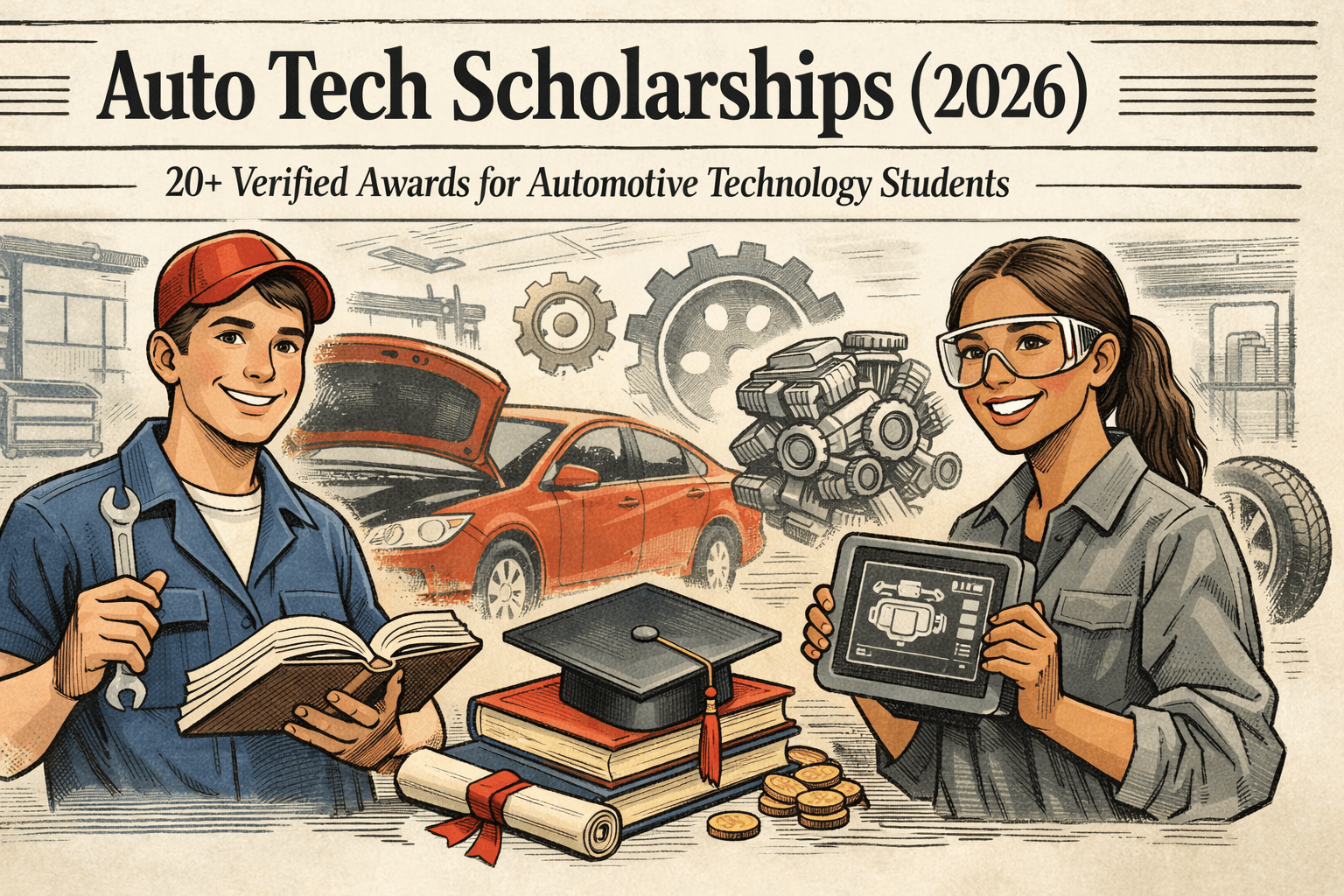
Auto Tech Scholarships (2026) — 20+ Verified Awards for Automotive Technology Students
Below are active or recurring scholarships for automotive technology students (mechanical, diagnostics, collision, refinishing, aftermarket). Sorted by calendar month (earliest deadlines first).
January
DEWALT Trades Scholarship
💥 Why It Slaps: A well-known trades award that includes automotive/mechanical programs at two-year and vo-tech schools.
💰 Amount: Typically around $5,000 (varies by year).
⏰ Deadline: Mid-January (last cycle closed Jan 16, 2025; next cycle expected Jan 2026).
🔗 Apply/info: https://scholarshipamerica.org/scholarship/dewalttrade/
Women’s Industry Network (WIN) Student Scholarships (Collision)
💥 Why It Slaps: Tailored for future collision repair/refinish pros; often includes tool/equipment support.
💰 Amount: Varies.
⏰ Deadline: January (annual; cycle opens in fall).
🔗 Apply/info: https://thewomensindustrynetwork.site-ym.com/page/Scholarship
March
SEMA Memorial Scholarship (Specialty/Performance/Aftermarket)
💥 Why It Slaps: Flagship aftermarket award; great fit for performance, custom, and specialty paths.
💰 Amount: Varies (up to several thousand).
⏰ Deadline: March 1 (annual).
🔗 Apply/info: https://sites.sema.org/scholarships
AutomotiveScholarships.com (University of the Aftermarket Foundation — UAF)
💥 Why It Slaps: One application considers you for dozens of aftermarket partner scholarships (Gates, Standard Motor Products, Federated, Pronto, etc.).
💰 Amount: Varies ($1,000–$5,000+ common).
⏰ Deadline: March 31, 2026.
🔗 Apply/info: https://automotivescholarships.com/
Mitchell 1 Automotive Technology Scholarship (via UAF)
💥 Why It Slaps: Auto tech-specific; winner also receives travel to the NACAT conference.
💰 Amount: $2,500 + $500 travel stipend + conference trip.
⏰ Deadline: March 31, 2026.
🔗 Apply/info: https://mitchell1.com/shopconnection/applications-for-the-mitchell-1-automotive-technology-scholarship-are-still-open/— ✅ Link verified September 23, 2025.
Standard Motor Products Scholarships (via UAF)
💥 Why It Slaps: Multiple awards for future technicians & aftermarket careers.
💰 Amount: Typically $1,000–$2,500 (varies by year).
⏰ Deadline: March 31, 2026.
🔗 Apply/info: https://automotivescholarships.com/scholarships/standard-motor
Gates Corporation Scholarships (via UAF)
💥 Why It Slaps: Recognizes aspiring techs (including veteran-focused awards).
💰 Amount: Typically $1,000–$2,500 (varies by year).
⏰ Deadline: March 31, 2026.
🔗 Apply/info: https://automotivescholarships.com/scholarships/gates
Auto Value Scholarship (Aftermarket Auto Parts Alliance)
💥 Why It Slaps: Alliance network award; great if you or family are connected to Auto Value/Bumper to Bumper.
💰 Amount: Varies.
⏰ Deadline: March 31 (annual).
🔗 Apply/info: https://automotivescholarships.com/scholarships/auto-value-scholarship
Bumper to Bumper Scholarship (Alliance Network)
💥 Why It Slaps: Sister program to Auto Value; same UAF application + brief group form.
💰 Amount: Varies.
⏰ Deadline: March 31 (annual).
🔗 Apply/info: https://automotivescholarships.com/scholarships/bumper-to-bumper
Women in Auto Care Scholarships (Auto Care Association via UAF)
💥 Why It Slaps: Robust support for women pursuing auto tech/aftermarket pathways.
💰 Amount: Varies ($1,000–$5,000+ common).
⏰ Deadline: March 31, 2026 (through AutomotiveScholarships.com).
🔗 Apply/info: https://automotivescholarships.com/scholarships/women-in-auto-care
AASP-MN (Alliance of Automotive Service Providers of Minnesota) Scholarships
💥 Why It Slaps: Directly supports MN students in ASE-accredited auto service/collision programs; can be used for tuition or tools.
💰 Amount: $500–$2,000.
⏰ Deadline: March 31 (annual).
🔗 Apply/info: https://automotivescholarships.com/scholarships/alliance
ARA Scholarship Foundation (Automotive Recyclers Association)
💥 Why It Slaps: Supports students interested in auto recycling & service industry careers (including tech tracks).
💰 Amount: Varies.
⏰ Deadline: March (annual; check current cycle).
🔗 Apply/info: https://www.a-r-a.org/category/scholarship/
Collision Repair Education Foundation (CREF) — Student Scholarships (Collision/Refinish)
💥 Why It Slaps: Collision-specific tuition & tool awards; spring and fall windows.
💰 Amount: Varies; scholarships & tool grants.
⏰ Deadline: Spring window typically late Feb–Mar; fall window typically Aug–Sept.
🔗 Apply/info: https://www.collisionrepaireducationfoundation.org/students-scholarships/
Automotive Hall of Fame Scholarships
💥 Why It Slaps: Prestigious national recognition for future auto industry professionals (tech, engineering, business).
💰 Amount: Varies.
⏰ Deadline: Spring (announced annually).
🔗 Apply/info: https://www.automotivehalloffame.org/education-resources/scholarships/
April
mikeroweWORKS Work Ethic Scholarship
💥 Why It Slaps: Big national trades award; frequently supports automotive/diesel students who show “work ethic” (S.W.E.A.T. pledge).
💰 Amount: Varies (multiple awards).
⏰ Deadline: Typically April (last cycle closed April 17, 2025).
🔗 Apply/info: https://mikeroweworks.org/scholarship/
MWACA / Technicians of Tomorrow Educational Foundation (TTEF) Scholarships
💥 Why It Slaps: Regional auto-service community support; great for students in the Midwest Auto Care Alliance footprint.
💰 Amount: Varies.
⏰ Deadline: April 1 – May 31 (annual window).
🔗 Apply/info: https://mwaca.org/awards/ttef/
NAPA Network Scholarships (TechForce — Local Markets)
💥 Why It Slaps: NAPA’s nationwide network funds local technician scholarships (many markets post a late-April deadline).
💰 Amount: Often ~$2,500 (varies by market).
⏰ Deadline: Varies by location (many announce by April).
🔗 Apply/info: https://techforce.org/techforce-napa-network-scholarship/
June (and Biannual)
AmericanMuscle Automotive Scholarships
💥 Why It Slaps: Two cycles per year for automotive-themed majors (auto tech programs at accredited technical institutes qualify).
💰 Amount: $2,500 each (two awards per year).
⏰ Deadline: June 15 (Fall awards) & October 15 (Spring awards).
🔗 Apply/info: https://www.americanmuscle.com/scholarships.html
Rolling / Multiple Windows (Apply Any Time or Repeating Cycles)
TechForce Foundation — Scholarships & Grants (General Portal)
💥 Why It Slaps: Central portal for many brand-funded auto/diesel/collision scholarships, emergency grants, tool funds, and more; rolling opportunities year-round.
💰 Amount: Varies.
⏰ Deadline: Rolling (multiple cycles year-round).
🔗 Apply/info: https://techforce.org/
NAPA / WD-40 Brand Scholarships (TechForce)
💥 Why It Slaps: Joint initiative funding technician students in auto/collision/diesel; simple application through TechForce.
💰 Amount: Varies.
⏰ Deadline: Rolling; cohorts announced periodically.
🔗 Apply/info: https://techforce.org/napa-wd40brand-scholarships/
Carlyle Tools MAX IMPACT Scholarship (TechForce)
💥 Why It Slaps: Monthly awards for standout tech students plus a professional-grade toolbox — perfect for ramping up your starter kit.
💰 Amount: $2,500 + Carlyle toolbox (awarded monthly).
⏰ Deadline: Rolling (monthly selections).
🔗 Apply/info: https://techforce.org/carlyle/
Ford Auto Tech Scholarship (TechForce / New Ford Tech)
💥 Why It Slaps: Supports students headed toward dealership technician careers (Ford/Lincoln), often in partnership with local dealers/ASSET programs.
💰 Amount: Varies.
⏰ Deadline: Rolling by region; waves announced during the year.
🔗 Apply/info: https://techforce.org/fordphilanthropy/
NTHS x TechForce Scholarships (for NTHS Members in Skilled Trades)
💥 Why It Slaps: Two annual awards for National Technical Honor Society members pursuing automotive and other technician programs — application through TechForce.
💰 Amount: $2,500 (two awards annually).
⏰ Deadline: Annual (through TechForce; watch portal).
🔗 Apply/info: https://techforce.org/news-release-techforce-foundation-nths-scholarship-collaboration/
Auto Tech Scholarships and the U.S. Technician Pipeline (2026)
Workforce, cost-of-entry, and scholarship-market analysis for Automotive Technology students
Prepared for ScholarshipsAndGrants.us — Auto Tech Scholarships hub
Automotive service technicians and mechanics sit at the center of U.S. mobility, household economics, and small-business productivity. Yet the technician pipeline is structurally constrained by (1) a persistent replacement gap, (2) rising technical complexity (electronics, ADAS, hybrids/EVs), and (3) unusually “front-loaded” training costs that include not just tuition but also tools, certification fees, and transportation. National labor-market data indicate a large installed base of employment (about 805,600 jobs in 2024), median annual pay of $49,670 (May 2024), and roughly 70,000 openings per year driven heavily by replacement needs. At the same time, industry estimates highlight a recurring pipeline shortfall: ~39,000 new service technicians graduate annually while ~76,000 are needed to replace retirements and meet demand—an estimated ~37,000 annual gap.
This paper maps the scholarship ecosystem that aims to close this gap—ranging from national nonprofits (e.g., TechForce) to trade-association funds (e.g., SEMA), and sector-wide scholarship aggregators (e.g., University of the Aftermarket Foundation). It also synthesizes evidence from higher-education finance and community-college interventions showing that targeted, well-timed aid—especially when paired with advising and other supports—can improve persistence and completion. The central conclusion: Auto tech scholarships are most effective when they treat technician training as a “total cost of entry” problem, funding tools, fees, and transportation alongside tuition, and when they connect recipients to structured work-based learning (co-ops/apprenticeships) that converts training into earnings quickly.
1) Why Auto Tech Scholarships matter now
1.1 A replacement-driven labor market
The U.S. auto repair workforce is not primarily constrained by lack of consumer need; it’s constrained by the rate at which new technicians enter and remain in the field. The Bureau of Labor Statistics (BLS) projects 4% employment growth from 2024–2034 and about 70,000 openings per year, with many openings tied to retirements and occupational exits rather than net new job creation.
Industry-facing data underscores the same point more bluntly: the National Automobile Dealers Association (NADA) notes that the retail auto and truck sector “continues to face a shortage,” estimating ~39,000 graduates from U.S. career technical colleges/training programs each year versus a need to replace nearly 76,000 technicians annually—~37,000 short.
Implication: Scholarships are not just “nice-to-have.” They function as capacity-expansion instruments for a labor market with recurring replacement pressure.
1.2 Technology transition raises the skill floor
Modern vehicles compress multiple high-skill domains into a single job family: electrical/electronic diagnostics, networked modules, sensor calibration, emissions systems, and increasingly hybrid/EV powertrains and advanced driver-assistance systems (ADAS). The credentialing infrastructure reflects this shift. ASE offers specialty certifications such as L3 (Light Duty Hybrid/Electric Vehicle) and L4 (ADAS Specialist)—signals that “general repair” is fragmenting into stackable specializations.
Implication: The training pathway increasingly resembles a ladder (foundational → specialization), and scholarships that support stackable credentials can accelerate wage progression and retention.
2) The real “price tag” of becoming an auto technician
Auto tech is often described as “affordable compared to a four-year degree,” but that framing can be misleading. What matters for many students is not the sticker price of tuition alone, but the cash-flow timing and non-tuition costs that must be paid early.
2.1 Tuition and program structure (certificate vs AAS)
Automotive technology programs commonly appear as certificates (often faster, job-entry focused) or Associate of Applied Science (AAS) degrees (often broader, more credits, sometimes with co-op). Tuition varies widely by geography and institution type. One consumer-facing aid organization summarizes certificate tuition and fees commonly ranging from $6,000 to $20,000 depending on program length and specialization.
2.2 Tools: the signature cost barrier
Tooling is one of the defining financial hurdles in automotive training and early career stages. Some programs explicitly publish expected tool budgets; for example, one community college program lists $1,800–$2,400 as an “anticipated” required tool cost, separate from tuition/fees.
Why this matters for scholarships: Traditional tuition-only awards can leave the binding constraint untouched—students may still be unable to start labs, internships, or entry-level jobs without tool access.
2.3 Certification and exam fees (often overlooked)
Credentials matter in hiring and wage signaling, and they also cost money. ASE’s current pricing structure includes a $34 registration fee per order, with tests commonly $62 each, and certain advanced tests (including L3/L4) priced at $124 each.
Even when fees look “manageable,” they become meaningful when bundled with tuition, tools, commuting, and lost wages from reduced work hours during training.
3) A typology of Auto Tech scholarships: who funds what, and why
The auto tech scholarship ecosystem is unusually industry-connected. Many funds are built not just for altruism, but as workforce development—often tied to brand ecosystems, aftermarket networks, or collision/repair pipelines.
3.1 National nonprofits and broad-access funds
TechForce Foundation is among the most visible national players focused on technician education. In 2025, TechForce announced it will award $6 million in scholarships and grants, positioning its aid as a lever for financially disadvantaged students entering technician careers. TechForce has also reported cumulative scale in prior years (e.g., millions distributed and large student reach), reflecting a “volume” strategy rather than a small elite-award model.
Design takeaway: Broad-access funds can reduce friction at the entry point, especially when awards cover more than tuition (tools, transportation, testing).
3.2 Trade-association funds (aftermarket and enthusiast-to-career pipelines)
SEMA scholarships are explicitly designed to convert passion for automotive culture into formal training and careers. SEMA’s scholarship rules emphasize eligibility tied to postsecondary enrollment in the U.S. or Canada and automotive career intent, with awards commonly described as up to $5,000.
Design takeaway: These scholarships often reward narrative, engagement, and career alignment—important for applicants who can demonstrate hands-on work, builds, clubs, or community involvement.
3.3 Aggregated “single application” scholarship platforms
A major structural innovation in this space is the use of single-application systems that match students to many scholarships at once—reducing transaction costs that disproportionately harm first-generation and working students.
-
The University of the Aftermarket Foundation (UAF) announced a record $900,000+ in scholarships for the 2026–27 academic year, emphasizing a centralized application model.
-
The Auto Care Association / Auto Care Foundation scholarship portal similarly describes 200+ scholarships (often $1,000–$5,000) with one application and a typical spring deadline rhythm.
Design takeaway: From an outcomes perspective, “one application → many awards” is not just convenient; it is an equity mechanism that reduces application burden and increases the probability of receiving at least some aid.
3.4 Collision and specialized repair funds
While “auto tech” students often focus on mechanical/electrical service, adjacent specialties—collision repair, refinish, heavy-duty/diesel—frequently share classrooms, facilities, and local labor markets. The Collision Repair Education Foundation (CREF) reports awarding over $9.1 million since 2009, illustrating long-run investment in tools, education support, and industry partnerships.
3.5 OEM-linked scholarships (brand ecosystems)
Manufacturer-aligned programs can function as “talent pipelines” into dealership networks. For example, Ford’s ASSET ecosystem includes a tuition scholarship listed at $2,500 for students already enrolled in an accredited Ford ASSET program.
Design takeaway: OEM-linked scholarships can be powerful when paired with structured work experience, mentoring, and clear job placement channels—reducing uncertainty for students.
4) What the best Auto Tech scholarships fund: a “Total Cost of Entry” model
A practical way to evaluate scholarship effectiveness is to ask: Does the award pay for the constraint that would otherwise stop the student from starting or finishing? In auto tech, that constraint is often not tuition. It is the combined burden of tools + transport + fees + time.
4.1 Total Cost of Entry (TCE) components
A TCE framework typically includes:
-
Direct education costs: tuition, fees, books.
-
Capital equipment: required tool sets and safety gear (often $1,800–$2,400+ just to begin).
-
Credentialing: ASE registration and test fees.
-
Mobility/commuting: gas, repairs, insurance, transit—especially relevant because many students commute to labs and shops.
-
Income disruption: reduced work hours during intensive lab blocks or internships.
Scholarship design implication: Awards that include tool stipends, exam vouchers, or transportation support may produce larger completion gains per dollar than tuition-only awards when tuition is already partially covered by Pell/state aid.
5) Equity and participation: who gets to become a technician
5.1 Underrepresentation and the recruitment frontier
Auto tech remains heavily male-dominated, and the underrepresentation of women is a widely documented challenge in dealership service environments. A sector analysis by Ducker Carlisle reports women as only ~1.2% of dealer technicians, highlighting the scale of the recruitment opportunity.
Why scholarships matter here: Targeted awards can lower entry costs, but retention depends on climate, mentorship, and career-path transparency. Scholarships can be paired with cohort models, women-in-industry networks, and paid work-based learning to improve persistence.
5.2 Local labor markets: scholarships as place-based policy
Because repair work is local and cannot be offshored, scholarships can be designed as place-based workforce policy—especially in regions facing long repair backlogs or rural service deserts. NADA’s national shortage estimate suggests many communities may experience structural service capacity constraints unless pipelines expand.
6) What research says about financial aid and completion (and why it applies to Auto Tech)
There is limited peer-reviewed causal research specifically on “auto tech scholarships” as a category, but there is strong evidence on adjacent mechanisms in community college and workforce training:
-
Incentivized and structured scholarship models can increase academic momentum. MDRC’s Performance-Based Scholarship Demonstration tested scholarships contingent on enrollment and progress, reflecting a broader principle: aid tied to clear milestones can change behavior when students face financial stress.
-
Comprehensive support models that combine financial help with advising can dramatically increase completion. MDRC’s randomized evaluation of CUNY’s ASAP (and its replications) found the program nearly doubled three-year graduation rates in some settings, emphasizing that dollars are most effective when paired with structure and student services.
-
Emergency aid alone shows mixed effects; rigorous evidence suggests that small grants may not move outcomes without complementary supports, though they can help students weather shocks.
Translation to auto tech: If scholarships only cover tuition while students still lack tools, transport, or coaching into apprenticeships, gains may be limited. The highest-impact designs look like “scholarship + wraparound + job linkage.”
7) Strategic recommendations
7.1 For students (how to maximize scholarship ROI)
-
Apply through “single-application” portals first (higher chance of at least one match): UAF and Auto Care-style multi-scholarship platforms reduce time cost and increase match probability.
-
Build evidence of hands-on aptitude: labs, projects, shop hours, small engine work, robotics, or documented builds can substitute for limited formal experience in scholarship review.
-
Budget for tools early and prioritize scholarships that explicitly allow tools/testing/transport as eligible expenses (many do, but you must confirm).
7.2 For schools and training providers
-
Publish a transparent Total Cost of Entry sheet (tuition + fees + tools + exams) so students can target scholarships to real constraints.
-
Co-design scholarships with local employers so awards link directly to paid internships/co-ops. This increases persistence by turning training into income sooner.
-
Stack credentials intentionally (core skills → ASE A-series → hybrid/EV/ADAS specialty) to keep learners progressing while employed.
7.3 For scholarship providers, donors, and industry partners
-
Fund the binding constraint: tools and transportation can be higher-leverage than tuition when Pell/state aid covers baseline instruction.
-
Pair dollars with structure: advising, milestone-based disbursement, paid work placements, and mentoring replicate the “comprehensive support” logic behind proven completion gains.
-
Target recruitment gaps (women, rural students, career changers) and measure outcomes (completion, ASE pass rates, placement, 12-month retention).
Conclusion
Auto tech scholarships are best understood as workforce-capacity investments in a replacement-driven labor market. National data show strong ongoing demand (employment base, steady growth, and large annual openings). Industry estimates add urgency by describing a persistent graduation-to-need shortfall. The central challenge is not simply paying for school—it is overcoming a Total Cost of Entry that uniquely includes tools and certification expenses alongside tuition.
The scholarship ecosystem is robust and diversified—national nonprofits (TechForce), trade associations (SEMA), aggregated scholarship platforms (UAF/Auto Care), collision-specific funds (CREF), and OEM-aligned pipelines (e.g., Ford ASSET). Evidence from community college finance research suggests the most effective aid is paired with structure and supports (advising, milestones, work-based learning).
For ScholarshipsAndGrants.us readers, the practical bottom line is clear: the best auto tech scholarship strategy targets programs that (1) reduce tool-and-fee barriers, (2) minimize application friction via centralized applications, and (3) connect awards to paid learning and long-term career ladders—including hybrid/EV and ADAS specializations that reflect the industry’s technological trajectory.
Selected references (public sources)
- Bureau of Labor Statistics, Automotive Service Technicians and Mechanics (OOH).
- National Automobile Dealers Association (NADA), Service Technicians issue brief.
- TechForce Foundation scholarship and impact announcements.
- University of the Aftermarket Foundation, record scholarship award announcements.
- SEMA scholarship eligibility and award information.
- ASE testing fees and registration details.
- Collision Repair Education Foundation scholarship impact summary.
- MDRC research on performance-based scholarships and ASAP completion effects.
Monthly Update (Jan 2026)
We re-verified every link and refreshed key dates for the 2025–26 cycle. The UAF/AutomotiveScholarships.com portal is open for the 2026 application year with a hard deadline of March 31, 2026. TechForce has multiple rolling partner programs live (NAPA/WD-40, Carlyle Tools MAX IMPACT, Ford Auto Tech). For spring-season awards like SEMA and many UAF partner scholarships (Gates, SMP, Auto Value/Bumper to Bumper), plan to finalize applications by March 1–31.
Pro tips to win auto tech scholarships
- Apply early through AutomotiveScholarships.com to unlock many partner awards with one application.
- Join TechForce (free) and complete the general app — you’ll get matched to rolling awards and brand programs.
- Keep a clean, readable resume, add ASE Student Certifications, and upload instructor recommendations and tool lists (for tool-grant-friendly programs).
- Track two cycles where applicable (e.g., AmericanMuscle: Jun 15 & Oct 15).
FAQs — Auto Tech Scholarships (read this before you apply)
1) Who actually qualifies for “auto tech” scholarships?
Most programs accept students in accredited automotive technology, maintenance & light repair (MLR), drivability/diagnostics, collision repair & refinish, aftermarket/performance, motorsports service, EV/Hybrid, ADAS calibration, and automotive recycling. Check each donor’s definition of “automotive”; some include diesel/heavy-duty and small engine, others don’t.
2) Do certificate and diploma programs count, or only associate degrees?
Certificates and diplomas at accredited tech schools usually qualify. Many donors accept AAS/AS and shorter programs if they’re credit-bearing and offered by an accredited institution. Read the “Eligible Programs/Schools” section on the official page.
3) High school seniors vs. current students—who can apply?
Both. Seniors entering an auto program next fall often qualify if they submit proof of acceptance. Current students typically submit an unofficial transcript plus enrollment verification.
4) Do I need ASE Education Foundation (formerly NATEF) accreditation?
A lot of awards prefer (or require) programs accredited by the ASE Education Foundation. Not universal, but accreditation helps you stand out and proves program quality. If your school isn’t accredited, emphasize instructor credentials, curriculum, and shop hours.
5) Do I need ASE Student Certification to be competitive?
Not always required, but it’s a strong plus—especially G1 (Maintenance & Light Repair) or other student tests. It shows baseline knowledge and commitment.
6) Can I use scholarship money for tools?
Often yes—but rules vary. Many donors allow tuition, fees, books, and required tools. Some provide tool-only awards or grants. If tools are allowed, upload a tool list/estimate from your program.
7) Are online or hybrid programs eligible?
Some awards require hands-on training; others allow hybrid if it includes lab/shop. 100% online programs are often excluded for auto tech. When in doubt, email the donor.
8) Do collision/refinish students have their own scholarships?
Yes. Collision & refinish awards are common (and sometimes separate) and often include tool grants. If your focus is body/paint/estimating, look for collision-specific foundations and spring/fall cycles.
9) Typical GPA and “financial need” requirements?
GPA minimums cluster around 2.0–2.5 (occasionally 3.0). “Financial need” may mean a short statement or FAFSA-based need—requirements vary. Even “merit” awards often ask for a budget/need explanation.
10) Can undocumented or DACA students apply?
Some private foundations are open to DACA/undocumented students; others require U.S. citizenship or permanent residency. Always check the donor’s eligibility line by line.
11) Can I stack scholarships with Pell Grants and school aid?
Usually yes. Awards can reduce unmet need or out-of-pocket costs. Your college may adjust your package if you exceed cost of attendance, but stacking multiple private scholarships is common.
12) What documents should I prep early?
- Unofficial transcript (HS/college)
- Proof of enrollment/acceptance (or program intent)
- Short resume (shop hours, certs, competitions)
- One strong recommendation (instructor/employer)
- Tool list and cost estimates (if tools are covered)
- 1–2 essays you can adapt
13) How do I get a great recommendation?
Ask someone who has seen you wrench: instructor, shop foreman, or service manager. Give them: your resume, draft essay, tool list, and a bullet list of achievements (attendance, safety habits, teamwork, diagnostics wins).
14) What makes an auto-tech essay stand out?
Show your diagnostic thinking and shop discipline. Concrete beats generic: describe a tricky DTC, your step-by-step tests, scope captures, TSB research, torque specs, safety checks, what you learned, and how you’ll grow (EV/ADAS training, ASE pathway). Tie your goals to the donor’s mission (aftermarket, collision, dealership, recycling).
15) How do selection committees score applications?
Common rubric buckets: commitment to the trade, program fit, hands-on experience (hours, internships, SkillsUSA), academics/attendance, financial need, and clarity of goals. Clean, error-free submissions matter.
16) Any portfolio tips for tech students?
Create a private folder with: before/after photos (blur plates/VINs), scan reports, scope screenshots with annotations, wiring-diagram markups, paint/refinish job sheets, and brief narratives of your role and results.
17) I missed a spring deadline—am I done for the year?
No. Many opportunities are rolling or have fall windows (collision/tool grants, brand-funded awards, and biannual programs). Keep your packet ready year-round.
18) How do I avoid scholarship scams?
Red flags: application fees, vague eligibility, no named organization or contact, no clear past winners, or “guaranteed” awards. Legit programs name the donor, show past recipients, list detailed criteria, and never charge to apply.
19) When are the biggest auto-tech deadlines?
Plan around March 1–31 (many national/aftermarket awards), late winter–spring (SEMA, collision, regional associations), June & October (some biannual programs), and rolling tool/brand awards throughout the year.
20) What’s the fastest way to uncover more niche awards?
Use one-to-many portals for the aftermarket (single app for dozens of partner awards) and create a profile with major technician-support nonprofits. Join your school’s program listserv, and check regional trade associations and local parts suppliers.
21) Any quick checklist before I hit submit?
- ✅ Name on all files matches your app
- ✅ Essay customized to donor’s mission
- ✅ Transcript & enrollment proof attached
- ✅ Recommendation requested early
- ✅ Tool list (if relevant) included
- ✅ Spelling/grammar check + PDF locks formatting
22) Can you make an ICS of these deadlines for my team?
Yes—say the word and I’ll generate a clean .ics calendar (with reminders) and a CSV tracker you can import into Sheets/Notion.