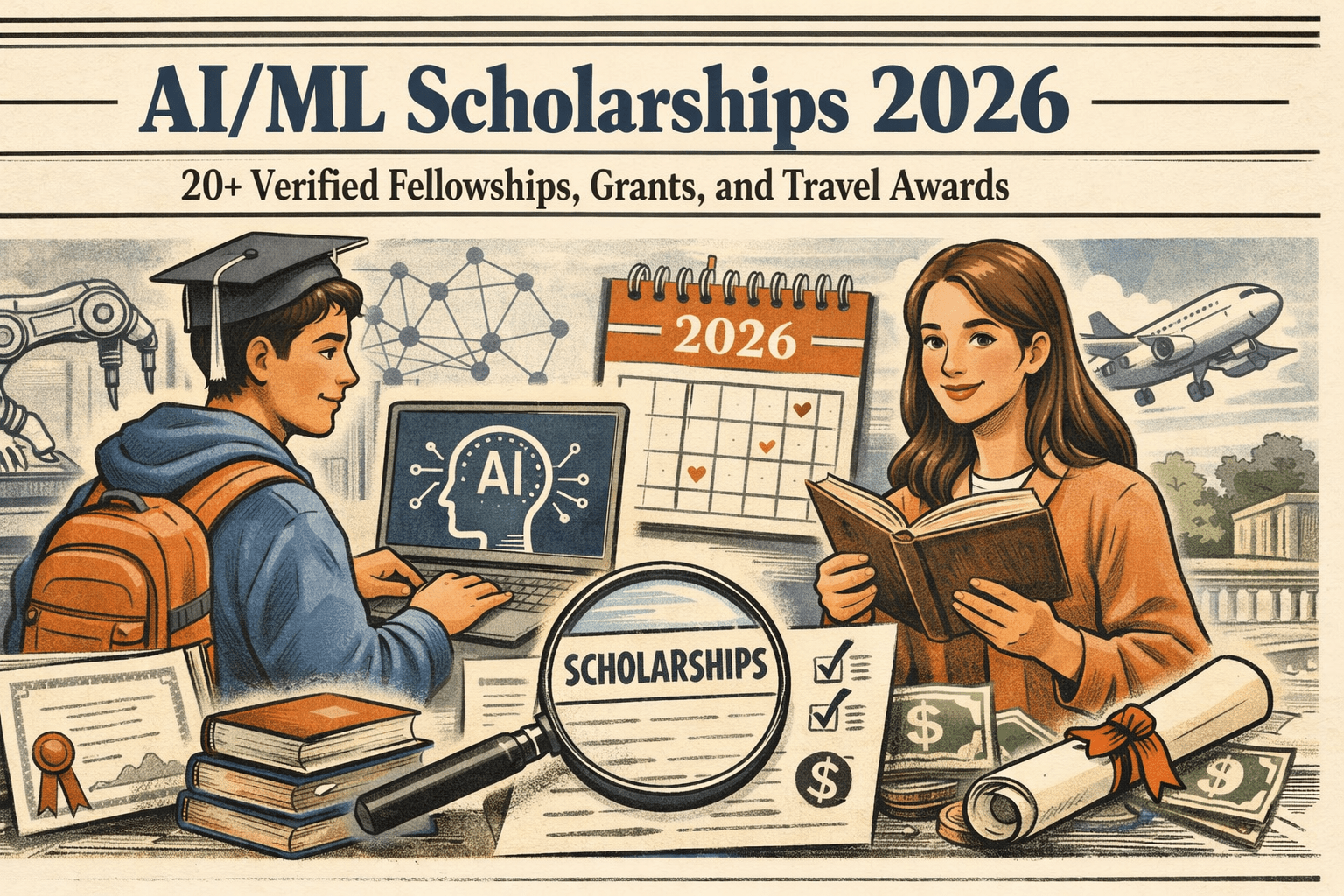
AI/ML Scholarships 2026 — 20+ Verified Fellowships, Grants, and Travel Awards (Sorted by Deadline)
Verified list of 20+ AI & Machine Learning scholarships, fellowships, residencies, and travel grants for undergrads, master’s, and PhD students. Official links only, sorted by deadline from January onward.
AI/ML Scholarships & Fellowships
January
DOE Computational Science Graduate Fellowship (CSGF)
💥 Why It Slaps: Flagship PhD fellowship supporting AI/ML-heavy HPC research with stipend, full tuition, practicum at a DOE lab.
💰 Amount: $45,000/year stipend + full tuition & fees + allowances (up to 4 years).
⏰ Deadline: January 16 (annual; 2025 cycle closed).
🔗 Apply/info: https://www.krellinst.org/csgf/how-apply
UBC Data Science for Social Good (DSSG) Fellowship (Vancouver, BC)
💥 Why It Slaps: Paid full-time summer ML/AI for social impact with public sector partners; ideal for applied AI portfolios.
💰 Amount: Stipend ~CA$3,200/month (2025).
⏰ Deadline: January 31 (annual; 2025 shown).
🔗 Apply/info: https://dsi.ubc.ca/data-science-social-good
March
IEEE ICMLCN 2025 Student Travel Grants (AI/ML in Communications)
💥 Why It Slaps: Helps students present ML-in-networks research; international travel support available.
💰 Amount: Up to $700 (varies by region).
⏰ Deadline: March 1 (for 2025 edition).
🔗 Apply/info: https://icmlcn2025.ieee-icmlcn.org/registration/travel-grants
April
ACM SIGHPC Computational & Data Science Fellowships (Grad)
💥 Why It Slaps: Competitive CS/data/ML fellowships; portable across institutions; diversity focus.
💰 Amount: $20,000 per year (up to 2 years).
⏰ Deadline: April 30 (annual).
🔗 Apply/info: https://www.sighpc.org/opportunities/fellowships
May
ICLR Financial Assistance (Conference Travel/Registration)
💥 Why It Slaps: Support to attend the top deep learning venue; can include registration and limited travel/hotel support.
💰 Amount: Registration covered; limited travel/hotel support (case-by-case).
⏰ Deadline: Early May (e.g., May 4, 2025 AoE; annual).
🔗 Apply/info: https://iclr.cc/Conferences/2025/FinancialAssistance
ICML Financial Aid (Conference Travel/Registration)
💥 Why It Slaps: Financial aid for the premier ML conference; helps offset travel/registration for students and under-represented folks.
💰 Amount: Registration waivers + travel/hotel support (case-by-case).
⏰ Deadline: Late May (e.g., May 30, 2025; annual).
🔗 Apply/info: https://icml.cc/Conferences/2025/FinancialAid
Google PhD Fellowship (ML/AI areas included) — US/Canada
💥 Why It Slaps: Full funding + Google Research mentor; ML foundation & application areas eligible.
💰 Amount: Tuition & fees + stipend (varies by region).
⏰ Deadline: Typically mid-May via university nomination; 2025 applications closed (decisions by Nov 2025).
🔗 Apply/info: https://research.google/programs-and-events/phd-fellowship/
July
ACM-W Scholarships for Attendance at Research Conferences (incl. AI/ML)
💥 Why It Slaps: Multiple rounds per year to fund student travel to CS/AI venues; undergrad & grad.
💰 Amount: Varies (travel/registration support).
⏰ Deadline: Multiple cycles annually (see schedule page; includes mid-year rounds).
🔗 Apply/info: https://women.acm.org/acm-w-scholarship-for-attendance-of-research-conferences-program/
September
NVIDIA Graduate Fellowship (AI/Accelerated Computing, PhD)
💥 Why It Slaps: Prestigious PhD award + mandatory NVIDIA internship; ideal for cutting-edge AI/ML systems research.
💰 Amount: Up to $60,000 + summer internship.
⏰ Deadline: Typically mid-September (2025 submissions closed).
🔗 Apply/info: https://research.nvidia.com/graduate-fellowships
Apple Scholars in AI/ML (PhD — by nomination)
💥 Why It Slaps: Apple-backed recognition & support for standout PhD researchers in AI/ML; university-nomination only.
💰 Amount: Unrestricted funding + mentorship (varies by institution).
⏰ Deadline: Early September typical (e.g., Duke 2025 nomination due Sep 9; internal campus deadlines earlier).
🔗 Apply/info: https://machinelearning.apple.com/updates/apple-scholars-aiml-2025
Citadel NeurIPS Travel Grant (Students/Recent Grads)
💥 Why It Slaps: Concrete travel aid to the top AI conference; fast application.
💰 Amount: Up to $2,000 travel grant.
⏰ Deadline: September 26, 2025 (for NeurIPS 2025).
🔗 Apply/info: https://www.citadel.com/careers/programs-and-events/conference-travel-grant/
October
NeurIPS Financial Assistance (Conference Travel/Registration)
💥 Why It Slaps: Registration coverage for all recipients; limited hotel/travel support for in-person awards.
💰 Amount: Registration + limited travel/hotel support (case-by-case).
⏰ Deadline: October 1, 2025 (AoE; annual).
🔗 Apply/info: https://neurips.cc/Conferences/2025/FinancialAssistance
NSF Graduate Research Fellowship Program — CISE (AI/ML eligible)
💥 Why It Slaps: Flagship US fellowship; stipend + cost-of-education; perfect for ML/AI research plans.
💰 Amount: Stipend + cost-of-education allowance (per NSF; see program page).
⏰ Deadline: October 28, 2025 (CISE); other fields Oct 27–30, 2025.
🔗 Apply/info: https://www.nsf.gov/funding/opportunities/grfp-nsf-graduate-research-fellowship-program
November
AAAI-26 Student Scholar & Volunteer Program (AAAI Conference)
💥 Why It Slaps: Fee reductions/waivers + service role; great way to attend a core AI venue on a budget.
💰 Amount: Registration support; limited travel aid may be available (varies by year).
⏰ Deadline: November 9–14, 2025 application window (for AAAI-26).
🔗 Apply/info: https://aaai.org/conference/aaai/aaai-26/student-scholar-volunteer-program/
December
DoD SMART Scholarship (AI/ML-related majors eligible)
💥 Why It Slaps: Full tuition + stipend + paid DoD internships + guaranteed civilian employment; CS/Data/AI aligned fields included.
💰 Amount: Full tuition + $30,000–$46,000 annual stipend + allowances.
⏰ Deadline: Annually the first Fri in December (app window opens Aug 1).
🔗 Apply/info: https://www.smartscholarship.org/smart/en
Rolling / TBA (Check Often — Cycles Reopen Annually)
Apple AIML Residency (12-Month, Paid, Full-Time)
💥 Why It Slaps: Break into applied AI/ML at Apple; mentored rotations and production impact.
💰 Amount: Paid full-time (salary varies).
⏰ Deadline: Varies by posting; typically announced in the fall.
🔗 Apply/info: https://machinelearning.apple.com/updates/aiml-residency-program-application-2025
IBM PhD Fellowship (AI among focus areas)
💥 Why It Slaps: Industry-backed funding and mentorship for exceptional PhD students (AI/Hybrid Cloud/Security/Quantum).
💰 Amount: Varies by region/year.
⏰ Deadline: Typically mid-July to late August (e.g., 2024 nominations Jul 15–Aug 30); 2025 cycle TBA.
🔗 Apply/info: https://research.ibm.com/university/awards/fellowships.html
Qualcomm Innovation Fellowship (Region-Specific; AI Topics Included)
💥 Why It Slaps: Team-based industry fellowship with funding + Qualcomm mentorship for ML/AI projects.
💰 Amount: Varies by region (e.g., Europe/NA programs).
⏰ Deadline: Varies by region/year; NA/Europe calls posted annually.
🔗 Apply/info: https://www.qualcomm.com/research/university-relations/innovation-fellowship
Cohere Labs Scholars — AI Research Career Incubator (Remote)
💥 Why It Slaps: Mentored research sprints on NLP/GenAI; portfolio-ready outputs with publication focus.
💰 Amount: Varies by cohort; see program page.
⏰ Deadline: Cohort-based; 2026 cohort program window posted (applications open per cycle).
🔗 Apply/info: https://cohere.com/research/scholars-program
IAPS AI Policy Fellowship (Fully-Funded 3-Month Program)
💥 Why It Slaps: Policy + technical interface; great for safety/governance-minded ML researchers.
💰 Amount: Fully funded (details per cohort).
⏰ Deadline: Annual; 2025 class announced — watch page for 2026.
🔗 Apply/info: https://www.iaps.ai/fellowship
IEEE CIS IJCNN Student Travel Grants (AI/Neural Nets)
💥 Why It Slaps: Travel support tied to a major AI conference within WCCI.
💰 Amount: Typical caps around $600 (domestic) / $1,200 (international).
⏰ Deadline: Posted each year with WCCI/IJCNN CFP.
🔗 Apply/info: https://2025.ijcnn.org/travel-and-grants/ieee-cis-travel-grants
Notes on “AI-Adjacent” Graduate Fellowships Frequently Used by ML Students
These aren’t strictly AI-only, but are widely used by ML researchers and worth tracking:
NSF GRFP (listed above under October) — CISE deadline Oct 28, 2025 (AI/ML proposals welcome). NSF – National Science Foundation
AI/ML Scholarships in the United States: A Data-Driven Analysis of Talent Pipelines, Equity, and Program Design (2026 Update)
Artificial intelligence (AI) and machine learning (ML) have moved from “hot electives” to core infrastructure skills across the U.S. economy, reshaping how organizations build products, make decisions, and manage risk. At the same time, the cost of education and unequal access to computing resources (datasets, GPUs, cloud credits, research mentorship) create barriers that can narrow who enters AI/ML and what kinds of problems get solved. This paper analyzes the AI/ML scholarship ecosystem as a human-capital intervention: how scholarships respond to labor-market demand, how they can broaden participation in a field with persistent representation gaps, and how “modern” scholarship design increasingly bundles funding with mentorship, compute, and ethics training. Using federal education and labor statistics, plus recent U.S. public-sector and industry commitments, the paper proposes evidence-based design principles and evaluation metrics for scholarship programs and offers practical implications for students, funders, and institutions.
1. Introduction: Why AI/ML Scholarships Became a Strategic Lever
Scholarships traditionally reduce tuition barriers. In AI/ML, scholarships increasingly do more: they function as pipeline policy for a general-purpose technology. Employers signal strong demand for data-driven roles and advanced computing research, while the U.S. education system produces a rapidly growing—yet still demographically imbalanced—pool of computing graduates. Meanwhile, public trust and governance concerns around AI (bias, safety, privacy, misuse) have made “responsible AI” training a workforce requirement, not a niche topic.
These forces have altered what “financial aid” means in AI/ML. Instead of only paying tuition, programs often include:
- Mentorship and professional networks (industry or research labs)
- Access to compute (cloud credits, GPUs, specialized tooling)
- Applied learning (research placements, capstone projects, hackathons)
- Ethics and risk management training aligned with emerging standards and frameworks
The scholarship ecosystem therefore operates at the intersection of (a) workforce economics, (b) higher-education finance, and (c) national competitiveness and research capacity.
2. Labor-Market Demand: Fast Growth, High Wages, Broad Diffusion
2.1. Occupational growth and earnings
Federal labor projections indicate continued expansion in occupations that map closely to AI/ML skills:
- Data Scientists: projected 34% employment growth from 2024 to 2034, with about 23,400 openings per year on average; median pay $112,590 (May 2024).
- Computer & Information Research Scientists: projected 20% growth from 2024 to 2034, about 3,200 openings per year, median pay $140,910 (May 2024).
These statistics matter for scholarship design because they signal two distinct markets:
- Applied AI/ML roles (analytics, modeling, product experimentation) often accessible with a bachelor’s plus portfolio/internships.
- Frontier R&D roles (research scientist, advanced ML systems) typically requiring graduate training, research experience, and stronger math foundations.
2.2. Skills signal: AI literacy is becoming “baseline”
Global employer surveys reinforce that AI-related capabilities are not confined to tech companies. In the World Economic Forum’s Future of Jobs reporting for 2025–2030, “AI and big data” rank at the top of fastest-growing skills.
This diffusion implies scholarship ROI can be high even when recipients do not become ML researchers. AI/ML training often complements domains like healthcare, finance, manufacturing, education, and public-sector analytics—expanding the set of students who can benefit from targeted scholarships.
3. The Supply Pipeline: Explosive Degree Growth, Persistent Gaps
3.1. Degree production in computing has surged
IPEDS/NCES data show U.S. institutions awarded 108,503 bachelor’s degrees in computer and information sciences (CIS) in 2021–22, up from 71,416 in 2016–17—a gain of roughly 52% in five years.
Graduate production is also substantial: 51,338 master’s and 2,790 doctorates in CIS in 2021–22.
For AI/ML scholarships, this growth signals a competitive but expanding base of potential applicants—especially as more universities create AI-related tracks inside CS, statistics, data science, and engineering programs.
3.2. Representation: the gender gap remains large in computing
Despite growth, representation gaps persist—important because scholarship programs often claim equity goals.
- In 2021–22, women earned 24,542 of 108,503 CIS bachelor’s degrees (22.6%).
- Science & Engineering Indicators data show women earned ~21.9% of computer and information sciences bachelor’s awards in 2021, 33.7% at the master’s level, and 25.7% at the doctoral level.
- Women were 35% of the U.S. STEM workforce in 2021, and are underrepresented in computer and information sciences.
These data suggest a crucial design reality: “merit-only” funding in a structurally imbalanced pipeline may reproduce the imbalance, unless programs also invest in preparation, mentoring, and community.
3.3. International talent is central at advanced levels
AI/ML research capacity in the U.S. depends heavily on international graduate education. Indicators data report that in 2021, temporary visa holders earned 59% of doctoral degrees in computer and information sciences.
This has two implications:
- Scholarships aimed at domestic pipeline expansion (especially for underrepresented U.S. citizens/permanent residents) can affect long-run national capacity.
- Programs should be transparent about eligibility constraints (citizenship requirements are common in some government or defense-related awards) and offer parallel pathways where possible.
4. The Cost Barrier: Tuition, Net Price, and “Compute as a Hidden Cost”
4.1. Tuition levels remain material—even when net price is lower
College Board highlights for 2025–26 list average published tuition and fees of $11,950 for public four-year in-state, $31,880 out-of-state, and $45,000 for private nonprofit four-year institutions.
Although average net tuition can be lower after grants, published prices still shape enrollment decisions and debt anxiety—particularly for first-generation students.
4.2. AI/ML has an additional affordability layer: access to tools
In many majors, a laptop and textbooks are the main “extra” costs. In AI/ML, students may also need:
- cloud compute for training models
- paid developer tooling
- conference travel
- specialized datasets or lab access
This is why modern scholarships increasingly include in-kind support (cloud credits, premium tools, conference funding) and why industry commitments to AI education often bundle money and infrastructure. For example, recent large-scale education initiatives described in major reporting emphasize financial support plus cloud credits and access to AI tools for students and universities.
5. The Scholarship Ecosystem: Who Funds AI/ML, and Why
AI/ML scholarships in the U.S. typically fall into five overlapping categories:
- University-based scholarships and assistantships
- Most common at the graduate level (MS/PhD), often tied to research labs.
- Align with national research goals; the federal government funds a large share of academic R&D.
- Federal and public-sector capacity building
- AI workforce efforts appear across agencies. NSF frames AI workforce development as “investing… at every stage” and explicitly highlights scholarships and fellowships as part of the toolkit.
- The Department of Energy and NSF have pointed to efforts intended to train 500+ researchers through pilot education and workforce opportunities.
- The U.S. Department of Education announced $169 million in FIPSE awards (Jan 5, 2026) supporting the responsible use of AI and capacity for new programs.
- Corporate scholarships and education commitments
- Often combine funding, mentorship, and tool access.
- White House–published summaries describe major organizations committing resources to AI education (e.g., multi-year investments, curriculum expansion, and workforce pathways).
- Nonprofit and professional-association scholarships
- Frequently mission-driven: equity, accessibility, civic impact, or domain-specific AI (health, geospatial, education).
- Hybrid “learning + credential” scholarships
- Growing category that supports short-term credentials, bootcamps, or employer upskilling—partly responding to the reality that AI skills are spreading beyond CS majors.
Economically, these programs exist because AI/ML skills generate positive externalities: spillovers in productivity, research output, and public-sector capacity. Scholarships are a way to subsidize training when private returns (high wages) do not guarantee equitable access.
6. Equity and Public Trust: Why “Responsible AI” Is Now Part of Scholarship Value
6.1. Workers want AI skills, but worry about impacts
Public attitudes point to a legitimacy challenge: if AI adoption expands while trust erodes, the field faces regulatory friction and reputational risks. Pew reports that 52% of workers feel worried about how AI may be used in the workplace.
At the same time, workplace AI use is rising; Pew reported increases in the share of workers saying at least some of their work is done with AI, with particularly notable growth among workers with a bachelor’s degree or more.
Scholarships that embed ethics, evaluation, and governance training can be understood as risk-reducing human capital. They help ensure future practitioners can build systems that are not only powerful but also safe, fair, and auditable.
6.2. Standards signal: risk management is becoming professional practice
NIST’s AI Risk Management Framework (AI RMF) aims to help organizations incorporate trustworthiness considerations into AI design, development, and evaluation.
Even when scholarship programs do not explicitly cite NIST, curricula increasingly align with the same ideas: documentation, testing, monitoring, and socio-technical evaluation. For funders, the implication is straightforward: AI/ML scholarships should reward not only technical excellence, but also competence in responsible deployment.
7. Program Design: What High-Impact AI/ML Scholarships Tend to Include
A data-driven design lens suggests four “bundles” that predict whether scholarship dollars translate into real outcomes.
Bundle A: Financial support calibrated to barrier level
- Tuition and fees vary widely, and published prices remain high.
- For community college and transfer pathways (increasingly relevant to AI-adjacent roles), targeted scholarships can unlock entry into data careers without four-year cost exposure.
Design implication: Programs should differentiate between (1) tuition-offset awards, (2) debt-reduction awards, and (3) “living support” stipends that prevent stop-outs.
Bundle B: Mentorship + network access
AI/ML careers are portfolio- and reputation-sensitive: publications, internships, and recommendations matter. Scholarships that offer mentor pairing or cohort models create durable advantages, particularly for first-generation students.
Bundle C: Compute and infrastructure access
NSF’s AI ecosystem approach includes building capacity and human capital.
In practice, compute access can be the difference between “learned the theory” and “shipped a model.” Modern scholarships increasingly treat compute as a first-class resource—similar to a lab bench in chemistry.
Bundle D: Ethics, safety, and domain grounding
With worker concern high and AI governance accelerating, a scholarship that includes responsible AI training (aligned with frameworks like NIST AI RMF) is arguably more future-proof.
8. Measuring Impact: Suggested Metrics for Funders and Institutions
Too many scholarships measure success only by “students funded.” AI/ML scholarships can be evaluated more rigorously with pipeline and outcome metrics, including:
- Access & persistence
- retention in computing majors
- time-to-degree
- reduction in stop-out rates
- Skill formation
- completion of applied projects (capstones, open-source contributions)
- internship placement rates
- research outputs (posters, preprints, conference submissions)
- Equity outcomes
- demographic composition relative to baseline department/program data (e.g., increasing women’s representation beyond ~22% in CIS bachelor’s awards)
- outcomes for underrepresented racial/ethnic groups (where underrepresentation is documented in Indicators reporting)
- Responsible AI competence
- documented model evaluation practices
- bias/robustness testing in student work
- ability to communicate limitations to nontechnical stakeholders
- Long-run labor outcomes
- placement into AI-adjacent roles (not just “ML Engineer”)
- wage and job quality indicators, benchmarked against occupation medians (e.g., BLS pay data)
9. Practical Implications for AI/ML Scholarship Applicants
For students using scholarship databases and lists, a research-driven strategy is to treat scholarships as stackable assets, not one-shot lotteries:
- Match your pathway: If you are targeting research-intensive AI, prioritize programs that fund graduate study and research experiences (assistantships, lab placements, conference travel). If you are targeting applied industry roles, prioritize portfolio-building support (compute credits, internships, project mentorship).
- Signal “evidence of doing”: AI/ML selection committees increasingly value demonstrable work: GitHub repos, notebooks, model cards, reproducibility, and thoughtful evaluation.
- Show responsible AI literacy: Given broad worker concern about AI and the rise of risk frameworks, even a short section on fairness, privacy, and evaluation can differentiate an application.
- Leverage institutional ecosystems: NSF’s AI institute network spans 29 institutes and 500+ funded/collaborative institutions, meaning many students can find AI-adjacent opportunities through their campus partnerships even when a scholarship is not labeled “AI.”
10. Conclusion
AI/ML scholarships now function as strategic infrastructure for the U.S. talent pipeline. Federal labor data show strong projected growth and high pay in roles aligned with AI/ML skill sets, while education data show surging computing degree production alongside persistent gender gaps and heavy reliance on international talent at the doctoral level.
In response, scholarship programs have evolved from tuition support into multi-resource packages that combine funding with mentorship, compute access, applied training, and responsible AI education. Public-sector initiatives and major organizational commitments reinforce that AI education and workforce preparation are now national priorities, not niche interests.
For ScholarshipsAndGrants.us readers, the takeaway is practical: the “best” AI/ML scholarship is not only the largest dollar amount—it is the one that reduces the most binding constraint in your pathway (tuition, time, compute, mentorship, or research opportunity) while building a credible, responsible portfolio for a fast-changing labor market.
References and Data Sources (selected)
- U.S. Bureau of Labor Statistics, Occupational Outlook Handbook: Data Scientists; Computer & Information Research Scientists.
- NCES Digest of Education Statistics, Table 325.35 (Computer & Information Sciences degrees by level and sex).
- NSF / NCSES, Science & Engineering Indicators (State of U.S. Science and Engineering 2024; Characteristics of S&E degree recipients).
- College Board Research, Trends in College Pricing Highlights (2025–26).
- World Economic Forum, Future of Jobs Report 2025 (digest).
- Pew Research Center, Workers’ views of AI use in the workplace; AI use at work trends.
- NIST, AI Risk Management Framework overview.
- NSF, National AI Research Institutes and AI workforce development pages.
- U.S. Department of Education, FIPSE press release on $169M awards supporting responsible AI in higher education (Jan 5, 2026).
AI/ML Scholarships — Frequently Asked Questions (FAQs)
1) Who qualifies for AI/ML scholarships and fellowships?
Most programs target students in computer science, data science, statistics, electrical/computer engineering, applied math, or related fields. Many also welcome “AI-in-X” applicants (e.g., AI for biology, climate, finance, policy) if your proposal and mentors are clearly ML-driven.
2) Are these only for graduate students?
No. While many marquee fellowships focus on master’s/PhD students, there are solid options for undergrads (REU-like summer research, conference travel awards, and industry scholarships). Read the eligibility carefully—some accept all levels, some are PhD-only.
3) Do I need a super high GPA?
Strong academics help, but reviewers care even more about demonstrated research potential and impact: well-scoped projects, code quality, experiments, and clarity of thinking. A crisp, testable plan beats a vague “solve AGI” essay every time.
4) What counts as “AI/ML experience” if I’m just getting started?
Capstone projects with real datasets, research assistantships, contributions to open-source ML libraries, well-documented repos, competitive programming/ML comps (with thoughtful write-ups), or course projects with reproducible notebooks all count.
5) Which materials are usually required?
Common set: CV/resumé, transcripts, 2–3 recommendation letters, a research statement or plan (with methods & evaluation), and sometimes a personal or DEI statement. For travel awards: acceptance proof (poster/paper), budget, and advisor note.
6) How do I write a standout research statement?
- Start with a precise problem and why it matters.
- Give a concrete method (model, data, metrics, baselines).
- Explain feasibility (compute, timeline, risks, plan B).
- Show impact & evaluation (ablation studies, error analysis).
- Name mentors/collaborators and relevant prior work you’ve done.
7) What do reviewers look for in recommenders?
Choose mentors who can speak to your research ability, independence, writing, and perseverance—not just course grades. Provide them a one-pager with your goals, key projects, and deadlines.
8) Can non-CS majors win AI/ML funding?
Yes—if your proposal is genuinely ML-based and you have the right mentorship. Bioinformatics, economics, robotics, geoscience, HCI, and policy applicants do well when they center ML methods, sound evaluation, and domain impact.
9) I don’t have publications yet—am I sunk?
No. Clear, promising in-progress work (with preliminary results, learning curves, and a realistic plan) is competitive. A tidy repo with reproducible scripts, good readme, and ablations is persuasive.
10) Are international students eligible?
Many university/industry programs are open globally. Some government-funded programs restrict eligibility (e.g., citizenship/PR). Always check the official page and your university’s internal nomination rules.
11) What’s the typical timeline across the year?
- Aug–Nov: Many big fellowships open/close; conference travel funds for winter/spring venues appear.
- Jan–Mar: Additional fellowships and summer research programs.
- Spring–Summer: Major conference aid (ICLR/ICML) cycles.
- Fall: NeurIPS/AAAI assistance and several industry fellowships.
Build a personal deadline calendar and set reminders 2–3 weeks ahead.
12) What’s the difference between a scholarship, fellowship, residency, and travel grant?
- Scholarship: tuition/fee/stipend support (often merit/need).
- Fellowship: multi-month/annual stipend + tuition + mentorship, research-focused.
- Residency: full-time, paid, fixed-term industry role to do applied research.
- Travel grant: targeted support (registration/flight/hotel) to present at a venue.
13) Can I stack awards?
Sometimes. Many programs allow combinations (e.g., travel grant + university funds). Some fellowships restrict stacking. If you receive multiple offers, ask both administrators in writing about compatibility and any stipend adjustments.
14) How do I show “responsible AI” in my application?
Address dataset provenance, demographic coverage, consent/licensing, bias/robustness testing, interpretability (when relevant), privacy, and compute efficiency. Include an ethics/risk subsection with specific mitigations you will run.
15) I lack big GPUs. Will that hurt me?
Not if you plan smartly: use smaller baselines, efficiency tricks (LoRA, distillation, quantization), subset curriculum, or simulation; focus on methodological clarity and evaluation depth. Explicitly budget compute and note available campus or cloud credits.
16) What’s a clean project structure reviewers love to see?
Problem → Prior art → Hypothesis → Method (with equations/pseudocode) → Data (splits/quality/consent) → Metrics → Baselines → Ablations → Error analysis → Risks & fallback → Timeline & milestones → Expected impact.
17) Common pitfalls that lead to rejection?
Hand-wavy goals, weak baselines, no error analysis, no risk plan, unclear mentorship, overclaiming results, sloppy writing, and missing eligibility details (e.g., wrong degree level, incomplete packet).
18) How do I find mentors if my school is small?
Email researchers whose preprints/tools you’ve used (succinctly), join virtual reading groups, contribute issues/PRs to open-source repos, and ask your department about cross-institution co-advising or research exchanges.
19) Are bootcamps eligible?
Most fellowships fund accredited degree programs. Some residencies or industry scholarships are degree-agnostic, but that’s the exception—always check the program’s fine print.
20) Any quick wins before I apply?
- Polish one flagship repo (clean readme, data card, training script, eval script).
- Prepare a 1-page research brief for recommenders.
- Draft a budget for travel grants.
- Create a deadline tracker with status tags (drafting/awaiting recs/submitted).