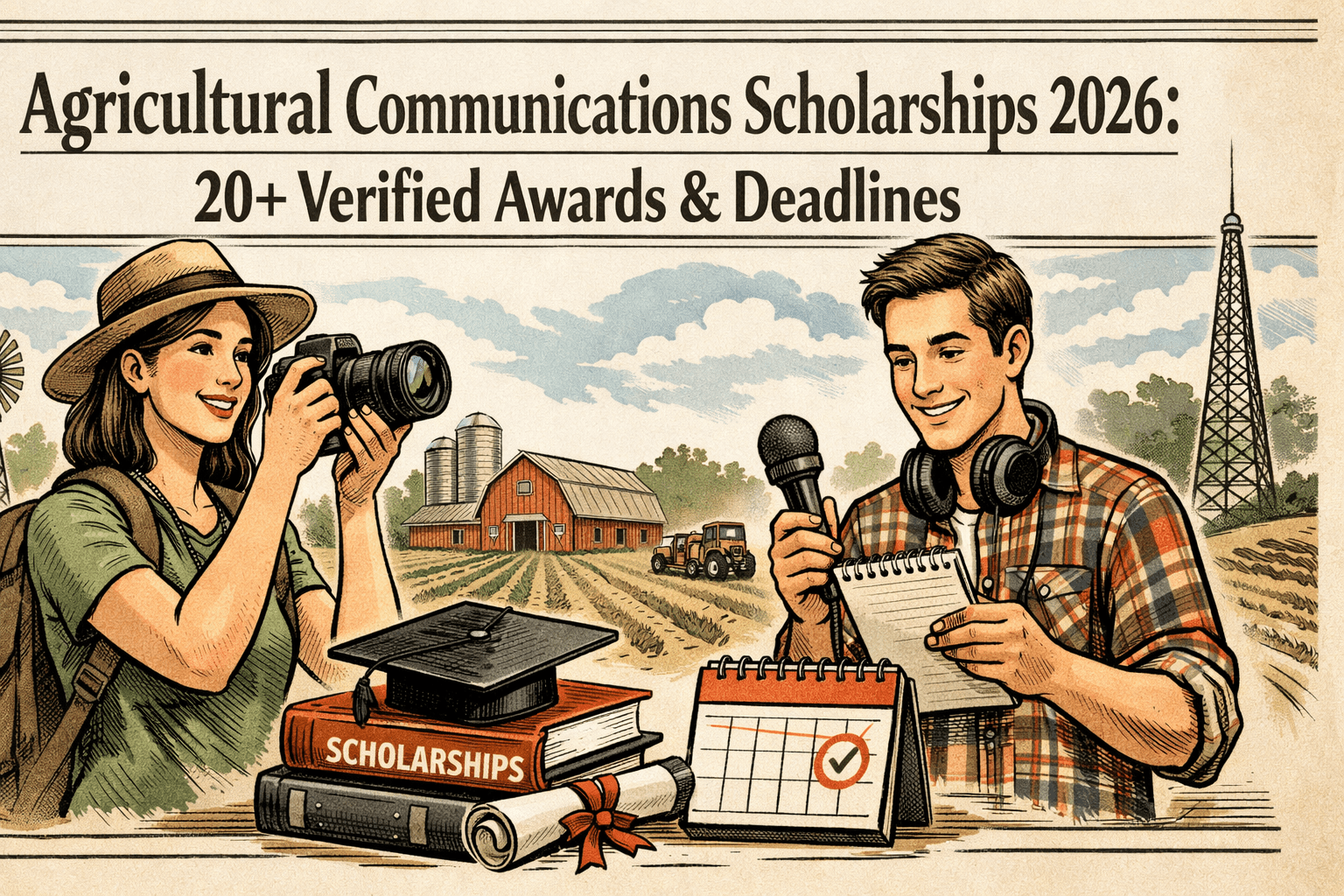
Agricultural Communications Scholarships 2026: 20+ Verified Awards & Deadlines
The ultimate, link-verified list of scholarships for Agricultural Communications majors—national/industry awards + top department/college funds. Sorted by deadline month with amounts, why it’s great, and direct apply links.
January
Iowa State CALS Scholarships (for Ag Comm majors via OneApp)
💥 Why It Slaps: One application, hundreds of college/department funds—great coverage for Agricultural Communication majors in CALS.
💰 Amount: Varies (CALS awards $4.5M+ annually).
⏰ Deadline: Priority window opens each fall; first-year priority typically early January (e.g., Jan 6, 2026).
🔗 Apply/info: https://www.cals.iastate.edu/scholarships
February
Texas Tech (Davis College) Scholarships (Ag Ed & Com eligible)
💥 Why It Slaps: TTU’s Davis College pools dozens of awards; priority deadline keeps you in the main selection round.
💰 Amount: Varies; multiple competitive awards.
⏰ Deadline: Priority Feb 1 (fall start).
🔗 Apply/info: https://www.depts.ttu.edu/agriculturalsciences/Students/prospective/ugrad/apply.php
Kansas State University—College of Agriculture Scholarships (ACJ eligible)
💥 Why It Slaps: Central K-State application (KSN) opens doors to college + departmental funds, including Ag Communications & Journalism.
💰 Amount: Varies; College awards $2.3M+ yearly.
⏰ Deadline: Priority Feb 1 (additional competitive dates may apply).
🔗 Apply/info: https://www.ag.k-state.edu/student-success/scholarships-financial-aid/
Ohio State—Department of Agricultural Communication, Education & Leadership (ACEL) Scholarships
💥 Why It Slaps: Dedicated ACEL funds (including named Ag Communication awards) + CFAES pool with a single timeline.
💰 Amount: Varies; dozens of named awards.
⏰ Deadline: Feb 15 (CFAES/department app).
🔗 Apply/info: https://acel.osu.edu/future-students/undergraduate/scholarships-and-financial-aid
NAMA—Wayne Bollum Memorial Scholarship (National Agri-Marketing Association)
💥 Why It Slaps: Flagship ag-marketing award for students eyeing brand/content/PR roles in ag.
💰 Amount: $5,000.
⏰ Deadline: Feb 7, 2025 (cycles annually around early Feb).
🔗 Apply/info: https://www.nama.org/nama-foundation-scholarship.html
NAMA—R.C. Ferguson Memorial Scholarship
💥 Why It Slaps: Recognizes leadership + communications chops for future ag communicators/marketers.
💰 Amount: $5,000.
⏰ Deadline: Feb 7, 2025.
🔗 Apply/info: https://www.nama.org/foundation/student-scholarships
NAMA—John Deere Scholarship
💥 Why It Slaps: Industry-backed, great for students building portfolios in content, digital, and campaigns.
💰 Amount: $2,500.
⏰ Deadline: Feb 7, 2025.
🔗 Apply/info: https://www.nama.org/foundation/student-scholarships
Livestock Publications Council—Forrest Bassford Student Award
💥 Why It Slaps: Premier ag media award—cash + travel to Ag Media Summit for networking & clips.
💰 Amount: Top award $1,500 + $500 travel; up to three $750 travel scholarships.
⏰ Deadline: Feb 21, 2025 (annual late-Feb rhythm).
🔗 Apply/info: https://livestockpublications.com/students/forrest-bassford-award/
University of Nebraska–Lincoln (CASNR) Scholarships (AESC majors eligible)
💥 Why It Slaps: College-wide pool; AESC students regularly funded with a simple application.
💰 Amount: Varies; CASNR awards $1M+ annually.
⏰ Deadline: Feb 1 (university/college apps).
🔗 Apply/info: https://casnr.unl.edu/student-resources/scholarships-financial-aid/
March
National ACT—Arthur Leal Memorial Study Abroad Scholarship
💥 Why It Slaps: Built for Ag Comm students doing university-sponsored study abroad—funds storytelling abroad.
💰 Amount: Varies (competitive travel grant).
⏰ Deadline: March 1 (2025 cycle).
🔗 Apply/info: https://nactnow.org/wp-content/uploads/2025/02/National-ACT-Leal-Scholarship-2025-March-1.pdf
North Dakota State—Department of Communication Scholarships (Ag Communication track eligible)
💥 Why It Slaps: One portal for communication-area awards—great for NDSU Ag Comm majors.
💰 Amount: Varies.
⏰ Deadline: Apps accepted Nov 1 – Mar 1.
🔗 Apply/info: https://www.ndsu.edu/communication/scholarships
Kansas Farm Bureau Foundation—Agricultural Communications & Journalism Scholarship
💥 Why It Slaps: Directly targeted to ACJ majors; membership-based, Kansas-focused.
💰 Amount: $1,000 (1 award).
⏰ Deadline: March 1.
🔗 Apply/info: https://www.kfb.org/Foundation-for-Agriculture/Scholarships
April
University of Minnesota—Division of Agricultural Education, Communication & Marketing (AECM) Scholarship
💥 Why It Slaps: Dedicated division fund; straightforward department application.
💰 Amount: Varies (division-specific awards).
⏰ Deadline: April 1 annually.
🔗 Apply/info: https://ag-ed.cfans.umn.edu/student-resources/scholarships
Agricultural Communicators Network (ACN)—Dr. James F. Evans Scholarship
💥 Why It Slaps: Flagship national scholarship for Ag Comm students; looks great on a media résumé.
💰 Amount: $3,000.
⏰ Deadline: Historically mid-April (e.g., April 15 in recent cycles).
🔗 Apply/info: https://agcommnetwork.com/scholarships/
Agricultural Communicators Network (ACN)—Past Presidents’ Scholarships (2)
💥 Why It Slaps: Two additional national awards recognizing leadership, professionalism, and potential.
💰 Amount: $2,000 each (2 awards).
⏰ Deadline: Historically mid-April (e.g., April 15).
🔗 Apply/info:https://agcommnetwork.com/scholarships/
National Dairy Shrine—McCullough Freshman Communications Scholarship
💥 Why It Slaps: A communications-specific dairy award for first-year students—perfect early boost.
💰 Amount: Varies (named scholarship).
⏰ Deadline: Spring (applications typically due in April).
🔗 Apply/info: https://dairyshrine.org/youth/
National Dairy Shrine—Dairy Management Inc. (DMI) Education & Communication Scholarship
💥 Why It Slaps: For upper-level students interested in dairy promotion, education, and comms.
💰 Amount: Varies; competitive national award.
⏰ Deadline: Spring (applications typically due in April).
🔗 Apply/info: https://dairyshrine.org/scholarships/
June
NAFB Foundation—College Scholarships (National Association of Farm Broadcasting)
💥 Why It Slaps: The broadcasting gold standard—cash awards + access to the farm broadcast network.
💰 Amount: Multiple awards; recent cycles included a $10,000 top award plus additional $7,500 awards.
⏰ Deadline: June 2, 2025 (annual early-June cadence).
🔗 Apply/info: https://nafb.com/foundation/scholarships
Fall (Department/Club Windows)
University of Florida—Department of Agricultural Education & Communication (AEC) Scholarships
💥 Why It Slaps: 30+ departmental scholarships for AEC undergrads; app opens each fall.
💰 Amount: $20,000+ total awarded annually.
⏰ Deadline: Fall semester (dates announced each year).
🔗 Apply/info: https://aec.ifas.ufl.edu/undergraduate/student-life/
University of Arkansas—Collegiate Farm Bureau Scholarship (AECT students active in CFB)
💥 Why It Slaps: Leadership-oriented award for Bumpers College students engaged in advocacy & comms.
💰 Amount: $500 (chapter scholarship).
⏰ Deadline: Varies (chapter announces annually).
🔗 Apply/info: https://agricultural-education-communications-and-technology.uark.edu/students/clubs/cfb.php
Additional “Covers Ag Comm Majors” Funding (Use alongside the above)
UNL—Department/College Scholarship Pathways (CASNR)
💥 Why It Slaps: Central info hub + department links to stack with AESC awards.
💰 Amount: Varies; many awards $500–$2,000+.
⏰ Deadline: Department windows vary; many align with Feb 1.
🔗 Apply/info: https://casnr.unl.edu/department-scholarships
💥 Why It Slaps: Snapshot of OneApp timing for first-year, transfer, and current students.
💰 Amount: Varies.
⏰ Deadline: First-year & current student priority dates posted by college.
🔗 Apply/info: https://financialaid.iastate.edu/types-of-aid/scholarships/oneapp/deadlines/
K-State—Scholarship Deadlines (University/CAS priority)
💥 Why It Slaps: Know the key dates (Dec 15 competitive; Feb 1 priority) that unlock College/Dept awards.
💰 Amount: Varies.
⏰ Deadline: Feb 1 (priority); other competitive dates listed.
🔗 Apply/info: https://www.k-state.edu/admissions/undergrad/manhattan/apply/deadlines.html
NDSU—College of Agriculture, Food Systems & Natural Resources (CAFSNR) Scholarships
💥 Why It Slaps: Central gateway to college-level funding; stack with Department of Communication awards.
💰 Amount: Varies.
⏰ Deadline: Posted annually; check CAFSNR page for current cycle.
🔗 Apply/info: https://www.ndsu.edu/agriculture/academics/scholarships
National ACT—Student AMS Travel/Contest Funding
💥 Why It Slaps: Helps cover attendance at Ag Media Summit (portfolio reviews, internships, networking).
💰 Amount: Varies (contest/travel support).
⏰ Deadline: Spring (recently mid-April).
🔗 Apply/info: https://nactnow.org/scholarships/
UNL—School/College Scholarship Snapshot (dates for undergrads)
💥 Why It Slaps: Confirms the general Feb 1 university scholarship timeline you’ll see across UNL pages.
💰 Amount: Varies.
⏰ Deadline: Feb 1 (typical for first-year/upperclass supplemental apps).
🔗 Apply/info: https://www.depts.ttu.edu/pss/student-resources/scholarships/index.php (TTU example of unified deadlines)
Tip: Many department/college pools let Ag Comm majors compete broadly (journalism/PR/marketing/leadership). Submit early, then update apps before final deadlines when allowed.
Financing the Story of Food: Analysis of U.S. Agricultural Communications Scholarships and the Talent Pipeline
Agricultural communications (AgComm) sits at the intersection of media, marketing, public relations, science communication, and agricultural systems. In an era defined by rapid information diffusion, contested narratives about food systems, and accelerating technological change on farms, AgComm professionals perform essential work: translating complex production realities into credible public knowledge, supporting producer decision-making, and helping food and agriculture organizations maintain legitimacy. This paper maps the U.S. scholarship ecosystem that supports AgComm students, using publicly available data from federal labor and agriculture statistics and a focused scan of national, field-specific scholarships offered by leading professional associations. We quantify scholarship award structures and non-cash benefits (e.g., expense-paid convention travel, interview opportunities), benchmark scholarship “coverage” against contemporary college costs, and analyze how scholarship design functions as both financing and workforce development policy. Findings suggest that AgComm scholarships operate less like one-time tuition offsets and more like pipeline instruments that subsidize professional identity formation, network access, and early career signaling. We conclude with evidence-aligned recommendations for students, scholarship sponsors, and higher-education programs, including equity-oriented design improvements and research metrics for evaluating scholarship impact.
1. Introduction: Why Agricultural Communications Needs Its Own Scholarship Market
Agricultural communications is not a niche “soft skill” add-on to agricultural science; it is a labor market response to structural features of U.S. agriculture: (1) a large, economically consequential production system; (2) concentration and complexity in supply chains; (3) growing distance between producers and consumers; and (4) information environments where credibility and speed are in constant tension. The 2022 Census of Agriculture reported 1.9 million farms and ranches, with an average size of 463 acres across 880 million acres of farmland (about 39% of U.S. land). Family-owned operations account for 95% of farms and operate 84% of farmland, while a small share of farms (those with $1M+ in sales) produce a dominant share of total sales—conditions that increase the importance of trust, transparency, and communication across very different farm scales.
The same census indicates rising digital integration: 79% of farms report internet access, and direct-to-consumer sales reached $3.3 billion in 2022—both signal that agricultural messaging increasingly occurs in hybrid spaces where producers must navigate marketing, consumer expectations, and public scrutiny. In this setting, AgComm is an enabling infrastructure for market participation and public legitimacy, not merely a media function. Scholarships targeted to AgComm can therefore be interpreted as investments in a public-facing workforce that shapes how agriculture is understood, debated, and governed.
2. Labor-Market Signals: Where AgComm Graduates Actually Work
AgComm graduates frequently enter occupations that the U.S. Bureau of Labor Statistics (BLS) tracks under broader categories—public relations, writing/editing, technical communication, marketing, and market research. While no single BLS code perfectly captures “agricultural communicator,” these occupation groups provide a defensible proxy for wages and growth trajectories.
Public relations specialists—a common destination for graduates working in agribusiness, commodity groups, cooperatives, and food brands—are projected to grow 5% from 2024 to 2034, with ~27,600 openings per year (many due to replacement). BLS explicitly ties demand to reputation management in fast-moving internet news cycles, which aligns with agriculture’s exposure to episodic crises (animal disease outbreaks, recalls, weather shocks, policy controversies).
For communication work that blends science and production complexity, technical writing is a strong proxy; BLS lists median pay of $91,670 (May 2024). Meanwhile, writers and authors show median pay of $72,270 (May 2024), reflecting a market with wide variance and high returns to specialization and audience access.
AgComm is also increasingly “marketing-analytics adjacent.” BLS reports median pay of $161,030 (May 2024) for marketing managers and projects 7% growth (2024–2034) for that occupation group—important because many AgComm curricula now include campaign strategy, audience segmentation, and digital metrics.
Implication: AgComm scholarships are underwriting entry into labor markets with (a) measurable demand for reputation and relationship management, (b) wage premia for specialized writing and technical translation, and (c) high upside for students who pair storytelling with analytics.
3. The Scholarship Ecosystem as Workforce Policy
Unlike many “general major” scholarships, AgComm scholarships often include professional-community gatekeeping (membership requirements, portfolio evidence, convention interviews). This design can be explained using human capital and signaling economics:
- Human capital subsidy: Scholarships reduce the private cost of training (tuition, time), increasing the supply of skilled communicators.
- Signal amplification: Selection criteria and competitive review act as labor-market signals (credible third-party endorsement).
- Network formation: Many awards bundle travel, interviews, and convention participation—effectively financing social capital, not just tuition.
These functions are visible in flagship AgComm-specific awards.
4. Signature National Scholarships: Award Sizes, Requirements, and “Hidden Value”
4.1 NAFB Foundation (Farm Broadcasting & Ag Communications)
The National Association of Farm Broadcasting (NAFB) Foundation represents one of the most financially substantial pipelines in the AgComm scholarship space. In 2025, it awarded $47,500 to six students studying agricultural communications, and recipients receive an expense-paid trip to attend the NAFB Convention. This matters because it converts scholarships into a bundled professional launch package: financing + industry immersion + hiring-network exposure.
At the ecosystem level, the NAFB Foundation reports passing $1 million distributed since its founding (1974), including 167 college scholarships and 200+ internship grants—a scale that resembles a sustained workforce development institution rather than a one-off donor program. Historical reporting shows awards commonly structured as multiple $7,500 scholarships plus a $10,000 scholarship, again with convention travel included—suggesting a deliberate strategy to fund “deep” awards that meaningfully offset costs and lock in professional participation.
4.2 Agricultural Communicators Network (ACN) + Ag Communicators of Tomorrow (ACT)
ACN’s scholarship design is explicitly pipeline-oriented: it offers the Dr. James Evans Scholarship ($3,000) and two Past Presidents’ Scholarships ($2,000 each) for undergraduates pursuing agricultural communications careers. Eligibility requires membership in National ACT, and applicants may join nationally if no local chapter exists.
Membership is intentionally low-cost—an Ohio State University Extension posting documents $17 national dues—but even small fees can function as a sorting mechanism (students must opt in). The scholarship process further strengthens signaling: finalists interview at the Ag Media Summit, and external reporting notes travel stipends (e.g., $1,000) to enable attendance. This feature converts scholarship competition into a professional performance test: writing skills, composure, and industry fluency are assessed in a context that mirrors real hiring environments.
4.3 Livestock Publications Council (LPC): Forrest Bassford Student Award
LPC’s award illustrates the “scholarship + mobility” model. The Forrest Bassford Student Award provides a $2,000 scholarship to the overall winner and up to four $750 travel scholarships for additional students to attend the convention. For a field where internships and freelance relationships are often decisive, travel subsidies can be as career-relevant as tuition offsets.
4.4 National Agri-Marketing Association (NAMA) Foundation
NAMA’s scholarship portfolio shows the marketing-communications overlap in agriculture. The NAMA Foundation lists multiple awards and eligibility criteria (e.g., student chapter membership, GPA thresholds), including larger awards such as the John Deere Scholarship ($6,000) and a $2,500 scholarship explicitly open to students majoring in agricultural communications (among other fields). Importantly, these awards are tied to chapter membership, reinforcing network formation as a core objective of scholarship design.
4.5 National FFA Scholarships: The High-School-to-College Bridge
While not a college-major-exclusive funder, National FFA is a major upstream feeder into AgComm majors and related careers. FFA reports that one application can be used for multiple scholarship opportunities totaling nearly $2.5 million, with a clear national timeline (application live Nov. 1, 2025; deadline Jan. 15, 2026; notifications Apr. 23, 2026). FFA also operates an Agricultural Communications career development event, reinforcing skill development and interest before college.
Takeaway: The AgComm scholarship market is structured as a ladder: FFA (early pipeline) → student chapters/membership organizations (identity + training) → profession-specific associations (network + placement) → industry roles.
5. Quantifying “Coverage”: What These Scholarships Buy in a 2025–26 College Cost Environment
To interpret scholarship value, we benchmark award sizes against contemporary college prices. College Board reports that in 2025–26, average published tuition and fees are approximately $11,950 for public four-year in-state students (inflation-adjusted series), and average student budgets are about $30,990 for in-state students at public four-year institutions (including living costs).
Using those benchmarks:
- $2,000 (LPC winner’s travel-bundle partials; ACN Past Presidents scale in some years) ≈ 17% of average public in-state tuition & fees, or 6% of the full student budget.
- $3,000 (ACN Dr. James Evans) ≈ 25% of tuition & fees, or 10% of the budget.
- $6,000 (NAMA John Deere Scholarship) ≈ 50% of tuition & fees, or 19% of the budget.
- $7,500–$10,000 (common NAFB scale historically) ≈ 63%–84% of tuition & fees, or 24%–32% of the budget.
This “coverage” framing clarifies an important point: in a budget environment where living costs dominate, scholarships that bundle travel + network access may produce outsized returns relative to their nominal dollar value. An expense-paid convention trip can substitute for a student’s out-of-pocket professional development costs while also increasing internship match probability.
6. Scholarship Design as Screening: Why Membership and Convention Interviews Are Common
A notable pattern in AgComm scholarships is the use of membership requirements and in-person interviews. ACN requires ACT membership to apply, and NAFB recognizes recipients at its convention while providing travel support. LPC similarly awards travel scholarships to attend its convention.
From a doctoral-level policy and labor-economics lens, this design solves two problems:
- Information asymmetry: Communication talent is difficult to evaluate using GPA alone. Portfolios, interviews, and conference engagement offer richer signals.
- Professional socialization: Agriculture communication is credibility-dependent. Sponsors want recipients who can operate within professional norms (accuracy, ethics, audience respect). Convention participation accelerates this socialization.
In other words, these scholarships are partially selection systems that allocate scarce professional opportunities.
7. Equity and Access: Who Gets to Compete, and Who Gets to Attend?
The ecosystem shows meaningful equity-promoting design features—low membership dues (ACT), travel stipends (Ag Media Summit finalists), and expense-paid trips (NAFB)—that reduce barriers for students who lack financial slack. However, access gaps can persist:
- Geographic constraints: Students far from land-grant hubs or without active chapters may have weaker mentorship and portfolio infrastructure.
- Time poverty: Many selection processes assume capacity for unpaid or low-paid internships, campus leadership, and travel—activities correlated with socioeconomic advantage.
- Narrative capital: Students with professional family networks may craft “industry fluent” applications more easily.
A design-forward equity improvement would be expanding “micro-credential” supports—equipment grants (camera/audio), paid mentorship cohorts, or remote interview pathways—while maintaining the professional-network core.
8. Practical Implications: How Students Can Maximize Scholarship Probability (Evidence-Aligned)
Given the selection mechanisms described above, the strongest AgComm scholarship applications tend to demonstrate measurable communication impact and professional readiness. Students can increase competitiveness by building a portfolio that is both creative and quantifiable:
- Impact metrics: engagement rates, audience growth, conversion outcomes, media pickups, newsletter open rates, event attendance changes.
- Credibility practices: sourcing, fact-checking workflow, correction policy, and ethical guidelines—especially for science-adjacent claims.
- Audience translation: a before/after example showing how you made a complex topic understandable without distortion.
- Network participation: membership + conference participation (even virtually) signals seriousness and lowers sponsor uncertainty.
- Role clarity: articulate which AgComm lane you’re pursuing (broadcast, PR, content strategy, extension outreach, ag journalism, corporate communications).
Because federal loan limits can be modest relative to total cost (e.g., dependent first-year Direct Loan example values in federal guidance), scholarships that reduce borrowing can materially change a student’s financial risk profile.
9. Recommendations for Scholarship Sponsors and Programs: Measuring What Matters
To move from “good intentions” to evidence-based workforce development, sponsors and universities should evaluate scholarship outcomes using metrics beyond simple recipient counts:
- Placement outcomes: internships secured within 6–12 months; first job sector and retention.
- Portfolio growth: pre/post assessment of publishable work quality and audience reach.
- Network centrality: participation in professional events and mentorship ties (social capital proxies).
- Equity indicators: access for students from 1890/1994 institutions, rural first-gen students, and non-traditional learners; compare applicant pool composition to recipient composition.
- Return on scholarship dollar: not in a narrow salary sense, but in workforce entry and public-facing communication capacity.
Conclusion
Agricultural communications scholarships in the United States form a distinctive ecosystem: they are not merely financial aid, but a set of structured pipeline instruments that subsidize talent formation, professional identity, and network entry. Federal agricultural data underscore the scale and heterogeneity of U.S. farming and the increasing digital nature of agricultural life—conditions that elevate the importance of skilled communicators. Labor market proxies show durable demand for PR, technical translation, writing, and marketing leadership—roles that AgComm graduates routinely inhabit.
Within this context, signature programs such as the NAFB Foundation (multi-year scale, convention travel, sustained distribution) and ACN/ACT (membership-based selection, interviews, targeted awards) demonstrate that the field’s scholarship market is best understood as financing + professionalization. The next frontier is measurement: tracking how scholarship design affects who enters the profession, how quickly they build credible portfolios, and whether the industry’s communication capacity grows in ways that improve public understanding and stakeholder trust across the food system.
References (selected, publicly accessible)
- U.S. Bureau of Labor Statistics (BLS), Occupational Outlook Handbook: Public Relations Specialists; Technical Writers; Writers and Authors; Advertising/Marketing Managers.
- USDA National Agricultural Statistics Service (NASS), 2022 Census of Agriculture release.
- USDA Economic Research Service (ERS), Chart of Note on farm counts from the 2022 Census.
- NAFB Foundation: Scholarships and Foundation Overview pages.
- Agricultural Communicators Network (ACN) scholarship page.
- Livestock Publications Council (LPC) Forrest Bassford Student Award page.
- National Agri-Marketing Association (NAMA) Foundation Scholarship page.
- National FFA Scholarships page (timeline and total opportunity statement).
- College Board, Trends in College Pricing and Student Aid 2025 (budgets; tuition and fees series).
- Federal Student Aid (FSA) Handbook: annual and aggregate Direct Loan limits (2025–26).
Monthly Update (January 2026)
- Verified and refreshed all direct application links; removed aggregator links.
- Added/confirmed 2025–26 timelines for NAMA (Feb 7), LPC (Feb 21), NAFB (June 2), National ACT—Leal (Mar 1), UMN AECM (Apr 1), and ACEL @ Ohio State (Feb 15).
- New adds: Kansas Farm Bureau ACJ Scholarship, NDSU Dept. of Communication Scholarships, and UF AEC departmental pool.
- Note: Some departments post dates each fall—watch for exact 2026 cycle opens (we’ve noted typical months above). aec.ifas.ufl.edu