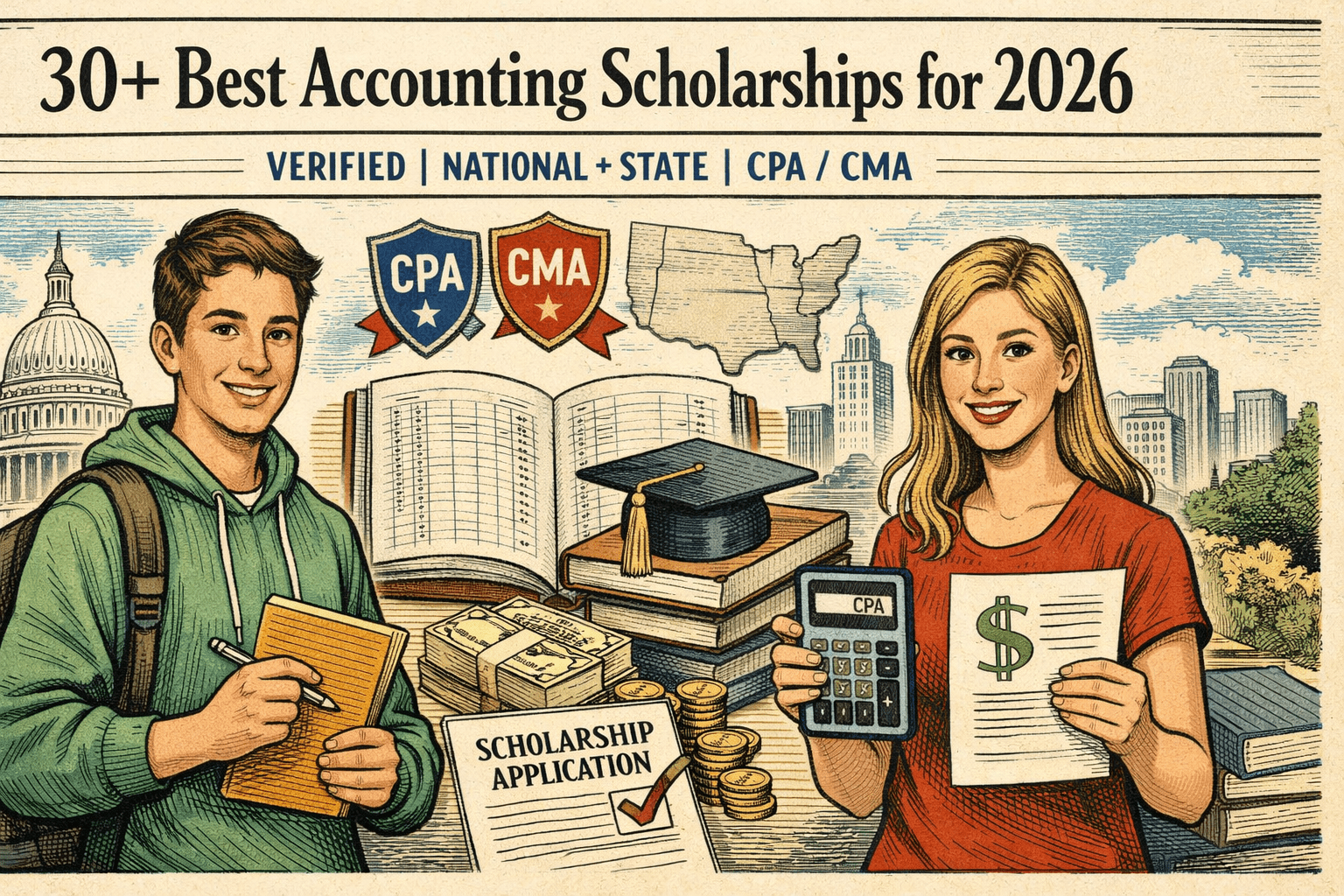
30+ Best Accounting Scholarships for 2026 (Verified | National + State | CPA/CMA)
Upgrade your money game, future CPA! 🔥 Here are 30+ verified scholarships, fellowships & exam-prep awards for accounting majors (UG, transfer, master’s/5th year, PhD) — sorted by deadline month with direct apply links, award amounts, and why each one slaps.
January
New Jersey Society of CPAs (NJCPA) — College Scholarships
💥 Why It Slaps: Clear ladder of awards for NJ sophomores, juniors, seniors, and community-college students transferring to 4‑year programs. Strong amounts and a well-run process with interviews. Great in-state network for internships.
💰 Amount: $2,000 (CC sophomores); $6,500 (juniors/seniors)
⏰ Deadline: Jan 7, 2026
🔗 Apply/info: https://www.njcpa.org/build-career/become-a-cpa/scholarships/college
Michigan Accountancy Foundation — Final Year Scholarship (MICPA/MAF)
💥 Why It Slaps: Aimed at final-year students finishing 150 hours in Michigan; helps close the 5th‑year funding gap right before CPA exam + often bundled with exam-prep resources.
💰 Amount: Typically up to $5,000
⏰ Deadline: Jan 31, 2026
🔗 Apply/info: https://micpa.org/community/michigan-accountancy-foundation/about-maf
AICPA Legacy Scholarships — Portal Window (Multiple Awards)
💥 Why It Slaps: One application → considered for multiple AICPA Foundation awards designed for CPA‑bound students, including Future CPAs, Two‑Year Transfer, Minority Accounting Students, AWSCPA (women), and John L. Carey (career‑changer to MAcc).
💰 Amount: ~$3,000–$10,000 (varies by program)
⏰ Deadline: Typically Dec–Mar window (watch the portal for 2026 cycle)
🔗 Apply/info: https://www.thiswaytocpa.com/education/aicpa-legacy-scholarships/
AICPA Foundation Scholarship for Future CPAs (within Legacy portal)
💥 Why It Slaps: Flagship AICPA award for undergrad/grad CPA‑intent students; national prestige + development programming.
💰 Amount: $3,000–$10,000
⏰ Deadline: In the AICPA window (Dec–Mar typical)
🔗 Apply/info: https://bigfuture.collegeboard.org/scholarships/aicpa-foundation-scholarship-for-future-cpas
AICPA Scholarship for Minority Accounting Students (within Legacy portal)
💥 Why It Slaps: Long‑running equity award supporting underrepresented students in accounting with strong brand recognition + AICPA community access.
💰 Amount: $3,000–$10,000
⏰ Deadline: In the AICPA window (Dec–Mar typical)
🔗 Apply/info: https://www.thiswaytocpa.com/education/aicpa-legacy-scholarships/
AICPA Two‑Year Transfer Scholarship (CC → 4‑Year)
💥 Why It Slaps: Purpose‑built for community‑college transfers finishing an accounting degree at a 4‑year school; ideal for closing the gap at transfer.
💰 Amount: $5,000 (typical)
⏰ Deadline: In the AICPA window (Dec–Mar typical)
🔗 Apply/info: https://www.thiswaytocpa.com/education/scholarship-search/aicpa-legacy-scholarships/
AICPA AWSCPA Scholarship Award (Women in Accounting)
💥 Why It Slaps: Dedicated to women in accounting; stacks well with campus awards and boosts visibility with employers and AICPA’s Women’s Initiatives community.
💰 Amount: Often $5,000 (varies by year)
⏰ Deadline: In the AICPA window (Dec–Mar typical)
🔗 Apply/info: https://www.thiswaytocpa.com/education/scholarship-search/awscpa-scholarship/
AICPA John L. Carey Scholarship (Non‑business BA/BS → MAcc/MPAc)
💥 Why It Slaps: Career‑switchers welcome! Liberal‑arts/non‑business grads heading to accounting grad school get funding + a name recruiters recognize.
💰 Amount: $5,000
⏰ Deadline: In the AICPA window (Dec–Mar typical)
🔗 Apply/info: https://www.thiswaytocpa.com/education/scholarship-search/john-l-carey-scholarship/
February
Washington CPA Foundation Scholarships (WSCPA)
💥 Why It Slaps: Big in‑state program with $5k–$10k tiers for juniors, seniors, 5th‑year, and master’s students in Washington; strong odds + community support.
💰 Amount: $5,000–$10,000
⏰ Deadline: Feb 10, 2026
🔗 Apply/info: https://www.wscpa.org/scholarships
ACFE Ritchie‑Jennings Memorial Scholarship (Anti‑Fraud)
💥 Why It Slaps: Perfect crossover for accounting + forensic/fraud careers; scholarship plus ACFE membership and national recognition.
💰 Amount: $2,000–$10,000
⏰ Deadline: Typically late Jan–Feb (check 2026 cycle)
🔗 Apply/info: https://www.acfe.com/scholarship
RSM US Foundation — Power Your Education Scholarship
💥 Why It Slaps: National firm award with clean app & clear criteria; great tie‑in to RSM recruiting.
💰 Amount: $10,000
⏰ Deadline: Typically Dec–Feb
🔗 Apply/info: https://rsmus.com/careers/starting-your-career/scholarships/power-your-education-scholarship.html
RSM US Foundation — First‑Gen Scholarship
💥 Why It Slaps: Multi‑year runway for first‑generation students; includes community + mentorship and visibility with RSM.
💰 Amount: Up to $30,000 (over 3 years)
⏰ Deadline: Typically Dec–Feb
🔗 Apply/info: https://rsmus.com/careers/starting-your-career/scholarships/first-generation-scholarship.html
RSM US Foundation — Power Your Transition (CC → University)
💥 Why It Slaps: Dedicated community college transfer funding with firm exposure; powerful for 2+2 routes.
💰 Amount: $10,000
⏰ Deadline: Typically Dec–Feb
🔗 Apply/info: https://rsmus.com/careers/starting-your-career/scholarships/power-your-transition-scholarship.html
KPMG Future Leaders Program (Women in Business/STEM)
💥 Why It Slaps: National women’s leadership cohort + renewable $10k per year (up to $40k) + mentoring & KPMG network. Excellent fit for accounting‑bound high school seniors entering business.
💰 Amount: $10,000/year (up to $40,000)
⏰ Deadline: Often Feb 1 (watch 2026 cycle)
🔗 Apply/info: https://apply.mykaleidoscope.com/scholarships/KPMGFutureLeaders2025
Becker — Newt D. Becker CPA Exam Review Scholarship
💥 Why It Slaps: Covers Becker CPA Review (high‑value exam prep) — huge cost saver at the CPA‑exam stage; widely recognized by employers.
💰 Amount: CPA Review package (value ~$2,499; varies by cycle)
⏰ Deadline: Often Feb–Mar (watch announcement)
🔗 Apply/info: https://www.becker.com/cpa-review/newt-d-becker-scholarship-program
March
Beta Alpha Psi — National Scholarships (multiple)
💥 Why It Slaps: If your chapter is active, BAP offers various member‑only awards (leadership, DEI, analytics, graduate support) backed by major partners; strong résumé signal.
💰 Amount: Varies
⏰ Deadline: Many close Mar–Apr
🔗 Apply/info: https://www.bap.org/partner-scholarships
IIA (Internal Audit Foundation) — Student Scholarships
💥 Why It Slaps: For students leaning into audit/assurance/internal audit; scholarships + conference access + professional pipeline through IIA chapters.
💰 Amount: Varies (often ~$1,000–$5,000)
⏰ Deadline: Typically late winter–spring
🔗 Apply/info: https://www.theiia.org/en/internal-audit-foundation/about-the-internal-audit-foundation/grants-and-awards/
CalCPA — Education Foundation Scholarships (CA)
💥 Why It Slaps: Big California footprint with dozens of chapter/foundation awards; ideal if you study/live in CA and want local firm access.
💰 Amount: Varies (often $1,000–$5,000+)
⏰ Deadline: Typically late winter–spring (chapter‑specific)
🔗 Apply/info: https://www.calcpa.org/education-foundation/scholarships
April
EFWA — Educational Foundation for Women in Accounting
💥 Why It Slaps: Women‑only awards across associate, bachelor’s, master’s (incl. targeted funds like Moss Adams partnership in some years). Several are multi‑year; strong alignment with CPA pipeline.
💰 Amount: Varies (some multi‑year)
⏰ Deadline: Many due by Apr 30
🔗 Apply/info: https://www.efwa.org/scholarships/
AFWA Foundation — Accounting & Financial Women’s Alliance
💥 Why It Slaps: National org for women in accounting/finance; scholarships + mentoring + local chapter ecosystem for internships and leadership.
💰 Amount: Varies
⏰ Deadline: Spring (varies by award)
🔗 Apply/info: https://www.afwa.org/foundation/scholarships/
Virginia Society of CPAs (VSCPA) — Educational Foundation Scholarships (VA)
💥 Why It Slaps: Strong in‑state pathway; undergrad/grad/doctoral categories with clear requirements and $80,000+ awarded yearly.
💰 Amount: Commonly $2,500+
⏰ Deadline: Apr 1, 2026
🔗 Apply/info: https://www.vscpa.com/scholarships
NSA Foundation — National Society of Accountants Scholarships
💥 Why It Slaps: Nationwide pool for undergrads (2‑yr & 4‑yr) with GPA ≥ 3.0; good for tax/accounting students seeking recognition outside big four orgs.
💰 Amount: Often $500–$2,500+
⏰ Deadline: Spring (varies by year)
🔗 Apply/info: https://nsacct.org/nsaf-scholarships/
Moss Adams Foundation — Ignite Scholarship
💥 Why It Slaps: Early‑talent booster (freshmen/sophomores welcome in many cycles) with $2,500 + mentorship + recruiting visibility at Moss Adams.
💰 Amount: $2,500
⏰ Deadline: Historically spring (confirm current cycle)
🔗 Apply/info: https://www.mossadams.com/about/stories/2025/06/announcing-the-2025-ignite-scholarship-recipients
May
NABA — National Association of Black Accountants Scholarships
💥 Why It Slaps: Deep corporate partnerships + conventions + mentorship. If you’re Black/African American in accounting, this is a must‑apply pipeline with strong alumni outcomes.
💰 Amount: Varies (often $1k–$10k+)
⏰ Deadline: Spring (varies by year)
🔗 Apply/info: https://nabainc.org/programs/scholarships
ALPFA — Association of Latino Professionals For America Scholarships
💥 Why It Slaps: Massive professional network for Latine students in business/accounting; scholarships often tie to conferences and corporate sponsors.
💰 Amount: Varies
⏰ Deadline: Spring (varies by program)
🔗 Apply/info: https://www.alpfa.org/page/scholarships
Ascend (Pan‑Asian) — Student Scholarships
💥 Why It Slaps: Multiple awards for traditional and non‑traditional students; great leadership community with Big 4/Fortune 500 visibility.
💰 Amount: Often ~$2,500 each (varies)
⏰ Deadline: Spring
🔗 Apply/info: https://www.ascendleadership.org/page/scholarships
June
AGA — Association of Government Accountants Academic Scholarships
💥 Why It Slaps: For students targeting government/ public‑sector finance & accounting; multiple categories (freshmen → grad) + community‑service awards.
💰 Amount: $3,000 each (most categories)
⏰ Deadline: Typically May–June (watch for 2026 open/close)
🔗 Apply/info: https://www.agacgfm.org/award-scholarship/academic-scholarships/
September
IMA® — CMA® Scholarship (Professor Nomination)
💥 Why It Slaps: Covers CMA entrance + both exam parts + study materials — a huge value for management accounting careers. Requires nomination from a professor.
💰 Amount: Full CMA package (entrance & exam fees + prep)
⏰ Window: Sept 1 – Jun 30 (nominations)
🔗 Apply/info: https://www.imanet.org/ima-certifications/cma-certification/students/scholarship
October
Ohio CPA Foundation — College Scholarship Program (OH)
💥 Why It Slaps: Straightforward app for Ohio accounting majors planning to be CPAs; opens early with fall deadline for the next aid year.
💰 Amount: Often ~$2,000
⏰ Deadline: Typical cycle Oct–Dec (example: Dec 19, 2025 last cycle)
🔗 Apply/info: https://ohiocpa.com/quick-links/the-ohio-cpa-foundation/recruiting-students/scholarship-program
November
GFOA — Government Finance Officers Association (multiple national awards)
💥 Why It Slaps: Best‑in‑class for public/government accounting: includes Frank L. Greathouse (UG), Daniel B. Goldberg (Grad), and Minorities in Government Finance (UG/Grad). Powerful springboard to public‑sector audit or CAFR/ACFR roles.
💰 Amount: $5,000–$30,000 (varies by award)
⏰ Deadline: Application period typically opens in November
🔗 Apply/info: https://www.gfoa.org/scholarships
Rolling / School‑Specific / Varies
PCAOB Scholars Program (Nomination‑Based)
💥 Why It Slaps: One of the largest single awards in the field (recent cohort at $15,000). You’re nominated by your school — so talk to your accounting chair early.
💰 Amount: $15,000 (recent cycles)
⏰ Timeline: School nominations (no public app)
🔗 Info: https://pcaobus.org/about/scholars-program
Deloitte Foundation Accounting Scholars Program (DFASP) — Full Tuition at Partner Schools
💥 Why It Slaps: At participating universities, DFASP can cover one‑year full tuition & fees for MAcc/MTax — an elite path to 150 hours + recruiting advantage. Apply through the partner school.
💰 Amount: 100% tuition & academic fees (books/living not included)
⏰ Deadline: School‑specific
🔗 Info: https://www.deloitte.com/us/en/about/deloitte-foundation/deloitte-foundation-accounting-cpa-scholars-program.html
IMA® Student Scholarships (MEF, SCMS, Century Scholarship, etc.)
💥 Why It Slaps: Beyond the CMA package, IMA offers cash awards (e.g., MEF, SCMS, Century Scholarship) for leadership‑minded accounting students — great for those eyeing FP&A/controllership tracks.
💰 Amount: Varies; Century Scholarship has included $7,500 + CMA benefits
⏰ Deadline: Varies by award (often late winter–spring)
🔗 Apply/info: https://www.imanet.org/students/scholarships-and-awards
Financial Women of San Francisco (FWSF) — Scholarships (Bay Area)
💥 Why It Slaps: Women in accounting/finance at Bay Area schools; cohort experience + mentors + alum network in a top U.S. finance hub.
💰 Amount: Varies (competitive)
⏰ Deadline: Historically Feb–Mar; next cycle expected Jan 2026
🔗 Apply/info: https://financialwomensf.org/scholarships/
ALTS: CPA/CMA Exam‑Prep Awards (extra help at license time)
Becker Newt D. Becker Scholarship — CPA Review package awards
🔗 https://www.becker.com/cpa-review/newt-d-becker-scholarship-program
UWorld Accounting & Finance Scholarships — CPA/CMA/CFA Elite‑Unlimited course access
🔗 https://accounting.uworld.com/scholarship/
Accounting Scholarships as Human-Capital Investment: Evidence from the U.S. CPA Pipeline, Degree Completions, and Labor-Market Returns
Accounting scholarships are often framed as “college funding,” but their economic role is broader: they are targeted human-capital investments designed to stabilize the CPA pipeline, reduce licensure friction costs, and widen access to high-demand finance and assurance roles. Using national pipeline indicators (accounting degree completions and CPA exam candidate volumes), labor-market statistics (employment, projected openings, and pay), and financial-aid evidence on enrollment and completion effects, this paper evaluates where scholarships can generate the largest marginal returns for students and the profession. The empirical picture is mixed but clarifying: accounting degree completions have materially declined from mid-2010s highs, while annual occupational openings remain large and firms report continued hiring demand. Scholarships are most likely to move outcomes when they (1) offset “lumpy” costs created by the 150-credit pathway and exam preparation, (2) arrive early enough to influence major choice and persistence, and (3) bundle financial support with structured mentoring, internships, and exam-timing guidance. The paper concludes with design principles and evaluation metrics for scholarship makers, plus practical implications for students searching and stacking accounting scholarships efficiently.
Keywords: accounting scholarships, CPA pipeline, accounting education, student debt, merit aid, need-based aid, licensure pathways, labor economics
1. Introduction: Why Accounting Scholarships Matter Now
Accounting is a “license-linked” profession where educational decisions are tightly coupled to credential requirements. In the U.S., many students pursue additional credits beyond a bachelor’s degree to meet CPA eligibility—often through a master’s program, a fifth-year, or dual majors—creating a distinct cost structure compared to many other business majors. This makes scholarships uniquely consequential in accounting: they can influence whether students (a) enter the major, (b) persist through the advanced-credit period, and (c) finance the CPA exam and preparation without excessive borrowing.
At the same time, the profession is navigating structural change. The CPA Evolution model introduced new exam disciplines alongside core sections, shifting curricular emphasis toward technology, data, and systems assurance. In parallel, new licensure pathways are being adopted in some jurisdictions (with some effective in 2025), potentially reshaping how students plan their education-experience bundles. These shifts increase the value of scholarships that explicitly fund transition points—community college transfer, the 150-credit “bridge,” exam costs, and experiential learning aligned to newer competency expectations.
2. Data and Method
This analysis synthesizes four evidence streams:
- Supply-side pipeline data: AICPA Trends Report (using IPEDS completions for accounting CIP codes) for long-run accounting bachelor’s and master’s completions and recent year changes.
- Credential throughput data: NASBA’s 2024 candidate performance reporting headline indicators on CPA exam candidates and the introduction of new disciplines under CPA Evolution.
- Labor-market outcomes: U.S. Bureau of Labor Statistics Occupational Outlook Handbook statistics for accountants and auditors, including employment, projected growth, annual openings, and median pay.
- Affordability and aid impact evidence: College Board trends on borrowing, Federal Reserve SHED indicators on the prevalence of education debt among young adults, and causal research on how grant/merit aid affects enrollment and completion.
A limitation is that there is no single national dataset enumerating all accounting scholarships, award sizes, and award rates. Therefore, scholarship “market structure” is inferred through representative, well-documented programs (e.g., AICPA Foundation scholarships and grants; national affinity organizations; state CPA society examples), paired with outcome evidence on how aid changes behavior.
3. The Accounting Pipeline: Degree Completions, Enrollment Signals, and CPA Exam Throughput
3.1 Degree completions: a long decline from the mid-2010s peak
A central pipeline fact is the contraction in accounting completions since the mid-2010s. The AICPA Trends series shows combined accounting bachelor’s + master’s completions near ~79,854 in 2015–16 and 55,152 in 2023–24 (provisional), with bachelor’s completions at 40,817 and master’s at 14,335 in 2023–24.
Recent dynamics also matter for scholarship timing. The report notes a sharp bachelor’s decline from 2021–22 to 2022–23, followed by a smaller year-over-year decline into 2023–24; master’s completions declined more steeply in 2023–24. In pipeline terms, that pattern is consistent with students hesitating at the advanced-credit step (often associated with master’s enrollment or an additional year), which is precisely where scholarships can have high leverage.
3.2 Enrollment green shoots: why they don’t automatically fix completions
The same Trends report highlights that accounting enrollments increased in 2024 compared to 2023 (as measured via National Student Clearinghouse enrollment data referenced in the report), suggesting potential future stabilization in completions as cohorts progress.
But enrollment increases do not guarantee licensure throughput, especially if affordability constraints intensify during the fifth year, exam period, or internship-to-offer transition. Scholarships that are renewable, staged, or explicitly tied to the 150-credit pathway are more likely to convert enrollment into completions and exam attempts.
3.3 CPA exam candidate volumes: a “throughput” view
NASBA reports that 74,165 candidates sat for the CPA exam in 2024, including 27,994 new candidates, with 13,070 completing their final section. Those numbers provide a practical target for scholarship impact: the most measurable, profession-relevant scholarship outcomes are not only graduation, but exam participation and completion momentum. Scholarships that cover exam-related costs (fees, prep materials, travel, time off) can shift the “conversion rate” between degree completion and credential completion.
3.4 Licensure pathways changing: scholarships must stay jurisdiction-aware
NASBA notes that new pathways to licensure are being adopted across the U.S., with some jurisdictions’ changes effective in 2025, and provides a map current as of December 3, 2025.
Scholarship eligibility language that assumes a single pathway (e.g., “must be enrolled in a 150-hour program”) risks becoming misaligned. Future-proofed scholarships should specify outcomes (CPA intent, accounting program completion, exam attempt) while allowing multiple compliant education-experience routes.
4. Labor-Market Returns and the Financial Case for Scholarships
4.1 Demand baseline: jobs, openings, and pay
BLS reports approximately 1.6 million accountant and auditor jobs (2023), projected growth of 6% from 2023–2033, and about 91,400 openings per year on average—along with a 2024 median pay of $79,880.
These headline indicators suggest that even if employment growth is “moderate,” replacement needs and annual churn create persistent opportunity. For scholarship funders, this supports a workforce development rationale: scholarships can be justified not just as student support but as labor supply stabilization.
4.2 The affordability constraint: debt and the 150-credit “cost bump”
College financing data helps quantify the student-side constraint. The College Board reports that among 2023–24 bachelor’s degree recipients who borrowed, the average amount borrowed was $29,560 (in 2023 dollars). Meanwhile, the Federal Reserve’s SHED report shows the share of young adults (18–29) reporting education debt declined from 55% (2017) to 42% (2024), indicating fewer borrowers overall—but not necessarily lower burden for those who do borrow, and not accounting-specific.
Accounting’s unique friction is that the credential path often extends beyond four years. Scholarships targeted at (1) fifth-year credits or master’s tuition, and (2) CPA exam + prep costs, directly address the “last-mile” affordability barrier that general aid may not cover.
4.3 Starting pay signals: improving, but still a recruiting friction
The AICPA/PCPS Management of an Accounting Practice (MAP) Survey reported median starting salaries of $60,834 for bachelor’s new hires and $67,750 for master’s new hires (2025 survey; reflecting fiscal year 2024 benchmarking).
Starting pay improvements strengthen the ROI case for accounting education—yet the profession’s challenge is that students often compare accounting’s workload and licensure costs against adjacent fields. Scholarships operate as a “net price correction,” improving perceived ROI at the exact moment students choose majors or decide whether to pursue the additional credits and exam.
5. The Scholarship Landscape in Accounting: What Exists and What It Signals
5.1 National professional association funding: AICPA Foundation as a reference case
The AICPA Foundation provides a visible, well-documented model of scholarship design aligned to the CPA pipeline. In 2024, the AICPA Foundation awarded $691,000 in academic scholarships to 127 students for the 2024–2025 academic year through the Legacy Scholars Program, including awards typically ranging from $3,000 to $10,000, plus targeted programs such as a two-year transfer scholarship and minority accounting student awards.
A separate AICPA overview notes that the Foundation awards more than $1 million in scholarships, grants, and fellowships to hundreds of students each year, with recipients receiving on average $5,000.
This structure is important because it demonstrates portfolio logic:
- Entry and persistence: undergraduate/graduate scholarships ($3k–$10k).
- Pathway equity: community college transfer and minority-focused awards.
- Licensure friction: exam grants (e.g., up to $1,000).
- Faculty pipeline: doctoral fellowships (multiple $15,000 awards, potentially renewable).
5.2 Affinity and representation organizations: scholarships as pipeline correction
Accounting scholarships also operate as equity instruments aimed at representation gaps. BLS Current Population Survey tables show demographic composition for “accountants and auditors” (e.g., sex and race/ethnicity shares) and can be used as a baseline for targeting.
National organizations such as the National Association of Black Accountants (NABA) explicitly provide scholarships for students preparing for accounting and finance careers.
A key takeaway: scholarships are not only “aid”; they are field-building tools that can raise entry rates among underrepresented groups and strengthen mentoring and professional-network access.
5.3 State and local CPA societies: “place-based” scholarship logic
State CPA societies frequently run foundations or scholarship programs that are geographically targeted. This matters because accounting labor markets are local (firms recruit regionally, and many students attend in-state publics). Place-based scholarships can reduce the net cost for students most likely to stay and practice locally, which can be especially valuable for rural communities and smaller firm ecosystems.
6. What Scholarships Do (Causally): Evidence from Financial-Aid Research
Accounting-specific scholarship impact studies are rare, but high-quality causal evidence from financial-aid research clarifies what scholarship dollars can realistically change.
- Merit aid increases college attendance and shifts students toward four-year institutions. Dynarski’s work on merit programs finds increases in college attendance on the order of five to seven percentage points in many contexts, while distributional effects depend heavily on eligibility rules.
- Well-designed scholarships can yield positive earnings returns that exceed costs for targeted subgroups. Evidence from large merit scholarship evaluations (e.g., the Nebraska Scholarship Program studied by Angrist and colleagues) suggests projected lifetime earnings gains can exceed costs, particularly for disadvantaged students.
- Grant offers can materially raise both enrollment and completion. An NCES experimental study on expanding Pell eligibility for short-term programs reports sizable increases in enrollment and completion when aid becomes available.
Implication for accounting scholarships: The most effective scholarship designs are likely those that (a) reduce upfront cost uncertainty, and (b) reduce administrative and timing friction. For accounting, that translates into scholarships that arrive before students commit to a major or a fifth-year plan, and scholarships that explicitly fund exam and prep costs to prevent “post-graduation stall.”
7. Design Principles for High-Impact Accounting Scholarships
Principle 1: Target the pipeline bottlenecks (not just tuition broadly)
Accounting’s bottlenecks are predictable:
- Major declaration and early persistence (sophomore year): scholarships here influence selection and reduce switching.
- Transfer into four-year accounting programs: transfer-specific funding can raise completions. (The AICPA model explicitly supports this.)
- 150-credit completion / master’s year: the most “fragile” affordability moment.
- CPA exam + prep: the last-mile friction where many candidates delay.
Principle 2: Use “stackable” awards and staged disbursement
A single award rarely covers the entire cost bump. Stackability matters: smaller scholarships distributed at multiple milestones (e.g., “complete Intermediate Accounting,” “secure internship,” “sit for first exam section”) can maintain momentum and create measurable intermediate outcomes.
Principle 3: Bundle money with structured professional capital
Evidence across education interventions suggests that combining financial support with advising and non-financial supports can improve persistence and completion. In accounting, bundling should include:
- CPA exam planning calendars aligned to graduation,
- mentorship with CPAs,
- internship placement support,
- exposure to multiple career tracks (audit, tax, advisory, government, forensic, IT audit).
Principle 4: Equity-aware eligibility rules
Merit thresholds can unintentionally exclude students with high potential but uneven preparation. The merit-aid literature warns that rules can produce unequal access if not designed carefully.
In accounting, equity-aware design can mean:
- incorporating context measures (first-gen status, work hours, caregiving),
- allowing GPA recovery (e.g., “2.8+ with upward trend”),
- reserving awards for transfer and re-entry students.
Principle 5: Keep scholarships jurisdiction- and pathway-flexible
With licensure pathways changing in some states, scholarships should avoid narrow definitions that become outdated and instead support CPA intent and accounting completion across compliant routes.
8. Practical Implications for Students Applying for Accounting Scholarships
For applicants, the evidence implies a strategy that mirrors pipeline leverage:
- Apply early and often, but prioritize “bottleneck funders.” Transfer scholarships, fifth-year/master’s scholarships, and CPA exam grants can be more outcome-changing than small one-time awards.
- Stack across categories: professional association + state society + employer/firm + campus department awards.
- Treat the CPA exam like a project with funding milestones. Scholarships that fund prep or exam fees are effectively “time-to-licensure accelerators.”
- Use ROI framing in essays: tie the scholarship to measurable outcomes (credits completed, exam sections passed, planned service in local communities, or commitment to under-served populations).
- Keep pathway documentation ready: transcript, credit-hour plan, exam timeline, internship verification—these reduce administrative friction and raise award probability.
9. A Data Snapshot for an “Accounting Scholarships” Hub Page
The following indicators can anchor a data-driven intro section:
| Indicator | Recent benchmark | Why it matters |
|---|---|---|
| Accounting bachelor’s + master’s completions | 55,152 (2023–24 provisional) | Measures national supply of new grads |
| Annual CPA exam candidates | 74,165 (2024) | Measures credential throughput demand |
| Median pay (accountants & auditors) | $79,880 (2024) | Signals labor-market returns |
| Average annual openings | ~91,400/year (2023–2033) | Replacement demand + churn |
| Average borrowed (borrowers, bachelor’s grads) | $29,560 (Class of 2023–24) | Shows why scholarships reduce debt loads |
| AICPA Foundation scholarships example | $691,000 to 127 students (2024–25) | Illustrates typical award scale and targeting |
10. Conclusion
Accounting scholarships should be understood as targeted investments that reduce pipeline leakage at predictable, high-friction stages: transfer, fifth-year/150 credits, and CPA exam preparation. National evidence shows accounting completions have fallen meaningfully from their mid-2010s highs, while occupational openings remain substantial and credential throughput remains a central policy concern for the profession.
Because scholarships can causally increase enrollment and completion—especially when structured to reduce uncertainty and friction—their design matters as much as their dollar value. The highest-return accounting scholarships will be stackable, milestone-based, and paired with mentoring and exam-timing support, while remaining flexible to evolving licensure pathways.
For students, the practical message is equally clear: the best “scholarship strategy” is pipeline strategy—fund the bottlenecks, stack sources, and convert aid into faster completion and earlier CPA momentum.
References (selected)
American Institute of Certified Public Accountants (AICPA). (2025). 2025 Trends Report: A report on accounting education, the CPA Exam, and public accounting firms’ hiring of recent graduates.
AICPA & CIMA. (2024). AICPA awards $691,000 in scholarships to aspiring CPAs.
AICPA & CIMA. (2025). AICPA Scholarships for Accounting Students.
Bureau of Labor Statistics. (2025). Accountants and auditors: Occupational Outlook Handbook.
Dynarski, S. (2002). The consequences of merit aid. National Bureau of Economic Research Working Paper.
Federal Reserve Board. (2025). Economic well-being of U.S. households in 2024: Higher education and student loans.
National Association of State Boards of Accountancy (NASBA). (2025). The NASBA Report: Candidate performance on the Uniform CPA Examination – 2024 edition (summary release).
NASBA. (2025). New licensure pathways (map current as of Dec. 3, 2025).
College Board. (2024–2025). Trends in Student Aid highlights (student debt).
Angrist, J., et al. (2020). Marginal effects of merit aid for low-income students. NBER Working Paper 27834.
National Center for Education Evaluation and Regional Assistance. (2025). Highlights: The effects of expanding Pell Grant eligibility…
State Society Spotlight (More to check if you study/live in these states)
- CalCPA (CA): https://www.calcpa.org/membership/chapters/chapter-scholarship-information — Spring deadlines (chapter‑based).
- WSCPA (WA): https://www.wscpa.org/scholarships — Feb 10, 2026 deadline.
- VSCPA (VA): https://www.vscpa.com/scholarships — Opens Jan 1; Due Apr 1, 2026.
- NJCPA (NJ): https://www.njcpa.org/build-career/become-a-cpa/scholarships — Jan 7, 2026 (college); HS seniors also available.
- Ohio CPA Foundation (OH): https://ohiocpa.com/quick-links/the-ohio-cpa-foundation/recruiting-students/scholarship-program — Opens Oct; closes Dec (typical).
- MICPA/MAF (MI): https://micpa.org/community/michigan-accountancy-foundation/about-maf — Nov–Jan window typical.
Tip: Nearly every state society (NYSSCPA, GSCPA, FICPA, TSCPA, etc.) runs scholarships. Search “[Your State] CPA society scholarships” and apply to your home/college state.
Fast Apply Game Plan (save time, boost odds)
- Anchor 4–6 applications: AICPA (Legacy), WSCPA (if in WA), a state society where you live/study, GFOA (if public finance/audit), ACFE RJMS, IMA CMA (prof‑nominated).
- Add 3–4 network awards: NABA / ALPFA / Ascend + one firm foundation program (RSM, Moss Adams).
- Schedule 45‑min weekly sprints: Recycle essays (ethics, why CPA, leadership) with tailored intros; track deadlines on a shared calendar.
FAQs
Q1) I’m a community‑college student planning to transfer. What’s best for me?
Prioritize AICPA Two‑Year Transfer, RSM Power Your Transition, and your state CPA society (home & destination states). Add campus transfer awards and ask instructors to nominate you for the IMA CMA Scholarship if management accounting is your lane.
Q2) I already finished my bachelor’s and need 150 hours. Where should I look?
State‑society funds (e.g., WSCPA/VSCPA/NJCPA/MICPA), EFWA/AFWA (if eligible), public‑sector options (GFOA, AGA), and DFASP at a partner MAcc/MTax school (can cover full tuition & fees for one year).
Q3) Do exam‑prep scholarships help if I still need tuition money?
Yes. Becker, UWorld, and IMA CMA awards remove major costs at exam time so you can redirect savings to tuition and books. They also signal commitment to recruiters.
Q4) Can international students apply?
Some programs require U.S. citizenship/permanent residency; others accept international students enrolled at U.S. schools. Check eligibility sections carefully. If you’re on F‑1, confirm any work/award restrictions with your international office.
Q5) How do I stand out?
Show CPA intent (timeline to sit, 150‑hour plan), ethics/leadership, and measurable impact (tutoring hours, VITA returns prepared, club roles). Tailor your first paragraph to the sponsor’s mission (public interest, DEI, government finance, etc.).
Q6) What GPA do I need—and what if mine is lower?
Many awards set 3.0–3.5 minimums. If you’re slightly below, apply where allowed and address upward trends, heavy work hours, caregiving, or military service with concise context (not excuses) plus recent A‑level accounting coursework.
Q7) Can I stack multiple scholarships?
Often yes, but your school may adjust institutional aid. Always disclose outside awards to financial aid. Ask whether external funds reduce loans first rather than grants.
Q8) What proves “financial need”?
Most ask for your FAFSA Student Aid Index (SAI) or CSS Profile details. Prepare:
• Latest FAFSA SAR (PDF)
• Brief “special circumstances” note (if applicable)
• Budget showing 150‑hour year costs (tuition/fees/books/exam fees)
Q9) Smart ways to reach 150 hours (cheaply)?
• Fifth‑year certificate or targeted grad credits
• Summer community‑college credits (check transfer rules)
• Combined BS/MAcc or accelerated programs
• AP/dual‑enrollment audits with your state board’s education rules
Q10) I’m targeting government/audit. Which awards fit best?
GFOA (Greathouse/Goldberg/Minorities in Gov Finance), AGA, and many state‑society public‑service tracks. Emphasize ACFR/CAFR exposure, internal control projects, or VITA.
Q11) No Beta Alpha Psi chapter at my school—does that kill my chances?
No. Join IMA or IIA student memberships, help start a BAP or accounting club, or become an at‑large member where allowed. Leadership > labels.
Q12) Are DACA/undocumented students eligible anywhere?
Some private foundations and campus funds are status‑agnostic. Many state‑society and federal‑adjacent programs require citizenship/PR. Read eligibility lines closely and check your school’s scholarship hub and Dream resource center.
Q13) When should I request recommendation letters?
Aim for 3–4 weeks ahead. Provide: resume, unofficial transcript, deadline + prompt, and 3–5 bullet achievements (with outcomes). Gently remind at T‑7 and T‑2 days.
Q14) What documents should I keep ready year‑round?
• Unofficial transcript (and how to order official)
• Resume (1 page)
• FAFSA SAR / SAI
• Proof of major/enrollment (advisor note or degree audit)
• Membership IDs (NABA/ALPFA/Ascend/IMA/IIA/BAP)
• Portfolio of essays (ethics, leadership, why CPA, service)
Q15) Most common mistakes that torpedo apps?
Using aggregator links instead of the official page, missing a membership requirement, generic essays, not answering the prompt, and forgetting to submit transcripts or signatures.
Q16) Are scholarships taxable?
Generally, amounts used for tuition, required fees, and required books are non‑taxable; amounts for room/board and living are taxable. Keep records; ask a tax pro for edge cases (exam‑prep benefits, stipends).
Q17) I’m part‑time or in an online program—am I eligible?
Many programs require full‑time, but some accept part‑time or online learners (especially working professionals). Verify enrollment requirements on each page.
Q18) I already accepted an internship/offer. Should I still apply?
Yes. Awards can cover 150‑hour costs and exam fees. Disclose any employer tuition benefits if asked; most scholarships do not disqualify you for having an offer.
Q19) Do I need to be an “accounting” major vs. business with accounting concentration?
Varies. Many require either an accounting major or a clearly stated plan to sit for the CPA (with required accounting credits). Spell out your course plan.
Q20) How do I verify an “official” scholarship link?
Check the URL (https, sponsor’s domain), find a contact email on the same domain, and confirm details via the organization’s parent site or news releases. Avoid third‑party forms unless clearly hosted by the sponsor (e.g., Kaleidoscope, Submittable).
Q21) Can prior recipients reapply or renew?
Some are one‑time, others are renewable (maintain GPA, credits, and thank‑you reports). Read renewal terms and note any credit‑hour/GPA checkpoints.
Q22) My program isn’t AACSB‑accredited—does that matter?
A few scholarships specify accreditation; many accept regionally accredited schools. If in doubt, email the contact listed on the scholarship page.
Q23) Do unpaid internships, VITA, or tutoring count as experience?
Absolutely—quantify hours, outputs (e.g., # returns filed, $ refunds assisted), software used, and controls concepts applied.
Q24) Any quick essay framework?
Hook (why accounting/ethics moment) → Evidence (projects, leadership, service) → Fit (how the sponsor’s mission matches your goals) → Future (CPA plan + 150‑hour timeline).