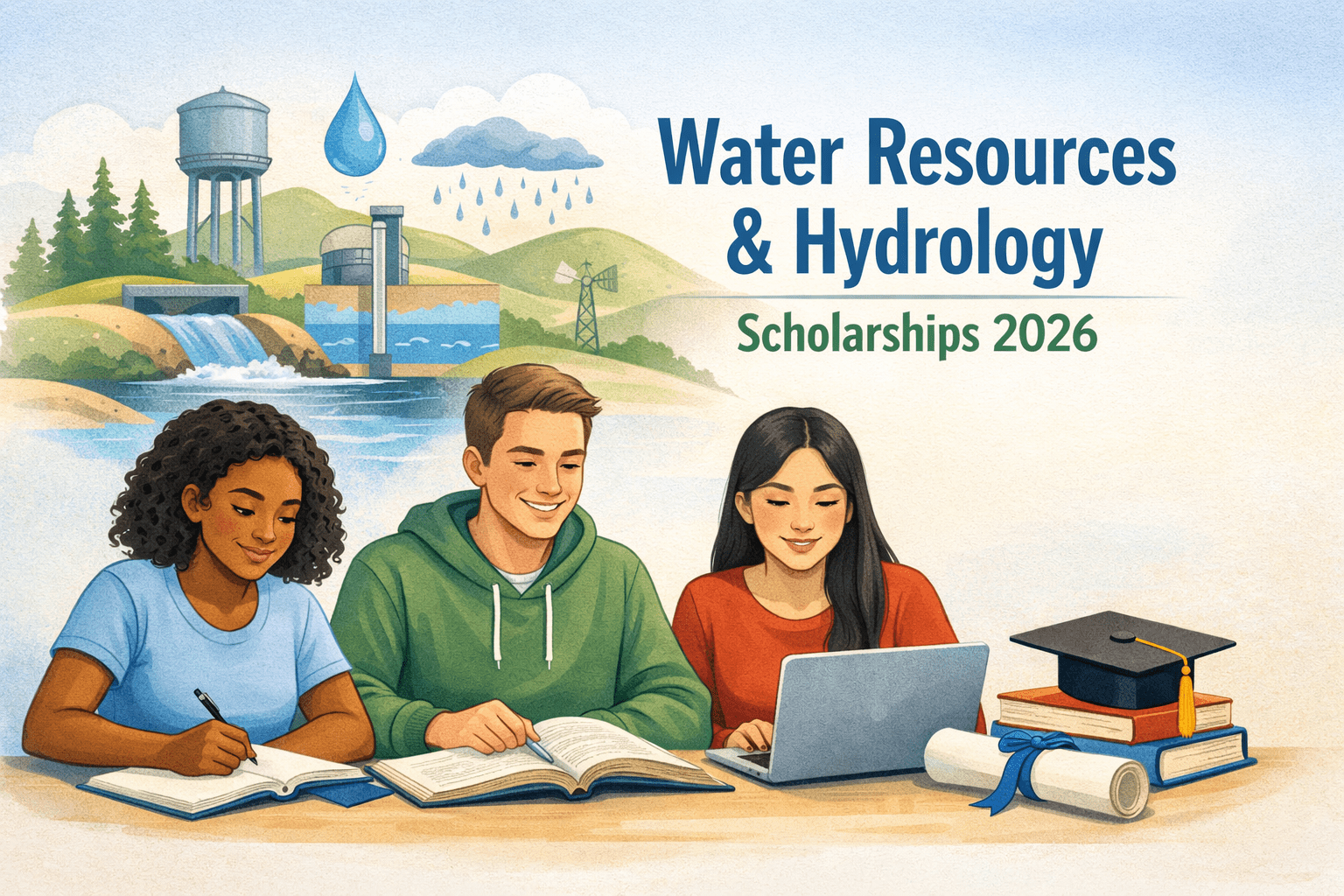
25+ Water Resources & Hydrology Scholarships (2026) — Verified Links
Hand-checked scholarships for Water Resources, Hydrology, Hydrogeology & Water/Wastewater engineering students.
January
ASCE — J. Waldo Smith Hydraulic Fellowship (Graduate)
💥 Why It Slaps: Classic ASCE fellowship specifically for experimental hydraulics; funds tuition/research/living for grad students focused on fluid flow/hydraulics.
💰 Amount: Varies by year (recent cycles around up to $4,000; with up to $1,000 additional equipment support).
⏰ Deadline: Jan 15 (annual).
🔗 Apply/info: https://www.asce.org/career-growth/awards-and-honors/fellowships/j-waldo-smith-hydraulic-fellowship
ASCE — Freeman Fellowship (Graduate)
💥 Why It Slaps: Flexible ASCE research fellowship; water/hydraulics/environment topics eligible.
💰 Amount: Varies (ASCE fellowships typically $2,500–$5,000).
⏰ Deadline: Jan 15 (annual).
🔗 Apply/info: https://www.asce.org/career-growth/awards-and-honors/fellowships/freeman-fellowship
ASCE — Arthur S. Tuttle Fellowship (Graduate)
💥 Why It Slaps: Supports the first year of graduate study in any CE discipline—great for students entering hydrology/water resources MS/PhD tracks.
💰 Amount: Varies (ASCE fellowships typically $2,500–$5,000).
⏰ Deadline: Jan 15 (annual).
🔗 Apply/info: https://www.asce.org/career-growth/awards-and-honors/fellowships/arthur-s-tuttle-fellowship
ASCE — Trent R. Dames & William W. Moore Fellowship (Graduate)
💥 Why It Slaps: Research-focused CE fellowship; hydraulics/hydrology projects are competitive fits.
💰 Amount: Varies (ASCE fellowships typically $2,500–$5,000).
⏰ Deadline: Jan 15 (annual).
🔗 Apply/info: https://www.asce.org/career-growth/awards-and-honors/fellowships/trent-r-dames-and-william-w-moore-fellowship
US Society on Dams (USSD) — Student Scholarships (UG/Grad)
💥 Why It Slaps: Focused on dams/levees—perfect for water resources, hydraulics, geotechnical students eyeing dam safety or river engineering.
💰 Amount: ~$4,000–$10,000 (varies by year).
⏰ Deadline: Late Jan–Feb (posted annually; expect late Jan).
🔗 Apply/info: https://www.ussdams.org/scholarships/
February
ASCE — John Lenard Civil Engineering Scholarship (UG)
💥 Why It Slaps: Dedicated to water supply or environmental engineering tracks—ideal for hydrology-focused CE students.
💰 Amount: Varies (recent awards often $2,000–$5,000).
⏰ Deadline: Feb 10 (annual).
🔗 Apply/info: https://www.asce.org/career-growth/awards-and-honors/scholarships/john-lenard-civil-engineering-scholarship
March
WEF — Canham Graduate Studies Scholarship (Graduate)
💥 Why It Slaps: $25,000 flagship award for grad students in the water environment field (water quality, wastewater, stormwater).
💰 Amount: $25,000 (education-related expenses).
⏰ Deadline: Mar 31 (annual).
🔗 Apply/info: https://wef.secure-platform.com/a/page/CGS
ASDSO — Senior Undergraduate Dam Safety Scholarship (UG seniors)
💥 Why It Slaps: For seniors pursuing hydraulics, hydrology, geotechnical, or dam engineering—directly aligned with water resources careers.
💰 Amount: Typically $5,000–$10,000 (up to $20,000 total funds in some years).
⏰ Deadline: Mar 31 (annual).
🔗 Apply/info: https://damsafety.org/apply-scholarship
SWCS — Soil & Water Conservation Society (National Scholarships)
💥 Why It Slaps: National conservation org; supports students in soil and water resource management (hydrology, watershed, nonpoint source).
💰 Amount: Varies by scholarship.
⏰ Deadline: March (varies by award).
🔗 Apply/info: https://www.swcs.org/resources/awards-and-scholarships
April
Society of Wetland Scientists (SWS) — Student Research Grants
💥 Why It Slaps: Small but targeted grants for wetland hydrology and water resources research (great CV booster + data collection funds).
💰 Amount: Up to $1,500 (typical).
⏰ Deadline: Apr 7 (2025; similar annually).
🔗 Apply/info: https://www.sws.org/student-research-grants/
May
AWRA — Richard A. Herbert Memorial Scholarship (UG/Grad)
💥 Why It Slaps: Core award from the American Water Resources Association—made for water resources/hydrology students.
💰 Amount: At least one $2,000 UG and one $2,000 Grad award (members-only).
⏰ Deadline: Early May (last cycle closed May 7, 2025).
🔗 Apply/info: https://www.awra.org/AWRA/Members/Scholarship_and_Awards/Herbert_Scholarship.aspx
EESF — Environmental Engineering & Science Foundation (Master’s)
💥 Why It Slaps: Master’s‑level awards in environmental engineering/science—perfect fit for students focused on water/wastewater or hydrologic water quality.
💰 Amount: $2,500 (multiple awards; includes URM‑designated awards).
⏰ Deadline: Late May (typical); application window opens early spring.
🔗 Apply/info: https://www.eesfoundation.org/scholarship/Masters.php
September
NGWA — Farvolden Scholarships (UG/Grad; Hydrogeology/Groundwater)
💥 Why It Slaps: Awards tied to presenting at NGWA’s Groundwater Week Science & Engineering Forum—great exposure and networking in hydrogeology.
💰 Amount: $1,000 (four awards).
⏰ Deadline: Mid‑September (last call for papers closed Sept 12, 2025).
🔗 Apply/info: https://groundwater.org/scholarships/
October
NSF — Graduate Research Fellowship Program (GRFP) (Grad, US citizens/permanent residents)
💥 Why It Slaps: The premier STEM fellowship—hydrology, hydroclimatology, and water resources modeling are eligible.
💰 Amount: $37,000 stipend/year + $12,000 COE allowance (3 years).
⏰ Deadline: Late Oct (field-specific deadlines; 2025 general deadline Oct 27, 2025).
🔗 Apply/info: https://www.nsf.gov/funding/opportunities/grfp-nsf-graduate-research-fellowship-program
December
The AWWA (American Water Works Association) academic scholarship portal typically runs September–December with a posted application deadline of Dec 20 for most awards. Below are directly water‑sector scholarships ideal for hydrology/water resources students. Apply to multiple where eligible.
AWWA — Abel Wolman Fellowship (Doctoral)
💥 Why It Slaps: A marquee PhD fellowship for water supply/water quality research; renewable for a second year.
💰 Amount: $30,000 initial year (up to 2 years).
⏰ Deadline: Dec 20 (annual).
🔗 Apply/info: https://www.awwa.org/water-equation/awwa-scholarship-program/
AWWA — Larson Aquatic Research Support (LARS) Scholarships (Grad)
💥 Why It Slaps: Bench/field research in drinking water; hydrochemistry/water treatment/watersheds welcome.
💰 Amount: $5,000 (MS) / $7,000 (PhD).
⏰ Deadline: Dec 20.
🔗 Apply/info: https://www.awwa.org/water-equation/awwa-scholarship-program/
AWWA — Jacobs Holly A. Cornell Scholarship (Grad)
💥 Why It Slaps: Encourages female and/or underrepresented students in water supply/water resources.
💰 Amount: $10,000.
⏰ Deadline: Dec 20.
🔗 Apply/info: https://www.awwa.org/water-equation/awwa-scholarship-program/
AWWA — Dr. Philip C. Singer Scholarship (Grad)
💥 Why It Slaps: Honors a water treatment legend—great fit for water quality/hydrochemistry research.
💰 Amount: $3,000.
⏰ Deadline: Dec 20.
🔗 Apply/info: https://www.awwa.org/water-equation/awwa-scholarship-program/
AWWA — Dr. James K. Edzwald Scholarship (Grad)
💥 Why It Slaps: Targets water treatment/clarification research—common crossover with watershed & drinking water hydrology.
💰 Amount: $3,000.
⏰ Deadline: Dec 20.
🔗 Apply/info: https://www.awwa.org/water-equation/awwa-scholarship-program/
AWWA — AECOM Academic Scholarship (UG/Grad)
💥 Why It Slaps: Industry‑backed award for students dedicated to water.
💰 Amount: $5,000.
⏰ Deadline: Dec 20.
🔗 Apply/info: https://www.awwa.org/water-equation/awwa-scholarship-program/
AWWA — American Water Scholarship (UG/Grad)
💥 Why It Slaps: Utility‑sponsored award for students pursuing careers in water/wastewater.
💰 Amount: $5,000.
⏰ Deadline: Dec 20.
🔗 Apply/info: https://www.awwa.org/water-equation/awwa-scholarship-program/
AWWA — Brown and Caldwell Dave Caldwell Scholarship (UG/Grad)
💥 Why It Slaps: Celebrates applied environmental/water work—helpful for students with internships or projects.
💰 Amount: $5,000.
⏰ Deadline: Dec 20.
🔗 Apply/info: https://www.awwa.org/water-equation/awwa-scholarship-program/
AWWA — Carollo Engineers Bryant L. Bench Scholarship (UG/Grad)
💥 Why It Slaps: Focused on innovative drinking water treatment—bench to pilot scale.
💰 Amount: $10,000.
⏰ Deadline: Dec 20.
🔗 Apply/info: https://www.awwa.org/water-equation/awwa-scholarship-program/
AWWA — CDM Smith Thomas R. Camp Scholarship (UG/Grad)
💥 Why It Slaps: Recognizes excellence in water/wastewater process development.
💰 Amount: $10,000.
⏰ Deadline: Dec 20.
🔗 Apply/info: https://www.awwa.org/water-equation/awwa-scholarship-program/
AWWA — GFT “Forces of Change” Scholarship (UG/Grad)
💥 Why It Slaps: Backs students tackling big water challenges—PFAS, climate resilience, equity.
💰 Amount: $5,000.
⏰ Deadline: Dec 20.
🔗 Apply/info: https://www.awwa.org/water-equation/awwa-scholarship-program/
AWWA — Hazen Scholarship (UG/Grad)
💥 Why It Slaps: Supports excellence in water/wastewater engineering—top‑tier industry sponsor.
💰 Amount: $10,000.
⏰ Deadline: Dec 20.
🔗 Apply/info: https://www.awwa.org/water-equation/awwa-scholarship-program/
AWWA — HDR One Water Institute Scholarship (UG/Grad)
💥 Why It Slaps: Emphasizes One Water / integrated water resources management—on point for hydrology + planning.
💰 Amount: $10,000.
⏰ Deadline: Dec 20.
🔗 Apply/info: https://www.awwa.org/water-equation/awwa-scholarship-program/
AWWA — Neptune Technology Group Scholarship (UG/Grad)
💥 Why It Slaps: Smart metering, distribution networks, and data‑driven water management—great for hydrology + data students.
💰 Amount: $5,000.
⏰ Deadline: Dec 20.
🔗 Apply/info: https://www.awwa.org/water-equation/awwa-scholarship-program/
AWWA — Raftelis Leadership Scholarships (UG/Grad)
💥 Why It Slaps: Two awards for emerging leaders in the water sector—utility finance, rate setting, planning + resources.
💰 Amount: $5,000 (each; two awards).
⏰ Deadline: Dec 20.
🔗 Apply/info: https://www.awwa.org/water-equation/awwa-scholarship-program/
AWWA — Roberts Filter Group “Charles ‘Chick’ Roberts” Scholarship (UG/Grad)
💥 Why It Slaps: Filtration‑focused; ideal for surface water treatment + water quality projects.
💰 Amount: $5,000.
⏰ Deadline: Dec 20.
🔗 Apply/info: https://www.awwa.org/water-equation/awwa-scholarship-program/
AWWA — Veolia Water Technologies & Solutions “Vernon D. Lucy III” Scholarship (UG/Grad)
💥 Why It Slaps: Industrial water & treatment processes—good fit for applied hydrology & water chemistry.
💰 Amount: $5,000.
⏰ Deadline: Dec 20.
🔗 Apply/info: https://www.awwa.org/water-equation/awwa-scholarship-program/
AWWA — Woodard & Curran Scholarship (UG/Grad)
💥 Why It Slaps: Consulting‑oriented award for students committed to water/wastewater careers.
💰 Amount: $5,000.
⏰ Deadline: Dec 20.
🔗 Apply/info: https://www.awwa.org/water-equation/awwa-scholarship-program/
Additional Relevant Opportunities (Rolling / Special Focus)
AGI — Harriet Evelyn Wallace Scholarship (Women in Geoscience, UG→Grad/Grad)
💥 Why It Slaps: $5,000 for female‑identifying geoscience students; hydrogeology eligible.
💰 Amount: $5,000.
⏰ Deadline: Winter (Dec–Feb); posted annually.
🔗 Apply/info: https://crm.americangeosciences.org/civicrm/contribute/transact?reset=1&id=2
American Water — Inclusion & Diversity Scholarship (UG)
💥 Why It Slaps: $10,000 scholarships for underrepresented students pursuing water‑adjacent STEM, policy, or environmental studies.
💰 Amount: $10,000.
⏰ Deadline: Spring (posted annually).
🔗 Apply/info: https://scholarshipamerica.org/scholarship/american-water/
AWWA Sections — One AWWA Operator Scholarships (CC/Operator Pathways)
💥 Why It Slaps: Entry‑to‑mid‑career support for operator certs/AA degrees in water/wastewater (amounts/eligibility vary by Section).
💰 Amount: ~$500–$2,000 (varies by AWWA Section).
⏰ Deadline: Varies by state/Section (most accept fall apps).
🔗 Apply/info: https://www.awwa.org/local-sections/awwa-section-scholarships/
Investing in the Water Future: Scholarships & Fellowships in Water Resources and Hydrology (U.S.-Focused, Globally Relevant)
Water resources and hydrology sit at the center of climate adaptation, infrastructure renewal, agricultural resilience, flood and drought risk management, ecosystem protection, and public health. Yet the talent pipeline that produces hydrologists, hydrogeologists, water-quality specialists, and water-resources engineers faces financial barriers that are unusually high for the field: extended field campaigns, specialized instrumentation, computing needs, and the expectation of conference participation to build professional networks. This paper synthesizes labor-market evidence, infrastructure investment signals, and the current scholarship/fellowship ecosystem to explain where funding exists, what it targets, and where gaps persist. Using publicly available data from U.S. federal agencies and leading professional organizations, we show that scholarship support in water is best understood as a stack: small local awards and travel grants feed into mid-sized professional society scholarships, which in turn connect students to large national fellowships and paid federal internships. We conclude with design recommendations for scholarship providers and a practical “funding strategy” framework for students to maximize probability of support while aligning with workforce needs and equity goals.
1) Why Hydrology Scholarships Matter Now: Demand Signals from Jobs, Retirements, and Infrastructure
1.1 Labor-market reality: stable headcount, steady openings, strong wages
Hydrology is not always a “high-growth” occupation by headcount, but it is a steady-replacement profession: jobs open because experienced workers retire and because new regulatory, modeling, and infrastructure needs shift skill requirements. The U.S. Bureau of Labor Statistics (BLS) reports a median annual wage of $92,060 (May 2024) for hydrologists, with ~500 openings per year projected on average over 2024–2034 despite “little or no change” in total employment.
Importantly, hydrology is embedded in a broader water workforce: hydrologic technicians and allied technical roles create alternative pathways that often begin at community colleges or applied programs. BLS reports geological and hydrologic technicians at $50,510 median pay (2024) with ~12,900 jobs and modest projected growth. This matters because scholarship design frequently overlooks technicians and operator-adjacent talent—yet utilities increasingly need both advanced modelers and hands-on field staff.
1.2 The retirement wave and “skills shift” increase scholarship ROI
Multiple workforce sources emphasize that utilities and water agencies face a retirement-driven transition. EPA notes that roughly one-third of the water sector workforce may be eligible to retire within 10 years, alongside increasing need for specialized technical skills as technology advances (including water reuse). Water-sector organizations echo this challenge, positioning workforce renewal as a strategic priority.
1.3 Infrastructure funding amplifies the urgency for trained water professionals
The U.S. is simultaneously attempting large-scale infrastructure modernization. EPA describes the Infrastructure Investment and Jobs Act (IIJA) as more than $50 billion over five years for drinking water, wastewater, reuse, conveyance, and storage—framed as the largest such investment in U.S. history. Recent funding actions (e.g., lead service line reduction investments) further signal ongoing labor demand in drinking-water engineering, hydrology, and water quality.
Implication: In workforce economics terms, scholarships in hydrology often function as high-leverage “human capital infrastructure”—relatively small investments that unlock careers essential to deploying much larger physical infrastructure dollars.
2) Method and Data Sources
This review uses a program-landscape synthesis approach:
-
Labor-market indicators: BLS Occupational Outlook Handbook and related profiles for hydrologists and technicians.
-
Federal pipeline programs: NSF Graduate Research Fellowship Program (GRFP), NOAA undergraduate scholarships, USGS student/recent graduate pathways.
-
Professional society and sector scholarships: Water Environment Federation (WEF), American Water Works Association (AWWA), American Geophysical Union (AGU), WateReuse sections, AWRA examples.
-
Policy/investment context: EPA IIJA water infrastructure resource pages and workforce pages; sector workforce reports.
Rather than attempting an exhaustive list of every local scholarship, we identify repeatable patterns in award size, eligibility logic, and application criteria—useful for both scholarship seekers and program designers.
3) The Funding Ecosystem: A “Stack” Model for Water Scholarships
Hydrology funding is best understood as four tiers, each with a different purpose and selection logic.
Tier A — Local/Section Scholarships (Signal + Access)
Local professional sections (AWWA, ASCE/EWRI, WateReuse state chapters, regional associations) commonly offer $500–$5,000 awards. AWWA notes that its local sections distribute 40+ scholarships ranging $100 to $5,000, providing broad access and early credentialing. Examples include section-level EWRI awards up to ~$2,000 for students entering water/environment fields.
What these awards do well
-
Lower barrier to entry; fewer applicants than national programs.
-
Strong alignment with local workforce needs (utilities, consulting, regulators).
-
Often serve as “first external validation” on a résumé.
Common hidden filter: local engagement (student chapters, volunteer roles, attendance at section meetings).
Tier B — Professional Society Scholarships (Professional Identity + Specialization)
These awards typically range from mid-four figures to $25,000, and they reward commitment to a specific subfield (wastewater, drinking water, groundwater, reuse, hydrologic science).
Representative examples:
-
WEF Canham Graduate Studies Scholarship: $25,000 for post-baccalaureate students in the water environment field, explicitly supporting education-related expenses; includes an expectation of working in the field post-degree.
-
AWWA Larson (LARS) Scholarships: $5,000 (master’s) and $7,000 (doctoral) for graduate students in relevant science/engineering.
-
AGU Horton Research Grant: up to $10,000 (plus limited travel support) for PhD students in hydrology/water resources, funding research and professional development.
-
WateReuse state/section scholarships: vary widely (e.g., $3,000 awards in Arizona; $5,000 scholarships in Colorado), often targeting reuse/desalination.
Selection logic tends to prioritize
-
Clear thesis/problem statement tied to real water challenges.
-
Evidence of “field readiness” (internships, lab/field methods, GIS/modeling skills).
-
Professional membership and recommendations from practitioners.
Tier C — National Competitive Fellowships (Scale + Autonomy)
These are the “transformational” awards—often worth tens to hundreds of thousands—that give students autonomy and status.
-
NSF GRFP: Provides $37,000 stipend + $16,000 cost-of-education allowance per funded year, for three years of support over a five-year award window.
Competitive dynamics matter: reporting indicates 12,000+ applicants annually and about 1,500 awards in 2025. -
Sea Grant Knauss Marine Policy Fellowship (water policy-adjacent): Many hydrology and water resources students use policy fellowships to work on coastal, Great Lakes, resilience, and water allocation issues. For Class of 2026, examples cite $73,100 stipend plus additional allowable expenses (often $5,000 and other travel/host support depending on program).
Why these fellowships shape the field
They reduce opportunity costs (students can focus on research), increase mobility (ability to choose advisors/labs), and provide reputational signals that accelerate placement into agencies, national labs, consulting leadership tracks, and academia.
Tier D — Paid Federal Internships and Pathways (Experience + Hiring Pipeline)
In water and hydrology, paid internships can be as valuable as scholarships because they function as direct hiring pipelines into federal service.
-
USGS Pathways / Students and Recent Graduates: USGS highlights paid internships and pathways programs for students and recent graduates.
-
NOAA undergraduate scholarship pathways also combine academic support with internships in NOAA mission areas (often relevant to hydrometeorology, coastal flooding, and climate impacts on water).
A critical “freshness” note: NOAA’s EPP/MSI undergraduate scholarship pathway has had changing availability; NOAA indicated it will not offer undergraduate scholarships for a class of 2026 (per its posted announcement).
This illustrates a core reality for water scholarship advising: students must track program continuity, not just program names.
4) Representative Awards and What They Signal
Below is a compact “map” of high-signal programs and their typical award magnitudes (examples, not exhaustive):
| Program (Sponsor) | Level | Typical Support | What It Buys (Strategically) |
|---|---|---|---|
| NSF GRFP (NSF) | Grad (MS/PhD) | $37k stipend + $16k COE/year (3 years) | Research autonomy + elite signal |
| WEF Canham Scholarship (WEF) | Grad | $25,000 | Water-quality identity + sector network |
| AGU Horton Research Grant (AGU) | PhD | up to $10,000 + travel limits | Research acceleration + publication momentum |
| AWWA Larson Scholarships (AWWA) | Grad | $5,000 (MS), $7,000 (PhD) | Drinking-water prestige + applied focus |
| NOAA Hollings Scholarship (NOAA) | Undergrad | up to $9,500/year (2 years) + paid internship | Federal pathway + mission-aligned experience |
| WateReuse state sections | UG/Grad | $1,000–$5,000+ | Reuse/desalination specialization |
| AWWA local sections | UG/Grad | $100–$5,000 | Local utility connections + early wins |
| USGS Pathways | UG/Grad | Paid internship (varies) | Direct experience + hiring pipeline |
5) Equity, Geography, and the “Cost Structure” of Hydrology Training
5.1 Field costs are not evenly distributed
Hydrology training often requires:
-
Field travel and vehicle costs
-
Sensors, sampling supplies, lab fees
-
High-performance computing or specialized software
-
Conference attendance (especially for research-based degrees)
Programs like AGU’s Horton grant explicitly allow research and travel costs, acknowledging that scientific progress depends on these expenditures. Scholarships that ignore field-cost reality can unintentionally favor students with private resources.
5.2 Equity is becoming a stated workforce strategy
Sector reports increasingly frame workforce development as both capacity-building and equity-building. EPA’s workforce framing emphasizes recruiting, training, and retaining workers as technology evolves, and broader water workforce reports argue for targeted strategies that expand access for underrepresented groups.
Design implication: The most equity-effective water scholarships do not only pay tuition. They fund (1) transportation, (2) certifications, (3) paid placements, and (4) mentoring—reducing the “participation tax” of entering the profession.
6) What Makes a Winning Water Scholarship Application: Evidence-Based Signals
Across the ecosystem, winning applications tend to demonstrate four kinds of fit:
-
Problem fit (why this water problem, why now)
Tie your work to a clear stressor: flood frequency shifts, drought planning, groundwater contamination, source-water protection, or reuse reliability. -
Method fit (can you execute?)
Show a credible toolkit: GIS/remote sensing, hydrologic/hydraulic modeling, stats, coding, sampling design, QA/QC. -
Sector fit (who benefits?)
Utilities, watershed districts, tribes, agriculture, coastal communities, regulators—name a real user of your work. -
Trajectory fit (how this becomes a career)
Many awards (e.g., sector-focused scholarships) want evidence you’ll stay in the field; WEF’s Canham scholarship explicitly includes a post-degree field commitment expectation.
7) Gaps and Opportunities: Where Scholarship Supply Still Lags Demand
Gap A: Technician/operator pathways are underfunded relative to need
BLS data show substantial employment in technician roles, yet many scholarships focus narrowly on traditional 4-year or graduate tracks.
Gap B: Rural and small-system workforce development needs more targeted awards
Workforce challenges are often most acute in smaller utilities and rural contexts (where recruitment is harder and training budgets are thinner). Water workforce reports highlight structural barriers and the need for tailored pipelines.
Gap C: Scholarship information volatility is a real barrier
NOAA’s program availability shifts are a concrete example. Students need curated, continuously verified scholarship hubs (exactly the kind of value your page can provide) because program names persist online even when cohorts pause.
8) Recommendations
8.1 For students (a “stacking strategy”)
-
Stack by tier: apply to 2–3 local/section awards + 1–2 society awards + 1 national fellowship + 2–3 paid internships.
-
Use local awards as proof: winning a $1,000–$2,000 section scholarship can strengthen NSF/WEF/AWWA applications by validating your trajectory.
-
Lead with outcomes: emphasize measurable deliverables (dataset, model improvements, sampling plan, decision tool).
-
Treat references as a project: most high-signal awards are recommendation-sensitive; build relationships early.
8.2 For scholarship providers (design features with the highest workforce payoff)
-
Bundle scholarships with paid placements (utility, agency, watershed org). NOAA-style scholarship + internship models are powerful because they convert funding into experience.
-
Pay the “fieldwork costs,” not just tuition: micro-grants for travel, sensors, and certifications reduce inequity and increase completion.
-
Target retirement pinch points: awards aimed at treatment operations, asset management, source-water protection, and reuse are aligned with near-term workforce needs.
-
Measure outcomes: track internship-to-hire conversion, degree completion, and retention in the sector.
8.3 For universities and departments
-
Create “scholarship-to-GRFP” coaching lanes (proposal bootcamps, peer review).
-
Partner with utilities for capstones so scholarship essays can truthfully claim real-world stakeholder engagement.
-
Build bridges with local sections (AWWA/WEF/EWRI/WateReuse) to turn student chapter activity into scholarship wins.
Conclusion
Water resources and hydrology scholarships are not simply financial aid; they are strategic instruments for building the workforce needed to implement historic infrastructure investments and manage intensifying climate-driven water risks. The funding ecosystem is strongest when it operates as a pipeline: local scholarships provide early validation, professional society awards deepen specialization and networks, national fellowships scale research autonomy, and paid federal pathways convert education into employment. Labor and workforce indicators—steady openings, strong wages, and looming retirements—suggest that scholarship dollars in this field have unusually high societal return.
FAQs (Water Resources / Hydrology Scholarships)
Q1: I’m in Civil/EnvE with a water focus—should I apply to general CE fellowships?
Yes. ASCE fellowships (Freeman, Tuttle, Dames & Moore) fund water/hydraulics topics—don’t skip them.
Q2: Can hydrology students win AWWA awards, or are they only for treatment?
Yes—AWWA’s portfolio spans drinking water, source water, watershed, treatment, distribution, and One Water planning.
Q3: How do I stand out?
Tie your project to real water problems (PFAS, climate resilience, drought/flood risk, equity). Show internships, fieldwork, modeling, or lab experience.
Q4: I’m more groundwater than surface water—what fits best?
Focus on NGWA Farvolden, AWRA Herbert, AWWA LARS (if hydrochemistry/water quality), and ASCE hydraulics/hydrology fellowships.
Q5: Are operator scholarships relevant if I’m doing hydrology research?
Mostly for certification/career pathways. If you’re research‑track, prioritize AWWA academic, ASCE, WEF, AWRA, USSD/ASDSO awards.
Q6: Can international students apply?
Policies vary. Many AWWA/ASCE/WEF awards accept international students studying at U.S. institutions; verify each page.
Q7: Hydrology vs. Hydrogeology vs. Water Resources—do different awards prefer one?
Hydrology (surface water, rainfall–runoff, hydraulics) maps well to ASCE, AWWA, WEF, USSD/ASDSO. Hydrogeology (groundwater) aligns strongly with NGWA and AWRA. Water Resources (planning/modeling/policy) fits AWRA, AWWA One Water/HDR, and consulting‑sponsored awards.
Q8: Do I have to be a member (AWWA/ASCE/AWRA/WEF)?
Some awards require active student membership; many do not. Student dues are low and often include conference discounts—membership can also strengthen your “commitment to the field” story.
Q9: Who should write my recommendation letters?
Prioritize a research advisor/PI (methods & rigor), an industry or utility supervisor (impact & professionalism), and a course instructor (technical mastery). Brief them with your CV + 3 bullet points tied to the sponsor’s mission.
Q10: What GPA is competitive?
Hard cutoffs are rare (3.0 is a common floor when stated). A strong record of water‑specific experience (fieldwork, modeling, WEF/AWWA/EWRI involvement) can offset a modest GPA.
Q11: I haven’t officially declared my water concentration yet—can I still apply?
Yes. Show coursework (hydraulics, hydrology, fluids, water chemistry), projects (HSPF/SWMM/HEC‑HMS/HEC‑RAS), and a clear plan to concentrate in water resources.
Q12: How do I prove “impact” in essays?
Quantify with water metrics: cfs, mgd, AF of storage, % I/I reduction, NTU removal, µg/L PFAS, Cs of runoff, avoided flood damages, or people served.
Q13: What goes into a strong technical portfolio?
1–3 pages of figures/maps/hydrographs with short captions; include model screenshots, QA/QC tables, and a brief “role & result” note. Keep code links off the application unless requested; summarize methods instead.
Q14: Can I reuse NSF GRFP essays for field‑specific awards?
Yes—but tailor aggressively. Keep Intellectual Merit/Broader Impacts framing, then map impacts to sponsor priorities (e.g., drinking water equity for AWWA, dam safety for ASDSO, groundwater sustainability for NGWA).
Q15: I’m an international student. Which awards am I eligible for?
Many society/industry scholarships accept international students enrolled at U.S. institutions; a few (e.g., NSF GRFP) are limited to U.S. citizens/PR. Always check each page carefully.
Q16: Can I stack scholarships with RA/TA funding?
Often yes—most awards allow stacking with assistantships; a few fellowships may adjust amounts. If in doubt, ask your graduate coordinator about any institutional conflict rules.
Q17: Are there travel grants for conferences (WEFTEC, EWRI Congress, Groundwater Week)?
Yes—look for student travel grants or poster awards. Even small travel stipends are valuable lines on your CV and help you network into internships.
Q18: How should I track shifting deadlines?
Build a 12‑month calendar with recurring reminders 60/30/7 days out. Keep a one‑page “core packet” (statement, CV, transcripts) ready and tune per sponsor.
Q19: I’m transferring from a community college—what fits me?
Check One AWWA Operator and utility‑sponsored awards if you’re pursuing operator certificates or an AA→BS path; highlight hands‑on lab/plant experiences.
Q20: I’m a working professional doing a part‑time MS—am I competitive?
Yes. Emphasize real‑world impact (projects, asset management, CMOM, resilience plans) and how scholarship funds accelerate your credentialing or thesis.
Q21: Tips for first‑gen/URM applicants?
Connect your experiences to water equity, community resilience, and mentorship. If an award lists DEI priorities, show concrete actions and leadership, not just intent.
Q22: How do I align my topic with a sponsor?
Mirror their mission: AWWA → drinking water/source water; WEF → wastewater/stormwater; ASDSO/USSD → dams/levees; NGWA → groundwater; AWRA → integrated water resources & policy.
Q23: Do field safety credentials help?
Yes. Note OSHA‑10/30, HAZWOPER, Confined Space, boating safety, swiftwater awareness—plus any FEMA ICS training. It signals field readiness.
Q24: Common mistakes that sink otherwise strong apps?
Generic essays, no water metrics, ignoring the sponsor’s mission, missing the transcript upload, and using recommender letters that read like course participation notes.
Q25: Do I need sealed transcripts and wet signatures?
Most programs accept unofficial PDFs and electronic signatures unless explicitly stated; read instructions carefully.
Q26: How early should I line up recommenders?
Four weeks minimum. Share your draft statement and bullets; schedule a reminder 1 week before the deadline.
Q27: Which majors are welcome for dam‑safety‑oriented awards?
Civil (hydraulics/structures), geotechnical, geological engineering, hydrology/hydrogeology, and sometimes environmental engineering—highlight relevant coursework.
Q28: The portal isn’t open yet—what can I do now?
Draft essays, refresh your CV, collect unofficial transcripts, and pre‑request letters. Have a polished packet ready to upload on day one.
Q29: Are utility‑sponsored scholarships limited by geography?
Often yes—they may require residence, study, or work intent in a service territory. Verify location rules early.
Q30: Can first‑ and second‑year undergrads compete?
Some awards prefer juniors/seniors; others are open to all levels. If you’re early, emphasize internships, labs, and student‑chapter leadership.