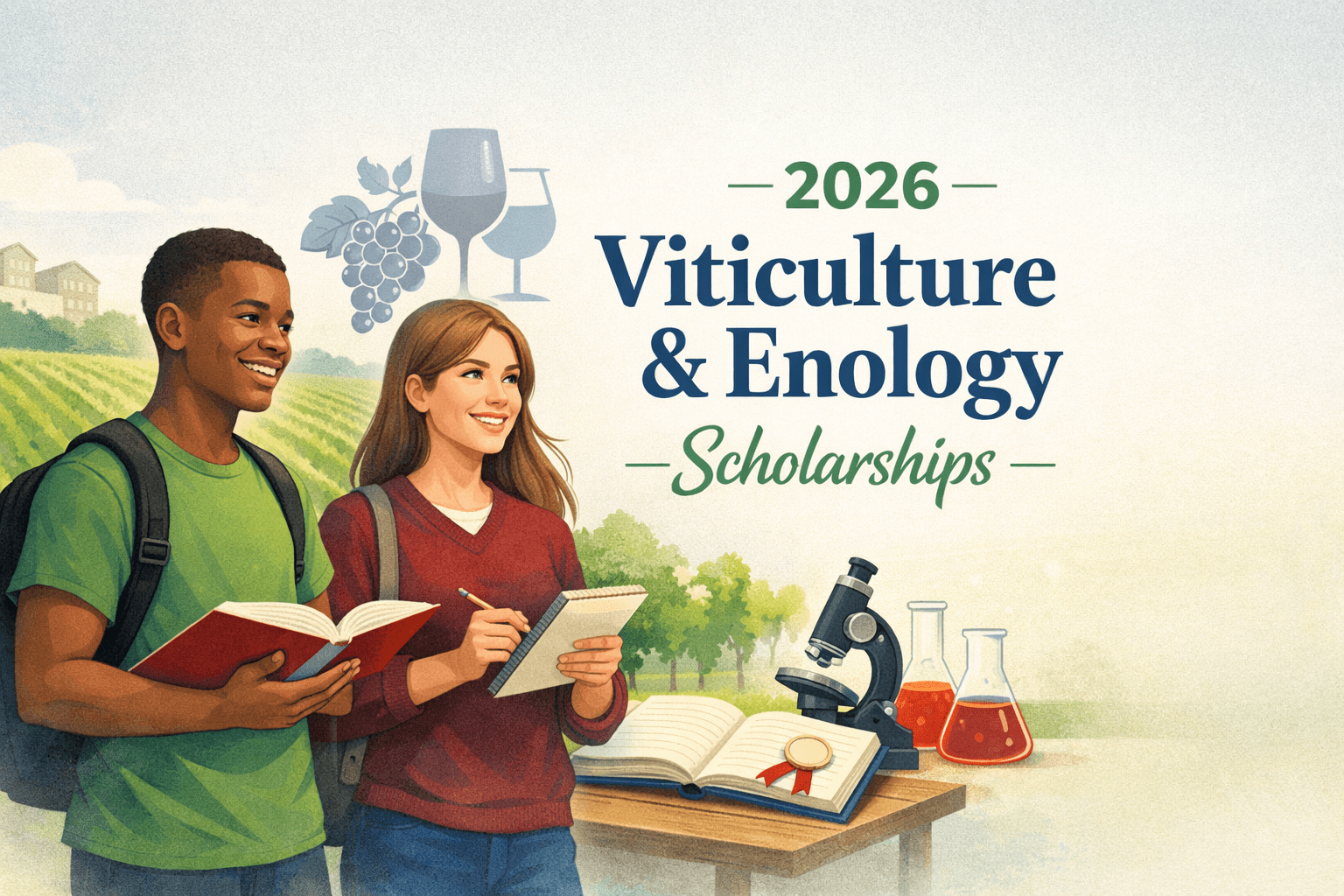
2026 Viticulture & Enology Scholarships (California • Oregon • Washington) — 25 Verified Awards
Updated monthly. The best legit scholarships for viticulture & enology students in CA/OR/WA — ASEV, AWSEF, WWIF, CAWG, OOWB, Lodi/Temecula/Paso/Monterey foundations, plus college-specific funds.
Viticulture & Enology Scholarships (CA • OR • WA)
March Deadlines
Order of the Oregon Wine Brotherhood (OOWB) Scholarship
💥 Why It Slaps: Oregon wine industry-backed aid for wine studies at OR schools.
💰 Amount: Varies (multiple awards).
⏰ Deadline: March 1 (applications open Jan 15).
🔗 Apply/info: https://www.oregonwinebrotherhood.org/scholarship-program
El Futuro Educational Scholarship (Napa Valley CCF + Farmworker Foundation)
💥 Why It Slaps: Multi-year support for Napa County students pursuing A.S. in viticulture/enology at NVC or SRJC.
💰 Amount: $5,000/year, up to 3 years.
⏰ Deadline: March 3 (2025 cycle; watch for 2026 update).
🔗 Apply/info: https://www.napavalleycf.org/im-a-student/el-futuro-educational-scholarship/
American Wine Society Educational Foundation (AWSEF) Graduate Scholarships
💥 Why It Slaps: National awards for M.S./Ph.D. work squarely in enology or viticulture.
💰 Amount: $3,500 each (current value).
⏰ Deadline: March 31 (annual).
🔗 Apply/info: https://www.awsef.org/scholarships
Vineyard Team — Juan Nevarez Memorial Scholarship (CA)
💥 Why It Slaps: Multi-year funding + a dedicated mentor for children of vineyard/winery workers.
💰 Amount: $1,000–$6,000 per year (multi-year).
⏰ Deadline: Feb 3–Mar 31 (typical window; 2025 closed, 2026 opens Feb).
🔗 Apply/info: https://www.vineyardteam.org/scholarship/
ASEV Traditional Scholarship (American Society for Enology & Viticulture)
💥 Why It Slaps: Flagship merit awards for students in V&E or closely related sciences.
💰 Amount: Varies (multiple awards).
⏰ Deadline: Typically late winter/early spring; watch the application page each cycle.
🔗 Apply/info: https://www.asev.org/awards-lectures/scholarship-programs/
ASEV Presidents’ Award for Scholarship in Enology & Viticulture
💥 Why It Slaps: ASEV’s top two awards each cycle for standout V&E scholars.
💰 Amount: Varies (two top awards annually).
⏰ Deadline: Typically late winter/early spring; confirm on ASEV site.
🔗 Apply/info: https://www.asev.org/awards-lectures/scholarship-programs/
Lodi Grape Festival — Funds for the Future (Book Scholarships)
💥 Why It Slaps: Practical textbook money for students from the Lodi region (wine country hub).
💰 Amount: Varies (book grants; re-apply up to two times).
⏰ Deadline: March 1 (annual).
🔗 Apply/info: https://www.grapefestival.com/p/about/funds-for-the-future-scholarship
April Deadlines
Lodi District Grape Growers Association — Jim Kissler Memorial Scholarship
💥 Why It Slaps: Crush District 11 award prioritizing viticulture/enology/ag majors.
💰 Amount: Varies.
⏰ Deadline: April 1 (annual).
🔗 Apply/info: https://ldgga.org/education-scholarships/
Temecula Valley Winegrowers Association — Scholarships
💥 Why It Slaps: SoCal wine region funding (HS seniors & college) with ag/viticulture tracks.
💰 Amount: Varies.
⏰ Deadline: April 30 (applications open March 1 each year).
🔗 Apply/info: https://www.temeculawines.org/scholarship/
Spring (Dates Post When Live — WA)
Washington Wine Industry Foundation — Foundation Fund Scholarship
💥 Why It Slaps: $2k–$10k awards for WA students in viticulture/enology/wine biz (CWU/WSU focus).
💰 Amount: $2,000–$10,000.
⏰ Deadline: Spring (2025 closed; 2026 window posts on page).
🔗 Apply/info: https://washingtonwinefoundation.org/scholarships/
WWIF — Walter J. Clore Scholarship
💥 Why It Slaps: Honors Dr. Clore; supports any wine/viticulture-related study area.
💰 Amount: From $1,000 (varies).
⏰ Deadline: Spring (see WWIF page).
🔗 Apply/info: https://washingtonwinefoundation.org/scholarships/
WWIF — Horse Heaven Hills Wine Growers Scholarship
💥 Why It Slaps: Two $3k awards; preference to Klickitat/Benton/Yakima residents with wine-industry ties.
💰 Amount: $3,000 (two awards).
⏰ Deadline: Spring (see WWIF page).
🔗 Apply/info: https://washingtonwinefoundation.org/scholarships/
WWIF — George & Susan Carter Scholarship
💥 Why It Slaps: $1k auto-renewing up to 4 years for V&E students with financial need.
💰 Amount: $1,000/year (renewable up to 4 years).
⏰ Deadline: Spring (see WWIF page).
🔗 Apply/info: https://washingtonwinefoundation.org/scholarships/
WWIF — Albert Don Memorial Scholarship
💥 Why It Slaps: $3k for students pursuing viticulture or wine business management.
💰 Amount: $3,000.
⏰ Deadline: Spring (see WWIF page).
🔗 Apply/info: https://washingtonwinefoundation.org/scholarships/
WWIF — Alliance of Women in Washington Wine Scholarship
💥 Why It Slaps: $5k for a female student in any viticulture/enology-related program.
💰 Amount: $5,000.
⏰ Deadline: Spring (see WWIF page).
🔗 Apply/info: https://washingtonwinefoundation.org/scholarships/
Summer/Fall (or Program-Specific Windows)
Yakima Valley College — Vineyard & Winery Technology Scholarship (WA)
💥 Why It Slaps: Entry boost for new/returning students in YVC’s wine/vineyard programs.
💰 Amount: Up to $1,750 (full-time; prorated for part-time).
⏰ Deadline: August 12 (for Fall 2025; check page for 2026).
🔗 Apply/info: https://yvcc.edu/academics/agriculture/ag-scholarships.php
Paso Robles Wine Country Alliance Foundation — Scholarships (CA)
💥 Why It Slaps: Paso wine community funding for local students; recurring annual awards.
💰 Amount: Typically $1,500 each (plus periodic expanded awards via auction).
⏰ Deadline: Varies annually (summer/fall cycle).
🔗 Apply/info: https://pasowine.com/gifting/
Monterey County Vintners & Growers Foundation — Peter Figge Memorial Scholarship (CA)
💥 Why It Slaps: Supports “Monterey Wine Family” students heading to college; vine-to-glass inclusive.
💰 Amount: Varies.
⏰ Deadline: Varies (announced each cycle).
🔗 Apply/info: https://www.montereywinesfoundation.org/scholarships
California-Specific (Cycle/Dept-Managed Dates)
CAWG Foundation — General Scholarships (Children of Vineyard Workers)
💥 Why It Slaps: Long-running program for CA high-school seniors with vineyard-worker parents/guardians.
💰 Amount: Varies (multiple awards).
⏰ Deadline: Posted each cycle (typically spring).
🔗 Apply/info: https://cawgfoundation.org/apply-now/
CAWG Foundation — Robert Miller Memorial Scholarship (Cal Poly SLO / Allan Hancock)
💥 Why It Slaps: Dedicated V&E scholarship tied to two key Central Coast programs.
💰 Amount: Varies.
⏰ Deadline: Posted each cycle (spring).
🔗 Apply/info: https://cawgfoundation.org/robert-miller-memorial-scholarship/
Mendocino WineGrowers Foundation — Scholarships (CA)
💥 Why It Slaps: County winegrowers funding local students (industry-supported).
💰 Amount: Varies (multiple awards).
⏰ Deadline: Annual (spring; check page for next opening).
🔗 Apply/info: https://communityfound.org/fund/mendocino-agricultural-families-scholarship-fund/
UC Davis — Viticulture & Enology Department Scholarships (CA)
💥 Why It Slaps: Dozens of named funds for V&E majors; awards announced via departmental call.
💰 Amount: Varies by fund.
⏰ Deadline: Departmental cycle (spring).
🔗 Apply/info: https://wineserver.ucdavis.edu/academic-programs/undergraduate-program/scholarships-and-aid
Cal Poly SLO — Wine & Viticulture Scholarships (CA)
💥 Why It Slaps: Multiple endowed funds for Wine & Viticulture majors (V&E & wine biz tracks).
💰 Amount: Varies by fund.
⏰ Deadline: University scholarship cycle (posted annually).
🔗 Apply/info: https://plannedgiving.calpoly.edu/scholarships/cafes
Napa Valley Community Foundation — Robert Alexander Scott Scholarship (CA)
💥 Why It Slaps: Upskill pathway for current vineyard/winery workers (and their families) to advance in V&E.
💰 Amount: Varies; renewable while completing degree/certificate.
⏰ Deadline: Posted per cycle.
🔗 Apply/info: https://www.napavalleycf.org/im-a-student/robert-alexander-scott-scholarship/
Napa Valley College — Scholarships Portal + VWT Program
💥 Why It Slaps: On-campus scholarship ecosystem feeding directly into the Viticulture & Winery Technology program.
💰 Amount: Varies by named fund.
⏰ Deadline: Spring rounds (e.g., Spring 2026 opens late Nov 2025).
🔗 Apply/info: https://www.napavalley.edu/admissions-and-aid/financial-aid/scholarships.html
Wines & Steins — Enology/Viticulture Scholarship (SLO County, CA)
💥 Why It Slaps: Community wine club giving a direct V&E scholarship to a local HS senior.
💰 Amount: $1,500 (example 2024–25; amount may update).
⏰ Deadline: Annual; posted on program page.
🔗 Apply/info: https://winesandsteins.org/page-1856309
Oregon & Washington — School-Directed Awards (Dates Vary)
Chemeketa Community College — Wine Studies Scholarships (incl. Erath Matching)
💥 Why It Slaps: Multiple named funds (incl. Erath) aimed at OR wine-study students; one app to many awards.
💰 Amount: Varies by fund.
⏰ Deadline: Foundation scholarship window (posted each cycle).
🔗 Apply/info: https://www.chemeketa.edu/programs-classes/program-finder/wine-studies/
Linfield University — Evenstad Center for Wine Education Scholarships (OR)
💥 Why It Slaps: Wine-studies scholarships embedded in Linfield’s wine program.
💰 Amount: Varies.
⏰ Deadline: University scholarship cycles.
🔗 Apply/info: https://linfield.edu/wine/
Walla Walla Community College Foundation — Enology & Viticulture Scholarships (WA)
💥 Why It Slaps: Many named funds for WWCC’s V&E program (one foundation portal).
💰 Amount: Varies.
⏰ Deadline: Posted on WWCC Foundation page each cycle.
🔗 Apply/info: https://www.wwcc.edu/paying-for-college/scholarships/
Bonus: Industry-Sponsored CA Campus Funds (Rollups)
Orange County Wine Society (OCWS) — Campus Scholarships (incl. Cal Poly & Allan Hancock)
💥 Why It Slaps: Ongoing donor program that channels funds directly to CA V&E campuses.
💰 Amount: Varies by campus/year.
⏰ Deadline: Managed by each campus; see OCWS pages/campus links.
🔗 Apply/info: https://ocws.org/ocws-scholarship-program-2/
Apply-Later Watchlist (Worth Tracking — Pages Active)
Paso Robles / Temecula / Monterey updates
💥 Why It Slaps: Regional wine organizations fund scholarships tied to local wine economies; pages above post new dates each year.
💰 Amount: Varies.
⏰ Deadline: Watch pages for 2026 cycles (linked above). Paso Robles Wine Country Alliance
Viticulture & Enology Scholarships as Workforce Infrastructure: Access, Human Capital, and Industry Resilience
Viticulture and enology (V&E) education sits at the intersection of agriculture, food science, climate adaptation, and luxury/consumer goods. In the United States, the wine sector’s economic footprint is large—projected at $323.55B in total economic activity in 2025, supporting 1.75M jobs and $102.14B in wages—yet it faces demand volatility, margin bifurcation, and accelerating climate risk. Scholarships and allied funding (paid internships, endowed funds, and association awards) function as “workforce infrastructure,” shaping who enters the pipeline, which skills are developed, and how quickly the sector can respond to structural shocks. This paper synthesizes labor-market and education data with a map of major scholarship mechanisms (association, philanthropic, regional industry, and worker-family–focused models), and proposes an outcomes framework for designing scholarships that measurably improve completion, equity, and employer-ready competencies.
1. Why scholarships matter in V&E
1.1 The wine sector’s scale—and why talent is a constraint
Wine is produced in all 50 U.S. states and D.C., with 10,761 wine producers and 763,080 vineyard acres reported in WineAmerica’s 2025 economic impact study. Beyond production, the industry’s spillovers reach logistics, packaging, tourism, lab services, equipment, and hospitality. WineAmerica estimates 74M tourist visits and $14.13B in tourism expenditures associated with wine country regions.
This scale does not automatically translate into stable career entry. The “passive growth era is over,” with Silicon Valley Bank’s 2026 wine report describing a split: top-quartile wineries reported 8% sales growth and 11.9% operating income, while the bottom quartile saw –10.2% sales decline and –10.5% operating margin. In such a polarized market, employers tend to prioritize candidates who can deliver measurable operational improvements: vineyard efficiency, precision viticulture, fermentation control, sensory QC, compliance, and direct-to-consumer analytics.
Scholarships influence who can access these skill pathways—especially in regions where wine education is concentrated and living costs are high.
1.2 Climate and resource pressures raise the skill bar
V&E careers increasingly require climate adaptation competence (heat/drought resilience, smoke exposure risk, disease management, water efficiency, and remote sensing). UC Davis explicitly frames climate change, disease, and scarce water as major threats, highlighting research directions like predictive modeling, remote sensors, carbon capture, and water reduction technologies. Academic syntheses similarly document shifting viticultural suitability and the need to re-optimize practices and varietal choices under changing climate regimes.
Scholarships that fund research internships, field trials, and lab training are therefore not “nice-to-haves”—they accelerate the sector’s adaptive capacity.
2. Education supply: where V&E degrees come from and what it costs
2.1 Program concentration and degree production
U.S. degree production in V&E is geographically clustered. Data USA’s CIP profile (using IPEDS-linked reporting) shows top producers such as Cal Poly San Luis Obispo (71 degrees in 2019), Walla Walla Community College (48), and Napa Valley College (38), with county-level clustering mirroring major wine regions. This concentration has two scholarship implications:
-
Regional pipeline dependence: scholarships anchored in California, Washington, and Oregon can disproportionately shape national talent flow.
-
Mobility barriers: students outside these regions may face higher travel/relocation costs, making scholarships more determinative for access.
2.2 Cost structure: scholarships as “tuition coverage multipliers”
Data USA reports average tuition benchmarks for V&E majors: roughly $5,742 median in-state public tuition versus $56,550 median out-of-state private tuition. Even modest awards can be high-leverage: a $5,000 scholarship can nearly cover a year of in-state tuition, but barely dents private/out-of-state costs—suggesting that award design (stackability, renewability, living stipend add-ons) matters as much as award size.
2.3 Labor-market pay signals around V&E-adjacent roles
Because V&E is a specialized field with crosswalks into agriculture and food science, wage signals from adjacent BLS occupations are informative. In May 2024, BLS reports median pay of $78,770 for agricultural and food scientists; $85,310 for food scientists/technologists; and $87,980 for farmers/ranchers/agricultural managers. Technician pathways—often aligned with certificates/associate degrees—show lower medians (e.g., $46,790 agricultural technicians; $49,430 food science technicians).
Scholarship takeaway: layered funding is rational—support certificates/associate programs to widen entry, while also funding BS/MS/PhD pathways that build technical leadership.
3. Who gets V&E degrees: equity signals and why targeted scholarships exist
Data USA indicates demographic skew in degrees awarded: White students (236 degrees) and Hispanic/Latino (75) are listed among the most common race/ethnicity categories in the V&E degree-award breakdown, and a sex imbalance appears with male ~57.8% among common institutions.
This sits alongside a workforce reality: vineyard labor forces in many regions include substantial immigrant and first-generation communities, yet management and technical winemaking roles have historically been less representative. Scholarships are one of the few levers that can directly target this “representation gap” by underwriting progression from entry-level/worker-family backgrounds into degree-bearing technical and leadership tracks.
4. The scholarship ecosystem: four funding models and what they optimize
Rather than a single “scholarship market,” V&E funding is an ecosystem with distinct design logics:
Model A: Professional association scholarships (disciplinary identity + conference access)
ASEV (American Society for Enology and Viticulture) offers scholarship programs for students pursuing enology/viticulture or foundational sciences relevant to the grape/wine industry, and notes creation of the ASEV Foundation (2023) to support charitable and educational activities including scholarships.
The ASEV–Eastern Section model goes further by bundling a $1,000 award with conference registration and lodging, effectively turning scholarships into professional-network accelerators.
Optimization target: professional socialization, research visibility, and early-career network effects.
Model B: Philanthropic mega-gifts (capacity building + scholarships at scale)
The Wine Spectator Scholarship Foundation demonstrates a “capital + pipeline” approach. A $10M gift to Napa Valley College supports construction/expansion of VWT teaching spaces; the program is described as one of the largest in the country with 800–1,000 annual enrollment, a vineyard, and a commercial winery, offering certificates and an AS degree with specializations including viticulture and enology.
In Washington, Wine Spectator pledged $1M to WSU’s V&E program, with half supporting facilities and half funding scholarships—$100,000 per year for five years.
Optimization target: long-run training capacity (labs, sensory classrooms) plus predictable scholarship outflows.
Model C: Regional industry foundations (place-based workforce stability)
Washington Wine Industry Foundation scholarships list award ranges of $2,000–$10,000, with named funds (e.g., Walter J. Clore scholarships at $3,000).
Oregon’s Wine Brotherhood scholarships (as described via WSU Extension coverage) range $1,000–$5,000, and explicitly tie eligibility to full-time enrollment in wine-related programs and regional residency.
Optimization target: retaining talent in-region and aligning curricula to local industry needs.
Model D: Worker-family mobility scholarships (equity + intergenerational advancement)
These programs are especially important in a sector where essential vineyard labor is often structurally separated from credentialed technical roles.
-
Napa Valley Vintners (NVV) expanded scholarships intended to encourage people of color to pursue wine-industry careers; need-based awards were reported at $3,500–$7,500 annually for up to four years.
-
Sonoma State’s Wine Industry Scholarship Program (WISP) supports children of vineyard/winery workers and reports ~$150,000 in scholarships annually, with eligibility linked to worker-family background and first-generation/low-income status.
-
The CAWG Foundation awards scholarships up to $8,000 (UC/CSU pathways) and $2,000 (community college pathways), and reports >$680,500 awarded to 215 students since 1998—specifically for high school seniors whose parent/guardian is employed by a California winegrape grower.
-
The Wilson Artisan Wines Children of Vineyard Workers Scholarship Fund describes awards $500–$2,500 and notes total annual awards “over $40,000” in the referenced materials.
Optimization target: widening access and converting “local industry proximity” into credentialed upward mobility.
5. What “good” scholarship design looks like in V&E: an outcomes framework
Because V&E is hands-on and regionally clustered, scholarship ROI is best measured through pipeline outcomes, not just “dollars awarded.” A practical framework:
5.1 Access metrics
-
Applicant pool diversity (first-gen, worker-family, rural, underrepresented groups)
-
Geographic reach vs. program location constraints
-
Stackability (can awards combine with Pell/state aid/employer tuition assistance?)
5.2 Persistence and completion metrics
Programs that integrate advising and structured supports tend to outperform “check-only” scholarships. For example, the Wines of Dry Creek Valley scholarship program references administration via 10,000 Degrees and reports 84% completion for their supported students (contrasted with a “54%” national average in their materials). Even if completion benchmarks vary by cohort/definition, the key design insight holds: wraparound support (deadlines, counseling, FAFSA guidance, academic coaching) is often the hidden driver of scholarship effectiveness.
5.3 Skills and employability metrics
-
Internship/externship placement rates (harvest internships, lab rotations, vineyard practicum)
-
Competency attainment (sensory analysis, QA/QC, fermentation kinetics, pest/disease scouting, GIS/remote sensing)
-
Time-to-employment and retention in wine/grape roles 12–36 months post-completion
Research-internship models, like Oregon State’s OWRI undergraduate scholars program (research internships in viticulture, enology, and wine economics), are particularly aligned with skill-based outcomes because they fund supervised, applied learning rather than only tuition.
5.4 Sector resilience metrics (the “climate dividend”)
Given climate and water constraints emphasized by UC Davis, scholarships that fund climate adaptation research, smoke mitigation work, and precision agriculture training can be evaluated by downstream adoption: field trials deployed, best practices disseminated, and technology transfer to growers/wineries.
6. Strategic recommendations for a “next-generation” V&E scholarship portfolio
Recommendation 1: Build stacked pathways (certificate → AS → BS → MS/PhD)
Use awards in tiers: small awards for certificates/associate degrees (reducing entry barriers), larger renewable awards for BS completion, and research fellowships for MS/PhD candidates working on high-impact problems (disease resistance, water efficiency, smoke exposure, low-alcohol fermentation, etc.).
Recommendation 2: Couple funding to experiential bottlenecks
In V&E, the bottleneck is rarely lecture access—it’s harvest-season internships, lab time, and field practicum. Scholarships should explicitly cover:
-
safety gear and field tools
-
lab fees and sensory kits
-
travel/housing for harvest placements
-
conference attendance (association model)
Recommendation 3: Target mobility where the pipeline is already “warm”
Worker-family scholarships (NVV, WISP, CAWG Foundation, vineyard-worker scholarship funds) are strategically powerful because they operate where industry proximity is high but credential access may be low.
Recommendation 4: Fund capacity, not only students
Wine Spectator’s model demonstrates the multiplier effect of facilities: sensory classrooms, modern wine labs, and teaching wineries increase throughput and training quality—especially in high-enrollment programs like Napa Valley College’s VWT (800–1,000 students annually).
Recommendation 5: Align scholarship criteria with the industry’s new reality
Given the SVB-reported performance spread, scholarships can prioritize competencies that correlate with resilience: data literacy, direct-to-consumer analytics, quality systems, and climate-adaptive viticulture.
7. Appendix: Selected, high-signal scholarship and funding programs (examples)
(Award sizes and rules change—always verify before applying.)
-
ASEV Scholarships (Traditional + President’s Award) – national association scholarships for V&E and aligned science curricula.
-
ASEV–Eastern Section Scholarship – typically $1,000 plus conference registration and lodging (graduate/upper-level undergrads in-region).
-
Napa Valley Vintners Scholarship Program – need-based $3,500–$7,500 annually, up to four years, focused on encouraging people of color into wine-industry careers.
-
Sonoma State WISP – ~$150,000 annually; supports children of vineyard/winery workers with first-gen/low-income criteria.
-
CAWG Foundation Scholarships – up to $8,000 (UC/CSU) and $2,000 (community college); >$680,500 to 215 students since 1998; for children of California winegrape grower employees.
-
Washington Wine Industry Foundation Scholarships – awards range $2,000–$10,000; includes named funds (e.g., Clore scholarships).
-
Alliance of Women in Washington Wine Scholarship – $5,000; Washington residents in wine business/viticulture/enology tracks (deadline stated as April 14 for the referenced cycle).
-
Oregon Wine Brotherhood Scholarships – $1,000–$5,000 range; regional eligibility and program list.
-
Wine Spectator Scholarship Foundation gifts to training programs – major investments in Napa Valley College facilities and WSU scholarships ($100,000/year for five years in the referenced pledge).
-
OWRI Undergraduate Scholars Program (OSU) – paid research internship model supporting hands-on training in viticulture, enology, and wine economics.
Conclusion
Viticulture and enology scholarships are not merely student aid; they are strategic instruments that shape the wine sector’s technical capacity, equity, and resilience. The economic stakes are substantial (hundreds of billions in activity and 1.75 million jobs), and the skill demands are rising under climate and market pressure. The most effective scholarship ecosystems share three traits: (1) they are place-based yet portable (supporting regional needs while enabling mobility), (2) they fund experiential learning (internships, labs, conferences), and (3) they pair dollars with completion supports that turn access into credentials and careers. In a sector where the next decade will be defined by adaptation—environmental, technological, and commercial—scholarships designed as workforce infrastructure are among the highest-leverage investments the industry can make.
FAQs — Viticulture & Enology (CA • OR • WA)
Q1: When do most V&E scholarships open and close?
Most post between January–March and close March–April (Oregon/Washington industry funds are often “spring;” many California regionals post late winter). Start your materials in December so you can hit early-March cutoffs.
Q2: What majors actually count as “eligible”?
Clearly eligible: Viticulture, Enology, Wine & Viticulture, Vineyard/Wine Technology. Often eligible: Plant Science, Horticulture, Fermentation Science, Food Science, Chemistry, Microbiology, Ag Business with a wine emphasis. If a page says “closely related,” align your coursework/essay with grape or wine outcomes.
Q3: Typical GPA requirements?
Common minimums are 2.5–3.0 for regional/community funds and 3.0–3.5 for selective or graduate awards. If your GPA is borderline, use your essay to spotlight lab work, harvest hours, leadership, and upward trend.
Q4: Undergrad vs. grad—who gets more money?
Graduate awards (e.g., research-heavy enology/microbiology) can be larger per student, but there are more total undergrad awards. Apply to both general and niche V&E funds.
Q5: Do scholarships stack with Pell, Cal Grant, or WUE?
Usually yes—awards stack until you hit cost of attendance. Many schools reduce loans or work-study first. Share your award letters with Financial Aid so they can rebalance in your favor.
Q6: Residency rules—do I have to live in CA/OR/WA?
State/region funds often require residency, graduating from a local HS, or attending a local program. National/industry awards usually don’t. If you’re out-of-state, target national and school-run funds at your campus.
Q7: Are DACA/undocumented students eligible?
Some programs restrict to citizens/PR; others are status-agnostic. California school-based funds are often more flexible. If you’re unsure, email the fund with a yes/no eligibility question—no extra details needed.
Q8: What experiences impress V&E reviewers the most?
- Harvest (“crush”) hours and cellar/vineyard shifts
- QA/QC lab skills (Brix, TA, pH, SO₂, sanitation protocols)
- Tractor/sprayer safety and PPE familiarity
- IPM, canopy management, irrigation, and sampling
- Research/experiments (ferment trials, yeast strains, phenolics)
- Leadership (vineyard crew lead, safety captain, club officer)
Q9: How do I stand out in essays?
Tell a tight story: a moment in the vines/cellar, a problem you solved, a measurable result (e.g., reduced VA, improved yield quality, better sampling workflow). Close with specific next steps (courses, certs, internships) and how this award accelerates them.
Q10: Who should write my recommendation letters?
Prioritize winemakers, vineyard managers, cellar leads, lab supervisors, or V&E faculty who can quantify your skills (e.g., “logged 250 harvest hours; independently ran TA/pH; corrected off-aroma via protocol X”). Give them your resume + bullet points two weeks ahead.
Q11: Can funds cover boots, pruners, or lab gear?
Many awards are paid to your school account (tuition/fees first). Some allow books/supplies; a few allow stipends. If you need gear, ask if the fund will release to you with receipts—policies vary.
Q12: Community college to university—any special tips?
Yes: use CC foundation scholarships, then plan a 2+2 transfer into a V&E program. Keep transfer prereqs tight (chemistry, micro, stats), maintain a strong GPA, and reapply for upper-division V&E funds post-transfer.
Q13: I work full-time during harvest. Will that hurt me?
No—if anything it helps. Explain your time management and what you learned (e.g., fruit sampling design, press cycles, sanitation SOPs, safety logs). Ask recommenders to validate your hours and responsibilities.
Q14: Women-focused or diversity awards in wine—where to look?
Many state wine foundations and campus programs include women-focused or first-gen/underrepresented student funds. On campus, search the department + foundation pages and use filters for major + identity.
Q15: Do wine-business majors qualify, or is it only science?
Plenty of funds include wine business/sales/marketing if you show a direct tie to the grape-to-glass chain (e.g., distribution analytics, compliance, DTC, sustainability economics). If the fund is science-leaning, emphasize sensory, QC, or vineyard operations in your plan.
Q16: What should a “mini-portfolio” include (if allowed)?
- Lab data from a fermentation trial with conclusions
- Before/after canopy or irrigation adjustments with metrics
- Safety checklist you implemented
- GIS/block map with sampling zones
- Event/club initiative with attendance or sales data
Q17: Renewable awards—how do I keep them?
Track the GPA, credit load, and any progress reports required. Set a reminder 30 days before each renewal checkpoint, and keep a simple log of harvest/lab hours and certifications.
Q18: What certifications actually help?
For early career: OSHA-10/30, forklift, first aid/CPR, food safety, WPS training. Wine-knowledge certs (e.g., WSET) can help for business/sales roles but won’t replace V&E coursework for science-leaning funds.
Q19: How many applications should I file?
Aim for 8–12 quality submissions. Build a core packet (resume, transcript, hours log, two letters) and customize essays with one local detail (region, AVA, crop issues) and one personal metric (what you’ve improved, what you’ll measure next).
Q20: Any fast proofreading checklist before submitting?
- Scholarship name and year are correct
- You answered every prompt (and sub-prompt)
- Numbers (hours, yields, trials) are accurate and consistent
- Recs are requested + confirmed
- File names are clean (LastName_ScholarshipName.pdf)
- One last read-aloud to catch jargon or typos
Q21: What if my school isn’t a classic wine campus?
No problem—show how your courses, faculty, and local industry support your path (e.g., nearby wineries, seasonal internships, research access). Tie your plan to industry needs (water, heat, smoke, labor safety, sustainability metrics).
Q22: How do I handle “financial need” questions if I’m independent or helping family?
Be concise and factual: outline tuition gap, work hours, and specific costs (lab fees, commute, gear). Emphasize how the award reduces work hours so you can finish key labs/harvest on time.