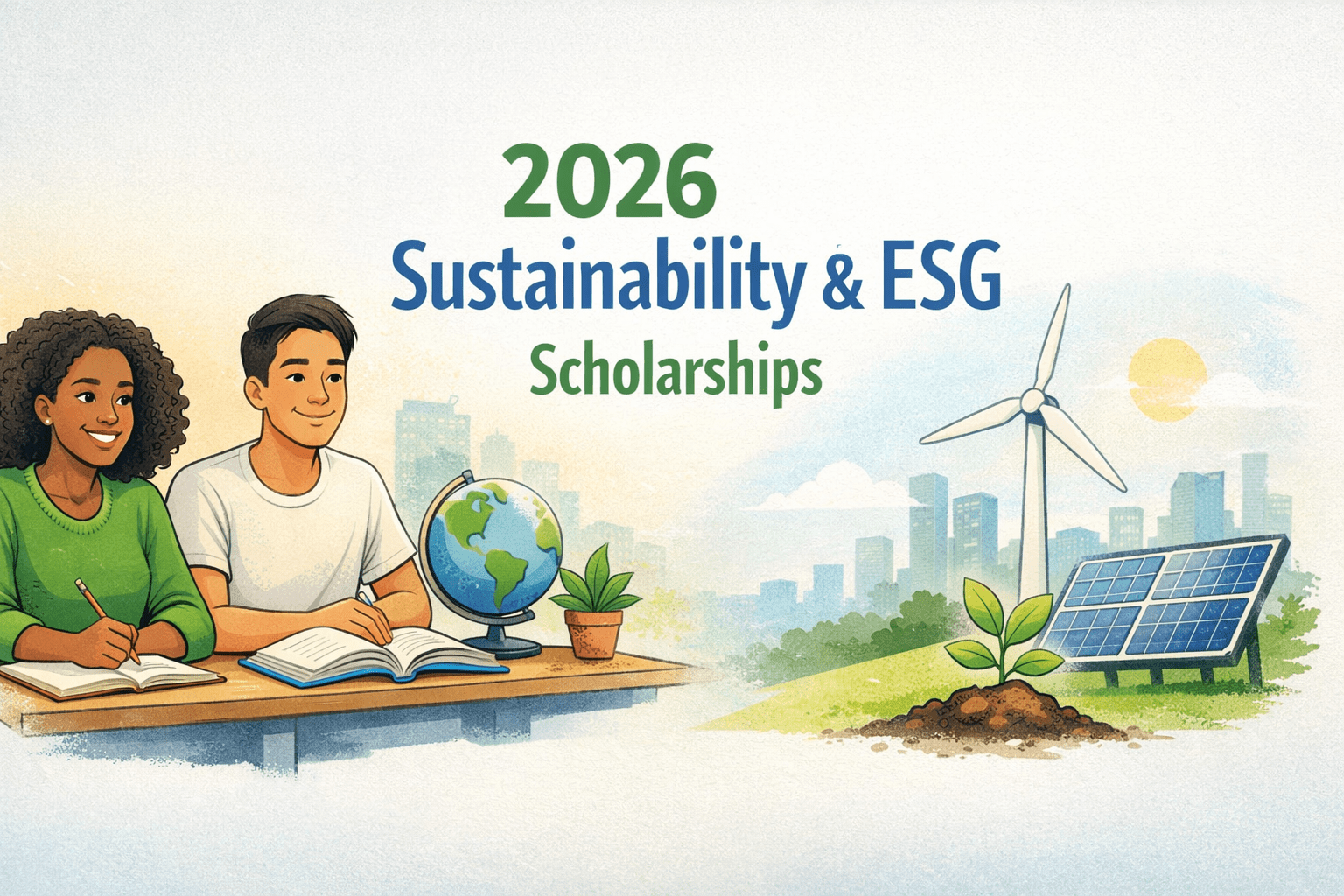
2026 Sustainability & ESG Scholarships — 20+ Verified Awards by Month
Hand-checked sustainability & ESG scholarships for 2026 — environment, water, climate, energy efficiency, EHS, and policy.
January
The Garden Club of America Award in Coastal Wetlands Studies
💥 Why It Slaps: Funds grad students protecting coastlines, wetlands, and climate-resilient ecosystems.
💰 Amount: Varies (research grant).
⏰ Deadline: January 10, 2026.
🔗 Apply/info: https://www.gcamerica.org/scholarships/apply
GCA Award in Desert Studies
💥 Why It Slaps: Backs undergrad/grad work on water, restoration, and sustainability in arid lands.
💰 Amount: Varies.
⏰ Deadline: January 15, 2026.
🔗 Apply/info: https://www.gcamerica.org/scholarships/apply
GCA Keller Scholarship in Conservation Horticulture
💥 Why It Slaps: Supports plant conservation capacity at public/botanic gardens (core to biodiversity & ESG).
💰 Amount: Varies.
⏰ Deadline: January 15, 2026.
🔗 Apply/info: https://www.gcamerica.org/scholarships/apply
NOAA Hollings Undergraduate Scholarship
💥 Why It Slaps: $9,500/year + paid NOAA summer internship = climate, oceans, and atmospheric impact.
💰 Amount: $9,500 per year (2 years) + paid 10-week internship & travel.
⏰ Deadline: January 31, 2026 (applications open Oct 1, 2025).
🔗 Apply/info: https://www.noaa.gov/office-education/hollings-scholarship
NOAA EPP/MSI Undergraduate Scholarship (for MSI students)
💥 Why It Slaps: Multi-year support + paid internships in coastal, oceanic, and environmental fields.
💰 Amount: Varies (includes academic support + paid internships).
⏰ Deadline: January 31, 2026 (applications open Oct 1, 2025).
🔗 Apply/info: https://www.noaa.gov/office-education/epp-msi/undergraduate-scholarship
February
Water Environment Federation (WEF) Canham Graduate Studies Scholarship
💥 Why It Slaps: Signature national award for grad work in water quality, wastewater & resource recovery.
💰 Amount: Varies (major single scholarship).
⏰ Deadline: Early February 2026 (prior cycles in Feb; confirm current date on WEF page).
🔗 Apply/info: https://www.wef.org/membership–community/awards-recognition/education-awards/wef-canham-graduate-studies-scholarship/
National Hydropower Association — Past Chairs’ Legacy Scholarship
💥 Why It Slaps: For students aiming at clean, renewable waterpower—engineering, hydro, fisheries, comms.
💰 Amount: $2,500.
⏰ Deadline: February (last cycle Feb 13, 2025; 2026 date posts on program page).
🔗 Apply/info: https://www.hydro.org/awards/past-chairs-legacy-scholarship/
ASSP Foundation Academic Scholarships (EHS/Safety)
💥 Why It Slaps: Hundreds of awards for environmental health & safety—core “E” in ESG.
💰 Amount: Varies (multiple awards each cycle).
⏰ Deadline: February 15, 2026 (application window Oct 15, 2025 – Feb 15, 2026).
🔗 Apply/info: https://foundation.assp.org/academic-scholarships/
GCA National Parks Conservation Scholarship (with SCA)
💥 Why It Slaps: Funds conservation leadership roles in U.S. National Parks—real climate resilience work.
💰 Amount: Varies (supports SCA leader/apprentice roles).
⏰ Deadline: February 15, 2026.
🔗 Apply/info: https://www.gcamerica.org/scholarships/apply
American Meteorological Society (AMS) Undergraduate Scholarships
💥 Why It Slaps: Climate-critical scholarships for met, oceanic & hydrologic sciences (key ESG data areas).
💰 Amount: Varies by named scholarship.
⏰ Deadline: Typically mid-to-late winter; confirm current-cycle date on AMS page.
🔗 Apply/info: https://www.ametsoc.org/ams/information-for/students/ams-scholarships-and-fellowships/
March
Udall Undergraduate Scholarship (Environment track)
💥 Why It Slaps: One of the top U.S. environmental leadership awards for undergrads.
💰 Amount: Up to $7,000.
⏰ Deadline: Early March 2026 (via your campus representative; see program timeline).
🔗 Apply/info: https://www.udall.gov/ourprograms/scholarship/scholarship.aspx
Switzer Environmental Fellowship (Graduate)
💥 Why It Slaps: $17K leadership fellowship for solutions-driven environmental grads (CA & New England).
💰 Amount: $17,000.
⏰ Deadline: Opens January; annual deadline announced each cycle (spring timeframe).
🔗 Apply/info: https://www.switzernetwork.org/become-a-fellow
NEHA/AAS Environmental Health Scholarships
💥 Why It Slaps: Supports undergrad & grad students in environmental health—air, water, food, climate resilience.
💰 Amount: Varies.
⏰ Deadline: Announced each cycle; typically spring.
🔗 Apply/info: https://www.neha.org/practice/resources
April
Environmental Research & Education Foundation (EREF) Scholarships
💥 Why It Slaps: Big, renewable awards for solid waste, circular economy & sustainability research.
💰 Amount: Varies; often multi-year.
⏰ Deadline: April 15, 2026 (spring cycle) and November 1, 2025 (fall cycle).
🔗 Apply/info: https://erefdn.org/scholarships/
AEE Foundation (Association of Energy Engineers) Scholarships
💥 Why It Slaps: Energy efficiency & sustainability focus via local AEE chapters (global program).
💰 Amount: Varies by chapter.
⏰ Deadline: April 26, 2026 (last cycle listed April 26 for student applications).
🔗 Apply/info: https://www.aeecenter.org/aee-news/planting-the-seeds-today-for-a-sustainable-tomorrow/
May
AWRA — Richard A. Herbert Memorial Scholarships
💥 Why It Slaps: Long-running national awards for water resources (undergrad & grad).
💰 Amount: At least one $2,000 undergrad + one $2,000 grad award annually.
⏰ Deadline: 2026 application timeline to be announced (historically spring).
🔗 Apply/info: https://www.awra.org/AWRA/Members/Scholarship_and_Awards/Herbert_Scholarship.aspx
September
AWWA Scholarship Program (Water Equation)
💥 Why It Slaps: Dozens of water-sector scholarships, including climate & treatment resilience research.
💰 Amount: Varies; includes the Abel Wolman Fellowship ($30,000 first year; second year possible).
⏰ Deadline: Program for 2026–27 opens September 22, 2025 (check each scholarship’s close date).
🔗 Apply/info: https://www.awwa.org/water-equation/awwa-scholarship-program/
October
Air & Waste Management Association (A&WMA) International Graduate Scholarships
💥 Why It Slaps: Graduate funding in air quality, waste management & sustainability policy—core ESG.
💰 Amount: Varies (multiple named awards).
⏰ Deadline: Details for 2026/27 posted in October; awards typically due in January.
🔗 Apply/info: https://www.awma.org/scholarships
November
EREF Scholarships (Fall Cycle)
💥 Why It Slaps: See EREF above — second deadline for late-year applicants.
💰 Amount: Varies; often multi-year.
⏰ Deadline: November 1, 2025.
🔗 Apply/info: https://erefdn.org/scholarships/
December
ASHRAE Undergraduate Engineering Scholarships (Energy & High-Performance Buildings)
💥 Why It Slaps: Energy efficiency, decarbonization, and sustainable HVAC/R—practical ESG careers.
💰 Amount: Typically $3,000–$10,000+ depending on scholarship.
⏰ Deadline: December 1, 2025 (for 2026–27 cycle).
🔗 Apply/info: https://www.ashrae.org/communities/student-zone/scholarships-and-grants/undergraduate-engineering-scholarships
GCA Fellowship in Ecological Restoration
💥 Why It Slaps: Funds graduate research healing degraded ecosystems—biodiversity & climate wins.
💰 Amount: $8,000.
⏰ Deadline: December 31, 2025.
🔗 Apply/info: https://www.gcamerica.org/scholarships/apply
Also Worth Your Radar (Rolling / Cycle-Announced Dates)
American Public Power Association — DEED (Energy/Efficiency/Public Power)
💥 Why It Slaps: Scholarships & internships tied to real-world utility sustainability and energy efficiency projects.
💰 Amount: Varies.
⏰ Deadline: Cycles announced on the DEED page; check current windows.
🔗 Apply/info: https://www.publicpower.org/deed-rd-funding
AWWA — Abel Wolman Fellowship (Doctoral—Water Supply Research)
💥 Why It Slaps: Flagship PhD fellowship anchoring water resilience and treatment innovation.
💰 Amount: $30,000 first year; second year possible.
⏰ Deadline: Follows AWWA Scholarship Program cycle (opens Sept 22, 2025).
🔗 Apply/info: https://www.awwa.org/water-equation/awwa-scholarship-program/
Financing the Sustainability & ESG Talent Pipeline: Scholarships, Fellowships, and Credential Support in a Fast-Regulating Economy
Sustainability and Environmental, Social, and Governance (ESG) work has moved from a niche interest to a mainstream labor-market requirement across finance, operations, supply chains, and public policy. Yet the education-to-employment pipeline is constrained by (1) a measurable “green skills” supply–demand mismatch; (2) rapidly evolving disclosure and reporting regimes; and (3) fragmented funding mechanisms that often sit outside traditional departmental scholarship channels. This paper synthesizes labor-market evidence, sustainable finance and disclosure trends, higher-education participation signals, and flagship scholarship program structures to map the current U.S.-oriented funding landscape for Sustainability & ESG majors. It then proposes a practical taxonomy and outcome-based framework for designing, targeting, and evaluating scholarships and grants that build the next generation of climate- and ESG-capable professionals.
1. Introduction: Sustainability & ESG as a Cross-Disciplinary Major—and a Cross-Sector Skill
“Sustainability & ESG” is less a single academic discipline than a competency stack: systems thinking, carbon and nature accounting, risk and scenario analysis, stakeholder governance, supply-chain traceability, and impact measurement. This cross-disciplinary character matters because scholarship funding is often siloed—environmental science awards on one side, finance and accounting awards on another, and public policy fellowships elsewhere—while modern ESG roles increasingly blend them.
Two macro signals explain why scholarship demand and supply have intensified:
-
Labor-market pull for green/ESG capability. LinkedIn’s analysis of green skills continues to document a mismatch between rising employer demand and available talent, with green hiring and green skills not scaling at the same rate in many markets.
-
Regulatory and quasi-regulatory push for disclosure-ready talent. Even where rulemaking is contested or delayed, companies are investing in ESG reporting capacity because customers, lenders, insurers, and large buyers increasingly request comparable emissions and risk data. California’s disclosure statutes (SB 253 and SB 261), for example, have been estimated to cover thousands of firms, creating compliance-driven demand for carbon accounting, assurance, and climate-risk reporting skills.
These forces reshape scholarships in three ways:
-
Sustainability awards increasingly target applied reporting, measurement, and decision-useful disclosure (not just environmental passion).
-
Funding is expanding beyond tuition to include paid internships, conference travel, and professional credential support.
-
Selection criteria are shifting toward demonstrated impact + analytical rigor, reflecting ESG’s move into finance and governance.
2. Methods and Data Sources
This paper uses desk-based synthesis across four evidence categories:
-
Labor-market and skills signals: LinkedIn’s Green Skills/Green Stocktake reporting (green talent supply–demand and sector patterns).
-
Sustainable finance infrastructure: PRI signatory scale and AUM; Global Sustainable Investment Alliance’s 2024 review and its methodological cautions about measuring the “size” of sustainable investment consistently across regions and definitions.
-
Higher-education adoption: AASHE STARS rated institutions count; Princeton Review’s Green Colleges guide statistics and applicant interest metrics.
-
Flagship scholarship program structures: Federal and quasi-federal programs (Udall; NOAA Hollings; NOAA EPP/MSI) and sustainability-professional convenings offering travel/attendance support.
Where appropriate, the paper interprets these sources through human-capital and signaling theory: scholarships act as (a) financing tools, (b) quality signals to employers/graduate programs, and (c) mechanisms for shaping who enters ESG work and what competencies they develop.
3. Demand-Side Reality: The “Green Skills” Gap and the ESG Capability Stack
3.1 The skills mismatch is persistent—and sectoral
LinkedIn’s green talent analyses repeatedly show that demand for green skills is rising faster than supply in many labor markets, with adoption extending beyond “environmental” industries into finance and professional services. This matters for scholarships because the highest-return funding often supports transferable skill-building (data analysis, reporting standards, life-cycle assessment, audit/assurance readiness) rather than narrow topical interest alone.
3.2 ESG is not just “values”—it is measurement, controls, and risk
The scholarship landscape is increasingly shaped by the operationalization of ESG:
-
Carbon/energy accounting: GHG Protocol-aligned inventories, scope boundary decisions, and data pipelines.
-
Climate-risk reporting: scenario analysis, materiality, and governance.
-
Supply chain traceability: purchased goods/services emissions, deforestation risk, labor practices.
-
Assurance and controls: documentation, audit trails, and quality management.
California’s Air Resources Board materials explicitly reference the use of established standards such as the GHG Protocol in the context of SB 253 implementation, signaling that students who can work with these standards are nearer to “job-ready” than those with general interest alone.
4. Capital-Market Pull: Why Sustainable Finance Keeps Generating ESG Funding
4.1 PRI scale illustrates institutionalization
PRI’s annual reporting indicates thousands of signatories and a very large base of assets under management represented by those signatories, underscoring ESG integration as a mainstream expectation in institutional investment. That scale drives demand for analysts and operators who can translate sustainability issues into financially material metrics, governance controls, and credible disclosures.
4.2 Measurement fragmentation is real—and scholarship applicants must navigate it
The Global Sustainable Investment Alliance’s 2024 review highlights a key research constraint: diverging definitions and methodologies have made it difficult to produce a single aggregated value for “global sustainable investment” comparable to prior biennial reports, prompting a shift toward Morningstar fund disclosure analysis.
For students, this isn’t academic trivia—it affects essays and interviews. Strong applications now demonstrate:
-
awareness of definitional variance (ESG integration vs. impact vs. thematic);
-
ability to communicate clearly what is being measured and why;
-
commitment to avoiding “greenwashing-by-vagueness.”
5. Education-Side Signals: Sustainability is Mainstreaming Across Campuses
5.1 Institutional participation is large and trackable
AASHE’s STARS program lists 387 institutions that have achieved a STARS rating, indicating broad institutional engagement with sustainability benchmarking and reporting practices.
5.2 Student interest is measurable—and influences admissions behavior
Princeton Review’s 2026 Guide to Green Colleges profiles 388 colleges and reports that, among 7,000+ surveyed students, 59% said information about a college’s environmental commitment would affect their decision to apply or attend. The same release provides operational sustainability statistics across the profiled schools (e.g., prevalence of sustainability officers and sustainability-focused majors).
These metrics matter because scholarship providers often follow student demand signals; where applicant interest is high, targeted scholarship “branding” can attract strong candidates and improve program visibility.
6. The Scholarship Ecosystem for Sustainability & ESG: A Practical Taxonomy
Sustainability & ESG scholarships are best understood as a portfolio, not a single category. Below is a taxonomy that aligns funding types with the ESG competency stack.
6.1 Public-service and environmental leadership scholarships (tuition-forward)
These programs often emphasize leadership, public impact, and long-run service trajectories:
-
Udall Undergraduate Scholarship (U.S.): In 2026, anticipates awarding up to 65 scholarships of $7,500 each for students in environmental, Tribal public policy, and related fields.
Why it matters for ESG majors: Udall is a “leadership signal” scholarship—valuable even for private-sector ESG paths because it validates public-interest credibility and policy fluency.
6.2 Mission-agency pipeline scholarships (tuition + structured internship)
These awards bundle funding with experiential learning inside agencies:
-
NOAA Hollings Undergraduate Scholarship: awards include academic support up to $9,500 per year plus a paid NOAA internship component.
-
NOAA EPP/MSI Undergraduate Scholarship: provides up to $45,000 in support across junior/senior years (including travel and conference participation) with internship and development components.
Why it matters for ESG majors: These programs reward applicants who can translate coursework into applied research, data collection, and decision support—directly analogous to ESG analyst work.
6.3 Campus sustainability and professional convening support (micro-awards and access scholarships)
Not all “scholarships” are tuition checks. Many are access mechanisms (travel/registration) that unlock networks, mentoring, and job pipelines:
-
AASHE-related scholarship offerings are used to widen participation in sustainability convenings; AASHE’s conference ecosystem also includes explicitly priced attendee scholarships (e.g., prospectus-based scholarship allocations).
These micro-awards can be high ROI for ESG majors because conferences are where students learn the “real language” of reporting frameworks, vendor ecosystems, and job roles.
6.4 Credential and professional pathway subsidies (finance/risk/ESG credentials)
ESG employment—especially in finance—often values credentials that signal standardized competence:
-
CFA Institute offers scholarship structures that reduce CFA Program exam costs (e.g., student scholarships reducing fees to a defined level).
-
Professional certificate pathways in sustainable investing and climate risk are expanding as a bridge between majors and employers.
For students, the strategic insight is: a partial fee subsidy + an in-demand credential can function like a scholarship, especially when it yields hiring advantages.
6.5 Specialized graduate/professional scholarships in impact and ESG practice
Some sustainability/ESG funding is embedded in professional programs, law, or applied policy:
-
Example: NYU’s Impact Scholarship model provides partial tuition support tied to social entrepreneurship and impact investing interests.
7. Policy and Compliance Shockwaves: Why Disclosure Rules Influence Scholarship Design
7.1 California’s SB 253/SB 261 as a demand amplifier
Legal and implementation details are evolving, but coverage estimates are large. One analysis based on CARB staff estimates suggests roughly 2,600 companies may be subject to SB 253 and ~4,100 to SB 261, using revenue thresholds and “doing business in California” criteria. CARB workshop and FAQ materials emphasize timelines, scoping, and the use of recognized standards in planning and reporting.
Scholarship implication: funding will increasingly prefer applicants who can demonstrate competencies in carbon accounting, data governance, and materiality—because those are scarce, compliance-critical skills.
7.2 European CSRD and global supply chain spillover
Even U.S.-based firms are affected through global operations and supply chains. The European Commission’s CSRD overview outlines phased application (earlier cohorts reporting first, later cohorts phased in), while policy adjustments (e.g., “stop-the-clock” discussions) illustrate that timelines can shift even as overall direction remains toward more structured reporting.
Scholarship implication: essays that connect sustainability study to cross-border reporting and supplier data read as more realistic and employer-aligned.
7.3 Federal-level uncertainty still matters
In the U.S., the SEC’s posture on climate-related disclosure rules has been politically and legally contested; the Commission has publicly addressed its litigation stance regarding its climate rules, reinforcing uncertainty around exactly what will be required and when.
Scholarship implication: applicants should emphasize skills that remain valuable under any regulatory scenario (measurement, assurance readiness, risk analysis), not just compliance with a single rule.
8. Toward a Data-Driven Scholarship Strategy for Sustainability & ESG Students
A recurring problem for Sustainability & ESG majors is that funding opportunities are distributed across keywords and disciplines. Students who search only “ESG scholarship” miss the majority of relevant funding. A data-driven approach is to map scholarships to competency areas and then search using those competency terms.
8.1 High-yield search clusters (what actually finds money)
Instead of one keyword, use a matrix:
-
Measurement & accounting: “GHG inventory,” “carbon accounting,” “LCA life cycle assessment,” “Scope 3,” “assurance,” “sustainability reporting”
-
Risk & finance: “sustainable investing,” “climate risk,” “impact investing,” “ESG analytics,” “responsible investment”
-
Built environment & energy: “green building,” “LEED,” “energy efficiency,” “renewable energy,” “decarbonization”
-
Water, agriculture, nature: “watershed,” “conservation,” “sustainable agriculture,” “biodiversity,” “natural capital”
-
Justice & community: “environmental justice,” “public lands,” “Tribal policy,” “community resilience”
Programs like Udall and NOAA make clear that “sustainability” funding often hides under mission language (public lands, natural resources, oceans, climate).
8.2 What selection committees increasingly reward
From the structure of mission-driven scholarships and the compliance orientation of modern ESG work, competitive applicants tend to show:
-
Impact with metrics (not vibes): emissions reduced, waste diverted, procurement shifted, habitat restored, policy adopted.
-
Systems thinking: understanding rebound effects, leakage, equity impacts, and governance tradeoffs.
-
Evidence-handling maturity: data quality, uncertainty, assumptions, and standards awareness—mirroring the measurement fragmentation noted in sustainable finance reporting.
-
Leadership in messy contexts: stakeholder conflict, incomplete data, and changing rules.
9. Scholarship Design Recommendations for Funders and Universities
If the goal is to build a credible ESG workforce (not just sponsor sustainability branding), funders can improve outcomes with three design shifts.
9.1 Bundle money with work-integrated learning
NOAA’s models illustrate the value of pairing academic support with internships and professional development.
Recommendation: create “scholarship + practicum” structures where students must complete a measurable project (inventory, materiality assessment, supplier engagement plan) and publish a short methods memo.
9.2 Support micro-credentials and access, not only tuition
Conference and access scholarships lower barriers to high-leverage networks and professional norms (how ESG is practiced).
Recommendation: allocate a portion of funding to travel/registration + mentorship pairings; require recipients to produce a portfolio artifact (poster, data dashboard, policy brief).
9.3 Evaluate with an outcomes dashboard
Move beyond “recipient success story” anecdotes:
-
internship placement rate
-
credential completion rate
-
job placement in ESG-adjacent roles
-
retention in sustainability careers after 2–3 years
-
diversity and equity metrics in recipient pools
This aligns scholarship ROI with the same accountability logic driving corporate reporting.
10. Conclusion
Sustainability & ESG scholarships are no longer just about supporting environmental passion; they are becoming instruments for building a disclosure-ready, analytics-capable, cross-disciplinary workforce. Evidence from labor-market green skills analysis, the scale and institutionalization of responsible investment, higher-education sustainability adoption, and mission-based scholarship program structures all point to the same conclusion: the highest-impact funding models are those that (1) finance access, (2) build measurable competencies, and (3) connect students to applied practice through internships, convenings, and standardized credential pathways. For students, the winning strategy is to search and apply across the broader sustainability competency stack—environment, finance, risk, reporting, and justice—using a keyword and portfolio approach that reflects how ESG is actually practiced.
References (selected)
-
Association for the Advancement of Sustainability in Higher Education (AASHE). STARS Rated Institutions.
-
California Air Resources Board (CARB). SB 253/SB 261 workshop slides and FAQs (implementation planning, standards references, and timelines).
-
Global Sustainable Investment Alliance (GSIA). Global Sustainable Investment Review 2024 (definitions/methodology and measurement limitations).
-
LinkedIn. Global Green Skills Report / Green Stocktake (green talent supply–demand and sector dynamics).
-
NOAA Office of Education. Hollings Undergraduate Scholarship; EPP/MSI Undergraduate Scholarship Program.
-
Princeton Review. Guide to Green Colleges 2026 press release (institution counts and applicant interest metrics).
-
PRI (Principles for Responsible Investment). Annual report (signatory and AUM scale).
-
Udall Foundation. Udall Undergraduate Scholarship (award count/amount).
-
U.S. Securities and Exchange Commission (SEC). Public statements regarding litigation posture on climate disclosure rules.
FAQs — Sustainability & ESG Scholarships
1) What majors count as “Sustainability” or “ESG”?
Environmental science, sustainability, ecology, climate/atmospheric science, water resources, energy engineering, environmental health & safety (EHS), industrial hygiene, waste/circular economy, environmental policy, geography/GIS, urban planning, architecture (high-performance buildings), civil/chemical/mechanical engineering (energy/water), data science for climate, economics/public policy (climate/ESG), and business/accounting/finance with ESG focus.
2) I’m a business or communications major. Can I still apply?
Often yes. Many programs welcome ESG-aligned business, accounting (sustainability reporting/assurance), finance (climate risk), supply chain (scope 3), marketing/comms (behavior change), and public policy.
3) Typical eligibility basics?
Full-time or part-time enrollment; U.S. citizen/permanent resident (varies), minimum GPA (commonly 3.0 but ranges), relevant major or career intent, and (sometimes) student chapter membership (AWWA/WEF/ASSP/ASHRAE/AEE/etc.).
4) Do community college or transfer students qualify?
Yes—many awards include 2-year students and transfers, especially in energy, water, EHS, and building performance pathways.
5) Are international or DACA students eligible?
Some programs are open; others are restricted. Check each page’s citizenship section. If restricted, look for university foundation, department, or professional-society chapter awards, which are often more flexible.
6) How competitive are these awards?
Selective—but you can stand out with: a clear “problem → solution → impact” story, measurable outcomes (kWh/water/tons diverted), faculty or supervisor letters tied to your project results, and a tight resume/portfolio.
7) What should my essay highlight?
Lead with one specific outcome (e.g., “reduced dorm electricity 12% via retrofits + behavior nudges”), then connect to your long-term plan (mitigation/adaptation, circularity, equity). Name the tools/methods (e.g., GHG inventory, LCA, ArcGIS, energy modeling) you’ve used.
8) What proof or artifacts help?
Short project briefs, dashboards/graphs, posters, links to public repos or portfolios, before/after photos, media mentions, or supervisor attestations. Keep it concise and verifiable.
9) Which student activities impress selection committees?
- Engineers for a Sustainable World / Net Impact / Enactus
- AWWA/WEF/ASHRAE/AEE/ASSP student chapters
- Campus energy/waste audits, compost programs, green labs
- Local watershed cleanups, tree planting, disaster resilience work
10) Do I need professional certifications?
Not required, but LEED Green Associate, WELL AP coursework, OSHA-30 (EHS), HAZWOPER, or energy auditing training can signal readiness for internships and applied projects.
11) How do need-based vs merit-based awards differ?
Need-based usually require financial info (often FAFSA). Merit-based lean on academics, leadership, and project impact. Many awards blend both.
12) Can I stack these with Pell/State aid or other scholarships?
Usually yes—up to your school’s Cost of Attendance. Coordinate with your financial aid office to prevent “over-awards.”
13) Are fellowship-style awards different from scholarships?
Fellowships often target graduate students, include a stipend, and emphasize leadership/cohort programming. Scholarships typically offset tuition/fees and may be open to undergrads or grads.
14) What documents should I prep early?
Unofficial transcript, resume (1 page), portfolio links, a 300–500 word “master” essay you can tailor, recommenders list + brag sheet, and proof of chapter membership (if required).
15) Common mistakes to avoid?
Generic essays, missing the specific sustainability angle, not quantifying results, ignoring eligibility fine print, submitting without faculty review, and waiting until the final week.
16) How do I find local or niche awards?
Check your city’s water/waste utilities, regional air districts, state energy offices, local professional-society chapters, and your university department or sustainability office.
17) What if I lack research experience?
Use applied impact: energy behavior campaigns, building audits, food recovery/compost, campus green purchasing, bike/ped projects, equity-focused climate adaptation, stormwater/green infrastructure volunteers.
18) What GPA do I need?
Varies widely (some 2.5–3.0+, others none). If your GPA is lower, emphasize trajectory (recent upward trend) and concrete project outcomes.
19) Taxes—will I owe anything?
Amounts used for qualified tuition/required fees/books are typically tax-free; funds for room/board or optional expenses can be taxable. Confirm with your aid office or a tax professional.
20) How far in advance should I start?
8–10 weeks before deadlines. Draft essays in month one, secure recommenders in week 2–3, finalize documents in week 6, and submit a week early.
21) Quick month-by-month game plan?
- Sept–Oct: Build master essay + resume, list recommenders, join 1 professional chapter.
- Nov–Dec: Compile portfolio artifacts, run a mock GHG/LCA/energy case.
- Jan–Mar: Hit federal/pro society deadlines (NOAA/Udall/ASSP/etc.).
- Apr–Jun: Target energy/waste/water cycles.
- Jul–Aug: Prep next cycle; refresh portfolio with summer internship outcomes.