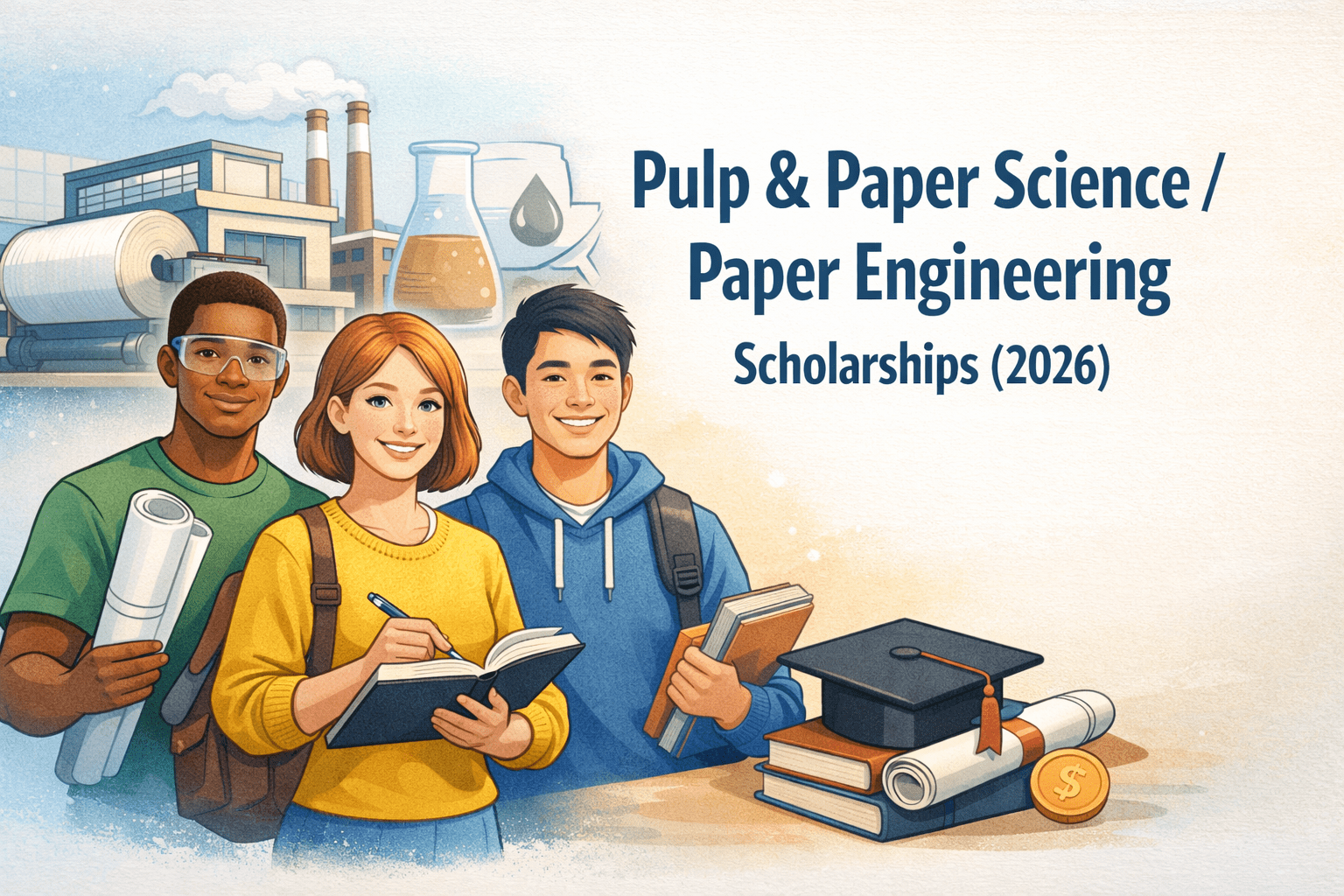
Pulp & Paper Science / Paper Engineering Scholarships (2026) — Verified Links & Deadlines
A hand-checked, monthly-updated list of scholarships for Pulp & Paper Science, Paper Engineering, and related majors.
January
(no major paper-specific national deadlines typically fall in January; earliest big cluster is February)
February
TAPPI William L. Cullison Scholarship
💥 Why It Slaps: TAPPI’s flagship award for rising juniors headed for pulp, paper, corrugated, or converting careers. Recognized industry-wide.
💰 Amount: $4,000
⏰ Deadline: February 15 (for the following academic year)
🔗 Apply/info: https://tappiawards.smapply.io/prog/william_l_cullison_scholarship_/ — ✅ Link verified 09/21/2025.
TAPPI Corrugated Packaging Division Scholarships
💥 Why It Slaps: Up to four awards for students aiming at corrugated packaging; great door-opener to plant co-ops.
💰 Amount: $1,000 (up to four awards)
⏰ Deadline: February 15
🔗 Apply/info: https://tappiawards.smapply.io/prog/corrugated_packaging_scholarships/ — ✅ Link verified 09/21/2025.
TAPPI Engineering Division Scholarships
💥 Why It Slaps: Specifically for students pursuing engineering roles in pulp & paper operations.
💰 Amount: $2,000 (two awards)
⏰ Deadline: February 15
🔗 Apply/info: https://www.tappi.org/education/college-and-university-programs/scholarship-overview/division-and-local-section-scholarships/ — ✅ Link verified 09/21/2025.
TAPPI Process Control Division Scholarship
💥 Why It Slaps: Targets process control/automation—the hot skillset in modern mills.
💰 Amount: $1,000 (single award)
⏰ Deadline: February 15
🔗 Apply/info: https://www.tappi.org/education/college-and-university-programs/scholarship-overview/division-and-local-section-scholarships/ — ✅ Link verified 09/21/2025.
TAPPI Coating & Graphic Arts Division Scholarships
💥 Why It Slaps: Perfect if you’re into coated grades / print performance chemistry.
💰 Amount: Up to $1,000 (multiple awards)
⏰ Deadline: February 15
🔗 Apply/info: https://www.tappi.org/education/college-and-university-programs/scholarship-overview/division-and-local-section-scholarships/ — ✅ Link verified 09/21/2025.
TAPPI Paper & Board Division Scholarship
💥 Why It Slaps: Core to paper & board manufacturing pathways; pairs well with summer mill internships.
💰 Amount: $1,000
⏰ Deadline: February 15
🔗 Apply/info: https://tappiawards.smapply.io/prog/paper_and_boardscholarship — ✅ Link verified 09/21/2025.
NC State Pulp & Paper Foundation Scholarships
💥 Why It Slaps: Big foundation with strong industry ties and a clear priority cycle; integrates with PSE curriculum & co-ops.
💰 Amount: Varies (multiple awards)
⏰ Deadline: Priority by February 15 (new students); separate cycles for transfers/continuing students
🔗 Apply/info: https://cbe.ncsu.edu/pse/scholarships/ — ✅ Link verified 09/21/2025.
March
ReMA Paper Stock Industries (PSI) Chapter Scholarships
💥 Why It Slaps: For dependents of employees at PSI member recycling companies—great if your family works in recovered fiber/recycling.
💰 Amount: $2,500 (multiple) and one $5,000 grand prize (2025 program)
⏰ Deadline: March 1 (annually; check current year page)
🔗 Apply/info: https://www.recycledmaterials.org/chapter/paper-stock-industries-chapter/psi-scholarships/ — ✅ Link verified 09/21/2025.
University of Maine Pulp & Paper Foundation — Upper-Class Scholarships
💥 Why It Slaps: One of the most established P&P foundations; steady support plus job placement connections.
💰 Amount: Varies (multiple awards)
⏰ Deadline: March 30 (also fall cycle Oct 30)
🔗 Apply/info: https://www.famemaine.com/education/topics/financial-aid/types-of-aid/scholarships/umaine-pulp-and-paper-foundation/ — ✅ Link verified 09/21/2025.
April
Washington Pulp & Paper Foundation (UW — Bioresource Science & Engineering) Scholarships
💥 Why It Slaps: Scholarships for UW’s BSE major; application window makes it easy to plan.
💰 Amount: Typically $2,500–$10,000 (per WPPF/SEFS info)
⏰ Deadline: April 1–30 (annual application window)
🔗 Apply/info: https://uwwppf.org/students/scholarships/ — ✅ Link verified 09/21/2025.
May
UW SEFS (school-wide) Scholarship Window (for context)
💥 Why It Slaps: If you’re in allied SEFS programs (or timing off by a week), this window sometimes runs into early May.
💰 Amount: Varies
⏰ Deadline: Commonly late April–early May (e.g., May 5 on recent cycle)
🔗 Apply/info: https://sefs.uw.edu/students/scholarships/ — ✅ Link verified 09/21/2025.
December
Auburn Pulp & Paper Foundation (APPF) Scholarships
💥 Why It Slaps: Big range—from $2,000 up to in-state tuition; strong co-op culture with mills across the Southeast.
💰 Amount: $2,000 up to full in-state tuition
⏰ Deadline: For scholarship consideration, complete Auburn app by December 1; AU scholarship portal date also in Feb (see page).
🔗 Apply/info: https://eng.auburn.edu/appf/programs/ — ✅ Link verified 09/21/2025.
ASPI (Association of Suppliers to the Paper Industry) Scholarship
💥 Why It Slaps: Supplier-side network scholarship; great visibility with equipment & chemical vendors.
💰 Amount: Varies
⏰ Deadline: December 13, 2025 (current cycle posted)
🔗 Apply/info: https://www.aspinet.org/aspi-scholarship — ✅ Link verified 09/21/2025.
University of Maine Pulp & Paper Foundation — First-Year Scholarships
💥 Why It Slaps: A powerhouse foundation with long-running industry sponsorship; pairs well with UMaine’s internships.
💰 Amount: Varies (multiple awards)
⏰ Deadline: December 31 (first-year cycle)
🔗 Apply/info: https://umaineppf.org/scholarships/— ✅ Link verified 09/21/2025.
Miami University — Paper Science & Engineering Foundation (PSEF) Scholarships
💥 Why It Slaps: Paper-minor-focused aid + 100% placement track record; $500 first-year award plus larger upper-class awards.
💰 Amount: Varies; $500 first-year (second semester) for students declaring the minor; larger awards for upper-class students
⏰ Deadline: University merit priority December 1; PSEF scholarships via internal application/interview thereafter
🔗 Apply/info: https://miamioh.edu/cec/centers-institutes/paper-science-engineering-foundation/students/scholarships.html — ✅ Link verified 09/21/2025.
Rolling / Program-Specific Windows
Western Michigan University — Paper Technology Foundation (PTF) Scholarships
💥 Why It Slaps: Deep Kalamazoo industry ties; dedicated PTF support for Paper Engineering & Imaging majors.
💰 Amount: Varies (multiple awards)
⏰ Deadline: Varies by entry term; see PTF page for current cycle
🔗 Apply/info: https://wmich.edu/papertechfoundation/scholarships — ✅ Link verified 09/21/2025.
UW–Stevens Point — Paper Science & Chemical Engineering Foundation Scholarships
💥 Why It Slaps: Consistent support; published note of up to ~$2,400/semester for qualifying students.
💰 Amount: Up to ~$2,400 per semester (for qualifying recipients)
⏰ Deadline: Foundation/portal windows vary (see page and linked docs)
🔗 Apply/info: https://www3.uwsp.edu/papersci/Pages/Scholarships.aspx — ✅ Link verified 09/21/2025.
Washington Pulp & Paper Foundation — New Student Award
💥 Why It Slaps: $10,000 for first-time UW entrants (freshmen or CC transfers) headed for BSE; renewable with performance.
💰 Amount: $10,000 (first year), renewable
⏰ Deadline: Rolling within WPPF/Admissions timelines; inquire early
🔗 Apply/info: https://uwwppf.org/students/ — ✅ Link verified 09/21/2025.
SUNY ESF — Syracuse Pulp & Paper Foundation (SPPF) Full-Tuition Scholarships
💥 Why It Slaps: Yes—full tuition for Paper Engineering majors at ESF, plus 100% placement history.
💰 Amount: Full tuition scholarships (multiple)
⏰ Deadline: Aligns with ESF scholarship review (commonly by February 1 for new students); check SPPF page for current specifics
🔗 Apply/info: https://www.sppf-esf.org/scholarships-grants — ✅ Link verified 09/21/2025.
SUNY ESF — SPPF $21,000 Graduation Grant
💥 Why It Slaps: Finish your B.S. in Paper Engineering with a 2.5+ GPA and receive a $21,000 grant after graduation.
💰 Amount: $21,000 (paid post-graduation; tax-free per foundation page)
⏰ Deadline: Program criteria-based; apply via SPPF during senior year
🔗 Apply/info: https://www.sppf-esf.org/scholarships-grants — ✅ Link verified 09/21/2025.
SUNY ESF — SPPF Paper Science Minor / MPS Grant
💥 Why It Slaps: Not a full major? Complete the Paper Science minor (or ESF MPS option) and still earn a $7,500 grant.
💰 Amount: $7,500
⏰ Deadline: Rolling within SPPF timelines
🔗 Apply/info: https://www.sppf-esf.org/scholarships-grants — ✅ Link verified 09/21/2025.
SUNY ESF — SPPF Management Minor Grant
💥 Why It Slaps: Add business skills for mill leadership and get $5,000 toward your path.
💰 Amount: $5,000
⏰ Deadline: Rolling within SPPF timelines
🔗 Apply/info: https://www.sppf-esf.org/scholarships-grants — ✅ Link verified 09/21/2025.
Georgia Tech — Renewable Bioproducts Institute (RBI): PSE Scholarships & Fellowships
💥 Why It Slaps: Access to RBI’s papermaking labs/network; good fit for students pursuing the PSE certificate.
💰 Amount: Varies
⏰ Deadline: Varies by program
🔗 Apply/info: https://research.gatech.edu/rbi/endowed-fellowships — ✅ Link verified 09/21/2025.
ISA (Automation) Student Scholarships
💥 Why It Slaps: Instrumentation & controls are the heartbeat of modern paper mills; ISA awards help fund that path.
💰 Amount: Varies
⏰ Deadline: Apps open Dec–Feb; recipients typically announced August
🔗 Apply/info: https://www.isa.org/membership/students/scholarships — ✅ Link verified 09/21/2025.
UW–Stevens Point — ASPI “Engineer of the Future” Scholarship (noted on UWSP page)
💥 Why It Slaps: Supplier-side recognition; complements UWSP PSE foundation awards.
💰 Amount: Varies
⏰ Deadline: Historically mid-April for the following fall (check current ASPI page for the latest cycle)
🔗 Apply/info: https://www3.uwsp.edu/papersci/Pages/Scholarships.aspx — ✅ Link verified 09/21/2025.
Western Region / Local Section (TAPPI) Scholarships (overview entry)
💥 Why It Slaps: Several TAPPI local sections award student scholarships—use this hub to find section-specific links (Lake States, etc.).
💰 Amount: Typically $1,000–$2,000+
⏰ Deadline: Often February; varies by section
🔗 Apply/info: https://www.tappi.org/education/college-and-university-programs/scholarship-overview/division-and-local-section-scholarships/ — ✅ Link verified 09/21/2025.
UW College of Engineering Scholarship Windows (UW context if cross-applying to CoE units)
💥 Why It Slaps: If your course plan touches ChemE/CoE while in BSE, these windows can stack with WPPF.
💰 Amount: Varies
⏰ Deadline: Department windows typically April–May
🔗 Apply/info: https://www.engr.washington.edu/current/scholarships — ✅ Link verified 09/21/2025.
Pulp & Paper Science / Paper Engineering Scholarships: Funding, Workforce Demand, and Program Design
Pulp & Paper Science and Paper Engineering sit at the intersection of chemical engineering, materials science, sustainable manufacturing, and packaging systems. Despite the sector’s public perception as “legacy industry,” contemporary pulp-and-paper work is increasingly defined by fiber-based circularity, process automation, product innovation (barrier coatings, molded fiber, advanced tissue), and decarbonization. This paper analyzes the scholarship ecosystem that supplies talent into these roles—focusing on how industry-funded “paper foundations,” professional associations, and university programs structure awards to reduce student debt, increase enrollment stability in small programs, and align curricula with mill- and converting-plant hiring. Drawing on publicly available scholarship policy pages, institutional program statements, and labor/industry statistics, we show that (1) scholarship support is unusually concentrated relative to many engineering majors, often covering a high share of enrolled students; (2) awards are tightly coupled to experiential learning (co-ops/internships) and professional socialization (student chapters, conferences); and (3) the scholarship market is best understood as a workforce pipeline investment responding to sectoral shifts (packaging growth, printing-writing decline) and a looming replacement cycle for skilled retirees. We conclude with a practical funding map and design recommendations for students, universities, and scholarship publishers.
1. Introduction: Why paper engineering scholarships operate differently
Most engineering scholarship markets are diffuse—funded by broad STEM philanthropies, large university endowments, and government aid—while discipline-specific support is often marginal. Paper Engineering is an outlier. Because the number of dedicated programs is small, the industry has historically built tight institutional partnerships that bundle scholarships + paid work experience + professional networks into a single pipeline architecture.
The macroeconomic rationale is clear. Forest products remain a major U.S. manufacturing employer; AF&PA reports more than 925,000 jobs, ~$80 billion payroll, and approximately 4.7% of U.S. manufacturing GDP, with over 75% of U.S. pulp and paper mills located in counties that are >80% rural—magnifying local workforce dependence on stable hiring pipelines. In the paper manufacturing subsector (NAICS 322), BLS shows ~355.5k employees (Dec 2025), reinforcing the scale at which technical and supervisory talent must be replenished.
Meanwhile, demand is rebalancing across grades: AF&PA’s monthly reporting indicates packaging papers & specialty packaging shipments rose 2% in Dec 2025 vs Dec 2024, while printing-writing paper shipments fell 11% over the same comparison—an industry mix shift that increases the value of engineers trained in converting, packaging systems, and process optimization.
Against that backdrop, scholarships function less like generic “aid” and more like targeted human-capital investment—with eligibility rules (GPA thresholds, major intent, co-op participation) designed to reduce dropout risk and increase placement into mills and supplier firms.
2. Data and method (public, triangulated sources)
This analysis uses:
-
Labor and industry statistics from the U.S. Bureau of Labor Statistics and AF&PA releases;
-
Program-embedded scholarship disclosures from university foundations and departmental pages (NC State, SUNY ESF/Syracuse Pulp & Paper Foundation, UMaine Pulp & Paper Foundation, WMU Paper Technology Foundation, Miami University PS&E Foundation, UW–Stevens Point Paper Science Foundation);
-
Professional association scholarships from TAPPI’s scholarship portal and division scholarship listings.
Because award amounts and recipient counts are not uniformly published, the quantitative sections use observable amounts and published annual totals (where provided) to derive conservative descriptive metrics (e.g., average award size where both total dollars and scholarship counts are stated). Findings should be interpreted as pipeline indicators rather than a complete census of all awards.
3. Workforce economics and the ROI logic behind scholarships
3.1 Employment scale and replacement pressure
Paper manufacturing employment remains substantial (BLS NAICS 322 ~355.5k in Dec 2025). At the same time, sector leaders frequently highlight replacement hiring challenges as experienced workers retire—an issue documented in industry reporting on mill recruitment and retiree replacement. Even if total employment is stable or slowly changing, replacement demand can be large in aging technical workforces, especially in rural mill communities where geographic mobility constraints reduce applicant pools.
3.2 Earnings as pipeline incentive
Paper Engineering pathways often map onto chemical engineering, process engineering, and manufacturing leadership. BLS reports the median annual wage for chemical engineers at $121,860 (May 2024). Industry salary surveys reinforce strong compensation for early-career engineers; AIChE’s 2025 survey reports median salary for new graduates around $79,000 (survey-based, not a federal statistic). Programs also publish outcomes: WMU’s Paper Technology Foundation cites an $88K median starting salary (2021–22 outcomes report).
From a scholarship-funder perspective, even a $3,000–$10,000 annual award can be economically rational if it reduces vacancy duration, improves retention, and increases the probability of placing a trained engineer into a hard-to-fill mill role.
3.3 Sustainability and circularity as a second driver
AF&PA reports that in 2024, 46 million tons of paper were recycled in the U.S., and 60%–64% of paper (and 69%–74% of cardboard) available for recovery was recycled—along with rising recycled fiber share over 20 years (to 44.4% in 2024). These metrics strengthen the narrative that paper engineering is central to circular materials, which helps recruitment and scholarship branding (eco-conscious packaging, fiber-based alternatives, energy efficiency).
4. The scholarship ecosystem: three institutional “engines”
Engine A: University-linked paper foundations (high concentration, high coverage)
Paper foundations behave like hybrid scholarship-and-placement cooperatives—funded by company memberships, alumni gifts, and endowments, often with governance structures and committees that mirror professional boards.
NC State (Paper Science & Engineering)
NC State’s Pulp and Paper Advisory Committee reports over 135 endowed scholarships and states that ~80% of students are supported by one of these scholarships. It also discloses a standard incoming award design: $3,000/year for up to four years (with conditions and GPA requirements). Separately, the program catalog notes ~125 scholarships totaling ~$380,000 annually, implying an average award magnitude around $3,040 (380,000 / 125) for scholarships counted in that figure.
SUNY ESF (Syracuse Pulp & Paper Foundation, SPPF)
SPPF operationalizes a “skills + experience” grant structure:
-
$7,500 grant tied to completing the paper science minor / MPS pathway,
-
$5,000 management minor grant,
-
$2,000 internship/co-op grant (awardable up to two times),
-
$175 FE exam sponsorship.
This is notable because it treats milestone completion (minor, internship, FE exam) as scholarship triggers—effectively paying students to accumulate labor-market signals.
University of Maine (UMaine Pulp & Paper Foundation)
UMaine’s foundation reports more than 160 scholarships annually, supported by 60+ companies and 300+ alumni/friends, and sets a clear high-school applicant deadline (Dec 31) plus professional participation expectations (student orgs, internships/co-ops). It also reports a striking placement indicator: 100% of senior scholarship recipients are employed or attending graduate school. (As with all self-reported outcomes, interpret as a program-level signal rather than a controlled causal estimate.)
Western Michigan University (Paper Technology Foundation, PTF)
PTF highlights scale and outcomes: 130 paper engineering students, $8 million in scholarship support awarded, 35 corporate partners, and the $88K median starting salary outcome claim. PTF also frames its program as scarce capacity: WMU states it offers 1 of 4 ABET-accredited paper engineering programs in the U.S. Scarcity tends to increase scholarship concentration because industry cannot simply “outsource” the talent pipeline to dozens of universities.
Miami University (Paper Science & Engineering Foundation)
Miami reports $6.9 million+ in scholarships awarded since inception, with ~60% of 1,500+ graduates benefiting, 38 member companies, and $270,000 in scholarship awards in 2020–21. This level of published historical totals is unusually transparent and supports the thesis that scholarships are integral to program identity.
UW–Stevens Point (Paper Science Foundation)
UWSP’s paper program notes scholarships up to $2,400 per semester for qualified students. A UWSP news release documents $54,500 to 49 students in one fall cycle (≈$1,112 average in that distribution, acknowledging it’s a snapshot). The foundation also reports $118,100 awarded in 2024–25 (site-reported).
Interpretation: Across these programs, scholarships are not peripheral—they are structural. When a single program can report “~80% of students supported,” the scholarship market behaves like a coordinated pipeline rather than a competitive, student-driven search.
Engine B: Professional association scholarships (TAPPI as the national backbone)
TAPPI provides cross-institution funding that complements university foundations and helps standardize deadlines and application behaviors.
TAPPI states that the deadline for Technical Division scholarships is Feb 15 for the following academic year, and lists division awards with published amounts including: Engineering Division (e.g., $2,500 rising junior, $3,000 rising senior), Environmental Working Group ($3,500 Douglas Barton Memorial), Process Control ($1,000), and multiple corrugated awards including $1,000 scholarships and $5,000 memorial scholarships.
In addition to traditional awards, TAPPI’s Horizon Scholarship explicitly targets persistence through barriers and bundles industry exposure: complimentary membership, conference registration, mentorship, and a $1,000 travel stipend, with a published application deadline (example cycle: March 23, 2025).
Interpretation: TAPPI scholarships do two things beyond dollars:
-
Normalize the “professional identity” pathway (membership, conference attendance, mentorship), and
-
Reduce transaction costs for students at non-core paper schools (or adjacent majors like chemical engineering, materials, environmental) who want to enter the industry.
Engine C: Experiential-learning-linked “shadow scholarships” (co-ops and internship grants)
Several programs explicitly integrate co-ops into scholarship logic:
-
NC State notes scholarships can be suspended during a co-op semester and then restored, signaling that co-op participation is expected, not penalized.
-
SUNY ESF/SPPF pays $2,000 for completing an internship/co-op (up to twice).
-
WMU’s PTF scholarship design conditions later support on co-op completion (program policy framing).
This effectively converts internships into subsidized human-capital accumulation: the student receives wages from the employer and a grant from the foundation, while the employer receives early screening and a trained candidate.
5. Quantitative portrait: award sizes, coverage, and “pipeline density”
5.1 Observed award range (examples)
From publicly posted figures across major pipeline institutions and TAPPI:
-
$500–$1,500: smaller targeted scholarships (e.g., select SPPF or TAPPI division awards).
-
$2,000–$5,000: internship grants, management minor grants, many division scholarships.
-
$7,500: milestone grants tied to minor completion (SPPF).
-
Up to ~$4,800/year: UWSP scholarships up to $2,400/semester.
-
Structured multi-year awards: NC State incoming awards at $3,000/year up to four years.
5.2 Coverage signals (how “deep” the money goes)
Coverage is where paper engineering stands out:
-
NC State: ~80% of students supported by endowed scholarships.
-
UMaine: 160+ scholarships annually plus a stated 100% placement/grad school outcome for senior recipients.
-
Miami: long-run scale ($6.9M+ awarded; ~60% of 1,500+ grads benefited).
-
WMU: cumulative $8M scholarship support, with corporate-partner structure and published outcomes.
Interpretation: In pipeline terms, these programs exhibit high scholarship penetration (share of majors receiving aid) and strong social-capital scaffolding (mentors, boards, student summits). This is consistent with an industry seeking to stabilize enrollment in scarce ABET-accredited capacity.
6. Implications for equity and access
A concentrated scholarship ecosystem can either reduce barriers—or reproduce them—depending on design. Two notable equity mechanisms appear in the data:
-
Barrier-aware scholarships: TAPPI’s Horizon scholarship explicitly supports students who have overcome personal, social, or economic barriers and bundles mentorship plus exposure (conference access).
-
Milestone-based grants: SPPF’s minor completion and internship grants reward demonstrated progress and experience rather than only high-school pedigree.
At the same time, common eligibility rules—major intent declarations, GPA thresholds (often ≥3.0), and structured curricula—can disadvantage students who discover the major later or who must work significant hours. The strongest programs mitigate this by pairing scholarships with paid co-ops and by creating “on-ramps” through minors (paper science minor; management minor) that let adjacent majors enter the pipeline.
7. Practical funding map (what to feature on a scholarships-by-major page)
Below is a compact “market map” of the most structural funding channels—useful for students and for scholarship publishers building a Pulp & Paper major hub.
7.1 National / multi-school
-
TAPPI Technical Division Scholarships (many awards; Feb 15 deadline norm; awards commonly $1,000–$7,000 depending on division/endowment).
-
TAPPI Horizon Scholarship (mentorship + conference + $1,000 travel stipend; barrier-aware; deadline varies by cycle).
7.2 Program-embedded “paper foundations” (often the biggest dollars)
-
NC State Pulp & Paper Advisory Committee scholarships (135+ endowed; ~80% coverage; incoming award model $3,000/year up to four years).
-
SUNY ESF SPPF grants ($7,500 minor/MPS grant; $2,000 internship grant; $5,000 management minor grant; FE sponsorship).
-
UMaine Pulp & Paper Foundation (160+ scholarships/year; deadline Dec 31 for prospective students; structured professional participation expectations).
-
WMU Paper Technology Foundation (large cumulative scholarship support; corporate partners; published outcomes).
-
Miami University PS&E Foundation ($6.9M+ historical scholarships; $270k in 2020–21; member-company structure).
-
UW–Stevens Point Paper Science Foundation (up to $2,400/semester; documented cohort distributions; annual totals reported).
8. Recommendations (pipeline-optimized, evidence-aligned)
For students (maximize probability of funded entry)
-
Treat Feb 15 as the national TAPPI “anchor deadline.” Build recommenders, transcripts, and resumes to be ready for that window.
-
Prioritize programs with embedded foundations if you want the highest scholarship penetration (NC State, UMaine, WMU, SUNY ESF/SPPF, Miami, UWSP).
-
Stack money with experience: target co-op/internship-linked grants (e.g., SPPF internship grant) and remember that co-ops can coexist with scholarships (NC State explicitly restores awards after co-op terms).
-
Leverage sustainability narratives with real numbers: cite recycling and fiber circularity metrics (46M tons recycled in 2024; recycled fiber share 44.4% in 2024) in essays/interviews to signal industry alignment.
For universities and foundations (increase yield and retention)
-
Use milestone grants to widen access: SPPF-style grants tied to minors, internships, and FE exam completion reward progress and reduce reliance on early high-school sorting.
-
Publish basic metrics annually: Miami’s transparency (annual award totals, historical totals, member counts) is a model for pipeline credibility.
-
Align scholarship triggers with sector shift: With packaging up and printing-writing down, scholarship categories should emphasize packaging systems, converting, automation, and sustainability/process efficiency.
For scholarship publishers (ScholarshipsAndGrants.us major page design)
-
Segment scholarships by “where the money really is”: (A) TAPPI national, (B) school-specific foundations, (C) internship/co-op grants. This mirrors how students actually fund paper engineering degrees.
-
Add a mini “deadline architecture” box: Dec 31 (UMaine prospective), Feb 15 (TAPPI core), March (some school committees), plus rolling/semester grants (SPPF).
-
Quantify outcomes carefully: include published placement metrics (e.g., UMaine senior recipients 100% employed/grad school) as “reported by program,” avoiding causal language.
Conclusion
Pulp & Paper Science / Paper Engineering scholarships form a distinctive funding ecosystem that is best understood as an integrated workforce pipeline. The sector’s economic footprint (hundreds of thousands employed in paper manufacturing; broader forest products at 925k jobs) and shifting product mix (packaging resilience vs printing-writing decline) create strong incentives for companies and alumni to concentrate scholarships within a small set of ABET-accredited or closely aligned programs. The most effective funding models tie dollars to professional formation—co-ops, internships, minors, FE exam sponsorship, and association engagement—reducing both student debt and employer hiring friction. For students, the implication is optimistic: compared with many engineering niches, paper engineering offers unusually “deep” scholarship penetration when applicants target the right foundations and meet the industry-facing expectations embedded in eligibility rules.
FAQs — Pulp & Paper Science / Paper Engineering Scholarships (Read This First)
1) What majors count for these scholarships?
Paper Engineering, Paper Science & Engineering, Bioresource Science & Engineering (BSE), Packaging/Paper tracks, Chemical Engineering with a pulp/paper or process emphasis, and closely related majors (coatings, printing, converting, fiber/recycling).
2) I’m a high school senior—can I apply now?
Yes. Several foundation awards (e.g., university-affiliated P&P foundations) have first-year cycles that open to seniors. Others (like many TAPPI division awards) target rising sophomores/juniors already in a qualifying program.
3) Do I need to be a TAPPI member?
For some TAPPI division scholarships, student membership is required or strongly preferred. It’s inexpensive, gives you access to mentors, and signals commitment to the field.
4) What GPA do I need?
Most awards ask for ~3.0+ cumulative. Competitive recipients often sit higher (3.3–3.7), but some programs weigh work experience, leadership, and fit with industry just as much.
5) Are these scholarships need-based or merit-based?
Both exist. University-foundation awards often mix merit and need; TAPPI division/section awards skew merit/field engagement. Always submit the FAFSA (and state aid forms) to be eligible for need-based stacking.
6) Can I stack multiple awards?
Often yes—subject to your school’s Cost of Attendance and each donor’s rules. Some awards reduce if you exceed COA. Tell your financial aid office about all external awards early.
7) I’m at a community college—am I eligible?
Usually yes if you’re transferring into a qualifying program (e.g., Paper Engineering, BSE, ChemE with paper emphasis). Many foundations have specific transfer pathways and dedicated awards.
8) What if my school doesn’t have “Paper Engineering”?
Apply as Chemical Engineering (process track), Bioresource/Bioproducts, or Materials/Manufacturing with paper/fiber electives and internships. Use essays to show industry intent (pulping, bleaching, recovery, tissue, board, corrugated, coatings, converting, recycling).
9) What are the big deadline clusters each year?
University early action/merit portals (Nov–Dec), TAPPI division/section awards (commonly mid-February), some industry/supplier and recycling awards (late winter–spring), and program-specific windows (spring). Plan backwards from mid-February.
10) What does a strong application look like for P&P awards?
- Evidence of field interest: TAPPI involvement, mill tour, co-op/internship, capstone or lab projects (pulping, coating, wet end chemistry, DCS/PLC, recovery).
- Clear career goals (e.g., tissue process engineer, corrugated operations, process controls/automation).
- Quantified impact (lab yields, downtime reductions, OEE, safety/5S).
- Recs from professors, co-op supervisors, or mill mentors who can speak to your plant-floor grit.
11) Do I need industry experience to win?
Not strictly, but co-op/internships help a lot. If you’re early, highlight lab skills (Kajaani fiber analysis, handsheets, TAPPI test methods), student chapter leadership, design teams, and safety culture understanding.
12) How do I show “fit” with pulp & paper if I’m new?
Mention coursework (material/energy balances, unit ops, transport, colloids/surface, statistics/DOE), plus sustainability angles (fiber sourcing, water reuse, energy recovery, circularity via recycling).
13) What’s the difference between Paper Engineering, Paper Science, and BSE?
All prepare you for the same industry. Paper Engineering leans process/manufacturing; Paper Science blends chemistry and materials; BSE frames it as renewable bioproducts/biomass with papermaking tracks.
14) Are international students eligible?
Some awards accept international students; others require U.S. citizenship or permanent residency. University foundations are often more flexible than national groups. Always check the eligibility line items.
15) Do scholarships require the FAFSA?
If any portion is need-based, yes. Even for merit awards, schools frequently need a FAFSA on file to package aid correctly.
16) What do reviewers look for in essays?
Clarity, specificity, and industry literacy. Replace “I love sustainability” with “I want to reduce dryer section steam by 5% via heat recovery & improved press felt conditioning.”
17) Common interview questions for P&P awards?
- “What part of the mill do you want to start in and why?”
- “Tell us about a time you solved a messy, ambiguous problem on a team.”
- “What TAPPI standards/tests have you used?”
- “How will you contribute to safety and reliability on day one?”
18) Should I include plant safety content?
Absolutely. Knowing LOTO basics, PPE, confined-space respect, and PSM awareness communicates you’re mill-ready.
19) Which minors/certificates pair well with Paper Engineering?
Process control/automation (ISA/PLC/DCS), Data analytics/DOE, Business/management, Sustainability/ESG, or Packaging/corrugated.
20) How do I find local/section TAPPI scholarships?
Search your state/region TAPPI section and your university’s paper foundation page. Many local sections award $1k–$2k and have far fewer applicants.
21) I’m optimizing for February 15 awards—what’s my prep timeline?
- October–November: join TAPPI, list experiences, set recommenders.
- December: draft master essay + role-specific variants (tissue, corrugated, coatings, controls).
- January: request transcripts, polish resume, submit early.
- 1 week prior: reconfirm recommender submissions.
22) Can graduate students apply?
Yes—especially at schools with bioproducts/biomaterials research (e.g., lignin valorization, nanocellulose, barrier coatings). Look for institute/foundation fellowships and thesis-aligned industry grants.
23) Any tips for recommendation letters?
Give your recommender a one-page “brag sheet”—courses, projects, co-op bullet points with measurable outcomes—plus the scholarship’s focus and deadline.
24) How do I avoid scholarship scams/aggregators?
Use official university foundation pages, TAPPI division/section pages, and recognized industry associations. Avoid sites that request fees, SSNs up front, or don’t name a real sponsor.
25) What if a link changes or a portal is closed?
Sponsors often rotate portals (e.g., Submittable/SMApply/university systems). If closed, look for the sponsor’s “scholarships” hub or email the foundation contact for the next cycle date.
26) Do these awards require U.S. mill employment after graduation?
Most do not, but some programs (especially large grants) encourage industry placement. Read the fine print for any service or GPA/renewal clauses.
27) What’s a realistic award mix per year?
Many students piece together: 1–2 university foundation awards + 1 TAPPI/local section award + 1 external/industry award, plus paid co-ops that significantly offset costs.
28) I’m into sustainability & recycling more than virgin pulping—does that still fit?
Yes. Coatings/barriers for fiber-based packaging, OCC/ONP deinking, stickies control, circular fiber streams, and mill wastewater/biogas are all high-demand areas.
29) Any resume math I should include?
Translate lab or co-op work into impact metrics: % yield improvement, kWh/ton saved, steam lb/ton reduced, unplanned downtime minutes avoided, OEE delta, COD/BOD reductions.
30) Can I use this page’s dates in my calendar?
Yes—ask us to export an ICS with the listed fixed deadlines. For “rolling” or “windowed” programs, we’ll include reminder pings 30/14/7 days before typical open/close dates.
Bonus: Copy-Paste Essay Scaffold (customize it!)
- Hook (1–2 sentences): Your first exposure to a mill or a lab result you’re proud of.
- Field Fit (3–4 sentences): Connect coursework to mill areas (wet end, recovery, tissue, corrugated, coatings, controls).
- Impact (3–5 bullets): Quantify improvements you led or measured.
- Career Aim (2–3 sentences): First role target + how scholarship accelerates it.
- Closer (1 sentence): Safety mindset + readiness to contribute on day one.