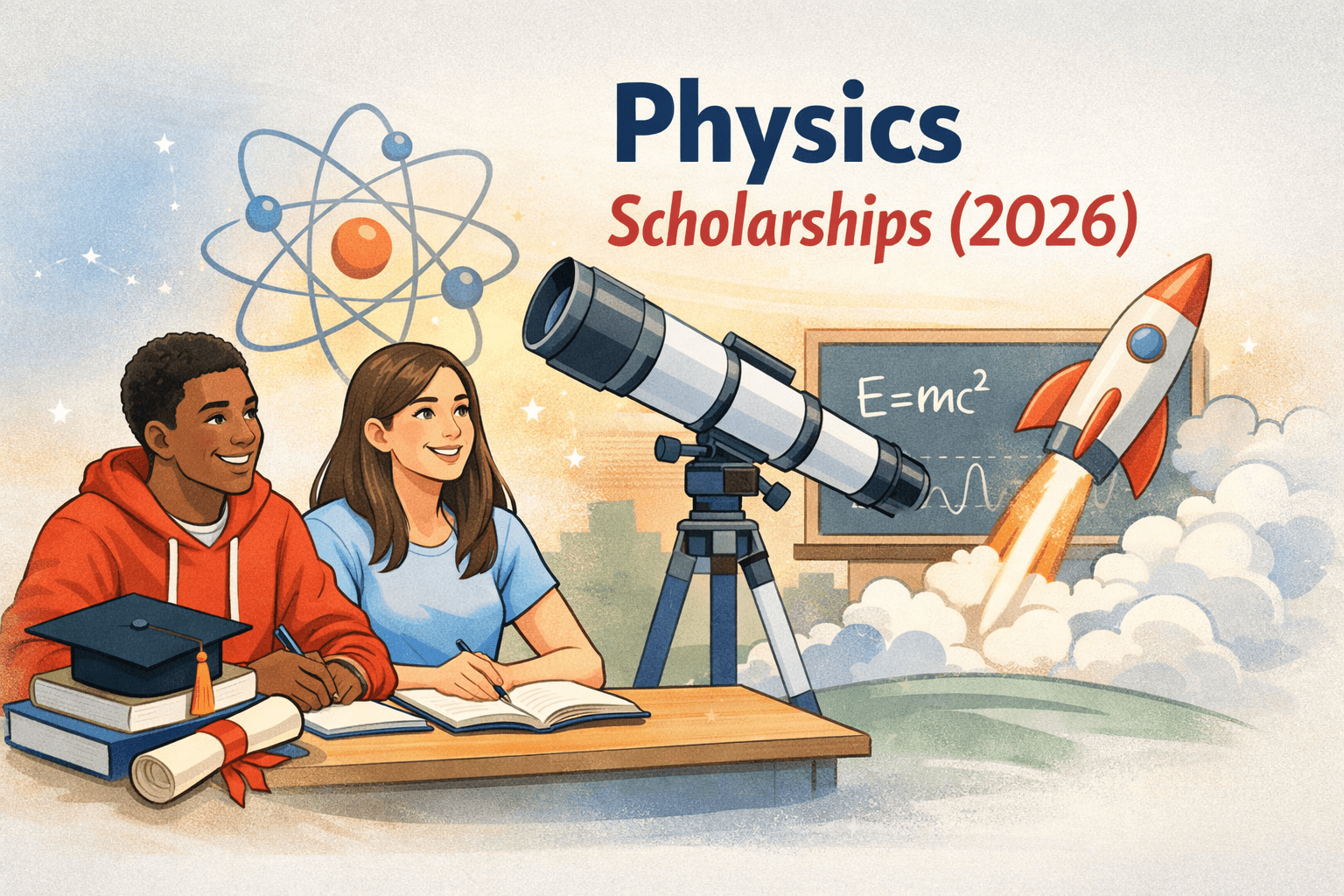
25+ Physics Scholarships (2026) — Verified Links & Monthly Updates
Physics Scholarships (Sorted by Deadline Month)
January
Barry Goldwater Scholarship (STEM undergrads)
💥 Why It Slaps: Premier U.S. merit award for sophomores/juniors eyeing research careers (physics included).
💰 Amount: Up to $7,500/year.
⏰ Deadline: January 30, 2026 (institution nominations).
🔗 Apply/info: https://goldwaterscholarship.gov
NOAA Hollings Undergraduate Scholarship
💥 Why It Slaps: Tuition support + paid NOAA summer internship; physics students in atmospheric/ocean/earth/space-related tracks are eligible.
💰 Amount: Tuition assistance + paid internship (see program).
⏰ Deadline: January 31, 2026 (2026 cycle).
🔗 Apply/info: https://www.noaa.gov/office-education/hollings-scholarship
DOE Computational Science Graduate Fellowship (CSGF)
💥 Why It Slaps: Flagship PhD fellowship for computational physics; tuition, stipend, and national-lab practicum.
💰 Amount: Tuition + stipend (see program).
⏰ Deadline: TBA (typically January).
🔗 Apply/info: https://www.krellinst.org/csgf
DOE NNSA Stewardship Science Graduate Fellowship (SSGF)
💥 Why It Slaps: For PhD students in high-energy density physics, nuclear science, materials under extreme conditions.
💰 Amount: Tuition + stipend (see program).
⏰ Deadline: TBA (typically January).
🔗 Apply/info: https://www.krellinst.org/ssgf
February
American Nuclear Society (ANS) Scholarships
💥 Why It Slaps: Dozens of awards across nuclear science/engineering (reactor physics, materials, etc.). Physics tracks often eligible.
💰 Amount: Typically $1,000–$5,000+.
⏰ Deadline: General app due Feb 1; some freshman/community-college categories Apr 1.
🔗 Apply/info: https://www.ans.org/scholarships/
March
Sigma Xi Grants-in-Aid of Research (GIAR)
💥 Why It Slaps: Micro-grants that can fund physics research travel/equipment; two rounds yearly.
💰 Amount: Typically up to $1,000 (larger for astronomy/vision).
⏰ Deadline: March 15 & October 1 annually.
🔗 Apply/info: https://www.sigmaxi.org/programs/grants-in-aid-of-research/apply
AWIS Kirsten R. Lorentzen Award (via SPS)
💥 Why It Slaps: Supports undergraduate women in physics, honoring leadership and scholarship.
💰 Amount: See program page.
⏰ Deadline: March 15 annually.
🔗 Apply/info: https://awis.org/kirsten-r-lorentzen-award/
Astronaut Scholarship Foundation (university-nominated)
💥 Why It Slaps: Among the most prestigious undergrad STEM awards; many physics recipients.
💰 Amount: Up to $15,000.
⏰ Deadline: March 31, 2025 for 2025 cycle; schools follow similar spring timelines each year.
🔗 Apply/info: https://www.astronautscholarship.org/programs/astronaut-scholarship/
SPIE Optics & Photonics Education Scholarships
💥 Why It Slaps: Big umbrella for optics/photonics (quantum, lasers, imaging); strong fit for physics majors.
💰 Amount: Typically US $3,000–$10,000+ (varies by named awards).
⏰ Deadline: TBA; 2025 cycle closed Mar 28, 2025.
🔗 Apply/info: https://spie.org/membership/student-hub/scholarships/optics-and-photonics-education-scholarships
May
AIP TEAM-UP Together Scholarship (Undergrad physics)
💥 Why It Slaps: National program to support Black/African American students pursuing physics with funds + wraparound support.
💰 Amount: See program (multi-thousand-dollar support).
⏰ Deadline: Last cycle due May 23, 2025; next cycle TBA.
🔗 Apply/info: https://www.teamuptogether.org/
June
APS M. Hildred Blewett Fellowship (returning to physics research)
💥 Why It Slaps: Enables women who paused their physics careers to restart research.
💰 Amount: Up to $45,000 (one-year).
⏰ Deadline: Typically June 1 (watch APS page for exact date each year).
🔗 Apply/info: https://www.aps.org/funding-recognition/fellowship/blewett-fellowship
USRA Distinguished Undergraduate Awards (Space research/STEM)
💥 Why It Slaps: Highly regarded space-focused awards; physics majors welcome.
💰 Amount: $5,000 per named award (see list).
⏰ Deadline: Opens each June; 2025 cycle closed—next cycle Spring 2026.
🔗 Apply/info: https://www.usra.edu/educational-activities-and-opportunities/usra-distinguished-undergraduate-awards/
September
NSA Stokes Educational Scholarship Program (STEM)
💥 Why It Slaps: Scholarship-for-service—tuition aid + paid summers + guaranteed NSA employment (physics is eligible under STEM).
💰 Amount: Tuition assistance + salary during summers; service commitment.
⏰ Deadline: Opens early September; closing window varies by posting.
🔗 Apply/info: https://www.intelligencecareers.gov/nsa/students-and-internships
Optica Women Scholars (optics/photonics; undergrad & master’s)
💥 Why It Slaps: US$10,000 each + mentoring/network for 20 women annually; physics with optics focus eligible.
💰 Amount: $10,000.
⏰ Deadline: 2026 application opens October 2025 (deadline TBA).
🔗 Apply/info: https://optica.org/womenscholars
October
NSF Graduate Research Fellowship Program (Physics)
💥 Why It Slaps: Gold-standard PhD fellowship; 3 years of support across 5-year window.
💰 Amount: Stipend + cost-of-education (see program).
⏰ Deadline: Late October (field-specific dates each year).
🔗 Apply/info: https://www.nsfgrfp.org
SPIE BACUS Scholarship (photomask/semiconductor lithography)
💥 Why It Slaps: Niche optics/semiconductor pathway—great for physics students leaning into photonics manufacturing.
💰 Amount: See program.
⏰ Deadline: October 1 annually.
🔗 Apply/info: https://spie.org/membership/bacus-technical-group/bacus-scholarship
Sigma Xi Grants-in-Aid of Research (GIAR)
💥 Why It Slaps: Second annual round—good for fall projects (see March entry for details).
💰 Amount: Typically up to $1,000 (larger for astronomy/vision).
⏰ Deadline: October 1 annually.
🔗 Apply/info: https://www.sigmaxi.org/programs/grants-in-aid-of-research/apply
November
Hertz Fellowship (applied physical & engineering sciences)
💥 Why It Slaps: Ultra-selective PhD fellowship; unmatched research freedom in physical sciences.
💰 Amount: Full tuition + personal stipend (see program).
⏰ Deadline: Typically late Oct–early Nov (annual).
🔗 Apply/info: https://www.hertzfoundation.org/hertz-fellowship/
NASA Space Technology Graduate Research Opportunities (NSTGRO)
💥 Why It Slaps: Funded PhD research with NASA mentors; strong fit for experimental/theoretical physics with space tech tie-ins.
💰 Amount: Tuition/fees + stipend (see current call).
⏰ Deadline: TBA; prior call closed in early November.
🔗 Apply/info: https://www.nasa.gov/directorates/stmd/space-tech-research-grants/
DOE Office of Science Graduate Student Research (SCGSR)
💥 Why It Slaps: Supports thesis research at DOE national labs; great for many physics subfields.
💰 Amount: Travel + monthly support during lab visit (see program).
⏰ Deadline: Semiannual; a fall/November deadline is typical (watch site).
🔗 Apply/info: https://science.osti.gov/wdts/scgsr
NDSEG Fellowship (DoD PhD fellowship)
💥 Why It Slaps: Full-ride PhD funding in physics and allied fields; no service requirement.
💰 Amount: Full tuition + stipend (see program).
⏰ Deadline: Fall window; exact date posted each cycle.
🔗 Apply/info: https://ndseg.org
December
DoD SMART Scholarship-for-Service
💥 Why It Slaps: Full tuition, annual stipend, paid DoD internships, and guaranteed post-grad job; physics is an approved field.
💰 Amount: Full tuition + stipend + signing bonus options (see program).
⏰ Deadline: First Friday in December (applications open Aug 1 annually).
🔗 Apply/info: https://www.smartscholarship.org
AAPT Barbara Lotze Scholarship (future physics teachers)
💥 Why It Slaps: For undergrads planning to teach high-school physics; renewable up to 4 years.
💰 Amount: Up to $3,000.
⏰ Deadline: December 1, 2025 (for current cycle).
🔗 Apply/info: https://apps.aapt.org/Lotze/
Rolling / Date-Varies (Check Often)
NSF GRFP (see above) — dates vary by field in October.
CIA Undergraduate/Graduate Scholarship Programs (Stokes & CIA USP) — scholarship-for-service with physics-aligned roles; application windows vary; currently some programs paused for Summer 2026. 🔗 https://www.cia.gov/careers/student-programs/ CIA
AAPM Scholarships & Fellowships (Medical Physics) — several scholarships/fellowships (including Hispanic & Latin-X Scholarship); deadlines vary by award. 🔗 https://gaf.aapm.org
Health Physics Society Scholarships (Radiation/Health Physics) — undergrad/grad awards; watch annual window. 🔗 https://hps.org/aboutthesociety/awards/scholarships.html
Optica Foundation — Women Scholars (see Sept) & other student scholarships — multiple optics/photonics awards beyond the women’s program. 🔗 https://www.optica.org/foundation/opportunities/scholarships/ Optica
Notes on Fit
- Undergrad Physics: Goldwater, TEAM-UP Together, Astronaut Scholarship, ANS (some categories), AAPT Lotze (teacher-prep), SPIE/Optica, Sigma Xi GIAR, SMART/NSA/CIA (service).
- Grad/PhD Physics: NSF GRFP, Hertz, NDSEG, DOE CSGF/SSGF/SCGSR, NASA NSTGRO, AAPM, HPS, SPIE/Optica.
FAQs — Physics Scholarships & Fellowships (Read Before You Apply)
Q1) I’m a first-year undergrad with limited research. What can I realistically win?
Early wins usually come from department awards, local/community foundations, identity-based orgs, and small research micro-grants (travel/equipment). Aim to join a lab, present a poster, and collect one strong faculty rec before the spring deadlines.
Q2) What GPA do physics scholarships expect?
Many list a 3.0+ minimum; competitive national fellowships trend higher. Strong research fit, clear goals, and standout recommendations can offset a borderline GPA.
Q3) Do I need published papers to be competitive?
No. Concrete research contributions (methods you used, data you analyzed, what you learned) plus a credible plan for future work matter more than journal authorship.
Q4) I’m at a community college. Do these still apply to me?
Yes—look for transfer-friendly awards and programs that accept applicants prior to university matriculation. Build relationships with physics faculty early for recommendations.
Q5) I took a break from school/work. Am I eligible?
Plenty of awards welcome non-traditional and returning students. Some fellowships specifically fund people re-entering physics research after a pause.
Q6) I’m not a U.S. citizen. What can I apply to?
Government-funded scholarships may require U.S. citizenship or permanent residency. Many society/foundation awards (especially optics/photonics) are open internationally—always check the eligibility section.
Q7) I’m pre-med but love physics. Anything for me?
Yes—medical physics, imaging, and radiation science awards exist. Emphasize how physics training supports your clinical or translational goals.
Q8) How do I prove “financial need”?
Some programs accept FAFSA/EFC figures; others use your school’s aid letter or a short statement. Keep documents handy and consistent with your financial aid file.
Q9) Can I stack multiple awards?
Often yes, but “coordination of benefits” rules apply. Universities may reduce internal aid when external funds arrive; federal fellowships may not be combinable with certain stipends. Ask your department admin before accepting.
Q10) What does “scholarship-for-service” mean?
You receive funding now and commit to work for the agency/organization after graduation (or during summers). Read service terms, locations, and security-clearance notes carefully.
Q11) Are graduate fellowships taxable?
Tuition/required fees paid to the institution are typically not taxable; portions used for living expenses often are. Keep award letters and consult a tax professional or your grad school payroll office.
Q12) Do these awards require the GRE?
Most modern programs do not require GRE scores. If accepted, treat GRE as optional signaling—only submit if it strengthens your case.
Q13) What makes a physics personal statement pop?
Lead with a concrete research problem, your contribution (skills, techniques, results), the “so what” impact, and a tight plan for the next stage. Avoid generic passion intros; show technical growth and hypothesis-driven thinking.
Q14) How many recommendation letters do I need—and from whom?
Two to three is common. Prioritize research supervisors who can discuss your day-to-day work, independence, and problem-solving with specific examples.
Q15) I missed a deadline. Worth emailing the program?
If the portal briefly failed or you have a documented emergency, politely ask about late submission. Otherwise, set calendar alerts for the next cycle and use the time to improve your package.
Q16) What counts as “physics” for eligibility?
Core subfields (AMO, HEP, condensed matter, astro, biophysics), plus adjacent areas (materials, geophysics, optics/photonics, data-driven/computational) often qualify—eligibility language rules.
Q17) Do undergrads really get national awards?
Yes—especially those with early lab experience, strong mentoring, and a crisp research narrative. Start small (campus SURF/REU, Sigma Xi-style micro-grants), then scale.
Q18) Any quick timeline I can follow this year?
- Sept–Oct: Identify targets, request letters, draft statements, update CV.
- Nov–Dec: Submit teacher-prep/DoD programs; polish major spring apps.
- Jan–Mar: Peak season for national undergrad/optics/astro awards.
- Apr–Jun: Departmental/association awards; some fellowships open.
Set reminders 30, 14, and 3 days before each deadline.
Q19) How do I verify a scholarship is legit (no spam)?
Look for an official .edu/.gov or the professional society’s domain, a clear eligibility page, past recipient lists, and named staff contacts. Avoid portals that charge application fees or demand unrelated sensitive data.
Q20) Any application red flags that sink candidates?
Vague goals, recycled essays without program fit, missing transcripts, generic letters, and sloppy abstracts. Have a physics mentor proofread for technical clarity.
Q21) I’m applying to both physics and engineering awards. Is that okay?
Yes—just tailor your essays. Translate your physics skills (modeling, instrumentation, algorithms) into the application’s language and outcomes.
Q22) What if my school doesn’t have many physics resources?
Leverage virtual seminars, arXiv clubs, open-source toolkits, and external mentors (REUs, society chapters). Document self-taught skills and open-lab contributions in your CV.
Q23) How long should my CV be?
Undergrads: 1–2 pages with sections for Education, Research Experience (with methods/tools), Presentations/Posters, Skills, Awards. Grad: 2–4 pages depending on output.
Q24) Any quick essay structure I can steal?
Hook (problem & why it matters) → Your contribution (methods/results) → Skills gained (tools, theory) → Next steps (what you’ll do with the award) → Broader impact (who benefits, how you’ll share results).