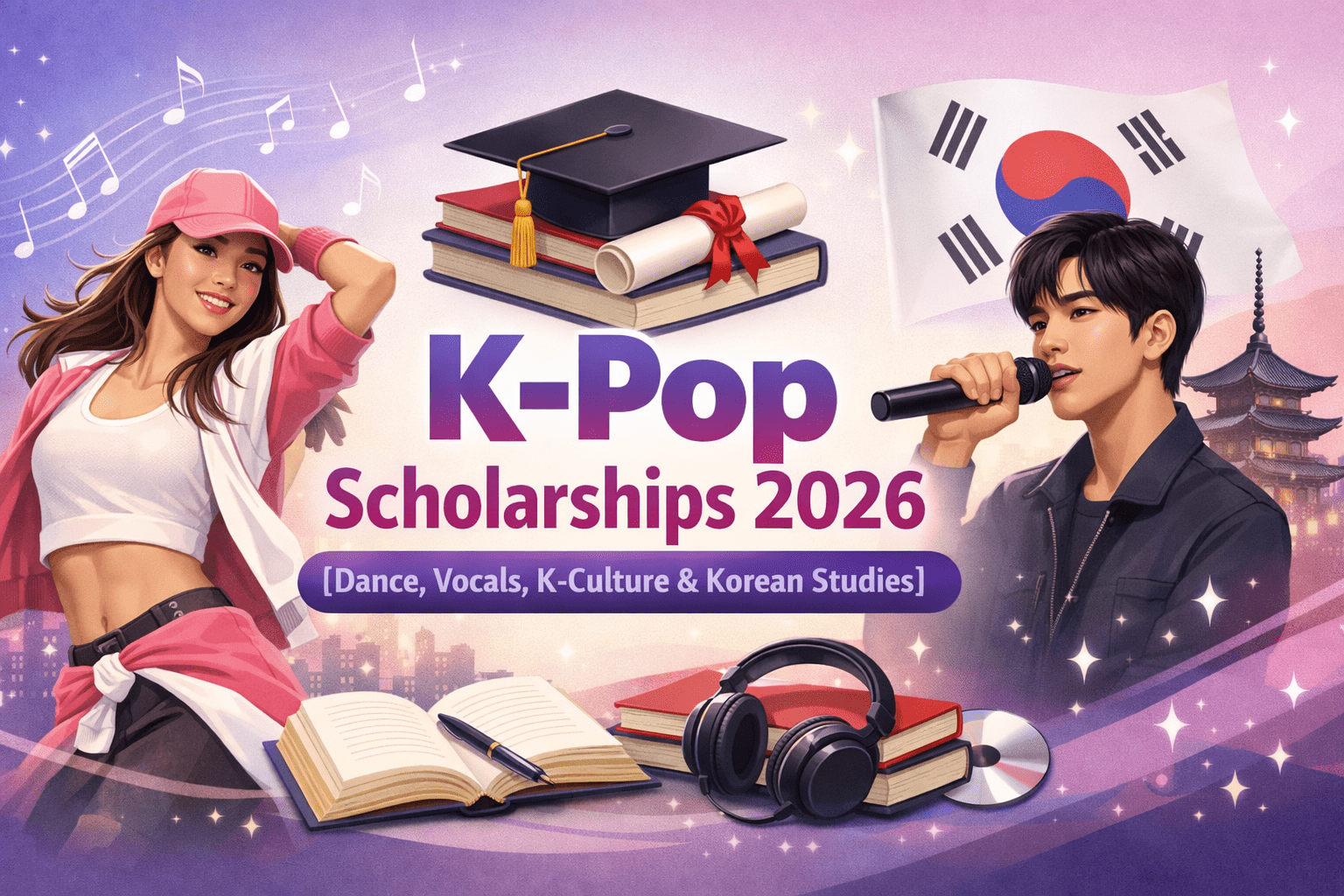
K-Pop Scholarships 2026 (Dance, Vocals, K-Culture & Korean Studies) — Verified Links
Real K-Pop-adjacent scholarships—dance/voice/music awards, fan scholarships, Korean language & culture funding, Korean Studies fellowships, study-in-Korea programs. Sorted by month.
K-Kop Scholarships Video
January
Boren Scholarship (Undergrad) – Study a Critical Language (incl. Korean) Abroad
💥 Why It Slaps: Big money for immersive language study; can position you for producing/songwriting careers with real Korean language & culture chops.
💰 Amount: Up to $25,000 for year-long study (shorter terms available).
⏰ Deadline: Late January (last cycle was Jan 29, 2025; new date posts each fall).
🔗 Apply/info: https://www.borenawards.org/
February
University of Hawaiʻi Center for Korean Studies — Multiple Scholarships
💥 Why It Slaps: Several awards (incl. performing arts—Korean dance/music) plus Korean Studies funds; clear dollar amounts and firm due date.
💰 Amount: Typically $2,500–$5,000 depending on the specific award.
⏰ Deadline: February 15 annually (last cycle Feb 15, 2025).
🔗 Apply/info: https://manoa.hawaii.edu/koreanstudies/programs/scholarships/
Sejong Cultural Society — Korean Culture Essay Competition
💥 Why It Slaps: Celebrate K-culture/Hallyu in an academic way and earn cash; great portfolio piece for arts or Asian studies majors.
💰 Amount: Cash prizes (varies by placement).
⏰ Deadline: February 28 (last cycle Feb 28, 2025).
🔗 Apply/info: https://www.sejongculturalsociety.org/writing/current/index.php
March
Global Korea Scholarship (GKS) — Graduate Degree (International Students)
💥 Why It Slaps: Korea’s flagship full-ride for study in Korea (you can choose arts/performing arts programs).
💰 Amount: Full ride (tuition + monthly stipend + airfare + insurance; specifics vary by year).
⏰ Deadline: Late Feb–March (varies by Embassy/University track; watch the official page and your local Korean Education Center).
🔗 Apply/info: http://www.niied.go.kr/user/nd35203.do
Overseas Korean Student Scholarship Program (OKA)
💥 Why It Slaps: For overseas Koreans (incl. Korean Americans) who study in Korea; robust monthly support.
💰 Amount: KRW 1,100,000/month living stipend + roundtrip airfare + insurance (per latest call).
⏰ Deadline: Spring (2025 call posted March 13; check your local KEC/consulate page each year).
🔗 Apply/info: Example notice (Seattle Consulate): https://www.okocc.or.kr/portal_en/support/fut_gen_pro.do, https://usa-seattle.mofa.go.kr/us-seattle-en/brd/m_4809/view.do?seq=761423
Korean Resource Center (KRC) Scholarships (Los Angeles)
💥 Why It Slaps: Community-based awards with a dedicated category for undocumented students.
💰 Amount: 3 awards × $2,000 (last cycle).
⏰ Deadline: Spring (call posted Mar 7, 2025; watch page for exact date each year).
🔗 Apply/info: https://www.krcla.org/krc-news/2025-krc-scholarship
May
KACF-SF — Ryu Family Karen Ha Scholarship (Bay Area)
💥 Why It Slaps: Korean-heritage focus; clear community impact and simple application hub.
💰 Amount: Varies.
⏰ Deadline: May 30 (last cycle).
🔗 Apply/info: https://www.kacfsf.org/scholarship
June
Korean Honor Scholarship (Embassy of the Republic of Korea, USA)
💥 Why It Slaps: Prestigious recognition for Korean/Korean-American students; looks great alongside arts/music apps.
💰 Amount: Up to $5,000.
⏰ Deadline: June 20 (application typically opens in April; 2025 window Apr 21–Jun 20).
🔗 Apply/info: Embassy notice: https://www.mofa.go.kr/us-losangeles-en/brd/m_4394/view.do?seq=761582
Korean American Scholarship Foundation (KASF) — Regional Awards
💥 Why It Slaps: Long-running national foundation; multiple regional scholarships (undergrad/grad/HS seniors).
💰 Amount: Typically $500–$5,000 (varies by region).
⏰ Deadline: June 30 (most regions; confirm your chapter).
🔗 Apply/info: https://www.kasf.org/
July
Korean War Veterans Association (KWVA) Academic Scholarships
💥 Why It Slaps: For descendants of Korean War or Korean Defense veterans—ties back to Korean history & community.
💰 Amount: $1,000–$1,500 (multiple awards).
⏰ Deadline: July 31 (last cycle).
🔗 Apply/info: https://kwva.us/?page=programs_scholarship
Understanding Korea Essay Contest (Academy of Korean Studies)
💥 Why It Slaps: International contest on Korea-related themes; solid résumé line for culture/arts applicants.
💰 Amount: Prize packages valued at KRW 600,000 / 400,000 / 200,000 (Grand/Excellence/Encouragement).
⏰ Deadline: July 31 (2025 cycle).
🔗 Apply/info: https://www.mofa.go.kr/kh-en/brd/m_25856/view.do?seq=56
September
Korea Foundation (KF) — Scholarship for Graduate Studies (outside Korea)
💥 Why It Slaps: Supports MA/PhD students doing Korea-related work (Hallyu/K-pop studies welcome in many programs).
💰 Amount: Tuition + living/research expenses (varies by grantee and region).
⏰ Deadline: September 12, 2025 (2025–26 cycle; new window posts each summer).
🔗 Apply/info: https://www.mofa.go.kr/il-en/brd/m_11417/view.do?seq=759978
October
K-POP Fan No-Essay Scholarship (Bold.org)
💥 Why It Slaps: Quick entry; fun, fandom-friendly pick for K-pop stans.
💰 Amount: $500.
⏰ Deadline: October 2, 2025.
🔗 Apply/info: https://bold.org/scholarships/K-POP-fan-no-essay-scholarship/
TOMORROW X TOGETHER (TXT) Ult Group Scholarship (Bold.org)
💥 Why It Slaps: Built by MOA for MOA—five sizeable awards for dedicated TXT fans.
💰 Amount: 5 winners × $5,530 (total $27,650).
⏰ Deadline: October 13, 2025.
🔗 Apply/info: https://bold.org/scholarships/tomorrow-x-together-TXT-ult-group-scholarship/
November
Critical Language Scholarship (CLS) — Korean (U.S. Dept. of State)
💥 Why It Slaps: Fully funded summer language program; Korean track helps artists/creators work in Seoul or collaborate with K-music pros.
💰 Amount: Fully funded (tuition, travel, housing, stipend).
⏰ Deadline: Mid-November (TBA each fall); last cycles announced “mid-Nov.”
🔗 Apply/info: https://clscholarship.org/languages/korean
NSLI-Y (High School) — Korean, Summer/Academic Year (U.S. Dept. of State)
💥 Why It Slaps: Fully funded teen programs in Korea; some cohorts even include K-pop dance cultural activities.
💰 Amount: Fully funded (program + airfare & more).
⏰ Deadline: November (TBA); last cycle due early November.
🔗 Apply/info: https://www.nsliforyouth.org/
Rolling / School-Posted
Korea National University of Arts (K-ARTS) — AMA+ (Art Major Asian) Scholarship
💥 Why It Slaps: Study voice, dance, composition, or other arts in Korea—on a full K-arts scholarship.
💰 Amount: Full scholarship for eligible bachelor’s/master’s students (benefits detailed by K-ARTS).
⏰ Deadline: Varies by annual call (watch the AMA+ page).
🔗 Apply/info: https://www.karts.ac.kr/en/karts/ama.do
Seoul Institute of the Arts — International Student Scholarships
💥 Why It Slaps: Korean arts conservatory with film/acting/music/dance programs; institutional scholarships available.
💰 Amount: Varies (merit/need-based).
⏰ Deadline: Posted per admission cycle.
🔗 Apply/info: https://www.seoularts.ac.kr/eng/web/content.do?proFn=9922100
UC Berkeley — Korean Literature Essay Contest (Campus-Specific)
💥 Why It Slaps: Departmental contest tied to contemporary Korean literature; great academic signal for K-culture careers.
💰 Amount: Prize awards (see annual poster).
⏰ Deadline: Spring (announced each year).
🔗 Apply/info: https://korean.berkeley.edu/events/essay-contest
Korean Women’s Association (KWA) Scholarship (Washington State)
💥 Why It Slaps: Regional community scholarship for high-achieving seniors.
💰 Amount: Varies.
⏰ Deadline: Spring (announced each year).
🔗 Apply/info: https://www.kwacares.org/kwa-scholarship/
AKS Graduate Fellowship (Academy of Korean Studies)
💥 Why It Slaps: Funded 6-month research residency in Korea for grad students in Korean Studies (great for K-pop/Hallyu research).
💰 Amount: Stipend + research support (benefits detailed in annual call).
⏰ Deadline: Typically spring (2025 guidelines posted in March/April).
🔗 Apply/info: https://www.mofa.go.kr/hk-en/brd/m_1495/view.do?seq=761515 (see current “Graduate Fellowship” notice)
Korea Foundation — Calls for Graduate Studies / Fellowships (outside Korea)
💥 Why It Slaps: Supports Korea-related grad work & postdocs abroad (including media/culture/Hallyu research).
💰 Amount: Tuition + living/research (varies).
⏰ Deadline: Windows published each summer (e.g., Jul 21–Sep 12, 2025 for 2025–26).
🔗 Apply/info: https://www.mofa.go.kr/kh-en/brd/m_25856/view.do?seq=59
Descendants of UN Korean War Veterans Scholarship (Study in Korea @ HUFS/MPVA)
💥 Why It Slaps: Specialized pathway to earn a degree in Korea if you’re a descendant of a UN Korean War veteran.
💰 Amount: Full tuition (language + degree), dorm, plus travel support listed in call.
⏰ Deadline: Fall (e.g., last cycle Nov 8, 2024; watch for new call each fall).
🔗 Apply/info: Example consulate notice: https://overseas.mofa.go.kr/us-dallas-en/brd/m_26375/view.do?seq=761052
K-Pop Scholarships as Human-Capital Infrastructure: Funding Pathways, Labor-Market Signals, and Cultural-Diplomacy Spillovers
“K-Pop scholarships” are rarely a single, standardized funding category. Instead, they function as a bundle of adjacent scholarship pathways—Korean language, Korean Studies, performing arts, music production, entertainment business, and study-abroad mobility—plus a small but visible layer of “fan-identity” micro-awards. This paper frames K-Pop-linked scholarships as an emerging human-capital infrastructure that converts global demand for Korean popular culture into formal education and skill development. Using a data-driven typology, we compare award sizes, selection logics, and institutional incentives across (1) micro-scholarships targeting fandom, (2) academic and diaspora scholarships that scale educational access, and (3) government-backed language and exchange programs aligned with national priorities. We argue that the scholarship ecosystem around K-Pop is best understood as a talent pipeline (creative labor), a mobility system (study abroad and degree programs in Korea), and a soft-power instrument (cultural diplomacy). We conclude with evidence-based recommendations for students and scholarship providers to improve legitimacy screening, equity, and outcomes.
1. Introduction: Why “K-Pop Scholarships” Exist at All
K-Pop’s scholarship “surface area” has expanded because the cultural sector’s global reach now produces measurable educational demand. South Korea’s music-industry export value has been reported at USD 1.22 billion in 2023, representing dramatic long-run growth (e.g., dozens-fold compared with mid-2000s baselines). Such export performance is not just an entertainment story; it is a labor-market and education-policy story. When a cultural product becomes an export engine, it creates sustained demand for language competency, cross-cultural management, audio engineering, choreography, marketing analytics, IP/legal expertise, and platform distribution strategy.
The scale of global interest is likewise non-trivial. The Korea Foundation’s reporting has placed global Hallyu fandom in the hundreds of millions (e.g., 225 million Hallyu fans reported for 2023). At the perception level, cultural content also becomes a national brand: a Korean Ministry of Culture-linked survey has reported K-Pop as the most common first association with Korea (e.g., 17.8%) and very high stated liking for Korean content (e.g., 70.3%).
These figures matter for scholarships because scholarships follow demand signals. If a large youth cohort wants Korea-linked cultural and educational experiences, scholarship designers—from governments to universities to nonprofits—have an incentive to subsidize the training and mobility that turn interest into competence.
2. Cultural Demand → Educational Demand: Language Learning as the Bridge
The first measurable conversion from K-Pop fandom to education is language enrollment and practice intensity. U.S. college enrollments in Korean increased substantially in the late 2010s and early 2020s; the Modern Language Association has reported +38.3% growth for Korean enrollments (2016→2021). On consumer language platforms, Korean has remained a top global learning choice; Duolingo’s 2025 reporting places Korean among the most studied languages globally (e.g., #6 worldwide).
Why does this matter for scholarships? Because language is the “gatekeeper skill” that transforms K-Pop from passive consumption into active participation in Korean cultural and professional contexts—whether that participation is academic (Korean Studies), creative (lyrics writing, choreography direction), or commercial (A&R, touring logistics, brand partnerships). Scholarship ecosystems tend to subsidize gatekeeper skills because they predict downstream success and reduce attrition in higher-cost training programs.
3. Industry Structure and the Scholarship Problem: High Training Costs + Winner-Take-Most Rewards
K-Pop’s modern “idol production” system is widely characterized by high upfront training costs (dance, vocal coaching, language training, fitness, styling, media practice) and uncertain payoff (selection, debut probability, contract outcomes). In such systems, scholarships can serve two distinct functions:
- Access subsidies: reducing the cost barrier for capable students lacking resources.
- Talent discovery subsidies: reducing the search cost for institutions seeking high-potential candidates (universities, governments, nonprofits).
However, K-Pop’s scholarship landscape is unusual because it includes both serious education finance (tuition, research support, exchange programs) and symbolic micro-awards that reward identity affiliation (fandom) rather than skill accumulation. This duality creates confusion for students: “K-Pop scholarship” can mean “$500 essay award for fans,” or it can mean “multi-year funding to build Korean language and cultural expertise.”
4. A Data-Driven Typology of K-Pop-Adjacent Scholarships
Below is a practical typology that aligns award design with the underlying economic logic of skill formation and mobility.
4.1 Micro-Scholarships for Fans (Identity-Based Signaling)
These awards are typically small (hundreds of dollars), frequently no-essay or short-essay, and framed around fandom identity. Examples include Bold.org awards such as the “K-Pop Fan No-Essay Scholarship” and other K-Pop-themed micro-scholarships (often around $500).
Economic logic: marketing/community engagement + low administrative burden.
Student value: marginal tuition relief; useful as a stacking strategy (apply to many).
Risk: students may overestimate how much these awards can fund; some are not tied to accredited training or verified pipelines.
4.2 Program-Specific Study-Abroad Scholarships (Mobility Subsidies)
Some K-Pop-relevant funding appears through Korea-focused study programs (language and culture). For instance, an IE3 Global / University of Oregon Korea program scholarship has been listed in the $1,000–$3,000 range.
Economic logic: increase participation in programs that build language/cultural capital.
Student value: can materially reduce the marginal cost of a Korea semester/summer.
4.3 Government-Backed U.S. Scholarships (Language & National-Priority Skills)
Several major U.S. programs function as Korea-relevant funding pathways when students pursue Korean language or Korea-based programs:
- Gilman Scholarship: up to $5,000, with critical-language supplemental funding options (e.g., up to $3,000 for critical need languages).
- Critical Language Scholarship (CLS): an intensive ~8-week summer language program; since 2006 it has supported nearly 10,000 participants, and the Korean track requires one year of prior study.
- Boren Awards: up to $25,000 for undergraduates and up to $30,000 for graduate students (depending on program structure and domestic/overseas components).
Economic logic: national workforce development + language capacity building.
Student value: these are among the highest-ROI options for K-Pop-adjacent goals because they subsidize durable, marketable skills (language + overseas experience), not just fandom.
4.4 Korea-Linked Degree Funding and Cultural Exchange (Soft-Power and Talent Magnet)
South Korea also runs major scholarship pathways for international students, most prominently the Global Korea Scholarship (GKS), with application routes via embassies or universities and centralized guidance through Study in Korea resources.
Economic logic: talent attraction + international education exchange.
Student value: potentially transformational for students seeking full degree programs in Korea.
4.5 Academic and Diaspora Scholarships (Community and Field-Building)
Scholarships that support Korean heritage communities and Korean Studies can be highly relevant to K-Pop-oriented students who pursue adjacent majors (Korean Studies, media studies, music business, etc.). The Korean American Scholarship Foundation (KASF) reports long-run scale and annual granting figures (e.g., $15M granted, 8,794 students awarded, and $845,500 awarded in 2025).
The Korea Foundation supports Korean Studies through various programs and scholarships, functioning as field-building infrastructure for Korea-related expertise.
Economic logic: community investment + academic field development.
Student value: often more substantial and credible than micro-awards; can align strongly with rigorous academic trajectories.
4.6 Private Training “Scholarships” (Ambiguous Category Requiring Due Diligence)
Some organizations advertise K-Pop-linked “scholarships” tied to training programs. For example, ACOPIA advertises a “K-Pop Debut Support Scholarship” framed as a cash refund (e.g., KRW 500,000).
Economic logic: reduce price friction for paid training programs (customer acquisition).
Student value: can help if the program is reputable and outcomes are transparent.
Risk: high—because terms vary, outcomes are uncertain, and “scholarship” can function as marketing. Students should verify contracts, costs, and reputational signals carefully.
5. Comparing Award Economics: Typical Value Bands and What They Actually Fund
A practical way to interpret the ecosystem is by award band:
| Award band | Typical examples | What it realistically funds | Primary selection logic |
|---|---|---|---|
| Micro ($250–$1,000) | Fan micro-scholarships | Books/fees; small tuition slice | Identity, short essays, lotteries/no-essay |
| Mobility ($1,000–$5,000) | Program scholarships; Gilman baseline | A meaningful share of airfare + program fees | Merit + need + program fit |
| Major awards ($8,000–$30,000) | Boren; higher-leverage study abroad | Semester/year abroad + language training | Strategic language + commitment + service (Boren) |
| Multi-year / degree support | Fulbright Korea awards; GKS pathways | Tuition + living support (program-dependent) | Academic excellence + project design + field relevance |
This banding shows why “K-Pop scholarships” can feel inconsistent: they cover both symbolic engagement grants and serious, career-shaping investments.
6. Outcomes: From Fan Identity to Employable Competence
A core doctoral-level claim is that scholarships matter insofar as they accelerate conversion from interest to competence. In the K-Pop context, competence clusters into five skill portfolios:
- Language + cross-cultural competence (Korean proficiency; intercultural teamwork)
- Creative performance (dance, vocal performance, stagecraft)
- Production stack (audio engineering, songwriting, mixing/mastering, creative direction)
- Business stack (marketing analytics, touring logistics, brand partnerships, IP/licensing)
- Research and criticism (Korean Studies, media studies, cultural economics)
The most scalable scholarships are those that fund portfolios, not just fandom. U.S. government language scholarships explicitly emphasize workforce competitiveness and strategic language capacity. Fulbright awards demonstrate a parallel model: funding is tied to research, study, or arts practice within structured international exchange, including Korea-specific graduate degree support in Korean Studies.
7. The Streaming/Physical Sales Paradox: What the Music Economy Signals to Scholarship Designers
Global recorded-music revenue has continued to grow; IFPI reporting for 2024 revenues (released in the 2025 reporting cycle) places the global market around $29.6B with year-over-year growth. In parallel, K-Pop’s global footprint is visible in rankings and sales narratives: IFPI’s reporting has highlighted South Korean acts’ strength in global album formats, while press coverage of IFPI’s charts notes multiple Korean acts in top global positions.
Yet K-Pop’s physical album boom has also been criticized for environmental and incentive distortions (e.g., bulk buying to access fan-sign perks), with reporting describing rapid growth in physical units and related concerns. For scholarships, the implication is subtle: as the industry evolves, scholarship providers may prefer funding sustainable skill formation (language, production, management, research) over narrowly funding consumption-adjacent engagement.
8. Legitimacy, Risk, and Anti-Scam Heuristics for K-Pop-Labeled Awards
Because “K-Pop scholarship” is an attractive label, it can invite low-quality or ambiguous offerings. Students should apply a legitimacy checklist:
- Who funds it? University, government, established nonprofit, or a paid training vendor? (Vendor-linked “scholarships” can be legitimate but require extra scrutiny.)
- Where does the money go? Direct tuition payment, stipend, or “refund” contingent on enrollment/purchase?
- Are outcomes measurable? Past recipient lists, transparent selection criteria, clear terms.
- Is it stackable? Micro-awards are best treated as stackable supplements, not primary funding.
- Does it build durable capital? Favor awards that fund language acquisition, accredited study, or portfolio-building experiences (research, performance training with credible instructors, production internships).
9. Strategy for Students: Match Your “K-Pop Goal” to the Right Scholarship Market
Rather than searching “K-Pop scholarships” as a single pool, students should select a pathway:
- If you want to perform (dance/vocals): prioritize accredited performing-arts scholarships, plus Korea-linked mobility funding that supports training and audition readiness.
- If you want music production/songwriting: target audio engineering/music technology programs and seek study abroad + language funding to collaborate in Korean contexts.
- If you want entertainment business/management: treat Korean language study and international experience as differentiators; pursue Gilman/Boren-style funding if eligible.
- If you want Korean Studies / research on K-Pop: consider Fulbright Korean Studies degree pathways and Korea Foundation field-building supports.
- If you’re building Korea-linked identity/community leadership: diaspora scholarships like KASF can be high-impact and scalable.
This matching approach also reduces wasted effort: a student chasing a performing career should not rely primarily on fan micro-awards; a student aiming for Korea-based graduate study should treat major exchange and degree programs as the main funding targets.
10. Recommendations for Scholarship Providers: Designing High-Impact K-Pop-Adjacent Funding
For foundations, universities, and program designers, the data suggests three evidence-based design moves:
- Fund “conversion skills” (language + portfolio) rather than consumption. Growth in Korean language demand indicates a scalable training target.
- Bundle mobility with mentoring and placement. Funding travel without guidance can produce shallow outcomes; pairing scholarships with internships, labs, or performance showcases raises ROI.
- Increase transparency to reduce market lemons. Publish recipient outcomes, selection criteria, and total awards distributed—practices visible in more mature scholarship organizations.
Conclusion
“K-Pop scholarships” are best understood not as a niche gimmick, but as a distributed funding ecosystem that sits at the intersection of global cultural trade, language education, international mobility, and creative-industry labor markets. Export and fandom-scale indicators show why scholarship supply is expanding. Yet the ecosystem’s heterogeneity—micro fan awards alongside major government and academic funding—requires careful interpretation. Students maximize outcomes when they treat K-Pop as a motivation and scholarships as a skills infrastructure: target awards that finance language acquisition, accredited study, portfolio development, and credible international exchange. Providers maximize outcomes when they fund conversion skills, bundle support services, and maintain high transparency. In short, the most powerful “K-Pop scholarships” are those that turn global cultural enthusiasm into durable human capital.
Selected References (for further verification and citation building)
- Korea Creative Content Agency (KOCCA) reporting on music-industry export value.
- Korea Foundation reporting on global Hallyu fandom scale.
- Modern Language Association reporting on Korean enrollments in U.S. higher education.
- Duolingo reporting on Korean’s popularity among language learners.
- U.S. Department of State: Gilman Scholarship and CLS program information.
- Boren Awards funding caps and program structure.
- Fulbright Korea-related award descriptions and Korean Studies degree support.
- Examples of K-Pop-labeled micro-scholarships (award size benchmarking).
- KASF organizational scale and annual award totals (diaspora scholarship benchmarking).
FAQs — K-Pop Scholarships & Study-in-Korea
What actually counts as a “K-Pop scholarship”?
Scholarships rarely fund “idol training” directly. The real, legit buckets: (1) Korean language/culture programs (e.g., government or university awards), (2) arts/performance scholarships (dance, voice, music production), and (3) fan-funded micro-awards. Use them to build skills, network, and fund study that supports your K-music path.
I’m not Korean. Can I still apply?
Yes. Many language/arts programs are open to all nationalities. Heritage-based awards exist too, but plenty are open to non-heritage applicants.
I’m in high school. What should I target first?
Look for fully funded summer language programs, local community foundation awards, performing-arts scholarships, and fan-funded micro-awards. Keep a clean, well-labeled audition/portfolio folder (voice + dance + any production).
What materials do arts-leaning scholarships usually ask for?
A short audition video (60–180s), performance résumé, repertoire list, one to two recommendation letters (music/dance/choir/coach), transcript, and a brief statement connecting your training to goals (college major, study in Korea, career plan).
How should I frame my essay if I’m a “stan”?
Lead with work not worship: practice logs, classes, choreography you’ve learned/created, collabs, performances, language study, and measurable growth. Connect fandom → skill-building → academic plan → community impact.
Do I need Korean language for arts programs in Korea?
It helps. Many programs offer foundation/bridge language terms. If you’re early in your journey, set a 6–12 month plan (daily vocab, graded readers, weekly conversation practice) and mention it in essays.
Are “no-essay” fan scholarships worth my time?
Yes—as a volume play. Low time cost, but also lower odds. Enter consistently while prioritizing merit/need-based awards where your portfolio gives you an edge.
Can undocumented/DACA students apply?
Some community organizations explicitly welcome undocumented students. Read eligibility lines carefully; if allowed, line up alternative documents (e.g., school ID, counselor letter) early.
How do these awards typically pay out?
Most disburse to your school’s financial-aid office; some send funds to you. Know each award’s rules (tuition-only vs. broader educational expenses) before budgeting.
Are scholarships renewable?
Sometimes. Common conditions: minimum GPA, credit load, updated transcript, short impact report. Put renewal checkpoints in your calendar 30–45 days before the stated date.
Any tax tips I should know?
In the U.S., scholarship money used for qualified tuition/fees is generally tax-free; portions used for room/board can be taxable. Keep receipts and talk to a tax professional for your situation.
What’s a realistic yearly application plan?
Target 12–20 applications across categories: 4–6 language/culture, 4–6 arts/performance, 4–8 fan/local/community. Start drafts in September, finalize by October, and keep rolling entries on your weekly to-do list.
How do I pick strong recommenders?
Choose people who’ve seen the work: choir director, voice teacher, dance coach, music tech instructor, Korean teacher. Give them a 1-page brag sheet (highlights + links), your deadlines, and your statement draft at least 3 weeks ahead.
What goes into a great audition video?
Neutral background, clear lighting, one take if allowed (or follow cut rules), slate (name, piece, role), full-body framing for dance, clean audio for vocals, filename with YourName_Piece_Type_Date. Upload unlisted and share link.
Can I submit K-Pop covers in auditions/contests?
Often yes—if the rules allow covers. Follow any music length/arrangement limits. Don’t use commercial backing tracks unless permitted by the organizer; read the fine print on rights.
How do I avoid scams?
Red flags: application fees, “guaranteed placement,” paid auditions promising visas, suspicious domains, or requests for banking info. Stick to recognized institutions and programs linked above.
What if my GPA isn’t perfect?
Performance and progress can offset a middling GPA. Show consistent training, repertoire range, language learning, and community work (teaching covers, school showcases, cultural club leadership).
Can international students in the U.S. apply?
Some U.S. awards require citizenship/PR; others are open to international students. Read the eligibility line first and maintain your visa status with your school’s international office.
How do I budget for study in Korea?
Map tuition, housing, visa fees, airfare, insurance, meals, transit, and practice costs (studio time, lessons). Even with full tuition, you’ll want a cushion for living and training expenses.
How do I stack multiple small awards?
Check each award’s stacking rules. Many allow stacking as long as you don’t exceed cost of attendance. Tell your financial-aid office early so they can coordinate disbursement.
What if my portfolio mixes dance, vocals, and production?
That’s a plus. Curate a 3-clip “reel” (≤5 minutes total): one dance, one vocal, one production/composition. Add a short PDF with credits, gear/DAW list, and training timeline.
Any timeline hacks so I don’t miss deadlines?
Create a master sheet with columns: Name | Category | Amount | Eligibility | Deadline | Docs | Status. Set two reminders per application: 14 days before (final polish) and 48 hours before (submit).
How do I show “impact” beyond performing?
Document teaching workshops, hosting cover-dance practices, translating lyrics for club events, arranging pieces for school ensembles, or organizing cultural nights. Quantify hours and audience size.
What if I’m taking a gap year?
Plenty of programs allow it. Use the time to level up language, build audition repertoire, and collect recommendation letters from paid/volunteer teaching or performance gigs.
Do I need TOPIK (Korean proficiency test)?
Not always. It’s valued for academic programs and can help with placement. If required, most arts/foundation tracks will say so. If optional, list your level or plan (e.g., target TOPIK I by spring).
Can I combine private training with university study?
Yes, but clear it with your program. Keep academics first; book studio time around class/visa requirements. Note private training in your scholarship progress updates.
What’s the best way to talk about injuries/voice changes?
Briefly and professionally. Show your rehab plan, technique adjustments, and what you learned about sustainable training. Emphasize coach/teacher guidance and safe practice routines.
Any quick checklist before I hit “submit”?
✓ Name matches ID/transcript
✓ Eligibility confirmed (citizenship/region/major/level)
✓ Essay answers the exact prompt and shows work → growth → plan
✓ Video links work on mobile and desktop
✓ Recommenders confirmed and thanked
✓ Budget + stacking rules noted
✓ Calendar reminders set for results/renewals