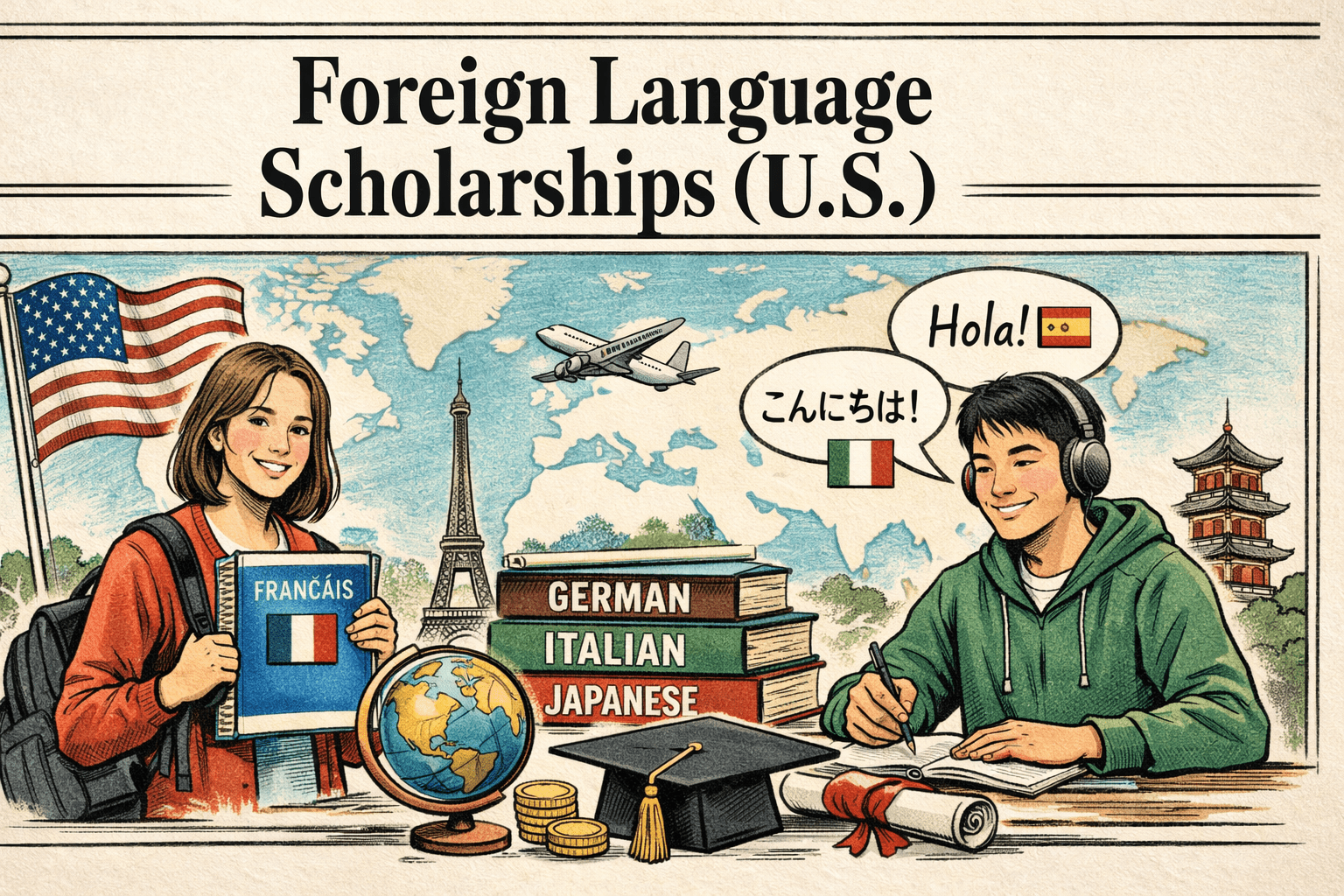
Foreign Language Scholarships (U.S.) — Get Paid to Get Fluent
Gen Z, this one’s for you: a hand-picked list of legit language funding that actually moves the needle (tuition, stipends, travel).
Boren Scholarship (Undergrad)
-
Why it slaps:
-
🌏 Big money for year-long language immersion
-
🤝 Pipeline to federal careers (national security, diplomacy)
-
🔁 Preference for less-commonly-taught languages/regions (not W. Europe)
-
-
Amount: Up to $25,000 (undergrad) depending on duration. new.expo.uw.edu
-
Deadline: Opens each fall; see current cycle.
-
Apply/info: https://www.borenawards.org/ borenawards.org
Boren Fellowship (Graduate)
-
Why it slaps:
-
🧠 Funds language + thesis research or internships abroad
-
🧾 Can add a domestic summer intensive before departure
-
💼 Non-competitive eligibility for federal hiring
-
-
Amount: Up to $25,000 overseas; up to $30,000 with domestic summer add-on. borenawards.orgIIE
-
Deadline: See current cycle.
-
Apply/info: https://www.borenawards.org/ borenawards.org
Critical Language Scholarship (CLS)
-
Why it slaps:
-
🆓 Fully funded summer intensive (beginner-friendly in many languages)
-
🚀 Alumni perks + career network
-
💻 Virtual option (CLS Spark) for some languages
-
-
Amount: Program costs + travel covered. Critical Language Scholarship Program
-
Deadline: Late fall; see site.
-
Apply/info: https://clscholarship.org/ Critical Language Scholarship Program
Gilman Scholarship + Critical Need Language Award (Pell-eligible undergrads)
-
Why it slaps:
-
💸 Need-based grant for study/intern abroad
-
➕ Up to $3,000 extra for critical languages
-
🧭 Perfect for first-time travelers
-
-
Amount: Gilman varies; CNLA up to $3,000. gilmanscholarship.org
-
Deadline: Fall/Spring cycles.
-
Apply/info: https://www.gilmanscholarship.org/ gilmanscholarship.org
FLAS — Foreign Language & Area Studies Fellowships (via universities)
-
Why it slaps:
-
🏫 Funds academic-year or summer language + area studies at your campus
-
🎓 Available for undergrad & grad (varies by school)
-
🗺️ Emphasis on less-commonly-taught languages
-
-
Amount examples: Stipend + tuition (varies by campus; see your FLAS center). U.S. Department of EducationGlobal Languages Institute
-
Deadline: Campus-specific.
-
Apply/info: Start at the U.S. Dept. of Ed FLAS page, then your university’s FLAS office — https://www2.ed.gov/programs/iegpsflasf/index.html U.S. Department of Education
The Language Flagship (Undergrad programs)
-
Why it slaps:
-
🎯 Structured path to professional proficiency
-
💼 Capstone year abroad; ties to Boren funding
-
🧑🏫 Cohort + intensive advising
-
-
Amount: Funding varies by host program; many students combine Boren (up to $25k). The Language Flagship
-
Deadline: Program-specific.
-
Apply/info: https://thelanguageflagship.army.mil/ The Language Flagship
Freeman-ASIA (Study in East/Southeast Asia, undergrad)
-
Why it slaps:
-
💵 Need-based grants for Asia study abroad
-
🧭 Ideal add-on with language programs in Japan/Korea/SE Asia
-
🧑🎓 Community college students eligible
-
-
Amount: $3,000 (summer), $5,000 (semester), $7,000 (year). IIE
-
Deadline: See IIE site for current term.
-
Apply/info: https://www.iie.org/programs/freeman-asia/ IIE
U.S.–Japan Bridging Foundation Scholarships (Semester/Year in Japan)
-
Why it slaps:
-
🇯🇵 $2,500 (semester) / $4,500 (year) cash stipend
-
🧑🤝🧑 Cohort programming + mentorship
-
🧠 Japanese study not required to apply
-
-
Amount & details: See foundation page; amounts listed above. United States-Japan Bridging Foundation
-
Deadline: Typically mid-March for next AY.
-
Apply/info: https://www.bridgingfoundation.org/scholarships United States-Japan Bridging Foundation
DAAD University Summer Course Grant (Germany)
-
Why it slaps:
-
🇩🇪 Funds 3–4-week German language/culture summer courses in Germany
-
🧳 Great on-ramp to longer immersion
-
-
Amount: Scholarship toward course + related costs (see DAAD page; details vary). DAAD
-
Deadline: Usually fall/winter for the following summer.
-
Apply/info: https://www.daad.org/en/find-funding/undergraduate-opportunities/ DAAD
Fund for Education Abroad (FEA)
-
Why it slaps:
-
🌈 Equity-focused awards; many language learners qualify
-
📈 Partner awards up to $10k for academic-year programs
-
-
Amount: Partner awards range up to $10,000; multiple named scholarships. fundforeducationabroad.org
-
Deadline: Twice yearly.
-
Apply/info: https://fundforeducationabroad.org/ fundforeducationabroad.org
Fulbright U.S. Student — English Teaching Assistant (ETA)
-
Why it slaps:
-
✈️ Paid year abroad teaching English; massive language immersion
-
🏆 Prestigious alumni network + benefits
-
-
Amount/benefits: Country-specific; typically stipend + travel + health coverage. Fulbright Online
-
Deadline: Early fall; campus deadlines earlier.
-
Apply/info: https://us.fulbrightonline.org/applicants/types-of-awards/english-teaching-assistant-awards Fulbright Online
NSLI-Y (High School)
-
Why it slaps:
-
🧑🎓 Fully funded overseas programs for U.S. high school students
-
🌐 Critical languages (Arabic, Chinese, Korean, etc.)
-
-
Amount: Program costs + travel covered. nsliforyouth.org
-
Deadline: Fall annually.
-
Apply/info: https://www.nsliforyouth.org/ nsliforyouth.org
Blakemore Freeman Fellowships (Advanced Asian Languages)
-
Why it slaps:
-
🧠 Funds a full year of advanced study in East/Southeast Asia
-
💼 Tuition + living + travel covered
-
🔬 Designed for serious career language users
-
-
Amount: Tuition + stipend for living/transportation (full-year). Blakemore Foundation
-
Deadline: Late Dec each year.
-
Apply/info: https://www.blakemorefoundation.org/blakemorefreeman Blakemore Foundation
TAPIF — Teaching Assistant Program in France (paid placement)
-
Why it slaps:
-
🇫🇷 Get paid ~€810/month net to live in France 7 months
-
🗣️ Daily immersion + school breaks to travel
-
-
Amount: ~€810/month net (gross ~€1,010.67; varies by region). tapif.orgvilla-albertine.org
-
Deadline: Applications usually open fall; see site.
-
Apply/info: https://www.tapif.org/ tapif.org
Language Honor Societies (micro-scholarships)
-
Pi Delta Phi (French): Members can apply for summer study awards (France/Quebec). Apply via your campus chapter. usa.campusfrance.orgDepartment of French
-
Delta Phi Alpha (German): Members eligible for $500–$1,250 study-abroad scholarships (cycles vary). Center for International Education, Education Abroad and Overseas Campuses
Pro Tips (save your sanity)
-
Boren = amazing money, but public-service commitment after graduation. Make sure that’s your vibe. Reed College
-
Pell-eligible? Put Gilman on your list; add the Critical Need Language Award for up to +$3k. gilmanscholarship.org
-
Not a language major? Most programs don’t require it (e.g., CLS, Bridging). Critical Language Scholarship Program, United States-Japan Bridging Foundation
-
Deadlines change each cycle. Always double-check the portal before you plan your timeline. (All links above are from official program pages and were verified today.)
Helpful Resources (official)
-
FAFSA (Federal Student Aid) for stacking aid: https://studentaid.gov/h/apply-for-aid/fafsa — ✅ Verified Aug 20, 2025. Federal Student Aid
-
Travel safety while abroad (enroll in STEP): https://travel.state.gov/…/smart-traveler-enrollment-program.html — ✅ Verified Aug 20, 2025. Travel.state.gov
-
Fulbright award benefits overview: https://us.fulbrightonline.org/about/award-benefits — ✅ Verified Aug 20, 2025. Fulbright Online
Foreign Language Scholarships in the U.S.: Demand, Declining Enrollments, and the Strategic Role of Scholarships (2026)
Foreign language scholarships sit at the intersection of three powerful trends in U.S. higher education: (1) long-run declines in college language course enrollments, (2) persistent national-security and public-service demand for advanced language capability, and (3) widening equity gaps in who can afford intensive language study and overseas immersion. This paper synthesizes major national datasets and program rules to map the foreign-language scholarship ecosystem and explain why scholarships increasingly function less like “nice-to-have tuition discounts” and more like structural financing for high-impact learning (immersion, proficiency testing, and experiential practice). Using Modern Language Association (MLA) enrollment census data, NCES degree completions, U.S. Census language-use statistics, BLS occupational projections, and Open Doors study-abroad participation, we quantify the contraction of formal language study and identify where scholarship capital is most catalytic. We then analyze the dominant scholarship models (federal service-linked awards, access-oriented study-abroad awards, and Title VI pipeline fellowships) and propose evidence-based strategies for applicants and program designers.
Keywords: foreign language scholarships, study abroad funding, Title VI FLAS, Boren Awards, Critical Language Scholarship, Gilman Scholarship, language enrollments, language workforce
1. Introduction: Why Foreign Language Scholarships Have Become “Infrastructure,” Not Extras
Foreign language study is often framed as enrichment, yet U.S. data increasingly portray it as a constrained public good: broadly valuable, unevenly funded, and vulnerable to institutional retrenchment. The MLA’s latest comprehensive census reports that course enrollments in languages other than English fell 16.6% between fall 2016 and fall 2021 (from 1,418,584 to 1,182,562 enrollments), the steepest drop recorded in the census’s modern history. This decline is not merely a byproduct of overall college enrollment changes; the MLA notes that total college enrollment fell 8.0% over the same period, roughly half the rate of language-course contraction.
Degree completions mirror the contraction. NCES Digest data show bachelor’s degrees in Foreign languages, literatures, and linguistics declining from 21,647 (2012–13) to 13,912 (2021–22)—a drop of roughly 36% across the decade. In other words, the pipeline of credentialed language graduates is shrinking even as the U.S. remains linguistically diverse and globally entangled.
Meanwhile, the societal “demand side” is not flat. The U.S. Census Bureau reports that 78.3% of people age 5+ speak only English at home (2018–2022 ACS 5-year), implying that roughly 1 in 5 Americans uses another language at home—an enduring multilingual reality that affects healthcare, courts, education, and labor markets. These cross-pressures—declining formal study, persistent real-world multilingual needs—help explain why scholarships matter: they underwrite the high-cost components (immersion, tutoring, summer institutes, overseas capstones) most likely to produce measurable proficiency gains.
2. Data and Method: What “Data-Driven” Means in a Scholarship Landscape
This analysis integrates five empirical lenses:
-
Higher-ed language study demand (MLA course enrollments): total enrollments, historical peaks, and language-by-language shifts.
-
Credential pipeline (NCES degree completions): trends in language-related bachelor’s degrees.
-
Population language ecology (U.S. Census/ACS): share speaking non-English languages at home and major language groups.
-
Labor-market signals (BLS): occupational outlook for interpreters and translators as one (imperfect) proxy for language-mediated work.
-
Immersion participation (Open Doors): study abroad volumes and the share of participants in “Foreign Language & International Studies.”
Scholarship program rules and award parameters are drawn from official program pages (e.g., Boren, Gilman, CLS, Title VI FLAS, Fulbright).
3. The Demand Problem: Language Study Is Shrinking Faster Than Higher Education Itself
3.1 Course enrollments: a long decline after a 2009 peak
The MLA reports a historic peak of 1,673,566 language enrollments in 2009 followed by sustained decline; by 2021, enrollments had fallen about 29.3% from that peak. The same report documents an additional structural signal: the number of language programs reporting enrollments dropped from 11,734 (2016) to 10,773 (2021) (an 8.2% reduction), suggesting a thinning institutional footprint even when programs are not formally “closed.”
3.2 Which languages are “buckling” vs. “bending upward”
Among the 15 most commonly taught languages, the MLA notes only three with enrollment gains from 2016 to 2021: American Sign Language (+0.8%), Biblical Hebrew (+9.1%), and Korean (+38.3%). This pattern is consistent with two forces:
-
Domestic service demand (ASL in education, accessibility, healthcare systems),
-
Geopolitical and cultural-economic salience (Korean via entertainment exports, technology ties, and strategic relevance).
3.3 Credential pipeline: language majors declining despite overall degree growth
While total bachelor’s degrees remain near two million annually, language-degree completions fell substantially across 2012–2022. For scholarship designers, the implication is stark: if you want more advanced proficiency in the U.S. workforce and public sector, you are increasingly funding against the current of institutional incentives.
4. The Immersion Constraint: Study Abroad Rebounded, but Language Study Remains a Minority Track
Study abroad is the most reliable high-impact mechanism for rapid proficiency gains—yet participation is shaped by affordability and program structure. Open Doors reports that in 2022/23, U.S. students studying abroad for academic credit increased 49% to 280,716. However, within fields of study, Foreign Language & International Studies accounted for 16,004 students (5.7%) in 2022/23—meaning most study abroad participants are not language-and-area specialists by major, even if they may be language learners by practice.
This is a key reframing for a “Foreign Language Scholarships” page: the highest-ROI scholarships often target language acquisition as a component of another pathway (STEM, business, public health, policy, security), not only language majors.
5. Labor-Market Reality: Language Value Is Diffuse, Not Always Captured by One Occupation
A common misconception is that language learning “pays off” only through translator/interpreter jobs. BLS projects interpreter/translator employment growth of 2% from 2024 to 2034 (slower than average), but still estimates about 6,900 openings per year largely due to replacement needs. That combination—modest net growth, substantial churn openings—suggests stable demand but intense competition and occupational restructuring.
Two complicating factors matter for scholarship strategy:
-
AI translation is changing task composition. Reporting in 2025 described accelerating substitution of routine translation tasks by AI, pushing human linguists toward high-stakes domains (legal, medical, diplomatic) and “post-editing” roles where cultural judgment still matters.
-
Language skill premiums vary by context. Some U.S.-focused literature reviews note that broad ACS-based analyses do not always find an economy-wide wage premium for bilingual workers; gains can be sectoral and geography-dependent. Meanwhile, non-U.S. evidence (e.g., European labor-market studies) reports sizable premiums for advanced foreign-language skills—useful as directional evidence, but not directly transferable without caution.
Takeaway: scholarships are most defensible when they fund verifiable proficiency (ACTFL-aligned outcomes, OPI/OPIc testing, advanced coursework) and domain specialization (language + nursing, language + supply chains, language + cybersecurity), because the labor market increasingly rewards language-mediated expertise, not language alone.
6. The Scholarship Ecosystem: Three Dominant Funding Models
Model A: Federal service-linked “critical language” funding (high dollars, high commitment)
These programs treat language as national capacity.
-
Boren Scholarships (NSEP): provide up to $25,000 for undergraduates (often for longer overseas study) and require a federal service commitment after graduation.
-
Project GO (ROTC): supports ROTC students with fully funded language and culture study (often covering tuition, room/board, airfare, fees) through program-specific packages.
Economic logic: These awards “buy” talent into the public sector by lowering the cost of high-intensity training, then reclaiming value via service.
Model B: Access-oriented study abroad awards (equity-centered, scalable, language-friendly)
These programs treat international experience as mobility and opportunity—often with language add-ons.
-
Gilman Scholarship: offers up to $5,000 and awards nearly 3,000 scholarships per year; eligibility requires Pell Grant receipt.
-
Gilman Critical Need Language Award: adds up to $3,000 (total up to $8,000) when applicants study a qualifying critical language while abroad.
-
Critical Language Scholarship (CLS): a State Department-funded summer immersion covering major costs (including travel, tuition, housing, plus a stipend) and providing structured intensive instruction.
Equity logic: These awards reduce the wealth barrier to immersion—crucial because study abroad is still primarily funded by personal/family resources in many cases.
Model C: Title VI pipeline fellowships (institution-allocated, proficiency-focused, often for LCTLs)
Title VI programs fund universities to produce area and language expertise.
-
FLAS (Foreign Language and Area Studies): provides institutional allocations so campuses can support undergraduates and graduate students pursuing language + area/international studies; students apply through funded institutions.
-
Typical award structures (illustrative, campus-administered): graduate academic-year packages commonly combine tuition support and living stipends (e.g., $18,000 tuition + $20,000 stipend at some institutions), while summer awards often include a smaller stipend plus tuition coverage for intensive programs.
Capacity logic: Title VI money builds a national bench of advanced proficiency, particularly in less commonly taught languages (LCTLs).
7. Comparative Snapshot: Major Scholarship “Mechanisms” (Not Exhaustive)
| Program / Mechanism | Typical funded activity | Typical funding signal | Key constraint |
|---|---|---|---|
| Boren (NSEP) | Long-term overseas study in regions critical to U.S. interests | Up to $25,000 | Federal service requirement |
| CLS | 8–10 week intensive summer language institute | Full costs + stipend | Highly selective; structured program |
| Gilman | Study/intern abroad for Pell recipients | Up to $5,000; ~3,000 awards | Must be Pell-eligible during application |
| Gilman CNLA | Critical-need language add-on | + up to $3,000 | Must justify language plan abroad |
| FLAS (Title VI) | Language + area studies (AY or summer) | Tuition + stipend (campus-administered) | Only through FLAS-funded institutions |
| Fulbright U.S. Student | Research/study/ETA abroad; language enhancement possible | Country-based stipend/benefits | Country/award-specific competitiveness |
| Project GO | ROTC language study (often abroad) | Program-dependent full funding | ROTC participation required |
8. Risk and Volatility: Why “Verify Deadlines” Is Not a Throwaway Line
Foreign-language scholarships are unusually exposed to federal appropriations, agency priorities, and travel/geopolitical constraints. In early 2025, news reporting described a temporary funding freeze affecting State Department exchange programs, disrupting payments for participants in programs including Fulbright and other study abroad initiatives. Separately, travel advisories and host-country conditions can change eligibility or placement, and some program rules explicitly exclude costs like passports or medical requirements.
Implication for applicants and scholarship platforms: scholarship information must be treated as a living dataset with verification workflows, not static content.
9. Equity: Scholarships as the Main Counterweight to the “Affordability Wall”
Two data points clarify the equity challenge:
-
Open Doors shows study abroad rebounding strongly, but personal/family resources still dominate as a funding source in many cases (as reflected in Open Doors fast facts).
-
Gilman’s Pell requirement is an explicit equity design choice, converting federal need-based eligibility into international opportunity at scale.
Because immersive language learning is time-intensive (and often unpaid), scholarship design that covers living costs (not just tuition) is disproportionately consequential for first-gen, low-income, and working students.
10. Applicant Strategy: A Research-Based Playbook for Winning Foreign Language Scholarships
Scholarships in this space tend to reward credible plans over generic enthusiasm. A high-performing application package usually demonstrates:
-
Proficiency trajectory, not just interest: specify baseline, target level, and how you’ll measure progress (e.g., ACTFL-aligned assessments; CLS itself references formal certification of gains and structured instruction).
-
Language + mission fit: align language with a domain (public health, cybersecurity, supply chain, education) and a plausible pathway. This matters even more as AI handles casual translation and human value concentrates in high-context domains.
-
Feasibility and cost realism: show you understand what’s covered (tuition/travel/housing) vs. what isn’t (passports, some medical costs).
-
Commitment signals: for service-linked programs (e.g., Boren), treat the service requirement as a core narrative asset, not a footnote.
-
Institutional leverage: for FLAS, success often depends on matching your plan to your university’s area center priorities and language offerings.
11. Policy and Program Design Recommendations: Funding What Actually Produces Proficiency
Given the empirical contraction in enrollments and degrees (MLA; NCES), scholarship dollars should prioritize interventions with the highest proficiency yield per dollar:
-
Longer duration and intensity: the MLA notes sustained decline after 2009; reversing outcomes likely requires depth (yearlong, intensive summer) rather than shallow exposure.
-
Stackable pathways: scholarships that ladder (campus FLAS → CLS/overseas summer → capstone/advanced year) create compounding returns.
-
Assessment-backed outcomes: programs that attach recognized proficiency measurement create labor-market clarity.
-
Cross-sector alignment: coupling language with sector needs (healthcare access, education, security) makes funding more resilient under budget pressure and political volatility.
Conclusion
Foreign language scholarships are increasingly a form of national and institutional capacity-building: they subsidize time, travel, and instructional intensity that the modern university often cannot sustain through tuition revenue alone. The data show a clear contraction in language enrollments and degrees even as multilingual realities persist in U.S. society and the public sector continues to value advanced capability. The most strategic scholarships do three things simultaneously: they enable immersion, measure outcomes, and connect language study to service or specialized expertise. For students, the winning move is to frame language not as an isolated passion but as an applied competency with a concrete proficiency plan, a credible context for use, and a budget-and-logistics strategy grounded in program rules. For scholarship platforms (and policymakers), the mandate is equally clear: treat language scholarship information as living infrastructure—verified, updated, and designed to finance proficiency, not just participation.
FAQ (quick + real)
Do I have to be fluent already?
No. CLS accepts beginners for many languages; Boren/FLAS often expect intermediate+ but it depends on language and program. Critical Language Scholarship Program, borenawards.org, U.S. Department of Education
Can I stack awards?
Sometimes. Example: Pell-eligible students can win Gilman and may add the Critical Need Language Award. Always check each program’s stacking rules. gilmanscholarship.org
What’s the catch with Boren?
You commit to one year of federal service post-graduation. Many grads love the career jumpstart—it’s just not for everyone. Reed College
I’m in high school—anything for me?
Yes: NSLI-Y fully funds overseas language study for U.S. high-schoolers. nsliforyouth.org
Do these cover flights + housing?
Many do (CLS, Fulbright ETA, some FLAS packages). Always read the “Benefits” section on the official page. Critical Language Scholarship Program, Fulbright Online, U.S. Department of Education