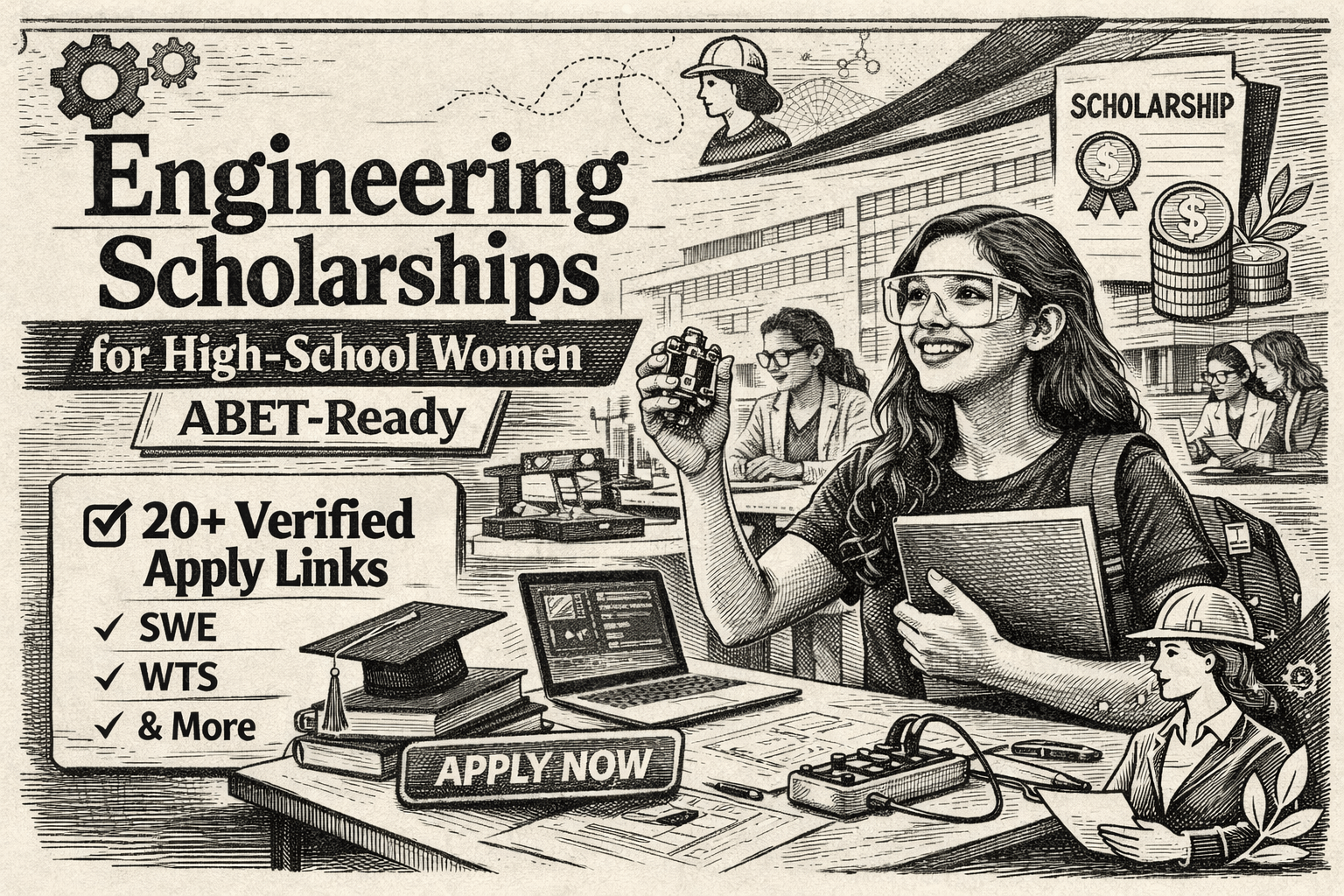
Engineering Scholarships for High-School Women (ABET-Ready) — 20+ Verified Apply Links (SWE picks, WTS, & more)
.png)
Scholarships
Society of Women Engineers — Emerging First Year Scholars
💥 Why It Slaps: One SWE app → you’re auto-considered for dozens of freshman awards. ABET majors only, and SWE gives out $1.5M+ annually.
💰 Amount: Varies (many $1,000–$5,000+)
⏰ Deadline: Typically opens Dec; closes late Mar/early Apr (varies)
🔗 Apply/info: https://swe.org/apply-for-a-swe-scholarship/
SWE Chicago Regional Section — HS Scholarship
💥 Why It Slaps: Local SWE sections are hidden gems—solid odds for Chicagoland seniors headed to ABET programs.
💰 Amount: Varies (often $1,000+)
⏰ Deadline: Usually Feb–Mar (check page)
🔗 Apply/info: https://chicago.swe.org/scholarships/
SWE Pikes Peak Section — Entering Freshman
💥 Why It Slaps: Colorado Springs/Front Range seniors; ABET-bound; classic community-backed SWE award.
💰 Amount: Varies
⏰ Deadline: Typically Feb–Mar
🔗 Apply/info: https://sites.swe.org/pikespeak/scholarships/
SWE Greatland (Alaska) — HS Senior Scholarship
💥 Why It Slaps: Alaska-specific with clear amounts and multiple awards—nice odds for ABET majors.
💰 Amount: Up to $2,000 & $1,500 (per site)
⏰ Deadline: Usually Mar
J
🔗 Apply/info: https://greatland.swe.org/scholarships/
SWE Lehigh Valley — HS Women in Engineering
💥 Why It Slaps: Long-running program for PA seniors; perfect for ABET-aligned engineering entrants.
💰 Amount: Varies
⏰ Deadline: Typically Jan–Feb
🔗 Apply/info: https://sites.swe.org/lehighvalley/
SWE San Diego — HS & College
💥 Why It Slaps: San Diego County seniors headed to engineering—local donors, practical criteria.
💰 Amount: Varies
⏰ Deadline: Usually Feb–Mar
🔗 Apply/info: https://www.swesandiego.org/scholarships
SWE Golden Gate (Bay Area) — HS Scholarships
💥 Why It Slaps: Bay Area seniors, ABET-ready; recurring awards and strong SWE network.
💰 Amount: Varies
⏰ Deadline: Usually Feb–Mar
J
🔗 Apply/info: https://ggs.swe.org/2025-scholarship-information/
SWE Detroit — Freshman/HS Senior
💥 Why It Slaps: Michigan seniors bound for engineering; historic section with reliable funding.
💰 Amount: Varies
⏰ Deadline: Typically Feb–Mar
🔗 Apply/info: https://swe.org/scholarships/swe-detroit-section-scholarship/
SWE Rocky Mountain — CO/WY Region
💥 Why It Slaps: Regional focus + ABET pathway; great for Denver/Fort Collins/Boulder seniors.
💰 Amount: Varies
⏰ Deadline: Usually Feb–Mar
🔗 Apply/info: https://swe-rms.swe.org/ — ✅ Link verified Sep 14, 2025.
SWE Pacific Northwest (PNW) — HS & Collegiate
💥 Why It Slaps: PNW section explicitly invites high-school seniors and freshmen; ABET majors.
💰 Amount: Varies
⏰ Deadline: Typically Jan–Mar
🔗 Apply/info: https://swe-pnw.swe.org/about-us/scholarship-programs/
SWE Savannah Coastal Empire — GA/SC Counties
💥 Why It Slaps: Local reach across coastal GA/SC; ABET-oriented engineering majors.
💰 Amount: Varies
⏰ Deadline: Usually Feb–Mar
🔗 Apply/info: https://sceswe.swe.org/
SWE Antelope Valley (CA) — HS Seniors
💥 Why It Slaps: Focused desert-region section near aerospace industry—great for future ME/AE majors.
💰 Amount: Varies
⏰ Deadline: Usually Feb–Mar
🔗 Apply/info: https://antelopevalley.swe.org/
SWE Pittsburgh — HS Senior Women
💥 Why It Slaps: Western PA seniors; ABET-aligned degrees, classic SWE local pipeline.
💰 Amount: Varies
⏰ Deadline: Typically Feb–Mar
🔗 Apply/info: https://pittsburgh.swe.org/
SWE Philadelphia — HS & Collegiate
💥 Why It Slaps: Philly metro seniors entering engineering; active section = solid mentorship too.
💰 Amount: Varies
⏰ Deadline: Usually Feb–Mar
🔗 Apply/info: https://philadelphia.swe.org/scholarships/
SWE New York Professional Section — HS Seniors/College
💥 Why It Slaps: NYC-area ABET entrants; strong corporate ties for internships + recs.
💰 Amount: Varies
⏰ Deadline: Typically Feb–Mar
🔗 Apply/info: https://newyork.swe.org/
WTS Foundation — Transportation YOU High-School Scholarship (National)
💥 Why It Slaps: National umbrella for female HS juniors & seniors eyeing transportation/civil/traffic/rail—amounts commonly around $2,500 via chapters. Start here, then apply through your local chapter.
💰 Amount: Varies by chapter (often ~$2,500)
⏰ Deadline: Chapter-specific (commonly Jan–Apr)
🔗 Apply/info: https://www.wtsinternational.org/wts-foundation/scholarships
WTS Los Angeles — High-School Scholarship
💥 Why It Slaps: One of the largest WTS chapters; frequent HS awards for future CE/transport pros.
💰 Amount: Varies
⏰ Deadline: Typically Jan–Mar
🔗 Apply/info: https://www.wtsinternational.org/chapters/los-angeles/scholarships
WTS Boston — HS Scholarship
💥 Why It Slaps: Robust New England network in transit/transport; strong chapter backing.
💰 Amount: Varies
⏰ Deadline: Typically Jan–Mar
🔗 Apply/info: https://www.wtsinternational.org/chapters/boston/scholarships
WTS Chicago — HS Scholarship
💥 Why It Slaps: Chicago’s a national transportation hub; this chapter pushes real dollars to future women engineers.
💰 Amount: Varies
⏰ Deadline: Typically Jan–Mar
🔗 Apply/info: https://www.wtsinternational.org/chapters/greater-chicago/student-info/scholarships
Women in Aviation International (WAI) — Scholarships
💥 Why It Slaps: $1M+ in annual awards across engineering/aerospace/avionics pathways; HS seniors headed to engineering or aviation programs can qualify for select awards.
💰 Amount: Varies widely (many $1,000–$10,000+)
⏰ Deadline: Typically closes Oct 15 (varies annually)
🔗 Apply/info: https://www.wai.org/scholarships
Science Ambassador Scholarship (Cards Against Humanity)
💥 Why It Slaps: $20,000 tuition scholarship + funding for your own science-communication project; open to HS seniors entering STEM (yes, engineering ABET-aligned works).
💰 Amount: $20,000 tuition (per recipient)
⏰ Deadline: Opens fall; deadlines vary (usually Dec)
🔗 Apply/info: https://www.scienceambassadorscholarship.org/
BHW Women in STEM Scholarship
💥 Why It Slaps: Straightforward essay → $3,000 for women headed into STEM (engineering included). HS seniors enrolling next year are eligible.
💰 Amount: $3,000
⏰ Deadline: Apr 15 (typical)
🔗 Apply/info: https://thebhwgroup.com/scholarship
Women at Microsoft (WAM) Scholarship
💥 Why It Slaps: Company-backed award for women & non-binary HS seniors pursuing tech/engineering—recent cycles offered $5,000 one-time awards.
💰 Amount: Typically $5,000 (one-time)
⏰ Deadline: Usually Feb–Mar (program cycles vary)
🔗 Apply/info: https://www.microsoft.com/en-us/diversity/programs/women-at-microsoft-scholarship
Michigan Council of Women in Technology (MCWT) Foundation — HS Senior Scholarships
💥 Why It Slaps: Michigan-only, women-focused scholarships for CS/CE/IT—great for ABET-aligned computing majors.
💰 Amount: Varies
⏰ Deadline: Typically Jan–Mar
🔗 Apply/info: https://mcwt.org/programs/scholarships
NCWIT Award for Aspirations in Computing (HS)
💥 Why It Slaps: National recognition + cash/prizes and many affiliate awards; standout for CS/CE bound women. Great résumé boost for ABET-ready apps.
💰 Amount: Varies (national & affiliate prizes; some include scholarships)
⏰ Deadline: Typically Oct–Nov for HS
🔗 Apply/info: https://www.aspirations.org/award-programs/aic-high-school-award
EngineerGirl Writing Contest (K-12 Girls)
💥 Why It Slaps: National contest from the NAE’s EngineerGirl—cash awards; a perfect pre-engineering distinction for your ABET app.
💰 Amount: Cash prizes (typically a few hundred up to ~$1,000)
⏰ Deadline: Annually (prompts release in fall)
🔗 Apply/info: https://www.engineergirl.org/1283/EngineerGirl-Writing-Contest
SWE Pacific Northwest — (alt link) Columbia River Subsection
💥 Why It Slaps: Oregon/SW Washington focus; locally selected SWE-endowed awards for women in engineering.
💰 Amount: Varies
⏰ Deadline: Typically Feb–Mar
🔗 Apply/info: https://swe.org/scholarships/columbia-river-section-scholarships-oregon-and-southwest-washington/
Exelon Foundation STEM Leadership Academy — Chris Crane Memorial Scholarship (for Academy alumnae)
💥 Why It Slaps: If you attended the Exelon STEM Academy (girls’ HS program in Chicago/Philly/DC/Baltimore), you can compete for a full-ride style scholarship covering remaining cost of attendance + internships—massive if you’re energy/EE/ME bound.
💰 Amount: Covers tuition/fees/room & board up to full need
⏰ Deadline: Opens annually for eligible alumnae
🔗 Apply/info: https://exelonstemacademy.org/girls-scholarship/
SWE Pacific Northwest — Main Scholarships Hub
💥 Why It Slaps: (If you missed it above) PNW’s consolidated page with HS-senior eligibility spelled out.
💰 Amount: Varies
⏰ Deadline: Typically Jan–Mar
🔗 Apply/info: https://swe-pnw.swe.org/
💡 Pro tip: Want the widest net? Apply to SWE national and 1–3 local SWE sections near where you live (or will attend college) + WTS if you’re eyeing transportation/civil. That combo hits the most ABET-aligned awards with solid odds.
Engineering Scholarships for High-School Women
Women remain underrepresented in engineering education and engineering occupations despite decades of progress in broader STEM participation. This gap is not simply a “college problem”; it is shaped by high-school course access, confidence signals, advising, and affordability at the exact moment students decide whether engineering is “for them.” Scholarships targeted to high-school women—especially those entering engineering majors—operate as more than tuition offsets: they can function as early commitment devices, identity affirmations, and on-ramps into mentoring networks that improve persistence. Using recent U.S. indicators from the National Science Foundation (NSF), the Society of Women Engineers (SWE) synthesis of NCES/ASEE data, the U.S. Bureau of Labor Statistics (BLS), College Board reporting, and salary/tuition benchmarks, this paper maps (1) where the pipeline narrows, (2) how scholarship design can mitigate those drop-offs, and (3) what an evidence-aligned scholarship “portfolio” looks like for high-school women pursuing engineering. It concludes with actionable recommendations for scholarship providers, schools, families, and scholarship-information platforms to maximize equity, completion, and workforce impact.
1. Why engineering scholarships for high-school women are a high-leverage intervention
Engineering is simultaneously one of the most economically rewarding undergraduate pathways and one of the most gender-segregated STEM domains. NSF’s national S&E indicators show that women are underrepresented among engineering degree recipients and in the STEM workforce overall (women comprised about 35% of STEM workers in 2021). The labor-market stakes are substantial: BLS reports a median annual wage of $97,310 for architecture and engineering occupations (May 2024), far above the median for all occupations.
This combination—high returns, persistent underrepresentation—creates a policy-relevant “efficiency + equity” opportunity: relatively modest scholarship dollars can unlock entry into a field with strong wage premiums and large national demand. Yet the scholarship conversation often begins too late (after enrollment), missing the decisive period when high-school women are building course records, testing confidence, and choosing majors. A scholarship awarded at the high-school-to-college transition can change perceived feasibility (“I can afford this”), perceived belonging (“people like me do this”), and perceived pathway clarity (“I know what steps come next”).
2. Data sources and analytic frame
This analysis draws on:
-
Pipeline and representation: SWE’s U.S. Degree Attainment and U.S. Employment syntheses (built from NCES, ASEE, and BLS) ; NSF S&E Indicators key takeaways .
-
High-school preparation signals: NCES reporting on advanced math/science course completion and College Board reporting on AP Computer Science A participation by gender (as one visible STEM-identity indicator).
-
Affordability and returns: College Board tuition/price highlights ; NACE early-career salary reporting ; BLS wage benchmarks for engineering occupations .
-
Scholarship market exemplars: SWE scholarship program scale and discipline-specific awards such as AIAA’s high-school senior engineering scholarship.
The frame is intentionally “pipeline-aware”: scholarships are evaluated not only as financial awards but as interventions placed at critical transition points (advanced coursework → major choice → persistence → workforce entry).
3. Where the pipeline narrows: preparation, entry, and persistence
3.1 High-school preparation: advanced math as a gatekeeper
Engineering readiness is strongly correlated with advanced math preparation. NCES reports gender gaps in calculus completion among high-school graduates (with calculus completion gaps larger among graduates than among 12th-graders overall in the cited indicator). Even when overall performance is strong, differential exposure to “engineering-adjacent” coursework (calculus, physics, computer science) influences admissions competitiveness and, crucially, students’ own self-assessment of fit.
Implication for scholarships: awards restricted to students who have completed particular advanced courses can unintentionally reward pre-existing access rather than expand opportunity. A more equity-aligned approach is to fund students who demonstrate “engineering trajectory” through projects, dual enrollment, CTE engineering pathways, or community-based maker work—especially for schools without AP/IB breadth.
3.2 Major choice: women’s engineering degree attainment is rising, but still low
SWE’s synthesis of NCES data shows that women’s share of engineering and engineering technology bachelor’s degrees increased from 17.2% (2011) to 23.0% (2021), with the number of degrees earned by women more than doubling over that period. That trend is meaningful progress—but it also underscores that roughly 3 out of 4 engineering/engineering-technology bachelor’s degrees still go to men.
Discipline mix matters. SWE’s use of ASEE data highlights that women’s representation varies dramatically by subfield (e.g., higher in biomedical and chemical engineering than in mechanical or aerospace, in the cited 2023 discipline breakdown). This suggests that “women in engineering” scholarships can inadvertently cluster women into a subset of engineering domains if the awards (or common advising narratives) disproportionately emphasize certain “traditionally higher-female-share” fields.
Implication for scholarships: to expand women’s representation across engineering (not just within selected disciplines), scholarship providers can:
-
create discipline-balanced quotas (or rotating discipline spotlights), and
-
fund pre-major exploration that helps students choose among civil/mechanical/electrical/aerospace/CS-in-engineering with real information and role models.
3.3 Workforce conversion: the steepest drop occurs after degree completion
The workforce numbers illustrate the “leak” beyond college. SWE’s employment synthesis notes that women were 15% of engineering occupations as of 2023 (using BLS), indicating that even when women earn engineering degrees, conversion into engineering jobs and retention over time remain challenges. This aligns with NSF’s broader point that women remain underrepresented in the STEM workforce overall.
Implication for scholarships: scholarships that attach mentoring, internships, professional membership, and cohort support (not just tuition) are more likely to move outcomes from “matriculation” to “engineering employment.”
4. The economics: affordability pressures meet high-return degrees
The affordability barrier is immediate at college entry. College Board lists average published tuition and fees of $11,950 (public four-year in-state) and $45,000 (private nonprofit four-year) in its pricing highlights (not including full cost of attendance components like housing/food). Engineering programs can add cost through lab fees, computing needs, and reduced flexibility for paid work (due to sequenced lab schedules). Meanwhile, returns are strong: BLS reports high median wages for the architecture and engineering occupational group , and NACE reports an overall average starting salary of $65,677 for the Class of 2024 (across majors), often used as a benchmark when comparing early-career outcomes.
Scholarship design takeaway: because engineering yields strong long-term returns but can impose short-term cash-flow constraints, scholarships that reduce first-year financial stress (deposits, housing, textbooks, laptop) may have disproportionate persistence benefits compared with the same dollars spread thinly over later years.
5. The scholarship landscape: what exists, and what it signals
High-school women pursuing engineering typically encounter scholarships in six overlapping categories:
5.1 Professional-society scholarships (pipeline + identity + network)
SWE is the flagship example of a scholarship program embedded in a professional network. SWE reports disbursing 330+ scholarships valued at nearly $1.6 million in 2025 and emphasizes sustained scholarship support as part of its mission pipeline. Their partner scholarship page also documents prior-year scale (e.g., 330+ scholarships totaling more than $1.5M in 2020). Beyond dollars, these programs act as “network accelerators,” connecting recipients to internships, mentoring, conferences, and professional identity formation.
5.2 Discipline-specific scholarships (clear workforce alignment)
Some societies explicitly target the high-school-to-engineering transition. For example, AIAA offers up to four $10,000 scholarships for high-school seniors enrolling in an engineering major (as described in its K-12 scholarship listing). These awards are powerful because they reduce first-year affordability barriers while reinforcing a concrete engineering domain (aerospace) that is often male-skewed.
5.3 Corporate scholarships (talent pipeline strategy)
Many corporate scholarships explicitly encourage women applicants in computing/engineering-adjacent majors. For instance, Google’s Generation Google Scholarship notes that women are strongly encouraged to apply (program positioning varies by year and region). The corporate logic is straightforward: scholarships operate as early recruitment, brand affiliation, and diversity pipeline development.
5.4 Local scholarships (high hit-rate, lower awards, crucial stacking)
Local scholarships tend to be smaller but less nationally competitive—often the best “probability-adjusted” dollars for students. AAUW branches and local foundations frequently fund women’s education through community-based awards (structures vary by branch). For high-school women, these can be the difference between manageable and unmanageable first-year costs when stacked with institutional aid.
5.5 Pre-college pathway scholarships (program participation as a credential)
Some awards are tied to participation in structured STEM pathways (engineering academies, CTE programs, summer institutes). These operate as both skill builders and signals of commitment.
5.6 Need-based STEM scholarships (equity-first, retention-aware)
At the postsecondary level, NSF’s S-STEM program is a major example of scholarship funding explicitly designed to enable academically talented, low-income students to complete STEM degrees (often paired with co-curricular supports). While S-STEM is not a direct “high-school award,” its model is instructive: scholarships are treated as part of a retention system, not a standalone check.
6. Do scholarships improve retention? What the evidence suggests
Direct causal evidence is complicated (selection effects are real: scholarship recipients are often already high-achieving). Still, retention-oriented scholarship programs increasingly publish outcomes research and evaluation logic. SWE explicitly frames scholarships as a sustained investment and has published research summaries examining scholarship impacts on retention in engineering, engineering technology, and computer science. The key mechanism is plausible and consistent with broader higher-education evidence: reducing financial stress lowers stop-out risk, while cohort and mentoring supports increase academic and professional integration.
For high-school women specifically, the most defensible claim is not “scholarships alone fix the gap,” but:
-
Early awards change major-choice feasibility, and
-
Awards attached to belonging + advising resources support persistence, particularly in programs with high first-year “weed-out” culture.
7. A practical “scholarship portfolio” model for high-school women in engineering
A data-aligned strategy treats scholarships as a diversified portfolio across competitiveness tiers and across cost types.
7.1 Three-tier targeting (probability × payoff)
-
Anchor awards (high payoff, competitive): national society/corporate scholarships (e.g., $10k range awards like AIAA; large SWE partner scholarships).
-
Stability awards (moderate payoff, moderate competition): regional foundations, state STEM initiatives, mid-size corporate programs.
-
Stacking awards (smaller payoff, higher hit-rate): local scholarships (including women’s clubs/branches) and school-specific awards.
7.2 Match scholarships to engineering cost drivers
Engineering students face costs beyond tuition. A strong portfolio includes at least one award that can cover:
-
Laptop/software needs (CAD, coding environments)
-
Lab/course fees
-
Conference travel (career fairs, SWE conference participation)
-
Unpaid/low-paid early experiences (research, shadowing)
7.3 Build an “engineering narrative” that scholarship reviewers can score
For high-school women, reviewers often look for demonstrated alignment, not just grades. High-signal components include:
-
A design project with constraints/tradeoffs (documentation matters)
-
Robotics/engineering competition participation (or equivalent community projects)
-
Evidence of persistence through challenging coursework (math/physics)
-
A clear articulation of why this engineering field (civil vs mechanical vs electrical vs aerospace vs CS-in-engineering), tied to real problems
College Board’s reporting on AP Computer Science A shows female participation has grown substantially since 2017 and provides concrete counts of women test-takers in 2024. Even when students don’t have AP access, an equivalent signal can be dual enrollment, certifications, or portfolio coding/design artifacts.
8. Recommendations for scholarship providers, schools, and scholarship platforms
8.1 For scholarship funders: design for access + persistence, not just merit
-
Avoid over-reliance on “elite access” filters (AP physics, multiple advanced courses) that mirror school inequities. Use project-based evidence and contextual review.
-
Bundle money with mentoring (professional society membership, near-peer mentors, internship matching). Workforce underrepresentation (15% women in engineering occupations) suggests conversion and retention require more than admissions.
-
Front-load support: first-year funding prevents derailment during the toughest transition (and addresses high upfront costs). College pricing benchmarks reinforce why early cash matters.
8.2 For high schools and counselors: treat engineering choice as a process
-
Normalize engineering identity early through role models, engineering clubs, and visible pathways.
-
Ensure advanced math access and advising for course sequencing; NCES indicates advanced course completion patterns differ and matter.
8.3 For ScholarshipsAndGrants.us: present scholarships as a pipeline tool
For a page like /women/engineering/, the highest-impact structure is not just a long list—it’s a decision system. Recommended on-page elements:
-
Filters by engineering discipline, award size, deadline month, and eligibility stage (HS junior/senior, incoming freshman, undergrad).
-
A “stacking recipe” box (1 national + 2 regional + 3 local) with examples.
-
A short module explaining why early scholarships matter using the key pipeline stats (women’s degree share, workforce share, and wage upside).
Conclusion
The gender gap in engineering is sustained by a chain of small frictions: uneven access to advanced preparation, limited role-model exposure, affordability shocks at the college transition, and persistence barriers that continue into workforce entry. Recent data show steady progress in women’s engineering degree attainment (e.g., rising to 23% of engineering and engineering technology bachelor’s degrees by 2021 in NCES-based synthesis), but the workforce share remains much lower (15% in engineering occupations as of 2023), indicating leakage after degree completion.
Engineering scholarships for high-school women are uniquely positioned to intervene at the highest-leverage moment—when a student is deciding whether to step onto the engineering pathway at all. The most effective scholarship designs reduce early financial barriers, avoid access-biased eligibility rules, and attach recipients to mentoring and professional networks. For scholarship platforms and advocates, presenting scholarships as a pipeline strategy—organized by discipline, milestone, and stacking logic—can turn information into outcomes: more women entering engineering, persisting through the degree, and converting into engineering careers in an economy that needs their talent.
References (selected, APA-style)
Bureau of Labor Statistics. (2025). Architecture and engineering occupations: Occupational Outlook Handbook (May 2024 wage data).
College Board. (2025). AP Computer Science Female Diversity Award announcement (2024 participation counts).
College Board. (2025). Trends in College Pricing highlights (tuition benchmarks).
National Science Board / NSF NCSES. (2024). The State of U.S. Science and Engineering 2024: Key takeaways.
National Center for Education Statistics. (n.d.). High school mathematics and science course completion (indicator).
National Association of Colleges and Employers. (2025). Average starting salary for Class of 2024 shows mild gain.
Society of Women Engineers. (2025/2026). U.S. Degree Attainment (NCES/ASEE synthesis).
Society of Women Engineers. (2025/2026). U.S. Employment (BLS-based share of women in engineering occupations).
Society of Women Engineers. (2025). SWE Scholarships (annual scholarship totals).
American Institute of Aeronautics and Astronautics. (n.d.). K-12 scholarships: Roger W. Kahn Scholarship ($10,000 high-school senior scholarship details).
What counts as “ABET-ready”?
If your intended major is in engineering, engineering technology, or computing at a school with an ABET-accredited program (think ME, EE, CE, ChemE, CS, etc.), you’re good for the vast majority of awards above—especially SWE and WTS.