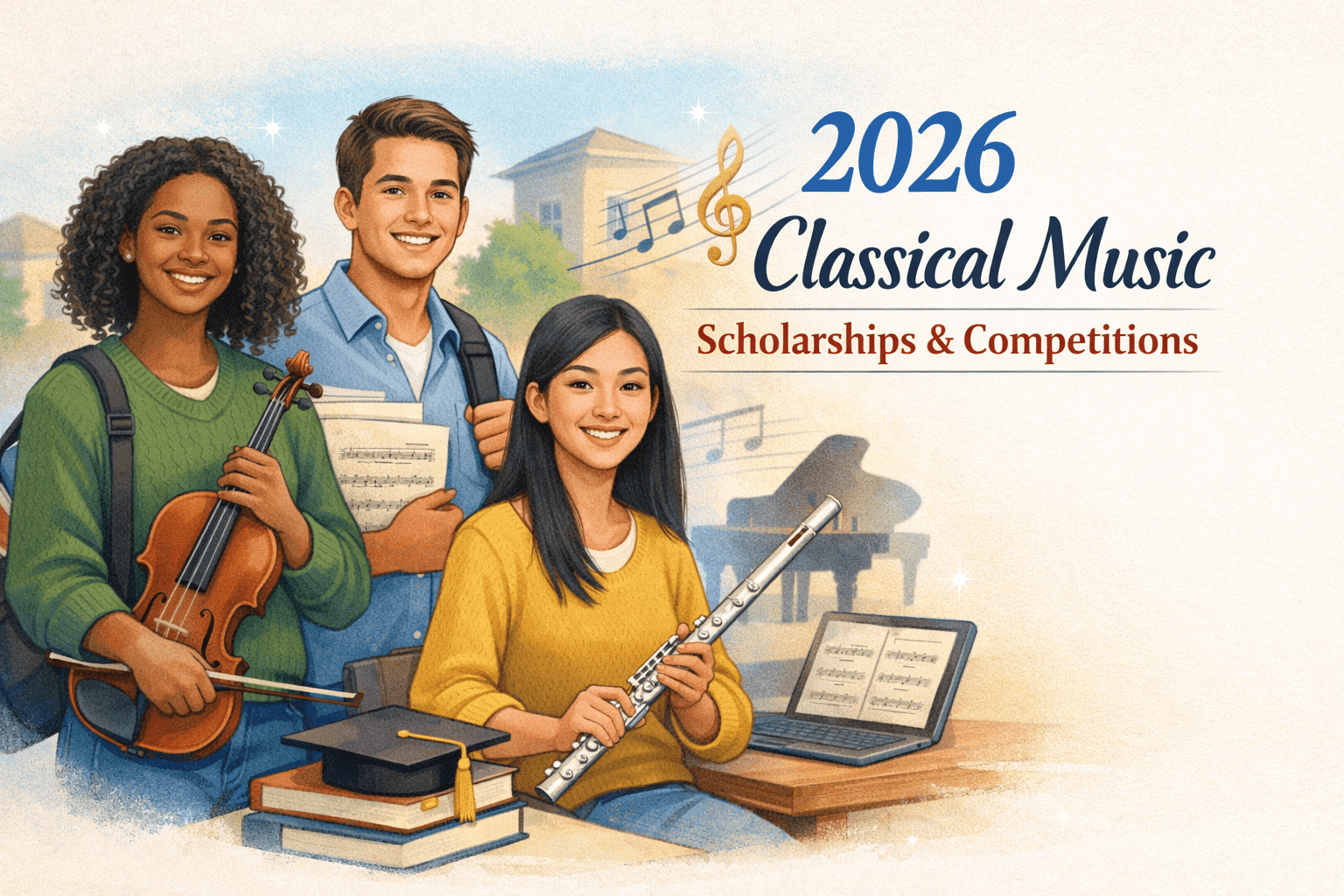
2026 Classical Music Scholarships & Competitions
January
BMI Student Composer Awards
💥 Why It Slaps: One of the premier awards for emerging concert music composers (ages 27 and under).
💰 Amount: Cash awards (amount varies by year).
⏰ Deadline: January 31, 2026.
🔗 Apply/info: https://bmifoundation.org/applications/bmifoundation/awards/bmi_student_composer_awards
(Historic Jan Window) VSA International Young Soloists (Kennedy Center)
💥 Why It Slaps: National recognition + performance opportunities at the Kennedy Center for young musicians with disabilities (ages 14–25).
💰 Amount: $2,000 per winner.
⏰ Deadline: TBA for 2026 (2025 cycle closed Jan 8; 2026 details typically post in early fall).
🔗 Apply/info: https://www.kennedy-center.org/education/opportunities-for-artists/info/vsa-international-young-soloists/
February
ASCAP Foundation Morton Gould Young Composer Awards
💥 Why It Slaps: Flagship national award for concert composers up to age 30.
💰 Amount: Cash awards (varies).
⏰ Deadline: February 1, 2026.
🔗 Apply/info: https://www.ascapfoundation.org/programs/awards/young-composer-awards
George & Nora London Foundation — Awards Competition (Opera)
💥 Why It Slaps: Prestigious early-career opera awards; finals at the Morgan Library (NYC).
💰 Amount: Top awards $12,000; encouragement awards $2,000.
⏰ Deadline: TBA (Final Round: February 20, 2026).
🔗 Apply/info: https://www.georgeandnoralondon.org/competition
NFMC (National Federation of Music Clubs) — Mary Alice Cox Strings Award (HS)
💥 Why It Slaps: National strings award for high school players.
💰 Amount: $2,500 (1st), $1,500 (2nd), $1,000 (3rd).
⏰ Deadline: March 1 annually; prep begins in Feb.
🔗 Apply/info: https://www.nfmc-music.org/competitionscategory/junior-division/
March
NFMC — Stillman Kelley/Thelma Byrum Award (HS)
💥 Why It Slaps: Long-running national award recognizing top young classical performers.
💰 Amount: $2,000 (1st), $1,000 (2nd), $750 (3rd) + regional awards.
⏰ Deadline: March 1 (state pre-rounds may have earlier cutoffs).
🔗 Apply/info: https://www.nfmc-music.org/competitionscategory/junior-division/
NFMC — Martha Marcks Mack Junior Vocal Award (HS)
💥 Why It Slaps: National classical voice award for grades 10–12.
💰 Amount: $1,500 (1st), $1,000 (2nd), $500 (3rd).
⏰ Deadline: March 1.
🔗 Apply/info: https://www.nfmc-music.org/competitionscategory/junior-division/
NFMC — The Marilyn Caldwell Piano Award (HS)
💥 Why It Slaps: National recognition for high-school pianists.
💰 Amount: $1,250 (1st), $750 (2nd).
⏰ Deadline: March 1.
🔗 Apply/info: https://www.nfmc-music.org/competitionscategory/junior-division/
April
NATS — National Student Auditions (classical voice, multiple categories)
💥 Why It Slaps: Huge national pipeline for young classical singers; >$80k total prizes.
💰 Amount: Category prizes; overall pool >$84,000.
⏰ Deadline (national screening): April 10, 2026 (entry by invitation from region rounds).
🔗 Apply/info: https://www.nats.org/competitions.html
May
Chopin Foundation — Scholarship Program for Young American Pianists
💥 Why It Slaps: Multi-year support to prep for the National Chopin Piano Competition.
💰 Amount: $1,000, renewable (up to four years).
⏰ Deadline: May 15 every year.
🔗 Apply/info: https://www.chopin.org/requirements
NFMC — Lana M. Bailey Piano Concerto Award (HS seniors)
💥 Why It Slaps: Concerto-focused national award for graduating seniors.
💰 Amount: $1,500 (1st), $500 (2nd).
⏰ Deadline: May 1.
🔗 Apply/info: https://www.nfmc-music.org/competitionscategory/junior-division/
Summer (May–July windows)
American Harp Foundation — Anne Adams Awards (Harp)
💥 Why It Slaps: Biennial national scholarship awards; canon in the harp world.
💰 Amount: Scholarship awards (historically $3,000 each to three winners).
⏰ Timeline: Applications post in 2025; competition held May 2026 (exact due date TBA).
🔗 Apply/info: https://harpfoundation.org/adams-2/
September
NATS Artist Awards (NATSAA) — Early-Career Classical Voice
💥 Why It Slaps: National, biennial; >$50k in cash/prizes; winner featured at NATS Conference.
💰 Amount: Winner >$13,000; runner-up >$6,000; additional cash/prizes.
⏰ Deadline to apply: September 8, 2025 (for Jan 2026 finals).
🔗 Apply/info: https://www.nats.org/nats-artist-awards.html
October
YoungArts — National Arts Competition (Classical Music, Voice)
💥 Why It Slaps: Cash awards, national spotlight, and eligibility for U.S. Presidential Scholar in the Arts consideration.
💰 Amount: Individual awards up to $10,000.
⏰ Deadline: October 8, 2025 at 8 PM ET (2026 cycle).
🔗 Apply/info: https://youngarts.org/apply/
National Young Composers Challenge (NYCC)
💥 Why It Slaps: Feedback from pros + winners’ works performed by orchestra or ensemble.
💰 Amount: Cash awards; performance opportunity (varies).
⏰ Deadline: October 1, 2025 (2026 cycle dates TBA—check site).
🔗 Apply/info: https://youngcomposerschallenge.org/
Sphinx Competition (Black/Latine string players)
💥 Why It Slaps: Top U.S. classical strings competition elevating underrepresented artists; major prizes + concerto engagements.
💰 Amount: Cash awards (Senior Division historically includes a $50,000 first prize).
⏰ Deadline: October 13, 2025 for 2026 competition.
🔗 Apply/info: https://www.sphinxmusic.org/sphinx-competition
November
“The President’s Own” U.S. Marine Band — Concerto Competition (HS Strings/Piano/Harp in 2025–26)
💥 Why It Slaps: Winner solos with the Marine Chamber Orchestra + scholarship.
💰 Amount: $2,500 (1st), $1,000 (2nd), $500 (3rd).
⏰ Deadline: November 15, 2025.
🔗 Apply/info: https://www.marineband.marines.mil/Educational/Concerto-Competition/
December
International Trombone Association — Solo & Ensemble Competitions
💥 Why It Slaps: Premier global stage for classical trombonists; finals at the 2026 International Trombone Festival.
💰 Amount: Awards/recognition (varies by competition).
⏰ Entries open Oct 6; deadline December 8, 2025 (for 2026 finals).
🔗 Apply/info: https://trombone.net/awards-competitions/competitions/ita-solo-ensemble-competitions/
Rolling / TBA (check windows)
Jack Kent Cooke Young Artist Award (From the Top)
💥 Why It Slaps: Need-based award for exceptional pre-college classical musicians featured on NPR’s “From the Top.”
💰 Amount: Up to $10,000.
⏰ Deadline: Rolling cycles; see current apply page.
🔗 Apply/info: https://fromthetop.org/apply/jack-kent-cooke-young-artist-award/
Yamaha Young Performing Artists (YYPA)
💥 Why It Slaps: National winners (ages 18–22) get an all-expenses-paid pro-development weekend, performance, and career mentorship.
💰 Amount: No cash award advertised; travel/experience provided.
⏰ Deadline: Opens each fall; see current rules/FAQ.
🔗 Apply/info: https://usa.yamaha.com/education/yypa/index.html
MTNA Student Competitions (Performance/Composition)
💥 Why It Slaps: Nationally respected MTNA pipeline with state, division, and national rounds.
💰 Amount: Cash awards (varies by level).
⏰ Deadlines vary by state; 2025–26 cycle info posted on MTNA site.
🔗 Apply/info: https://www.mtna.org/MTNA/Engage/Competitions/Competitions.aspx
Young Concert Artists — Susan Wadsworth International Auditions
💥 Why It Slaps: Career-launch platform with management, residencies, and concert debuts for winners.
💰 Amount: Career development prizes (includes new $5,000 Laureate Prizes).
⏰ Deadline: Final deadline for 2025 was Aug 4; 2026 cycle posts in spring.
🔗 Apply/info: https://yca.org/auditions/
Giulio Gari Foundation — International Vocal Competition (Opera)
💥 Why It Slaps: Cash awards + career support for rising opera singers.
💰 Amount: Cash awards (varies).
⏰ Deadline: Spring (2025 was March); watch for 2026 posting.
🔗 Apply/info: https://giuliogari.org/
Loren L. Zachary National Vocal Competition (Opera)
💥 Why It Slaps: One of the most valuable U.S. opera competitions for emerging singers.
💰 Amount: Significant cash prizes (e.g., $15,000 first prize in 2025).
⏰ Deadline: Early spring (regional dates/entry post for each cycle).
🔗 Apply/info: https://www.zacharysociety.org/competition
Gerda Lissner Foundation — International Vocal Competitions
💥 Why It Slaps: Renowned NYC-based competitions (opera/art song) with major prizes + Carnegie Hall winners’ concerts.
💰 Amount: Cash awards (varies by division).
⏰ Deadline: Early winter (e.g., Jan in 2025); 2026 announcements rolling.
🔗 Apply/info: https://gerdalissner.org/
American Guild of Organists — Pogorzelski-Yankee Memorial Scholarships (Organ)
💥 Why It Slaps: One of the largest U.S. scholarships for organ majors; two multi-year awards.
💰 Amount: $15,000 per year (two awards; 2026–27 cycle).
⏰ Deadline: Guidelines/app open January 2026 for the 2026–27 academic year.
🔗 Apply/info: https://www.agohq.org/ago/education/scholarships/
International Trombone Association — Larry Wiehe Tenor Trombone / Other ITA Comps
💥 Why It Slaps: Named competitions with repertoire standards; prestige + visibility.
💰 Amount: Awards/recognition (varies).
⏰ Annual; see each competition page (finals 2026 during ITF).
🔗 Apply/info: https://trombone.net/awards-competitions/competitions/
NATS Chapters/Regions (Multiple Local & Regional Awards)
💥 Why It Slaps: Local-to-national pipeline for classical singers; great feedback + resume value.
💰 Amount: Varies by chapter/region.
⏰ Dates vary (regionals late fall–spring; nationals April/June).
🔗 Info hub: https://www.nats.org/competitions.html
Monthly Update (September 2025)
- We re-verified all apply/info links and replaced aggregator URLs with official organization pages wherever available.
- New/confirmed dates: YoungArts (closes Oct 8, 2025), Sphinx (Oct 13, 2025), Marine Band HS Concerto Competition (Nov 15, 2025), ITA Solo/Ensemble (accepts Oct 6–Dec 8, 2025), NATSAA (apply by Sep 8, 2025), BMI (Jan 31, 2026), ASCAP (Feb 1, 2026), Chopin Foundation (May 15 annually). Chopin Foundation of the United States
- Instrument-specific highlights added: Organ (AGO Pogorzelski-Yankee), Harp (Anne Adams), Trombone (ITA). agohq.org
Notes for Readers
- Amounts listed as “varies” reflect competitions that offer cash awards without a fixed published amount each cycle; always confirm current prize tiers on the official page before applying.
- Several opera competitions (London/Lissner/Gari/Zachary) post 2026 details on rolling schedules—bookmark and check monthly.
Classical Music Scholarships & Competitions in the U.S.: Review of Access, Signaling, and Career Outcomes
Abstract
Classical music training is an unusually high-cost educational pathway: it combines tuition, private instruction, instrument acquisition/maintenance, accompanist fees, summer festivals, and travel for auditions and competitions. Scholarships and competitions function as the primary “capital markets” of this ecosystem, shaping who can enter, persist, and transition into professional careers. This paper synthesizes current U.S.-relevant evidence on (1) the economics and labor-market realities facing emerging classical musicians, (2) how institutional scholarships and philanthropic awards distribute opportunity, and (3) how competitions operate as both funding mechanisms and labor-market “signals.” Using publicly available data from the U.S. Bureau of Labor Statistics (BLS), federal education sources, and official competition and conservatory disclosures, the analysis highlights three findings: (a) financial aid is widespread at elite training institutions but still leaves large gaps in living costs and pre-college expenditures; (b) competitions award meaningful cash and—more importantly—career services and visibility, but are characterized by steep selection funnels and high participation costs; and (c) socioeconomic inequities in access to music education and arts participation likely propagate into scholarship and competition pipelines. Policy and program recommendations emphasize transparency, cost-reduction mechanisms (fee waivers, travel support), and better outcomes reporting to improve equity and efficiency.
Keywords: classical music scholarships, conservatory financial aid, music competitions, talent pipelines, equity in arts education, signaling
1. Introduction: Why scholarships and competitions matter more in classical music
In many academic majors, students can rely primarily on standardized pathways (coursework → internships → entry-level jobs). Classical music is different. Training is apprenticeship-like and reputation-based: access to elite teachers, ensembles, festivals, and gatekeeping audition panels often matters as much as (or more than) formal credentials. Scholarships and competitions therefore play a dual role:
-
Financing role: they offset the direct costs of education and professionalization.
-
Signaling role: they certify talent to institutions, agents, presenters, and donors.
This dual role makes classical music an ideal case for studying how educational finance interacts with labor-market signaling—especially because professional earnings are volatile and frequently project-based. The BLS reports a median hourly wage for musicians and singers of $42.45 (May 2024), with wide dispersion (bottom 10% under $18.68; top 10% above $105.44), reflecting uneven access to high-paying engagements and steady employment.
The central research question is not “Are scholarships available?” but: How do scholarships and competitions shape access, persistence, and career outcomes under conditions of high cost, high uncertainty, and strong gatekeeping?
2. Data and methods
This paper uses a descriptive, data-driven synthesis approach:
- Labor market context: BLS Occupational Outlook Handbook for Musicians and Singers.
- Institutional scholarship models: official conservatory financial aid pages, plus standardized consumer-data sources (College Board BigFuture; College Scorecard references where consistent).
- Competition economics: official competition pages for prize structures and applicant volume; select reputable reporting for recent prize data.
- Equity framing: National Endowment for the Arts (NEA) participation findings and NAfME equity statements, supplemented by peer-reviewed research on resource inequality and competition judgments.
Because award terms and competition rules change frequently, the analysis prioritizes official program disclosures and recent publication dates where possible.
3. The economics of becoming a classical musician
3.1 Cost structure: tuition is only one line item
For performance students, tuition is often the most visible cost, but not necessarily the binding constraint. The pre-college “shadow curriculum” can include:
- weekly private lessons (often with elite teachers),
- accompanist rehearsals,
- instrument purchase/repair and bow upkeep (strings) or maintenance (winds/brass),
- summer festivals and institutes,
- recording/video production for prescreens,
- travel for auditions and competitions.
Scholarships can reduce tuition, but living expenses and pre-college costs frequently remain unfunded—meaning financial barriers can persist even when tuition discounts look large on paper.
3.2 Earnings reality and risk
BLS data underscores the risk profile: musicians’ earnings vary dramatically, and work is commonly episodic. This volatility changes the calculus of educational debt: borrowing may be rational for some fields with predictable wage floors, but is riskier when income is uncertain and geographically concentrated in major arts markets.
A second layer is career timing: competitions and auditions often reward early professional readiness. This can compress the development timeline and increase spending intensity (coaching, travel, festival tuition) exactly when families have the least institutional support.
4. Scholarship models in classical music: four “markets” of aid
Classical music funding tends to cluster into four overlapping scholarship markets:
-
Conservatory/institutional scholarships (merit + need blends)
-
University music department awards (often tied to ensembles/service)
-
Philanthropic or foundation scholarships (targeted, sometimes instrument- or region-specific)
-
Competition-linked awards (cash + career services + visibility)
4.1 Tuition-free (or tuition-guaranteed) conservatory models
A small number of elite conservatories operate with unusually strong scholarship commitments, effectively shifting cost from families to endowments/donors.
-
Curtis Institute of Music states that tuition is free for all students via full-tuition scholarships, and provides published annual scholarship values (e.g., $54,364 undergraduate; $67,502 graduate for 2025–26).
-
Colburn Conservatory of Music reports full tuition scholarships for conservatory students, while charging a comprehensive fee to cover institutional costs.
These models are consequential because they reduce the need to “win” tuition discounts through a patchwork of external awards. However, they do not eliminate the broader cost structure (housing, food, travel, lost earnings, and pre-college expenses).
4.2 High-aid conservatory models (not tuition-free, but aid-prevalent)
Other top institutions emphasize that many students receive scholarships, but tuition remains listed and award packages vary.
-
Juilliard notes that most students do not pay full cost, and that more than 90% of students have received scholarship assistance in recent years.
-
College Board’s BigFuture (consumer-facing) reports 73% of Juilliard students receiving financial aid and an average aid package figure (useful for comparison, though not a substitute for institutional net price calculators).
-
BigFuture reports New England Conservatory figures such as average net price and share receiving financial aid, illustrating that even highly selective conservatories can have meaningful remaining net costs.
4.3 A snapshot comparison
Illustrative examples (selected; terms change annually):
| Institution / Source | Scholarship approach | Data point (recently published) |
|---|---|---|
| Curtis Institute of Music | Full-tuition scholarships for all admitted | Scholarship value published for 2025–26 (UG/Grad). |
| Colburn Conservatory | Full tuition scholarships; fees still apply | Comprehensive fee described; tuition covered. |
| Juilliard | Aid prevalent; tuition not universally free | “More than 90%” receive scholarship assistance (recent years). |
| NEC (BigFuture) | Aid varies; net price can remain high | BigFuture net price + aid share (program-level variability). |
Interpretation: Scholarship generosity is real and often substantial, but it is uneven across institutions and frequently does not solve total cost constraints.
4.4 Philanthropic scholarships: targeted but smaller-dollar on average
Philanthropic awards can be decisive “gap fillers,” especially for pre-college and continuing study costs. A representative example is the Colburn-Pledge Music Scholarship, which provides tuition assistance for young string players up to a capped amount (reported not to exceed $3,000 per recipient) and publicly summarizes cumulative award counts. Such awards rarely replace institutional aid, but can finance a festival, lessons, or audition travel—often the actual bottleneck for talent development.
5. Competitions as financing + signaling systems
5.1 Prize structures: cash is only the visible part
Competitions bundle benefits:
- direct cash prizes
- career management / concert bookings
- recording opportunities
- visibility to presenters, agents, and donors
- credential value (“laureate” status)
The Van Cliburn International Piano Competition is a clear example: it reports an estimated $2 million total prize package value, including career management and concert bookings. Its prizes page documents a $100,000 cash award for First Prize alongside multi-year career support.
At the youth/pre-professional level, YoungArts publicly states cash awards ranging from $250 to $10,000 and reports an applicant pool of nearly 11,000 applications across disciplines in a recent cycle—evidence of both scale and selectivity.
At the national student-competition level, MTNA lists structured prizes (e.g., $1,000 national winner in Junior Performance categories), showing how large participation funnels can culminate in modest cash—but meaningful résumé signal and teacher-network value.
International contests also provide benchmark prize levels; for example, reporting on the 2025 International Chopin Piano Competition cites a top award of €60,000, illustrating the scale of late-stage global competitions.
5.2 Selectivity: steep funnels and high variance
Competitions are frequently “winner-take-most” in outcomes, even when cash awards are distributed. The Cliburn reports 340 applications from 45 countries/regions for its 2025 cycle, illustrating intense global competition for a tiny number of finalist slots.
5.3 Competitions as labor-market signals (and their limits)
In economics terms, competitions function as signal amplifiers: they reduce uncertainty for gatekeepers by ranking performers under standardized conditions. Yet measurement is imperfect. A peer-reviewed economics study examining international classical music competitions (1979–2021) finds that jury and audience preferences match only 38% of the time, suggesting that “quality” in performance evaluation is partly subjective and context-dependent.
Implication: competitions can accelerate careers—but they also introduce randomness and may reward style/fit as much as enduring artistic potential. For scholarship strategy, this means students should treat competitions as a portfolio of shots, not a single do-or-die event.
6. Equity and access: why the pipeline is not neutral
Scholarship and competition systems inherit inequities from earlier stages of music education.
-
The NEA emphasizes that education and income strongly predict arts participation across cohorts and art forms—an important signal that upstream access is stratified.
-
NAfME explicitly states that students do not have equitable access to music education and frames equity as a systemic issue.
-
Recent peer-reviewed research documents disparities in resources for Western instrumental music education, reinforcing that “talent pipelines” are shaped by unequal inputs.
Mechanisms of inequity in scholarships and competitions
-
Cost of readiness: private study and coaching can be expensive and geographically constrained.
-
Cost of participation: entry fees, accompanists, recording, travel, and time off work/school.
-
Information asymmetry: knowing which programs exist and how to package an application often comes from networks (teachers, feeders, alumni).
-
Risk tolerance: families with less financial slack may avoid “long-shot” competitions even when the student is competitive.
Scholarships mitigate these barriers only when they address total cost and participation cost, not just tuition.
7. Practical implications for applicants: a strategy grounded in the data
A data-informed applicant strategy treats scholarships and competitions as complementary tools:
7.1 Build a “stackable funding plan”
-
Target institutional scholarships first (largest dollars).
-
Use foundation/association awards to close gaps (festival tuition, travel, instrument repairs).
-
Use competitions strategically for both signal and funds—especially those that provide mentorship/career services (e.g., YoungArts’ longer-term support framing).
7.2 Optimize for ROI in competitions
Given steep funnels (e.g., 340 Cliburn applicants) and subjective judging (38% jury-audience alignment), competition choice should be deliberate.
Best practice is a laddered portfolio:
-
local/regional (low cost, feedback, confidence),
-
national (credential),
-
selective international (career inflection points).
7.3 Budget around the hidden costs
Even tuition-free models emphasize that living costs remain and fees can exist (e.g., Colburn’s comprehensive fee). Applicants should forecast: housing, food, health insurance, accompanist time, recordings, and summer training.
8. Recommendations for scholarship providers and competition organizers
To improve access and the efficiency of talent discovery:
- Publish cost-of-participation supports: fee waivers, travel stipends, accompanist grants.
- Standardize transparency: report applicant counts, demographic aggregates, and award distributions annually (like Cliburn’s published applicant volume).
- Decouple opportunity from cash-only prizes: expand career services, paid performance opportunities, and mentorship (Cliburn prize package model).
- Reduce evaluation noise: structured rubrics, bias mitigation training, and where feasible, blind preliminary rounds.
- Track outcomes: scholarship and competition programs should report longer-term outcomes (enrollment persistence, graduation, professional placements, debt levels). Without outcomes data, “prestige” can substitute for evidence.
Conclusion
Classical music scholarships and competitions form a tightly coupled system that finances training and allocates prestige. The best-supported pathways (e.g., tuition-free scholarship models at select conservatories) demonstrate that large-scale access interventions are feasible, but they do not erase the broader cost structure of professionalization. Competitions contribute meaningful resources and powerful signals—sometimes worth far more than cash through career management and bookings—yet remain selective, costly to pursue, and partly subjective in outcomes.
A data-driven approach for students emphasizes stacking aid, budgeting for hidden costs, and building a competition portfolio that maximizes learning and signal per dollar spent. For institutions and organizers, the equity frontier is clear: reduce participation costs, publish outcome metrics, and design awards that support career sustainability, not just short-term prestige.
References (selected)
- U.S. Bureau of Labor Statistics. Musicians and Singers: Occupational Outlook Handbook (median hourly wage, May 2024).
- Curtis Institute of Music. Financial Aid / Free Tuition scholarship values (2025–26).
- Colburn School. Cost and Financial Aid (Conservatory).
- The Juilliard School. Tuition, Fees, and Expenses (scholarship prevalence statement).
- College Board BigFuture. Juilliard costs and aid; NEC costs and aid (consumer data snapshots).
- National YoungArts Foundation. Awards range; 2025 winners applicant pool.
- Van Cliburn International Piano Competition. Prize package value; prizes and awards; applicant volume news.
- Music Teachers National Association (MTNA). Competition awards (2025–2026).
- National Endowment for the Arts. Arts participation and the role of education/income.
- NAfME. Equity and access in music education (position statement).
- Asmat, R., et al. (2023). Jury vs audience agreement in classical music competitions (1979–2021).
FAQs — Classical Music Scholarships & Competitions (Think-Very-Hard Edition)
1) Who’s eligible for “classical” awards—do film scoring, jazz, musical theatre, or pop count?
Most classical awards mean Western art music (Baroque → contemporary “new music”), including opera, art song, orchestral/choral, chamber, solo instrumental, classical guitar/harp/organ, early music, and contemporary classical composition. Jazz, MT, or pop usually go to separate categories unless an organization explicitly says otherwise. Always check the category list before you submit.
2) Are international students allowed?
Often yes, but not always. Some U.S. foundations restrict applicants to U.S. citizens, permanent residents, or DACA. Others are open globally. Read eligibility lines closely (citizenship, residency, school location, age), and don’t assume last year’s rule still applies.
3) Do these awards require financial need, or are they merit-only?
Both exist. Composition/competition prizes are commonly merit-only; degree-seeking scholarships may be merit, need, or mixed. If need is considered, be ready to upload FAFSA/ISIR (U.S.), CSS Profile, or school financial-aid docs.
4) How are age cutoffs calculated?
Three common patterns: (a) age on the application deadline; (b) age on the finals date; (c) age on a fixed date (e.g., Jan 1). If you’re on the cusp, confirm which rule applies before paying a fee.
5) Can I apply while taking a gap year or doing a non-music major/minor?
Many awards require you to be actively studying music or pursuing a music career track, but some high-school or open competitions allow gap-year applicants and non-majors. Check the “enrollment” or “intent to major” clauses.
6) What counts as acceptable repertoire?
Expect standard classical repertoire lists, with room for contemporary works. Many competitions publish approved lists or time ranges (e.g., 8–12 minutes). Memorization is commonly required for pianists/strings/voice; organ, percussion, harp, and winds vary. Contemporary techniques are fine if rules don’t prohibit them.
7) Do I need an accompanist? Can I use pre-recorded or piano reductions?
Voice and many wind/strings categories require live piano (or a pre-approved high-quality track where allowed). Concerti are typically with piano reduction unless a specific concerto round is offered. Always follow the accompaniment policy; disqualifications for wrong accompaniment are common.
8) Audition video standards (so I don’t get bounced on a technicality)?
- One take per piece unless multi-take is explicitly allowed.
- Neutral background, full body for singers, full keyboard/hands for pianists, full instrument posture for strings/winds/percussion/harp/organ.
- 1080p (or better), steady camera, no heavy reverb or post-processing, no EQ/compression “sweetening.”
- Slate your name/repertoire only if asked; otherwise title cards or file-names usually suffice.
- Upload formats: MP4/MOV links or direct uploads; unlisted links if using video platforms.
- Check duration caps—don’t exceed.
9) Composition submission must-haves?
- Score PDF with clear parts, page numbers, instrumentation, duration.
- Audio: live recording preferred; high-quality mockup is sometimes allowed (MIDI alone often discouraged).
- Keep your name off the score if blind judging is used.
- Program note and instrumentation list help adjudicators quickly understand the work.
- If submitting multiple pieces, hit the minimum/maximum durations.
10) May I submit pieces performed or composed with AI tools?
Unless explicitly permitted, assume AI-generated audio/scores are not allowed. If you used notation/production tools, that’s fine; if an AI co-wrote the music, expect disqualification. When in doubt, ask the organizer in writing.
11) Can I reuse a past winning piece or a school jury video?
Generally yes if the repertoire still fits and the rules don’t require “previously unawarded” or “premiered after [date].” Many competitions prohibit resubmitting a work that already won that same competition. Always check “prior awards” clauses.
12) Recommendation letters: who should write them and can I reuse them?
Studio teacher, conductor, theory/composition teacher, or department chair are best. Many orgs accept a sealed or direct-upload letter that you can reuse if it meets the date window. Track letter formats (PDF vs. portal form) and deadlines to avoid last-minute scrambles.
13) Fees & waivers: how do I avoid financial barriers?
Plenty of orgs grant fee waivers for need—ask early. Provide a short note + proof (FAFSA/CSS or school letter).
Template you can copy:
“Hello [Organizer], I’m applying to [Competition/Scholarship] and request a fee waiver due to financial need. I can provide FAFSA/CSS Profile or a school aid letter. Thank you for considering—this support makes participation possible.”
14) Are travel or accompanist costs covered?
Some finals provide travel stipends, housing, per diem, or an official accompanist. Others don’t. If funds are limited, filter for organizations that list travel help or remote preliminary rounds.
15) Taxes: are scholarship/award funds taxable?
In the U.S., amounts used for qualified tuition and required fees/books may be non-taxable; portions for room, board, travel, or general stipends are typically taxable. Keep every award letter and 1099/official tax form. This is general info—not tax advice—consult a tax professional.
16) When do cycles open, and why do dates move?
Most pages refresh late summer–fall with finalized dates spanning Oct–May deadlines. Some move dates year-to-year due to venue, funding, or conference alignment. Build a rolling calendar, set 2–3 reminders per opportunity (launch, 2 weeks out, 72 hours out).
17) Can I apply to multiple awards at once, or will that hurt me?
Apply broadly. Judges rarely penalize parallel applications; in fact, diversified submissions spread your risk. Just ensure each set of materials follows that organization’s exact specs.
18) Do I lose rights to my piece or recording if I win?
Usually you retain copyright to compositions and recordings. Winners often grant the organizer a limited license to perform, stream, archive, or publish media for promotion. Read the media and IP clauses; beware of exclusive or perpetual all-rights grabs.
19) What if I need disability accommodations?
Most reputable orgs provide reasonable accommodations (extra time, page-turners, accessible formats, remote rounds). Request in writing as early as possible and describe the exact accommodation needed. Keep organizer replies on file.
20) How do I make my application stand out without gimmicks?
- Repertoire: contrast styles/eras and show your current best, not just hardest.
- Materials: clean score PDFs, precise time stamps, professional bio (100–150 words), current CV, and tidy file-naming.
- Story: add a short artistic statement (what you’re exploring musically) when allowed—concise, authentic, no fluff.
21) What GPA do I need for school-based music scholarships?
Common floors: 2.5–3.0 overall; conservatories may be higher and weigh auditions far more. For purely competition prizes, GPA often isn’t considered.
22) Can homeschooled or early-college students apply?
Yes, if you meet the age/level rules and can provide transcripts or a school official’s letter (homeschool coordinator counts). For minors, guardian consent forms may be required.
23) What about early-music or “non-standard” instruments (harpsichord, theorbo, natural horn, recorder)?
Some orgs welcome them; others categorize by family (keyboard, plucked strings, winds) or offer “open” categories. If not listed, ask the organizer—provide repertoire and approximate duration.
24) My piece/aria is slightly over the time limit—okay to cut?
If allowed, do a musically sensible cut and annotate your score/video description. Never exceed stated limits.
25) Any last-mile checklist before I hit submit?
- Eligibility confirmed (age, citizenship, student status).
- Repertoire fits, timing verified.
- Video/audio quality acceptable; file names clear; links unlisted and tested.
- Required docs: ID, transcript, headshot, CV, short bio, statements, recommendation letters, proof of need (if applicable).
- Paid fees or received waiver confirmation.
- Calendar reminders set for results and next-round timelines.