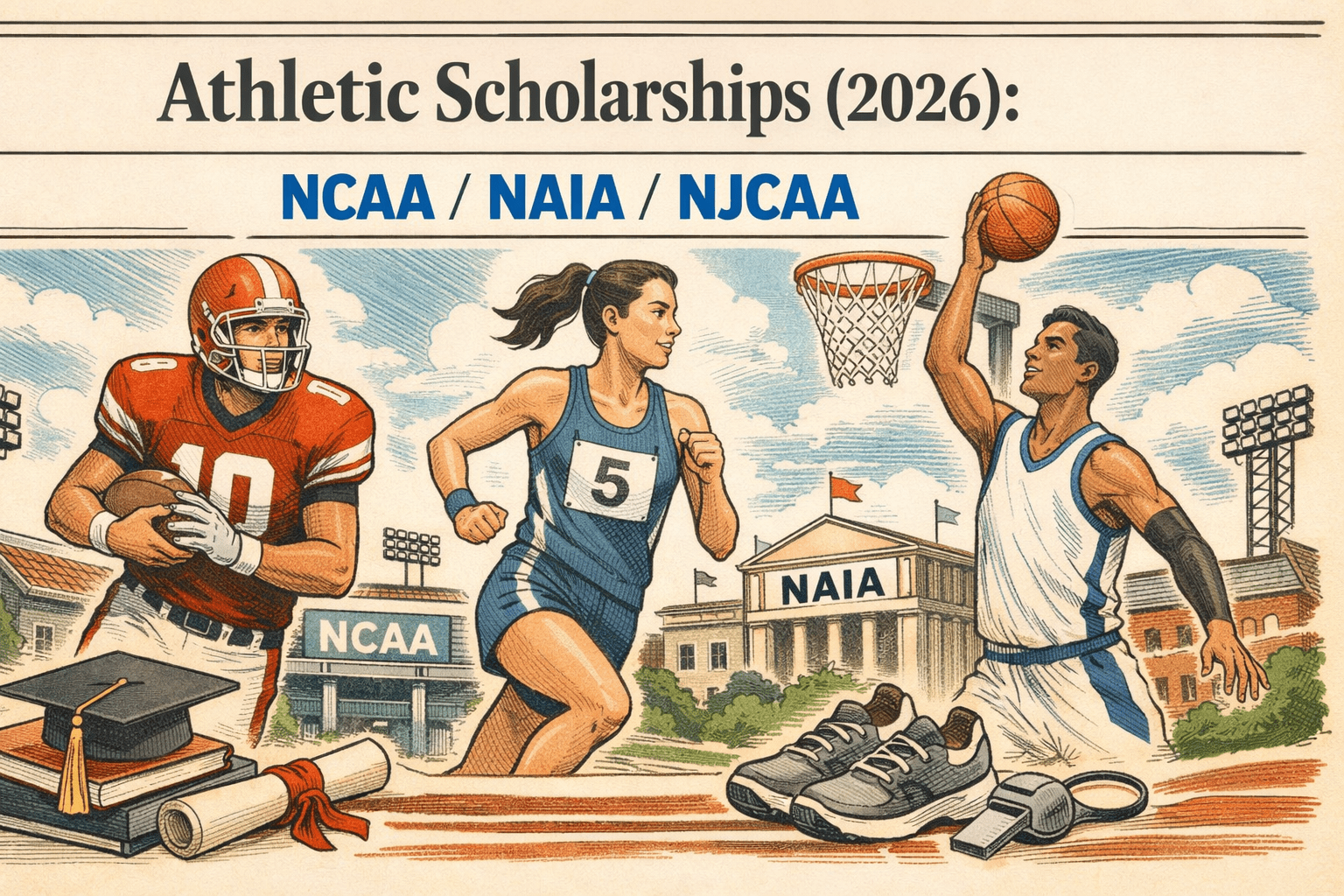
Athletic Scholarships & Grants: Build the Bag While You Play
You bring the hustle; we bring the money map. This page rounds up legit athletic scholarships and association awards (plus where DI/DII/NAIA/NJCAA money actually comes from). We list Why it slaps first, then amount, timeline, and the official apply/info link — all verified so you don’t rage-click dead ends. 🥇
Featured Athlete Scholarships & Programs (Verified)
Heisman High School Scholarship (HS seniors, all sports)
- 💥 Why it slaps
- National brand recognition = résumé boost
- Celebrates academics + leadership + athletics
- Multiple winners at school/state/national levels
- 💰 Amount: Awards at several tiers (varies by year)
- ⏰ Deadline: Opens each fall; check the current portal
- 🔗 Apply/info: heismanscholarship.com
BigSun Student Athlete Scholarship (any sport)
- 💥 Why it slaps
- Simple essay; open to HS seniors & college athletes
- All sports welcome (team or individual)
- Annual award — easy add to your apply stack
- 💰 Amount: $500 (recent cycles)
- ⏰ Deadline: June 19 annually (site shows next: 2026)
- 🔗 Apply/info: bigsunathletics.commefa.org Amount/date corroborated by MEFA.
NCAA Postgraduate Scholarship (college student-athletes)
- 💥 Why it slaps
- Prestigious $10,000 one-time grad award
- 126 awards per year across fall/winter/spring sports
- Pure flex on a grad school application
- 💰 Amount: $10,000 (one-time)
- ⏰ Deadline: Three cycles per year (by sports season)
- 🔗 Apply/info: NCAA.org
NCAA Walter Byers Graduate Scholarship
- 💥 Why it slaps
- NCAA’s top academic award; 1 male + 1 female nationally
- Can renew for year 2 with good progress
- 💰 Amount: $24,000/yr (potentially renewable to 2 years)
- ⏰ Deadline: Annual; see current call
- 🔗 Apply/info: NCAA.org Byers page
NCAA Jim McKay Graduate Scholarship (sports comm/PR focus)
- 💥 Why it slaps
- For student-athletes heading into sports media/PR
- National visibility + cash for grad study
- 💰 Amount: $10,000
- ⏰ Deadline: Annual; see current call
- 🔗 Apply/info: NCAA.org NCAA.org
NAIA Athletic Scholarships (college aid via schools)
- 💥 Why it slaps
- Scholarships awarded by NAIA member schools
- Official NAIA Eligibility Center + recruiting hub
- 💰 Amount: Varies by school/sport (merit + athletic often stack)
- ⏰ Timeline: With admission/coach offers; rolling by school
- 🔗 Apply/info: PlayNAIA (official)
NJCAA Athletic Scholarships (two-year colleges)
- 💥 Why it slaps
- Division I JUCOs can fund full scholarships (tuition, fees, books, room & board + some supplies/transport)
- DII partial; DIII no athletic aid
- 💰 Amount: By division & school
- ⏰ Timeline: Team/coach driven; per-school deadlines
- 🔗 Apply/info: NJCAA Divisional Structure
NCAA: Where the Money Actually Is (context you need)
- 💥 Why it slaps
- DI & DII schools provide ~$4.0B in athletic scholarships annually to ~197,000 athletes
- DIII: no athletic scholarships, but 75–80% get merit/need aid
- 💰 Amount: School-awarded; varies widely
- ⏰ Timeline: Coach offers + financial aid cycles
- 🔗 Info: NCAA FSNCAANCAA.org
LPGA Foundation Scholarships (golf, female students)
- 💥 Why it slaps
- Multiple named awards (e.g., Marilynn Smith, Phyllis G. Meekins)
- Great for HS seniors planning to play or study golf-related fields
- 💰 Amount: Often $1,250–$5,000 (e.g., Marilynn Smith $5k; 25 awards in 2024)
- ⏰ Deadline: Annual spring windows (vary by award)
- 🔗 Apply/info: LPGA
USTA Foundation College Scholarships (tennis)
- 💥 Why it slaps
- For seniors active in NJTL/organized youth tennis, with community service + need
- Clear checklist + rec letters from coach/teacher
- 💰 Amount: Varies by fund (multiple awards annually)
- ⏰ Deadline: Example 2025 cycle due May 19
- 🔗 Apply/info: USTA Foundation
U.S. Figure Skating — Memorial Fund Scholarships
- 💥 Why it slaps
- Academic and skating scholarships; $750k+ distributed across programs each year
- Competitive results and GPA recognized
- 💰 Amount: Varies by award
- ⏰ Deadline: Annual; check current call
- 🔗 Apply/info: U.S. Figure Skating
USRowing — United We Row Scholarships
- 💥 Why it slaps
- Scholarships to reduce financial barriers for rowers/coxswains
- Multiple programs under one national hub
- 💰 Amount: Varies by scholarship
- ⏰ Deadline: Posted per cycle
- 🔗 Apply/info: USRowing
USOPC — Team USA Tuition Grants (elite athletes)
- 💥 Why it slaps
- Tuition grants for Team USA athletes pursuing education
- Run by the U.S. Olympic & Paralympic Committee
- 💰 Amount: Part of $800k+ in annual education support
- ⏰ Deadline: Cycles posted by USOPC
- 🔗 Apply/info: usopc.org
Athletic Scholarships in the Post-House Era: Analysis of Opportunity, Incentives, and Equity in U.S. College Sports (2026)
Athletic scholarships sit at the crossroads of higher-education finance, talent identification, and the political economy of college sports. While families often imagine “full rides” as a common outcome, the scholarship market is better understood as a rationed benefit system shaped by (1) NCAA/NAIA/NJCAA rules, (2) athletic-department budgets that frequently run operating deficits, and (3) legal and policy shocks—most notably the court-approved House settlement, which for participating NCAA Division I institutions replaces traditional scholarship caps with sport-specific roster limits beginning July 1, 2025. Drawing on NCAA participation and finance datasets, NCAA academic outcomes (Graduation Success Rate and APR), federal transparency tools (EADA), and governing-body scholarship rules (NCAA, NAIA, NJCAA), this paper quantifies the size of the college-sports population (over 554,000 NCAA student-athletes in 2024–25), clarifies where athletic scholarships do and do not exist (e.g., Division III offers no athletics scholarships), and explains why partial awards dominate many sports. We conclude with a strategy framework for applicants: treat “athletic scholarship” as a stackable financing plan (athletics + academic merit + need-based aid) constrained by cost-of-attendance rules, and adapt recruiting tactics to the new roster-limit environment that may expand scholarship “slots” in some sports while tightening roster access for others.
1) Why athletic scholarships deserve serious financial analysis
Athletic scholarships are frequently discussed as inspirational stories or recruiting “wins,” but they operate like a specialized financial-aid regime: awards are scarce, governed by eligibility rules, and embedded in institutional budgets. The NCAA itself emphasizes that only about 2% of high school athletes receive athletics scholarships to compete in college, a statistic that helps reframe expectations and highlights the importance of broader aid strategies.
At the same time, the scope of college athletics is enormous. The NCAA reports that the number of student-athletes competing in NCAA championship sports in 2024–25 reached 554,298, an all-time high. NCAA research also documents record levels of team sponsorship and growing participation in emerging sports. The result is a large, competitive market in which scholarship policies shape who gets access to selective colleges, who can afford attendance, and—especially after recent legal changes—how teams build rosters.
2) Data and methodological approach
This paper uses a “policy-economy” framework grounded in administrative and governing-body data:
-
Participation scale and sport growth: NCAA sponsorship/participation reports and NCAA reporting about record student-athlete counts.
-
Athletics finances: NCAA Division I revenue/expense trend reports, which describe disparities by subdivision and the prevalence of negative net generated revenue.
-
Academic outcomes: NCAA Graduation Success Rate releases and trend PDFs; NCAA Academic Progress Rate explanations and national APR reporting.
-
Scholarship rules by governing body: NCAA Division II equivalency limits and Division III scholarship prohibition; NAIA financial-aid limits; NJCAA divisional scholarship allowances.
-
Legal/policy shift (post-House): NCAA announcements implementing the court-approved House settlement, including roster-limit adoption effective July 1, 2025, and associated institutional guidance; College Sports Commission roster-limit materials for participating schools.
-
Federal transparency (gender equity and aid reporting): U.S. Department of Education’s EADA athletics data portal, a key source for institution-level reporting on participation and athletically related student aid.
Where precise national aggregates are not directly provided in a single authoritative source (e.g., “average athletic scholarship amount”), we avoid over-precision and instead analyze the structural constraints that produce partial awards and uneven distribution.
3) The scholarship landscape by division and association
3.1 NCAA Divisions I, II, and III
Division I and Division II are the primary NCAA scholarship divisions; Division III does not offer athletics scholarships. Division III’s philosophy has been repeatedly reaffirmed as prohibiting financial aid based on athletics ability/participation/performance.
Division II is explicitly organized around a partial-scholarship (equivalency) model, where each sport has a maximum equivalency limit (e.g., football, soccer, and other sports each have a capped “scholarship budget” that can be split across athletes). The NCAA’s Division II model page provides sport-by-sport equivalency limits illustrating how aid is typically distributed as partial awards.
3.2 NAIA
The NAIA similarly uses an equivalency logic. Its financial-aid guidance describes sport limits and explains that the “total scholarship money a team has available” is constrained by cost-of-attendance and the sport’s cap (i.e., a budget that can be divided among athletes).
3.3 NJCAA (Junior College / JUCO)
Junior college athletics can be a major scholarship pathway—especially for late developers, students needing academic remediation, or athletes seeking a second recruiting cycle. The NJCAA outlines scholarship allowances by division: NJCAA Division I colleges may grant “full” athletic scholarships (tuition, fees, books, room and board, and specified additional allowances), while other NJCAA divisions have more limited coverage.
Key implication: Families should not treat “athletic scholarships” as synonymous with NCAA Division I. The market includes NCAA D2, NAIA, and NJCAA options with distinct scholarship mechanics and sometimes meaningfully better odds of receiving aid.
4) How many athletes are competing—and what that implies for scholarship scarcity
The NCAA reports 554,298 NCAA student-athletes in 2024–25. Separately, NCAA probability materials note that “nearly eight million” students participate in U.S. high school athletics and that roughly “530,000 compete as NCAA athletes” (the NCAA figure varies by reporting year). Even without converting those numbers into a single “chance” statistic (because not all college athletes are NCAA—many compete in NAIA, NJCAA, and other associations), the scale mismatch explains why athletic scholarships are scarce: there are millions of high-school participants competing for a finite set of roster positions and scholarship budgets.
The NCAA also publishes methodological documentation showing how it calculates high-school-to-NCAA participation percentages using NFHS participation counts and NCAA sponsorship/participation reports. This transparency matters: it lets families interpret “odds” statistics as approximations grounded in annual participation data, rather than recruiting folklore.
5) Why partial scholarships dominate (and why “full ride” is the exception)
Even before recent legal changes, most sports were governed by equivalency limits—meaning coaches managed a fixed scholarship “budget” and spread it across a roster. The NCAA Division II model illustrates this logic: a sport might have an equivalency cap that makes full rides mathematically impossible for all starters, so coaches strategically allocate partial awards. NAIA operates similarly by limiting team aid to a sport cap tied to cost of attendance, which naturally encourages partial distribution.
Two additional constraints reinforce partial awards:
-
Cost-of-attendance rules and stacking limits. NCAA guidance has long emphasized that aid cannot exceed cost of attendance, while also clarifying interactions with Pell Grants in specific circumstances (e.g., a Pell Grant plus a full athletics scholarship may be permissible up to cost of attendance or another defined threshold).
-
Athletic department budget realities. NCAA financial trend reports document persistent structural deficits for many programs, especially outside the most lucrative football/basketball contexts. For example, the NCAA’s Division I finances reporting highlights that expenses often exceed generated revenue for most institutions and provides median negative net generated revenue figures in certain subdivisions.
Interpretation: Partial scholarships are not merely a coaching preference; they are an expected equilibrium outcome when scholarship budgets are capped (by rule or by money) and rosters are large.
6) The post-House policy shift: from scholarship caps to roster limits (NCAA Division I participating schools)
A defining change for athletic scholarships is the NCAA’s implementation of the court-approved House settlement. In June 2025, the NCAA Division I Board of Directors formally adopted rule changes implementing the settlement, including roster limits effective July 1 (with exceptions designed to protect some current athletes from displacement). NCAA leadership has publicly characterized this shift as replacing scholarship limits with roster limits and potentially expanding scholarship opportunities—particularly for women.
For schools participating in the settlement framework, NCAA scholarship limits are removed and sport-specific roster limits are established (as reflected in materials published by the College Sports Commission, the designated enforcement entity referenced in NCAA implementation guidance).
6.1 What changes in practice?
-
Scholarship “count” is no longer the binding constraint (for participating D-I schools). The binding constraint becomes the roster limit plus the institution’s budget and strategy.
-
Walk-ons and partial-aid athletes face greater roster competition if coaches prioritize fully funded aid within a capped roster. (This is an inference consistent with the rule structure; outcomes differ by school resources and sport economics.)
-
Gender equity debates intensify. NCAA leadership explicitly notes the potential for major scholarship expansion for women under the roster-limit model.
6.2 Why the change matters for recruits
Recruiting strategy has historically hinged on sport scholarship limits (e.g., how many “equivalencies” exist) and the coach’s willingness to split them. Under roster limits, the “slot” itself becomes more central: being among the athletes a program chooses to roster can matter as much as the percentage of scholarship offered, especially when athletic departments reallocate budgets.
7) Academic outcomes: scholarships as a performance contract
Athletic scholarships are often framed as payment for performance; in NCAA governance, they are also part of an accountability system that ties eligibility and progress to team consequences.
7.1 Graduation Success Rate remains high
NCAA releases show Division I student-athletes posting record graduation outcomes. NCAA reporting indicates Division I graduation success has held at 91% in recent releases (GSR) and provides sport-level breakdowns in its trend documents.
7.2 APR links aid to academic progress
The NCAA’s Academic Progress Rate (APR) is calculated for student-athletes receiving athletically related financial aid—each athlete earns points for retention and eligibility; teams must meet benchmarks to remain eligible for postseason participation. NCAA reporting also notes that national four-year APR averages have remained strong and stable in recent reporting.
Why this matters to scholarship seekers: athletic aid is embedded in academic compliance. Recruits should understand that eligibility is not a one-time checkbox but a continuing condition tied to progress-toward-degree standards and team accountability.
8) Equity, transparency, and Title IX pressures
Even without litigating Title IX doctrine, the scholarship system is clearly shaped by gender-equity constraints and transparency regimes.
The federal Equity in Athletics Disclosure Act (EADA) requires annual institutional reporting (via the U.S. Department of Education portal) that includes participation and athletics financial support data, providing a public-facing basis for assessing gender equity in athletic aid.
Post-House changes increase the stakes: if scholarship caps are removed for participating NCAA Division I schools, institutions face strategic choices about how expanded scholarship availability interacts with gender participation and equity obligations. NCAA leadership has explicitly suggested the scholarship opportunity expansion may be substantial for women.
A second equity dimension is the rise of NIL economics. While NIL opportunities can help some athletes offset costs, reporting on the NIL market consistently describes highly unequal distributions—where a small share of athletes capture a large share of NIL dollars—meaning scholarships and need-based aid remain central for the majority.
9) Practical implications for scholarship applicants: an evidence-based strategy framework
Strategy 1: Build a “three-pillar” funding plan (not a single offer)
Treat athletic aid as one pillar among:
-
Athletics-based aid (governed by NCAA/NAIA/NJCAA rules)
-
Academic merit aid (institutional scholarships; especially important for D-III where athletic scholarships are prohibited)
-
Need-based aid (federal/state/institutional), within cost-of-attendance constraints and stacking rules
Strategy 2: Expand your target market beyond NCAA Division I
Given scholarship scarcity (the NCAA’s ~2% framing), widening the search to NCAA D-II, NAIA, and NJCAA increases the feasible set of scholarship outcomes.
Strategy 3: Adapt to roster-limit recruiting dynamics (post-House)
For recruits targeting participating NCAA Division I schools:
-
Ask direct questions about roster plans and how the staff thinks about roster limits and scholarship allocation under the new model.
-
Recognize that being “promised a spot” and being officially rostered may matter more than ever (because roster caps are binding).
Strategy 4: Treat eligibility as an asset you actively manage
The NCAA states that Divisions I and II have initial-eligibility standards tied to GPA and core courses; recruits should treat academic planning as scholarship protection, not a compliance afterthought.
Strategy 5: Read the offer like a contract
A scholarship offer should be evaluated in terms of:
-
What costs it covers (tuition, fees, room/board, books, cost-of-attendance components)
-
Renewal conditions and duration (one-year vs multi-year; school policy)
-
Interaction with other aid (merit/need) and the “do not exceed COA” boundary
-
Roster expectations and role clarity in the new roster-limit era
Conclusion
Athletic scholarships are best understood as a regulated, budget-constrained aid system that delivers meaningful college access to a small share of the high-school athlete population while operating under shifting legal, financial, and equity constraints. The data make three points clear. First, college athletics is massive (over 554,000 NCAA student-athletes in 2024–25), but scholarship scarcity remains fundamental. Second, scholarship design differs sharply by association and division—most importantly, NCAA Division III prohibits athletic scholarships, making academic/need-based stacking essential for D-III athletes. Third, the House settlement implementation marks a structural shift in participating NCAA Division I programs from scholarship caps to roster limits, likely reshaping recruiting, walk-on opportunities, and gender-equity debates for years.
For students and families, the most rational response is not to chase a mythical universal “full ride,” but to execute a modern financing strategy: broaden divisions, stack aid types under cost-of-attendance rules, protect eligibility, and interrogate roster realities in the post-House environment.
❓ Frequently Asked Questions (Athletic Scholarships)
Q1. Do only Division I athletes get scholarships?
Nope. DI and DII schools offer athletic scholarships, while NAIA and NJCAA schools also give real aid. DIII schools don’t offer athletic scholarships, but up to 80% of DIII athletes get academic or need-based aid instead. Translation: don’t sleep on DIII.
Q2. What’s the difference between NCAA, NAIA, and NJCAA scholarships?
-
NCAA DI/DII: Full or partial scholarships based on your sport & school budget
-
NAIA: Smaller schools, but still athletic money + often stacked with academic aid
-
NJCAA (JUCO): Division I JUCOs can cover tuition, books, housing & more
Bottom line: each pathway can pay — the best fit depends on your sport and goals.
Q3. Are athletic scholarships full rides?
Only a few sports (like football, basketball, volleyball) at DI “headcount” schools guarantee full rides. Most other sports are “equivalency” sports, meaning scholarships get split among players. Partial scholarships are super common.
Q4. Can I stack athletic scholarships with academic ones?
Yes! Many schools let you stack athletic, academic, and need-based aid. That’s how students cover the full bill — being solid in the classroom matters as much as being a beast on the field.
Q5. What GPA do I need to keep my scholarship?
Depends on the school and league:
-
NCAA: 2.3 core GPA (HS eligibility) and progress-toward-degree rules in college
-
NAIA: 2.0 minimum GPA in college
-
NJCAA: Progress rules vary by division, but you need to stay academically eligible
So yes, hit the books too. 📚
Q6. Do high school athletes apply directly for NCAA/NAIA scholarships?
Not exactly. You register with the Eligibility Center (NCAA or NAIA), but scholarships come through coach offers at each school. BigSun, Heisman, LPGA, USTA, etc. are the exceptions — those are external scholarships you apply for directly.
Q7. What deadlines should I expect?
-
Recruiting-based aid: Timelines tied to admissions & coach offers (varies by sport)
-
Association scholarships: Usually annual, with deadlines from Jan–June (e.g., BigSun in June, USTA in May)
Tip: Apply early, since coach slots + association funds move fast.
Q8. Are there scholarships for athletes who don’t go pro?
Absolutely. Most of these scholarships celebrate leadership, academics, and sport participation, not pro potential. Think of them as a reward for being a balanced student-athlete.
Q9. Where can I get extra help?
- NCAA Eligibility Center (ncaa.org) — check rules + register
- NAIA PlayNAIA (naia.org) — recruiting & eligibility portal
- NJCAA (njcaa.org) — JUCO pathways explained
- Scholarshipsandgrants.us — curated athlete awards with verified links