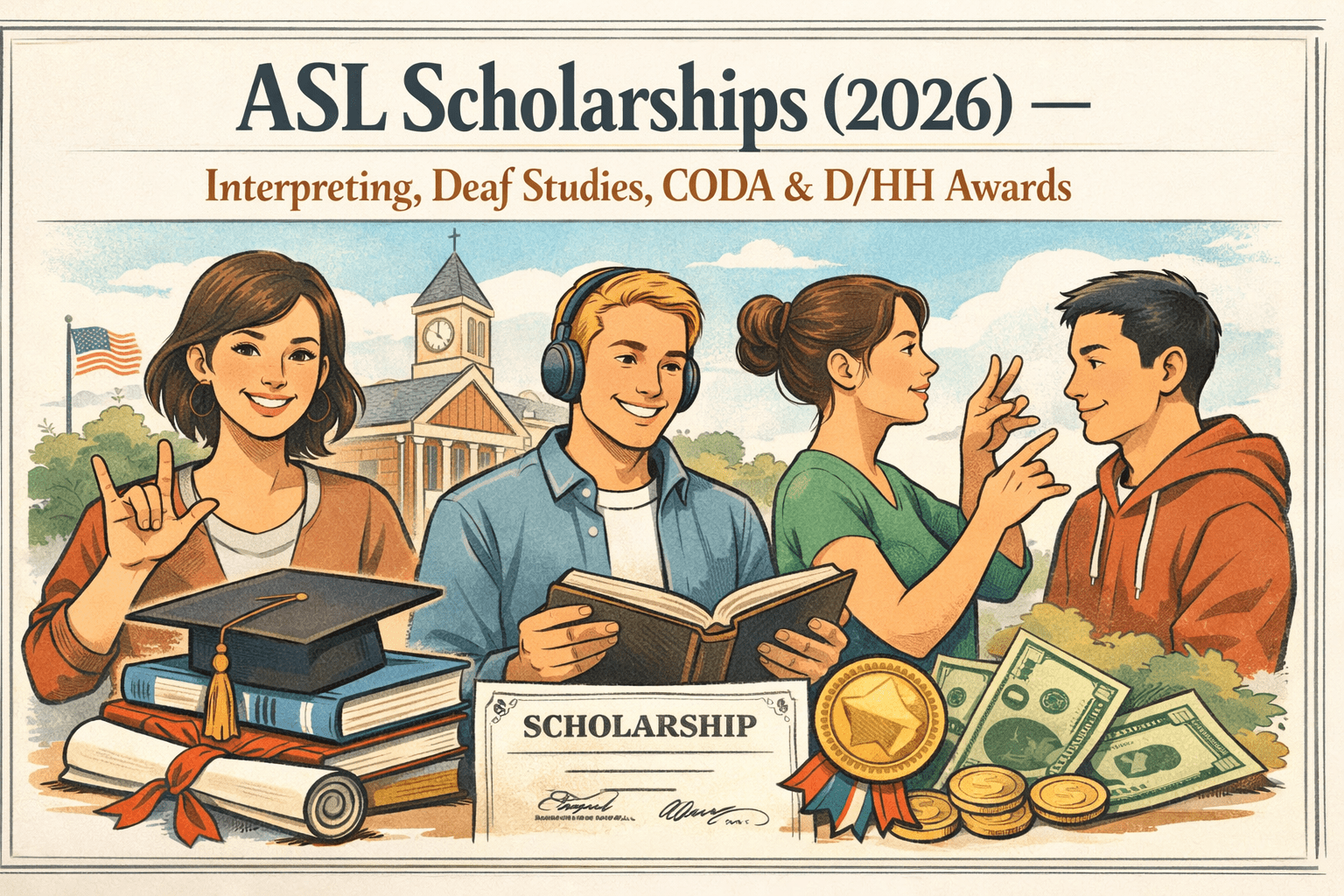
ASL Scholarships (2026) — Interpreting, Deaf Studies, CODA & D/HH Awards
Verified list of 20+ ASL & Deaf-community scholarships for 2026: interpreting (RID, WSRID), ASL Honor Society, CODA, NBDA, TAPED, Gallaudet, NTID & more. Deadlines sorted by month, with “Why It Slaps,” amounts, and ✅ link-verified.
MARCH
George H. Nofer Scholarship for Law & Public Policy (AG Bell)
💥 Why It Slaps: One of the few national awards specifically for D/HH students in law or public policy.
💰 Amount: Up to $5,000 (three awards annually)
⏰ Deadline: March 15 (last cycle closed Mar 15, 2025; typically mid-March)
🔗 Apply/info: https://agbell.org/financial-aid/
Frank R. Turk Scholarship (NAD Youth Leadership Camp)
💥 Why It Slaps: Helps cover YLC tuition for Deaf/HOH high school leaders.
💰 Amount: Varies (tuition support)
⏰ Deadline: March 15 (YLC scholarship deadline noted on NAD Youth pages)
🔗 Apply/info: https://youth.nad.org/ylc/turk-scholarship-fund/
Sertoma Scholarship for Students who are Hard of Hearing or Deaf
💥 Why It Slaps: Long-running national scholarship for D/HH undergrads across any major.
💰 Amount: Typically $1,000 (tuition/books/supplies)
⏰ Deadline: March 31 annually (based on program guidance & past cycles)
🔗 Apply/info: https://www.sertoma.org/what-we-do/scholarships
APRIL
NAOBI-DC Scholarship (National Alliance of Black Interpreters – DC Chapter)
💥 Why It Slaps: Supports Black interpreters/interpreting students—equity + representation.
💰 Amount: Varies (chapter scholarship)
⏰ Deadline: April 7 (last cycle window Mar 11–Apr 7, 2025)
🔗 Apply/info: https://naobidc.org/ (Scholarships page)
CODA International — Millie Brother Scholarship
💥 Why It Slaps: For hearing Children of Deaf Adults (CODAs) headed to college—iconic award in the community.
💰 Amount: Varies (multiple awards annually)
⏰ Deadline: Late April (historically; watch current cycle details)
🔗 Apply/info: https://www.coda-international.org/scholarships
RID Scholarships (National) — Spring Window closes Apr 30
(You can apply to ONE per cycle; all cover training/exam/mentoring/conference costs, not general tuition.)
-
Interpreters of Tomorrow Fund — BIPOC & underrepresented interpreter groups (CASLI/training fees).
💰 Amount: Varies (fee support)
⏰ Deadline: Apr 30 (Spring) / Oct 31 (Fall)
🔗 Apply/info: https://rid.org/scholarships-and-awards/ -
Career Exploration Fund — High-school seniors/recent grads entering ASL/English ITPs.
💰 Amount: Varies (training support)
⏰ Deadline: Apr 30 / Oct 31
🔗 Apply/info: https://rid.org/scholarships-and-awards/ -
ASL Heritage Fund — For D/deaf, CODA, or heritage signers pursuing RID certification.
💰 Amount: Varies (fee support)
⏰ Deadline: Apr 30 / Oct 31
🔗 Apply/info: https://rid.org/scholarships-and-awards/ -
New Horizons Mentoring Fund — Supports enrollment in interpreter mentorship programs.
💰 Amount: Varies (mentorship/training)
⏰ Deadline: Apr 30 / Oct 31
🔗 Apply/info: https://rid.org/scholarships-and-awards/ -
Pathways to Professionalism — Helps cover initial CASLI exam fees.
💰 Amount: Varies (exam fees)
⏰ Deadline: Apr 30 / Oct 31
🔗 Apply/info: https://rid.org/scholarships-and-awards/ -
Signs of Impact — Leadership training for aspiring leaders in ASL interpreting/RID/community.
💰 Amount: Varies (leadership training)
⏰ Deadline: Apr 30 / Oct 31
🔗 Apply/info: https://rid.org/scholarships-and-awards/ -
Conference Connections Fund — Assists with travel/registration for RID national/regionals.
💰 Amount: Varies (one per region per year)
⏰ Deadline: Apr 30 / Oct 31
🔗 Apply/info: https://rid.org/scholarships-and-awards/ -
Laurie Nash DPI Scholarship — For Deaf-parented interpreters (Deaf or CODA) ready to take CASLI exams.
💰 Amount: Varies (exam costs; up to 2 recipients/year)
⏰ Deadline: Uses same Spring/Fall windows (see RID)
🔗 Apply/info: https://rid.org/scholarships-and-awards/
ASL Honor Society (ASLHS) — Student Scholarships (via ASLTA)
💥 Why It Slaps: THE national scholarship line for high school ASL students (Dr. Nathie Marbury & others).
💰 Amount: Varies (student awards)
⏰ Deadline: Typically March; details posted annually (check ASLTA ASLHS page)
🔗 Apply/info: https://aslta.org/aslhs/scholarship-grants/
MAY
WSRID Scholarships (Washington State RID)
💥 Why It Slaps: Two cycles yearly; supports interpreting students/interpreters with fees/pro dev.
💰 Amount: Varies (chapter scholarships)
⏰ Deadline: Spring & Fall cycles; awards typically in May & Nov (see chapter page) agbell.org
🔗 Apply/info: https://wsrid.com/Scholarships
T.A.P.E.D. Scholarships (Texas Association of Parents & Educators of the Deaf)
— Tracks include: D/HH students, future Deaf educators, and future educational interpreters.
💥 Why It Slaps: Three targeted scholarships; strong Texas pipeline for Deaf Ed & K-12 interpreting.
💰 Amount: Varies
⏰ Deadline: Spring (announced each year; 2025 cycle publicized in April) taped.org
🔗 Apply/info: https://taped.org/
JUNE (chapter example)
HLAA – Los Angeles Chapter College Scholarship
💥 Why It Slaps: Local chapter award for D/HH college students; great odds & community support.
💰 Amount: $2,500 (chapter program)
⏰ Deadline: Spring/Summer (chapter announces annually; 2025 call posted May 13)
🔗 Apply/info: See HLAA-LA announcement feed; contact chapter via https://www.hearinglossla.org (start from the posted announcement)
FALL (SECOND WINDOW)
RID Scholarships (National) — Fall Window closes Oct 31
💥 Why It Slaps: Second chance if you miss Spring; same funds as above.
💰 Amount: Varies
⏰ Deadline: Oct 31 (Fall window)
🔗 Apply/info: https://rid.org/scholarships-and-awards/
WSRID Scholarships — Fall Cycle
💥 Why It Slaps: Regional support right before end-of-year conferences/certification pushes.
💰 Amount: Varies
⏰ Deadline: Fall cycle; awards in November agbell.org
🔗 Apply/info: https://wsrid.com/Scholarships
ROLLING / VARIES (Institutional & Chapter Programs)
NBDA — National Black Deaf Advocates Scholarships
💥 Why It Slaps: Supports Black Deaf/HOH students; prestige + community network.
💰 Amount: Varies (see NBDA)
⏰ Deadline: Varies by year/program
🔗 Apply/info: https://www.nbda.org/scholarships/
WisRID — Scholarship Assistance Program (Wisconsin RID)
💥 Why It Slaps: Helps Wisconsin interpreting students/practitioners with PD & certification expenses.
💰 Amount: Varies
⏰ Deadline: Varies (chapter-run)
🔗 Apply/info: https://wisrid.org/Scholarships
Gallaudet University — Merit-Based Scholarships (Undergrad)
💥 Why It Slaps: Automatic merit review for Deaf/HOH students—four-year awards; stack with other aid.
💰 Amount: Examples: Provost’s Excellence $11,000/yr; Dean’s Prestige $9,000/yr (and more)
⏰ Deadline: Aligns with admissions timeline (no separate app)
🔗 Apply/info: https://gallaudet.edu/tuition-financial-aid/scholarships/
Gallaudet — Undergraduate Endowed Scholarships
💥 Why It Slaps: Dozens of endowed funds for specific backgrounds/majors; renewable criteria apply.
💰 Amount: Varies
⏰ Deadline: Varies by fund
🔗 Apply/info: https://gallaudet.edu/finance/student-financial-services/undergraduate-endowed-scholarships/
RIT/NTID — Merit-Based Scholarships (Undergrad)
💥 Why It Slaps: Almost all NTID students receive RIT merit; generous multi-year awards.
💰 Amount: NTID/RIT merit commonly ranges (see brochure; many students receive $10k–$25k/yr tiers)
⏰ Deadline: With admissions; auto-consideration (no separate app)
🔗 Apply/info: https://www.rit.edu/admissions/aid/ntid-merit-based-scholarships
Interpretek Endowed Scholarship (at RIT/NTID Interpreter Training)
💥 Why It Slaps: Funds NTID interpreting students specifically—career-direct money.
💰 Amount: Varies (endowed fund)
⏰ Deadline: Varies (awarded via NTID)
🔗 Apply/info: https://interpretek.com/scholarships/
NAD Youth Programs — Leadership & College Bowl (scholarships tied to events)
💥 Why It Slaps: National-stage recognition; some programs include scholarship awards.
💰 Amount: Varies by program/event
⏰ Deadline: Varies (biennial/annual program timelines)
🔗 Apply/info: https://www.nad.org/youth/
Financing Access: ASL Scholarships and the U.S. Pipeline for Deaf-Centered Language, Education, and Interpreting
American Sign Language (ASL) scholarships sit at the intersection of language education, disability rights, workforce development, and equity. They fund (1) Deaf and hard-of-hearing (D/HH) students pursuing higher education in ASL-rich environments, and (2) the national pipeline of sign language professionals (interpreters, Deaf interpreters, educators, and allied access specialists). This paper synthesizes labor-market data, degree-completion patterns, certification-cost structures, and documented shortage mechanisms to evaluate how ASL scholarships can be designed to maximize social return on investment (SROI). Using U.S. Bureau of Labor Statistics (BLS) wage and employment estimates; Data USA’s IPEDS-based degree and tuition profiles for ASL and sign-language interpreting programs; National Institute on Deafness and Other Communication Disorders (NIDCD) prevalence statistics; a 2024 state interpreter-shortage study (Arizona) as a “stress test” case; and scholarship-program documentation from Deaf-serving institutions and professional bodies, we argue that scholarships work best when they fund the full pathway (language immersion → practicum → mentorship → certification fees → early-career retention), not just tuition. We conclude with an outcomes-based framework for scholarship design and a research agenda to modernize ASL-use measurement and evaluate scholarship effectiveness.
1. Why ASL scholarships matter: access is a labor market
ASL scholarships are often treated as a niche subset of language funding. Economically, they function more like access-infrastructure investments. The demand signal is not only “students want to study ASL,” but “society has legal and ethical obligations to ensure communication access across education, healthcare, courts, and civic life.”
The scale of potential need is large. NIDCD estimates that 1 in 8 people in the U.S. ages 12+ (13%, ~30 million) has hearing loss in both ears based on standard hearing examinations. That statistic does not translate directly into ASL use (many people with hearing loss do not use ASL), but it frames why access services—interpreting, captioning, and bilingual programs—remain structurally important.
At the same time, estimating ASL users is notoriously difficult. A frequently cited Gallaudet University research paper reviews the messy chain of secondary estimates and notes that “no accurate census” exists; it discusses a safer estimate of ~250,000 native users of ASL (historically grounded, but not a contemporary national count). The policy implication is straightforward: when core population metrics are uncertain, scholarship programs should emphasize measurable pathway outputs (credits earned, proficiency gains, certification attempts/pass rates, retention), rather than rely on population denominators that may be unstable.
2. Data and methods
This paper integrates five empirical lenses:
- Labor market outcomes for interpreters and translators (including sign language interpreters within that broader occupation): employment levels, wages, and projected openings from BLS.
- Training pipeline size and cost using IPEDS-derived “completions” and median tuition estimates for:
- American Sign Language (ASL) majors, and
- Sign Language Interpretation & Translation programs (often the more direct interpreter pipeline).
- Credentialing friction via published exam fee schedules and documented pass-rate constraints.
- Shortage mechanisms from a 2024 Arizona interpreter-shortage study (a state-level microcosm capturing unfilled request rates, vacancies, and licensure composition).
- Scholarship ecosystem mapping using primary program pages from Gallaudet University, RIT/NTID, RID/CASLI, and major nonprofit scholarship providers.
Implementation note: I attempted to use the web tool’s PDF screenshot function for the Arizona and Gallaudet PDFs, but the screenshot calls returned tool errors; citations therefore reference the PDFs’ parsed text output.
3. Demand signals: interpreting is not a “nice-to-have”
3.1 Interpreting and translation as an occupation
BLS reports 51,560 people employed as interpreters and translators (May 2023 estimates) with a median annual wage of $57,090. While this category includes spoken-language interpreters, BLS also notes demand drivers specific to ASL (including video relay services).
Sector wages matter for scholarship ROI because graduates often move into (or away from) particular settings. BLS wage estimates show that pay varies substantially across industries; for example, “Junior Colleges” appear among higher-paying industry categories in the occupational wage tables.
3.2 Shortages show up as unfilled assignments and long vacancies
The Arizona Commission for the Deaf and the Hard of Hearing (ACDHH) shortage study provides concrete shortage indicators. Among surveyed ASL referral agencies, the report lists monthly unfilled request rates ranging from ~2% to 11% (depending on the agency). It also documents staff positions remaining open for “many years” in some settings (including courts), and reports K–12 staff hourly rates in the ~$20–$28/hr range for listed vacancies.
Arizona is not “the U.S.” But state-level studies help reveal how shortages work in practice: the shortage is not just “not enough interpreters,” but a complex interaction of pay structures (especially in K–12), geographic concentration, credentialing timelines, and retention.
3.3 Burnout as an access risk
Even when interpreters exist, retention can fail. The National Deaf Center highlights a national interpreter shortage affecting colleges and notes interpreter burnout as an additional threat to accessibility. Scholarship design that ignores workload and early-career support risks subsidizing training without sustaining the workforce.
4. The training pipeline: who graduates, where, and at what cost?
4.1 ASL as an academic major (language/culture pathway)
IPEDS-based profiles indicate ASL programs are heavily concentrated in public 2-year institutions by count and completions. Data USA reports median tuition for ASL majors of $6,228 (in-state public) versus $36,500 (out-of-state private), and notes public 2-year institutions account for 438 completions (2023).
Interpretation: ASL scholarships should not be designed as if most students are at private four-year colleges. A large share of the pipeline is at community colleges—where small scholarships can cover a meaningful portion of direct costs, but where students may still face high opportunity costs (work hours, caregiving, transportation).
4.2 Sign language interpreting programs (direct workforce pathway)
For Sign Language Interpretation & Translation, Data USA reports median tuition of $5,544 (in-state public) versus $32,470 (out-of-state private), and shows the most common degree is an associate degree, with public 2-year institutions producing 677 completions (2023).
A policy-relevant observation emerges when you juxtapose completions with labor-market churn: BLS projects ~6,900 openings per year for interpreters and translators (2024–2034 average annual openings). Even acknowledging that (a) openings include spoken-language roles and (b) completions are not one-to-one with new labor supply, the magnitude gap hints that scholarships alone won’t “solve” shortages—but they can strategically reduce bottlenecks.
5. The credentialing bottleneck: costs + pass rates + time
Scholarships in the ASL workforce pathway are unusually effective when they target credentialing friction, because small amounts of money can unlock large marginal gains in employability.
5.1 Direct costs: exam fees are non-trivial
CASLI’s posted payment information lists major exam components and fees (e.g., Generalist Knowledge Exam and Generalist Performance Exam fees in the several-hundred-dollar range). These costs arrive at exactly the moment many graduates are cash-constrained: after tuition, during practicum-to-employment transition.
5.2 Pass rates: “entry” is not guaranteed
The ACDHH study summarizes 2022 pass rates for several interpreter exams, including an NIC Interview & Performance Exam pass rate listed at ~42% in its table, alongside other pass rates (e.g., 59% and 70% for knowledge components, and low-40s for some performance tests).
From an economic lens, low pass rates act like a tax on entrants: candidates may pay multiple times (fees, travel, time), delay earnings, and potentially exit the field. Therefore, scholarships that fund only tuition may have weaker workforce impact than scholarships that fund (1) mentorship, (2) exam prep, and (3) first/second test attempts.
6. The scholarship ecosystem: four funding “families”
ASL scholarships are not a single market; they cluster into four families with different goals and evaluation metrics.
Family A: Deaf-serving institutions (access + leadership + completion)
Deaf-serving colleges (and programs within larger universities) often provide merit and endowed scholarships that reduce net price for D/HH students and strengthen degree completion in ASL-rich environments.
- Gallaudet University lists automatic consideration for undergraduate merit-based scholarships and publishes award tiers (e.g., multi-thousand-dollar annual awards).
- RIT/NTID emphasizes that applicants are considered for merit-based scholarships and outlines NTID scholarship processes.
These scholarships are best evaluated on graduation rates, persistence, and leadership outcomes—not just workforce placement.
Family B: Professional pipeline and upskilling (mentorship, testing, career progression)
The Registry of Interpreters for the Deaf (RID) explicitly frames scholarships and awards around mentorship and professional development.
- RID’s “Scholarships and Awards” includes items such as the New Horizons Mentoring Fund, supporting costs related to mentorship programs and training.
This is economically “high-leverage” funding: it targets the transition from novice to competent practitioner—exactly where pass-rate and burnout risks are highest.
Family C: Nonprofit disability scholarships (access + broad major flexibility)
Some scholarships fund D/HH students across any major, indirectly strengthening the broader Deaf professional class, including future ASL teachers, interpreters, and advocates.
- Sertoma’s Scholarship for the Hard of Hearing or Deaf is positioned as a leading national scholarship for D/HH students and applies to students pursuing four-year degrees in any discipline.
This family’s primary outcomes are educational attainment and reduced financial barriers, with secondary workforce effects.
Family D: Program-embedded scholarships (retention inside specific interpreter programs)
Some interpreter training programs host scholarships that function like “retention accelerators” (funding practicum time, community engagement, leadership, and travel).
- Austin Community College’s ASL interpreter training scholarship page includes student testimony emphasizing reduced hardship while participating in internships/leadership activities.
Program-embedded funding can be evaluated via within-program retention, practicum completion, and post-graduation certification attempt rates.
7. Scholarship design as applied economics: maximize SROI
A doctorate-level view treats scholarships as interventions in a constrained system. The goal is not merely to “help students,” but to produce the highest social payoff per dollar: more access hours delivered, higher-quality interpreting, and stronger Deaf educational outcomes.
7.1 What the data suggests about “where money moves the needle”
Tuition is not always the binding constraint in this field. Median in-state public tuition figures for ASL and interpreting programs (roughly $5.5k–$6.2k in the Data USA profiles) imply that for many community-college students, living expenses and time dominate.
Meanwhile, credentialing costs and delays are sharply timed and can block earnings. CASLI exam fees and documented low pass rates make a compelling case that scholarships should prioritize:
- exam fees (first + second attempt),
- structured mentorship,
- supervised hours / induction supports, and
- targeted specialization (medical, legal, K–12).
7.2 Place-based targeting: shortages are geographic and sector-specific
Arizona’s study reports 930 active licensed interpreters, with 43% residing out of state, and it explicitly excludes many K–12 interpreters from counts due to registry gaps. This highlights a national design lesson: shortages may persist even where “numbers look fine” because interpreters are not evenly distributed, not available in-person, or not credentialed for specific settings.
Scholarships with service obligations (e.g., 1–2 years in rural regions, courts, or K–12 districts) can be justified when paired with supports that reduce burnout risk and improve job quality.
7.3 K–12 is a critical, fragile segment
The Arizona report describes K–12 pressures: pay barriers, lack of respect, and administrative misunderstandings, with vacancies at the “highest in five years” per cited state survey results. In K–12, scholarship design should fund:
- educational interpreter performance assessment preparation,
- mentorship with experienced educational interpreters and Deaf mentors,
- school-district training modules on interpreter roles (reducing “role drift” and burnout), and
- wage/benefit supplements where feasible (often via employer partnerships, not scholarships alone).
8. Equity: scholarships should strengthen representation and quality
A common failure mode in access work is “warm body” deployment—placing underprepared interpreters into high-stakes settings. The ACDHH report discusses historic dynamics where rapid demand growth led schools to rely on under-equipped paraprofessionals.
Equity-oriented ASL scholarship strategy must therefore balance:
- access expansion (more interpreters/teachers), with
- quality assurance (credentialing, Deaf mentor involvement, ethical practice).
Practically, that means scholarships should be “bundled” with:
- paid time for Deaf-community immersion and language modeling,
- structured feedback loops (video review, supervised interpreting),
- ethics and demand-control skills (particularly for medical/legal),
- and cohort-based supports that reduce isolation (a factor linked to burnout in campus contexts).
9. A practical framework for ASL scholarship makers (and for students applying)
9.1 Outcomes-based scholarship design (recommended metrics)
Scholarship providers can measure impact using a small set of pathway KPIs:
- Persistence: term-to-term retention and graduation in ASL/interpreting programs.
- Proficiency progression: ASL coursework completion and demonstrated performance benchmarks.
- Credentialing: certification exam attempts, pass rates, and time-to-credential (critical given low pass rates in some performance exams).
- Placement & stability: employment in shortage settings (K–12, rural, legal, healthcare) and 12–24 month retention.
- Access delivered (when feasible): hours served, plus quality signals (consumer feedback, mentorship completion, continuing ed).
9.2 What applicants should prioritize (a “high-ROI” application strategy)
Students seeking ASL scholarships can stack funding most effectively by mapping awards to the pathway:
- Year 1–2: tuition + time-to-study supports (community college-friendly scholarships; need-based aid).
- Practicum phase: travel, childcare, unpaid practicum time offsets.
- Transition phase: mentorship scholarships + exam fees (RID/CASLI-related supports).
- Early career: specialization training (medical/legal/educational) and burnout prevention supports.
10. Conclusion and research agenda
ASL scholarships are not just “language scholarships.” They are investments in communication access, Deaf educational outcomes, and the stability of an interpreting workforce operating under real constraints: uneven geographic supply, sector pay disparities, credentialing costs, and burnout dynamics.
The data suggests three high-impact design moves:
- Shift from tuition-only funding to pathway funding (mentorship + exam fees + induction supports).
- Target shortage settings intentionally (K–12, legal/courts, rural healthcare), pairing service expectations with retention supports.
- Build better measurement: modernize ASL-use estimation and standardize national reporting on interpreter workforce supply, credentials, and shortages.
Finally, the field needs rigorous evaluation: quasi-experimental studies comparing cohorts who receive “pathway scholarships” versus tuition-only awards; and longitudinal tracking linking scholarship inputs to certification attainment, retention, and access outcomes. In a domain where access is both a civil right and a labor market, scholarship dollars should be treated as precision tools—designed to relieve the binding constraints that keep qualified ASL professionals from entering and staying in the work.
Selected sources (for page citations and further reading)
- U.S. Bureau of Labor Statistics (BLS), Occupational Outlook Handbook and OEWS wage tables for Interpreters and Translators.
- Data USA (IPEDS-derived profiles) for ASL and Sign Language Interpretation & Translation (tuition, completions, top institutions).
- NIDCD “Quick Statistics About Hearing” (population prevalence context).
- Gallaudet research paper on ASL user estimates and the limits of existing counts.
- ACDHH “Interpreter Shortage Study” (unfilled request rates, licensure composition, pass-rate table).
- RID scholarships/awards (mentorship and professional development funding).
- Gallaudet and RIT/NTID scholarship pages (institutional funding models).
- National Deaf Center (campus interpreting shortage/burnout context).
Notes on Eligibility Fit (ASL-focused)
- Interpreting majors & pre-certification: Prioritize RID funds, WSRID/WisRID, TAPED interpreter track, and institutional interpreting scholarships (NTID/Interpretek). Interpretek
- CODA students (any major): CODA International (Millie Brother).
- Law/Public Policy (D/HH): AG Bell Nofer. agbell.org
- High-school ASL students: ASLHS (via ASLTA). aslta.org
- Youth leadership: NAD YLC + Turk Scholarship. youth.nad.org