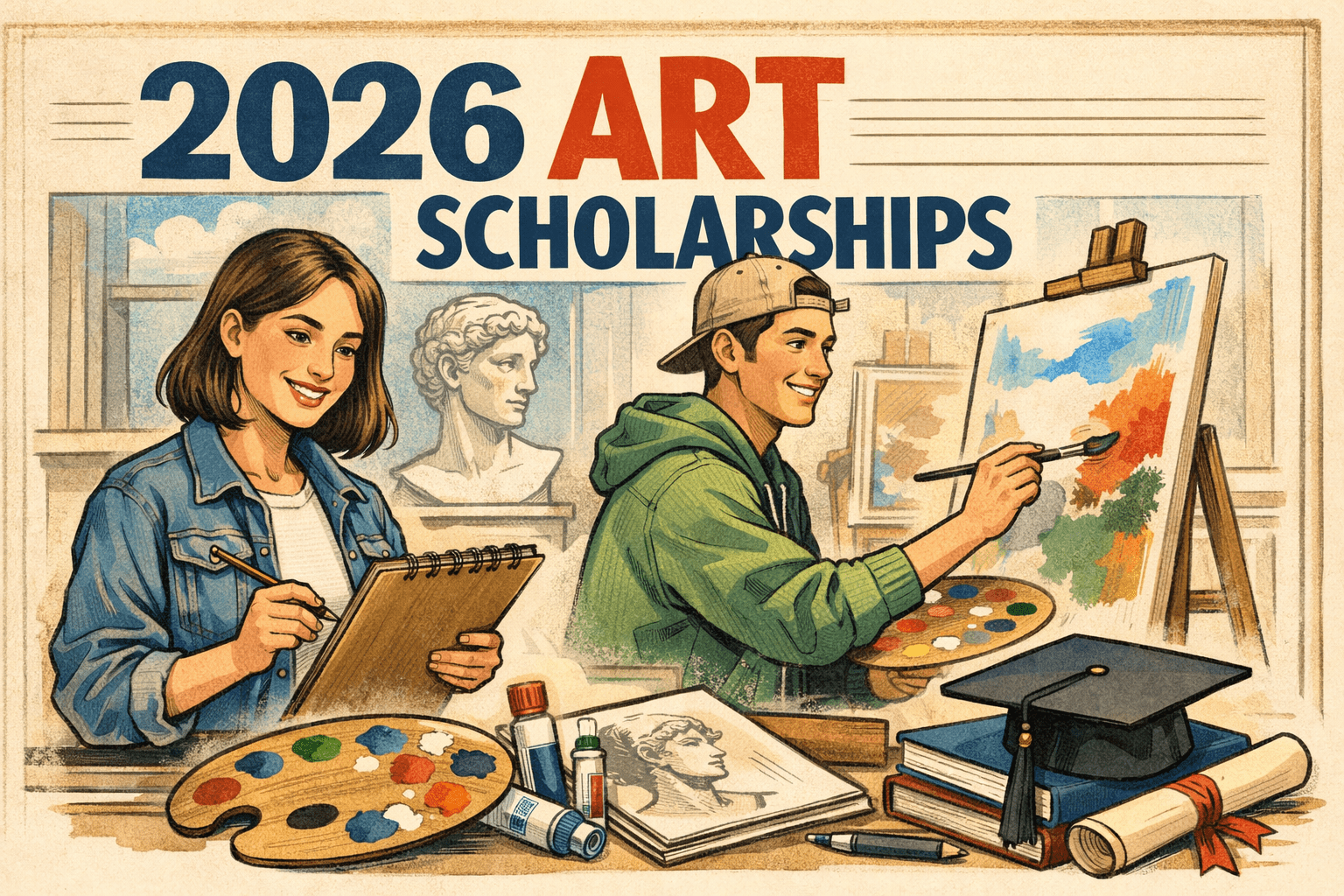
Art Scholarships (2026) — Find Your Best-Fit Awards
You make the art; we help make it affordable. This hub is your launchpad to legit, U.S.-based art scholarships—from general awards to ultra-specific niches like conservation and crafts. Jump into your subcategory, snag a few fits, and submit before deadlines vanish.
Art Scholarships
Art Scholarships in the U.S.: Analysis of Need, Design, and Equity (2026)
Abstract
Art scholarships sit at the intersection of higher-education finance, creative labor markets, and cultural production. Using federal education statistics, labor-market data, and philanthropic indicators, this paper analyzes why art scholarships matter, how the market for “art aid” is structured (institutional, public, and private), and which design choices improve access and outcomes. National completion data show that U.S. colleges awarded 90,022 bachelor’s degrees in visual and performing arts in 2020–21 (plus 15,743 master’s and 1,668 doctorates), indicating a large and persistent pipeline of art students with significant cost exposure. Labor data illustrate both opportunity and risk: among workers with a fine/performing arts degree, the median wage is $50,000 and 22% are employed part time, a profile that increases sensitivity to borrowing and makes upfront scholarship dollars especially consequential. The paper proposes a practical framework for scholarship design (targeting, timing, renewability, and “total cost of attendance” coverage), highlights persistent inequities tied to K–12 arts access and institutional capacity, and offers recommendations for students, donors, and colleges building effective art scholarship ecosystems.
Keywords: art scholarships, financial aid, portfolio review, equity, creative labor markets, cost of attendance, visual and performing arts
1. Introduction: Why “Art Scholarships” Are a Distinct Financial-Aid Problem
Art majors face many of the same college-cost pressures as other students, but the structure of expenses and the timing of professional payoff create distinctive scholarship needs. Tuition is only one piece: students also pay recurring “production costs” (materials, software subscriptions, studio/lab fees, portfolio printing, exhibition costs, travel to auditions or reviews). These costs can be academically non-negotiable, because portfolio quality and documented practice time are often central to admission, persistence, and early career entry. Meanwhile, early-career earnings in many creative pathways are volatile and can include self-employment, part-time work, and unpaid or low-paid internships.
This combination means art scholarships often function less like “merit trophies” and more like capital grants—financing the tools, time, and portfolio development that convert talent into marketable skill. In that sense, art scholarships behave similarly to targeted workforce grants for equipment-intensive fields, except the evaluation mechanism is typically portfolio-based rather than credential-based.
The U.S. also has strong macroeconomic reasons to care about the art pipeline. The Bureau of Economic Analysis reports arts and cultural production as a meaningful component of the national economy (measured through the Arts and Cultural Production Satellite Account). On the funding side, philanthropy remains a major upstream driver: Giving USA reports tens of billions of dollars annually directed to “arts, culture, and humanities,” which shapes the private scholarship landscape and explains why art aid often emerges from community foundations, donor-advised funds, and legacy gifts rather than purely state formula programs.
2. Data and Method
This analysis synthesizes:
- Education pipeline data from NCES Digest of Education Statistics on degrees conferred in visual and performing arts.
- Labor-market outcomes from the Bureau of Labor Statistics (BLS), including field-of-degree profiles and occupational outlook for arts and design roles.
- Cost and aid context from College Board’s Trends in College Pricing and Student Aid and national COA components like books/supplies benchmarks.
- Arts-access context from national reporting on K–12 arts availability, used here to explain pipeline inequities that scholarship systems inherit.
- Philanthropic and macro context from Giving USA and arts-economy reporting.
The paper is descriptive and policy-analytic: it does not claim causal effects for “art scholarships” specifically, but it draws on broader financial-aid research on grant impacts to inform design recommendations.
3. Scale of the Art Education Pipeline (and What It Implies for Scholarship Demand)
3.1 Degrees conferred: a large, steady flow
NCES reports that in 2020–21, institutions conferred 90,022 bachelor’s degrees in visual and performing arts, 15,743 master’s degrees, and 1,668 doctorates. The pipeline is also gendered: women received 56,861 of those bachelor’s degrees (about 63.2%).
Trend context matters: the NCES field-of-study table shows visual and performing arts bachelor’s awards at 90,027 in 2020–21 and 90,241 in 2021–22—a relatively stable level compared with the higher peaks earlier in the 2010s. Stability implies persistent scholarship demand even when macro conditions fluctuate.
3.2 Art majors are not a monolith
BLS field-of-degree data show the internal composition of “fine and performing arts” majors: commercial art and graphic design (25%), fine arts (22%), music (18%), drama/theater (11%), film/video/photographic arts (9%), and other (15%).
This matters because scholarship design that works for studio painting (materials-heavy) may not fit graphic design (software + hardware) or film (equipment + production teams). A “one-size” art scholarship may unintentionally subsidize some tracks while underfunding others.
4. The Economic Case for Art Scholarships: Costs, Earnings, and Risk
4.1 College cost context and “non-tuition” exposure
Even before art-specific costs, baseline college budgets are substantial, and many components are not optional. National COA estimates for books and supplies commonly exceed a thousand dollars annually, and these averages can understate art-specific needs. Public and private tuition trends also create different scholarship leverage points: tuition-heavy institutions may prefer tuition-discount scholarships, while commuter or lower-tuition institutions may generate higher marginal benefit from “materials-first” microgrants.
4.2 Earnings and work patterns: why scholarships can be debt-preventative
Among workers with a fine/performing arts degree, BLS reports $50,000 median wage and 22% part-time employment, compared with $70,000 and 15% across all fields. This profile increases the repayment fragility of debt-financed education: even modest loan balances can constrain early-career experimentation (residencies, apprenticeships, unpaid portfolio-building opportunities) that are often the stepping stones into stable creative work.
On the occupational side, BLS reports the broader “arts and design occupations” group has a $53,180 median wage (May 2024) and roughly 84,900 openings per year on average (mostly replacement needs). Within that ecosystem, earnings vary widely:
-
Graphic designers: $61,300 median pay (May 2024); projected ~20,000 openings/year.
-
Craft and fine artists: $56,260 median pay (May 2024), with large dispersion (a hallmark of winner-take-most markets).
This variance supports a key scholarship insight: risk pooling. Scholarships reduce downside risk for students who will not land top-decile outcomes immediately, while still enabling high-outcome students to develop.
5. How Art Scholarships Are Actually Allocated: A Three-Market Model
Art scholarships in the U.S. can be understood as three interacting “markets,” each with distinct incentives:
5.1 Institutional scholarships (colleges, departments, endowed funds)
Primary goal: enrollment management + student quality (portfolio strength) + retention.
Typical structure: merit scholarships at admission, sometimes renewable with GPA/credit requirements; separate departmental funds for continuing students.
Strength: can be integrated with portfolio review and program advising.
Weakness: can drift toward “discounting” tuition rather than funding materials/time, and may favor applicants with access to pre-college coaching.
5.2 Public scholarships and grants (federal/state)
Primary goal: broad access and affordability, often via need-based formulas.
Need-based aid (including federal grants) is heavily mediated by FAFSA completion. College Board reports FAFSA completion rates that leave meaningful money unclaimed—an important operational barrier for art students who may not identify as “traditional aid” applicants.
Strength: scale and predictability.
Weakness: often not tailored to art-specific costs (equipment, exhibitions), and award timing may not align with portfolio expenses.
5.3 Private/philanthropic scholarships (foundations, associations, community donors, corporate sponsors)
Primary goal: mission impact (community, identity, medium), talent development, or workforce pipeline (creative industries).
Giving USA indicates substantial annual giving to arts, culture, and humanities, reflecting why this sector frequently underwrites scholarships, residencies, and project grants.
Strength: flexibility (materials grants, travel awards, residencies).
Weakness: fragmented, deadline-heavy, and sometimes opaque; can advantage applicants with strong mentoring.
Implication: A healthy art scholarship ecosystem coordinates all three—using public aid to cover baseline affordability, institutional aid to anchor enrollment/retention, and private aid to fund portfolio-critical costs.
6. Equity and Access: Scholarships Inherit (and Can Correct) Pipeline Inequality
Scholarships do not operate on a level playing field because portfolio readiness is shaped long before college. National reporting shows most schools offer arts, but access and adequacy vary: for example, one national summary reports 93% of public schools offer at least one standalone arts class; 84% offer music and 82% visual arts, while fewer offer media arts (42%), drama (26%), or dance (13%). It also reports that only about 55% of schools say their arts program has adequate funding, facilities, and materials.
For scholarship design, the equity takeaway is direct: portfolio-based merit can unintentionally reward prior access to private lessons, expensive materials, or specialized high-school programs. Therefore, “equitable merit” in the arts often requires compensating mechanisms such as:
- Need-aware portfolio review (judging potential and growth, not only polish)
- First-year materials grants (so talent isn’t capped by supply costs)
- Bridge programs (summer portfolio intensives with stipends)
- Renewable awards tied to academic progress + portfolio milestones, not only GPA
These are not cosmetic changes; they alter who can compete in the first place.
7. Do Scholarships Improve Outcomes? What the Broader Aid Literature Suggests
While rigorous causal evidence specific to “art scholarships” is limited, the broader financial-aid literature consistently finds that grant aid can improve enrollment and persistence, especially for students with financial constraints. Meta-analytic work on need-based grants has found positive effects on enrollment and, in some contexts, completion, with effect sizes that are meaningful at scale (even when measured in a few percentage points).
For art students, the mechanism may be even more direct than in some other majors because scholarship dollars can buy time (fewer work hours) and inputs (materials/software) that translate into portfolio quality—an output that influences internships, commissions, exhibitions, and early job opportunities.
8. Design Principles for High-Impact Art Scholarships (A Practical Framework)
Below is a design framework that donors, colleges, and scholarship administrators can implement.
Principle 1: Fund the full cost of being an art student, not just tuition
A tuition-only scholarship can still leave students unable to complete required projects. Microgrants for supplies, printing, framing, software, and travel can have extremely high marginal returns for portfolio-based fields.
Principle 2: Time awards to portfolio “pressure points”
High-impact timing often includes:
- Pre-enrollment: portfolio prep + application fees + interview travel
- First year: foundational supplies and software
- Second/third year: equipment upgrades, internships, summer intensives
- Final year: thesis exhibition costs, film production budgets, grad school application support
Principle 3: Make renewability contingent on progress that predicts success
For many art tracks, GPA alone is a weak proxy for outcomes. Better renewal triggers include: credit completion + studio critique milestones + portfolio review check-ins.
Principle 4: Reduce administrative friction
Private scholarships often fail not because students aren’t qualified, but because the application process is costly in time and uncertainty. Streamlined requirements (one portfolio + brief statement + FAFSA/need signal when relevant) can materially increase equitable access.
Principle 5: Blend merit and need transparently
Given unequal K–12 arts preparation, scholarship committees should be explicit about evaluation rubrics: technical skill, originality, commitment, growth trajectory, and context (resources available). Transparency improves trust and can broaden applicant diversity.
9. Recommendations for Stakeholders
For students (how to “treat scholarships like a portfolio strategy”)
- Apply to scholarships that match your medium (illustration vs animation vs ceramics), not just “art.”
- Prioritize awards that cover materials/software or include professional development.
- Build a reusable portfolio package (artist statement, resume, 10–15 images or a reel) and iterate monthly.
For colleges and departments
- Add materials grants to admission scholarships, especially for low-income students.
- Use portfolio review to identify “high-potential/low-resource” applicants and pair aid with mentoring.
- Track outcomes beyond GPA (portfolio quality, internship attainment, exhibition participation, job placement).
For donors and foundations
- Fund small, flexible grants (e.g., $250–$1,500) for supplies and production—often more catalytic than tuition discounts.
- Sponsor review panels with diverse jurors and context-aware scoring.
- Support “last-mile” senior capstone funding (shows, films, thesis production) where a relatively modest award can determine whether a student’s final portfolio is professionally competitive.
For policymakers and public agencies
- Improve FAFSA completion and advising capacity, because need-based aid is foundational even for “merit” art pathways.
- Encourage state and institutional aid formulas that recognize program-specific cost structures (equipment-intensive majors).
10. Conclusion
Art scholarships are not simply charitable add-ons to college affordability; they are a targeted investment in human capital where the binding constraint is often portfolio production capacity—time, materials, and access to critique. National data show a large and steady pipeline of visual and performing arts degree completions, while labor-market evidence shows moderate median earnings with higher part-time incidence—conditions that increase the stakes of borrowing and magnify the value of scholarship dollars. Effective art scholarship systems therefore align funding with the real cost structure of art training, coordinate institutional/public/private aid, and implement equity-aware portfolio evaluation to counter inherited pipeline gaps in arts access.
References (selected, APA-style)
- Bureau of Labor Statistics. (2025). Arts and Design Occupations (May 2024 wage and projections).
- Bureau of Labor Statistics. (2025). Field of degree: Fine and performing arts (ACS-based outcomes).
- Bureau of Labor Statistics. (2025). Graphic Designers (May 2024 wage; projected openings).
- Bureau of Labor Statistics. (2025). Craft and Fine Artists (May 2024 wage distribution).
- National Center for Education Statistics. (2022). Digest of Education Statistics, Table 325.95 (visual & performing arts degrees by level/sex).
- National Center for Education Statistics. (2023). Digest of Education Statistics, Table 322.10 (bachelor’s degrees by field through 2021–22).
- Giving USA. (2024). Giving USA 2024: The Annual Report on Philanthropy for the Year 2023 (arts, culture, humanities giving).
- U.S. Bureau of Economic Analysis. (2024/2025). Arts and Cultural Production Satellite Account (ACPSA) (arts share of GDP).
- College Board. (2025). Trends in College Pricing and Student Aid (cost and aid context).
- Nguyen, T. D., Kramer, J. W., & Evans, B. J. (2019). The effects of grant aid on student persistence and degree attainment: A systematic review and meta-analysis.
How to win (micro-guide you can actually use)
- Portfolio first. Lead with 8–12 pieces that show range and a through-line (process to polish).
- Tell the story. Short artist statement = who you are, what you’re exploring, and why now.
- Proof of momentum. Exhibits, zines, commissions, community murals, Etsy shops—add receipts.
- Match the prompt. Conservation? Emphasize technical care & materials. Craft? Process, technique, durability.
- Ask early. Recommenders love you… with 2–3 weeks’ notice. Share your portfolio link + bullet wins.
- Submit early. Portals and uploads are gremlins at T-0. Aim for T-48 hours.
Bonus box: Resources for women artists 💪🎨
- Women’s Scholarships Hub (site): Start here for women-only + women-forward awards → /women/
- Women in the Arts sub-pages: Cross-apply if eligible (e.g., /women/general/).
- Mentorship ideas: Check local women’s arts collectives, museum young-artist programs, and campus WCCs for micro-grants.
Helpful external resources (official & practical)
- FAFSA (Federal Student Aid): Max out free money first → https://studentaid.gov/h/apply-for-aid/fafsa
- National Portfolio Day Association: Free in-person/virtual portfolio reviews → https://nationalportfolioday.org/
- NASAD (accredited art/design programs): School due-diligence check → https://nasad.arts-accredit.org/
- College Art Association (CAA): Careers, standards, and conference info → https://www.collegeart.org/
- American Institute for Conservation (AIC): Conservation careers & scholarships → https://www.culturalheritage.org/
Use these as supplements to our sub-pages; always apply via the official scholarship portal we link.
Art Scholarships FAQs (Extensive) 🎨💸
Use these FAQs on your Art Scholarships hub to answer the real questions students (and parents) Google: portfolios, eligibility, money rules, and how to stack awards.
Basics: What counts as an “art scholarship”? 🖼️
1) What is an art scholarship?
Money awarded to students pursuing visual arts, design, photography, film, animation, illustration, studio art, art education, art history, or related creative fields. Some are merit-based (portfolio/audition), others are need-based, and many are a blend.
2) Do I have to be an “art major” to apply?
Not always. Many scholarships accept:
- Art majors
- Art minors
- Students who show a strong creative practice (portfolio)
- Students planning careers in creative industries (design, media, content, UX)
3) Are art scholarships only for “talented” students?
No. Many focus on:
- Financial need
- Community service
- First-generation students
- Underrepresented backgrounds
- Specific mediums (ceramics, photography, digital art)
- Local/community involvement
4) Are art scholarships only for high school seniors?
No. There are scholarships for:
- High school seniors 🎓
- Current college students (sophomore+ awards are common)
- Community college + transfer students
- Graduate students (MFA/MA)
- Adult/returning learners
5) What’s the difference between “scholarships” and “grants” for art students?
- Scholarships: usually merit/portfolio/achievement-based
- Grants: often need-based or project-based (sometimes awarded by states, colleges, or arts orgs)
Eligibility: Who can apply? ✅
6) Do I need a minimum GPA?
Sometimes. Common ranges:
- 2.5–3.0 for many general scholarships
- 3.5+ for competitive merit awards
But plenty of portfolio-based awards prioritize work quality over GPA.
7) Do art scholarships require U.S. citizenship?
Some do, some don’t. Many accept:
- U.S. citizens
- Permanent residents
- DACA/undocumented students (varies by sponsor)
- International students (often fewer, but they exist)
8) Are there scholarships for art students with financial need?
Yes—and these can be powerful because they may also cover materials, studio fees, laptops, software, and other real costs.
9) Are there art scholarships for specific identities or communities?
Yes. Many scholarships support:
- Women in the arts
- BIPOC artists
- LGBTQ+ artists
- Students with disabilities
- Veterans/military-connected students
- First-gen and low-income students
10) Are there scholarships for specific mediums?
Absolutely. There are awards for:
- Illustration, painting, sculpture
- Digital art, animation, game art
- Photography, film/video
- Graphic/communication design
- Fashion/textiles
- Ceramics, printmaking, mixed media
Portfolio & Audition FAQs (the BIG one) 📁✨
11) What is an “art scholarship portfolio”?
A curated set of your best work (usually 10–20 pieces or a timed media reel) that shows:
- Technical skill
- Creativity
- Range + consistency
- Growth/potential
- Personal voice
12) How many pieces should I include?
Follow the scholarship rules first. If they don’t specify:
-
10–15 strong pieces is a solid standard
Better to submit fewer excellent pieces than lots of “filler.”
13) What kinds of pieces should I include?
Aim for a balanced mix:
- 1–2 “wow” pieces (your best)
- Observational work (drawing from life)
- A few pieces showing experimentation
- Optional: process sketches, iterations, studies (if allowed)
14) Should I include fan art?
Only if it’s clearly transformative and allowed. Many reviewers prefer original work. If you include it, make sure your portfolio still screams your voice.
15) Do I need to show “process” work?
If allowed, yes—process can be a differentiator. It shows how you think:
- thumbnails
- drafts
- iterations
- research/inspiration boards
16) What if I’m self-taught?
That’s totally fine. Scholarships often love self-driven artists. Your goal is to show:
- Commitment (consistent practice)
- Growth over time
- A strong “why” in your artist statement
17) What if I don’t have access to expensive materials?
You’re not doomed. Strong portfolios can come from:
- pencil/charcoal drawings
- phone photography
- free/low-cost tools (Krita, GIMP, Canva, Blender)
- recycled/repurposed materials
In your statement, briefly note constraints and how you worked creatively within them.
18) How should I photograph my artwork?
Quick checklist:
- Bright, even lighting (near a window is great)
- No harsh shadows or glare
- Straight-on shot (avoid distortion)
- Clean background
- Crop properly (show edges if required)
- High resolution, but within upload limits
19) What file types are usually accepted?
Common: JPG/PNG for images, PDF for compiled portfolios, MP4 for video. Always follow platform rules.
20) What is a “digital portfolio link”?
A website or portfolio page (Behance, Adobe Portfolio, ArtStation, personal site). Make sure:
- Links work 🔗
- Your name/contact is visible
- Pieces load fast
- The best work is visible in 1–2 clicks
21) What is an artist statement—and how long should it be?
A short explanation of your work and goals. Typical length: 150–300 words (unless specified). Focus on:
- Themes you explore
- Mediums you use
- What you want to learn next
- Why this scholarship matters
22) Do I need letters of recommendation for art scholarships?
Often yes, especially competitive awards. Great recommenders include:
- art teacher
- studio instructor
- mentor/employer in creative work
- community arts leader
Ask early and provide a “recommendation packet” (resume, portfolio link, deadline list).
Applications: Deadlines, essays, and strategy 🗓️
23) When should I start applying?
Ideal timeline:
- Spring–summer: build portfolio + shortlist scholarships
- Late summer–fall: major deadlines open
- Winter–spring: local/community scholarships peak
24) How many art scholarships should I apply to?
A good target:
- 5–10 “big” scholarships (competitive)
- 10–20 mid-sized
- 10+ local/community
Consistency wins.
25) Should I reuse the same essay?
You can reuse the core story, but customize:
- 1–2 lines specifically about the sponsor’s mission
- How your art connects to their values/community
26) What essay topics work best for art scholarships?
Themes that frequently win:
- A project that changed how you see the world
- Your creative process and why it matters
- Art as community impact (teaching, murals, volunteering)
- A hardship you transformed into purpose (without trauma-dumping)
27) What if a scholarship asks for a “project proposal”?
Treat it like a mini grant:
- Goal + concept
- Materials + budget
- Timeline
- Community impact (if relevant)
- What success looks like
28) Can I apply if I’m undecided between art and another major?
Yes, many scholarships accept “intended major.” Just be coherent about your plan.
Money Rules: What the scholarship can pay for 💵
29) What can art scholarships usually be used for?
Depends on the sponsor, but often includes:
- Tuition and fees
- Books and supplies
- Studio/lab fees
- Laptops/tablets
- Software subscriptions
- Sometimes: housing, travel, exhibitions
30) What are “materials grants” and why are they important?
They’re scholarships specifically for supplies and production costs (canvas, ink, camera gear, Adobe subscription). These can be the most life-changing for art majors.
31) Can I use scholarship money for an iPad, laptop, or camera?
Only if the scholarship allows it (or if it’s paid through your school as part of COA). Some programs reimburse; others require purchase through the institution.
32) Can I stack multiple art scholarships?
Often yes, but your school may adjust other aid if you exceed your total “cost of attendance.” Always ask your financial aid office about “stacking policy.”
33) Will a scholarship reduce my financial aid?
Sometimes. If you receive a new external scholarship, schools may reduce:
- loans first (best case)
- work-study
- grants/school aid (not ideal)
Ask: “Will this reduce loans first?” 💬
34) Are art scholarships taxable?
Often not taxable if used for qualified education expenses (tuition, fees, required supplies). Portions used for room and board may be taxable. (Not tax advice—ask a tax pro if needed.)
35) Do scholarships pay me directly or pay the school?
Both exist:
- Pays school: applied to tuition/fees
- Pays student: check/direct deposit (may require receipts)
Renewals & Keeping the Scholarship 🔁
36) Are art scholarships usually renewable?
Some are one-time; others renew yearly. Renewal rules may include:
- GPA minimum
- full-time enrollment
- portfolio review
- progress in the major
37) What if I change majors?
You may lose scholarships tied to the art department. If you’re switching, ask if the award can be converted to general aid.
38) What if I transfer schools?
Some scholarships transfer; many don’t. External scholarships are more likely to follow you than institutional awards.
39) What if my grades drop because studio courses are intense?
Tell your department early. Many programs have support options:
- tutoring
- advising
- reduced course loads
Also: studio-heavy schedules can be a time management shock—plan it like training.
Special Situations: Real-life scenarios 🧠
40) I don’t have many pieces yet. What should I do?
Make a “30-day portfolio sprint”:
- 20 quick studies (hands, faces, rooms)
- 5 finished works
- 3 experiments (new mediums)
- 2 “signature” pieces
Document your process.
41) I don’t have an art teacher. Who can recommend me?
Try:
- community center instructor
- employer (creative work or leadership)
- volunteer supervisor (arts-related)
- mentor from a program or workshop
42) I’m a community college student. Can I still win art scholarships?
Yes. Look for:
- transfer scholarships
- state/city arts org awards
- community foundation scholarships
Also ask your school about departmental funds.
43) Are there scholarships for graduate art students (MFA/MA)?
Yes—especially through:
- universities (assistantships/fellowships)
- foundations supporting specific mediums
- residencies that include stipends
MFA funding often blends scholarships + teaching assistant roles.
44) Do art scholarships exist for online programs?
Yes, but they may be less common. Many external scholarships allow any accredited program.
45) Can I apply if my art includes sensitive topics?
Usually yes. But keep it professional:
- Provide context in your statement if needed
- Avoid content that violates platform rules
- Follow the sponsor’s guidelines carefully
Safety: Scholarship scams and red flags 🚨
46) What are scholarship scam red flags?
Avoid scholarships that:
- require payment to apply
- promise “guaranteed” awards
- ask for bank login/passwords
- pressure you to act immediately
- have no real contact info/legit website
47) Should I ever pay a “processing fee”?
No. Legit scholarships don’t require fees to be considered.
48) How do I verify a scholarship is real?
Quick checks:
- sponsor has a real organization footprint
- contact email matches domain
- past winners listed (when appropriate)
- clear eligibility and rules
- searchable reputation (not just social posts)
After You Win: Next steps 🏁
49) What should I do right after winning?
- Reply fast and confirm acceptance ✅
- Ask how funds are distributed
- Track required forms (W-9, enrollment proof)
- Send a thank-you note (this matters a lot)
50) Do I need to write a thank-you letter?
Often yes—and it can help you get renewed or recommended for other awards. Keep it short:
- gratitude
- what you’re studying
- what the money helps you do
- one goal for the year
51) Can I lose my scholarship after winning?
Yes, if you:
- don’t enroll
- miss paperwork deadlines
- violate conduct rules
- fail to meet renewal requirements
Read every line of the award letter.
52) Can scholarships help me get internships or opportunities?
Yes. Some scholarships include:
- mentorship
- showcases
- networking events
- portfolio reviews
Those benefits can be as valuable as the money.
“Best Practices” FAQ: How to win more art scholarships 🧩
53) What actually makes an art scholarship application stand out?
Top differentiators:
- Clean, curated portfolio (no filler)
- Strong photos/scans
- A clear artistic voice
- Evidence of growth
- A compelling “why” connected to impact or goals
- Professional presentation (file names, formatting)
54) How do I choose what to submit if my work is inconsistent?
Pick a theme or direction and curate around it. Consistency signals maturity.
55) Should I include awards, exhibitions, or commissions?
Yes—add a short creative resume:
- shows/exhibitions
- competitions
- commissions
- leadership roles
- volunteer art projects
56) Can I submit the same portfolio for multiple scholarships?
Yes, but customize:
- order of pieces
- a short intro statement
- highlight relevant works for that sponsor
57) What’s the best way to manage lots of deadlines?
Use a simple tracker:
- Scholarship name
- Deadline
- Requirements
- Link
- Status (Not started / Draft / Submitted)
- Notes for next year
58) If I don’t win, can I apply again?
Often yes. Reapply with:
- stronger portfolio
- improved statement
- better-fitting scholarships
- earlier submission
Parents & Families FAQs 👨👩👧👦
59) How can parents support an art scholarship applicant?
- Help create time/space for art practice
- Take photos/scans of work
- Proofread essays
- Drive to portfolio reviews (if needed)
- Encourage consistent deadlines and planning
60) Is an art degree “worth it” financially?
It depends on the pathway. Scholarships help reduce risk—especially because early creative careers can be uneven. Many art students also work in adjacent fields (design, marketing, UX, education, media) where income stability can be higher.
Quick Mini-Checklist: “Scholarship-Ready Portfolio” ✅🎨
- 10–15 strong pieces (no filler)
- Clear photos/scans, correct cropping
- Titles, medium, year, size (if asked)
- 150–300 word artist statement
- Creative resume (1 page)
- Recommendation letter(s) requested early
- All links tested and public