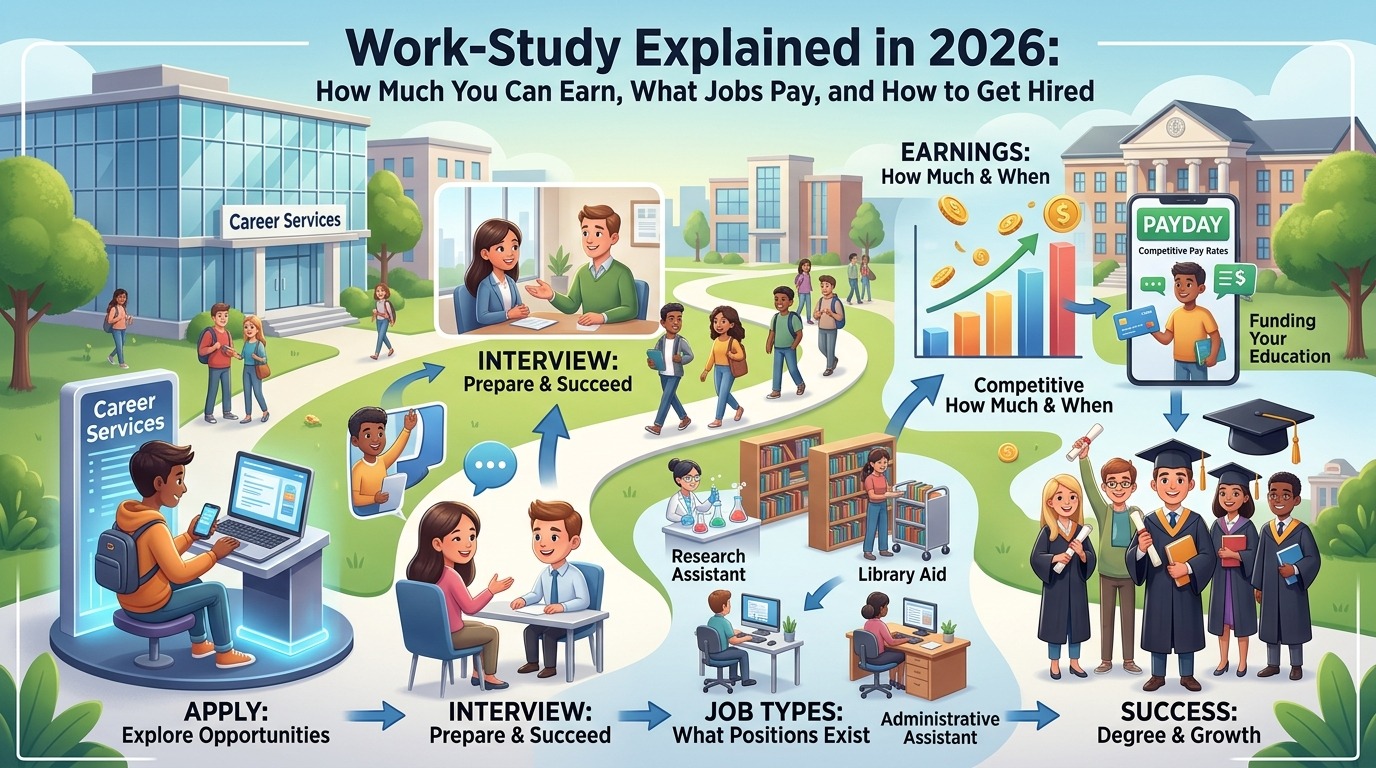
Work-Study Explained: How Much You Can Earn and What Jobs Pay in 2026
Federal Work-Study sounds simple at first: fill out the FAFSA, get awarded money, work part time, and use the paycheck for school costs. But once high-school seniors actually start comparing aid offers, the questions get more specific. How much can you really earn? Is work-study the same as a grant? Does it lower your financial aid later? Are the jobs only in the library, or can you do something related to your major? And in 2026, what do those jobs actually pay?
The short version is this: Federal Work-Study is not a grant that drops into your account automatically, and it is not a loan you pay back later. It is a need-based student employment prAdd Postogram. You earn the money only by working approved hours in an eligible job, and the amount you can earn depends on your school’s award, your wage rate, and how many hours your school lets you work before you hit your cap. Unlike a federal loan, work-study earnings do not have to be repaid.
For the 2026–27 award year, Federal Work-Study remains a campus-based aid program. That matters because schools do not all receive the same amount, and students do not all get the same award. The Department of Education announced final 2026–27 campus-based funding authorizations by April 1, 2026, and Congress appropriated $1.23 billion for the Federal Work-Study program for that award year. Even with that funding, schools still receive limited allocations and make their own student awards from those funds.
What Federal Work-Study actually is
Federal Work-Study is a federal aid program that gives eligible students the chance to earn money through part-time work while enrolled in college, career school, or trade school. The FAFSA is the entry point. If a school decides you are eligible, work-study can appear in your aid offer alongside grants and loans. But seeing it in the offer does not mean cash is automatically applied to your bill. Usually, you still have to find a work-study job, get hired, work the hours, and then receive pay through a paycheck or direct deposit.
This is where many families get confused. A Pell Grant is aid you can receive based on eligibility rules and enrollment. A federal loan is money you borrow and later repay. Work-study sits in the middle: it is federal aid, but it arrives as wages from a job. The 2026–27 FAFSA itself explains that students use the FAFSA to apply for grants, work-study, and loans, and that colleges then use the FAFSA and Student Aid Index to build an aid package.
That design is why work-study often helps with cash-flow problems more than with sticker-price shock. Tuition bills are usually due on school timelines. Work-study money usually shows up after you start working. Federal Student Aid says work-study pay is usually meant for day-to-day costs like food, transportation, and supplies, although some schools let students authorize those earnings to be credited to school charges such as tuition, fees, housing, or food plans.
Who can get work-study in 2026
To be considered for Federal Work-Study in 2026–27, a student must submit the FAFSA for that award year. The 2026–27 FAFSA covers July 1, 2026 through June 30, 2027. Federal Student Aid says the form can be submitted as early as October 1, 2025, and the federal deadline is June 30, 2027, though many state and college deadlines are much earlier. Filing earlier matters because work-study funds are limited and often run out before the federal deadline.
Federal Student Aid also says students who file the FAFSA early usually have a higher chance of receiving Federal Work-Study. That makes practical sense because schools award from limited campus-based pools. If your school has already allocated most of its work-study funds, filing late can reduce your chances even if you otherwise qualify.
In general, schools look at your financial need, your FAFSA information, and their available funds. Federal Student Aid says work-study awards can be affected by family income or financial need, whether you had work-study the prior year, and how much funding the school has available. The campus-based handbook also makes clear that the program is intended for students who need earnings to help meet postsecondary education costs.
How schools decide how much you can earn
There is no one national Federal Work-Study award that every student gets. Your school decides your specific award. Under federal guidance, the gross amount of a work-study award is based on the total number of hours expected to be worked multiplied by the anticipated wage rate. In plain English, your award is basically a spending cap on your eligible work hours.
That is why two students at two different colleges can both “have work-study” and still have totally different outcomes. One school may offer a $1,500 award for a lower-wage campus job. Another may offer $3,000, $4,000, or more for a higher-wage position. Official school pages show that awards vary widely. Stevens says awards range from $500 to $2,000 per academic year, while Marymount Manhattan says students are initially awarded $3,000 for the academic year, and PCOM says the usual award is $6,000 for eligible students.
This also explains why families should stop asking only, “Did I get work-study?” and start asking, “How big is the award, what is the hourly rate, how many hours can I work, and when do jobs open?” Those questions determine whether your real earnings will look like grocery money, book money, or something large enough to meaningfully reduce out-of-pocket pressure.
The formula: how much can you actually earn?
The easiest way to estimate earnings is:
Work-Study Award ÷ Hourly Rate = Total Hours Available
Marymount Manhattan publishes exactly this math. Its example shows that a $3,000 award at $16.50 per hour works out to about 181 hours of work for the academic period.
From there, you can estimate weekly and monthly pay:
Hourly Rate × Hours Per Week = Weekly Gross Pay
Weekly Gross Pay × 4 = Approximate Four-Week Gross Pay
So if your job pays $16.50 per hour and you work 8 hours per week, your gross weekly pay is about $132. Over four weeks, that is about $528 gross. At that pace, a $3,000 work-study award would last roughly 22.7 weeks before you hit the cap. That is arithmetic based on published school rates and award formulas, but your exact take-home pay will be lower if taxes are withheld.
The key limit is not just time. It is the award itself. Federal Student Aid says students should not exceed the total hours tied to their work-study job, and schools structure those limits around financial need and academics. In other words, even if your boss wants you for more hours, you usually cannot keep earning Federal Work-Study wages after you hit the authorized amount unless the school changes your funding or moves you into a regular student employee role.
What do work-study jobs pay in 2026?
There is no national work-study pay chart. Federal law requires at least the applicable minimum wage, and schools must follow the higher of federal, state, or local minimum wage rules. Federal guidance says undergraduates must be paid hourly, and schools must consider skill level, local labor rates, comparable non-work-study wages, and applicable wage laws when setting pay.
The federal minimum wage is still $7.25 per hour, but many states and localities are much higher. The Department of Labor’s January 1, 2026 table shows, for example, New York City at $17.00, New Jersey at $15.92 for most employers, and Washington at $17.13. That is a big reason why 2026 work-study pay in practice can range from single digits on some campuses to well above $20 per hour on others.
Here are real examples from official school pages and job listings available as of April 2026. These are examples, not a national pay schedule:
- Queensborough Community College (CUNY): on-campus work-study pay is $17.00 per hour effective January 1, 2026; students may work up to 20 hours per week.
- City College of New York: 2025–26 on-campus rates list $19.00 per hour for undergraduates and $20.00 for graduates.
- Kean University: part-time Federal Work-Study positions for 2025–26 pay $15.92 per hour effective January 1, 2026; examples include general office work, community service, tutoring, research assistants, and computer lab attendants.
- FIT: work-study jobs are paid at $16.00 per hour.
- SUNY Empire State University: America Reads jobs pay $18.00 per hour, and work-study pay may not exceed $19.90 per hour on that page.
- PCOM: most positions pay $18.00 per hour; community-service jobs pay $20.00 on campus and $22.00 off site when travel is required.
- Caltech: typical work-study wage range is $19.00 to $39.00 per hour, and community-service work through the Caltech Y pays at least $30.00 per hour.
What this means for students is simple: “How much does work-study pay?” is really the wrong question. The better question is, “What does my school’s work-study pay for my kinds of jobs?” Federal rules set the floor. Your state, city, school, department, and job type often determine the real number.
What kinds of jobs are common?
The stereotype is “library desk job,” but official school pages show a much wider mix. Kean lists general office work, tutoring, event staff, research assistants, off-campus community service, and computer lab attendants. Stevens says many opportunities involve assisting faculty or working in labs, academic departments, or administrative offices. Manhattan School of Music posts roles such as Financial Aid Assistant, IT Student Worker, Library Circulation Assistant, office assistant, recording studio assistant, and theory assistant.
That variety matters because some work-study jobs mainly solve a money problem, while others also build a resume. A front-desk office role can teach customer service and organization. A lab or faculty-assistant role can connect to research and recommendations. A tutoring role can strengthen communication and subject mastery. An IT or media role can build technical experience. In other words, the best work-study job is not always the first open slot. It is often the one that pays reasonably and adds value to your future applications. That is an inference from how schools describe these roles and qualifications.
Will work-study reduce your future aid?
This is one of the best parts of the program. Federal Student Aid explicitly says earnings from a Federal Work-Study job will not be included as part of the total income used when the school calculates future aid offers. The 2026–27 Student Aid Index handbook also shows Federal Work-Study as an income allowance in the aid formula, which supports why those earnings get favorable treatment in aid calculations.
That does not mean work-study wages are invisible everywhere. They can still matter for tax reporting. But in the federal aid formula, work-study earnings are treated better than ordinary wages for future aid calculations. For students who are nervous that earning extra money will automatically wreck next year’s aid, this is an important distinction.
Is work-study taxed?
Usually, yes for income-tax purposes, maybe no for some payroll taxes depending on your situation. IRS guidance says being a student does not automatically exempt you from federal income taxes. Whether you owe income tax or must file depends on your income, dependent status, filing status, and age. Marymount Manhattan also states that Federal Work-Study wages are reportable income and that students receive a W-2.
At the same time, there is an important payroll-tax rule. IRS guidance on the student FICA exception says a half-time student who is not a career employee may qualify for the exception, and Federal Student Aid’s handbook notes that FICA taxes do not apply to service performed by students employed by a school, college, or university where the student is pursuing a course of study. That can mean some students do not have Social Security and Medicare taxes withheld in the same way as regular workers, though details depend on the employment relationship and school setup.
The practical takeaway is this: expect work-study to function like real wages. Check your pay stub, ask whether your school applies the student FICA exception, and do not assume “student job” means “tax free.”
Can work-study pay your tuition bill directly?
Usually not automatically. Usually it pays you first. Federal Student Aid says students generally receive work-study funds through a regular paycheck, and Stevens and Marymount Manhattan both say work-study is paid directly to the student rather than automatically applied to the bill. However, federal rules also allow schools to credit a student’s account if the student gives written authorization, and Federal Student Aid says some schools let students apply work-study earnings to billed charges like tuition, fees, and food and housing.
So the honest answer is: sometimes, but only if your school offers that option and you authorize it. Families should never assume a $3,000 work-study award is the same thing as a $3,000 tuition discount. It is not.
How many hours do students usually work?
Federal rules do not impose one universal weekly hour cap for every student, but schools are supposed to set hours based on financial need and academic progress, and many schools use practical academic-year caps around 20 hours per week. Federal Student Aid describes work-study as part-time, and official college pages commonly list caps such as 19.5 hours, 20 hours, or similar during the term.
That is why most students should picture work-study as a manageable school-year job, not a full replacement for parental support, grants, or larger scholarships. It can meaningfully cover books, transportation, meals, and some personal expenses. It can also sometimes help with smaller balances. But unless the wage is unusually high and the award unusually large, work-study alone is rarely the thing that makes an expensive college suddenly affordable. That conclusion follows from published award examples, hour caps, and pay ranges.
How high-school seniors should think about work-study in 2026
If you are comparing aid offers, treat work-study as earned aid, not as guaranteed upfront aid. That means separating your package into at least four buckets:
- Free upfront aid: grants and scholarships.
- Earned aid: work-study.
- Borrowed aid: federal loans.
- Gap: what is left after all of the above.
That framework keeps families from accidentally overestimating how affordable a college is. A school that offers a big grant and no work-study may still be cheaper than a school that offers less grant money but adds a large work-study line and more loans. The FAFSA form and Federal Student Aid materials both make clear that work-study and loans are different categories from grants.
High-school seniors should also think strategically about timing. Submit the FAFSA early. Check whether your aid offer includes work-study. Ask how the school awards jobs. Ask when job postings open. Ask whether freshmen actually get placed. Ask the hourly rate range. Ask whether earnings can be credited to the student account. And ask what happens if you hit your award early in the semester. Those are the questions that turn a vague work-study line into a real financial plan.
Smart questions to ask a financial aid office
Before you commit to a college, ask:
- Is my work-study award already included in my offer, and do I have to accept it separately?
- Am I guaranteed a job, or do I have to search and apply on my own?
- What is the hourly pay range for first-year students?
- How many hours per week do most freshmen work?
- Can work-study earnings be credited to my school bill with authorization?
- What happens when I hit my award limit? Can I continue as a regular student worker?
- Do you have roles connected to my major, such as tutoring, research, IT, lab work, or office support?
Final verdict
Federal Work-Study is one of the more misunderstood parts of a college aid offer. In 2026, the program still works best when students treat it as a flexible, part-time earning tool tied to financial need and job availability, not as automatic bill coverage. The best version of work-study gives you three wins at once: cash for real school-related costs, resume-building experience, and income that does not damage your future federal aid calculation the way ordinary wages can.
How much can you earn? Realistically, it depends on your school’s award, local wage law, job type, and hour cap. Official 2026 examples show campuses paying anywhere from around $15 to $19 per hour for many standard positions, with some schools publishing higher rates for specialized, technical, research, or community-service roles. That means your personal answer is not “whatever the federal government says.” It is “whatever your school awards, your job pays, and your schedule allows.”
FAQs
Do you have to pay back Federal Work-Study?
No. Federal Student Aid says work-study earnings do not have to be paid back like a federal student loan. You earn the money by working.
Do you get the full work-study amount automatically?
No. You only earn money for hours actually worked, up to your authorized award.
Can freshmen get work-study jobs?
Yes, if they qualify and are awarded work-study, but jobs are limited and schools often require students to search and apply.
Does work-study hurt next year’s FAFSA-based aid?
Federal Student Aid says no; Federal Work-Study earnings are not included the same way in future aid calculations, and the 2026–27 SAI guidance reflects that treatment.
Can work-study be used for off-campus jobs?
Yes. Federal Student Aid says some work-study jobs are off campus, especially through nonprofits and community-based work, and official school pages list community-service placements and tutoring roles.
Is work-study worth accepting?
Usually yes, if you need part-time income and can balance the hours with school. But it should be evaluated as earned aid, not as the same thing as a grant.