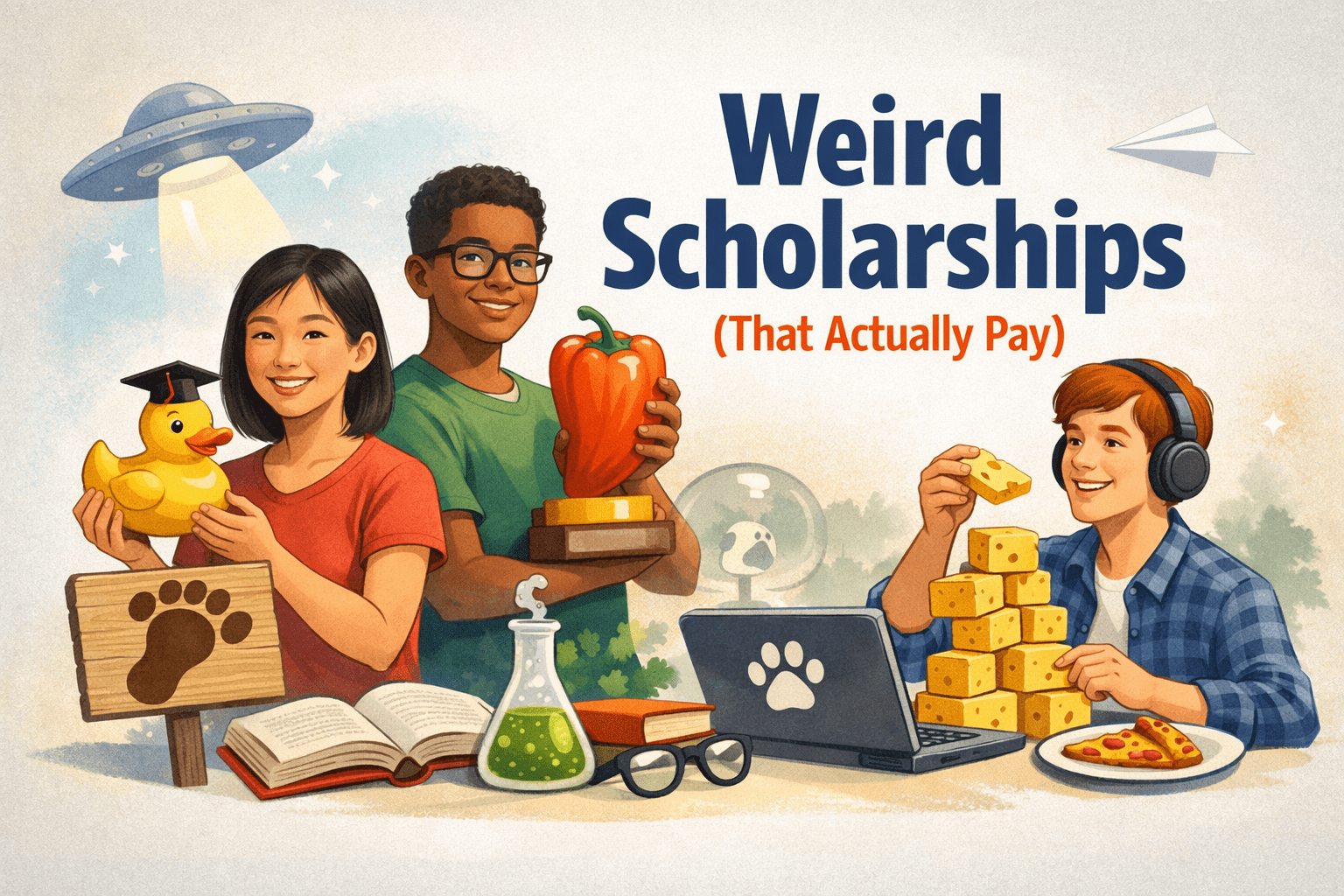
Weird Scholarships (That Actually Pay)
From duct-tape prom drip to duck‑calling champs and Star Trek superfans—these legit awards prove there’s a scholarship for your brand of awesome.
Hand‑Picked Weird Scholarships (Apply Now)
Duck Brand “Stuck at Prom®” Duct Tape Scholarship
-
💥 Why it slaps:
-
Turn duct tape into couture and win big.
-
Two grand prizes + runners‑up + judges’ picks.
-
-
💰 Amount: Dress GP $15,000; Tux GP $15,000; runners‑up $1,000; extra Judges’ Choice $1,000. duckbrand.com
-
⏰ Deadline: Opens each prom season; 2025 winners posted (watch for 2026 rules). duckbrand.com
-
🔗 Apply/info: https://www.duckbrand.com/stuck-at-prom — ✅ Link verified Aug 20, 2025. duckbrand.com
Tall Clubs International Foundation Scholarship (for really tall seniors)
-
💥 Why it slaps:
-
Height finally helps your wallet.
-
Simple criteria + national club network.
-
-
💰 Amount: Minimum $1,000 (varies). tallclubfoundation.org
-
⏰ Deadline: Early spring cycle (e.g., March window in 2025). tallclubfoundation.org
-
🔗 Apply/info: https://tallclubfoundation.org/scholarship/scholarship/ — ✅ Link verified Aug 20, 2025. tallclubfoundation.org
Unigo “Zombie Apocalypse” Scholarship
-
💥 Why it slaps:
-
250 words, survive the zombies, snag $$.
-
Open to ages 14+; creative prompt.
-
-
💰 Amount: $2,000. Unigo.com
-
⏰ Deadline: Runs annually on Unigo; see current status on the page. Unigo.com
-
🔗 Apply/info: https://www.unigo.com/scholarships/our-scholarships/zombie-apocalypse-scholarship — ✅ Link verified Aug 20, 2025. Unigo.com
Chick & Sophie Major Memorial Duck Calling Contest (HS seniors)
-
💥 Why it slaps:
-
Call ducks, win scholarships. Legendary Arkansas vibe.
-
-
💰 Amount: Scholarships totaling $9,000. Wings over the Prairie Festival
-
⏰ Deadline: Held annually during the Stuttgart Duck Festival; check contest page for dates. Wings over the Prairie Festival
-
🔗 Apply/info: https://www.stuttgartduckfest.com/scholarship-duck-calling-contest — ✅ Link verified Aug 20, 2025. Wings over the Prairie Festival
Vegetarian Resource Group (VRG) Scholarships (vegan/veg student leaders)
-
💥 Why it slaps:
-
Huge pot for student activists; multiple awards.
-
-
💰 Amount: In 2025, $50,000 total (one $10,000, six $5,000, plus runner‑ups). VRG+1
-
⏰ Deadline: Typically February 20 (check current cycle). VRG
-
🔗 Apply/info: https://www.vrg.org/scholarship — ✅ Link verified Aug 20, 2025. VRG
Create‑A‑Greeting‑Card Scholarship (Gallery Collection)
-
💥 Why it slaps:
-
Make a greeting card design; winner gets published + paid.
-
-
💰 Amount: $10,000 (per official rules). Gallery Collection
-
⏰ Deadline: Annual; see current contest page for exact dates. Gallery Collection
-
🔗 Apply/info: https://www.gallerycollection.com/greeting-cards-scholarship.htm — ✅ Link verified Aug 20, 2025. Gallery Collection
AFSA “No‑Essay” Fire Sprinkler Scholarship Contests
-
💥 Why it slaps:
-
10‑minute entry; learn a safety blurb, submit, done.
-
Two contests (HS seniors + grads).
-
-
💰 Amount: Five $1,000 awards per contest (two cycles yearly). AFSA No Essay Scholarship Program+1
-
⏰ Deadline: August & December cycles; see the page for current close dates. AFSA No Essay Scholarship Program
-
🔗 Apply/info: https://www.afsascholarship.org/ — ✅ Link verified Aug 20, 2025. AFSA No Essay Scholarship Program
National “Make It With Wool” Competition (scholarships + national finals)
-
💥 Why it slaps:
-
Sew/knit/crochet 60%+ wool fit, hit state → nationals → awards.
-
-
💰 Amount: Awards vary; national competition provides scholarships/awards. Make It With Wool
-
⏰ Deadline: State/At‑Large entry deadlines each fall (e.g., 2025 at‑large postmark Oct 15). Make It With Wool
-
🔗 Apply/info: https://makeitwithwool.com/ — ✅ Link verified Aug 20, 2025. Make It With Wool
STARFLEET (Star Trek Fan Association) Scholarships (members only)
-
💥 Why it slaps:
-
Trekkies → tuition. Multiple categories; membership req’d.
-
-
💰 Amount: Typically up to ~$1,000 per scholarship (varies by funds/applicants). STARFLEET+1
-
⏰ Deadline: Annual cycle; check STARFLEET scholarship page. STARFLEET
-
🔗 Apply/info: https://sfi.org/starfleet-scholarship/ — ✅ Link verified Aug 20, 2025. STARFLEET
American Association of Candy Technologists — John Kitt Memorial Scholarship
-
💥 Why it slaps:
-
For future Willy Wonkas (food/chem/bio majors).
-
-
💰 Amount: $2,500 (2025–26 cycle). aactcandy.org
-
⏰ Deadline: Annual; see AACT page for current dates. aactcandy.org
-
🔗 Apply/info: https://www.aactcandy.org/awards-scholarships/john-kitt-memorial-scholarship/ — ✅ Link verified Aug 20, 2025. aactcandy.org
Asparagus Club / NGA Foundation Scholarships (grocery industry careers)
-
💥 Why it slaps:
-
Quirky name, serious support; renewable awards for biz/food careers.
-
-
💰 Amount: Varies by fund; program is active via NGA Foundation. nationalgrocers.org+1
-
⏰ Deadline: Typically Jan–Apr window; confirm on NGA Foundation site. nationalgrocers.org
-
🔗 Apply/info: https://www.nationalgrocers.org/foundation/nga-foundation-scholarships/ — ✅ Link verified Aug 20, 2025. nationalgrocers.org
Unigo’s “Flavor of the Month,” “Make Me Laugh,” “Superpower,” etc. (monthly prompts)
-
💥 Why it slaps:
-
Short 250‑word entries; rotating, funny prompts all year.
-
-
💰 Amounts: $1,500 (Flavor/Make Me Laugh), $2,500 (Superpower), plus others. Unigo.com+2Unigo.com+2
-
⏰ Deadlines: Rolling by theme; check the “Our Scholarships” hub. Unigo.com
-
🔗 Apply/info: https://www.unigo.com/scholarships/our-scholarships — ✅ Link verified Aug 20, 2025. Unigo.com
⚠️ Note on “Left‑Handed” scholarships: The famous Juniata College Beckley Scholarship is widely reported online, but current official details are unclear; treat third‑party listings with caution and verify directly with Juniata Financial Aid before relying on it. juniata.eduOnline SAT / ACT Prep Blog
Pro Tips for “Weird” Awards (fast wins)
-
Own your niche: Lean into your hobby/identity (wool arts, fandoms, activism).
-
Read rules carefully: Weird ≠ vague—legit sponsors post full rules, deadlines, and contact info. (See Duck Brand & AFSA for great examples.) duckbrand.comAFSA No Essay Scholarship Program
-
Beware fakes: If it asks for fees/gift cards/logins, it’s a scam—report it. (See our Scam Guide.)
❓ FAQ
Are these “weird” scholarships legit?
Yes—each listing links to an official sponsor or program page we verified on Aug 20, 2025 (e.g., Duck Brand, AFSA, Unigo, VRG, STARFLEET, NGA). Always re‑check dates before applying. duckbrand.comAFSA No Essay Scholarship ProgramUnigo.comVRGSTARFLEETnationalgrocers.org
Do I need to be in a specific major?
Some do (e.g., candy tech → food/chem/bio), others don’t (duct tape, zombie essay). Check each page’s eligibility. aactcandy.orgUnigo.com
Are monthly “no‑essay”/fun prompts worth it?
If the entry is short and legit (like Unigo themes or AFSA’s quick entry), yes—set a reminder and stack multiple shots. Unigo.comAFSA No Essay Scholarship Program
How competitive are these?
Varies: national contests draw big crowds; niche skill awards (wool, duck calling) may have fewer eligible applicants. Check past‑winner pages to gauge demand. duckbrand.comUnigo.com+1
Can I apply to several at once?
Absolutely. Keep a tracker, reuse strong short essays, and prioritize those with near deadlines/high fit.
🔗 Helpful Resources (verified Aug 20, 2025)
- Duck Brand Stuck at Prom hub (rules, FAQs, prizes). duckbrand.com
- Unigo – Our Scholarships (monthly fun prompts + winners). Unigo.com
- AFSA No‑Essay Scholarships (HS seniors + grads; two cycles/year). AFSA No Essay Scholarship Program
- VRG Scholarship blog update (2025 $50,000 program details). VRG+1
- STARFLEET Scholarship page (member‑only awards; categories vary). STARFLEET
- NGA Foundation Scholarships (incl. Asparagus Club). nationalgrocers.org
- “Make It With Wool” national site (state contests & at‑large entry). Make It With Wool
Weird Scholarships as a Functional “Long-Tail” Market: A Data-Driven Research Review
Abstract
“Weird scholarships” (also called niche, novelty, or idiosyncratic-criteria scholarships) are awards whose eligibility rules intentionally deviate from conventional merit (GPA/test scores) or need (income/FAFSA) frameworks. While they’re often framed as internet curiosities, they operate as a practical micro-market inside the broader U.S. student-aid system—one shaped by donor motivations, marketing economics, and applicant search costs. Using national student-aid benchmarks and documented family scholarship behaviors, this paper models weird scholarships as a “long tail” allocation channel: many small awards, diverse criteria, variable competition, and high dependence on information frictions. We connect macro aid trends (aggregate grant volumes, institutional aid dominance) to micro scholarship design (application friction, signaling, and behavioral incentives), and we offer an evidence-informed strategy lens for students and families: weird scholarships are rarely “the” solution, but they can materially improve affordability when treated as a portfolio of small, stackable probability bets—especially when students reduce marginal application time through reuse and targeted matching.
1) Where weird scholarships sit in the U.S. aid landscape
A helpful starting point is scale. In the 2024–25 academic year, students received $275.1 billion in total aid (grants, loans, tax credits, and work-study), including $173.7 billion in grant aid. In that same year, institutional grants (aid funded by colleges/universities) were reported as a major component of grant aid, reaching $85.1 billion.
Weird scholarships are generally not institutional grants; they typically fall into private/community or employer/organization categories. That matters because U.S. aid is structurally dominated by large “pipes” (federal, state, institutional) and only partially complemented by smaller private awards. National data on first-time, full-time undergraduates show that institutional grants are especially prevalent at private nonprofits (large shares receiving them), and average institutional grant amounts can dwarf many outside awards.
This does not mean weird scholarships are negligible. It means their role is best understood as marginal affordability improvement—often paying for books, fees, a laptop, transportation, housing gaps, or reducing loan reliance at the margin.
2) Defining “weird”: novelty criteria as an allocation technology
A weird scholarship isn’t inherently unserious; it’s defined by unconventional eligibility filters, such as:
-
identity or personal attributes (height, handedness, uncommon names)
-
hobbies and subcultures (specific crafts, niche sports, fandom-adjacent creativity)
-
highly specific essays or creative prompts (odd questions, themed submissions)
-
hyperlocal or micro-community affiliation rules (tiny geographic zones, unusual club memberships)
From a market design perspective, “weirdness” is a screening mechanism. Donors use unusual criteria to narrow applicant pools, increase memorability, or align awards with brand identity (including publicity). The novelty requirement can reduce competition by discouraging broad, generic applicants and drawing in a smaller set of high-fit candidates.
3) The long-tail model: why many small, odd scholarships can add up
3.1 Portfolio logic vs jackpot logic
Students often chase “headline scholarships” (large awards, national prestige). But those operate like winner-take-most tournaments with very large applicant pools. Weird scholarships are more like micro-prizes in a long-tail distribution: smaller awards, but potentially better odds conditional on fit.
The student-aid reality supports the “portfolio” lens. In nationally reported aid patterns, average amounts of grants and loans for aid recipients are each in the thousands of dollars, meaning affordability gaps are typically composed of multiple components rather than a single missing chunk. In NPSAS reporting for 2019–20, for example, the average amount received from grants among aided undergraduates was $9,300, and the average amount from student loans was $7,900—a structure that naturally invites stacking strategies.
3.2 Observed family behavior: scholarships are used, but misunderstood
Survey-based evidence suggests scholarships/grants are widely used but often misunderstood. One scholarship-sector summary of Sallie Mae’s national “How America Pays for College” findings reported that 80% of families used scholarships and grants, with awards averaging just over $8,000 and covering about 27% of costs (in that survey’s framing).
At the same time, families hold misconceptions that suppress applications: a NASFAA write-up highlights that 46% of families believed scholarships are only for students with exceptional grades/abilities, and 36% believed scholarships can only be applied for before freshman year.
Weird scholarships directly counter these misconceptions because many are explicitly not grade-maximization contests—and many are open to students beyond the high-school-senior window.
4) Application friction is the hidden “price” of weird scholarships
4.1 Expected value (EV) and time cost
The rational way to evaluate any scholarship is expected value:
EV ≈ (Award Amount × Probability of Winning) − (Time Cost × Value of Time)
We rarely know exact probabilities because sponsors don’t consistently publish applicant counts. But “weirdness” often changes probability by changing competition.
A practical implication is that weird scholarships become attractive when:
-
you are genuinely high-fit for the criteria (raising win probability), and
-
the marginal time to apply is low (reusing essays, templates, recommendation packets)
If a student can cut an application from 3 hours to 30 minutes via reuse, the EV can shift dramatically even for $500–$2,000 awards.
4.2 Behavioral economics: design choices change participation
Scholarship applications are behaviorally hard: deadlines, forms, essays, and uncertainty. Behavioral economics research and practice guides emphasize that complex processes reduce take-up even when benefits are meaningful; reducing friction can increase participation and follow-through.
Weird scholarships often increase friction (quirky essays, creative submissions), which can reduce applicant volume—good for odds, bad for accessibility. This is the central tradeoff: weirdness can function like a self-selection filter.
5) Donor motives: altruism, community identity, and marketing economics
Weird scholarships exist because donors have mixed motives:
-
Altruism + identity: fund students who reflect a valued trait, community, or story.
-
Commemoration: memorial scholarships sometimes encode personal quirks or passions of the honoree.
-
Attention economics: novelty increases shareability, backlinks, press coverage, and brand recognition.
This is not inherently negative—marketing can subsidize scholarships. But it shapes design: sponsors may prefer prompts that produce publishable stories or user-generated content.
That design preference can create equity concerns: students with more time, coaching, or production resources (video editing, portfolios) may be advantaged. In other words, some weird scholarships unintentionally reward capacity rather than need.
6) Equity and distribution: who benefits, who gets left out?
Weird scholarships can be surprisingly inclusive when they:
-
avoid high GPA thresholds
-
minimize documentation burden
-
allow multiple education pathways (trade, community college, part-time)
But they can also reproduce inequities when they:
-
require unpaid time, complex projects, or costly materials
-
depend on insider knowledge of niche opportunities
-
require extensive identity documentation that some applicants cannot easily provide
Macro aid data underscore that large affordability changes generally come from bigger systems (federal, state, institutional). Weird scholarships most often help by reducing the “last-mile” gap—the remaining costs after main aid is applied—yet last-mile gaps are exactly where time scarcity is greatest for working students and caregivers.
A policy-relevant insight: weird scholarship markets tend to reward search sophistication. That is an information equity problem, not merely a funding problem.
7) Risk management: scams, fees, and the compliance layer
Because weird scholarships live in a fragmented private ecosystem, families need a clear risk filter.
7.1 Scam red flags
Two authoritative rules of thumb:
-
The FTC warns: never pay to apply for a scholarship; “processing” or “redemption” fees are major red flags.
-
Federal Student Aid warns about financial aid scams and emphasizes avoiding services that charge for access or promise outcomes.
Weird scholarships that request upfront payment, sensitive bank data, or guaranteed wins should be treated as high-risk.
7.2 Tax implications: “weird money” can be taxable money
Scholarships are not automatically tax-free. IRS guidance (Publication 970 and related IRS resources) explains that scholarship amounts are generally excludable from income only to the extent they are used for qualified education expenses (typically tuition, required fees, and required course materials). Amounts used for room and board or tied to required services can be taxable.
Weird scholarships are often flexible cash awards; students should understand whether the award is restricted to qualified expenses and keep receipts accordingly.
8) A practical evidence-aligned strategy for students: treat weird scholarships as an efficiency game
A research-based approach is to maximize applications per hour while staying high-fit:
-
Build a reusable application kit
-
master resume + activities list
-
2–3 adaptable essays (identity, challenge, leadership/service)
-
short bio (100–150 words) and long bio (300–500 words)
-
recommendation packet (brag sheet + deadlines)
-
-
Exploit prompt similarity
Weird prompts look unique, but many map onto standard constructs (values, persistence, community contribution). Reframe “quirky” questions into evidence-backed narrative structure. -
Prioritize low-friction, high-fit opportunities
The goal isn’t to apply to everything; it’s to apply where your fit is distinctive and the marginal work is low. -
Stack small wins
If families in national surveys report scholarships/grants averaging in the several-thousand range in aggregate usage, that “total” is frequently an accumulation of awards rather than a single check. -
Don’t ignore institutional and state aid
Since institutional aid is both prevalent and large in many sectors, optimizing admissions/aid negotiations, FAFSA timing, and state grants can yield bigger returns than any single weird scholarship.
9) Implications for scholarship sponsors and platforms (a design critique)
If the goal is genuine access rather than publicity, sponsors can redesign weird scholarships to improve equity without sacrificing uniqueness:
-
Lower documentation burdens (use attestation where appropriate)
-
Avoid requiring expensive production (video optional, multiple submission formats)
-
Publish selection criteria and approximate applicant volume (transparency increases trust)
-
Use short forms + staged review (a quick screen, then deeper review for finalists)
-
Offer multiple smaller awards rather than one winner (reduces all-or-nothing variance)
Behavioral design guidance suggests that simplifying steps and clarifying pathways increases participation among those who benefit most, which is especially relevant for first-gen and time-scarce students.
Conclusion
Weird scholarships are best understood as a functional long-tail market embedded inside the broader U.S. aid ecosystem. In a national context where total aid and grant aid are enormous—and where institutional grants form a major share of grant funding—private novelty scholarships rarely replace mainstream aid. Their value lies in marginal gains: last-mile affordability, reduced borrowing, and portfolio stacking—especially when students minimize application friction through reuse and target high-fit criteria.
However, weird scholarships also expose structural inequities in the scholarship landscape: information frictions, time scarcity, and variable transparency. Effective use requires both strategy (EV thinking, fit targeting) and consumer protection (scam filters, tax awareness).
In short: weird scholarships aren’t “free money for doing something silly.” They’re a distributed micro-aid system with real economics—one that can reward students who treat scholarship search as a disciplined, low-marginal-cost pipeline while still prioritizing the biggest levers: FAFSA, state grants, and institutional aid.
References (selected)
- College Board, Trends in Student Aid Highlights (2024–25 totals).
- NCES, Condition of Education: Sources of Financial Aid (IPEDS-based distributions and average award amounts).
- NCES, NPSAS 2019–20 report (average grants/loans among aid recipients).
- NASFAA summary of Sallie Mae findings (scholarship sources/averages; misconceptions).
- FTC consumer guidance on scholarship/financial-aid scams.
- IRS Publication 970 (tax treatment of scholarships and qualified expenses).
- ideas42, behavioral economics and postsecondary success (friction and take-up).