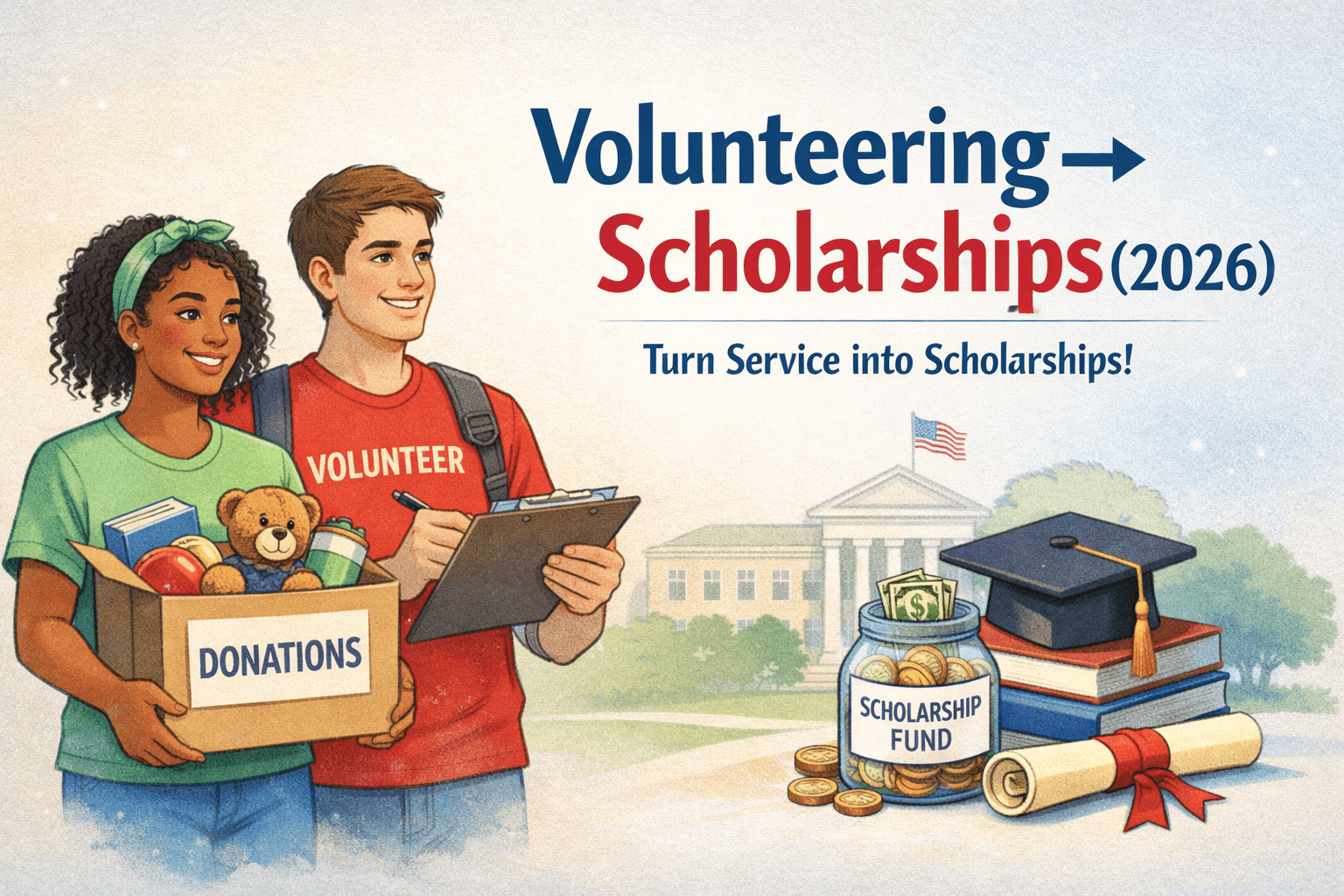
Volunteering → Scholarships (2026): AmeriCorps Award, Service-Driven Scholarships, and How to Find Legit Gigs
Turn service into tuition money. See AmeriCorps Segal Award ($7,395 max), leadership scholarships (Coke, Prudential, Barron), PVSA status, and top volunteer search hubs.
Volunteering → Scholarships
Volunteering functions as both (1) a direct pathway to education funding through structured service-for-aid programs and service-conditioned scholarships, and (2) an indirect pathway by strengthening merit scholarship competitiveness via demonstrated leadership, civic commitment, and skill development. Using recent U.S. volunteerism statistics and peer-reviewed evidence on service-learning and youth volunteering outcomes, this paper maps the mechanisms by which service translates into scholarship dollars, identifies where “hours-based” models mis-measure impact, and offers equity-aware design recommendations for students, families, schools, and scholarship providers. Nationally, formal volunteering has rebounded toward pre-pandemic levels: 75.7 million people—28.3% of U.S. residents age 16+—volunteered through an organization between September 2022 and September 2023. The estimated economic value of a volunteer hour was $34.79 in 2024, underscoring the scale of civic labor that scholarship systems attempt to incentivize and recognize. Evidence from recent research and meta-analyses indicates that well-designed community-engaged learning and service-learning are associated with improved academic outcomes (e.g., cumulative GPA, retention, and graduation), particularly for underrepresented students—effects that can indirectly increase scholarship retention and eligibility. The paper concludes with actionable strategies to convert service into credible scholarship evidence while reducing inequities for students with limited discretionary time.
Keywords: community service scholarships, service-learning, AmeriCorps education award, merit scholarships, civic engagement, equity in scholarship design
1. Introduction: Why volunteering shows up in scholarship decisions
Volunteering sits at the intersection of education finance and civic development. For students, it can be the difference between “eligible” and “ineligible” for certain scholarships (a direct link), and it can also function as a high-signal achievement that scholarship committees interpret as evidence of leadership, initiative, reliability, and community orientation (an indirect link). This dual role matters because modern scholarship ecosystems are fragmented: state aid programs, nonprofit scholarships, corporate foundations, and colleges each use different criteria—and “community impact” is one of the few criteria legible across all of them.
Recent national data suggest the relevance is not niche. The U.S. Census Bureau and AmeriCorps reported that 28.3% of the population age 16+—75.7 million people—formally volunteered through an organization between September 2022 and September 2023, indicating substantial student exposure to volunteering in families and communities. Meanwhile, the economic value of volunteer time is large: Independent Sector estimated $34.79 per volunteer hour in 2024 (national average). If a student completes 100 hours, the implied value of that labor is about $3,479; at 250 hours it is $8,697.50; and at 500 hours it is $17,395. This gap—between the large societal value of service and the often modest scholarship dollars attached to “hours”—helps explain why scholarship programs increasingly look beyond raw totals toward sustained commitment and measurable outcomes.
2. A framework: Three pathways from service to scholarship dollars
Volunteering translates into scholarship support via three dominant pathways:
Pathway A: Service-for-aid (explicit exchange)
Students perform structured service and receive education benefits. The canonical U.S. example is AmeriCorps, where completion of a service term can earn a Segal AmeriCorps Education Award. AmeriCorps listings commonly cite $7,395 for a full-time 1,700-hour term in recent service years, aligning with the maximum Pell Grant amount for 2025–26. The AmeriCorps member portal explains key constraints: the award must generally be used within seven years after the term ends, and members can earn no more than the equivalent of two full-time education awards.
Pathway B: Service-conditioned scholarships (eligibility gate)
Some scholarships require service hours to qualify, functioning like a checkbox gate rather than a ranking factor. A prominent example is Florida Bright Futures, which requires volunteer service hours or paid work hours (with specific hour thresholds by award level). Official handbook language notes changes over time (e.g., updated volunteer-hour requirements for students entering grade 9 in the 2024–25 school year and thereafter).
Pathway C: Service as a selection signal (competitive advantage)
In many major merit scholarships, service is explicitly part of the evaluation rubric. The Coca-Cola Scholars Program, for example, states applicants are evaluated on leadership, academics, and service. In these programs, service does not merely confer eligibility; it differentiates finalists—especially when service is sustained, leadership-based, and outcomes-oriented.
3. Descriptive data: The scale and “economics” of volunteering
Two kinds of data are useful when connecting volunteering to scholarships: prevalence and valuation.
Prevalence: volunteering as a mainstream behavior
The Census/AmeriCorps estimate (75.7 million formal volunteers, 28.3% of the population 16+) signals that volunteering is common enough to be a credible selection criterion without being universally available. That “common but not universal” status is exactly what selection systems like scholarships tend to favor: a criterion that many can pursue, but not all will pursue deeply.
Valuation: what scholarships are “buying,” implicitly
Independent Sector’s 2024 estimate of $34.79 per volunteer hour provides a concrete yardstick. Compare that with service-for-aid programs: a $7,395 AmeriCorps education award for a 1,700-hour term implies roughly $4.35 per hour in education-award value (before taxes and excluding living allowances). This does not mean AmeriCorps is “bad value”—participants often also receive stipends, training, and career pathways—but it highlights that scholarship systems typically compensate only a fraction of service’s estimated economic value. As a result, the true “return” to volunteering for scholarships is often mediated by signaling: how service is narrated, verified, and evidenced.
4. What the research says: volunteering, service-learning, and academic outcomes
Scholarship eligibility and renewal are frequently tied to academic performance (GPA, credit completion, satisfactory academic progress). Therefore, one of the most important indirect mechanisms is whether service experiences improve academic persistence.
4.1 Service-learning and community-engaged learning: consistent positive associations
Recent peer-reviewed work suggests that service-learning—when integrated into coursework and reflective practice—can benefit academic trajectories. A 2024 article reports that first-year service-learning participation benefits longer-term outcomes such as cumulative GPA, credits earned, retention, and graduation, with especially pronounced benefits for students from underrepresented backgrounds. Complementing this, a 2025 meta-analysis on community-engaged learning synthesizes effects across academic, personal, social, and citizenship outcomes, reinforcing that structured engagement tends to produce measurable gains (with variation by program design and context).
4.2 Volunteering and longer-run attainment
Beyond college outcomes, research on volunteering in youth and young adulthood also links service to educational attainment and later-life outcomes in nuanced ways. A 2025 study (SAGE) reports complex associations and includes findings that youth volunteering is positively associated with educational attainment and earnings in adulthood, while emphasizing that effects can vary by selection factors and context. Earlier longitudinal evidence from adolescent volunteering similarly examines relationships with completing secondary school and later volunteering behavior, suggesting that service can be part of a broader trajectory of educational persistence.
4.3 A crucial nuance: “voluntary” vs. “compulsory” service
A widely cited line of scholarship cautions that compulsory service may not produce the same civic returns as voluntary service. For scholarship systems, this distinction matters: hours logged to meet a graduation requirement may not translate into the same leadership narrative or sustained commitment as self-initiated service. For applicants, the implication is practical: scholarship committees are often looking for agency (choice, initiative, growth), not just compliance.
5. Direct mechanisms: Where volunteering literally becomes aid
5.1 AmeriCorps and education awards (service-for-aid)
AmeriCorps remains one of the clearest “volunteer → education funding” models. Public AmeriCorps listings commonly describe a $7,395 Segal Education Award for a full-time service term (often 1,700 hours), and federal student aid sources confirm the 2025–26 maximum Pell Grant is $7,395, which helps explain why the award is frequently described as “tied” to Pell maxima. The AmeriCorps education award overview also highlights constraints that matter for financial planning: use-by timelines (seven years) and lifetime caps (no more than two full-time equivalent awards).
Design insight: Service-for-aid programs monetize service without forcing students to be “chosen” by a scholarship committee. That can reduce subjective bias—but it can also impose high time costs, making participation easier for some students than others unless living allowances and supports are sufficient.
5.2 State scholarship eligibility tied to service (Bright Futures as an example)
Florida Bright Futures illustrates how states sometimes attach service (or paid work) to scholarship eligibility. Official guidance specifies volunteer or paid work hour requirements by award tier and notes updated requirements for newer cohorts.
Design insight: When programs allow paid work as an alternative to volunteering, they reduce inequity for students who must earn income—an equity practice more scholarship providers should emulate.
5.3 Campus-based service scholarships (Bonner as an archetype)
The Bonner Scholar Program is an institutional partnership model: students receive financial aid support in exchange for a structured multi-year service commitment (often described as 8–10 hours/week during the school year plus summer service expectations). Bonner’s national framing emphasizes access to education and the opportunity to serve, positioning service scholarships as both affordability strategy and civic pipeline.
Design insight: Multi-year service scholarships create continuity—helpful for community partners and for student development—and can produce the “sustained impact” narrative that competitive scholarships reward.
6. Indirect mechanisms: How service increases the odds of winning scholarships
Even when volunteering is not required, it can raise scholarship probability through four channels:
-
Signal strength (credible pro-social commitment). Scholarships often seek “future contributors” to communities, professions, or missions. Service is legible proof—especially when long-term and mission-aligned.
-
Human capital formation (skills scholarship committees value). Project management, public speaking, tutoring, caregiving, event logistics, bilingual support, data tracking—service can generate concrete competencies that translate into stronger essays and interviews.
-
Social capital (recommendation letters + networks). Consistent service creates adult mentors outside school who can write detailed letters and connect students to additional opportunities.
-
Academic persistence (keeping scholarships). If service-learning improves retention/GPA for some students, it can help them maintain renewable awards tied to performance.
This is why many major merit scholarships explicitly name service as a selection dimension. The Coca-Cola Scholars Program is a straightforward example, evaluating leadership, academics, and service.
7. Measurement problem: “Hours” are easy to count—but weak as impact evidence
Hours-based systems persist because they are administratively simple. Yet they create predictable distortions:
-
Inflation incentives: students chase hours rather than outcomes.
-
Access inequity: students working jobs or caring for siblings have less time for unpaid service.
-
Low information: 200 hours can mean repetitive tasks or high-impact leadership; the number alone can’t tell.
A more valid approach is hours + role + outcomes + reflection. This aligns with what research on effective service-learning emphasizes: structured roles, learning integration, and reflective practice.
8. Verification and the “proof problem” (including PVSA)
Students often ask: “How do I prove volunteering for scholarships?” Historically, the President’s Volunteer Service Award (PVSA) functioned as one standardized credential. However, the official PVSA website states the program is on a temporary pause effective May 27, 2025, as decided by AmeriCorps. This increases the importance of alternative documentation:
-
supervisor letters on letterhead with dates/hours/role
-
timesheets signed regularly (not retroactively)
-
project artifacts (flyers, impact reports, photos with captions, media mentions)
-
outcome metrics (people served, funds raised, items distributed)
-
third-party platforms used by schools/districts (where applicable)
Practical implication: Students should not rely on a single national credential to validate hours; instead, build a documentation portfolio.
9. Equity: Who gets to volunteer—and who gets rewarded for it?
Scholarship systems that reward volunteering can unintentionally advantage students with:
-
transportation access
-
schedule flexibility
-
parental support and knowledge of “prestige” service roles
-
fewer household responsibilities
-
schools with robust service-learning infrastructure
Conversely, students who work paid jobs may be penalized unless programs explicitly value employment and caregiving as forms of responsibility. Florida Bright Futures’ use of paid work as an alternative demonstrates a policy lever that mitigates inequity.
A second equity issue is role stratification: some students are offered leadership titles and public-facing tasks while others are relegated to invisible labor. Scholarship committees should treat “leadership” as behaviors and outcomes (initiative, reliability, impact), not only titles.
10. Turning service into scholarship wins: an evidence-based playbook
For a student-facing site, the research implies a concrete strategy:
-
Pick a problem, not a place. Anchor service in a community need (food insecurity, literacy, elder isolation).
-
Commit long enough to show trajectory. Scholarship readers look for sustained involvement, not one-off events.
-
Upgrade from “helper” to “owner.” Move toward training others, coordinating schedules, building systems.
-
Quantify outcomes. Hours are the floor; outcomes are the differentiator (e.g., “tutored 2 students weekly; reading level improved by X,” “raised $Y,” “recruited N volunteers”).
-
Document continuously. Create a simple audit trail (monthly logs + supervisor sign-offs).
-
Write the causal story. Link what you did → what changed → what you learned → what you’ll do next. This mirrors what service-learning research identifies as the “reflection” component that converts experience into development.
11. Recommendations for scholarship providers and schools (designing better service criteria)
Recommendation 1: Replace raw-hour thresholds with “impact evidence.”
Use a rubric that scores: role clarity, consistency, community need alignment, outcomes, and reflection.
Recommendation 2: Add equitable substitutes.
Allow paid work, family caregiving, or community responsibilities to fulfill “service” expectations when mission-aligned—mirroring approaches used in some state programs.
Recommendation 3: Fund service, not just praise it.
Microgrants for student-led projects can be more equitable than simply awarding scholarships to those who already had access to high-status volunteer roles.
Recommendation 4: Prioritize structured partnerships.
Campus/community programs (e.g., multi-year service scholarship models) generate better outcomes and clearer verification than ad hoc volunteering.
Recommendation 5: Treat verification as a system, not an afterthought.
Given PVSA’s pause, build verification pathways that do not depend on a single national credential.
Conclusion
Volunteering contributes to scholarships through direct exchanges (service-for-aid), eligibility gates (service-conditioned awards), and competitive signaling (merit selection). National data show volunteering remains widespread, and the estimated economic value of service is substantial—yet scholarship compensation often reflects only a fraction of that value, making how service is evidenced and narrated decisive. Research on service-learning and community-engaged learning indicates that structured engagement can improve academic persistence outcomes, which in turn supports scholarship retention—especially for underrepresented students. The most effective “volunteering → scholarships” strategy therefore combines sustained commitment, documented outcomes, reflective learning, and equity-aware program design. As scholarship ecosystems continue to reward civic engagement, the field’s next step is to move beyond hours and toward verifiable, outcomes-based models that recognize diverse forms of contribution and reduce opportunity gaps.
References (selected)
-
U.S. Census Bureau & AmeriCorps, civic engagement and volunteerism estimates (2022–2023).
-
Independent Sector, estimated value of volunteer time (2024).
-
U.S. Department of Education, 2025–26 Pell Grant maximum remains $7,395 (Dear Colleague Letter / StudentAid.gov).
-
AmeriCorps, Segal Education Award overview (use window; lifetime cap).
-
Florida Bright Futures handbook (volunteer/work hours requirements; cohort updates).
-
Coca-Cola Scholars Foundation, evaluation includes leadership, academics, service.
-
Do et al. (2024), first-year service-learning linked to long-term academic outcomes.
-
Guanlao et al. (2025), meta-analysis of community-engaged learning outcomes.
-
PVSA official site, program pause effective May 27, 2025.
How service pays for school
-
AmeriCorps = real tuition $$ via the Segal Education Award (worth up to the max Pell Grant for the year you serve—$7,395 for 2025–26). Many colleges match or add perks for AmeriCorps alums. AmeriCorps, Federal Student Aid
-
Service-driven scholarships (leadership/impact awards) can stack with need-based aid. See verified examples below. Scholars Foundation, Coca-Cola , Barron Prize
-
PVSA = recognition, not money (and it’s temporarily paused by AmeriCorps as of May 27, 2025). Use alternatives like Daily Point of Light for recognition while you wait.Presidential Service Awards, Points of Light
🔥 Turn your service into scholarship wins (hand-picked, verified)
AmeriCorps Segal Education Award (post-service tuition/loan help)
-
💥 Why it slaps: Serve your community → earn an edu award you can use at eligible colleges or to repay qualified loans. Many schools match or add scholarships for AmeriCorps alumni.
-
💰 Amount: A full-time award = max Pell Grant for the year your term is set (2025–26: $7,395). Partial terms prorate. Federal Student Aid
-
🎓 Bonus: Search Schools of National Service to find colleges that match or add perks. AmeriCorps AmeriCorps
Coca-Cola Scholars (service-heavy leadership award)
-
💥 Why it slaps: National prestige + huge alumni network.
-
💰 Amount: $20,000 to ~150 HS seniors each year (apps open Aug 1–Sep 30, 2025). Coca-Cola Scholars Foundation
Prudential Emerging Visionaries (youth service innovators, ages 14–18)
-
💥 Why it slaps: Fund your project and your education; coaching + summit trip.
-
💰 Amount: Up to $15,000 (category awards + grand prize). Access Scholarships, StudentScholarships
Gloria Barron Prize for Young Heroes (youth who lead service projects)
-
💥 Why it slaps: Purpose-built for community impact; flexible use.
-
💰 Amount: $10,000 (can support college or your project). Barron Prize, Scholarships.com
DoSomething “It Pays to Do Good” (no-essay, action-based)
-
💥 Why it slaps: Short actions → scholarship drawings; no GPA/essay/rec letters.
-
💰 Amounts vary by campaign (rolling). DoSomething.org
Key Club & Circle K (Kiwanis) member scholarships
-
💥 Why it slaps: If you’re active in Key Club/CKI, there are member-only awards.
-
💡 Note: Check your local/district Kiwanis, too. kiwanis.org
Bonner Scholars (at participating colleges)
-
💥 Why it slaps: Built-in aid + 8–10 hrs/wk service + summer service; deep mentorship.
-
🕒 Commitment: Typically 8–10 hrs/wk in term; summer service hours, too. bonner.org, spelman.edu
Pro-tip: Use BigFuture Scholarship Search and filter for “community service/leadership” to find local awards that love volunteer hours. BigFuture
🧭 Where to find legit volunteer gigs (fast)
-
VolunteerMatch — huge national hub for local & virtual roles. VolunteerMatch
-
Idealist — mission-driven orgs; filter by skills/interests. Idealist
-
Points of Light / Engage — one of the largest digital volunteer networks. Points of Light Engage
-
Volunteer.gov — national parks & federal lands. volunteer.gov
📝 How to document impact (so selection committees notice)
- Track dates, hours, org, supervisor, and impact metrics (meals served, funds raised, students tutored).
- Ask leaders for one-line quotes you can reuse in apps.
- Snap before/after photos (with permission) to show outcomes.
- Convert hours into one 3–5 sentence story (problem → what you did → measurable result → reflection). Committees love receipts.
⚠️ A quick word on PVSA (recognition, not $$)
The President’s Volunteer Service Award site notes the program is temporarily paused as of May 27, 2025. Keep logging hours and consider Daily Point of Light nominations while PVSA is paused. Presidential Service Awards, Points of Light
🔗 Helpful resources (verified Aug 20, 2025)
-
AmeriCorps — Segal Education Award (what it is, how much, uses). AmeriCorps
-
Pell Grant 2025–26 max = $7,395 (ties to Segal award). FSA Partner Connect, Federal Student Aid
-
AmeriCorps — Schools of National Service (find matching/benefit schools). AmeriCorps
-
Coca-Cola Scholars (2025–26 app window + amount). Coca-Cola Scholars Foundation
-
Prudential Emerging Visionaries (awards & summit). Access Scholarships
-
Gloria Barron Prize (what winners receive). Barron Prize
-
DoSomething scholarships hub (how their contests work). DoSomething.org
-
Key Club/CKI scholarships info (member eligibility). kiwanis.org
-
VolunteerMatch / Idealist / Points of Light Engage / Volunteer.gov (find roles). VolunteerMatch, Idealist, Points of Light Engage, volunteer.gov
🤔 FAQ
Do volunteer hours actually help me win scholarships?
Yep—many awards weigh impact + leadership heavily (Coke Scholars, Barron, Prudential). AmeriCorps converts service into a guaranteed education award after your term. Coca-Cola Scholars Foundation, Barron Prize, Access Scholarships, AmeriCorps
How much is the AmeriCorps education award in 2025–26?
A full-time term earns an amount equal to the Pell max—$7,395 for 2025–26. Partial terms are prorated. Federal Student Aid
Can I double-dip PVSA with scholarships?
PVSA is a recognition award, not funding—and it’s paused right now. Still great for your resume when it returns; in the meantime, use Daily Point of Light or school-based honors for recognition. Presidential Service Awards, Points of Light
Are DoSomething scholarships legit if there’s no essay?
Yes—they run action-based campaigns with scholarship drawings for participants; terms vary by campaign. DoSomething.org
What if I want a college that “matches” my AmeriCorps award?
Search the Schools of National Service list; some offer matches, fee waivers, or credit for service. Benefits vary by campus. AmeriCorps