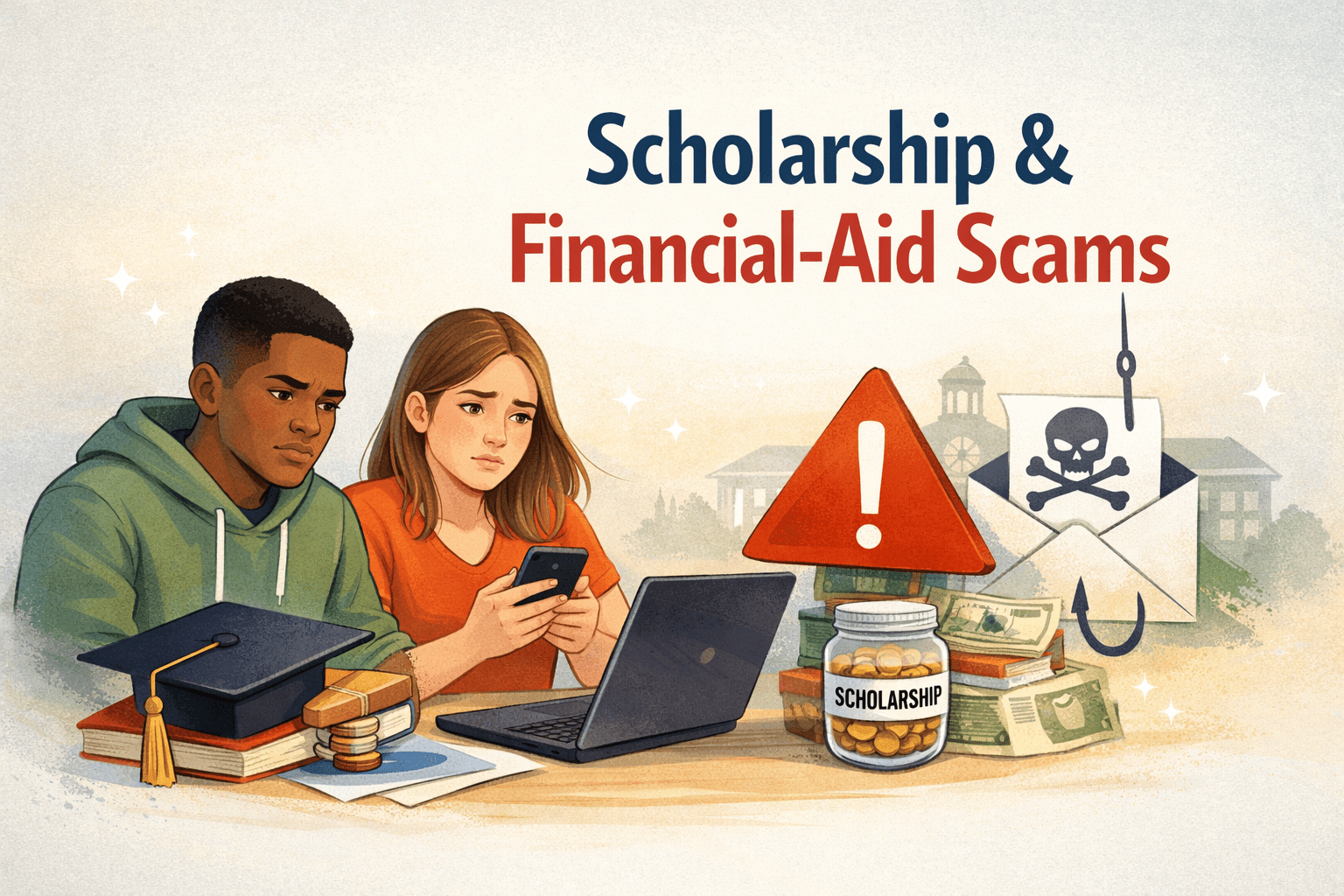
Scholarship & Financial-Aid Scams: Spot ’Em, Dodge ’Em, Report ’Em
Don’t get duped. Learn the top scholarship/financial-aid scam red flags, how to verify legit programs, and how to report fraud (FTC, StudentAid.gov).
Read this first
- Never pay to apply for a scholarship. Real aid doesn’t charge “processing” or “redemption” fees. If they guarantee an award or ask for money up front, bounce. Consumer Advice
- No “free government money.” The U.S. government doesn’t hand out personal-use grants via DMs/texts. USAGov
- Protect your FSA ID. Don’t share your login or pay anyone for “special access” or “forgiveness.” If it’s about federal student aid, rely on StudentAid.gov guidance. Federal Student Aid+1
- Report scams at ReportFraud.ftc.gov. If your identity may be at risk, start recovery at IdentityTheft.gov. IdentityTheft.gov
🚩 Common scam moves (and what legit looks like)
- “Pay to apply / guaranteed winner” → Real scholarships don’t charge application fees or guarantee awards. Consumer Advice
- “Exclusive government grant—act now!” → Government doesn’t DM you money; beware “grant processing” fees or gift-card/crypto/Zelle requests. USAGov
- Phishing for FAFSA/FSA ID → Scammers spoof logos to steal your login or SSN. Federal aid reminders: verify senders and never share credentials. Federal Student Aid
- Debt-relief up-front fees → Illegal for companies to charge before providing student-loan “relief.” Consumer Advice
- Fake check “overpayment” → They send a check, ask you to refund part, and the check later bounces—classic con (seen in BBB alerts). Better Business Bureau
✅ How to verify a scholarship (60-second script)
- Find the official site via your school’s financial-aid office listing or a well-known association, then cross-check on the org’s own site. Federal Student Aid specifically recommends using official sources. Federal Student Aid
- Scan rules: Who’s eligible, what docs are required, who’s funding it? Vague rules + payment requests = 🚩. Consumer Advice
- Confirm contacts: Email domain and phone route to a real org (not free webmail). For anything federal-aid related, compare with StudentAid.gov guidance. Federal Student Aid
- When unsure: Ask your financial-aid office to sanity-check the offer; they literally advise this. Federal Student Aid
🧰 If you already clicked / paid / shared info
- Stop the money: Contact your bank/credit card to dispute/stop payments.
- Secure accounts: Change FSA ID & email passwords; enable 2-step verification (StudentAid.gov offers security tips). Federal Student Aid
- Report it: File at ReportFraud.ftc.gov (fraud/scams). If personal data may be misused, start a recovery plan at IdentityTheft.gov. ReportFraud.ftc.gov, IdentityTheft.gov
- Tell your FA office: They can flag patterns and warn other students. Federal Student Aid encourages using your school as a legit checkpoint. Federal Student Aid
- Optional: Submit to BBB Scam Tracker to warn others. Better Business Bureau
🧪 “Red flag → Do this” quick-glance
| Red flag | Do this |
|---|---|
| “Pay a fee to claim your award” | Walk away; report to ReportFraud.ftc.gov |
| “Guaranteed scholarship / limited-time DM” | Verify with your FA office; ignore pressure tactics |
| “Send gift cards/crypto/Zelle” | Don’t send; real orgs don’t collect this way |
| “Log in with your FSA ID here” | Only use StudentAid.gov; reset password if shared |
| “Government grant for personal bills” | It’s a scam; see USA.gov warning and report |
(See detailed guidance from FTC, StudentAid.gov, and USA.gov for each red flag.) Consumer Advice, Federal Student Aid, USAGov
Scholarship & Financial-Aid Scams in the United States: A Data-Driven Research Synthesis, Threat Taxonomy, and Prevention Framework (2026)
Scholarship and student-financial-aid scams exploit a predictable vulnerability: families facing high tuition costs and strict deadlines, operating in information-dense environments where “help” is widely advertised and legitimacy is hard to verify. This paper synthesizes U.S. complaint, enforcement, and program-integrity evidence to characterize the modern scam ecosystem across the financial-aid lifecycle (search → application → verification → disbursement → repayment). Using Federal Trade Commission (FTC) Consumer Sentinel Network data, FBI Internet Crime Complaint Center (IC3) reporting, and U.S. Department of Education (ED) fraud-control actions, we show that (1) the broader fraud backdrop is massive and rising—FTC-reported fraud losses reached $12.5B in 2024, while IC3 recorded $16.6B in reported cyber-enabled losses; (2) channels most used by students—email, text, social media, and websites/apps—are also dominant scam vectors with substantial reported losses; and (3) identity-based aid fraud (including organized “fraud rings”) has become sufficiently systemic that ED has implemented nationwide identity-validation changes for federal student aid. We conclude with a layered prevention framework designed for students, families, schools, scholarship providers, and platforms.
Keywords: scholarship scams; FAFSA fraud; identity theft; imposter scams; student loan relief scams; program integrity; consumer fraud; higher education finance.
1. Introduction: Why scholarship and aid scams persist
The U.S. college-financing system is structurally attractive to scammers for three reasons:
-
High stakes + urgency. Families make time-pressured decisions about scholarships, FAFSA, and enrollment deposits. Scarcity cues (“24 hours,” “last chance”) therefore work unusually well.
-
Fragmented legitimacy signals. Legitimate aid is administered by federal agencies, state agencies, colleges, and private foundations, each with different websites, processes, and email practices—making impersonation easier.
-
Data-rich processes. The scholarship and aid lifecycle involves personally identifiable information (PII), identity documentation, and account credentials (e.g., FSA ID). A single credential compromise can enable account takeover, identity theft, or refund diversion.
This paper treats “scholarship & financial-aid scams” as a portfolio of related frauds—some aimed at small, high-volume payments (fees), others aimed at credential theft and identity exploitation, and others aimed at extracting large “service” payments (loan relief).
2. Data sources and methodological notes
This synthesis relies on three complementary evidence streams:
-
FTC Consumer Sentinel Network (CSN). Complaint-based data collected from consumers and partner organizations. It is not a survey and consists of unverified reports, but it provides scale, trends, and channel patterns.
-
FBI IC3 annual reporting. Complaint-based cybercrime reporting that aggregates losses and volumes across internet-enabled crime categories.
-
U.S. Department of Education program-integrity actions. Press releases and Federal Student Aid (FSA) guidance describing detected fraud patterns and policy responses (identity verification flags, disbursement controls, and institutional reporting obligations).
Limitations (important): Complaint systems undercount total victimization (many victims do not report), and category labels do not perfectly isolate “scholarship scams” as a standalone bucket. Therefore, the strongest empirical approach is triangulation: look at (a) overall fraud magnitude and channels, (b) education-specific scam guidance and enforcement, and (c) program-integrity controls triggered by observed fraud.
3. The macro fraud environment students are operating inside
3.1 Scale of reported losses
FTC data show consumers reported losing $12.5B to fraud in 2024, a 25% increase over the prior year, with the share of fraud reporters indicating a monetary loss rising to 38%.
IC3 reported 859,532 complaints and $16.6B in losses in 2024, with an average loss of $19,372 among complaints reporting a loss.
These totals are not “student-only,” but they define the ambient risk environment in which scholarship and aid-related scams flourish.
3.2 Why students are not “too young to be targeted”
FTC’s 2024 CSN Data Book reports that, among people who reported their age, those 20–29 reported losing money to fraud in 44% of reports—higher than older groups’ frequency of loss (even though older adults can have higher median losses when victimized).
This matters for scholarships because high school seniors (often 17–18) and college students (18–24) are heavily exposed to social media DMs, texts, email outreach, and “application help” marketing.
3.3 Channel patterns match student behavior patterns
FTC’s 2024 CSN Data Book shows that when a contact method is identified, fraud reports commonly involve email, phone calls, texts, social media, and websites/apps—and the aggregate reported losses associated with social media and websites/apps are each in the hundreds of millions to billions of dollars.
This aligns with how scholarship scams are typically distributed: social posts, influencer ads, “application portals,” lead-gen forms, and message-based outreach.
4. A lifecycle taxonomy of scholarship & financial-aid scams
A useful analytic lens is the financial-aid lifecycle, because scam techniques cluster by stage.
Stage A — Discovery scams (searching for money)
Common forms
-
“Exclusive scholarship list” or “match service” that charges a fee or harvests data.
-
Fake scholarship pages boosted via ads or social posts.
-
“You’ve been selected” messages that funnel students into paid “processing.”
Mechanism
Scammers monetize either through fees or by building identity/credential datasets that can be resold or used for downstream fraud.
Red-flag language (high diagnostic value): FTC identifies phrases like “guaranteed,” “you can’t get this information anywhere else,” and “pay a processing fee” as classic scam signals.
Stage B — Application scams (submitting materials)
Common forms
-
Application fee demands (often framed as “verification,” “redemption,” or “holding” a scholarship).
-
Fake contests with “finalist” notifications for contests never entered.
-
Scholarship “seminars” that are high-pressure sales pitches.
FTC explicitly advises: never pay to apply for a scholarship and treat “processing fees” as a strong scam indicator.
College Board similarly notes that requests for bank account numbers “to charge a processing fee” are a scam hallmark and that government aid does not charge such fees.
Stage C — FAFSA / aid-filing impersonation and credential theft
Common forms
-
“FAFSA filing help” that asks for your FSA ID username/password.
-
Fake “Department of Education” calls/texts promising grants to replace loans.
-
“Verification” messages pushing students to click look-alike links.
ED’s guidance emphasizes scam avoidance resources and identity-theft risk reduction for FAFSA applicants.
Because the FSA ID can enable account changes, credential theft can become a gateway to broader identity misuse and aid manipulation.
Stage D — Disbursement fraud (identity theft, “ghost students,” and refund diversion)
This is where scholarship scams intersect with program-integrity fraud: not just individual victims paying fees, but organized misuse of aid systems at scale.
Evidence of systemic identity-based fraud has driven major ED actions:
-
ED reported a review uncovering nearly $90M disbursed to ineligible recipients, including thousands of deceased individuals, and described restoring/strengthening automated screening controls.
-
ED announced that for fall 2025 it would implement new identity validation processes and reported identifying ~150,000 suspect identities in FAFSA forms marked for required identity verification before aid disbursement.
-
FSA issued guidance resuming identity-verification flags and reminded institutions of reporting obligations for suspected fraud (including identity theft), pointing schools to verification procedures and OIG reporting expectations.
Why this matters to families: even if you never pay a scammer, your identity can be weaponized, and tighter verification processes can increase legitimate students’ administrative burden (extra ID checks, delays) during peak enrollment periods.
Stage E — Repayment scams (student loan relief/forgiveness)
Common forms
-
“Loan forgiveness” companies charging upfront fees for services borrowers can access for free through servicers/ED.
-
Impersonators claiming affiliation with ED or known servicers.
-
Pressure to stop communicating with your servicer and pay the “helper” instead.
StudentAid.gov and CFPB guidance converge on key warnings: you should never have to pay for help with federal student aid, and you should verify communications and avoid sharing passwords.
5. The scam business model: why “small fees” can be rational and profitable
Scholarship scams often appear “low-dollar” (e.g., $10–$50 fees), which can reduce victims’ skepticism and increase conversion rates. The economics are straightforward:
-
Low friction: small payments feel reversible and “worth the chance.”
-
High scale: social ads + mass messaging create volume.
-
Upsell potential: once a victim pays once, scammers can introduce “verification fees,” “expedite fees,” or “premium matching.”
At the same time, broader fraud data show scammers prefer payment rails that reduce reversibility. FTC reports that bank transfers/payments and cryptocurrency account for very large aggregates of reported losses, consistent with scammer incentives to push irreversible payment methods.
A key empirical pattern is distributional: FTC’s median reported fraud loss in 2024 was $497, while total losses exceeded $12.5B—a sign of a heavy tail where a smaller share of cases generate very large losses.
Scholarship scams can serve as the “front door” to that tail by collecting identity and financial details that enable larger follow-on fraud.
6. Behavioral mechanisms: how scams convert in the scholarship context
Scholarship and aid scams reliably employ classic social-engineering levers:
-
Authority: “Department of Education,” “Financial Aid Office,” “National Scholarship Board.”
-
Scarcity/urgency: “deadline tonight,” “limited slots,” “act in 2 hours.”
-
Reciprocity: “we already pre-approved you,” “you’ve been selected.”
-
Cognitive overload: long forms, dense legal text, confusing “verification” steps.
-
Commitment escalation: small initial payment → larger payments → credential sharing.
The FTC explicitly warns that high-pressure seminar environments and “pay now or lose out” tactics are common scam features in the scholarship/aid space.
7. Institutional and equity implications
Two forces can collide:
-
Fraud pressure increases controls. ED’s identity validation initiatives reflect a belief that stolen-identity fraud rings are sufficiently severe to “imperil” Title IV programs.
-
Controls can impose burden. More identity verification can delay aid packaging, create documentation hurdles, and disproportionately affect students with limited access to technology, stable housing, or rapid document retrieval.
A policy-relevant research question is therefore not simply “how do we reduce fraud,” but “how do we reduce fraud without reducing access.” ED’s stated goal is to reduce burden while protecting taxpayers, but the effectiveness and distributional effects require ongoing evaluation (e.g., changes in verification rates, processing times, and enrollment outcomes by institution type).
8. Prevention: a layered framework for students and families
Below is a prevention model designed for real workflows—searching, applying, filing FAFSA, and responding to outreach.
Layer 1 — Verification (is it real?)
-
Prefer primary sources: scholarship sponsor’s official site, college financial aid office pages, and StudentAid.gov for federal processes.
-
Treat “guaranteed scholarship” claims as disqualifying.
-
Be wary of look-alike domains, social accounts, and ads that mimic official seals.
Layer 2 — Payment safety (how are they asking for money?)
-
Do not pay “processing,” “redemption,” “holding,” or “application” fees for scholarships.
-
Treat requests for gift cards, crypto, wire transfers, or “bank transfer only” as high-risk patterns consistent with broader fraud.
Layer 3 — Credential protection (what are they asking you to share?)
-
Never share your FSA ID password or let someone “manage” your StudentAid.gov account. Student aid help is available without surrendering credentials.
-
Use unique passwords and multi-factor authentication where available.
Layer 4 — Minimization (reduce the data you hand out)
-
A legitimate scholarship may need contact info and academic details; it rarely needs SSN, bank login, or full credential access up front.
-
When in doubt, pause and verify through an independent channel (call the sponsor using a number on their official site, not the message you received).
9. Response and reporting: what to do if you suspect a scam
Fast action increases recoverability and reduces identity damage.
-
Stop contact and document everything (screenshots, emails, payment receipts).
-
Report the fraud through:
-
FTC fraud reporting pathways and guidance for recovery steps.
-
FBI IC3 for internet-enabled fraud patterns.
-
StudentAid.gov scam reporting/support resources for student-aid-specific issues.
-
-
If credentials/identity may be compromised, prioritize account security and identity-theft steps (password resets, account monitoring, and appropriate identity reporting).
Institutions also have obligations: ED/FSA guidance reminds schools to complete required verification for flagged applicants and to report suspected fraud to oversight entities as required.
10. Recommendations for stakeholders beyond the individual student
For high schools, counselors, and college access organizations
-
Integrate scam literacy into FAFSA nights and scholarship workshops.
-
Use “live verification drills” (show real vs fake emails, domains, and forms).
-
Provide a vetted local list of legitimate scholarship sources and sponsor contacts.
For colleges and financial aid offices
-
Implement secure communication norms (signed emails, standardized sender domains, portal-based messaging).
-
Treat refund-diversion risk as an operational security problem (account change controls, step-up verification).
-
Maintain rapid response channels for students who report suspicious outreach.
For scholarship providers and platforms
-
Adopt verifiable legitimacy signals: domain verification, consistent sponsor email patterns, and public awardee history where appropriate.
-
Platforms hosting scholarship ads should strengthen advertiser verification, reduce impersonation, and add friction for high-risk claims (“guaranteed,” “instant approval”).
For policymakers and regulators
-
Expand secure data-sharing for eligibility/identity checks while measuring access impacts.
-
Focus enforcement on impersonation and advance-fee structures, which repeatedly surface in student loan relief fraud.
Conclusion
Scholarship and financial-aid scams are best understood as an ecosystem that exploits cost pressure, institutional complexity, and identity-rich processes. The data-driven picture is clear: reported consumer fraud losses are enormous; student-relevant channels (email/text/social/web) are central distribution routes; and identity-based aid fraud has escalated to the point of driving nationwide federal control changes. Effective prevention therefore cannot be reduced to “be careful.” It requires layered defenses—verification, payment safety, credential protection, minimization, and rapid reporting—paired with institutional and platform accountability. In practical terms, the strongest single heuristic remains the simplest: legitimate scholarships and federal aid do not require you to pay for access, “hold” funds, or unlock benefits—especially not under pressure.
🧠 Smart habits that keep you safe
- Keep FAFSA & FSA ID private; don’t pay third parties to “file for you.” Federal Student Aid has free, official help. Federal Student Aid
- Use 2-step verification on your StudentAid.gov and email accounts. Federal Student Aid
- Bookmark official hubs so you don’t follow spoofed links later.
- If it’s hype + hurry + money, it’s probably a scam. FTC’s consumer advice page says to walk away. Consumer Advice
🔗 Helpful resources (official, verified Aug 20, 2025)
- FTC: How to Avoid Scholarship & Financial Aid Scams — step-by-step red flags + reporting. Consumer Advice
- StudentAid.gov: Avoiding Student Aid Scams — examples and protective steps. Federal Student Aid
- FTC: ReportFraud.ftc.gov — file scam reports (screenshots, receipts help). ReportFraud.ftc.gov
- IdentityTheft.gov — personalized recovery plan if your data was exposed. IdentityTheft.gov
- USA.gov: No “Free Money” Grants — how fake “government grants” work. USAGov
- BBB Scam Tracker — report/lookup scholarship scams in your area. Better Business Bureau
- FTC: Paying for School & Avoiding Scams — illegal up-front fees for “debt relief.” Consumer Advice
❓FAQ (fast + friendly)
Is it ever OK to pay a scholarship application fee?
No. FTC guidance is clear: don’t pay to apply or to “unlock” an award. Real scholarships don’t charge you. Consumer Advice
Someone DM’d me about a “federal grant” for bills. Real?
No. The government doesn’t hand out personal-use grants by DM/text. That’s a scam—report it. USAGov
A company says they’ll do my FAFSA for a fee—worth it?
No. Use StudentAid.gov (free), and your school’s aid office can help. Don’t share your FSA ID with anyone. Federal Student Aid
I clicked a phishing link and entered my FSA ID. What now?
Change your password immediately, enable 2-step verification, and watch for suspicious activity. If identity theft is possible, start at IdentityTheft.gov. Federal Student AidIdentityTheft.gov
I already paid a “processing fee.” Can I get it back?
Act fast: contact your bank/issuer to dispute, then report at ReportFraud.ftc.gov; also log with BBB Scam Tracker to warn others. ReportFraud.ftc.govBetter Business Bureau