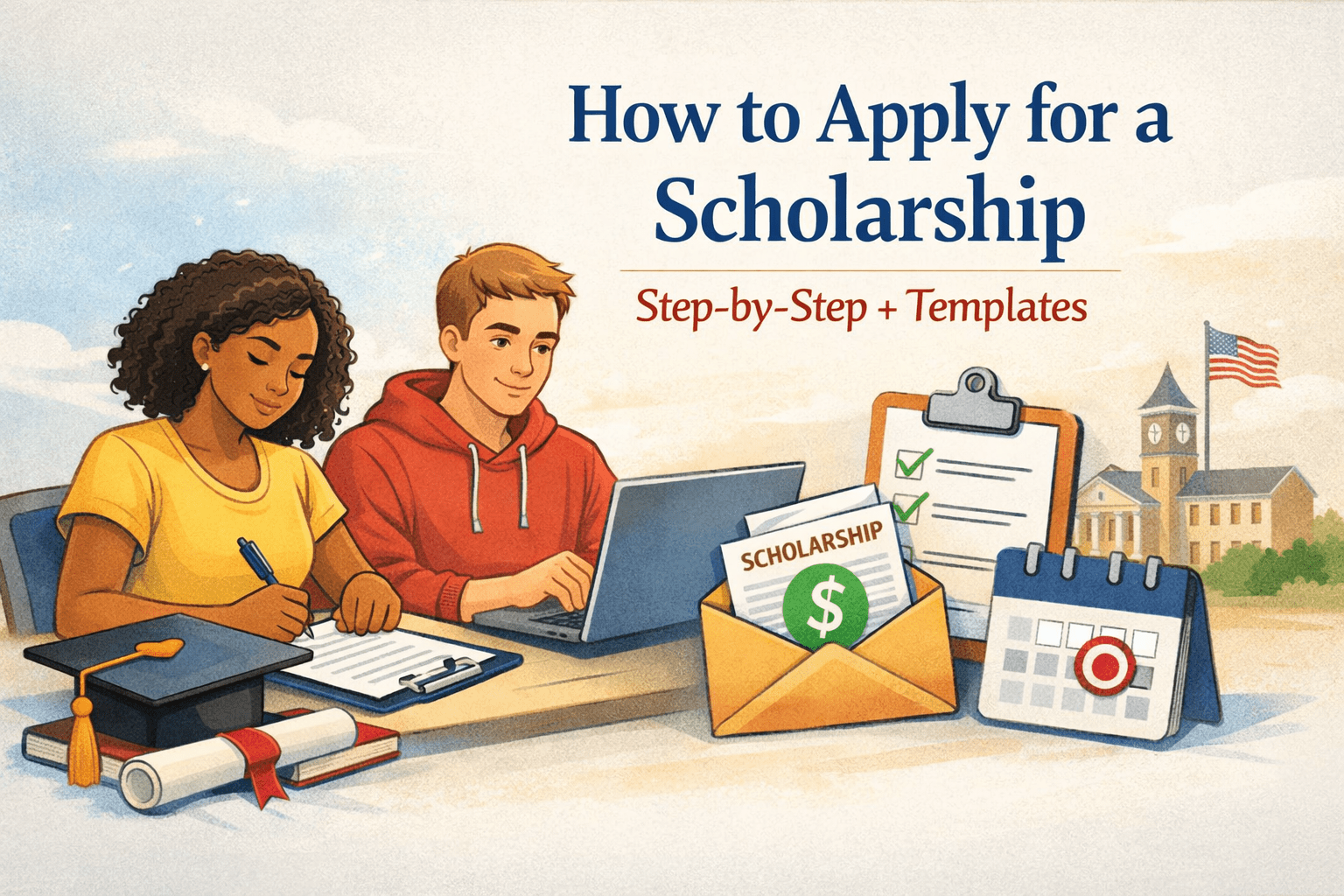
How to Apply for a Scholarship (Step-by-Step + Templates)
🚦 Before You Start
- Know the types: scholarships (free ),grants(free), grants (free ), work-study (earn ),loans(borrow), loans (borrow ). For scholarship basics + hunt tips, start here. Federal Student Aid
- Some programs require FAFSA/CSS Profile: even private awards may ask for FAFSA to confirm need; some colleges & scholarship orgs use the CSS Profile for institutional aid. CSS Profile, Federal Student Aid
🪜 8-Step Scholarship Playbook
-
Make a short-list (30–60 min).
Search school financial-aid pages, your department page, state programs, and reputable hubs (then verify on the official site). Federal Student Aid outlines places to look. Federal Student Aid -
Read the fine print (eligibility + criteria).
Check class year, GPA/major, citizenship/ residency rules, portfolio/test reqs, and docs (transcript, résumé, recs). “What they value” = your essay angle. Good FSA tip: stay organized. Federal Student Aid -
Calendar the deadline + mini-deadlines.
-
Draft due, recommender ask, transcript request, proofread, submit 48–72h early (in case a portal glitches).
-
-
Lock your FAFSA / CSS Profile (if required).
-
- FAFSA: free + widely used; do it early. Federal Student Aid
- CSS Profile: required by many private colleges/scholarships for institutional aid. CSS Profile
-
Write the essay (show receipts).
Use the mini-template below. Tie your receipts (impact, numbers, outcomes) to what the sponsor funds (mission, field, community need). FSA’s scholarship tips: tailor + stay organized. Federal Student Aid -
Ask for recommendation(s) the right way.
Ask early, share the prompt + your bullet achievements + deadline, and clarify submission steps. (Counselor/teacher rec guidance from national orgs backs early, specific requests.) NACAC Learn -
Proof + submit.
Confirm name spelling, file names, PDF formatting, word counts, and portal “Submitted/Received” status. Submit a day or two early. -
Track + follow up.
Keep a tracker (scholarship, amount, deadline, status, next steps). If required docs change, upload immediately and re-confirm status.
✍️ Scholarship Essay Mini-Template (copy/paste)
- Hook (1–2 lines): the moment or problem you’re solving.
- Why me (impact receipts): 2–3 bullets with numbers (e.g., “Scaled tutoring club → +38% pass rates”).
- Why this scholarship: mirror their mission/criteria in your own words.
- Future plan: 1–2 concrete next steps + how funds enable them.
- Close: values/legacy in one crisp sentence.
Tip from FSA: understand criteria + stay organized so your application matches the sponsor’s goals. Federal Student Aid
💌 Recommender Request (DM/Email Template)
Subject: Scholarship Rec Request — [Your Name] — Due [MM/DD]
Hi [Prof/Coach/Counselor Name],
I’m applying for the [Scholarship Name] to support [major/goal]. Would you be willing to write a strong recommendation? The prompt highlights [qualities]; I’ve attached:
3–5 bullets of recent impact
Resume & short bio
Deadline: [MM/DD] (submission link below)
Thank you for considering!
[Your Name] | [Phone] | [Portal Link]
(Professional orgs emphasize early, specific, and helpful requests.) NACAC Learn
🧾 Résumé Quick Build (1 page)
Top: name, email, phone, city/state, LinkedIn/portfolio (if relevant).
Education: school, grad year, GPA (if helpful), key courses.
Experience/Leadership: bullets with action verbs + impact numbers.
Projects/Competitions: brief one-liners with outcomes.
Awards/Skills/Certs: relevant + current.
🔐 Scam-Proof Your Search (non-negotiable)
Never pay to apply or to “guarantee” a scholarship.
Avoid “everyone wins” pitches, pressure to act now, or requests for bank/SSN outside secure portals.
When in doubt, back out and check with your counselor or FA office. Official FTC guidance here. Consumer Advice
✅ Final Pre-Submit Checklist
Eligibility confirmed (GPA/major/year/location)
Essay answers the exact prompt (and mirrors sponsor criteria)
FAFSA/CSS done if required (and added colleges) Federal Student AidCSS Profile
Recs requested (due date + link shared) NACAC Learn
Transcript/resume uploaded (PDF, named cleanly)
Submitted 48–72h early; confirmation received
📚 Helpful Resources (official + verified today)
Federal Student Aid — Scholarship Tips & How to Find
https://studentaid.gov/articles/scholarship-tips/ • https://studentaid.gov/help-center/answers/article/how-to-find-scholarships — ✅ Verified Aug 20, 2025. Federal Student Aid
FAFSA (apply/check status)
Federal Student Aid— ✅ Verified.
CSS Profile (some colleges/scholarships use for institutional aid)
CSS Profile — ✅ Verified.
Consumer Advice: Avoid Scholarship Scams (FTC) — ✅ Verified.
How to Apply for a Scholarship: An Evidence-Based, Systems Approach to Winning Aid
Scholarships are often framed as “free money,” but the application process behaves more like a competitive selection market shaped by information gaps, administrative burdens, and uneven access to advising. This paper synthesizes the best-available national data on student aid participation, grant and scholarship funding flows, and application frictions to present a research-informed, step-by-step scholarship application system. We treat “applying for scholarships” as an end-to-end production process—sourcing opportunities, screening fit, packaging credentials, producing persuasive materials, submitting accurately, and complying post-award—then show how applicants can increase expected returns by reducing friction, improving targeting, and building a diversified application portfolio. Key quantitative context includes: (1) in 2019–20, 72% of U.S. undergraduates received some type of financial aid, with an average total aid amount of $14,100 among aid recipients; (2) in 2024–25, total grant aid reached $173.7 billion, with roughly half originating from colleges/universities (institutional grants); and (3) FAFSA completion rates remain far from universal—about 54% of the high school class of 2025 had completed the FAFSA by late June—implying many students are structurally excluded from aid pathways that use FAFSA-linked eligibility.
1. Why “how to apply” matters: scholarships live inside a larger aid system
Scholarships rarely operate in isolation. They sit alongside federal grants and loans, state programs, and institutional aid—often with shared documentation requirements and overlapping eligibility rules. National data underscore how central aid is to access: nearly three-quarters of undergraduates received some form of financial aid in 2019–20, and among those receiving aid, average total aid was $14,100.
At the macro level, the biggest pools of “non-repayable” funding are not only private contests; they are grants embedded in federal policy and institutional pricing strategies. In 2024–25, total grant aid supporting postsecondary students was $173.7 billion, and College Board estimates that 49% of that total came from colleges and universities (institutional grants), with 31% from the federal government, 10% from state governments, and 10% from employers/other private sources.
Implication: a data-driven scholarship strategy must prioritize institutional and state pathways (which are often “hidden” inside admission + FAFSA processes) alongside external scholarships.
2. The scholarship application as a “production function” (and why most people underperform)
Think of scholarship outcomes as the result of inputs and constraints:
-
Inputs: time, information (knowing what exists), compliance capacity (documents), writing quality, and signaling (leadership, service, goals, identity, fit).
-
Constraints: deadlines, eligibility rules, recommendation access, verification steps, and psychological load.
-
Output: probability of award × award amount (plus renewability and non-cash benefits).
A key reason applicants underperform is not lack of merit, but friction. Public-policy research on administrative burden describes how “learning costs” (figuring out what to do), “compliance costs” (forms and documentation), and “psychological costs” (stress, stigma, uncertainty) reduce participation in programs even when individuals are eligible. Scholarship applications replicate these frictions: every extra transcript request, recommender reminder, essay prompt variation, and portal upload is a burden tax.
Therefore, the most effective “how to apply” advice is operational: reduce friction, standardize outputs, and build a repeatable pipeline.
3. The hidden gatekeeper: FAFSA completion and eligibility access
Many major scholarships and grants—especially need-linked awards—depend on FAFSA completion, directly or indirectly. Yet FAFSA completion is far from universal. College Board reports an estimated FAFSA completion rate of 54% for the high school class of 2025 as of late June (vs. 47% for the class of 2024), and also documents systematic differences by school characteristics (e.g., higher-income public high schools outperforming low-income schools, and lower completion in towns/cities vs rural/suburban settings).
Scholarship takeaway: If a student doesn’t complete FAFSA early, they may lose access not just to Pell and federal aid, but also to state grants, institutional scholarships, and any external scholarship that uses FAFSA-derived financial need or EFC/SAI screening.
4. Competitiveness is real: why portfolio strategy beats “one perfect application”
Prestige scholarships can be extremely selective. For example, the Coca-Cola Scholars Program selects 150 scholars from an applicant pool reported as 105,000+ in a recent cycle—well under 1% selection.
This does not mean students should avoid competitive scholarships. It means students should treat scholarships like a portfolio:
-
Tier A (high prestige / low probability): national brand-name awards, full-ride style programs.
-
Tier B (mid-selective / moderate probability): regional, professional associations, employer-sponsored awards.
-
Tier C (local / higher probability): community foundations, local businesses, rotary clubs, school-based awards.
-
Tier D (institutional): scholarship grids embedded in admission + FAFSA + departmental nominations.
Portfolio logic is rational under uncertainty: you cannot perfectly predict fit or committee preferences, so you increase expected winnings by increasing quality-adjusted volume while keeping effort efficient.
5. A doctorate-level workflow: the 10-stage scholarship application system
Stage 1: Build an opportunity universe (search, then structure)
Most students search; few structure. The research-backed improvement is to convert scattered opportunities into a dataset.
Minimum fields to track:
-
Scholarship name, sponsor, URL, deadline, amount, renewability
-
Eligibility flags (grade, state/county, major, identity/service criteria)
-
Required artifacts (essay, transcript, recommendation, FAFSA, portfolio)
-
Submission method (portal/email/mail) and verification steps
Because institutional grants represent nearly half of total grant aid nationally, include the institutional layer in your “universe”: admissions scholarship pages, department pages, honors program awards, and financial aid office grids.
Stage 2: Screen for fit using a “friction-adjusted expected value” rule
A practical decision rule is:
Friction-adjusted expected value (FAEV) = (Award × Estimated probability) ÷ (Hours required × Deadline risk)
You can’t know probability precisely, but you can approximate with:
-
competitiveness clues (e.g., national brand awards are often ultra-selective)
-
eligibility narrowness (narrow = fewer applicants)
-
committee alignment (mission fit, program goals)
A local $1,000 award that takes 45 minutes can outperform a $20,000 award that requires weeks of work and has a <1% chance—unless the larger award is renewable or unlocks network benefits.
Stage 3: Create a master applicant profile (single source of truth)
This is a control mechanism against administrative burden. Build one “profile packet” containing:
-
150–250 word bio (general) + 50-word short bio
-
Activity list with outcomes (numbers, impact, hours)
-
Leadership/service “impact bullets” (problem → action → result)
-
Honors/awards list
-
Work history + responsibilities
-
A “why this major/career” paragraph and a “why this community” paragraph
The objective is to reduce learning/compliance costs by reusing validated content.
Stage 4: Assemble a document vault (and standardize naming)
Most avoidable disqualifications are clerical: missing pages, wrong file types, unreadable uploads.
Vault checklist:
-
Unofficial transcript PDF + instructions for requesting official transcript
-
Test scores (if relevant)
-
FAFSA confirmation / Student Aid Index info if required
-
Resume (1 page for many scholarships; 2 pages for older students)
-
Proof documents (ID, residency, service hours log) if commonly requested
Name files consistently: LastName_FirstName_Scholarship_Transcript.pdf, etc.
Stage 5: Build a recommender system (not a one-off ask)
Recommendations are a supply chain. Your job is to reduce “recommender burden”:
-
Ask early with a one-page “brag sheet” + resume + deadline list
-
Provide 3 bullet points you hope they’ll emphasize
-
Use a tracking table for submission status
This increases the probability of timely, higher-quality letters because it reduces compliance costs for the recommender—an administrative-burden concept applied to your network.
Stage 6: Write essays with a rubric-first method (argument, evidence, fit)
A scholarship essay is typically scored on variations of:
-
mission alignment (fit with sponsor goals)
-
impact evidence (specific outcomes, not vague claims)
-
trajectory (why this funding changes the next step)
-
voice and clarity (readability under reviewer time limits)
Operational technique:
-
Write a one-sentence thesis: “I will use X to achieve Y because Z.”
-
Provide 2–3 evidence blocks with numbers (hours, dollars raised, people served).
-
Explicitly connect your story to the sponsor’s mission.
-
End with a forward-looking “return on investment” statement.
Stage 7: Submission engineering (quality control)
Before submitting, run a 7-point QA checklist:
-
Eligibility verified (including geography and enrollment status)
-
Word count and formatting compliant
-
PDFs open correctly and are readable on mobile
-
Names match exactly across documents
-
Recommendations requested and confirmed
-
Deadline time zone confirmed
-
Screenshots or confirmation email saved
Stage 8: Interview readiness (for finalist stages)
For programs with finalist interviews, create a “3×3” prep:
-
3 stories (challenge, leadership, service)
-
3 goals (academic, career, community)
-
3 proof points (numbers, outcomes, constraints overcome)
Stage 9: Post-award compliance: disbursement, renewals, and taxes
Some scholarships require enrollment verification, GPA thresholds, or periodic updates. Missed compliance can void funding. Also, not all scholarship dollars are tax-free.
IRS guidance explains that scholarships and fellowships are tax-free only to the extent they are used for qualified education expenses (generally tuition/fees and required course materials), and amounts earmarked for nonqualified costs (such as room and board) can be taxable.
Stage 10: Scam and fraud defense (protect your identity and your aid)
Scams are a predictable risk in scholarship markets. The FTC warns: never pay to apply, never pay “redemption” or “processing” fees to claim a scholarship, and do not share sensitive credentials like your FSA ID; “guaranteed scholarship” language is a major red flag.
Separately, the U.S. Department of Education has publicly described stepped-up fraud controls and identity verification measures in response to large-scale aid fraud—reinforcing that identity security is now part of the aid environment.
6. A data-driven annual timeline (high school seniors and beyond)
Because FAFSA timing influences access to federal, state, and institutional funding, synchronize scholarship work with the aid calendar. College Board notes FAFSA completion metrics are tracked through late June and vary significantly by school context—meaning early action and support can matter.
Suggested cycle (high school):
-
Spring (junior year): build profile + vault, identify recommenders
-
Summer: write core essays; apply to early national programs
-
Fall: heavy submission season; FAFSA opening period; institutional scholarship deadlines
-
Winter: finalist stages; local scholarships open; renewals
-
Spring: last-wave local and community foundation deadlines; award negotiation and verification
For college students, the cycle repeats with departmental scholarships, internships with scholarship components, and association awards tied to major/career tracks.
7. Equity and access: why systems beat “motivation” narratives
Two patterns appear repeatedly in aid data:
-
Aid is widespread but uneven. In 2019–20, 55% of undergraduates received federal aid, 23% received state aid, and 28% received institutional aid.
-
Access to the gateway form is uneven. FAFSA completion differs by school income and locale characteristics, with completion around the mid-50s in some contexts and closer to ~half (or below) in others.
This implies that “how to apply” must also be “how to reduce friction”: standardized packets, checklists, and deadline systems are not just productivity hacks—they are equity tools, because they lower learning/compliance costs that disproportionately harm students with less advising access.
8. Practical metrics: how to know if your strategy is working
Treat scholarship applying like an experiment with feedback loops:
-
Pipeline metrics: # identified → # eligible → # submitted → # advanced → # won
-
Efficiency metrics: hours per submission; dollars won per hour
-
Quality metrics: recommender on-time rate; disqualification rate (aim for ~0)
-
Narrative metrics: which essays advance more often; what themes recur in wins
Even without perfect probability estimates, tracking outcomes across tiers improves targeting over time.
Conclusion
Applying for scholarships is best understood as a system: a pipeline of opportunity discovery, eligibility screening, standardized documentation, persuasive narrative production, error-proof submission, and post-award compliance. National aid data show that grants and scholarships are central to financing education for most students, and that the largest pools of grant aid often flow through institutional structures rather than stand-alone contests—making FAFSA completion and institutional scholarship strategy foundational.
At the same time, administrative burden theory explains why eligible students fail to access funding: learning costs, compliance costs, and psychological load are not “personal shortcomings,” but predictable frictions that can be engineered away with templates, checklists, and a diversified portfolio approach.
Finally, modern scholarship ecosystems require identity and scam defenses: credible agencies warn against paying fees, trusting “guarantees,” or sharing sensitive login credentials, and public enforcement actions underscore the real scale of aid fraud risks.
References (APA-style)
College Board. (2025). Trends in College Pricing and Student Aid 2025.
College Board. (2025, November 6). Trends in College Pricing and Student Aid report: highlights (newsroom).
Federal Trade Commission. (n.d.). How to avoid scholarship and financial aid scams.
Internal Revenue Service. (2024). Publication 970: Tax benefits for education.
Internal Revenue Service. (2025, August 23). Tax benefits for education: Information center (qualified education expenses).
Institute of Education Sciences, National Center for Education Statistics. (2023, July 26). Nearly three-quarters of undergraduates received some type of financial aid in 2019–20 (press release).
QuestBridge. (2025, December 1). 2,550 high school seniors awarded full scholarships… (press release).
The Coca-Cola Scholars Foundation. (2025). Our 2025 Coke Scholars.
U.S. Department of Education. (2025, December 11). Department prevents more than $1 billion in federal student aid fraud… (press release).
University of Michigan, Ford School of Public Policy. (2025, March 20). Herd and Moynihan: A framework to reduce administrative burdens….
❓FAQ (fast + friendly)
Q1) Do I need FAFSA if the scholarship is private?
Often yes. Many colleges and scholarship orgs want FAFSA on file to verify need or package institutional aid with your award. Federal Student Aid
Q2) What’s the CSS Profile and do I need it?
Some colleges/scholarships require the CSS Profile to award non-federal institutional aid. Check each program’s requirements. CSS Profile
Q3) When should I ask for recommendation letters?
Ask 3–4 weeks before the deadline (earlier is better). Share the prompt, your bullets, and due date. National counseling org guidance favors early, specific requests. NACAC Learn
Q4) Red flags for scholarship scams?
Upfront fees, “guaranteed” awards, pressure to act now, requests for bank/SSN via shady forms. The FTC says never pay to apply. Consumer Advice
Q5) What makes a winning essay?
Receipts + fit. Show measurable impact, connect it to the sponsor’s mission/criteria, and outline a realistic plan the funds enable. FSA’s tip: understand criteria & stay organized. Federal Student Aid
Q6) I’m short on time—what’s the minimum I should do?
Pick 3–5 best-fit scholarships, tailor one strong essay, lock your FAFSA/CSS (if needed), and submit 2–3 days early. Use our checklist above.