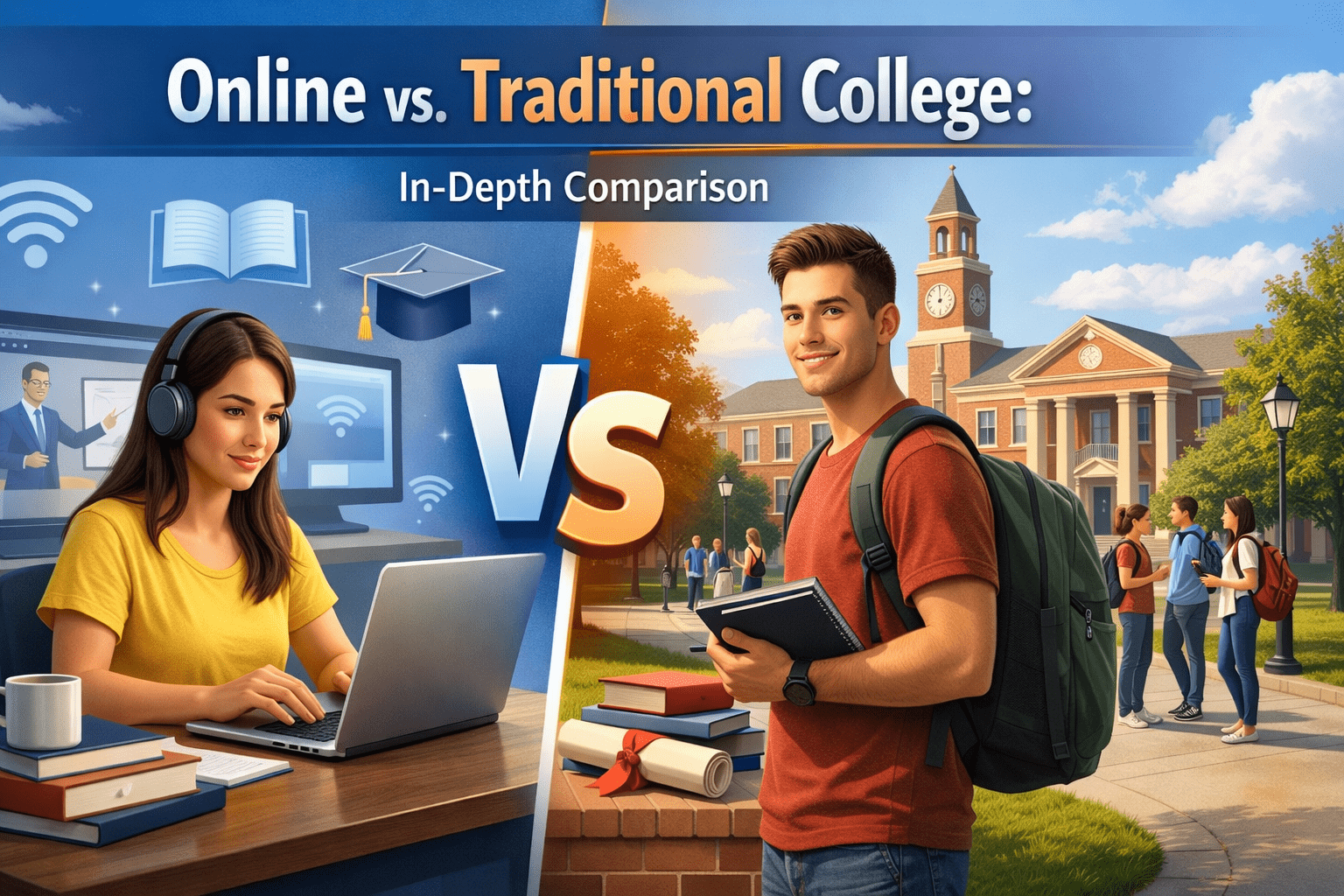
Online vs. Traditional College
Online college (distance learning) has become mainstream: by 2023 about 25.6% of U.S. college students were fully online and over 60% took some online courses. This report examines how online and on-campus college differ in delivery mode, pedagogy, accreditation, and student profiles, and compares key outcomes: cost, time to degree, retention/graduation, learning outcomes, employment, student satisfaction, equity, and mental health. We synthesize peer-reviewed studies and U.S. education data to guide high-school seniors. Major findings: Online programs offer flexibility and often lower costs, but face higher dropout rates and mixed learning outcomes. Many studies show online students earn slightly lower grades and complete degrees at lower rates than in-person peers, though some research finds comparable satisfaction or outcomes when courses are well-designed. Online learning can improve access (especially for working or rural students) but also demands strong self-discipline and good internet access (only ~76% of rural Americans have home broadband). We conclude with clear takeaways and recommendations for choosing the right format.
Definitions & Key Differences
Online college (distance learning): Courses and degree programs delivered via the internet, often using a mix of recorded lectures, live video or chat, discussion forums, and digital assignments. Students may work asynchronously (anytime) or synchronously (live online classes).
Traditional college (on-campus): In-person classes on a physical campus, with fixed schedules, face-to-face lectures, labs, campus facilities, and direct peer/instructor interaction.
Delivery & Pedagogy
- Flexibility: Online students can study from anywhere, often on their own schedule (e.g. early morning or late night), which benefits working adults and parents. Traditional classes meet at set times and locations on campus.
- Interaction: Online courses rely on digital tools: e-mail, chat, forums, video conferencing. This can personalize learning (adaptive quizzes, breakout rooms) but reduces spontaneous in-person contact. In person, students interact directly, fostering immediate feedback, social learning (study groups), and hands-on labs.
- Pedagogy: Online pedagogy often emphasizes self-direction. High-quality programs use interactive modules and frequent check-ins to keep students engaged. Traditional pedagogy can include real-time discussions and physical demonstrations. Research shows some students may struggle with the self-paced nature of online courses, leading to lower pass rates unless well supported.
Accreditation & Quality
- Accreditation: Legitimate online degrees are accredited by the same regional or national agencies as on-campus programs. Many public and nonprofit colleges offer identical curricula online. Students should verify accreditation, as some low-quality “diploma mills” exploit the online label. In fact, most scholarships and financial aid require accredited enrollment, regardless of mode.
- Quality Assurance: Some stakeholders worry about rigor in online programs, but quality varies widely by institution. Well-established universities (e.g. ASU, Penn State, WGU) have robust online campuses and even scholarship pools for distance learners. Accreditation bodies and federal rules apply equally to online and campus offerings.
Student Demographics & Profiles
Online students tend to be nontraditional: older, working, and often attending part-time. For example, the median age of undergraduates in fully online programs is around 30 years (vs. ~18–22 on campus). Many are “adult learners” juggling jobs, family or military service. In Fall 2023, about 1 in 4 four-year undergrads were exclusively online, versus almost none decades ago. Sector matters: online students are disproportionately enrolled in for-profit and community college sectors, which affects demographics (for-profit colleges had 43.4% of their students fully online). In contrast, traditional campuses still enroll a higher share of recent high-school graduates, often living on or near campus.
Comparative Data
Delivery & Cost: Online tuition per credit is often equal to or lower than on-campus tuition, and online students save (or avoid) room & board costs. One analysis found a full academic year of online bachelor’s courses cost about $12,216 (tuition+fees), compared to $18,981 on campus. That means an online degree can cost roughly 64% of the on-campus price. Public universities sometimes charge more for online credits, but avoid campus fees; private schools often charge similar or lower rates online. Importantly, online students incur far less housing/meal costs (since many live at home). A comparative summary (Table 1) shows key differences:
Table 1: Online vs Traditional College (illustrative)
| Aspect | Online College | On-Campus College | Data Source / Notes |
|---|---|---|---|
| Typical Student | Older (30+ median), working, part-time | Younger (18-22), often full-time | Median age ~30 for online |
| Enrollment Share | 25.6% of students exclusively online (2023) | Remaining campus students | |
| Tuition & Fees (annual) | ≈ $12,200 (4-yr, public avg) | ≈ $19,000 (4-yr, public avg) | Online = ~$12.2K/yr vs $18.98K |
| Room & Board | $0 (live off-campus) | ≈ $14,400/yr (median on-campus) | 85% of students live off-campus |
| Time to Degree | Often longer (many part-time, stop-outs) | Typically 4–6 years for bachelor’s if full-time | Cohort studies suggest online learners take longer |
| Retention / Grad Rates | Generally lower: more dropouts, transfers out | Higher rates of on-time graduation | UF study: online-only students completed degrees at lower rates; CC studies find higher failure/withdrawal in online |
| Grades & Learning | Slightly lower average grades on average | Slightly higher grades on average | Francis et al. (math) found online students had lower grades/pass rates |
| Satisfaction | Mixed: many appreciate flexibility; some report high satisfaction | Mixed: more social engagement, but less flexibility | One study found online students were more satisfied overall, though others prefer campus for mental health. |
| Equity & Access | Opens access (rural, disabled, adult); needs reliable internet | Geographic limits; benefits local/regional students | 74% of online students attend in-state; digital divide means 24% rural have no broadband. |
| Student Wellbeing | Lower stress for some; higher isolation risk | Better social support; campus life stressors | Med students had less anxiety online, but many students miss campus community. |
Cost & Financial Aid: Online students enjoy savings on room/commute, but sometimes face higher fees for tech or proctored exams. Most financial aid and scholarships apply equally online (accredited schools), but some awards with residency or campus requirements can exclude distance learners. ScholarshipsAndGrants.us notes many scholarships don’t explicitly ban online students, but they often require criteria that favor traditional students (e.g. on-campus volunteering). In short, online can be cheaper in total cost (no housing, often same or lower tuition), but aid policies vary.
Retention & Graduation: National data show lower persistence and completion rates for online programs. A University of Florida analysis found exclusively online degree-seekers were less likely to graduate than similar students taking any face-to-face classes. Similarly, the Community College Research Center reports that community college students who take online courses are “less likely to complete and perform well” than face-to-face students. Peer-reviewed literature concurs: online students on average earn lower grades and have higher dropout rates. For example, a study of 2,400 community college math students found online students had significantly lower course pass rates than in-person peers (especially adult learners). Another review notes that persistence (course completion) in online classes is “significantly low” compared to face-to-face. These gaps are often small-to-moderate (Cohen’s d ≈0.2–0.3), but translate to real differences: dropout/withdrawal rates can be 10–20% higher online. Methodological note: Many studies are observational (non-randomized); students who choose online are often working or academically underprepared, which can confound results. Some analyses (e.g. instrumental variable studies) suggest these negative differences often persist even after controlling for student backgrounds.
Learning Outcomes: Overall academic mastery is mixed. The Mgutshini (2013) study found online and on-campus students performed equally well on assignments and exams, but online students underestimated their own mastery. In fact, online learners reported higher satisfaction with their course experience, despite feeling less confident about the content. This suggests good online design can yield strong learning (self-directed problem tasks scored better online). On the other hand, some meta-analyses show online courses can modestly underperform classroom instruction on average. In practice, effectiveness depends on design quality: high-engagement, interactive online courses tend to narrow the gap.
Employment Outcomes: Little data directly compare online vs campus degrees in the labor market. Generally, employers value accreditation and degree level over mode. Some industry reports suggest no inherent wage gap after controlling for demographics and field (an online MBA or BS from a reputable college often commands similar pay as its on-campus counterpart). However, public skepticism remains; one survey noted 52% of Americans see online degrees as equally valuable. Continued research is needed, but current evidence implies that earning a degree (any mode) boosts earnings significantly compared to no degree.
Student Satisfaction: Surveys paint a nuanced picture. Some online students cite flexibility and safety (especially introverts or those with social anxiety) as positives, and many report satisfaction rates near or even above on-campus peers. In Mgutshini’s study, online learners reported more overall satisfaction with their learning experience than classroom students. Conversely, other students miss the campus community. A 62-student survey found most favored on-campus education for mental health reasons. Key issues are motivation and isolation: 76% of students in one study said motivation was the biggest online obstacle, and over 40% struggled with staying engaged online. Overall, younger traditional students often value in-person social support, whereas many adult learners prize online convenience.
Equity & Access: Online formats can expand access: students in remote areas, with disabilities, or family/work responsibilities can earn degrees that would otherwise be out of reach. For example, 74% of fully online students attend college in their home state, highlighting that online enables local funding and institutions to serve non-resident learners. However, a digital divide remains. About 24% of rural Americans (and similar shares of low-income families) lack reliable broadband, which limits online learning. Students without quiet study space or technology support can be disadvantaged online. Moreover, since online students are disproportionately first-generation or from underrepresented groups, institutions must ensure extra support (advising, tutoring, connectivity programs) to promote equity.
Mental Health: Online vs. campus impacts on well-being are mixed. One study of medical students found lower anxiety, stress, and daytime sleepiness during online learning compared to campus classes. This suggests online can relieve certain pressures (no commuting, flexible schedule). Conversely, surveys during COVID showed many students felt more stress and isolation online. In Suleymanova et al. (2023), most students reported worse mental health in remote learning and favored returning to campus. In summary, while online study can reduce some stressors, it may increase loneliness for others. Students prone to social anxiety might thrive online, whereas those seeking community may struggle without face-to-face peers and campus life.
Methodological Notes on Studies
Most comparative studies are non-experimental: students self-select into online or campus formats. Researchers try to control for differences, but factors like prior achievement, work status, or motivation can bias results. Sample sizes range from single-course cohorts (30–100 students) to national surveys (NCES’s tens of thousands). Many reports (e.g. InsideHigherEd’s piece) are based on large longitudinal datasets (BPS 2012‑17) tracking thousands. These provide statistical power but still rely on observational comparisons. Common limitations: unmeasured variables (e.g. self-discipline), variation in course quality, and outdated data (the surge of online in 2020 may change patterns). We emphasize findings confirmed across multiple studies and note where results are inconsistent. Where possible, we cite meta-analyses or systematic reviews (e.g. “[27] found online students more satisfied” but “[19] found lower pass rates”). Readers should interpret individual study results as indicative trends, not absolute guarantees.
Recommendations & Takeaways for Students
- Consider your learning style: If you are self-motivated and need flexibility (for work, health, travel), online may suit you. If you thrive on in-person interaction and structure, a traditional campus could be better.
- Look at outcomes: Research suggests on average online students earn slightly lower grades and graduate at lower rates. However, a well-designed online program with strong support can still lead to success. Investigate your chosen school’s online retention and graduation rates (some publish “distance vs campus” stats).
- Cost matters: Online programs often cost less overall (no room/board, lower per-credit tuition in many cases). Always compare total cost of attendance (tuition + living expenses) between options. Also check available online-specific scholarships or aid; many state and institutional grants do allow distance learners.
- Check accreditation: Ensure any online program is regionally accredited. Legitimate online degrees are valued like on-campus ones, but beware unaccredited/diploma-mill operations. Accredited status affects credit transfer, financial aid, and future graduate school.
- Plan for support: Online students often juggle jobs and family. Use available resources (online tutoring, advising, mental health counseling). Build a disciplined schedule and find study partners or mentors (even online). If digital access is a concern, check if your school or state has programs for internet grants or equipment loans.
- Visit or engage if possible: Even if online, try to connect virtually with faculty/students. For many online programs, occasional on-campus orientations or hybrid meet-ups exist. Participation improves satisfaction and outcomes.
- Balance commitments: Online learning hides the fact that it’s still college: you’ll have deadlines and workload. Make sure to manage time well. Conversely, on-campus students often accumulate debt and live away from home. Reflect on personal readiness for independence vs. support.
High-school seniors should weigh these pros and cons in light of their goals, budgets, and personal circumstances. Key takeaways: Online college can save money and fit nontraditional lifestyles, but it typically requires greater self-discipline and may delay graduation. Traditional college offers community and structure, which can boost motivation but at higher cost. Both paths can lead to good outcomes if chosen and managed wisely.
Suggested On-Site Headings and Meta Description
Page Title: Online vs Traditional College: Costs, Outcomes & What to Choose
H1 Headings (Main Title):
- Online vs Traditional College: Which Path Fits You?
H2 Subheadings (Section Titles):
- Executive Summary: Online vs Campus Education
- What Defines “Online College” vs “Traditional College”?
- Key Differences: Delivery, Pedagogy, and Demographics
- Comparing Costs, Time-to-Degree, and Graduation Rates
- Learning Outcomes and Employment Prospects
- Student Satisfaction, Equity, and Mental Health
- Study Limitations and Methodological Notes
- Recommendations for High-School Seniors
- Meta Description (for SEO): “Compare online and traditional college. Discover key differences in cost, completion rates, outcomes, and student satisfaction. Up-to-date U.S. stats and expert guidance to help high school seniors decide.”
Sources
This report cites U.S. government data and peer-reviewed research. Key sources: U.S. Dept. of Education/NCES (IPEDS) statistics on distance education, a 2024 Institute of Education Sciences report on college outcomes, peer-reviewed studies on online learning outcomes, plus institutional analyses. We also reference on-site research content from ScholarshipsAndGrants.us for context on scholarships and enrollment trends.
Prioritized sources:
- Francis et al., Front. Psychol., 2019 (online vs face-to-face outcomes).
- Mgutshini, Curationis, 2013 (student satisfaction).
- Salih et al., 2024 (med student mental health).
- Suleymanova et al., Contemp. Educ. Tech., 2023 (mental health survey).
- Community College Research Center, 2013 (online retention review).
- EducationData.org, 2025 (cost comparison).
- Inside Higher Ed (UF study summary), 2024.
- ScholarshipsAndGrants.us (online college report), 2026.
- NCES Education Statistics (digital equity).