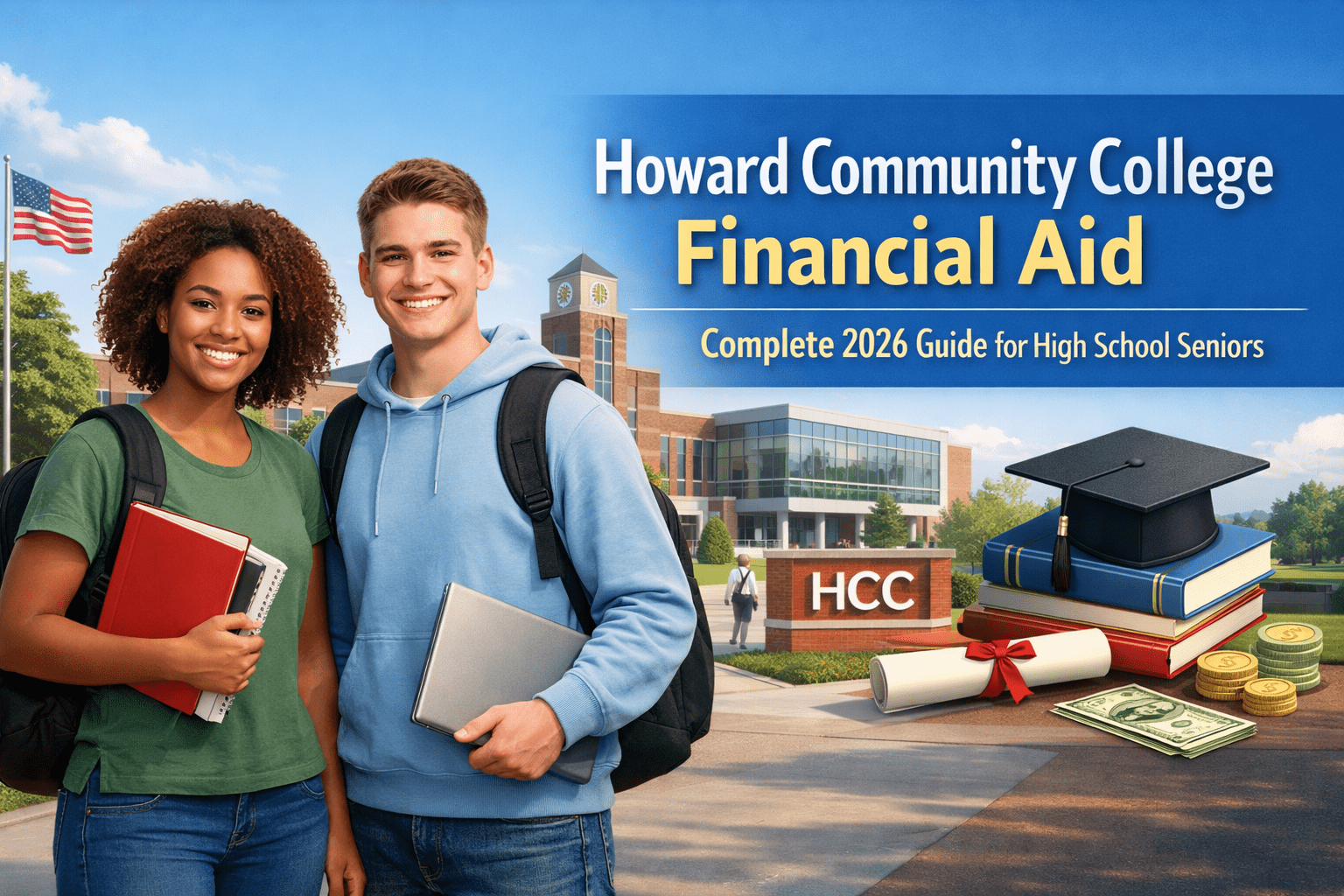
Howard Community College Financial Aid: Complete 2026 Guide for High School Seniors
If you are a high school senior thinking about Howard Community College, the biggest financial aid fact to know is this: start early, file the FAFSA or Maryland One-App, and use HCC’s federal school code 008175. Howard Community College offers federal aid, Maryland state aid, institutional grants, foundation scholarships, student employment, and payment options, but some of the best opportunities depend on filing by March 1 and completing any follow-up steps quickly.
Howard Community College also makes an important distinction that many first-time students miss: not every program is financial-aid eligible. To receive federal aid, you generally must be in an eligible degree or certificate program, have a valid Social Security number, be a U.S. citizen or eligible non-citizen, have a high school diploma or equivalent, and maintain satisfactory academic progress.
Official links you should bookmark
What Howard Community College financial aid really means
At Howard Community College, financial aid is not just one program. It is a package that can include:
-
Federal grants, especially the Pell Grant, which does not have to be repaid in most cases. For the 2026–27 award year, the maximum Pell Grant is $7,395.
-
Federal Work-Study or student employment, which lets eligible students earn money through part-time work while enrolled. Federal Student Aid says work-study jobs are part-time and earnings are not guaranteed unless you actually get hired and work the hours.
-
Federal Direct Loans, which must be repaid. Dependent first-year undergraduates can usually borrow up to $5,500 per year, with no more than $3,500 subsidized; independent first-year students can usually borrow up to $9,500, with no more than $3,500 subsidized.
-
Maryland state grants and scholarships, including the Howard P. Rawlings Educational Assistance Grant, Guaranteed Access Grant, Part-Time Grant, Maryland Community College Promise Scholarship, and some career-field-specific programs.
-
Howard Community College grants and scholarships, including need-based HCC grants and HCC Educational Foundation scholarships. HCC says institutional grants range from $100 to $3,000, and foundation scholarships can range from $100 to $5,000 per year, not exceeding tuition, fees, and books when combined with other grant or scholarship aid.
The smartest way to read an HCC aid offer is to separate the money into three buckets: free money first (grants and scholarships), earned money second (work-study or student employment), and borrowed money last (loans). That order helps you keep future debt lower. Federal Student Aid also explains that aid offers can include grants, work-study, and loans, and that schools make the final determination of the package you receive.
Current posted HCC tuition and fee picture
As of March 15, 2026, Howard Community College’s public tuition page shows these current posted credit tuition rates:
-
In-county: $144 per credit
-
Out-of-county: $278 per credit
-
Out-of-state: $388 per credit
HCC also charges a consolidated fee equal to 19.96% of the in-county tuition rate. For a student taking 12 credits, the consolidated fee is $344.88. For 15 credits, it is $431.10. HCC also says students do not pay more than 15 credit hours in tuition, even if they take more credits.
That means a simple current cost estimate for a typical semester looks like this before extra course fees:
-
12-credit in-county student: about $2,072.88 in tuition plus consolidated fee
-
12-credit out-of-county student: about $3,680.88
-
12-credit out-of-state student: about $5,000.88
HCC also notes that books and supplies are estimated at $2,000 for a year of full-time study, the tuition payment plan has a $30 fee per term, and some classes may carry extra course fees. In addition, courses with the Equitable Access designation carry a $23 per-credit-hour course material fee.
This is exactly why financial aid matters at HCC. For a student with a strong Pell Grant or state grant package, a large share of tuition and mandatory fees may already be covered before loans are even discussed. The best way to estimate your own real cost is HCC’s official Net Price Calculator, which the college defines as cost of attendance minus grant and scholarship aid based on similar students’ prior-year outcomes.
How to apply for Howard Community College financial aid for 2026–27
Howard Community College’s current application instructions say financial aid is an annual process, so you must reapply each academic year. HCC’s current page specifically lists the 2026–2027 application process for Fall 2026, Winter/Spring 2027, and Summer 2027.
Step 1: Complete the FAFSA or Maryland One-App
HCC says students should complete either the FAFSA or the Maryland One-App every academic year. Use HCC school code 008175 on the FAFSA. HCC also notes that students and contributors must provide IRS tax-information consent, or the student will not be eligible for federal aid.
For federal aid in the 2026–27 FAFSA cycle, Federal Student Aid says the FAFSA must be submitted by 11:59 p.m. Central Time on June 30, 2027, and corrections or updates must be submitted by September 12, 2027. But waiting that long is a mistake, because schools and states can run out of limited funds much earlier.
Step 2: File by HCC’s March 1 priority date
Howard Community College strongly urges students to apply by March 1. HCC says filing by March 1 helps students be considered for Maryland state aid and receive priority for HCC Educational Foundation scholarships.
Step 3: Complete the HCC scholarship application
HCC’s application page says students should complete the HCC Scholarship Application after filing the FAFSA or Maryland One-App. HCC policy says foundation scholarship priority is given to students who apply by May 1.
Step 4: Watch MyHCC and your HCC email
HCC says students should check MyHCC and their HCC email regularly for missing documents, required agreements, and award updates. The college also warns that financial aid processing may take up to four weeks, so filing early matters.
Federal aid you may receive at Howard Community College
Federal Pell Grant
The Pell Grant is the most important need-based federal grant for many community college students because it usually does not have to be repaid. For the 2026–27 award year, the maximum Pell Grant is $7,395. Federal Student Aid also explains that some students may qualify for up to 150% of their yearly Pell award if they attend an additional term in the same award year, often called year-round Pell.
For Howard Community College students, Pell can be especially powerful because posted tuition is relatively low compared with many four-year colleges. If your Pell Grant is high and your residency status gives you in-county or in-state tuition, Pell may cover a large portion of tuition and fees before other aid is added. That is one reason HCC repeatedly tells students to file the FAFSA even if they assume they will not qualify.
Federal Work-Study and student employment
Federal Student Aid says Federal Work-Study provides part-time jobs for students with financial need. It is important to understand that work-study is not cash you receive all at once. You earn it through hours worked, usually in a job you must apply for and secure. Federal Student Aid also warns that a work-study amount in an aid estimate is not guaranteed income until you actually get the job and work the hours.
Howard Community College’s student employment page says HCC student employment offers part-time jobs with flexible hours and competitive wages, pays students semi-monthly, and requires students to complete the Student Employment Participation Interest Agreement in Self Service. HCC also says student employment funding is limited and awarded on a first come, first served basis to eligible students.
Federal Direct Loans
Loans are useful, but they should usually come after grants and scholarships. Federal Student Aid explains that subsidized loans do not charge interest while you are in school or during the six-month grace period, while unsubsidized loans start accruing interest when disbursed. For first-year students, dependent undergraduates are generally limited to $5,500, with up to $3,500 subsidized, while independent undergraduates are generally limited to $9,500, with up to $3,500 subsidized.
Howard Community College adds an important local rule: to receive a federal direct loan at HCC, you must be actively enrolled at least half-time, meaning 6 or more aid-eligible credits. HCC’s FAQ also says loan disbursements are generally made at least five weeks after the semester start date or two weeks after certification, whichever is later.
Maryland state aid that can matter at HCC
Maryland residents should pay close attention to state aid because HCC’s March 1 filing date lines up with important state deadlines. The Maryland Higher Education Commission says it offers multiple state grant and scholarship programs for eligible Maryland residents.
Howard P. Rawlings Educational Assistance Grant
MHEC says students must submit the 2026–2027 FAFSA or MHEC One-App by March 1, 2026 to be considered. MHEC’s 2026–2027 one-pager says the Educational Assistance Grant can award up to $3,000 annually.
Howard P. Rawlings Guaranteed Access Grant
MHEC says students must submit the 2026–27 FAFSA or MHEC One-App by March 1, 2026 to be considered for the Guaranteed Access Grant, and required documentation is due by August 1.
Part-Time Grant
MHEC says the Part-Time Grant supports undergraduate part-time students with demonstrated financial need who are enrolled in degree-granting programs, and recipients are selected and awarded by the institution. This matters because many community college students do not attend full-time.
Maryland Community College Promise Scholarship
MHEC describes the Maryland Community College Promise Scholarship as a last-dollar scholarship for eligible students attending Maryland community colleges. MHEC’s current description says it can apply to students planning to enroll or already enrolled full-time or part-time in eligible community college programs, including credit-bearing certificates, associate degree pathways, some licensure or certification sequences, and registered apprenticeships. Because Promise details and deadlines can change by cycle, students should verify the current year directly on MHEC’s Promise page.
Workforce Shortage Student Assistance Grant
MHEC says the Workforce Shortage Student Assistance Grant pays $2,000 per year for students attending a Maryland community college full-time and $1,000 per year for those attending part-time in approved shortage fields. That can be a strong option for students entering high-demand career areas.
Howard Community College grants and scholarships
HCC has its own institutional aid on top of federal and state programs. According to the college, HCC Grants are need-based awards funded by the college’s operating budget, with awards typically ranging from $100 to $3,000. Priority goes to students who apply by the March 1 priority deadline and demonstrate financial need.
HCC also says the Howard Community College Educational Foundation offers scholarships funded by private businesses, civic organizations, foundations, and individuals. These scholarships range from $100 to $5,000 per year and may be based on academic achievement, leadership, and/or financial need. HCC policy says priority is given to students who apply by May 1.
For a high school senior, this means your best strategy is not to choose between federal aid and scholarships. Do both. At HCC, the FAFSA or Maryland One-App is the starting point for many opportunities, and the scholarship application is a separate second step that can add more money on top.
What happens after your aid is awarded
HCC says financial aid begins disbursing after the financial aid census date each semester. Eligible aid is typically applied to the student account within two weeks of the census date, as long as required documentation has been submitted. Aid is applied first to tuition, fees, and bookstore charges, and any remaining balance is refunded to the student using the selected refund method.
Howard Community College also says students with excess financial aid may use up to $1,400 per semester in the campus bookstore, or the amount of excess aid if lower, for eligible books, supplies, and bus passes. Remaining funds are then refunded. HCC states that refunds are generally issued within 14 days after a credit is posted to the student account.
This part matters because many freshmen misunderstand refunds. A refund does not mean college became free. It means your aid exceeded the charges already billed by the college. If you receive a refund, you may still need that money for books, transportation, or living costs later in the term. That interpretation follows HCC’s own explanation that leftover funds often help with books and living expenses.
How to keep your financial aid after you enroll
Howard Community College says students must maintain Satisfactory Academic Progress (SAP) to keep receiving aid. SAP is evaluated at the end of each semester, and HCC uses the student’s cumulative academic record. HCC also reminds students that they must reapply each academic year and maintain eligibility by meeting deadlines and staying enrolled in at least one financial-aid-eligible credit each semester.
HCC also states that financial aid can be used for a maximum of 30 attempted credits of developmental education coursework, and dropping, withdrawing, or never attending classes can affect aid and may require the college to return federal funds.
In simple terms, this means financial aid is not “set and forget.” Your class load, attendance, grades, and pace toward graduation all matter.
What to do if your family’s finances changed
Howard Community College has a Special Circumstances process for students whose FAFSA does not reflect their current reality. HCC says students must submit the FAFSA first before requesting an appeal. Federal Student Aid also explains that schools may review special financial circumstances such as loss of employment, pay cuts, and high unreimbursed medical or dental expenses.
This is one of the most overlooked parts of college funding. If your family’s income dropped recently, do not assume the first aid result is final. File the FAFSA, then contact HCC Financial Aid and ask whether you should submit a special circumstances or income adjustment appeal. HCC’s reminders page specifically tells students with significant income changes from the prior year to contact Financial Aid Services for a review.
Students who are not typical FAFSA filers
Howard Community College says the Maryland One-App / MSFAA pathway is available for applicants who do not meet FAFSA citizenship requirements but do meet certain Maryland residency requirements. HCC also states that undocumented students who meet Maryland in-state tuition rules may be eligible for some state aid and institutional scholarships.
For international students, HCC says students with Permanent Resident, Refugee, or Asylee status are generally eligible to apply for aid and scholarships, while students on F-1, J-1, J-2, or G-series visas are not eligible for federal financial aid, though some may still be eligible for certain institutional scholarships.
Best practical strategy for high school seniors
If you want the simplest path to the most aid at Howard Community College, do this:
-
Apply to HCC and confirm that your intended program is financial-aid eligible.
-
Complete the 2026–27 FAFSA or Maryland One-App as early as possible and list 008175.
-
Aim for March 1 to maximize state-aid and scholarship priority.
-
Complete the HCC Scholarship Application and try to finish it by May 1 for priority consideration.
-
Check MyHCC and your HCC email until every required item is complete.
-
Borrow loans only after you know your grants, scholarships, and work options. Federal loans can help, but they still have to be repaid.
Frequently asked questions
What is Howard Community College’s FAFSA code?
Howard Community College’s federal school code is 008175.
Does Howard Community College offer scholarships?
Yes. HCC offers institutional grants and Educational Foundation scholarships. HCC says institutional grants typically range from $100 to $3,000, and foundation scholarships can range from $100 to $5,000 per year.
Is March 1 really important?
Yes. HCC says students should complete the FAFSA by March 1 to be considered for Maryland state aid and to receive priority for HCC Educational Foundation scholarships.
Can I get financial aid if I attend part-time?
Yes, in some cases. Federal aid eligibility can change based on enrollment, and Maryland’s Part-Time Grant exists for part-time undergraduates with financial need. HCC also says some state, institutional, and private awards have specific enrollment requirements, so students should confirm the details of each program.
Do I need to be full-time to get a federal loan at HCC?
No, but you must usually be at least half-time, which HCC defines as 6 or more aid-eligible credits for student loan eligibility.
What if my parents lost income after the tax year used on the FAFSA?
You should still file the FAFSA first, then contact HCC about a special circumstances or income adjustment review.
How will I receive leftover financial aid money?
HCC says aid is applied to tuition, fees, and bookstore charges first. Any remaining balance is refunded through the student’s selected refund method, and refunds are generally issued within 14 days after the credit posts to the student account.
Final takeaway
Howard Community College can be a financially smart college choice, especially for students who qualify for in-county or in-state tuition, file early enough for federal plus Maryland aid, and complete the HCC scholarship application on time. The most important deadlines are not the final federal FAFSA deadline in 2027, but the much earlier March 1 priority window that affects your real chances of landing state aid and priority scholarship review.
For most high school seniors, the winning formula at HCC is straightforward: FAFSA or Maryland One-App first, grants and scholarships next, part-time work if needed, and loans only after you understand the gap. That approach matches how HCC and Federal Student Aid structure the financial aid process.