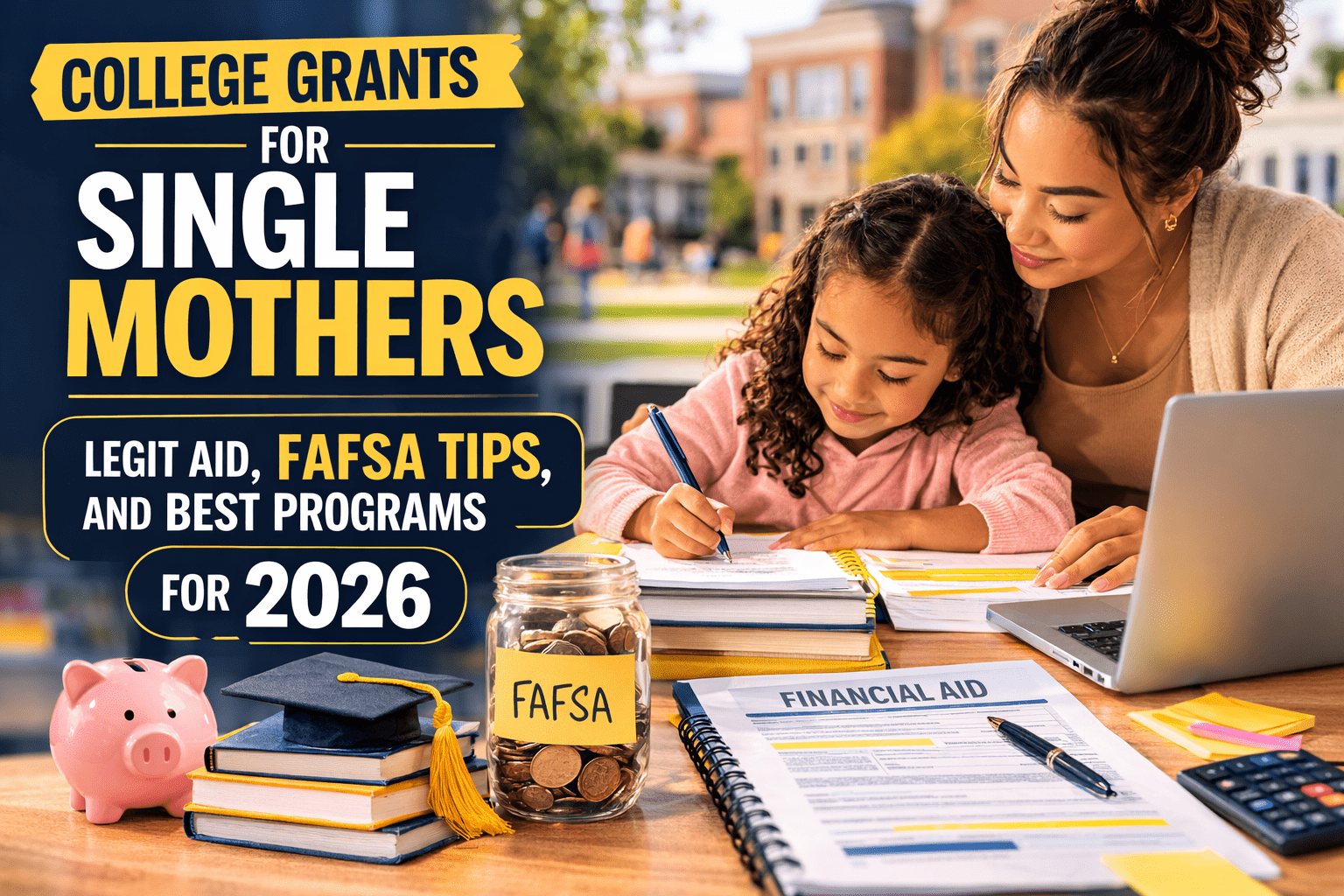
College Grants for Single Mothers: Legit Aid, FAFSA Tips, and Best Programs for 2026
If you are searching for college grants for single mothers, start with one important truth: there is no single national federal grant that only single moms automatically receive. The real money usually comes from stacking multiple sources together: the FAFSA, Pell Grants, state grants, campus-based grants, child care support, and a small number of private programs designed for women supporting children. That is the smartest and most accurate way to think about college funding in 2026.
This matters because single mothers are not a tiny niche in higher education. Recent research based on national student-aid data shows that nearly 1 in 5 undergraduate students are raising children while enrolled, representing about 3.14 million students. Other national summaries show women make up most student parents, and single mothers remain a very large share of that group. In plain English: colleges should already expect parenting students to be on campus, and there are real aid systems built around that fact, even when they are not labeled “single mom grants.”
There is also a strong long-term payoff. Research from the Institute for Women’s Policy Research found that single mothers with a bachelor’s degree are far less likely to live in poverty than single mothers whose education stops at high school. That does not make college easy, but it does explain why finding real grants, reducing child care costs, and choosing affordable schools can change a family’s future.
What “college grants for single mothers” really means
For most readers, this phrase includes four different kinds of help:
-
Federal grants, such as the Pell Grant and FSEOG.
-
State grants, which depend on where you live.
-
College-based aid, including child care support and emergency grants.
-
Private scholarships or education awards that work a lot like grants because they do not have to be repaid.
That is why the best search strategy is not “find one magic grant.” The best strategy is “find every aid stream I qualify for, then stack them.” For a single mother, that usually means going after tuition aid, book money, transportation help, and child care support at the same time.
First, file the FAFSA
If you only do one thing, do this first. The FAFSA is the gateway to the largest pool of aid in the country. Federal Student Aid says submitting the FAFSA can open the door to federal grants, work-study, loans, and often state and school aid too. For the 2026–27 aid year, the federal deadline is June 30, 2027, but many states and colleges use much earlier deadlines and some aid runs out.
A major advantage for many single mothers is that they may be treated as independent students for FAFSA purposes if they have children who receive more than half of their support from them. In practice, that can matter because federal aid calculations for independent students do not require parental income the way dependent student applications do. Check the current FAFSA dependency questions carefully when applying.
The best legit grant sources for single mothers
1) Federal Pell Grant
The Federal Pell Grant is the single most important grant for many low-income single mothers. For the 2026–27 award year, the maximum Pell Grant is $7,395. Pell eligibility is based on federal rules and FAFSA data, not on your GPA, sports record, or essay quality. If your income is modest and you are enrolling in an eligible program, this is the first major source to pursue.
Legit link: Federal Pell Grant information
2) Federal Supplemental Educational Opportunity Grant (FSEOG)
The FSEOG is another federal grant, but it is different from Pell. It is a campus-based grant for undergraduates with exceptional financial need, and colleges usually give first priority to students with the greatest need, often including Pell Grant recipients. Not every school has the same amount of FSEOG money, so applying early matters.
Legit link: FSEOG official overview
3) Ask your school to include dependent care in your cost of attendance
This is one of the most overlooked strategies in college funding. Federal aid rules allow schools to include a dependent care allowance in the student budget for actual child care costs tied to class, study time, commuting, internships, and similar school-related needs. That does not automatically create a new grant by itself, but it can increase documented financial need and make a student’s aid package more realistic. Many student parents never ask for this, even though it can be critical.
Legit link: Federal cost of attendance rules
4) CCAMPIS child care support
The federal Child Care Access Means Parents in School (CCAMPIS) program helps eligible colleges support campus-based child care for low-income student parents. The Department of Education says the purpose of CCAMPIS is to support low-income student parents by providing campus-based child care services, and program materials specify Pell eligibility as part of the student eligibility standard. If your college participates, this can be one of the most valuable supports available.
Legit link: CCAMPIS program page
5) State grants
State aid is a huge piece of the puzzle. NASSGAP reports that states provide billions of dollars in student aid every year, and nearly every state has at least one grant or scholarship program. For single mothers, state grants can be especially valuable because they sometimes stack on top of Pell and institutional aid.
Legit links: NASSGAP and state aid resources
6) Child care subsidies outside the college itself
Single mothers should not think only in “tuition” terms. Lowering child care costs can free up just as much cash as a small scholarship. The federal child care portal explains that families may be able to get help through subsidies and related support programs, and it provides state-by-state resources.
Legit links: ChildCare.gov help paying for child care and state child care resources
7) SNAP Employment and Training (SNAP E&T)
SNAP E&T is not a traditional college grant, but it can help cover the real-life costs that block school progress. USDA says SNAP E&T can support eligible participants with case management, transportation assistance, child care, books, and supplies while they train for work or advance in their careers. That makes it highly relevant for many single mothers in certificate, trade, or community-college pathways.
Legit link: SNAP Employment and Training
8) TANF-related education support
Temporary Assistance for Needy Families, or TANF, is state-run, so benefits vary. But federal guidance and USA.gov both note that TANF-related support can include child care, job training, and in some states help connected to tuition or work-related education. It is not the same in every state, but it is absolutely worth checking.
Legit links: USA.gov TANF overview and ACF guidance on TANF education and training
9) American Opportunity Tax Credit
The American Opportunity Tax Credit is not a grant paid up front by the school, but it can reduce education costs after the fact. The IRS says the AOTC can be worth up to $2,500 per eligible student per year, and up to $1,000 of that can be refundable. For working single mothers, that can be meaningful money at tax time.
Legit link: IRS AOTC page
Legit private programs single mothers should actually check
A lot of websites promise “single mom grants” and then send readers into junk lead forms. Skip those. Start with programs that have clear eligibility rules and real application pages.
Soroptimist Live Your Dream Awards
Soroptimist says it invests more than $3 million each year through the Live Your Dream Awards, helping women who are the primary financial support for their families. The application page states that recipients can potentially receive up to $16,000, and funds may be used for tuition, books, transportation, and child care.
Legit links: Program overview and application page
Patsy Takemoto Mink Education Support Awards
The Patsy Takemoto Mink Education Foundation supports low-income women with children. Its application page states that in 2025 the foundation offered five awards of up to $5,000 each. Because this is a foundation program, readers should always check the current cycle before planning around the amount.
Legit links: Foundation home and application page
One Family Scholars
This Massachusetts-based program provides scholarships and coaching for single parents with low incomes in college. The program specifically says support can help with tuition, fees, laptops, textbooks, and supplies.
Legit links: One Family Scholars and Massachusetts program page
Arkansas Single Parent Scholarship Fund
ASPSF is one of the clearest examples of a real single-parent-focused education fund. The organization says eligible single parents can receive up to $1,600 each semester, and its scholarship page emphasizes flexible support for education and everyday barriers.
Legit links: ASPSF home and scholarship page
The smartest low-cost college strategy for many single mothers
If money is tight, the most practical path is often community college, then transfer. New research shows that over half of student mothers attend community and technical colleges. That makes sense: these schools often cost less, have more flexible schedules, and may be closer to home and child care networks. For many single mothers, the “best” college is not the most famous one. It is the one that keeps debt low and graduation realistic.
How to maximize grants as a single mother
Start with this order:
-
File the FAFSA as early as possible.
-
Apply for your state grant program.
-
Ask the college financial aid office about FSEOG, emergency grants, and student-parent aid.
-
Request a review of your budget if child care is a major expense.
-
Ask whether the school participates in CCAMPIS or has a campus child care center.
-
Check ChildCare.gov and your state human-services agency for child care subsidies.
-
Apply to at least two private programs that support women with children.
-
Use the tax credit if eligible after enrollment.
Common mistakes to avoid
The biggest mistake is waiting for a grant labeled exactly “single mothers only.” That search is too narrow, and it makes readers miss the much larger pools of aid. The second big mistake is treating child care, books, transportation, and emergency cash as separate from college funding. For student parents, those costs are part of whether college is actually affordable. The third mistake is filing the FAFSA late, because campus-based and state funds may run out even though the federal FAFSA deadline is still open.
FAQs about college grants for single mothers
Are there federal grants only for single mothers?
Usually, no. The biggest federal aid sources are need-based grants such as Pell and FSEOG, not a special universal “single mom grant.” But single mothers often qualify strongly for these programs because they are designed around financial need.
Can grants help with child care?
Yes. Help may come through CCAMPIS, a school’s own student-parent support, a dependent-care adjustment in the aid budget, state child care subsidies, or some private education awards that explicitly allow child care expenses.
Do single mothers have to attend full time?
Not always. Many aid rules depend on the program and the school. Community colleges, certificate programs, and some private awards may work for part-time or nontraditional students, but each program has its own rules. That is one reason community and technical colleges are common among student mothers.
What is the best first step today?
Complete the FAFSA, then contact the financial aid office and ask one direct question: “What grants, child care assistance, and emergency aid do you have for student parents?” That question is simple, but it gets you closer to real money than most generic internet searches.
Bottom line
The best way to find college grants for single mothers is to stop looking for one magical program and start building a layered aid plan. File the FAFSA. Chase Pell first. Add state grants. Ask for child care and dependent-care budget adjustments. Look for campus emergency aid. Then apply to a few well-established private programs that support women raising children. That is the real-world formula that gives single mothers the best chance to lower college costs without falling into scam websites or high-debt choices.