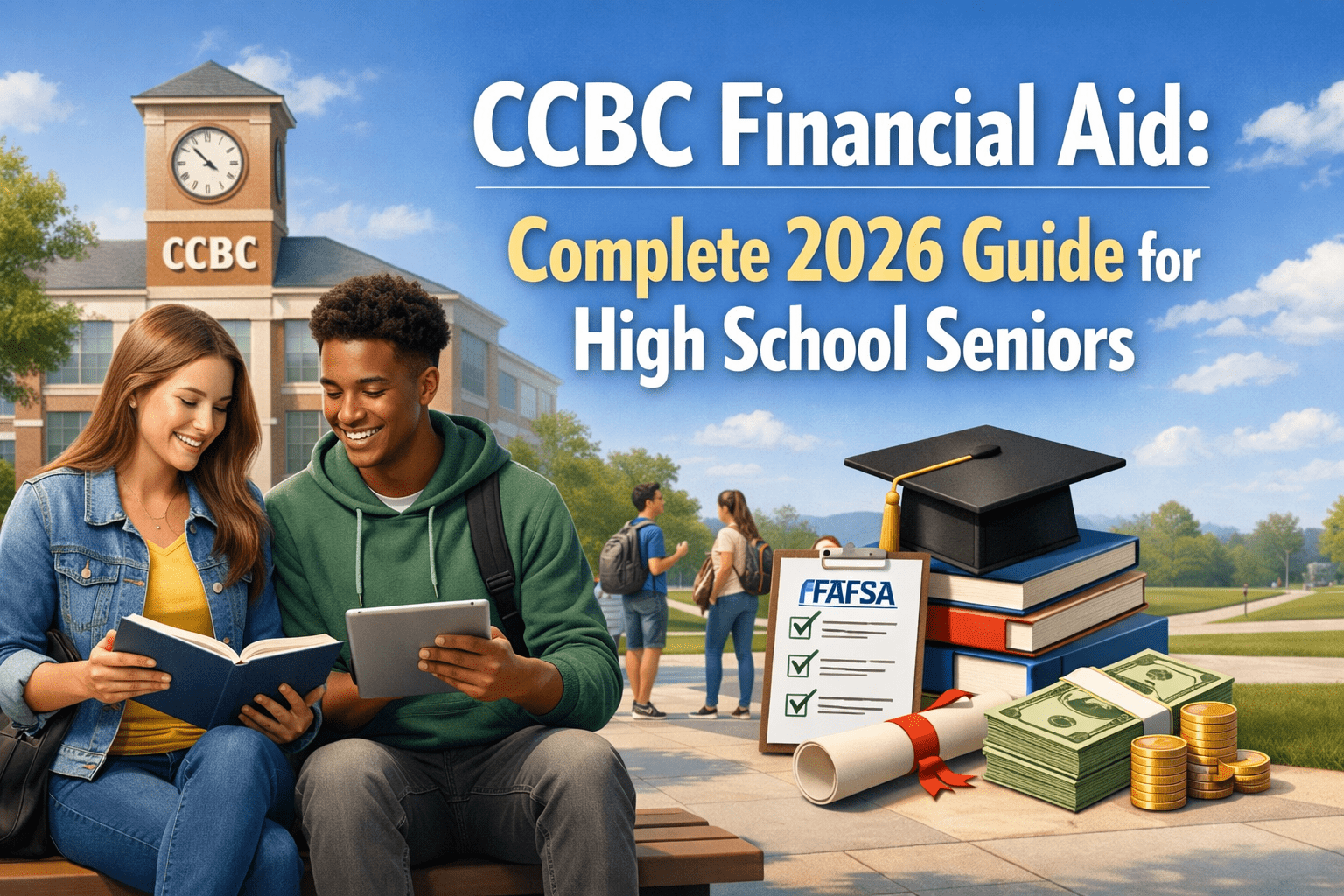
CCBC Financial Aid: Complete 2026 Guide for High School Seniors
If you are a high school senior planning to start college in fall 2026, “CCBC” in this guide means the Community College of Baltimore County in Maryland. CCBC is one of the more affordable public two-year colleges in the region, and the college says students received $51.8 million in aid from federal, state, county, and institutional sources in 2023–24. CCBC also reports that 66% of credit students receive some form of financial aid.
The big idea is simple: at CCBC, financial aid usually starts with the 2026–27 FAFSA, then moves to CCBC’s own scholarship system, Maryland state aid, and any special programs you may qualify for. CCBC’s FAFSA school code is 002063, and the college says that code works for all campuses.
What CCBC financial aid includes
CCBC says its aid options include grants, scholarships, work-study, and loans. In plain English, that means:
-
Grants are usually need-based money you do not repay.
-
Scholarships are money you do not repay, often based on need, merit, program, or donor rules.
-
Work-study lets you earn money through a part-time job.
-
Loans must be repaid, so they should usually be the last option, not the first.
For federal aid, the FAFSA is used to calculate your Student Aid Index (SAI). The SAI is not a bill and not the exact amount your family must pay. It is a formula-based number that helps colleges determine financial need. A lower SAI usually means higher need. Federal Student Aid explains that the SAI ranges from –1500 to 999999.
CCBC costs before aid
CCBC’s published 2025–26 tuition and fee rates show why many Maryland families start here. For Baltimore County residents, the college lists $124 per credit hour. At 15 credits, that works out to $2,598 per semester or $5,196 per year. For Maryland residents from other counties, the rate is $246 per credit, or $4,428 per semester at 15 credits. For out-of-state and international students, CCBC lists $247 per credit for online classes and $377 per credit for in-person or blended classes.
CCBC also reminds students that tuition is only part of the real price. Your cost of attendance (COA) includes tuition and fees, books and supplies, loan fees, food and housing, personal expenses, and transportation. CCBC says its COA estimate is based on 13 credits for an academic year, and your personalized COA appears in your student account after you apply for aid.
That is why FAFSA matters so much. Even at a relatively low-tuition college, grants and scholarships can cover not only tuition but also books, commuting, and other college costs. CCBC also advertises about $14,808 in two-year savings compared with the average public in-state university cost, which is a useful reminder that starting at a community college can be a strong financial strategy.
The most important aid programs for CCBC students
1) Federal Pell Grant
For the 2026–27 award year, the federal government set the maximum Pell Grant at $7,395 and the minimum Pell Grant at $740, effective July 1, 2026 through June 30, 2027. Pell is the most important need-based federal grant for many first-year students because it does not have to be repaid.
2) Maryland state grants
For Maryland residents, two of the biggest state programs are the Howard P. Rawlings Educational Assistance Grant and the Guaranteed Access Grant. For the 2026–27 year, both programs require students to file the FAFSA or MHEC One-App by March 1, 2026, and any required documentation is generally due by August 1, 2026. The Educational Assistance Grant has a maximum annual award of $3,000 and a minimum annual award of $400.
3) Maryland Community College Promise Scholarship
This is one of the most important CCBC-specific opportunities because it is designed to cover remaining tuition after federal and state aid is applied. CCBC says the Maryland Community College Promise can support students in degree and credit certificate programs as well as many workforce certificate programs. For credit programs, CCBC says eligible students can attend full time or part time at 6 or more credits, must be degree- or certificate-seeking, and must meet household income limits of $150,000 or less for a two-parent household or $100,000 or less for a single-parent household.
CCBC also says students pursuing credit programs must usually be Maryland residents, and in many cases Baltimore County residents, unless the program is not offered at the local community college. For recent high school graduates, CCBC lists an initial GPA threshold of 2.3 or higher if the student graduated within the last five years. To keep the Promise award, CCBC says credit students must submit the FAFSA each year, complete the CCBC$FundMe application each academic year, maintain enrollment, keep a 2.5 cumulative CCBC GPA, meet SAP, and finish the program within three years.
4) CCBC scholarships and grants
CCBC’s own scholarship system runs through the CCBC Grant and Scholarship Portal, often called CCBC$FundMe. The college says its scholarship application also connects students to federal and state grants as additional ways to cover costs. The scholarship portal states that FAFSA completion is the first step for any student who is FAFSA-eligible, and that not filing the FAFSA can keep a student from being reviewed for need-based scholarship and grant opportunities.
5) Federal Work-Study
CCBC offers part-time student employment through Federal Work-Study. On its official work-study page, the college says students can work up to 15 hours per week, the hourly rate is $15, and students need to be enrolled in at least 6 credits per semester to qualify.
6) Federal Direct Loans
CCBC participates in the federal Direct Loan program, including subsidized, unsubsidized, and Parent PLUS loans. Federal Student Aid lists the annual borrowing limit for a dependent first-year undergraduate at $5,500 total, of which no more than $3,500 can be subsidized. CCBC also says students must be enrolled in at least 6 credits to be eligible for a student loan.
How high school seniors should apply for CCBC financial aid
Step 1: Apply to CCBC
You need to be admitted before the college can build your financial aid file and award package. CCBC’s own Promise and tuition-free pages start with the same first move: apply for admission and register for classes as soon as possible.
Step 2: Create your StudentAid.gov account
Federal Student Aid says every student needs a StudentAid.gov account before completing the FAFSA online. If you are a dependent student, at least one parent will usually need to be invited as a contributor, and each contributor needs their own StudentAid.gov account.
Step 3: File the 2026–27 FAFSA
For students attending college between July 1, 2026 and June 30, 2027, the correct form is the 2026–27 FAFSA. The federal government says the 2026–27 FAFSA could be submitted as early as October 1, 2025, and the federal deadline is June 30, 2027. CCBC’s school code is 002063.
Step 4: If you are not FAFSA-eligible, use the Maryland One-App route
CCBC’s Promise page says students who are not eligible to complete the FAFSA, including some Maryland Dream Act students, should use the MHEC One-App instead. Maryland’s state aid pages also confirm that the One-App is the state route for students who qualify for Maryland aid but are not eligible to file FAFSA.
Step 5: Complete the CCBC$FundMe application
After FAFSA, CCBC directs students to the CCBC Grant and Scholarship Portal to complete the CCBC$FundMe application. This matters for institutional scholarships, Promise-related processes, and other aid opportunities.
Step 6: Watch your CCBC email and SIMON
CCBC says it communicates about missing items, verification, and awards through CCBC email and SIMON. The college specifically tells students to check both regularly because outstanding requirements can delay aid. If you are selected for verification, CCBC says you must review the requested documents, submit them through the secure upload process, and monitor SIMON for updates.
The deadlines that matter most for the Class of 2026
This is the most important timeline for a high school senior planning to start at CCBC in fall 2026:
-
October 1, 2025: The 2026–27 FAFSA became available. CCBC’s own dates page also lists October 1 as the FAFSA availability date for the 2026–27 cycle.
-
March 1, 2026: Maryland state aid consideration deadline for the 2026–27 cycle. CCBC’s dates page and Maryland’s state grant pages both point students to this date.
-
June 30, 2027: Federal FAFSA deadline for the 2026–27 year.
Because today is March 15, 2026, the March 1, 2026 Maryland priority/state deadline has already passed. That does not mean all aid is gone. It means some Maryland programs may no longer consider a routine on-time application, but students can still pursue federal aid, CCBC scholarships, and in certain cases state appeals.
Maryland’s appeal page says Late FAFSA/MHEC One-App appeals for the 2026–27 cycle opened March 3, 2026 and close July 1, 2026 for certain missed-deadline cases involving the Guaranteed Access Grant and Educational Assistance Grant. Maryland also offers a Special Financial Circumstance Appeal from February 11, 2026 through July 1, 2026 for families with major income changes.
What happens after you file
CCBC says that once your documents are complete, the college will notify you through CCBC email and post awards in SIMON. When you enroll, tuition, fees, and other authorized charges are deducted from your award. If your aid is greater than your CCBC bill, the extra money is sent to you as a refund through direct deposit. If the award covers only part of your bill, you must pay the rest.
CCBC also gives a very practical reminder that your aid is based on the number of credits you are enrolled in by the third week of the regular fall and spring semesters. The college says you cannot receive aid for courses you add after that point, including late-start courses.
If you still have aid left after tuition and fees are applied, CCBC says you may have bookstore credit, with up to $715 for full-time students. That can matter a lot for first-year students who need books, scrubs, tools, or sometimes even a laptop-related expense with documentation.
How to keep your aid once you get it
Getting aid is only half the job. Keeping it matters just as much.
CCBC says students must meet Satisfactory Academic Progress (SAP) to continue receiving aid. On the college’s SAP page, the standards include:
-
completing at least 67% of attempted coursework,
-
staying within 150% of the published program length,
-
and maintaining a minimum cumulative GPA that rises as more credits are completed, reaching 2.00 once a student has completed 45 or more credits.
CCBC also warns that withdrawing, auditing, or receiving incompletes can affect SAP and therefore financial aid eligibility.
Special note for workforce and career-training students
If you are not heading into a traditional associate degree path, CCBC still has important funding routes. The college says some Continuing Education and workforce programs qualify for grants, scholarships, waivers, and workforce funds. CCBC specifically lists CNC Machine Tool, Massage Therapist, Medical Assistant, and Polysomnographic (Sleep) Technician as workforce training programs that are Pell-eligible.
Maryland also runs the Workforce Shortage Student Assistance Grant, which supports students in fields such as child care, human services, teaching, nursing, therapy, social work, and public service. The state says the 2026–27 application opened January 15, 2026 and closes October 15, 2026.
Best strategy for a high school senior right now
For a student reading this in March 2026, the smartest order of operations is:
-
Apply to CCBC immediately.
-
Submit the 2026–27 FAFSA now with school code 002063, even though the Maryland March 1 deadline has passed, because federal aid is still available and CCBC/institutional processes still depend on FAFSA.
-
Complete CCBC$FundMe right away for scholarships and grants. CCBC’s portal says applications may continue to be accepted until funds are awarded.
-
Check whether you qualify for a Maryland appeal if you missed the March 1 state deadline because of special circumstances.
-
Watch SIMON and your CCBC email every few days until your file is complete.
Official pages to use
Use these official pages, not random third-party blogs:
-
CCBC Financial Aid
-
CCBC Scholarships and Grants
-
CCBC Grant and Scholarship Portal (CCBC$FundMe)
-
CCBC Tuition and Fees
-
CCBC Financial Aid for New Students
-
Federal Student Aid FAFSA information
-
Maryland state aid and MHEC One-App information
FAQ
Is CCBC really affordable enough to attend with little or no tuition cost?
For some students, yes. CCBC publicly promotes tuition-free pathways and says many students can cover costs through a mix of federal, state, county, and private funding. The college’s Promise and tuition-free pages make clear that eligibility depends on residency, income, program type, and completing the FAFSA and school scholarship steps.
Do I have to be full-time to get aid at CCBC?
Not always. CCBC says some aid options, including the Maryland Community College Promise for degree and certificate students, can work for students enrolled part time at 6 or more credits. Federal loans at CCBC also require at least 6 credits, and Federal Work-Study requires at least 6 credits per semester.
What if my parents will not help with FAFSA?
Federal rules still require contributor information for most dependent students. CCBC has a Parent Refusal to Complete FAFSA form, but that route generally limits the student to an unsubsidized federal loan only and blocks eligibility for many grants and work-study options.
Can undocumented students get help at CCBC?
Potentially, yes. CCBC says Maryland Dream Act students who are not FAFSA-eligible may use the MHEC One-App, and the college includes Dream Act pathways in its Community College Promise information.
Is transfer aid available later if I start at CCBC first?
Yes. Maryland’s 2+2 Transfer Scholarship is designed for students moving from a Maryland community college to a Maryland four-year institution. For the 2026–27 cycle, the application opened January 15, 2026 and closes October 15, 2026.