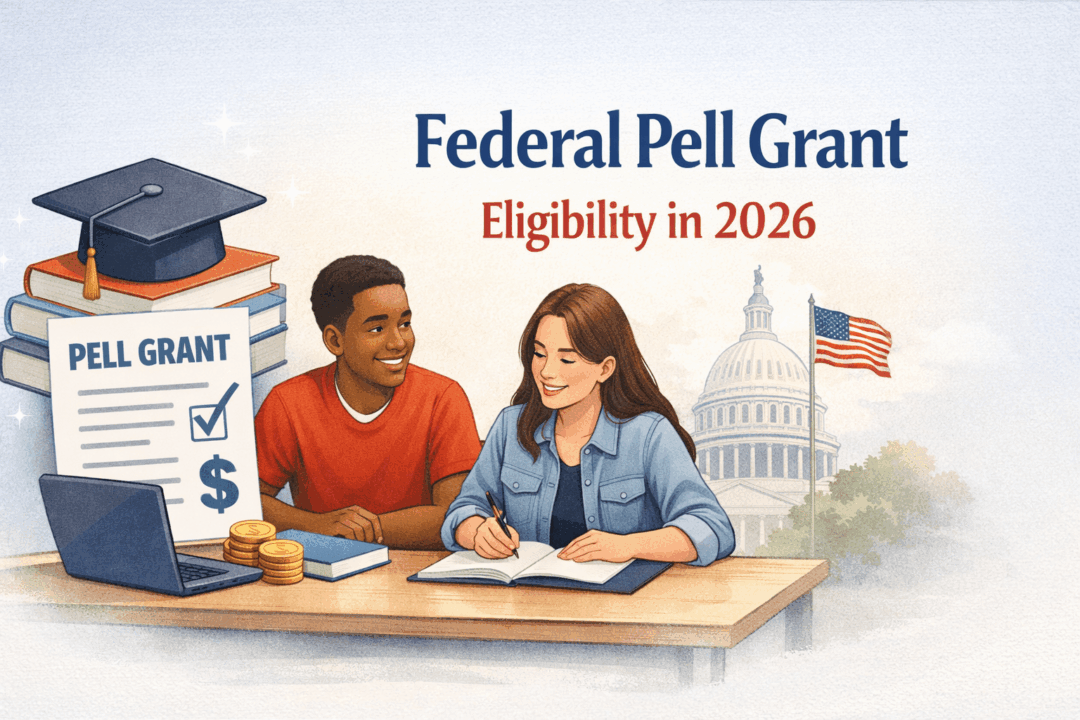
Federal Pell Grant Eligibility in 2026
The Federal Pell Grant is the United States’ largest need-based grant program for undergraduates and a cornerstone of college affordability policy. In FY2023, the program delivered roughly $31 billion to ~6.5 million students, functioning as a quasi-entitlement in which eligible students receive awards calculated under statute rather than capped by a fixed number of slots. In 2023–24, 32.4% of undergraduates received a Pell Grant, with an average award of $5,300, underscoring both the scale of Pell and the continuing role of federal grant aid in widening access.
Eligibility for Pell is not a single test; it is a layered determination shaped by (1) student status (e.g., undergraduate standing, degree history), (2) program and institution eligibility, (3) statutory need analysis (now centered on the Student Aid Index (SAI) and poverty-guideline comparisons), and (4) compliance requirements such as Satisfactory Academic Progress (SAP) and lifetime limits. Beginning in award year 2024–25, the FAFSA Simplification Act restructured Pell determination into three pathways—Maximum Pell, Minimum Pell, and SAI-calculated Pell—reducing reliance on legacy schedules and increasing the importance of poverty-guideline thresholds.
This paper synthesizes the most current federal guidance available as of January 2026, including (a) the 2025–26 maximum and minimum award amounts, (b) the post-2024–25 need-analysis framework, and (c) statutory changes announced for the 2026–27 FAFSA (including an SAI-based ineligibility cap and new asset/income treatments). It concludes with actionable, student-facing implications and policy recommendations aimed at improving take-up, persistence, and equity.
1. Why Pell eligibility matters (and why it’s easy to misunderstand)
Pell is frequently described as “aid for low-income students,” but that shorthand misses how modern eligibility is actually determined. Pell can be triggered through multiple statutory routes; it can vary by enrollment intensity; and it can be reduced by cost-of-attendance limits, lifetime usage limits, or academic progress rules. Even well-informed families often misjudge eligibility because they focus on one variable (income) and ignore others (family size, tax-filing status, assets, dependency status, and statutory poverty thresholds).
From a systems perspective, Pell’s reach is best understood as both broad and targeted: broad because roughly one-third of undergraduates receive it, and targeted because award size is concentrated among students with the greatest measured need. Institutions also use Pell receipt as an operational proxy for socioeconomic disadvantage (e.g., in accountability metrics, campus equity planning, and institutional grant targeting), which means that the technical details of eligibility can influence not only a student’s federal grant aid but also state, institutional, and philanthropic supports that “stack” on top.
2. Program architecture: what Pell is (and is not)
2.1 Statutory foundation and scale
The Federal Pell Grant program is authorized under Title IV of the Higher Education Act and has existed in modern form since the early 1970s. In FY2023 it delivered approximately $31B to ~6.5M students. Pell is generally described as a quasi-entitlement: eligible students receive calculated awards, while federal appropriations must adjust over time to cover costs.
2.2 Pell is a grant, but it’s not “free money with no rules”
Pell does not have to be repaid in typical circumstances, but it is still governed by eligibility rules and administrative controls. Students can lose eligibility if they exceed lifetime limits, fail SAP, withdraw and trigger return-of-aid calculations, or are determined ineligible due to citizenship/status documentation or program ineligibility.
3. The four-layer model of Pell Grant eligibility (the “eligibility stack”)
A practical way to explain Pell eligibility—without oversimplifying—is to treat it as an “eligibility stack” with four layers:
-
Student baseline eligibility (who you are)
-
Program/institution eligibility (where and what you study)
-
Need analysis & award calculation (how much you qualify for)
-
Ongoing compliance (keeping the grant)
A student must clear all layers.
4. Layer 1 — Student baseline eligibility (status, degrees, and special cases)
4.1 Undergraduate status and degree history
The core rule is straightforward: Pell is primarily for undergraduate students who have not earned a bachelor’s (or professional) degree. Federal guidance clarifies that a student with a baccalaureate/professional degree is generally ineligible, even if the degree is from an unaccredited or foreign institution—though institutions may need to evaluate equivalency for foreign degrees.
Edge case: “completed but not conferred.” If a student finishes all requirements for a bachelor’s but delays accepting the degree, the institution must determine whether the baccalaureate course of study has been completed; if yes, Pell ends.
4.2 Postbaccalaureate teacher certification (a narrow Pell exception)
A limited statutory pathway allows Pell for certain postbaccalaureate teacher certification/licensure programs when the program does not lead to a graduate degree, the student is pursuing initial certification, and the offering institution does not also offer a bachelor’s in education (plus additional program-structure requirements). This exception is important for career changers and paraprofessionals moving into teaching, but it is often misunderstood and applies only under specific institutional conditions.
4.3 Incarcerated and confined students (Pell restored)
Beginning July 1, 2023, confined or incarcerated individuals may be eligible for Pell if enrolled in an approved Prison Education Program (PEP), reversing the long-standing ban that began in the 1990s. This change has significant implications for reentry, workforce outcomes, and the equity reach of federal aid, particularly in states where PEP approvals are expanding.
5. Layer 2 — Program and institution eligibility (Title IV basics that can “block” Pell)
Even if a student qualifies on paper, Pell can’t be paid unless the student is enrolled in an eligible program at a Title IV-participating institution.
Key institutional/program conditions (simplified for students and families):
-
Enrollment must be in an eligible degree or certificate program at an institution approved to participate in federal student aid programs.
-
Students generally may not receive concurrent Pell disbursements from two schools at the same time (concurrent enrollment restrictions).
-
Awarding and disbursement are mediated through the school’s financial aid office, which uses FAFSA results and institutional cost-of-attendance components.
6. Layer 3 — Need analysis and award calculation (how Pell is determined in 2024–25 onward)
6.1 The pivot: EFC → SAI, and “three paths” to Pell
Starting in award year 2024–25, Pell eligibility and amounts are determined through three pathways:
-
Maximum Pell Grant (Max Pell)
-
Minimum Pell Grant (Min Pell)
-
SAI-calculated Pell (Calculated Pell = Max Pell − SAI)
This framework is explicitly described in federal guidance and is now central to “Pell eligibility literacy.”
6.2 What the Student Aid Index (SAI) is—and why it can be negative
The SAI is a need-analysis measure derived from FAFSA data (income, certain assets, family size, and other allowances). Federal guidance states that some students are assigned an SAI as low as −1500, especially where tax filing is not required (a marker of very low income).
Important implication: Under the post-2024–25 rules, having a low or negative SAI can place a student on a Max Pell track even before any institution-specific packaging decisions.
6.3 Maximum Pell eligibility (poverty-guideline thresholds and filing status)
Federal guidance specifies Max Pell eligibility rules using a combination of (a) tax filing requirement status and (b) adjusted gross income (AGI) relative to federal poverty guidelines. For example, for dependent students, a Max Pell pathway may apply when parents are not required to file taxes, or where AGI falls at or below specified multiples of poverty guidelines (different thresholds for single-parent vs non-single-parent households).
In short, Max Pell is often triggered by poverty-threshold logic, not by a single universal income cutoff—one reason informal “income charts” online frequently mislead families.
6.4 Minimum Pell eligibility (a safety-net for some higher SAI cases)
If a student does not qualify for Max Pell and their SAI is too high to yield a positive SAI-calculated Pell amount, federal guidance provides a Min Pell pathway based again on poverty-guideline thresholds (with different percentages depending on dependency/parenting status).
6.5 SAI-calculated Pell (the “Max minus SAI” core)
The post-simplification logic is simple in principle:
SAI-calculated Pell = Maximum Pell − SAI, rounded (and subject to other limits)
Federal guidance also notes that if the calculated amount falls below the minimum award level, the student is ineligible for SAI-calculated Pell, but may still qualify for Min Pell if they meet Min Pell criteria.
6.6 Cost of attendance (COA) cap and enrollment intensity
Two additional concepts shape the final amount:
-
COA cap: Pell is reduced so it does not exceed cost of attendance where applicable.
-
Enrollment intensity: Annual Pell is adjusted based on how many credits/hours a student takes. Federal guidance emphasizes that COA is calculated on a full-time, full-academic-year basis, while the student’s award is then adjusted based on enrollment intensity.
Practical takeaway: Two students with the same SAI can receive different Pell amounts if one enrolls part-time or attends a lower-COA program.
7. Layer 4 — Ongoing compliance: SAP, lifetime limits, and “year-round Pell”
7.1 Satisfactory Academic Progress (SAP)
To keep Pell, students must meet SAP policies set by their institution, within federal minimum standards. Federal guidance highlights that SAP includes qualitative measures (e.g., GPA), quantitative measures (pace), and a maximum timeframe (typically no more than 150% of program length for undergraduates), with required evaluation frequency.
Why SAP matters for Pell specifically: Pell is often the aid foundation for students with limited financial margin. SAP loss can trigger a cascade: grant loss → increased borrowing/work hours → higher stop-out risk. This is why advising that ties academic planning to aid retention is an equity strategy, not just a compliance function.
7.2 Lifetime limit (LEU): “about six years” in practice
Federal rules cap lifetime Pell eligibility at 12 semesters (or equivalent). Student-facing federal guidance simplifies this as “about six years total,” reflecting typical full-time enrollment patterns.
7.3 Year-round Pell (up to 150%)
Students may receive up to 150% of their scheduled award within an award year if they attend an additional term and remain otherwise eligible—commonly used for summer enrollment and acceleration strategies.
8. Award amounts and thresholds: what we know for 2025–26 and early 2026–27
8.1 2025–26 maximum and minimum Pell
For 2025–26 (July 1, 2025–June 30, 2026) federal guidance sets:
-
Maximum Pell: $7,395
-
Minimum Pell: $740 (10% of max, rounded rules)
8.2 2026–27 FAFSA updates: a new ineligibility cap and other statutory changes
In an August 15, 2025 Electronic Announcement, Federal Student Aid described statutory changes tied to Pub. L. 119-21, the One Big Beautiful Bill Act (OBBBA), signed July 4, 2025, to be implemented with the official 2026–27 FAFSA launch (by Oct. 1, 2025). Key Pell-related changes include:
-
Foreign earned income exclusion added to AGI when determining Pell eligibility.
-
SAI ineligibility cap: Applicants with an SAI ≥ twice the maximum Pell are ineligible for Pell (with a special-rule exception for certain dependents of deceased servicemembers/public safety officers). For 2026–27, the threshold is $14,790.
-
Asset exclusions for certain family businesses/farms/fishing operations in the SAI asset calculation (family-owned businesses with ≤100 FTE employees, farms on which the family resides, and certain family-owned commercial fishing businesses).
Separately, the Department of Education has described implementation work for a new Workforce Pell program intended to expand Pell access to certain short-term credential programs beginning in July 2026.
Interpretation (carefully bounded by the guidance): The new SAI cap is designed to prevent Pell eligibility at higher SAIs even if other pathways might otherwise generate a small award. Meanwhile, asset exclusions appear aimed at recalibrating how business/farm wealth affects need analysis. The net distributional impact will depend on how many applicants cluster near the cap and how many benefit from asset exclusions—an empirical question for the first 2026–27 cycle.
9. Citizenship and “eligible noncitizen” status: a frequent eligibility gate
A large share of Pell confusion comes from immigration/status categories. Federal rules restrict Title IV aid to U.S. citizens/nationals and certain “eligible noncitizen” categories. The Federal Student Aid Handbook lists eligible categories that include (among others) lawful permanent residents, refugees, asylees, certain parolees, Cuban-Haitian entrants, victims of trafficking, battered immigrants meeting criteria, and certain American Indians born in Canada (Jay Treaty), with additional documentation and verification requirements.
Student-facing implication: Even if a student’s income/SAI suggests Pell, aid cannot be disbursed until status is documented and confirmed under federal rules—so early FAFSA submission and prompt verification responses can matter.
10. Data portrait: who receives Pell (recent national indicators)
10.1 Participation and typical award levels
IPEDS Trend Generator data show that in 2023–24, 32.4% of undergraduates received a Pell Grant and the average Pell amount was $5,300. These figures align with Pell’s role as mass-scale need-based aid rather than a narrow program limited to extreme poverty.
10.2 Total program scale
CRS reports that Pell provided ~$31B in FY2023 to ~6.5M students. That magnitude matters for two reasons:
-
Macro: Pell is one of the largest single levers Congress can pull to affect college affordability.
-
Micro: Pell receipt changes student budgets in ways that influence enrollment intensity, work hours, and the probability of stop-out.
10.3 Pell as a “floor,” not a full solution
Even a maximum award of $7,395 is rarely enough to cover full annual costs at many four-year institutions when tuition, fees, housing, food, transportation, and course materials are included. Federal guidance explicitly frames Pell as foundational aid; other aid types (state grants, institutional grants, work-study, and loans) frequently fill the remaining gap.
11. The most common eligibility failure points (and how to prevent them)
11.1 FAFSA errors that block Pell
Federal guidance notes a simple but consequential pitfall: if an undergraduate student incorrectly reports they are a graduate student or already have a bachelor’s degree, the system may show them as Pell-ineligible until corrected.
Prevention strategy: Student-facing content should emphasize careful review of grade level/degree history fields before submission.
11.2 Asset reporting misunderstandings
Under the post-simplification system, some applicants are exempt from asset reporting based on Max Pell qualification, low AGI, or receipt of certain means-tested benefits. For 2026–27, additional statutory exclusions for certain businesses/farms/fishing operations will further complicate what families think they must report.
Prevention strategy: Publish a “what counts as an asset for FAFSA/SAI” explainer that distinguishes reportable assets, excluded assets, and exempt-from-reporting situations.
11.3 SAP loss (the silent Pell killer)
Many students lose Pell not because they become “too high income,” but because they fall behind academically or accumulate too many attempted credits without completion. Federal SAP requirements—especially pace and maximum timeframe—make academic planning inseparable from aid planning.
Prevention strategy: Pair Pell explainers with course-load guidance, tutoring referrals, and “drop/withdrawal” decision tools that explain aid consequences.
11.4 Lifetime limit surprises
Because LEU is expressed as an accumulation of usage across years and institutions, transfer students and stop-out/return students are at higher risk of running into limits unexpectedly. Federal guidance emphasizes the statutory 12-semester (or equivalent) cap.
Prevention strategy: Encourage students to ask their financial aid office for their current lifetime usage estimate when planning additional semesters or program changes.
12. Practical “eligibility workflow” for students and families (site-ready)
Below is a workflow ScholarshipsAndGrants.us can publish as a high-clarity, low-anxiety guide:
-
Confirm baseline eligibility
-
Undergraduate? No bachelor’s/professional degree?
-
In an eligible program at a Title IV school?
-
-
File the FAFSA early
-
Pell cannot be awarded without a processed FAFSA.
-
-
Read the FAFSA Submission Summary
-
Look for SAI and an estimated Pell range (if shown).
-
-
If selected for verification, respond fast
-
Verification delays can delay disbursement.
-
-
Enroll strategically
-
Pell is adjusted for enrollment intensity; part-time enrollment generally reduces the award.
-
-
Protect SAP
-
Know your school’s SAP policy; seek advising/tutoring early.
-
-
Use year-round Pell intentionally
-
If summer helps you graduate earlier, explore year-round Pell (up to 150%).
-
13. Policy analysis: what the 2026–27 changes likely do (and what to watch)
13.1 The new SAI cap (≥ 2× max Pell)
The 2026–27 ineligibility cap (SAI ≥ $14,790) will most directly affect applicants whose calculated SAI would otherwise still allow some Pell—potentially small awards—under older logic. This appears designed to sharpen targeting and reduce edge-case awards at higher SAIs, but it also introduces a clearer “hard ceiling” that did not exist in the same way in earlier years.
Equity watchpoint: If the cap disproportionately affects certain regions or family structures (e.g., families with higher nominal SAIs driven by specific income types), the distributional effects could be debated, particularly if college prices continue rising faster than grant maxima.
13.2 Asset exclusions for some businesses/farms/fishing operations
The shift to exclude net worth for specified family businesses and farms (where the family resides) can increase eligibility or award amounts for some applicants by lowering the asset-driven portion of SAI.
Implementation watchpoint: Because FAFSA/SAI is operationalized through forms, definitions, and verification, the real impact will depend on documentation standards and how consistently applicants interpret “family-owned” and “controlled” criteria.
13.3 Foreign earned income exclusion added back into AGI for Pell determination
Adding the foreign earned income exclusion amount to AGI for Pell eligibility, as announced, can reduce Pell eligibility or amounts for families previously benefiting from that exclusion.
Administrative watchpoint: Students with international ties may need clearer counseling on how this interacts with tax filing choices and FAFSA reporting.
13.4 Workforce Pell (short-term credentials)
The Department describes work to implement a new Workforce Pell program that would make Pell available for certain short-term credential programs beginning July 2026.
Quality watchpoint: Workforce Pell’s long-term success will hinge on whether eligibility is tied to program quality signals (completion, earnings, licensure passage, job placement), reducing the risk of low-value program expansion.
14. Recommendations for ScholarshipsAndGrants.us content strategy (high-impact additions)
To make this topic genuinely useful (not just accurate), consider publishing a Pell cluster with these assets:
-
“Pell Eligibility Calculator Explainer”
-
Plain-language walkthrough of Max/Min/SAI-calculated paths with 3–5 example households (dependent vs independent; single parent vs non-single parent).
-
-
“Pell + Enrollment Intensity” guide
-
How credit load changes grant amount; why part-time can reduce Pell.
-
-
“SAP Survival Kit”
-
Explain SAP, appeals, academic plans, and how to avoid aid loss.
-
-
“2026–27 FAFSA Changes” update post
-
Focused summary: business/farm asset exclusions, foreign income rule, and SAI cap.
-
-
“Year-Round Pell” acceleration playbook
-
Summer strategy for finishing earlier without exceeding limits.
-
Conclusion
Federal Pell Grant eligibility in 2026 is best understood as an interacting set of eligibility layers rather than a single threshold test. The post-2024–25 framework formalizes three distinct routes to Pell (Max, Min, and SAI-calculated), explicitly tying the most generous awards to poverty-guideline logic and simplifying the core arithmetic of SAI-calculated awards. At the same time, eligibility remains constrained by baseline student status (undergraduate/no bachelor’s), program eligibility, and ongoing compliance requirements such as SAP and lifetime limits.
Looking ahead, announced 2026–27 statutory changes introduce a clearer SAI-based ineligibility cap, revise the treatment of foreign earned income exclusions, and exclude certain family business/farm/fishing assets from SAI calculations—changes that will reshape eligibility edges and require strong student-facing guidance to prevent confusion and missed aid. For a site like ScholarshipsAndGrants.us, the highest-value contribution is translating these rules into decision-ready tools: examples, checklists, “what counts” explainers, and smart warnings about the most common failure points (verification delays, SAP loss, and degree-status mistakes).
References (selected, APA-style)
-
Congressional Research Service. (2024, November 6). Federal Pell Grant Program of the Higher Education Act: Primer (R45418).
-
Federal Student Aid. (2025, January 31; updated May 29, 2025). (GEN-25-02) 2025–2026 Federal Pell Grant Maximum and Minimum Award Amounts.
-
Federal Student Aid. (2025, August 15). (APP-25-23) 2026–27 FAFSA Form and Pell Grant Eligibility Updates.
-
Federal Student Aid. (2024–2025). Federal Student Aid Handbook: Student Aid Index (SAI) and Pell Grant Eligibility.
-
Federal Student Aid. (2024–2025). Federal Student Aid Handbook: Student Eligibility for Pell Grants.
-
National Center for Education Statistics. (2023–24). IPEDS Trend Generator: Pell Grant participation and average award.
-
U.S. Department of Education. (2025, December 12). Press release: Negotiated rulemaking to implement Workforce Pell Grant program.