Free Money for College (2026): Guide to Grants, Scholarships, and “Non-Debt” Aid in the U.S.
“Free money for college” is real—but it is not one thing. It is an ecosystem of non-repayable resources (federal/state grants, institutional aid, private scholarships, service benefits, and select tax and employer benefits) that reduces net price—what families actually pay after aid—often far more than sticker price suggests.
Three headline facts frame the modern affordability problem:
-
Grant aid is large and growing, but uneven. In 2024–25, total grant aid across postsecondary students was about $173.7B, and the federal share of total student aid has declined over the last decade as states/institutions/private sources play larger roles.
-
The Pell Grant remains the backbone of U.S. “free money,” but it rarely covers full costs. The 2025–26 maximum Pell is $7,395 (minimum $740). Yet in 2025–26, the maximum Pell covers about 62% of average in-state public 4-year tuition/fees, but only 29% of average tuition/fees plus housing/food at public 4-years.
-
Billions in free money go unclaimed because students never file the FAFSA. For the high school Class of 2024, NCAN estimated $4.4B in unclaimed Pell Grants associated with non-filed FAFSAs, amid lower completion rates following the 2024–25 FAFSA rollout issues.
This paper builds a rigorous map of the “free money” landscape, explains how the rules work in 2025–26 and what is changing for 2026–27, and offers a practical strategy framework families can follow to maximize non-repayable aid while avoiding common pitfalls (including scholarship displacement and scams).
This research paper synthesizes federal administrative guidance, nationally reported student aid statistics, and applied policy analyses to construct a comprehensive, data-driven model of “free money for college” in the United States for the Class of 2026. Using the conceptual lens of net price (cost of attendance minus non-repayable resources), the paper organizes grants, scholarships, service benefits, tax-based supports, and employer educational assistance into a unified “aid stack” framework. It documents macro-level trends in grant aid, illustrates how Pell and other programs translate into household-level affordability, and analyzes structural frictions—FAFSA completion gaps, administrative complexity, program design differences (first-dollar vs last-dollar), and institutional scholarship displacement—that shape real-world access. The paper concludes with evidence-aligned recommendations for students/families, schools/states, and higher-education institutions, and proposes implementable tools and content modules for ScholarshipsAndGrants.us to operationalize these insights.
Key terms (precise definitions)
-
Cost of Attendance (COA): A school’s official budget (tuition/fees + housing/food + books/supplies + transportation + personal/miscellaneous; varies by residency and living arrangement).
-
Sticker price vs net price: Sticker price is published tuition/fees (and sometimes total COA). Net price is what students pay after grants and scholarships; it is the correct affordability metric. NCES reports average net price by sector and income bands.
-
Free money (operational definition): Non-repayable resources that reduce net price or out-of-pocket cost—primarily grants and scholarships; also includes some service benefits and tax/employer supports that function as non-debt assistance in household budgets.
-
First-dollar aid: Applied before other aid; students can still “stack” additional scholarships for other COA components.
-
Last-dollar aid: Fills remaining tuition/fees after other grants/scholarships are applied; can crowd out/neutralize private scholarships if poorly designed.
-
Scholarship displacement: A reduction in institutional grant aid when outside scholarships appear—often justified as “meeting full need,” but it can weaken incentives for external scholarship seeking.
Data sources and method
This paper uses:
-
College Board Trends in College Pricing & Student Aid (2025) for national aid volumes, Pell coverage metrics, and institutional/state grant patterns.
-
NCES (Condition of Education) for net price and average grant/scholarship aid by sector and income.
-
Federal Student Aid (FSA) guidance (Dear Colleague Letters and Electronic Announcements) for Pell amounts, FAFSA simplification implementation, and 2026–27 changes tied to Pub. L. 119-21.
-
FSA Handbook for campus-based aid rules (e.g., FSEOG).
-
IRS for education tax credits and employer educational assistance rules (including changes enacted in 2025 for §127).
-
FTC consumer guidance for scholarship and financial aid scam red flags.
-
Policy summaries (CRS) for structured analysis of Pub. L. 119-21 changes affecting Pell, need analysis, and workforce Pell.
-
FAFSA completion and “unclaimed Pell” estimates reported by NASFAA summarizing NCAN’s analysis.
Methodologically, we combine descriptive statistics (aid volumes, coverage ratios, net price by income) with program-rule analysis (eligibility, stacking constraints, and policy changes) to generate a practical “aid stack optimizer” framework.
1) The scale of free money: how big is the non-repayable aid economy?
1.1 Grant aid is a central pillar of U.S. college finance
College Board reports that in 2024–25, total grant aid for postsecondary students reached $173.7B, representing an inflation-adjusted increase relative to 2014–15. This figure matters because it contextualizes scholarships/grants not as “rare windfalls,” but as a mainstream financing channel—larger than many families intuit.
1.2 But grant aid does not eliminate affordability pressure—because costs include living
One of the most common misunderstandings is treating “tuition covered” as “college covered.” The Pell coverage ratio makes the point stark: in 2025–26, the maximum Pell covers a majority of average in-state tuition/fees at public 4-years, but only a minority of tuition/fees plus housing/food. Students still face large living-cost gaps, especially in high-cost metro areas.
1.3 Most Pell recipients do not receive the maximum
Even the maximum-award narrative overstates typical Pell help. College Board notes that in 2022–23, 28% of Pell recipients received the maximum award; many receive smaller awards due to enrollment intensity (part-time) or SAI-based eligibility.
2) Net price: the affordability metric that explains why “free money” feels confusing
NCES net price statistics show why some families are shocked by aid letters and others assume aid is “impossible.”
-
For 2021–22, NCES reports average net price (grants/scholarships removed) around $15,200 at public 4-years, $12,700 at public 2-years, and $29,700 at private nonprofit 4-years (all-student averages).
-
Net price is highly income-graded. In 2021–22, for example, at public 4-years the average net price for students from families earning $30,000 or less was about $9,700, while the highest income band (over $110,000) averaged about $20,100.
A key implication for ScholarshipsAndGrants.us readers: aid optimization is not primarily about finding a mythical “full ride”; it’s about building the best stack that shrinks net price and stabilizes cash flow.
3) Federal “free money”: the foundation layer
3.1 Pell Grant (the backbone)
For 2025–26 (July 1, 2025 through June 30, 2026), FSA set:
-
Maximum Pell: $7,395
-
Minimum Pell: $740
Under FAFSA simplification, Pell is determined via (i) maximum Pell rules tied to poverty guidelines and family structure, (ii) an SAI-calculated Pell (max minus SAI), or (iii) minimum Pell under statutory minimum criteria.
Year-round Pell: Students can potentially receive up to 150% of their scheduled award in an award year if otherwise eligible. This matters for students who accelerate credits, attend summer, or recover from “stop-out” risk.
3.1.1 What changes for 2026–27 (important for Class of 2026 planning)
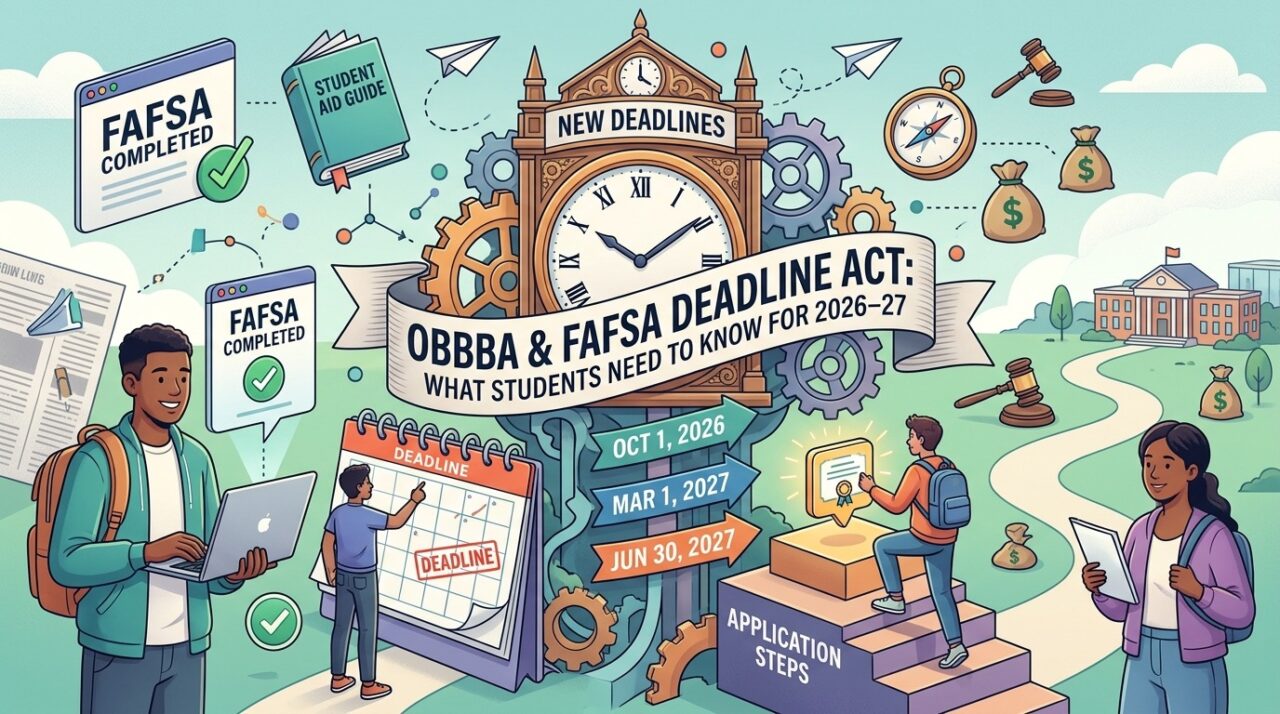
Federal Student Aid announced key Pell and FAFSA updates required by Pub. L. 119-21 (One Big Beautiful Bill Act), implemented with the 2026–27 FAFSA launch by Oct. 1, 2025. Notable items include:
-
Need analysis asset changes: exclusion from FAFSA assets of certain small family business/farm/fishing net worth (with specified criteria).
-
Pell eligibility changes: inclusion of foreign earned income exclusion in AGI for Pell eligibility; and ineligibility for applicants with SAI ≥ 2× the maximum Pell (threshold noted as $14,790 for 2026–27).
CRS further summarizes that Pub. L. 119-21 authorizes Workforce Pell and makes other targeted eligibility changes.
Practical meaning: Families should treat 2026–27 as a rule-change year. If your audience includes seniors and gap-year students, it’s worth publishing a dedicated “2026–27 aid changes” explainer and updating calculators accordingly.
3.2 Federal Supplemental Educational Opportunity Grant (FSEOG)
FSEOG is campus-based (limited funding, awarded by schools). The FSA Handbook notes:
-
Typical maximum $4,000/year (up to $4,400 in qualifying study-abroad circumstances); minimum $100 (proration allowed).
Because it’s campus-allocated, two students with identical financial need can receive different FSEOG outcomes depending on institution and timing. This makes early FAFSA filing and early admission more consequential than families realize.
3.3 TEACH Grant (service-conditioned “free money” with real risk)
The TEACH Grant is nominally up to $4,000/year, but FSA states that sequestration rules require reducing the statutory award amount. For disbursements in the covered period, the adjusted maximum is $3,772 (5.70% reduction).
Why it’s not “free” in the usual sense: Failure to complete service obligations can convert the grant to a loan (with interest). Families need a “risk-adjusted value” mindset: TEACH is high-value for students committed to qualifying teaching roles; high-risk for uncertain plans.
4) State and local free money: high variance, big opportunity
4.1 State grants are a major lever—and vary dramatically
College Board highlights that average state grant aid per FTE undergraduate rose over time (example: $920 to $1,280 inflation-adjusted for the cited period), reflecting state policy shifts toward affordability supports.
But by state, the distribution ranges widely. College Board shows state grant aid per FTE can be very low in some states and much higher in others, and that a small set of states accounts for a large share of total state grant dollars.
NASSGAP’s annual survey underscores the design diversity in state aid systems (need-based vs non-need-based), and the magnitude of state aid dollars.
Student takeaway: Moving from “find scholarships” to “optimize aid” means:
-
Understand your state’s flagship grant rules and deadlines.
-
Identify whether your state aid is “FAFSA-tied,” “GPA/test-tied,” “enrollment-intensity-tied,” or “institution-specific.”
4.2 Promise programs (“free college”)—first-dollar vs last-dollar matters
Legislatures continue to treat promise programs (often “free community college” or “tuition-free after aid”) as workforce and equity instruments. NCSL tracks state approaches and ongoing legislative activity in the space.
Design difference with huge student impact:
-
First-dollar promise: Pell can cover living costs; promise covers tuition/fees; students keep more flexibility.
-
Last-dollar promise: Pell is applied first; promise covers remaining tuition/fees; students may still struggle with housing/transportation.
For ScholarshipsAndGrants.us, this is a high-value content angle: students searching “free college” often don’t realize last-dollar designs can leave big out-of-pocket gaps.
5) Institutional aid: the biggest “free money” pool many families underestimate
Institutional grants (need-based and merit) are large, but vary by sector and admission strategy.
College Board reports that:
-
Average institutional grant aid among first-time full-time students is far higher in private nonprofit 4-years than public sectors, and has grown substantially since 2006–07.
-
In 2022–23, the share of first-time full-time students receiving institutional grant aid was approximately 65% at public 4-years and 83% at private nonprofit 4-years (with lower shares at public 2-years).
5.1 The admissions-aid coupling: why “where you apply” is an aid strategy
Institutional aid is often distributed through:
-
Need-based packaging (frequently coupled to CSS Profile at many private colleges)
-
Merit scholarships (often tied to academic metrics, talent, leadership, or institutional priorities)
-
Endowment-supported grants (varies by endowment spending, institutional mission, and discount rate)
A doctorate-level point that matters in practice: institutional aid is frequently optimized by admissions positioning—building a list of schools where a student is both admissible and likely to be valued (and therefore “bought” via merit aid). Net price calculators (NPCs) provide an initial estimate, but merit offers and competitive scholarships can move outcomes beyond NPC estimates.
5.2 Scholarship displacement: the hidden tax on hustle
Some institutions reduce institutional grants when students bring outside scholarships. While policies differ, the risk is widespread enough that families should always ask:
-
“Do outside scholarships reduce my institutional grant?”
-
“If so, in what order are scholarships applied (loans first? work-study first? unmet need first?)”
-
“Is there an outside scholarship ‘allowance’ before displacement begins?”
Content opportunity: publish a “Scholarship Displacement Question Script” and a tracking table for families to record answers across schools.
6) Private scholarships: the most visible, most fragmented layer
Private scholarships range from hyper-local awards ($250–$2,000) to major national competitions. They are “free money,” but acquisition costs are real: searching, eligibility matching, essay writing, recommendation logistics, and verification.
Two structural truths:
-
Private scholarships are not the dominant funding source nationally—but they can be decisive at the margin (closing a housing gap, reducing borrowing, or meeting an SAI shortfall).
-
The scholarship market is a matching market: the best outcomes come from fit (identity, major, geography, employer affiliations, union membership, community service, portfolio, or competition niche) rather than random mass-applications.
High-yield strategy: local + niche + repeatable templates (one “core essay,” modular add-ons, and a recommendation packet). This reduces marginal effort per application—turning scholarships into a production pipeline rather than one-off events.
7) Service benefits: “free money” earned through national service or military service
7.1 Veterans education benefits (GI Bill)
VA education benefits can cover substantial tuition/fees and provide housing allowances depending on eligibility and program specifics. The VA’s official GI Bill resources provide current rate structures and rules.
For families with a service connection, GI Bill benefits can be the single most powerful “free money” lever, often outperforming scholarship searching in expected value.
7.2 AmeriCorps education awards
AmeriCorps provides education awards for completed service terms; award values are often tied to the maximum Pell Grant, which makes the Pell maximum a useful benchmark when estimating expected benefit.
8) Tax and employer benefits: not “aid letters,” but real affordability tools
8.1 American Opportunity Tax Credit (AOTC)
The IRS describes the AOTC as a credit for qualified education expenses, with a maximum of $2,500 per eligible student (and a refundable portion under qualifying rules).
Important nuance: tax credits reduce taxes owed (and sometimes provide refundability), but they arrive later than tuition bills. In cash-flow terms, they are not a substitute for grants; they’re a reimbursement-like affordability tool.
8.2 Employer educational assistance (IRC §127): powerful and newly improved for 2026+
The IRS explains that employer educational assistance can be tax-free up to $5,250 per employee per year, with the limit adjusted for cost-of-living for tax years beginning after 2026.
The IRS further notes that legislation made permanent the inclusion of employer payments on qualified education loans under §127 and indexed the cap for inflation after 2026.
Practical use cases:
-
Working students can route part of college costs through employer programs.
-
Graduates can reduce student loan repayment burden using employer assistance when available—functionally “free money” because it is not taxed (up to limits) and does not require repayment.
9) The FAFSA, friction, and the $4.4B problem: why free money is often “lost money”
9.1 FAFSA simplification: fewer questions, different math, new bottlenecks
FAFSA simplification replaced the Expected Family Contribution with the Student Aid Index (SAI) and implemented IRS direct data exchange consent workflows.
FSA guidance notes negative SAI is possible (as low as –1,500) and provides packaging implications for need-based programs.
9.2 FAFSA completion gaps translate directly into foregone grants
NASFAA’s summary of NCAN’s analysis reports that the Class of 2024 left an estimated $4.4B in unclaimed Pell Grants due to FAFSAs not filed, with FAFSA completion dropping versus the prior class (51.4% vs 57.8% by a cited date).
Interpretation: the biggest scholarship most students never apply for is often the Pell Grant—because the application (FAFSA) wasn’t completed.
10) A practical aid-stack framework (with examples)
10.1 The “Aid Stack Ladder”
A high-probability, high-impact ordering for families:
-
FAFSA (federal grants, state grants in most states, institutional need aid, work-study eligibility)
-
State grants + promise programs (deadline-sensitive; often FAFSA-linked)
-
Institutional aid (need + merit; admissions strategy matters)
-
Service benefits (GI Bill, AmeriCorps, etc.)
-
Private scholarships (local/niche first; national competitions second)
-
Tax credits + employer benefits (optimize household finances and reduce borrowing)
10.2 Worked example (illustrative, not a guarantee)
Assume a public 4-year in-state COA = $28,000 (tuition/fees $12k, housing/food $12k, other $4k). Student is Pell-eligible.
-
Pell (max): $7,395
-
State grant: varies (often $500–$3,000+ depending on state and eligibility; state distributions vary widely)
-
Institutional grant: possible; many public 4-years award institutional grants to a substantial share of first-time full-time students
-
Outside scholarship: $1,500 local award
-
AOTC potential: up to $2,500 credit depending on qualified expenses and tax situation
This stack can move a student from “$28,000 sticker fear” to a materially lower net price. But the distribution depends on: FAFSA timing, state rules, institutional packaging philosophy, and whether outside scholarships displace institutional grants.
10.3 A compact comparison table families can use
| “Free money” type | Typical range (very rough) | Best for | Hidden gotchas |
|---|---|---|---|
| Pell Grant | $740–$7,395 (2025–26) | Low- to moderate-income undergrads | Doesn’t fully cover living; most don’t get max |
| FSEOG | $100–$4,000+ | Highest-need students at participating schools | Limited funds; timing matters |
| State grants | Hundreds to several thousand | Residents meeting state criteria | Deadlines; merit/need rules differ |
| Institutional grants | Often thousands; higher in private nonprofit | Students with need/merit fit | Displacement risk; renewal rules |
| TEACH Grant | Up to $3,772/yr (sequestered) | Future teachers in high-need fields | Service requirement conversion risk |
| GI Bill/Service benefits | Can be very large | Eligible service members/vets | Program/eligibility complexity |
| AOTC | Up to $2,500 credit | Families with tax liability/eligibility | Cash-flow lag; coordination rules |
| Employer §127 | $5,250 (indexed after 2026) | Working students/employees | Employer must offer; program terms |
11) Avoiding the “free money” traps
11.1 Scholarship and financial aid scams
The FTC’s guidance is blunt: never pay to apply; upfront “processing” or “redemption” fees are classic scam signals.
Rule of thumb for ScholarshipsAndGrants.us readers: If money must leave your pocket to “unlock” a scholarship, it’s not aid—it’s a con.
11.2 Administrative errors and identity protections
As aid systems modernize, fraud prevention and identity verification can add steps. Students should protect FSA IDs, monitor communications, and respond quickly to verification requests.
12) Policy and design recommendations (evidence-aligned)
12.1 For students and families
-
File FAFSA early—not only for federal aid, but for campus-based funds and state grants that run out.
-
Treat college list-building as an aid strategy: include schools where the student is likely to receive merit.
-
Ask every school about displacement and scholarship stacking—get it in writing.
-
Optimize enrollment intensity when possible (credit momentum improves completion probability and may increase aid efficiency).
-
Use tax and employer benefits deliberately—they’re often ignored “free money.”
12.2 For high schools and community organizations
-
Build FAFSA completion campaigns (counselor toolkits, text nudges, workshop calendars). The $4.4B unclaimed Pell estimate indicates large returns to low-cost interventions.
-
Provide scholarship “production support”: recommendation packet systems, essay bootcamps, transcript request automation.
12.3 For institutions and states
-
Design promise programs as first-dollar when possible to avoid neutralizing Pell’s role in covering living costs.
-
Increase transparency on displacement and net price outcomes.
-
Align aid with persistence supports (emergency grants, completion grants) to reduce stop-out.
12.4 For ScholarshipsAndGrants.us (actionable site modules)
To turn this research into high-conversion, student-useful tools:
-
Aid Stack Builder (interactive): inputs (state, income band, dependency status, enrollment plan) → outputs a “likely stack ladder” checklist and timeline.
-
FAFSA + State Deadlines Calendar (ICS + printable): include state grant priority dates, campus-based aid reminders, scholarship seasonality.
-
Scholarship Displacement Tracker: a one-page worksheet + script for calling financial aid offices.
-
Net Price Explainer + Calculator: emphasize COA components and living-cost gaps; integrate Pell coverage facts.
-
2026–27 Rule Change Hub: explain Pub. L. 119-21 FAFSA/Pell changes in plain language with examples and “who is impacted” scenarios.
-
Scam Shield Page: FTC-aligned red flags and reporting links.
Conclusion
“Free money for college” is not a scavenger hunt for one giant scholarship. It is a disciplined process of eligibility capture (FAFSA), stack construction (federal + state + institutional + private), and cash-flow optimization (tax + employer + service benefits). The U.S. system delivers enormous grant aid in aggregate, but the distribution is mediated by program design, administrative timing, institutional packaging practices, and student follow-through. For the Class of 2026, the urgency is amplified by 2026–27 rule changes tied to Pub. L. 119-21 that modify need analysis and Pell eligibility for specific groups.
The most impactful interventions are often unglamorous: file early, match to state rules, choose colleges with strong institutional aid fit, ask about displacement, and avoid scams. When executed together, these steps can transform the affordability picture for millions of students.
References (selected, APA-style pointers)
(Links omitted here; sources correspond to citations in text.)
-
College Board. (2025). Trends in College Pricing and Student Aid 2025.
-
National Center for Education Statistics. (2024). Condition of Education: Net Price.
-
Federal Student Aid. (2025). 2025–26 Federal Pell Grant Maximum and Minimum Award Amounts (Dear Colleague Letter).
-
Federal Student Aid. (2025). (APP-25-23) 2026–27 FAFSA Form and Pell Grant Eligibility Updates.
-
Congressional Research Service. (2025). Amendments to the Higher Education Act Made by P.L. 119-21 (R48727).
-
Internal Revenue Service. (2025). American Opportunity Tax Credit (AOTC).
-
Internal Revenue Service. (2025). Employers may help with college expenses through educational assistance programs; Internal Revenue Bulletin 2025-45.
-
Federal Trade Commission. (n.d.). How to Avoid Scholarship and Financial Aid Scams.
-
NASFAA / NCAN. (2025). Unclaimed Pell Grants Totaled $4.4B for the High School Class of 2024.