Scholarships 2026–2027 for College: Guide to Finding, Winning, and Maximizing Aid
The 2026–27 academic year sits at an inflection point in U.S. college financing: sticker prices continue rising, institutional grant budgets remain historically large, states are expanding (and reshaping) promise-style programs, and federal processes—especially the FAFSA—are stabilizing after disruptive transitions. In 2025–26, average published tuition and fees were $11,950 for in-state public four-year colleges, $4,150 for in-district public two-year colleges, and $45,000 for private nonprofit four-year institutions; average full-time student budgets ranged from roughly $21,320 (public two-year, commuter) to $65,470 (private nonprofit four-year, on-campus). Against that cost structure, the grant-and-scholarship ecosystem is enormous: College Board estimates $173.7B in total grant aid (undergraduate + graduate) in 2024–25, including $53.7B in federal grant aid and $85.1B in institutional grant aid. But the ability of students to convert this “aid supply” into reduced out-of-pocket costs depends on timing (FAFSA and priority deadlines), packaging rules (cost of attendance caps and “other financial assistance”), institutional policies (stacking vs. displacement), and application execution (evidence, narrative authenticity, and verification).
This paper synthesizes the most current public data and policy artifacts available for 2026–27—including the official 2026–27 FAFSA deadlines (federal deadline June 30, 2027, with many state priority deadlines earlier) and the Department of Education’s reported beta-testing performance metrics for the 2026–27 FAFSA—to build a practical, evidence-backed strategy for families, students, counselors, and scholarship publishers. We also analyze emerging “market design” issues (aid displacement, AI-era essay screening, scam risk) and propose data infrastructure and editorial standards for scholarship information platforms in 2026–27.
1) The 2026–27 affordability baseline: costs are still high, but “net price” is not the sticker price
A realistic scholarship strategy starts with the price students actually face: total cost of attendance (COA), not just tuition. COA bundles tuition/fees, housing/food, books/supplies, transportation, and personal expenses. College Board’s 2025–26 estimates put average full-time budgets at about $30,990 for in-state public four-year on-campus students and $50,920 for out-of-state public four-year students; private nonprofit four-year on-campus budgets average $65,470.
Two implications matter for 2026–27 scholarship planning:
-
Room/board and “other expenses” dominate COA for many students. This is why micro-scholarships, emergency grants, and non-tuition aid (food, tech, transit, childcare) can be high-impact even when the dollar amount looks modest.
-
Net price can be dramatically lower than sticker price, especially at public two-year colleges and many public four-year institutions. College Board highlights that first-time, full-time students at public two-year colleges have, on average, received enough grant aid to cover tuition and fees since 2009–10, and that inflation-adjusted net tuition/fees at public four-years has fallen from a 2012–13 peak to an estimated $2,300 in 2025–26 for first-time full-time in-state students.
Scholarship takeaway: Optimize for net price reduction, not “winning money.” Sometimes the highest-ROI move is selecting institutions where existing need-based or automatic merit already compresses net price—then using outside scholarships to reduce borrowing, housing gaps, books, or basic needs.
2) The grant and scholarship ecosystem is huge—and mostly not private scholarships
Many families think “scholarships” are mainly private awards. In reality, most gift aid comes from three dominant sources: federal grants, state grants, and institutional grants (college-funded aid). College Board’s recent highlights estimate:
-
$173.7B total grant aid (undergrad + grad) in 2024–25
-
$53.7B total federal grant aid in 2024–25, including $38.6B in Pell Grants
-
$85.1B institutional grant aid in 2024–25
State grants vary widely: average state grant aid per FTE undergraduate ranged from under $200 in six states to over $2,000 in nine states (2023–24).
Private scholarships matter—but their role is best understood as targeted gap funding and risk reduction (less debt, fewer work hours), not the primary engine of affordability for most students.
A concrete example of private-sector scale: Scholarship America reports distributing more than $315 million in scholarships in 2024, to 111,000 recipients, while working with nearly 1,000 program sponsors and over 400 community chapters. That’s meaningful—and still smaller than institutional grant aid nationally.
Scholarship takeaway: Treat private scholarships as a portfolio strategy that complements (and sometimes interacts with) institutional aid rules.
3) FAFSA 2026–27: earlier stability, hard deadlines, and why timing is now the “first scholarship”
3.1 What the official 2026–27 FAFSA documents say
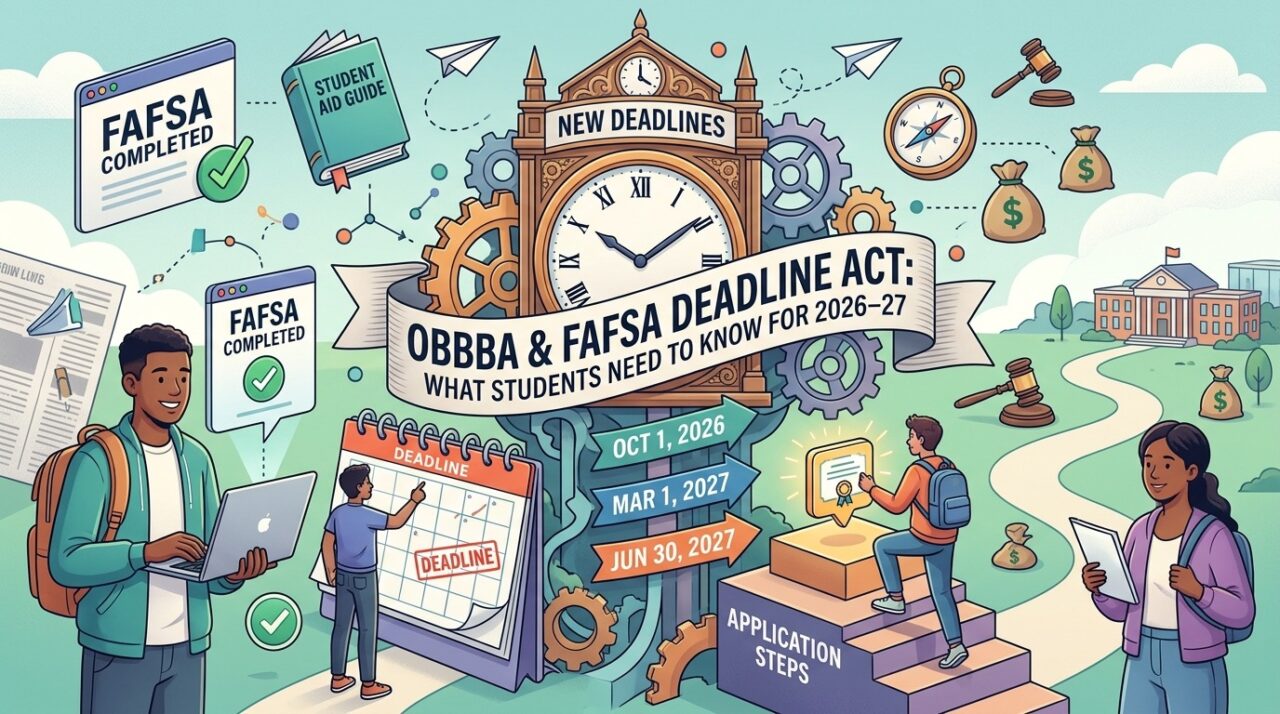
The official 2026–27 FAFSA PDF states: for federal aid, submit “as early as possible, but no earlier than October 1, 2025,” and the federal deadline is June 30, 2027—while many states and colleges set earlier priority deadlines.
Crucially, the FAFSA form itself includes a state-by-state list of deadlines (priority and final), illustrating the key operational reality: FAFSA timing is a competitive mechanism for limited state and institutional funds.
3.2 What the Department of Education reported about the 2026–27 FAFSA launch
In a 2025 press release describing the 2026–27 FAFSA rollout, the U.S. Department of Education reported beta-testing beginning August 3, 2025, and provided early quality/experience signals: 97% respondent satisfaction, 90% saying it took a reasonable time, and tens of thousands of applications started/submitted/processed during beta.
The same release references statutory requirements under the FAFSA Deadline Act framework: certification by September 1 and launch by October 1.
Scholarship takeaway: For 2026–27, the FAFSA process is designed to be operationally predictable again. That predictability increases the payoff of early filing, because schools can generate aid offers sooner—and students can negotiate, compare, and target scholarships with real numbers.
4) The “Scholarship Equation” for 2026–27: COA − SAI − OFA (and why it changes your tactics)
Most scholarship advice ignores the packaging math that financial aid offices must follow. For 2026–27, the modernized FAFSA uses the Student Aid Index (SAI). Packaging guidance in the Federal Student Aid Handbook (still the authoritative operational rulebook for aid administrators) summarizes the core constraints:
-
Need-based aid cannot exceed a student’s financial need
-
Total aid + other financial assistance (OFA) cannot exceed COA
-
The handbook gives the canonical expression for remaining need: COA − SAI − OFA.
Why families should care
Because outside scholarships count as OFA, they can trigger “overawards” that require adjustment. Schools often reduce loans/work-study first (a good outcome), but sometimes reduce institutional grants (a bad outcome, called displacement). Scholarship America notes that displacement happens when colleges subtract scholarship dollars from parts of the aid package, and emphasizes that regulations limit over-awards.
Scholarship takeaway: Your scholarship strategy must include an aid-packaging strategy—especially for students with high need or large institutional grants.
5) Displacement vs. stacking: the most misunderstood risk in scholarship hunting
5.1 Displacement is real and measurable
A growing research and practitioner literature describes how external grants can be partially absorbed by institutional aid adjustments. A 2024 economics-of-education study (ScienceDirect abstract) frames external scholarship displacement as a mechanism that can undermine the effect of grant dollars on access and attainment, especially for low-income students who are sensitive to unexpected price changes.
Scholarship America’s practitioner guidance is more direct: some schools reduce institutional aid rather than loans/work-study when outside scholarships arrive, reducing the student’s net gain.
5.2 The 2026–27 operational best practice: pre-commit stacking rules
A modern scholarship strategy includes a “stacking script” students use with financial aid offices:
-
Ask: “How are outside scholarships treated in your packaging policy?”
-
Ask: “Will outside scholarships reduce loans/work-study first, or institutional grants?”
-
Ask: “If my total aid exceeds COA, which components are adjusted?” (Because COA is the legal ceiling.)
-
Ask for the answer in writing (email is enough).
5.3 Provider-side design (what scholarship funders should do)
Scholarship America recommends program design choices to increase the likelihood the award reduces loans/work rather than being displaced, such as coordinating timing and communications with aid offices.
Scholarship takeaway: For students, the goal is “stackability.” For providers, the goal is “non-displaceable design.” For a scholarship publishing platform, the goal is to label scholarships by displacement risk and suggest mitigation steps.
6) The data about who’s in college (and why it matters for scholarship competition)
Competition depends on the size and composition of the applicant pool. NCES reports that in fall 2021 there were about 15.4 million undergraduates enrolled, with substantial variation by race/ethnicity and shifts since 2010: declines for White and Black enrollment and increases for Hispanic and multiracial students over the decade. NCES also reports that 61% of undergraduates took at least one distance education course in fall 2021, and 28% were exclusively distance education—indicating persistent demand for flexible pathways.
Why this matters for 2026–27 scholarships:
-
Scholarship eligibility is increasingly segmented by pathway (online, commuter, adult learner, transfer).
-
Providers are expanding beyond the “18-year-old first-time freshman” model.
-
Verification burdens (transcripts, enrollment intensity, program length) become more complex—especially as short-term workforce pathways grow.
7) Workforce scholarships and the expansion of short-term training aid (2026–27 is a pivot year)
A major structural shift underway is the expansion of Pell eligibility to shorter workforce programs—often called “Workforce Pell.” TICAS notes that starting July 1, 2026, programs between 150 and 599 clock hours (as short as 8–15 weeks) may become eligible for Workforce Pell Grants for the first time, changing the funding landscape for career training. Complementary policy and implementation guidance outlets echo the same timing and the operational challenge of scaling approvals during the 2026–27 award year.
Scholarship takeaway: 2026–27 is not only “college scholarships”—it is a convergence year where scholarship publishing and counseling must include certificate and workforce pathways, because federal grant eligibility is expanding into program formats previously financed mostly through cash, employer support, or state grants.
8) How much aid do students actually receive? Evidence from NPSAS
The National Postsecondary Student Aid Study (NPSAS) is the core federal dataset for how students finance college. NCES’s “First Look” summary for NPSAS:20 reports that among undergraduates who received any aid, the average total aid was $14,100, with $9,300 from grants on average and $7,900 from student loans on average.
These averages hide distributional realities:
-
Aid amounts differ sharply by institution type, dependency status, and income.
-
“Grant dollars” include federal/state/institutional aid, and often interact with tuition discounting.
-
Many students who “receive aid” still face unmet need because COA includes living costs.
Scholarship takeaway: Winning a $1,000–$2,000 scholarship can be pivotal for persistence when it targets non-tuition costs (transportation, books, childcare) that often drive stop-out decisions.
9) The AI era: authenticity becomes a scholarship “signal,” and policies are getting explicit
By 2026–27, scholarship selection is increasingly shaped by trust signals in writing and documentation. A growing number of scholarship organizations are publishing explicit AI guidelines rather than informal warnings. For example:
-
The Goldwater Scholarship Foundation states that starting in 2026, its application will ask whether AI was used in developing any part of an application, and that the disclosure will be provided to reviewers (while evaluation remains based on criteria, not AI use per se).
-
A community foundation policy updated in September 2025 allows AI for understanding prompts, brainstorming reflection questions, and grammar/length edits—but prohibits AI outlining or writing personal narratives, and warns that generic voice patterns trigger concern.
-
College Success Foundation guidance similarly frames “copy-paste AI essays” as plagiarism risk and emphasizes reflection and voice.
Scholarship takeaway (student-side): In 2026–27, the safest position is: AI can help you think and edit, but your narrative must be yours, and you must be able to defend it in interviews or follow-up prompts.
Scholarship takeaway (publisher-side): Scholarship listings should include an “AI policy” field when available (Allowed / Allowed with limits / Disclosure required / Prohibited / Unstated), because it changes how students prepare.
10) Scams, fraud, and “application security”: the hidden scholarship cost
Scam risk is rising in the broader digital environment, and scholarship seekers are prime targets because they are time-pressured and financially vulnerable. Two authoritative indicators:
-
The FBI’s IC3 2024 annual report describes 859,532 complaints and $16.6B in reported losses in 2024 (33% increase from 2023).
-
The FTC reported a sharp increase in reported fraud losses in 2024 and emphasizes that the growth is driven by more people losing money (not just more reports).
Scholarship takeaway: Scholarship platforms should treat scam prevention as part of affordability: a single scam can wipe out the value of multiple real awards. For 2026–27, “verified link” and “no-fee application” labeling becomes a core consumer protection feature—especially on high-traffic list pages.
11) A 2026–27 scholarship strategy model: from “search” to “portfolio engineering”
A doctorate-level view of scholarships treats the process like a portfolio optimization problem under constraints (time, eligibility, displacement risk, and deadlines). Below is a practical model built from the policy/data realities above.
11.1 Stage 1: Build the eligibility graph (reduce search space)
Instead of browsing lists, build a structured profile:
-
Citizenship/aid category (FAFSA eligible? undocumented pathway?)
-
State residency and target schools
-
Program type (2-year/4-year/online/short-term training)
-
Major/field keywords
-
Identity/community categories (where relevant)
-
Constraint flags: work hours, caregiving, disability accommodations, travel limits
This “graph” reduces wasted applications and increases hit rate.
11.2 Stage 2: Time the FAFSA and the scholarship calendar
For 2026–27, FAFSA can be submitted starting Oct 1, 2025; federal deadline Jun 30, 2027, but priority deadlines often arrive much earlier, including spring 2026 for many states/programs.
Operationally, filing early yields:
-
earlier aid offers
-
earlier gap identification
-
earlier targeting of “gap-cover” scholarships (housing, books, remaining tuition)
11.3 Stage 3: Classify scholarships by “impact channel”
Not all awards reduce the bill the same way. Classify each scholarship into one of four impact channels:
-
Net price reducers (likely to reduce out-of-pocket)
-
Debt reducers (likely to replace loans/work-study rather than grants)
-
Liquidity stabilizers (books, emergency aid, stipends; prevents stop-out)
-
Pathway enablers (covers program entry costs: tools, testing, certifications)
Then match applications to the student’s biggest risk (tuition gap vs. housing gap vs. borrowing vs. persistence).
11.4 Stage 4: Manage displacement risk explicitly
Before applying heavily for outside scholarships, students should learn the target institution’s packaging approach (loans/work-study reduction first vs. institutional grant reduction). Packaging must comply with COA ceilings and overaward rules.
A high-level rule:
-
If a student has large institutional grants, prioritize scholarships that the institution is likely to apply against loans/work-study (or non-institutional costs).
-
If a student has small institutional grants, outside scholarships more often reduce net price directly.
11.5 Stage 5: Build “evidence density” (what actually wins)
In practice, scholarships reward proof of:
-
sustained commitment (time series: hours, roles, progression)
-
clear academic/career direction (courses → projects → outcomes)
-
verifiable impact (letters, artifacts, metrics)
-
authentic narrative (AI-era screening makes “generic excellence” less persuasive)
12) A 2026–27 timeline that actually fits how awards happen
Below is a field timeline that aligns FAFSA realities with scholarship cycles. (Dates are illustrative; students should also follow state and program deadlines in the FAFSA’s state list.)
Aug–Sep 2025
-
FAFSA beta period and readiness indicators reported publicly
-
Seniors finalize college list + build scholarship resume & portfolio artifacts
Oct–Dec 2025
-
FAFSA available (no earlier than Oct 1, 2025)
-
Many major national scholarships peak (fall deadlines); early state priority windows open
Jan–Apr 2026
-
State priority deadlines cluster (varies by state/program; the FAFSA PDF lists these)
-
Students compare aid offers; begin appeal/verification workflows; target gap scholarships
May–Aug 2026
-
Summer bridge: scholarships for enrollment deposit, housing, orientation, tech
-
Workforce Pell eligibility expansion begins July 1, 2026 (implementation dependent), shifting grant availability for short-term training pathways
Fall 2026–Spring 2027
-
Persistence scholarships, departmental awards, emergency microgrants become high leverage
-
Students renew FAFSA/aid, re-apply for continuing scholarships, manage Satisfactory Academic Progress (SAP) requirements
June 30, 2027
-
Federal FAFSA deadline for 2026–27
13) What “data-driven” scholarship advising looks like in 2026–27
For counselors, families, and scholarship platforms, the highest-impact advising uses metrics.
13.1 Student-level metrics (portfolio performance)
Track:
-
applications submitted per month
-
completion time per application (median)
-
win rate by scholarship type (local vs national; merit vs need)
-
ROI: dollars per hour (and dollars per artifact reused)
-
displacement-adjusted value: estimated net gain after packaging
13.2 Platform-level metrics (ScholarshipsAndGrants.us use-case)
For scholarshipsandgrants.us specifically, a 2026–27 system that outperforms competitors typically includes:
-
Deadline normalization: store exact deadlines + timezone + “priority vs final” flags
-
Verification logs: “link verified on [date]” plus screenshot/archived proof (for editorial QA)
-
Packaging flags: whether the scholarship is paid to student vs school; whether it’s restricted to tuition; whether it’s “last-dollar” (common in promise programs)
-
AI policy field: Allowed / Restricted / Disclosure / Prohibited / Unstated (increasingly relevant)
-
Displacement risk label: high when likely to hit COA ceilings or schools known to reduce institutional grants
-
Scam risk controls: no-fee labeling, official domain checks, and fraud education given broader scam losses
14) Policy and market outlook through 2027: what’s likely to shape scholarships next
Several macro forces are poised to shape scholarship design and competition through 2027:
-
Process stability and earlier FAFSA filing will increase “early decision” behavior for financial aid (students compare offers earlier, scholarship timing shifts earlier).
-
Workforce Pell + state workforce grants will expand scholarship demand outside traditional four-year pathways, creating new provider segments (tools, transportation, short-term tuition).
-
Displacement scrutiny is rising among providers and policymakers; expect more “stacking protection” advocacy and clearer institutional policies.
-
AI disclosure norms will spread—first via elite scholarships (like Goldwater), then via community foundations and large administrators.
-
Fraud pressures will keep increasing; scholarship sites will be expected to behave like consumer-protection platforms, not just list aggregators.
15) Recommendations (actionable, evidence-aligned)
For students (the 2026–27 playbook)
-
File FAFSA as early as eligible (no earlier than Oct 1, 2025 for 2026–27) and treat state priority deadlines as “hard.”
-
Ask each college: “How do you treat outside scholarships—loans/work first or institutional grants?” Keep the response.
-
Use AI only within published rules: comprehension + proofreading; avoid AI-written personal narratives; disclose when asked.
-
Treat scam prevention as part of your financial plan; never pay to apply; verify organizations and domains (fraud losses are rising nationally).
-
Target scholarships that match your biggest COA gap (housing/books/transport), not just “largest award.”
For parents
-
Plan around COA, not tuition. Housing and non-tuition costs are where scholarship dollars often matter most.
-
Help your student build documentation: tax records, residency proof, caregiving verification, employment letters—these often decide eligibility faster than essays.
For counselors and community organizations
-
Build FAFSA + scholarship calendars together; FAFSA timing shapes state/institutional aid access.
-
Offer “evidence workshops” (resume artifacts, impact logs, letters). Execution quality differentiates winners more than motivation.
For scholarship providers
-
Design awards to reduce displacement: communicate with aid offices, specify whether funds can replace loans/work-study, and consider paying awards in ways that reduce COA-cap conflicts.
-
Publish AI policies explicitly; ambiguity increases applicant anxiety and weakens screening fairness.
For scholarship publishing platforms (ScholarshipsAndGrants.us)
-
Treat your database as policy-aware: include COA/stacking/AI fields, not just amount/deadline.
-
Elevate verification and scam protection to first-class product features given rising fraud losses.
-
Add pathway coverage: 2-year, transfer, adult learner, and short-term training (Workforce Pell era).
References (selected, APA-style)
-
College Board. (2025). Trends in College Pricing 2025 (highlights and PDF).
-
College Board. (2025). Trends in Student Aid (highlights).
-
Federal Student Aid. (2026–27). FAFSA form PDF and deadlines.
-
U.S. Department of Education. (2025). Earliest FAFSA form launch in program history (beta metrics, deadlines framework).
-
NCES. (2023–2024). NPSAS First Look (2019–20) summary tables.
-
NCES. (2024). Condition of Education: Undergraduate enrollment (IPEDS-based indicators).
-
Federal Student Aid Handbook (2024–25). Cost of attendance and packaging aid.
-
Scholarship America. (2024/2025). Organizational impact report; displacement guidance.
-
FBI IC3. (2024). Annual Internet Crime Report (losses and complaint volume).
-
FTC. (2025). Fraud loss trends in 2024 (press release).
-
TICAS. (2025). Preparing to implement Workforce Pell Grants (July 1, 2026 expansion details).
-
Goldwater Scholarship Foundation. (2025/2026). AI guidelines (disclosure beginning in 2026).
-
Community Foundation of the New River Valley. (2025). AI acceptable use policy for scholarship applicants.