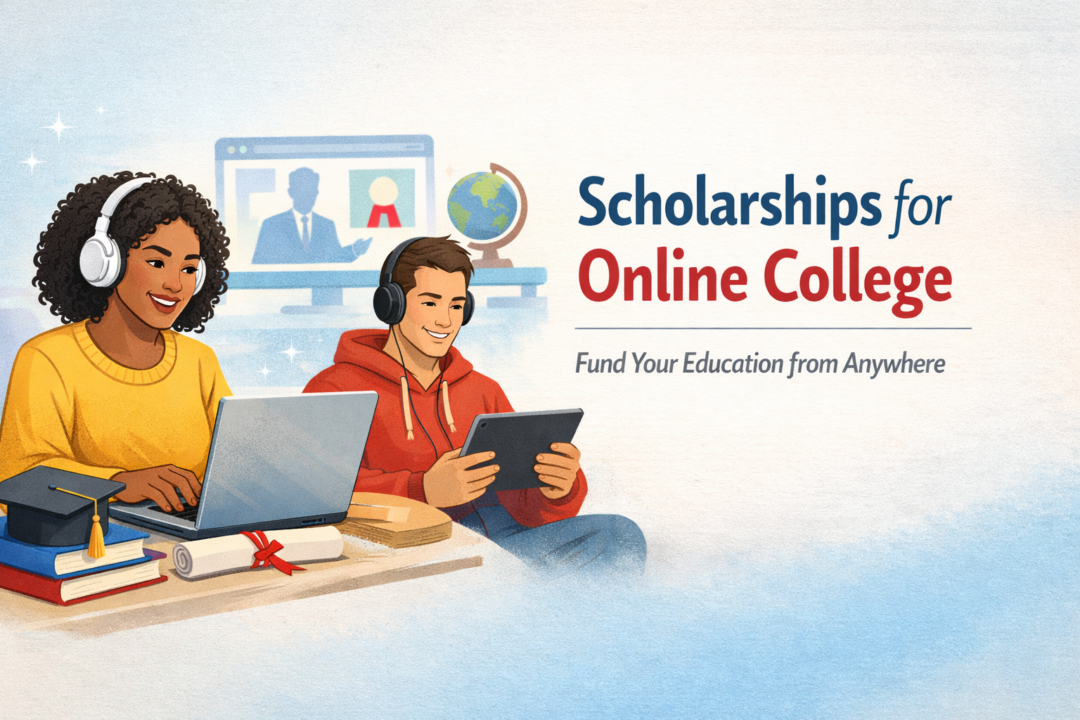
Scholarships for Online College
Online college is no longer a niche pathway—it is a central feature of U.S. higher education. Yet the scholarship ecosystem still “assumes” a traditional full-time, on-campus student in subtle ways: eligibility language tied to residency, program format, credit intensity, campus involvement, and even where a student is physically located. This research paper synthesizes the latest federal enrollment data on distance education, maps how scholarships actually flow to online learners (institutional, external, and hybrid models), and proposes a practical, verification-first method for finding legitimate scholarships that do work for online students. It concludes with program design recommendations—especially “last-mile” completion scholarships, part-time-friendly awards, and technology access grants—aimed at improving persistence and equity in online degree completion.
1) The online college reality in 2026: the “new normal,” quantified
1.1 Distance education enrollment is structurally large—and uneven across sectors
IPEDS (NCES) Fall 2023 data show that 4,982,428 students (25.6%) at Title IV institutions were enrolled exclusively in distance education courses, and another 27.5% took some distance education courses. In other words, a majority of students had some online exposure, and about 1 in 4 were fully online.
At the undergraduate level (Fall 2023), 16.2 million students were enrolled overall, with 11.1 million in 4-year institutions. Among 4-year undergraduates, 2,352,313 (14.5%) were exclusively online; the share was far higher in the for-profit 4-year sector (43.4% exclusively online).
Two implications matter for scholarships:
-
Online students are not a monolith. Sector, credential level, and enrollment intensity shape eligibility and award probability.
-
Scholarship risk is asymmetric. Because exclusively online students are concentrated in certain sectors, they face higher exposure to aggressive marketing and “aid-adjacent” scams—making verification and accreditation checks non-negotiable.
1.2 Online students often “stay in-state”—even while learning online
NCES reporting on Fall 2021 undergraduates enrolled exclusively online found that 74% attended an institution in the same state they lived in, and 82% attended a public institution.
This is a big deal for funding strategy. It suggests that state aid, regional foundations, and in-state institutional scholarships can be unusually relevant for online learners—even when the student never sets foot on campus.
1.3 Enrollment totals are rising again; affordability pressures remain
National Student Clearinghouse Research Center’s Final Fall Enrollment Trends (published Jan 15, 2026) reports over 19.4 million total postsecondary enrollments in Fall 2025 (16.2M undergrad; 3.2M graduate), a +1.0% total increase year-over-year driven by undergraduate gains.
While this is not “online-specific,” it frames the macro environment: higher participation plus persistent price pressure increases competition for institutional aid and makes external scholarships more valuable—especially for adult, part-time, and reskilling students who disproportionately choose online formats.
2) Why scholarships for online college work differently than people assume
2.1 Most scholarships are modality-agnostic, but eligibility filters still “select against” online learners
A key misconception: “There aren’t scholarships for online students.” In reality, many scholarships do not restrict delivery format—they only require accredited enrollment. The problem is that many awards include proxy requirements correlated with on-campus attendance, such as:
-
Full-time enrollment minimums (12 credits/term)
-
On-campus club leadership or local volunteering hours
-
“Traditional student” assumptions (recent high school graduation, SAT/ACT emphasis)
-
In-person program requirements (labs, clinicals, residency weekends) that complicate “fully online” status
-
Geographic constraints tied to physical campus location or county foundations
The result is a structural mismatch: online learners can be eligible on paper, but filtered out by process.
2.2 Online learners face unique friction costs: time, bandwidth, and documentation
Online students are more likely to be working, caregiving, and enrolled part-time—conditions that raise the time cost of scholarship applications. A scholarship that takes 10 hours to apply for is effectively “smaller” for a working adult than for a residential student with dedicated advising support. These frictions produce predictable behavioral outcomes:
-
Over-reliance on loans (low time-cost, immediate approval)
-
Under-application to scholarships with complex narratives or reference letters
-
Higher susceptibility to “guaranteed scholarship” pitches
Scholarship strategy for online students therefore must be ROI-based (probability × award ÷ time) and verification-first (legitimacy before effort).
3) A typology of scholarships for online college
Think of online college funding as four overlapping lanes. Strong strategies use all four.
Lane A: Institutional scholarships (online-eligible by definition)
These are scholarships and grants offered by the student’s institution. For online students, they are often the largest pool of “fit-aligned” funding because the school can target persistence, completion, or program-specific pipelines.
Examples of what institutions do well:
-
Start-window scholarships (for new students within a certain time window)
-
Program cluster awards (IT, nursing, education, business)
-
Completion scholarships (“last 30 credits”)
-
Access grants (technology, emergency aid, micro-grants)
Western Governors University (WGU) explicitly organizes scholarships by program area (health/nursing, business, IT, education, military, partner scholarships) and sets an application window tied to the student’s program start date.
Penn State World Campus reports offering “more than 40 scholarships” awarded to hundreds of undergraduates each year; it also provides scholarship “facts” that clarify considerations for residents and international students.
ASU Online emphasizes that online students are eligible for scholarships and grants and strongly positions FAFSA as a gateway for scholarships, grants, and aid packaging.
Oregon State Ecampus highlights that many online students qualify for aid and scholarships; its financial aid office FAQ notes Ecampus grants can be awarded up to $500 per term and are tied to FAFSA timing and at least half-time enrollment.
UMGC states it awarded more than $21 million in institutional and donor-funded scholarships “last year,” signaling a large institutional pool for qualifying students.
Design insight: For online students, institutional scholarships are often the most “application-efficient” because they reuse existing data (admissions file, FAFSA, GPA) and streamline award matching.
Lane B: External scholarships designed explicitly for online/distance learners
These are rarer, but high-value because eligibility is aligned to the modality. They also make excellent “anchor scholarships” for a ScholarshipsAndGrants.us page because they match the query intent precisely.
GetEducated Online College Scholarship Program awards $1,000 twice a year to students attending accredited online degree programs, with deadlines listed as October 15 or March 15 and eligibility including U.S. citizenship and a minimum 3.0 GPA.
Study.com Online Undergraduate Degree Scholarship describes a $1,000 award for students pursuing an online associate or bachelor’s degree and includes an apply link on its page. (Note: pages like this sometimes show a past deadline; treat the page as the source of truth and verify the current cycle before publishing.)
eLearners “Free Scholarship for College” is framed as a $1,000 scholarship for students enrolled in online degree programs, but the page also states the scholarship is “currently closed,” illustrating why “verify status” should be built into scholarship content workflows.
Design insight: Online-specific scholarships tend to cluster around (a) online learning platforms, (b) lead-gen/college discovery brands, and (c) mission-driven online institutions. They can be legitimate, but they require extra diligence (deadlines can go stale; ownership can change).
Lane C: Completion and persistence scholarships (the “last-mile” model)
Completion scholarships are especially relevant to online learners because stop-out risk rises with life shocks, part-time pacing, and competing obligations.
A clear example is Purdue Global’s Completion Scholarship, which describes awards “up to a maximum of $5,000” toward tuition and resource fees, for eligible students within 30 credits of graduation, with GPA and conduct requirements.
Penn State’s World Campus Smart Track to Success provides a $1,500 scholarship over two consecutive semesters plus a course and mentoring for new students (first-year or fewer than 18 credits), blending financial support with structured onboarding—exactly the kind of model linked to improved persistence.
Design insight: These models treat scholarships not as one-time prizes but as part of a retention system—especially powerful in online environments where social integration is harder.
Lane D: Modality-neutral scholarships (online students can and should win them)
This lane includes most national scholarships by major, demographic group, employer affiliation, community foundation, and professional associations. The trick is to filter for eligibility and disbursement compatibility, because some awards pay directly to a bursar’s office or require proof of full-time status.
Universities often encourage students to use major scholarship databases. Purdue Global, for example, points students to large scholarship search platforms and provides guidance on applying outside scholarship funds through billing processes.
4) A verification-first framework: how online students should search for scholarships (and avoid traps)
4.1 The legitimacy checklist: accreditation + Title IV + direct source
Online education is fertile ground for confusion between (a) legitimate accredited programs, (b) non-Title IV institutions, and (c) outright scams.
At minimum, students should verify:
-
Accreditation status via the U.S. Department of Education’s DAPIP database.
-
Whether a school is eligible for federal student aid (Title IV) using Federal Student Aid guidance.
-
The scholarship’s “source of truth”: the official scholarship page or foundation site (not a repost)
This verification step is not bureaucratic—it prevents wasted application time and protects students from data theft.
4.2 Scam avoidance: the red-flag language is predictable
The FTC warns that scholarship and financial aid scams often involve high-pressure pitches, upfront fees, “guaranteed” scholarships, or requests for sensitive information. Critically: students should never pay to apply and should never share FSA ID credentials.
For online students, scam risk is amplified because:
-
they are often searching without access to a campus financial aid office
-
they may be targeted through social media ads and “tuition relief” marketing
-
they face urgency (career transitions, layoffs, family needs)
Operational recommendation for ScholarshipsAndGrants.us: put a short “Legit Check” box above every scholarship list: No fees. Official source link. Accreditation verified. Deadline verified.
5) A data-driven application strategy built for online learners
Step 1: Treat FAFSA as the “master key,” even when you think you won’t qualify
Many institutions use FAFSA data for packaging and scholarship matching, and some online-focused schools explicitly state FAFSA is required “if eligible” to access certain scholarship pathways.
Step 2: Sequence scholarships from highest probability to highest payoff
A practical sequencing model for online students:
-
Institutional scholarships (highest match + easiest verification)
-
Online-specific external scholarships (high fit; moderate competition)
-
Completion/retention grants (if within a defined credit window)
-
Major-based / employer-based / association awards
-
National sweepstakes-style awards (low probability; only if time is abundant)
Step 3: Build an “application ROI” score
For each scholarship, estimate:
-
Award size (A)
-
Probability of winning (P) — even a rough tier (high/medium/low)
-
Application hours required (H)
-
Disbursement friction (D) — does it pay tuition directly? require full-time? extra paperwork?
A simple prioritization heuristic:
ROI ≈ (A × P) ÷ (H × D)
Online students win by applying to fewer scholarships—but the right ones, consistently.
Step 4: Optimize for part-time eligibility and credit thresholds
Many online learners enroll part-time. Some grants require half-time enrollment (common threshold for loans and certain institutional grants), which Oregon State’s Ecampus FAQ also reflects.
Filtering for part-time-eligible scholarships is one of the highest-leverage moves for adult online students.
6) Curated scholarship and grant opportunities for online college (with live URLs)
Below is a curated set that mixes (1) online-specific external scholarships, (2) large institutional scholarship hubs for online learners, and (3) completion/access models particularly relevant to online students. Details can change—so each entry should be treated as “verify before publish,” with last-checked dates in your editorial workflow.
6.1 Online-specific external scholarships (high intent match)
-
GetEducated Online College Scholarship Program (awards $1,000 twice yearly)
-
Study.com Online Undergraduate Degree Scholarship ($1,000)
-
eLearners Free Scholarship for College ($1,000; currently marked closed)
6.2 Institutional scholarship hubs designed for online students
-
WGU Scholarships (program-category structure; defined application window)
-
Penn State World Campus Scholarships (40+ scholarships; high-level award facts)
-
ASU Online scholarship opportunities and FAFSA-first guidance
-
Oregon State Ecampus financial aid & Ecampus grant FAQ (up to $500/term noted)
-
UMGC Scholarships (reports $21M+ awarded last year)
-
Liberty University Online scholarships hub
-
University of the People scholarships (supports fees for accepted students; first-come, first-served funding logic)
6.3 Completion/persistence scholarships (online-optimized design)
-
Penn State World Campus Smart Track to Success ($1,500 over two semesters + mentoring)
-
Purdue Global Completion Scholarship (up to $5,000; eligibility rules)
6.4 Scholarship search infrastructure (to scale beyond a short list)
-
Purdue Global’s “Outside Scholarships” page (examples of search platforms + how funds may bill to school)
7) Policy + program design recommendations: what would actually move completion
If we treat online education as a mainstream pathway, scholarship design should reflect online learner realities. Three evidence-aligned design moves stand out:
7.1 Part-time-friendly scholarships (and “stacking-safe” rules)
Online learners frequently study part-time. Scholarships that hard-require full-time status exclude a large, high-need group. Institutions can adopt:
-
half-time eligibility where feasible
-
pro-rated awards by credits
-
re-award policies that tolerate stop-outs without permanent loss
Oregon State’s Ecampus grant language illustrates a common compromise: eligibility and retention tied to half-time enrollment and FAFSA timing.
7.2 Last-mile completion scholarships with clear credit windows
Completion scholarships (e.g., “within 30 credits”) are exceptionally aligned to online persistence challenges and have a strong logic: the highest ROI for both student and institution is preventing a near-finish stop-out. Purdue Global’s completion scholarship criteria are a concrete model.
7.3 Scholarships bundled with structured support (coaching + cohort)
Online students often lack the ambient supports of campus life. Penn State’s Smart Track model explicitly bundles scholarship dollars with a two-semester skills course and mentoring.
This “aid + advising” bundle is likely to outperform standalone awards for first-term online retention.
8) Implementation notes for ScholarshipsAndGrants.us (high-conversion page architecture)
To win SEO and genuinely help students, a “Scholarships for Online College” page should be built like a decision tool, not a listicle:
-
Data snapshot box (IPEDS headline: “~1 in 4 students fully online”)
-
3-minute eligibility triage (accredited? Title IV? half-time?)
-
Curated online-specific scholarships (GetEducated, Study.com, eLearners)
-
Top institutional scholarship hubs for online learners (WGU, ASU Online, Penn State World Campus, UMGC, OSU Ecampus)
-
Safety module: scams + red flags (FTC)
-
“Scholarship stacking” explainer (institutional + external + completion)
-
Verification badges: ✅ Link checked + date; ✅ deadline checked + date; ✅ eligibility checked + date
Conclusion
Scholarships for online college exist in far greater volume than most students assume—but they are distributed through systems that still privilege traditional enrollment patterns. The data show online enrollment is structurally significant (and sector-skewed), and the policy environment makes verification critical. The highest-impact approach for online learners is a four-lane funding strategy: institutional scholarships first, then online-specific externals, then completion/persistence models, and finally modality-neutral scholarships filtered for part-time compatibility. For scholarship publishers and advisors, the best service to online students is not “more links,” but verified links + eligibility clarity + scam resistance + ROI-based application strategy.
ONLINE-SPECIFIC SCHOLARSHIPS (EXTERNAL)
https://www.geteducated.com/free-college-scholarships/20-distance-learning-scholarships/
https://collegeprep.study.com/resources/online-undergraduate-degree-scholarship
https://www.elearners.com/scholarships/online-students/
ONLINE-FOCUSED UNIVERSITY SCHOLARSHIP HUBS (INSTITUTIONAL)
https://www.wgu.edu/financial-aid-tuition/scholarships.html
https://www.worldcampus.psu.edu/tuition-and-financial-aid/scholarships
https://achieve.psu.edu/programs/world-campus-smart-track-to-success/
https://asuonline.asu.edu/what-it-costs/scholarship-opportunities/
https://ecampus.oregonstate.edu/tuition/financial-aid.htm
https://financialaid.oregonstate.edu/ecampus-student-faq
https://www.umgc.edu/tuition-financial-assistance/scholarships
https://www.liberty.edu/online/scholarships/
https://www.uopeople.edu/tuition-free/scholarships/
https://www.purdueglobal.edu/tuition-financial-aid/outside-scholarships/
https://www.purdueglobal.edu/docs/purdue-global-completion-scholarship.pdf?abtestactive=true%2Ctrue%2Ctrue%2Ctrue
VERIFICATION + SAFETY (HIGHLY RECOMMENDED ON EVERY ONLINE SCHOLARSHIP PAGE)
https://ope.ed.gov/dapip/
https://ope.ed.gov/accreditation/Search.aspx/
https://studentaid.gov/help-center/answers/article/schools-eligible-federal-student-aid
https://studentaid.gov/h/apply-for-aid/fafsa
https://consumer.ftc.gov/articles/how-avoid-scholarship-and-financial-aid-scams