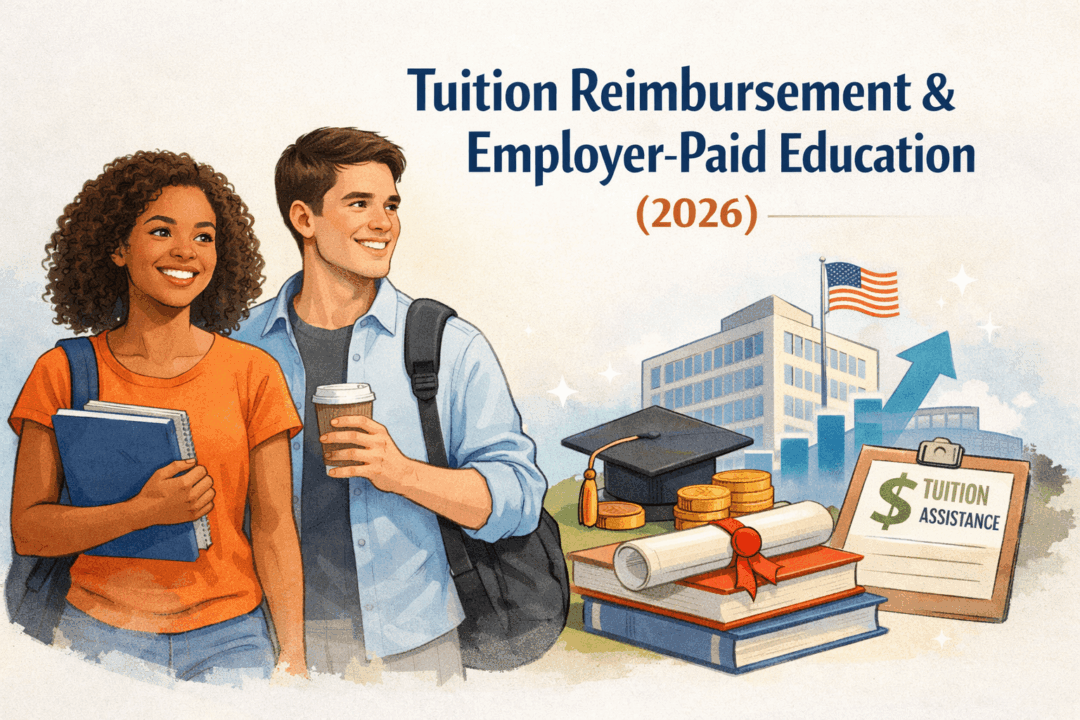
Tuition Reimbursement & Employer‑Paid Education (2026)
Know This First
-
Section 127 = tax‑free up to $5,250/yr of employer‑provided educational assistance (undergrad/grad, tuition, fees, books). Through Dec 31, 2025, employers can also use this to pay employees’ student loans within the same $5,250 cap. IRS
-
Anything over $5,250 is generally taxable wages to you. (Your W‑2 should reflect it.) IRS
-
No double‑dipping: Expenses covered tax‑free by your employer can’t also be used for AOTC/LLC tax credits or tax‑free 529 withdrawals. Allocate costs smartly. IRS
What counts as “tuition reimbursement” vs “education benefits”?
-
Tuition reimbursement / assistance: Company pays you back (or pays upfront) for eligible classes at approved schools. If offered under a proper Section 127 plan, up to $5,250 per year is excluded from your taxable income. IRS
-
Student‑loan repayment via employer (through 12/31/2025): Employers may apply part/all of that same $5,250 toward your student loan principal/interest. Ask HR if they’ve enabled this option. IRS
How to use your employer program (5‑step script)
-
Find the policy: Look in your benefits portal or ask HR for the written Section 127 educational assistance plan (must be a written plan). IRS
-
Pre‑approve the course/degree: Many programs require pre‑approval, accredited schools, and major/grade requirements.
-
Know the payment flow: Some employers pre‑pay tuition (amazing), others reimburse after you submit grades/receipts.
-
Track tax stuff: Keep invoices and proof of payment. Remember the $5,250 tax‑free cap and coordinate with any AOTC/LLC claim so you don’t double count. IRS
-
Watch clawbacks: Some employers require you to stay X months after reimbursement; leaving early may trigger repayment—read the policy.
Real‑world examples (official pages, verified today)
-
Amazon Career Choice — pre‑paid tuition + reimbursement for books/fees up to an annual limit; 600+ approved schools. careerchoice.amazon
-
Walmart Live Better U — 100% Walmart‑paid tuition & books for eligible associates via partner schools (Guild). Walmart Corporate News and Information
-
Target “Dream to Be” — tuition‑free programs via Guild (associate, bachelor’s, certificates; see eligible list). target.guildeducation.com
-
Starbucks College Achievement Plan — 100% upfront tuition for a first‑time bachelor’s through ASU Online for benefits‑eligible partners. starbucksbenefits.com
-
Chipotle (via Guild) — 100% tuition‑paid for select degrees + large catalog of programs. Chipotle Education Benefit
-
UPS Earn & Learn — national tuition assistance program; official UPS benefits pages outline eligibility and lifetime support figures. Jobs UPSAbout UPS-US
-
Disney Aspire — tuition paid up front for eligible hourly cast; broad school network (Guild). Disney Impact
Program details (amounts, eligible majors, waiting periods) change—always confirm on the employer’s own page/portal linked above before enrolling.
Smart coordination = more money, less tax
-
$5,250 tax‑free via employer? Great. Then use AOTC/LLC only on your remaining qualified expenses to avoid “double benefits.” IRS
-
Mixing 529 + employer benefits? Don’t claim the same dollar of tuition for both tax‑free 529 and a credit. Use IRS Pub 970 for examples if you need to adjust which year/expense you count. IRS
Copy‑paste Ask‑HR template (email/DM)
Subject: Question about our Tuition Reimbursement / Student‑Loan Benefit
Hi [HR/Benefits],
Could you share our Section 127 educational assistance summary? I’m planning to [take X class / pursue Y degree] this term.
- Pre‑approval required? Eligible schools/majors?
- Payment timing: upfront vs. reimbursement after grades?
- Annual cap + tax‑free amount (confirm $5,250)?
- Any service commitment or payback if I leave?
- Do we support student‑loan repayment under Section 127 through Dec 31, 2025?
Thanks!
Tuition Reimbursement & Employer-Paid Education
Employer-paid education sits at the intersection of labor-market strategy, human capital formation, and household financial stability. As tuition and fees remain substantial—especially when combined with living costs—employer education benefits can function as a “third financing pillar” alongside federal aid and personal savings. Recent U.S. tuition benchmarks for 2025–26 show large sticker-price variation by sector and state, underscoring why predictable, tax-advantaged employer support matters for access and completion. At the same time, student loan balances remain historically high (about $1.64T in mid-2025 and rising thereafter), while delinquency pressures have intensified after repayment resumed. This paper synthesizes (1) the legal/tax architecture that governs employer educational assistance, (2) adoption and utilization patterns, (3) empirical evidence on retention and returns, and (4) a practical “how-to” playbook for employees seeking to maximize the benefit while avoiding common compliance and financial-aid pitfalls.
Keywords: Section 127, tuition reimbursement, employer-paid education, upskilling, retention, student loan repayment benefit, education finance, ROI.
1. Why employer-paid education matters now
College prices remain high enough that incremental funding sources can materially change enrollment and persistence decisions. For 2025–26, College Board reports wide state-by-state and sector-by-sector variation in average published tuition and fees (e.g., public two-year in-district and public four-year in-state ranges), highlighting how “average” national figures can mask affordability shocks for specific students and geographies.
Meanwhile, macro household balance-sheet data show student debt remains a major structural liability. Reuters’ reporting on New York Fed data placed total student loan debt around $1.64 trillion in Q2 2025, with delinquency stress rising after repayment restart. By Q3 2025, Reuters reported student loan balances rising further (about $1.65T) alongside continued repayment stress. In this environment, employer-paid education functions as both an access tool (reducing out-of-pocket tuition) and a risk-management tool (reducing reliance on higher-cost borrowing).
2. The legal and tax backbone: what “counts” as employer-paid education
2.1 Section 127 educational assistance programs (the core mechanism)
In the U.S., the central tax preference for employer education benefits is Internal Revenue Code Section 127. Under a qualifying program, employer-provided educational assistance is excluded from the employee’s gross income up to a statutory annual limit (historically $5,250). The IRS’s sample plan explicitly frames the exclusion and the annual cap, and defines “education” broadly as instruction or training that improves capabilities (not limited to job-related courses or degree programs).
To qualify as a Section 127 program, the plan must be a separate written plan for the exclusive benefit of employees and must satisfy nondiscrimination and other requirements. Key compliance features from IRS guidance and the sample plan include:
-
Eligible expenses commonly include tuition, fees, books, supplies, and equipment; exclude meals, lodging, and transportation, and generally exclude tools/supplies (other than textbooks) the employee keeps after the course.
-
Nondiscrimination: the plan cannot favor highly compensated employees; additionally, no more than 5% of annual benefits can go to certain owners/shareholders and related persons (the “limitation class”).
-
No “cash-or-education” choice: the plan may not offer employees a choice between educational assistance and other taxable compensation (a common design pitfall).
-
Substantiation: employees must document eligible expenses.
2.2 Student loan repayment as an education benefit (and what changed recently)
Historically, employers could also use Section 127 to pay principal or interest on qualified education loans, but this provision had a sunset date in earlier law (reflected in IRS sample plan language referencing payments “before January 1, 2026”).
Recent legislative updates changed the trajectory. Multiple benefits and HR policy analyses report that the One Big Beautiful Bill Act (OBBBA) made employer-paid student loan repayment under Section 127 permanent and directed that the education assistance cap be indexed for inflation going forward (though sources vary on timing specifics for when inflation adjustments begin).
Practical takeaway: employees should read their employer’s benefit documents carefully in 2026 and beyond—many internal policy PDFs still reflect the earlier “through 2025” framing, while the statutory environment has evolved.
2.3 Coordination rules: avoiding “double benefits” on taxes
Tax rules generally prevent claiming multiple tax advantages for the same education dollars. IRS Publication 970 highlights “no double benefit” principles—e.g., you generally can’t deduct work-related education expenses if those expenses were paid with tax-free scholarships, grants, or employer-provided educational assistance.
Employee implication: if your employer benefit is tax-free, you may need to reduce what you treat as “qualified education expenses” for other tax benefits (credits/deductions), depending on your situation.
3. Market landscape: adoption is meaningful, utilization is the bottleneck
3.1 How common are these benefits?
Employer education benefits are widespread enough to matter, but not universal. Professional HR survey summaries commonly place tuition assistance among the more prevalent development benefits, and student loan repayment assistance as less common. One HR-focused summary of SHRM findings reports ~45% of organizations offering undergraduate/graduate tuition assistance and ~8% offering student loan repayment assistance, with an average maximum annual tuition benefit around the Section 127 cap.
Government benefit data show student loan repayment assistance remains limited and stratified by wage levels. The Bureau of Labor Statistics reported that 5.0% of all workers had access to employer student loan repayment benefits in March 2023. In a later BLS release, access in March 2025 varied markedly by wage category (e.g., ~3% in the lowest wage quartile versus ~13% in the highest, for private industry).
3.2 Utilization: “benefit offered” ≠ “benefit used”
A central empirical reality is underutilization. A Georgetown-curated summary of reporting and expert estimates notes that only ~1% to 10% of eligible workers use employer-provided education benefits, with lower usage among low-wage workers—often because “reimbursement” models require paying tuition up front.
A well-cited NBER chapter similarly discusses low participation norms, noting that participation rates in tuition reimbursement programs are “typically around 5%” in practice.
Interpretation: the primary barrier is not “program existence,” but program design + cash-flow feasibility + employee bandwidth.
4. What the research says about outcomes: retention, mobility, and ROI
4.1 Human capital and retention: theory vs evidence
Classic human capital theory predicts that investing in general skills can increase outside options—potentially raising turnover. Yet employer-paid education persists, suggesting complementary mechanisms: screening, commitment, internal labor markets, and complementarities between firm-specific and general skills.
Empirically, the NBER case-based analysis finds that tuition reimbursement can substantially increase retention for new hires, providing support for the employer claim that these programs reduce turnover (even where theory might predict higher mobility).
4.2 ROI evidence: promising, but interpret carefully
Employer-side ROI studies often find positive returns through reduced turnover and internal promotion. Lumina Foundation’s synthesis of Accenture-supported research reports that:
-
Discover Financial Services saved $2.44 per $1 invested in tuition reimbursement, with participating employees seeing 41%–50% higher wage gains than peers;
-
Cigna saved $2.29 per $1, with participating employees seeing 43%–57% wage gains compared to peers.
These figures are directionally important but should be read with a research lens: participation is not random. More motivated employees may be more likely to enroll, and programs vary widely in eligibility, coaching, school partnerships, and internal advancement pathways.
5. The employee playbook: how to actually use tuition reimbursement (step-by-step)
This section translates policy and research into an execution plan that students/workers can follow.
Step 1: Identify the benefit type (the “money path”)
Most employer education benefits fall into one of four structures:
-
Reimbursement (pay first → employer reimburses after grades/receipts)
-
Upfront tuition assistance (employer pays the school/partner directly)
-
Direct-bill partnerships (employer contracts with specific schools/vendors; often zero out-of-pocket tuition for covered programs)
-
Student loan repayment assistance (employer pays lender or reimburses employee loan payments)
The design matters because it determines whether the benefit is usable without cash reserves—an issue repeatedly highlighted in utilization research.
Step 2: Read the policy like a contract (because it is)
Look for these “hidden levers” in the employer’s document:
-
Annual cap (often aligned with Section 127; may be higher, but tax treatment can change above the cap)
-
Eligible programs (degree vs certificate; accredited vs non-accredited; specific partner schools)
-
Pre-approval requirements (course must be approved before enrollment)
-
Grade requirement (e.g., “C or better”)—explicitly permitted in IRS sample plan language
-
Service requirements / clawbacks (repay if you leave within X months after reimbursement)
-
Timing rules (submit receipts within a window; reimbursements tied to calendar year caps)
Step 3: Build a cash-flow plan (even if the benefit is generous)
If reimbursement-based, your bottleneck is often timing, not eligibility. A simple approach:
-
Estimate term tuition/fees due dates.
-
Map employer reimbursement timing (end-of-term? after grades posted?).
-
If there’s a gap, consider: payment plan with the school, employer advance options, or shifting to an upfront/partner pathway if available. Utilization research shows upfront coverage can be a major unlock for lower-wage workers.
Step 4: Maximize the tax advantage (know what “tax-free” really buys you)
If your employer pays (or reimburses) under a qualifying Section 127 plan, you may receive up to the statutory cap tax-free.
A practical way to think about it: tax-free dollars are worth more than wage dollars. For a worker facing a combined marginal rate near one-third (federal + payroll + state, varies by household), a $5,250 tax-free education benefit can feel like ~$8,000 of pre-tax wages earmarked for school.
Step 5: Coordinate with financial aid and scholarships (avoid accidental reductions)
If you’re enrolled in a degree program and also using FAFSA-based aid, employer tuition assistance can be treated by some schools as an “outside resource” (estimated financial assistance) that can reduce certain need-based components or loan eligibility, depending on institutional packaging policies. Many school financial aid policies explicitly require disclosure of employer reimbursement/tuition assistance as part of EFA.
Best practice: notify the financial aid office early and ask what gets reduced first (institutional grant, subsidized loans, unsubsidized loans, work-study), because “last-dollar” vs “stackable” treatment differs by campus.
Step 6: Keep documentation like you’re doing an audit
Because substantiation is a core plan requirement, keep:
-
approval emails
-
itemized tuition bill
-
proof of payment
-
grades/completion record
-
reimbursement confirmations
This matters both for employer compliance and for your own tax coordination if questions arise.
6. Equity and access: why many programs miss the workers who need them most
Evidence consistently flags that reimbursement-first design produces inequitable access: those without savings cannot float tuition. Wage stratification in access to student loan repayment benefits compounds the issue, with higher-wage workers more likely to have access.
Equity-oriented design fixes (employer-side):
-
shift from reimbursement → upfront payment for approved programs
-
provide coaching/advising and clear marketing (participation is highly information-sensitive)
-
cover non-tuition barriers (books, exam fees where allowed; childcare supports outside Section 127)
-
create on-ramps (short certificates → stackable credentials → degree pathways)
7. Practical recommendations (two audiences)
7.1 For employees/students (how to “stack” your funding)
-
Pick the right employer pathway: if you’re cash-constrained, prioritize upfront tuition assistance or direct-bill partnerships.
-
Target credentials with labor-market payoff: align program choice to internal roles or industry-recognized pathways that your employer actually hires/promotes into.
-
Use scholarships strategically: private scholarships can cover what employer plans exclude (fees above caps, books, childcare, transportation), but disclose them to aid offices as required.
-
Avoid tax “double dipping”: track which dollars were tax-free employer assistance so you don’t accidentally reuse the same expenses for other tax benefits.
7.2 For employers (what a “high-functioning” program looks like)
-
Compliance-first: written plan, nondiscrimination, no cash choice, substantiation—these are non-negotiable.
-
Utilization-first: measure participation by wage band, shift schedule, and tenure; redesign around access barriers (upfront payment is often decisive).
-
Mobility-first: tie education to internal job ladders; ROI studies show retention and wage growth gains are plausible when education translates into promotion pathways.
Conclusion
Tuition reimbursement and employer-paid education are not fringe perks; they are a structurally important financing mechanism with measurable effects on retention and worker advancement when designed for real-world constraints. The strongest programs are those that (1) exploit the tax architecture of Section 127 responsibly, (2) remove cash-flow barriers that depress utilization, (3) connect learning to internal mobility, and (4) coordinate cleanly with financial aid and tax rules. In an era of persistent tuition pressure and elevated student debt balances, the practical question for most students/workers is not “Does this benefit exist?” but “Can I actually use it without breaking my cash flow—and can I stack it safely with other aid?” The answer is yes, but only with informed execution.
Selected references (for site editors)
-
IRS. Educational Assistance Programs (FAQs; sample plan Publication 5993; Publication 970).
-
College Board. Trends in College Pricing and Student Aid 2025 (2025–26 benchmarks).
-
BLS. Student loan repayment benefit access (TED, 2023; EBS summary, 2025).
-
Manchester, C. F. (NBER chapter). Tuition reimbursement and turnover (retention effects; participation norms).
-
Lumina Foundation talent investment research summaries (ROI and wage-gain comparisons).
FAQ 🤔
1) Is employer tuition money always tax‑free?
Up to $5,250/year under a valid Section 127 plan is excluded from income. Amounts above that are usually taxable to you. IRS
2) Can my company pay my student loans instead of tuition?
Yes—through Dec 31, 2025, employers may apply Section 127 funds to your student loan (within the $5,250 cap). Ask HR if they’ve enabled it. IRS
3) Can I stack this with AOTC/LLC or a 529?
Yes, but don’t double‑count the same expense. Use credits on remaining qualified expenses after subtracting any tax‑free employer payments. IRS
4) Do part‑time employees qualify?
Many big programs (e.g., Starbucks, UPS) include part‑time, but eligibility varies. Check your employer’s page/portal for specifics. starbucksbenefits.comJobs UPS
5) What about GPA or “stay‑X‑months” rules?
Common. Some require a minimum grade (like C or better) and/or a service commitment (clawback if you leave early). That’s policy‑specific—read your plan.
6) Is pre‑approval a thing?
Often yes. Programs may limit to accredited schools, approved majors, or partner networks (e.g., Guild). Get written approval first. guild.com