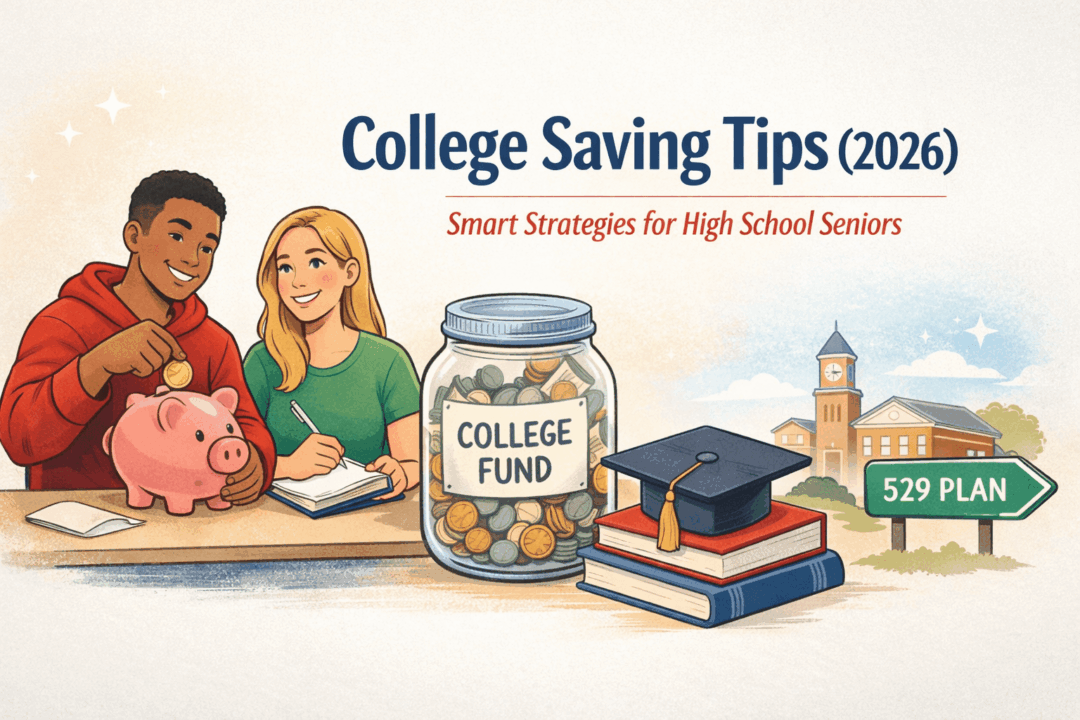
College Saving Tips (2026): Stack Free Money, Cut Costs, Grow Smart
The up-to-date playbook to cut college costs: 529 tax-free growth, 2025 gift rules, Coverdell ESAs, Roth IRA education withdrawals, I Bonds, CLEP/dual-enrollment, and OER.
Quick Wins (do these first)
-
Open a 529 plan in your state (possible state tax perks) and automate even $25/month. Investor.gov
-
If your kid is in high school, target dual enrollment, AP, or CLEP to earn credits early. ACTclep.collegeboard.org
-
Swap pricey textbooks for OpenStax or other OER options when your professor allows. OpenStax
-
Coordinate savings with financial aid: parent-owned 529s are treated differently than student-owned UGMAs/UTMAs. Federal Student Aid
The Big Tools (and how to use each)
1) 529 Plans = tax-free growth for education 📈
-
Earnings are federally tax-free if used for qualified higher-ed expenses (tuition, fees, books, supplies; room & board if ≥ half-time). Many states also give tax deductions/credits for contributions (often only in your home-state plan). IRSInvestor.gov
-
K-12 tuition: up to $10,000/year federally; state rules vary—check your state before using for K-12. IRS
-
529 → Roth IRA (SECURE 2.0): you may roll unused 529 funds to a beneficiary’s Roth IRA (lifetime cap $35,000, account open ≥15 years; annual IRA limits apply; funds contributed in last 5 years aren’t eligible). This improves “what if we overfund?” flexibility. my529
-
Gift strategy: 2025 annual gift tax exclusion = $19,000 per donor per beneficiary (5-year “superfunding” lets you front-load up to $95,000 and treat it as made over 5 years; couples can effectively double via split gifts). IRS
Pro move: automate contributions the day after payday; add cashback/card rewards or family gifts straight into the 529. (Confirm your state’s tax rules first.) Investor.gov
2) Coverdell ESA (good for K-12 + college) 🎒
-
$2,000/year max per beneficiary; contributions must be cash and generally stop at age 18 (special-needs exception). Qualified K-12 and college expenses grow tax-free. IRS
3) Roth IRA (education back-up plan) 🧠
-
Your contributions can be withdrawn anytime tax- and penalty-free.
-
Earnings are taxable if withdrawn early but the 10% penalty is waived for qualified higher-education expenses. (Still, retirement first!) IRS
4) U.S. Savings Bonds (EE/I) 🎟️
-
Under the Education Savings Bond Program, interest may be excludable from income when redeemed for qualified higher-ed expenses if ownership/age/income rules are met. TreasuryDirect
Financial Aid Impact (ownership matters)
-
Parent-owned 529 for a dependent student = reported as a parent asset on FAFSA (more favorable than student assets). UGMA/UTMA accounts are reported as student assets. FSA Partners, Federal Student Aid
-
Grandparent-owned 529s: under the simplified FAFSA, distributions are no longer reported as student income for federal aid starting 2024-25 (great news), but some CSS Profile schools may still consider them. Verify policies at Profile schools. Schwab Brokerage, Saving for College, mefa.org
Cut the Bill Before You Borrow (low-effort wins)
-
Dual enrollment: take college classes in high school—often low/no cost, but confirm credit transfer at your target colleges. ACT, All4Ed | Equity. Justice. Education.
-
CLEP exams: test out of intro classes and finish faster/cheaper (accepted at ~2,900 colleges; always check your campus policy). clep.collegeboard.org
-
Open textbooks (OER): many gen-ed courses can use OpenStax or other OERs—$0 books when allowed by your instructor. OpenStax, Open Educational Resources
Smart Coordination (don’t trip on taxes)
-
Keep receipts by category (tuition, books, R&B).
-
Don’t “double-count” the same expense for both a tax credit and tax-free 529 treatment—see our Tax Credits guide and IRS Pub 970 for coordination rules. IRS
Helpful Resources (official, verified Aug 20, 2025)
-
IRS — Pub 970: Tax Benefits for Education (529s, Coverdell, coordination). IRS
-
IRS — 529 Q&A (qualified expenses; K-12; coordination pointers). IRS
-
Investor.gov — 529 Plans overview + state-tax note. Investor.gov
-
IRS — Gift/Estate: 2025 $19,000 annual gift exclusion. IRS+1
-
Form 709 instructions (how to make the 5-year 529 election). IRS
-
TreasuryDirect — Education Savings Bond Program (EE/I). TreasuryDirect
-
IRS — Pub 590-B + Early Distribution Exceptions (Roth IRA education rule). IRS
-
College Board — CLEP (earn credit by exam). clep.collegeboard.org
-
ACT — Dual Enrollment FAQs (how/why it saves money). ACT
-
OpenStax (free college textbooks). OpenStax
FAQ 🤔
Is a 529 always better than saving in a regular brokerage?
For education goals, usually yes: tax-free growth + tax-free withdrawals for qualified expenses can beat taxable investing—especially over many years. Check your state tax benefits too. IRS, Investor.gov
What if we overfund a 529?
You can change the beneficiary, use funds for grad school, or (subject to rules) roll up to $35,000 lifetime into a Roth IRA for the beneficiary. my529
Do 529s wreck financial aid?
Not typically. Parent-owned 529s count as parent assets (more favorable). Grandparent-owned 529 no longer creates student income on FAFSA (from 2024-25), but CSS Profile schools may still look at them, so ask each college. Schwab Brokerage, Saving for College
Should I use a Coverdell ESA instead of a 529?
Coverdell works well for K-12 expenses but caps at $2,000/year per beneficiary and has income limits; 529s allow larger contributions and broad higher-ed use. Many families use both. IRS
Can I tap a Roth IRA for college costs?
Yes—your contributions are always accessible; earnings may be taxed but no 10% penalty for qualified higher-ed expenses. Compare against the long-term cost to your retirement. IRS
Are savings bonds worth it?
If you meet the Education Savings Bond Program rules, the interest can be tax-free. They’re safe and can diversify your education savings mix. TreasuryDirect
| Type of College | Average Published Yearly Tuition and Fees |
|---|---|
| Public Two-Year College (in-district students) | $3,440 |
| Public Four-Year College (in-state students) | $9,410 |
| Public Four-Year College (out-of-state students) | $23,890 |
| Private Four-Year College | $32,410 |