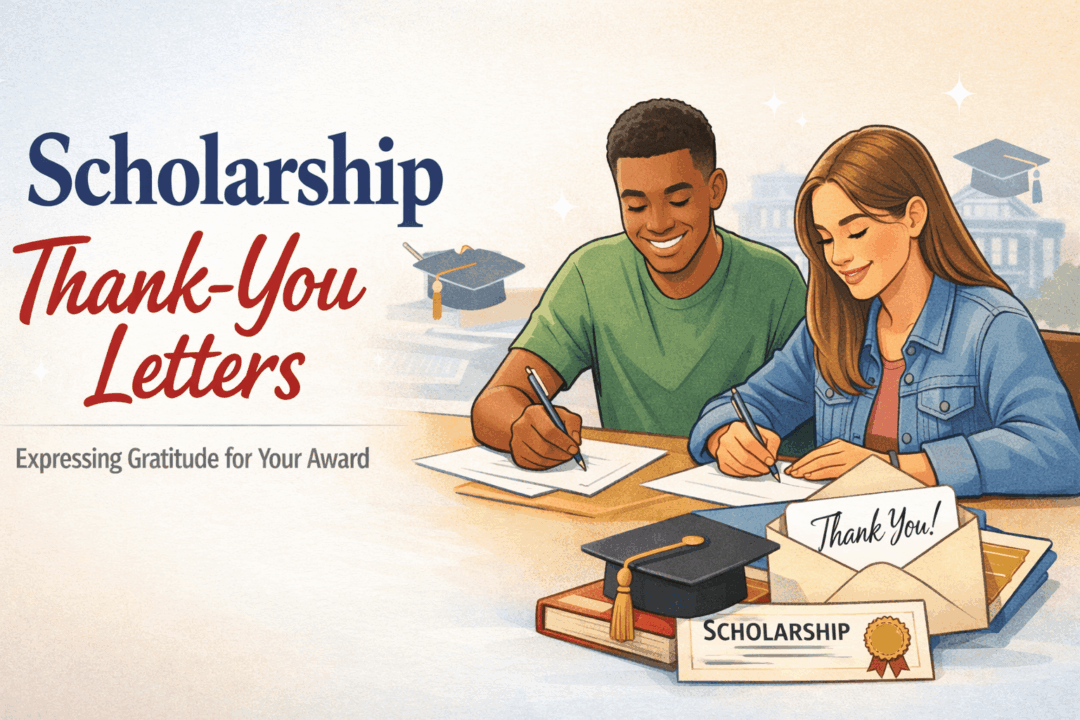
Scholarship Thank-You Letters as a High-Leverage Stewardship Intervention: Evidence, Design Principles, and a Practical Writing Protocol
Scholarship thank-you letters are often treated as etiquette—an expected “nice to have” after funds are awarded. The evidence base from philanthropy, behavioral science, and donor-relationship research suggests a stronger conclusion: properly designed expressions of gratitude function as a low-cost stewardship intervention that can shape donor psychology, reinforce perceived impact, and support long-run scholarship sustainability. This paper synthesizes research on gratitude and prosocial reinforcement, donor retention dynamics in the nonprofit sector, and experimental findings on acknowledgment messaging. It then translates that evidence into scholarship-specific letter design principles (source, focus, specificity, impact signaling, authenticity, and timing), a practical writing protocol, and implementation recommendations for scholarship programs and recipients. Sector data show donor retention remains structurally fragile—overall retention around 31.9% through Q3 2025, with new-donor retention around 14% and recapture about 2%—making retention-oriented stewardship especially valuable for donor-funded scholarships.
1. Introduction: Why a “Simple Letter” Matters in a High-Friction Giving Economy
Scholarships sit at the intersection of private generosity and public purpose. For donors—individuals, families, foundations, alumni, and employers—scholarship giving is rarely only transactional. It is identity-expressive (values, legacy), impact-seeking (student outcomes), and trust-dependent (confidence that funds are used well). These motivations collide with an uncomfortable empirical reality: donor retention is weak across much of the charitable sector, and the pipeline from first gift to sustained support is especially leaky. The Fundraising Effectiveness Project’s sector benchmarks show an estimated overall donor retention of 31.9% through Q3 2025; new donors retained year-to-date were about 14% (unadjusted), while recapture of lapsed donors was about 2%.
Scholarship funds—particularly those relying on annual or renewable gifts—are exposed to this retention environment. Even small changes in perceived meaning, trust, and relational warmth can influence whether donors renew, upgrade, or expand a scholarship. The scholarship thank-you letter is one of the few stewardship touchpoints that is (a) scalable, (b) low cost, and (c) uniquely credible because it can come from the direct beneficiary (the student). Yet many letters underperform because they are written as generic gratitude rather than as persuasive stewardship communication.
This paper asks a practical, evidence-driven question: What design choices make scholarship thank-you letters more likely to strengthen donor relationships without sounding manipulative, performative, or transactional?
2. Donor Retention as the Core Constraint: The Data-Driven Case for Stewardship
To understand the value of scholarship thank-you letters, we must start with the constraint they are trying to relieve: attrition. FEP’s Q3 2025 benchmarks also show retention varies sharply by donor segment, with “micro” donors ($1–$100) representing a large share of donors and experiencing low retention (about 21.3% YTD, unadjusted). The same report highlights the strategic imperative to re-engage one-time donors, who are retained at particularly low rates.
Why does this matter for scholarship programs? Because many scholarship funds rely on broad donor bases—alumni participation, community giving, employee giving, or local foundations. When donor counts shrink, programs drift toward dependence on fewer, larger donors, increasing volatility and reducing equitable access to scholarship opportunities. In a Q1 2025 update, AFP summarized FEP data showing total dollars raised rose while donor counts and retention showed strain, underlining the need to diversify and strengthen donor relationships over time.
Implication: Scholarship thank-you letters are not merely polite; they are one component of a retention toolkit. Their role is not to “ask” but to reinforce meaning, credibility, and impact—drivers that retention research consistently associates with loyalty.
3. The Behavioral Science of Gratitude: Why Being Thanked Changes Future Prosociality
A robust behavioral literature shows that receiving gratitude can increase a helper’s willingness to help again—i.e., gratitude can operate as a “moral reinforcer.” In a well-cited experimental program, Grant and Gino show that a brief written expression of gratitude increased subsequent helping behavior and that the mechanism was primarily communal (feeling socially valued) rather than purely agentic (feeling competent).
This mechanism maps cleanly onto scholarship giving. Donors rarely meet recipients; without feedback, the gift can become psychologically “silent,” weakening emotional reinforcement. A strong thank-you letter restores the donor’s sense of social worth: my action mattered to a real person; it was seen; it was valued. That is precisely the psychological state that encourages repeated prosocial engagement.
Key translation: Scholarship letters should be designed to increase the donor’s sense of social worth through sincere, specific acknowledgment of impact—without slipping into flattery or transactional language.
4. Acknowledgment Design Matters: Who Says Thank You—and How They Frame It
4.1. Source effects: beneficiary vs. organization
Evidence suggests the source of acknowledgment shapes donor response. In experiments reported in Frontiers in Psychology, acknowledgment letters “from beneficiaries” produced more favorable subsequent donation desires than letters framed as coming from the charity. This is crucial for scholarship programs: the student letter is not just a tradition; it is an empirically plausible advantage because the beneficiary voice can feel more authentic and less “institutional.”
4.2. Focus effects: other-focused vs. self-focused gratitude
A related line of experimental work finds that other-focused acknowledgments (emphasizing the donation’s benefit and meaning for recipients) can outperform self-focused acknowledgments (emphasizing the donor’s admirable traits). In the “self-focused vs. other-focused” studies, other-focused letters generated higher subsequent donation desire, mediated by “morality preference” and feelings of doing the morally right thing.
Practical translation: Avoid “You are such an amazing, generous person” as the main strategy. Instead, center the concrete effect of the donor’s action, with the donor treated as a respected partner rather than a hero being praised.
5. What Stewardship Should Not Do: Backfiring Through Extra Asks or “Gift-Like” Incentives
Stewardship communication can backfire when recipients infer manipulation. Field-experimental evidence on “thank you letters” that add additional asks is cautionary. In Sudhir and coauthors’ field experiment context, embedding an explicit ask for more giving (or even a social media follow request) reduced giving—consistent with a “reactance” interpretation when donors perceive the thanks as instrumental rather than sincere.
Relatedly, research on thank-you gifts shows that adding material “thank-you” incentives can reduce giving in some contexts—contrary to intuition—by reframing the exchange as quasi-market rather than moral.
Translation for scholarship letters:
-
Student thank-you letters should not include fundraising language (“please consider donating again”) or marketing CTAs.
-
Programs that bundle student letters with fundraising appeals should treat this as a separate design problem; combining them can dilute sincerity signals.
6. Channel and Timing: Evidence, Constraints, and Real-World Program Rules
Many institutions impose operational constraints that implicitly reflect stewardship best practice: send letters promptly and follow program formatting rules. For example, Tennessee Tech requires completion of donor thank-you letters within two weeks of accepting the award and explains that donor feedback is meaningful and can support continued giving.
Institutional guidance also emphasizes mechanics that protect donor preferences and processing workflows: Santa Clara University recommends first-person narrative and even advises not dating letters because donors may receive multiple letters at once.
Other institutions formalize brevity and privacy norms. UNC Gillings suggests keeping letters to ~200 words and stresses specificity and correct salutations. Idaho State advises 50–100 words, to explain impact, and explicitly says not to include the scholarship dollar amount.
Evidence-aligned interpretation: Promptness, clarity, and operational compliance reduce friction and increase the likelihood that the letter is actually delivered and read in a positive frame.
7. A Scholarship-Specific Model: The Thank-You Letter as “Impact Signal” in a Triadic Relationship
Scholarship giving is triadic: donor → institution/fund → student. The student letter must do three jobs simultaneously:
-
Affirm the donor’s identity and intent (respect the motive).
-
Reduce uncertainty about impact (credible, concrete outcomes).
-
Protect authenticity (avoid manipulation cues).
From the evidence above, we can translate those jobs into six design dimensions:
Dimension A: Beneficiary voice (source credibility)
Write in first person; sound like a real student, not a brochure. Beneficiary-sourced acknowledgment can outperform charity-sourced thanks in donor response.
Dimension B: Other-focused framing (moral meaning)
Emphasize what the gift does—time, focus, opportunity, reduced stress—more than praising the donor’s character. Other-focused acknowledgments elicit stronger subsequent donation desires.
Dimension C: Specificity (information value)
Specificity is not decoration; it is evidence. UNC’s guidance explicitly recommends being specific about interests and experiences.
Dimension D: Impact pathway (how funds change behavior)
Donors infer impact more strongly when the letter explains the causal pathway: Because of this scholarship, I reduced work hours / bought required materials / joined an unpaid internship / took a heavier credit load / stayed enrolled. This aligns with the broader donor evaluation logic captured in retention research emphasizing impact and performance signals.
Dimension E: Authenticity safeguards (avoid reactance)
Do not add asks, marketing links, or exaggerated gratitude. Reactance can suppress giving when thanks is seen as manipulative.
Dimension F: Timing and compliance (delivery probability)
Follow program rules; many require letters within ~two weeks. If a letter is late, the best “fix” is not perfection—it is prompt delivery with sincere ownership.
8. A Practical Writing Protocol for Students (Evidence-Based, Program-Friendly)
Below is a protocol that synthesizes common university requirements with the donor-psychology evidence.
Step 1: Open with precise gratitude (1–2 sentences)
-
Name the scholarship (if allowed) and state sincere thanks.
-
Keep tone professional, not performative.
Step 2: Establish identity in one snapshot (1–2 sentences)
-
Major, year, campus/community involvement, or a short origin detail.
-
Avoid oversharing sensitive information.
Step 3: Describe the impact pathway (2–4 sentences)
Use concrete “because → therefore” logic. Examples:
-
“Because this scholarship reduced my work hours from X to Y, I was able to…”
-
“It covered required equipment/materials that are essential for…”
-
“It allowed me to accept an internship / participate in research / stay enrolled full time…”
Step 4: Future orientation (1–3 sentences)
Connect to goals (career, service, research, community), showing the donor their gift is building forward momentum.
Step 5: Close with respect and gratitude (1–2 sentences)
-
Thank them again; avoid asking for continued support.
-
End cleanly and follow formatting rules from the program.
Length guidance: Many programs want short letters (e.g., 50–100 words at ISU, ~200 words at UNC). Treat brevity as a feature: donors value clarity.
9. A High-Performing Scholarship Thank-You Letter Template (Adaptable)
(Adjust to your program rules—some schools add salutations/closings for you, or restrict formatting.)
Paragraph 1 (gratitude + scholarship reference):
Thank you for supporting the [Scholarship Name]. I’m honored to be selected, and I’m truly grateful for the opportunity your generosity provides.
Paragraph 2 (who you are + what you’re studying):
I’m a [year] student studying [major/program]. This year I’m involved in [1–2 activities/research/work roles], and I’m working toward [near-term academic goal].
Paragraph 3 (impact pathway + forward look):
This scholarship is making a direct difference by [specific impact: reducing work hours, covering required materials, enabling full-time enrollment, supporting an internship/research, etc.]. Because of that support, I can focus more fully on [coursework/training/project] and continue toward my goal of [career/service goal]. Thank you again for investing in students like me and for helping make this path possible.
Note: Some schools explicitly advise not to include the award amount.
10. Implementation Guidance for Scholarship Programs (How to Get Better Letters at Scale)
If you manage a scholarship program, the evidence implies three operational moves:
-
Design prompts that elicit other-focused impact language.
A simple form prompt (“In 1–2 sentences, describe what this scholarship allows you to do that you otherwise could not”) encourages the framing shown to support donor response. -
Preserve beneficiary authenticity.
Over-editing can turn student letters into institutional messaging, potentially losing the “beneficiary source” advantage. Light editing for clarity and professionalism is helpful; rewriting voice is risky. -
Do not bundle student thanks with additional asks.
If fundraising appeals must be included, separate them in time or packaging. Evidence suggests extra asks inside thank-you communications can reduce giving in some settings.
11. Limitations and What “Data-Driven” Really Means Here
Not every gratitude tactic works in every channel. For example, large-scale field experiments found thank-you calls (as commonly implemented) produced a precisely estimated null effect on subsequent giving, despite strong professional beliefs that they would increase retention. This does not mean gratitude is ineffective; it means execution, channel, and framing matter, and “standard practice” can underperform without careful design.
Scholarship thank-you letters differ from calls: they can be reread, shared, and archived; they originate from the beneficiary; and they often contain richer impact narratives. The best inference from the full evidence base is conditional: gratitude strengthens prosocial reinforcement when it feels authentic, beneficiary-grounded, and impact-specific—and weakens when it feels instrumental or transactional.
Conclusion
Scholarship thank-you letters are one of the rare scholarship practices that are simultaneously ethical, human, and strategically consequential. In a donor ecosystem where retention is structurally low, especially for new and one-time donors, scholarship programs benefit from stewardship touchpoints that reinforce meaning and credibility. Sector benchmarks underscore the fragility of retention, while behavioral evidence shows gratitude can reinforce future prosociality—especially when it increases the helper’s sense of social worth and when acknowledgment is framed from the beneficiary perspective.
The data-driven best practice is not “write something nice.” It is: deliver prompt, compliant, beneficiary-voiced, other-focused, specific, impact-causal gratitude—without additional asks. Done well, a scholarship thank-you letter becomes more than manners: it becomes stewardship that helps keep scholarships funded for the students who come next.
References (Selected, APA-style)
-
Association of Fundraising Professionals. (2025, July 29). Fundraising Effectiveness Project data for Q1 2025…
-
Fundraising Effectiveness Project. (2025). Q3 2025 quarterly benchmark report / retention rate metrics.
-
Grant, A. M., & Gino, F. (2010). A little thanks goes a long way: Explaining why gratitude expressions motivate prosocial behavior.
-
Samek, A., et al. (2023). Do thank-you calls increase charitable giving? Expert forecasts and field experimental evidence. American Economic Journal: Applied Economics.
-
Sudhir, K., Fong, H., et al. (2019/2021). Greedy or grateful? Asking for more when thanking donors (field experiment / working paper versions).
-
Wenting, F., et al. (2021). Beneficiaries or charity: The influence of the source of acknowledgments… Frontiers in Psychology.
-
Wenting, F., et al. (2022). Self-focused or other-focused: The influence of acknowledgment type on subsequent donation desires. Frontiers in Psychology.
-
Santa Clara University. Letter writing tips – thanking donors.
-
Tennessee Tech University. Thank you letters (scholarships).
-
UNC Gillings School of Global Public Health. (2017). Guidelines and tips for writing a great thank you letter.
-
Idaho State University. Guidelines for thank you letters.
💡 Why Do Scholarship Thank You Letters Matter?
-
Good manners = good reputation 🫶 – A thank you shows respect for the donor’s generosity.
-
Professional growth 🚀 – It’s basically practice for future networking and job etiquette.
-
Future opportunities 🔑 – Many donors continue supporting students who show gratitude.
According to the National Scholarship Providers Association, over 75% of donors say they expect a thank you letter before considering renewing or continuing funding (source: NSPA, 2024).
📝 How to Write a Thank You Letter (Made Easy)
Don’t overthink it! Here’s the simple structure:
-
Greeting – Start with “Dear [Scholarship Donor/Committee Name],”
-
Gratitude – Thank them for the specific scholarship by name.
-
Personal Touch – Share your major, career goals, or a bit about your journey.
-
Impact Statement – Tell them how this scholarship is making a difference.
-
Future Outlook – Show how their support will help you reach your dreams.
-
Closing – Sign off politely (“Sincerely,” or “With gratitude,” + your name).
📬 Example of a Scholarship Thank You Letter
Here’s a realistic, professional, and Gen Z–friendly sample you can use as inspiration:
Dear [Scholarship Committee or Donor’s Name],
I am writing to sincerely thank you for awarding me the 2025 Future Leaders Scholarship. I am currently a junior at Central High School, planning to study Computer Science at [Your University Name] this fall.
This scholarship not only eases the financial stress of tuition but also motivates me to continue striving for excellence in my academic and extracurricular activities. I hope to use my skills in technology to create accessible digital tools for underserved communities, and your generosity is helping make that possible.
Thank you again for believing in my potential and supporting students like me. I hope to one day give back to others, just as you have given to me.
With gratitude,
[Your Full Name]
🚀 Quick Tips for Gen Z Writers
-
Keep it short and sweet (200–300 words max).
-
Write in a professional tone — no texting lingo like “thx” or “u rock.”
-
Handwritten 💌 letters feel extra personal, but email is totally fine if that’s what’s preferred.
-
Proofread before sending! (Grammarly or Google Docs spellcheck = lifesavers).
🌐 Resources to Help You Shine
🎯 Final Takeaway
A thank you letter might seem small, but it can leave a BIG impression. It’s not just about saying thanks — it’s about showing appreciation, professionalism, and future potential. So, whether you handwrite it on crisp paper or send it as a polished email, make it heartfelt, respectful, and memorable.
✨ Your scholarship journey is just starting, and a thank you letter is your first step into the professional world.