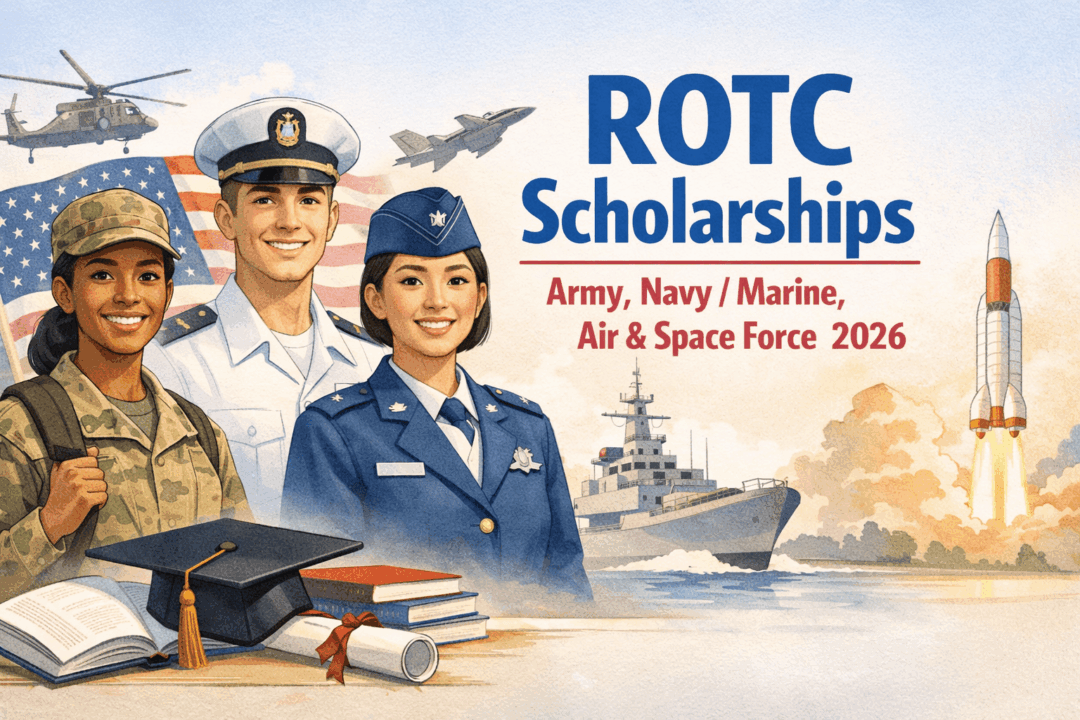
ROTC Scholarships (Army, Navy/Marine, Air & Space Force) — Deadlines, Amounts, and Verified Apply Links (2026)
The most accurate, monthly-updated guide to ROTC scholarships: Army, Navy/Marine Corps NROTC, Air Force & Space Force AFROTC, Green to Gold, Minuteman (USAR/Guard), leadership sub-scholarships, and more.
January
NROTC National Scholarship (Navy Option)
💥 Why It Slaps: Full tuition + fees (or school room/board equivalents in some cases) with textbook stipend and monthly subsistence; commissions into the Navy.
💰 Amount: Full tuition & fees; ~$750/yr books; monthly stipend that increases by class year.
⏰ Deadline: January 31, 2026 (national submission).
🔗 Apply/info: https://www.netc.navy.mil/Commands/Naval-Service-Training-Command/NROTC/Prospective-Midshipmen/Scholarship-and-Non-Scholarship-Options/Four-Year-National-Scholarship/
NROTC Scholarship (Marine Option)
💥 Why It Slaps: Full tuition under the NROTC Marine pipeline; pairs with Marine-specific summer training and commissioning.
💰 Amount: Full tuition & fees; book stipend; monthly subsistence.
⏰ Deadline: January 31, 2026 (national submission).
🔗 Apply/info: https://www.netc.navy.mil/Commands/Naval-Service-Training-Command/NROTC/Prospective-Midshipmen/Scholarship-and-Non-Scholarship-Options/Marine-Corps-Scholarships/
Army ROTC National Scholarship — 2nd Board (HS seniors)
💥 Why It Slaps: Most flexible pathway; 2–4 year awards; choose tuition/fees or room & board; includes $1,200/yr for books + $420/mo stipend.
💰 Amount: Full tuition & fees or R&B (up to program cap), $1,200/yr books, $420/mo stipend.
⏰ Deadline: January 19, 2026 (Round 2 packet due).
🔗 Apply/info: https://www.goarmy.com/careers-and-jobs/find-your-path/army-officers/rotc/scholarships
Marine Corps NROTC Leadership Scholarships (subset of NROTC Marine Option)
— Frederick C. Branch (FCB) (HBCUs)
— Pedro Del Valle (PDV) (HSIs)
— Vicente Tomás Garrido Blaz (VTGB) (AANHPI focus)
— Margaret Brewer (MB) (leadership, women’s trailblazer)
💥 Why It Slaps: Same full NROTC Marine scholarship benefits, routed to specific leadership pipelines/school types; strengthens your competitiveness.
💰 Amount: Full tuition & fees; book stipend; monthly subsistence.
⏰ Deadline: Typically January 31 (aligns with NROTC Marine Option national cycle; check current MARADMIN each year).
🔗 Apply/info: Latest MARADMIN listing these programs — https://www.netc.navy.mil/Commands/Naval-Service-Training-Command/NROTC/Prospective-Midshipmen/Scholarship-and-Non-Scholarship-Options/Marine-Corps-Scholarships/
February
Boren ROTC Initiative (NSEP — language study + commissioning track)
💥 Why It Slaps: Funds critical-language study tied to national security + adds special advising and opportunities for ROTC cadets/midshipmen.
💰 Amount: Up to ~$25,000 (varies by program/year); campus & national advising.
⏰ Deadline: Late Jan–Feb (varies by year—plan for early Feb national deadline).
🔗 Apply/info: Overview specific to ROTC: https://www.borenawards.org/boren-rotc
March
Army ROTC National Scholarship — Final Window
💥 Why It Slaps: Last chance for the HS national board cycle; opens pathway to any Army component (Active, Guard, Reserve).
💰 Amount: Full tuition & fees or R&B option; $1,200/yr books; $420/mo stipend.
⏰ Deadline: You must start by March 4, 2026 (complete soon after per board schedule).
🔗 Apply/info: https://www.goarmy.com/careers-and-jobs/find-your-path/army-officers/rotc/scholarships
AFCEA ROTC Scholarships (STEM; for enrolled ROTC cadets)
💥 Why It Slaps: Stackable private awards for Army/Navy/Marine/Air Force ROTC sophomores & juniors; multiple named funds.
💰 Amount: Typically $2,500–$3,000.
⏰ Deadline: Opens Feb 1; closes Apr 1 (typical window).
🔗 Apply/info: https://www.afcea.org/rotc-scholarships
April
AFCEA ROTC Scholarships — Final Submission
💥 Why It Slaps: One application considers you for multiple AFCEA ROTC awards.
💰 Amount: $2,500–$3,000 typical.
⏰ Deadline: April 1, 2026 (current cycle planned; check site each year).
🔗 Apply/info: https://www.afcea.org/rotc-scholarships
May
AFCEA General ROTC Scholarship (select funds close later)
💥 Why It Slaps: Additional AFCEA awards sometimes run into May depending on the named fund—good second-chance option.
💰 Amount: Often $2,500 per award (varies).
⏰ Deadline: Around May 1 (varies by fund/year—confirm current).
🔗 Apply/info: Central AFCEA scholarship hub — https://www.afcea.org/rotc-scholarships
June
Army ROTC Minuteman (USAR) — GRFD Scholarship
💥 Why It Slaps: Guarantees Reserve service (USAR) with full tuition or $12,000/yr room & board, $1,200/yr books, $420/mo stipend—plus SMP drill pay and potential kicker.
💰 Amount: Up to full tuition & fees or $12,000 R&B (yr), plus books & stipend.
⏰ Deadline: June 1 for nominations (AY25 campaign; next cycle posts each fall).
🔗 Apply/info: https://www.usar.army.mil/MinutemanCampaign/
July
AFROTC High School Scholarship Program (HSSP) — Opens
💥 Why It Slaps: Type 1 (full tuition) and Type 2 (up to $18,000/yr) options; can convert to on-campus housing scholarship (up to $10,000/yr). Space Force track available.
💰 Amount: Type 1 full tuition & fees; Type 2 up to $18,000/yr; ~$900/yr books; monthly stipend.
⏰ Window: Opens July 1, 2025; see December for the close date.
🔗 Apply/info: https://www.afrotc.com/scholarships/high-school/application/
August
Coast Guard College Student Pre-Commissioning Initiative (CSPI) (ROTC-adjacent commissioning scholarship)
💥 Why It Slaps: Full-ride style benefits (tuition/fees/books + full-time Coast Guard pay/benefits while in school) for selected students at approved MSI partner schools; leads to OCS and CG commission.
💰 Amount: Tuition/fees/books + E-pay/benefits while enrolled (per CG program terms).
⏰ Deadline: Windows vary by FY—watch for annual announcements (often late summer/fall).
🔗 Apply/info: https://www.gocoastguard.com/get-started/officer-applications/college-student-pre-commissioning-initiative-cspi-scholarship
October
Army ROTC National Scholarship — 1st Board (HS seniors)
💥 Why It Slaps: Early board = more seats; same full tuition or room/board option, plus books and stipend.
💰 Amount: Full tuition & fees or room & board; $1,200/yr books; $420/mo stipend.
⏰ Deadline: October 13, 2025 (Round 1 packet due).
🔗 Apply/info: https://www.goarmy.com/…/rotc/scholarships
Green to Gold (Active-Duty Option & Scholarship Option) — Phase I dates post each fall
💥 Why It Slaps: For enlisted Soldiers shifting to officer track via college. ADO lets you stay on active duty; Scholarship Option can pay full tuition or capped room/board + stipend & books.
💰 Amount: Scholarship Option: Full tuition & fees or R&B cap (recent cap ~$10–12k/yr), + $1,200/yr books, $420/mo stipend; ADO retains pay/allowances.
⏰ Deadline: Phase I submissions typically due in November (AY25–26: Nov 10, 2025).
🔗 Apply/info: https://armyrotc.army.mil/green-to-gold/ (AY25–26 handbook for exact dates)
November
Green to Gold (Active-Duty Option) — Phase I (AY25–26 example)
💥 Why It Slaps: Remain on active duty while finishing your degree and earning your commission—ideal for Soldiers with 2 years left to finish school.
💰 Amount: Keep active-duty pay/allowances; use GI Bill as needed (no ROTC tuition benefit on ADO).
⏰ Deadline: Nov 10, 2025 (Phase I docs; ADO window opens July 4; Phase II due April 1, 2026).
🔗 Apply/info: AY25–26 ADO handbook (official PDF): https://armyrotc.army.mil/…/G2G-ADO-Handbook…pdf
December
AFROTC High School Scholarship Program (HSSP) — Closes
💥 Why It Slaps: Your main AF/Space Force ROTC entry scholarship; two award tiers; Space Force track embedded.
💰 Amount: Type 1 (full tuition & fees) or Type 2 (to $18k/yr) + ~$900/yr books + monthly stipend; room option to $10k/yr.
⏰ Deadline: December 12, 2025 (AY25–26).
🔗 Apply/info: https://www.afrotc.com/scholarships/high-school/application/
NROTC Nurse Option (timeline mirrors NROTC national)
💥 Why It Slaps: Full tuition for BSN students + nursing pipeline to commission as a Navy Nurse Corps officer.
💰 Amount: Full tuition & fees; ~$750/yr books; monthly subsistence.
⏰ Deadline: Generally by late Dec–Jan (recommend submitting by Dec 31; national deadline typically Jan 31).
🔗 Apply/info: https://www.netc.navy.mil/…/NROTC/Prospective-Midshipmen/NROTC-Apply-Now/
Rolling / Campus-Based (apply ASAP; units have their own cutoffs)
Army ROTC Campus-Based 2- & 3-Year Scholarships (college students)
💥 Why It Slaps: Activate scholarship during college if you didn’t win a 4-year; same tuition/books/stipend benefits.
💰 Amount: Up to full tuition & fees (or R&B option), $1,200/yr books, $420/mo stipend.
⏰ Deadline: Unit-set & rolling; start early in freshman/sophomore years.
🔗 Apply/info: https://armyrotc.army.mil/scholarships/
Army ROTC Nursing Scholarship (college nursing students)
💥 Why It Slaps: Army-backed funding specifically for BSN students; clinical leadership experience + guaranteed job path.
💰 Amount: Full tuition & fees or R&B option; $1,200/yr books; $420/mo stipend.
⏰ Deadline: Rolling by host program; apply through your Army ROTC battalion.
🔗 Apply/info: https://armyrotc.army.mil/nursing/
Army Dedicated Guard/Reserve (DED-GRFD) Scholarships (ARNG/USAR service commitment)
💥 Why It Slaps: Tuition/fees or R&B funding with simultaneous Guard/Reserve service; SMP drill pay possible.
💰 Amount: Often full tuition & fees or R&B cap + books + stipend; SMP pay/kicker may apply.
⏰ Deadline: Rolling by component & state (Guard) or by USAR nomination cycles.
🔗 Apply/info: ARNG overview & eligibility: https://nationalguard.com/tools/guard-scholarships
NROTC College Program — Side-Load 3-Year / 2-Year Scholarships
💥 Why It Slaps: Didn’t win the national? Earn a 3- or 2-year “side-load” after strong freshman/sophomore performance.
💰 Amount: Full tuition & fees from activation + book stipend + monthly subsistence.
⏰ Deadline: Unit nomination cycles (usually each term/year); check your NROTC unit.
🔗 Apply/info: Official NROTC College Program page — https://www.netc.navy.mil/…/NROTC/…/College-Program/
NROTC MSISR (Minority Serving Institution Scholarship Reservation)
💥 Why It Slaps: NROTC Navy Option scholarships reserved for students attending partner MSIs; same full benefits.
💰 Amount: Full tuition & fees + books + monthly subsistence.
⏰ Deadline: Typically aligns with NROTC national (late fall through Jan 31); unit nominations required.
🔗 Apply/info: See unit guidance (example) & how to flag MSISR interest on the NROTC application —https://ncyionline.org/wp-content/uploads/2024/08/US-Navy-MSI-SCHOLARSHIP-PROGRAM.pdf — ✅ Links verified Sep 28, 2025.
AFROTC In-College Scholarship Program (ICSP) & General Charles McGee Leadership Award (CMLA)
💥 Why It Slaps: Big path for non-HSSP cadets; many detachments award Type 2 via ICSP; CMLA commonly funds junior/senior years.
💰 Amount: Often Type 2 up to $18,000/yr + ~$900/yr books + monthly stipend; CMLA typically Type 2 for two years; room option up to $10,000/yr.
⏰ Deadline: Detachment nomination windows (commonly spring).
🔗 Apply/info: https://www.afrotc.com/scholarships/college/types/
AFROTC J-100 AFJROTC Character-in-Leadership Scholarship (HS seniors in AFJROTC/SFJROTC)
💥 Why It Slaps: Type 1 full tuition plus $10,000/yr housing allowance, books, and stipend—designed for top JROTC cadets headed to AFROTC/USSF.
💰 Amount: Full tuition & fees + $10,000/yr housing + books + monthly stipend.
⏰ Deadline: Unit nomination & interview timelines run Dec–Jan; selections typically announced late January.
🔗 Apply/info: Official AF/AETC program overview — https://www.aetc.af.mil/…/unlocking-futures-air-force-junior-rotcs-j-100-scholarship-program/
AFROTC Space Force HSSP-SF (via AFROTC)
💥 Why It Slaps: HSSP track that specifically targets commissioning into the U.S. Space Force; same benefits as AF HSSP plus SF interviews.
💰 Amount: Type 1/Type 2 per HSSP; room option up to $10,000/yr.
⏰ Deadline: Within HSSP window (see Dec 12, 2025 close); SF interviews have their own cutoffs (e.g., mid-Jan milestones).
🔗 Apply/info: AY25–26 HSSP Applicant Guide (with SF notes): https://www.reddit.com/r/AFROTC/comments/11a65c0/hssp_space_force/
ROTC Scholarships as a U.S. Human-Capital Pipeline: Funding, Commissioning Outcomes, and Equity Tradeoffs
Reserve Officers’ Training Corps (ROTC) scholarships sit at the intersection of higher-education finance, talent selection, and national security labor markets. Unlike civilian scholarships, ROTC awards function as contracted investments: the federal government subsidizes college costs and pays stipends in exchange for a defined service obligation, with potential recoupment if the contract is broken. This paper synthesizes congressional, Department of Defense (DoD), and service-program evidence to evaluate ROTC scholarships as a commissioning instrument, with emphasis on (1) scale and output (officer commissioning and “gains”), (2) cost structure (appropriations and per-officer investment logic), and (3) distributional outcomes (gender and race/ethnicity patterns and institutional geography). Using DoD population representation data for FY2022, ROTC scholarship and non-scholarship pathways together account for 7,295 of 17,218 active-component commissioned officer gains (about 42%), with large service-level variation (e.g., ~62% of Army gains vs ~20% Navy). Funding is similarly material: CRS reports ~$1.036B in FY2023 enacted ROTC funding (O&M plus MILPERS), supporting scholarships, stipends, training, and program infrastructure. The evidence suggests ROTC scholarships are best understood as a portfolio of service-specific talent strategies—balancing affordability, technical workforce needs, and civil-military connectivity—while confronting persistent equity and campus-politics constraints.
Keywords: ROTC, scholarships, officer accessions, human capital, military manpower, equity, commissioning sources
1. Introduction: ROTC scholarships as “contracted affordability”
Traditional scholarship policy is typically evaluated on access, persistence, and post-graduation earnings. ROTC scholarships require a broader analytic frame because they convert educational aid into a labor-supply contract for officer production under Title 10 authority. CRS describes Senior ROTC (SROTC) as an officer training and scholarship program hosted at civilian colleges, managed separately by the Army, Navy (including Marine option), and Air Force (including Space Force commissioning eligibility). In contrast to service academies (fully federal, residential training institutions) and OCS/OTS/PLC pipelines (post-baccalaureate screening and training), ROTC embeds pre-commissioning development inside civilian higher education—making it simultaneously a manpower program and a civic institution.
Two features make ROTC scholarships analytically distinct:
-
Dual compensation streams. ROTC scholarship recipients receive tuition/fees (or in some programs a room-and-board alternative) plus cash allowances such as book stipends and monthly subsistence. For example, GoArmy’s ROTC scholarship page specifies a $420/month stipend during the school year and $1,200/year for books for Army ROTC scholarships.
-
Service obligation and recoupment risk. Contracted students commit to commission, and statutes/policy allow repayment or enlisted service in some disenrollment cases; CRS notes that contracted enrollees who break the commitment may be required to reimburse educational expenses.
This “contracted affordability” model creates classic public-economics and labor-economics questions: How efficiently does spending translate into officer accessions? What are the selection effects of scholarship design (merit screening, major targeting, medical/fitness standards)? How do campus distribution and program closures alter equitable access to this pathway?
2. Program architecture: three services, multiple scholarship designs
Although commonly discussed as a single program, ROTC scholarships are best treated as three partially distinct systems (Army ROTC, Naval ROTC, Air Force ROTC), each with its own commissioning needs and incentive design.
2.1 Army ROTC: broad major eligibility and flexible benefit structure
Army ROTC scholarships are offered in 2-, 3-, and 4-year variants and can cover tuition and fees or room and board (in lieu of tuition) depending on award type and eligibility. GoArmy describes an eight-year obligation for scholarship acceptance, with active/reserve mix depending on scholarship type.
A key policy lever is the Army’s Reserve Component-aligned scholarships (e.g., GRFD/Minuteman), which explicitly trade flexibility for a guaranteed Guard/Reserve outcome and specify room-and-board flat rates (commonly described as $12,000/year for certain GRFD variants).
2.2 Naval ROTC: option-based obligations (Navy, Marine, Nurse)
Naval Service Training Command’s scholarship guidance differentiates service obligations by option: Navy option scholarship midshipmen owe at least 5 years active duty, Marine option owes at least 4 years, and Navy Nurse Corps owes at least 4 years. This option-based structure aligns scholarship contracting with distinct career pipelines and training investments.
2.3 Air Force ROTC: major-category targeting and rated-career commitments
AFROTC publicly describes typical officer commitments as 4 years active duty, with longer commitments for rated specialties (e.g., 10 years for pilots). In scholarship allocation, AFROTC applicant guidance has increasingly emphasized categorizing majors (e.g., critical/non-critical) as part of workforce shaping.
3. Funding and the economics of officer production
3.1 Appropriations: ROTC is a billion-dollar scale program
CRS reports DoD appropriates ROTC funds primarily through Operation & Maintenance (O&M) and Military Personnel (MILPERS) accounts. In FY2023 enacted, CRS totals are approximately $861M (O&M) and $175M (MILPERS)—about $1.036B combined. O&M covers scholarships, travel/per diem, contractual support, and supplies; MILPERS covers cadet/midshipman pay and allowances, uniforms, and stipends. Importantly, CRS notes ROTC military instructors’ pay and benefits are not included in these figures, implying that “full program cost” is larger than the headline appropriation.
A practical implication: ROTC scholarship economics cannot be assessed solely by tuition checks. The program’s cost structure includes training events, administration, and cash compensation—meaning any ROI claim should treat “scholarship value” as only one component of a broader production system.
3.2 Contextualizing value against college sticker prices
College Board reports average 2025–26 published (sticker) tuition and fees of $11,950 for public four-year in-state, $31,880 for public four-year out-of-state, and $45,000 for private nonprofit four-year institutions. These sticker prices frame why ROTC scholarships can be decisive for affordability—especially at out-of-state and private institutions—while also highlighting a policy tension: high-tuition schools increase per-student subsidy variance, raising questions about how services manage cost control versus recruiting reach.
3.3 A rough “investment per annual officer output” lens (with caveats)
CRS states ROTC produces more than 8,500 officers annually. If one divides FY2023 ROTC funding (~$1.036B) by 8,500, the implied spending is on the order of ~$122k per officer-year of output (a coarse benchmark, not a causal cost per graduate). This back-of-the-envelope ratio is useful for policy comparisons (e.g., changes in scholarship mix or training requirements), but it must be treated cautiously because (1) ROTC funding supports multiple cohorts simultaneously, and (2) “officers produced” differs conceptually from “officer gains,” which can include component transfers and returns.
4. Commissioning outcomes: what FY2022 “officer gains” data show
DoD’s Population Representation tables provide a standardized view of active component commissioned officer gains by commissioning source. In FY2022, total DoD active-component commissioned officer gains were 17,218, distributed across major sources including service academies, ROTC (scholarship and non-scholarship), OCS/OTS/PLC, and direct appointments.
4.1 ROTC’s share of FY2022 officer gains
From the FY2022 table:
-
ROTC Scholarship gains: 3,554
-
ROTC Non-Scholarship gains: 3,741
-
Combined ROTC (sch+non): 7,295 of 17,218 (~42%)
This confirms ROTC’s role as the dominant single commissioning ecosystem when scholarship and non-scholarship ROTC are combined.
4.2 Service-level variation: ROTC is not equally central everywhere
FY2022 officer gains by service show very different reliance on ROTC:
-
Army: 6,973 total gains; ROTC (sch+non) 4,305 (~62%)
-
Air Force: 4,047 total gains; ROTC (sch+non) 1,933 (~48%)
-
Space Force: 319 total gains; ROTC (sch+non) 175 (~55%)
-
Navy: 4,106 total gains; ROTC (sch+non) 831 (~20%)
-
Marine Corps: 1,773 total gains; ROTC (sch+non) 51 (~3%), with large shares in OCS/PLC and “unknown/other” categories
Interpretation: ROTC is structurally central to Army and Air/Space Force officer production, while Navy and Marine Corps appear to diversify across direct appointments and OCS/PLC pathways more heavily in the gains data. This should not be read as “ROTC doesn’t matter” for naval services; rather, it reflects how different communities (e.g., medical, chaplain, technical direct commissions) and reporting categories contribute to FY2022 gains.
4.3 Gender composition: women’s representation differs by commissioning source
The FY2022 table also reports the percentage of women by source. For DoD totals, women comprised 25.3% of total officer gains, with source-specific variation (e.g., ~26.0% at academies; ~24.2% ROTC scholarship; ~22.8% ROTC non-scholarship; ~16.9% OCS/OTS/PLC; ~42.0% direct appointments).
This pattern suggests two workforce dynamics: (1) direct appointment pipelines (often professional specialties) have higher female representation, and (2) ROTC—while substantial in scale—does not automatically equalize gender representation without targeted policy interventions (recruiting, campus placement, scholarship allocation, and climate/safety measures).
5. Equity and representation: race/ethnicity and institutional geography
5.1 Race/ethnicity patterns among ROTC-commissioned officers
CRS, drawing on GAO data for Academic Year 2021, reports the race/ethnicity distribution of ROTC-commissioned officers by service. For example:
-
Army ROTC AY2021: White 64.8%, Black 11.9%, Hispanic 12.5%, Asian 7.0%
-
Navy ROTC AY2021: White 73.3%, Black 4.0%, Hispanic 8.0%, Asian 6.6%
-
Air Force ROTC AY2021: White 67.5%, Black 5.5%, Hispanic 11.3%, Asian 6.4%
These differences matter because they imply ROTC’s diversity outcomes are partially service-specific—likely reflecting recruiting strategies, major targeting, geographic distribution of units, and occupational pipelines.
5.2 Where ROTC exists shapes who can access it
CRS reports approximately 1,441 schools had an ROTC host, cross-town, or extension unit between 2011 and 2021, and it documents four affiliation models (host, extension, cross-town, consortium). This institutional geography is not a neutral backdrop: if units cluster away from minority-serving institutions or high-need regions, the program’s affordability benefits and commissioning opportunities become less equally distributed.
CRS also notes that attempts to close ROTC detachments have historically generated controversy and congressional pushback, including appropriation provisions limiting disestablishment in prior periods. The implication for scholarship equity is direct: unit placement is scholarship access—because many scholarships and contracting pathways are practically mediated through campus detachments and their recruiting ecosystems.
5.3 The Coast Guard exception (and what it reveals)
CRS notes the Coast Guard does not have an ROTC program, but offers CSPI scholarships targeted to students at minority-serving institutions, followed by placement into Officer Candidate School upon graduation. This provides a natural comparison case: commissioning and affordability goals can be met through other scholarship-to-OCS models, but ROTC’s unique strength is sustained multi-year leadership development and campus presence.
6. Policy implications: designing scholarships for readiness, affordability, and legitimacy
6.1 ROTC scholarships are a portfolio, not a single lever
Because services differ in commissioning demand, occupational shortages, and retention challenges, ROTC scholarship policy functions as a portfolio optimization problem: balancing
-
Cost control (tuition variability; scholarship vs room-and-board options)
-
Talent targeting (critical majors; academic/fitness screens; leadership evaluation)
-
Equity and access (unit distribution; recruiting at MSIs; climate and safety)
-
Production elasticity (how quickly scholarship adjustments translate into officer gains)
6.2 Accountability metrics that match the program’s true objectives
A rigorous evaluation framework should track outcomes beyond “number of scholarships awarded”:
-
Commissioning yield: contracts → commissioning, stratified by scholarship type and institution category.
-
Career field alignment: share of scholarship recipients entering shortage specialties (e.g., technical/rated communities).
-
Retention and promotion: scholarship vs non-scholarship officer career trajectories (to ensure the program is not merely an accession subsidy).
-
Equity outcomes: demographic parity conditional on eligibility (medical/fitness/academic standards) and geographic access (unit placement).
-
Cost per commissioned officer (cohort-based): integrating O&M + MILPERS and, where feasible, instructor/overhead costs.
6.3 Campus legitimacy and civil-military relations are not “side effects”
CRS documents past campus controversies (Vietnam era protests, DADT era restrictions, and subsequent reintegration). These episodes show ROTC’s campus presence is politically and culturally salient—meaning scholarship policy that ignores university governance and student climate can face implementation risk. From a systems perspective, ROTC scholarships buy not only officers but also a form of structured civil-military contact—a public good that is hard to quantify but strategically valuable.
Conclusion
ROTC scholarships remain one of the United States’ most consequential “education-to-service” pipelines, operating at billion-dollar scale and producing a large share of active-component officer gains. FY2022 DoD data indicate ROTC scholarship and non-scholarship pathways together account for roughly 42% of active-component officer gains, with especially high reliance in the Army and Air/Space Force. At the same time, representation patterns differ across services, and access is shaped by where units exist and how scholarships are targeted. A modern ROTC scholarship strategy should therefore be evaluated as a portfolio: optimizing affordability and workforce needs while explicitly managing equity, campus legitimacy, and long-run officer quality.
FAQs — ROTC Scholarships
1) What exactly is “ROTC,” and which branches offer scholarships?
ROTC is a college-based officer commissioning program with funded scholarships offered by: Army ROTC, Navy/Marine Corps via NROTC, and Air Force & Space Force via AFROTC. Each has its own application, benefits, and service commitments. goarmy.com
2) How long is the service commitment after I commission?
- Army ROTC: An 8-year total military obligation, usually fulfilled as ~4 years Active Duty (or drilling in Guard/Reserve) plus time in the IRR, depending on your contract. goarmy.com
- Navy (NROTC): Most Navy-option officers owe 5 years Active Duty; some communities (e.g., aviation) require more. Marine-option officers typically owe 4 years Active Duty. Title of Site | Rice University
- Air & Space Forces (AFROTC): Most line officers owe 4 years Active Duty; pilots owe 10 years, and some rated roles (CSO/ABM/RPA) owe 6 years after training. AFROTC
3) What do the scholarships actually pay for?
- Army ROTC: Full tuition & fees or room & board (school-capped), $1,200/yr books, $420/mo stipend. Army ROTC
- NROTC (Navy/Marine/Nurse): Full tuition & fees or room & board (up to program cap), ~$750/yr books, and a tiered monthly stipend. Navy Network Clearinghouse
- AFROTC (Air & Space): Type 1 (full tuition) or Type 2 (up to $18,000/yr); ~$900/yr books; monthly stipend; option to convert to housing (up to $10,000/yr) at many schools. AFROTC
4) Are SAT/ACT scores required right now?
- AFROTC HSSP (AY26–27): Minimum SAT 1310 or ACT 28; single-sitting score used. AFROTC
- NROTC: SAT/ACT required for national scholarship; minimums published by Navy/NROTC. Navy.com
- Army ROTC: Requires SAT or ACT for the national high-school board. goarmy.com
5) Can I major in anything, or do I need STEM?
- Army ROTC: Open to any academic discipline. Army ROTC
- NROTC (Navy option): Uses Tier 1/2/3 major priorities; Tier 1/2 (engineering/tech) are favored, Tier 3 is limited but possible. MIT Navy ROTC
- AFROTC: Scholarship type and competitiveness often favor technical/critical majors, though non-tech awards exist. University of Southern Mississippi
6) What are the fitness tests I must pass to contract/continue?
- Army ROTC: Army Fitness Test (AFT)—deadlift, hand-release push-ups, sprint-drag-carry, plank, 2-mile run (min 60 points per event). Army
- AFROTC: Physical Fitness Assessment (PFA)—abdominal measurement, 1-min push-ups & sit-ups, 1.5-mile run. AFROTC
- Navy/Marine (NROTC): Navy PRT (push-ups, plank, 1.5-mile run with approved alternates) or USMC PFT standards for Marine option. My Navy HR
7) Do I need a medical exam? What if I have a condition?
Yes. DoDMERB determines medical qualification. Many conditions can be waiverable depending on the branch and needs. No scholarship activates until you’re medically qualified or granted a waiver. TRICARE
8) Can I stack ROTC with Pell Grants, state aid, or merit awards?
Usually yes—but how funds interact depends on school policy and whether your ROTC award covers tuition or room & board. Many students pick R&B (when available) to let other awards cover tuition; work with your battalion/unit + financial aid early to optimize. (General program rules cited above for each branch’s pay structure.) Army ROTC
9) Are ROTC stipends or scholarships taxable?
- ROTC educational/subsistence allowances for advanced training are generally excluded from taxable income; active-duty pay (e.g., summer training) is taxable. IRS
- Scholarship amounts used for room & board may be taxable under IRS scholarship rules. Always confirm with a tax professional. IRS
10) I’m a high-school senior—when should I apply?
- Army ROTC National: Boards run Oct 2025 and Jan 2026; you must start by Mar 4, 2026 for the final window. goarmy.com
- AFROTC HSSP (Air/Space): Jul 1–Dec 12, 2025 window for AY25–26. AFROTC
- NROTC (Navy/Marine/Nurse): FY26 applications close Jan 31, 2026. Submit early. netfocus.ncdc.navy.mil
11) What if I miss the high-school (national) cycle?
Look at campus-based/side-load options: Army ROTC 2- & 3-year campus scholarships, NROTC college program → side-load 3/2-year, and AFROTC ICSP/CMLA for in-college cadets. Talk to your unit early. Army ROTC
12) Can I transfer my scholarship to another school?
- NROTC: Possible via a Placement Change Request; needs approval from Navy placement and the losing/gaining units. Navy Network Clearinghouse
- Army ROTC: Possible, case-by-case, coordinated through Cadet Command and the involved battalions. Start by accepting the offer, then submit a transfer request with your new admission letter. goarmy.com
13) What happens if I disenroll after my scholarship starts?
Policies vary by branch, but after the obligation point you may be required to repay scholarship funds and/or serve enlisted time; waivers exist for specific circumstances. Do not disenroll without talking to your unit cadre. Navy Network Clearinghouse
14) Do I have to be a U.S. citizen?
Yes for scholarship activation. Army requires U.S. citizenship for scholarship eligibility; AFROTC lets you apply earlier but you must be a citizen by the end of your first term to activate; NROTC requires U.S. citizenship. goarmy.com
15) I’m already enlisted—are there ROTC paths for me?
Yes. Army Green to Gold (ADO/Scholarship/Non-Scholarship) is the standard enlisted-to-officer ROTC path; the Marine Corps runs enlisted NROTC options each FY via MARADMIN; Airmen/Guardians have enlisted-to-AFROTC programs (e.g., ASCP/SOAR). Timelines and eligibility are strict—start early. Army ROTC
16) Can I study abroad, play varsity sports, or go Greek and still do ROTC?
Usually yes—with prior unit approval and careful scheduling around PT, labs, and summer training. Some majors/seasons make it harder; coordinate with cadre before committing. (Program structures and required training are outlined on service sites above.) goarmy.com
17) I’m pursuing Nursing—what’s different?
Army ROTC Nursing and NROTC Nurse Option fund BSN pathways and commission into the Army Nurse Corps or Navy Nurse Corps. Benefits mirror each program’s scholarship; clinical timing and licensure steps are built into the training plan. U.S. Army Reserve
18) What’s the Guard/Reserve “Minuteman/GRFD” scholarship?
A Reserve Component-committed Army ROTC pathway: full tuition & fees or $12,000/yr room & board, $1,200/yr books, $420/mo stipend, SMP drill pay, and an 8-year drilling obligation after commissioning. Deadlines and nomination steps are set each FY. U.S. Army Reserve
19) Do the Space Force and Air Force use the same scholarship?
Yes—you apply through AFROTC HSSP and can opt into the Space Force track; selection and interviews are run within that window. Commitments and degree priorities are Service-specific. AFROTC
20) Any quick tax/aid optimization tips?
Coordinate early with financial aid + your unit to decide whether to apply ROTC to tuition or room & board (where permitted). Remember: active-duty training pay is taxable; advanced-training ROTC allowances are generally not; scholarship dollars used for R&B can be taxable under IRS rules. Keep records. IRS