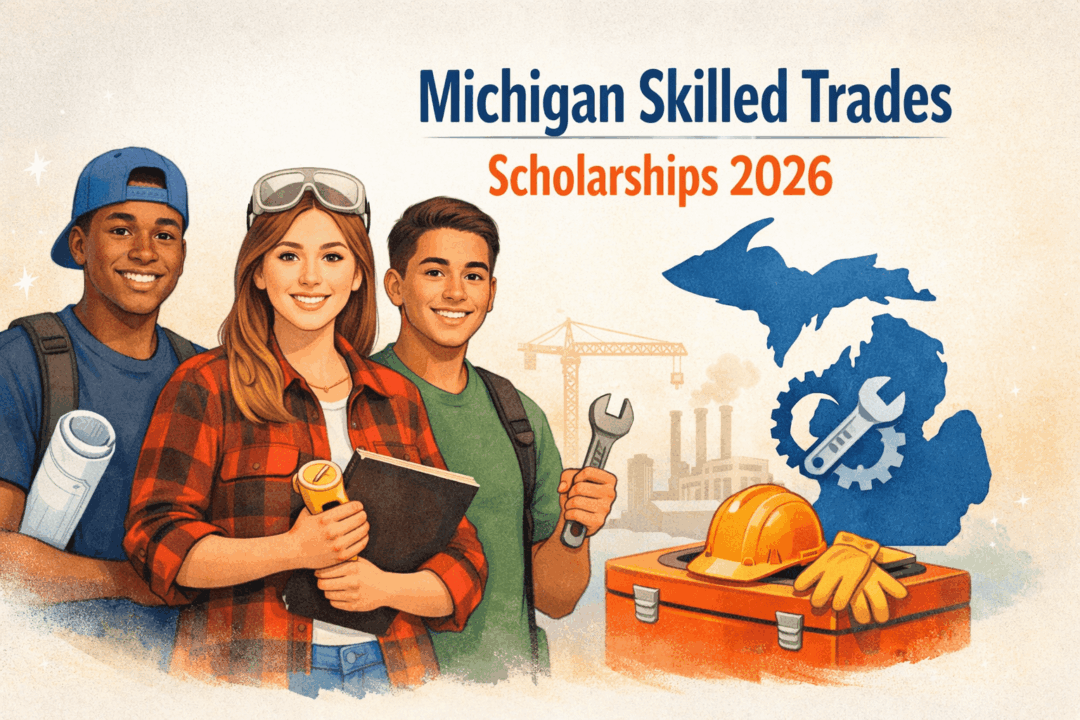
Michigan Skilled Trades Scholarships (High School Seniors — Class of 2026)
Verified list of Michigan scholarships for skilled trades (Class of 2026). Includes welding, machining, HVAC, lineworker, construction & CTE awards.
How this list works
- Focus: Michigan high school seniors graduating in 2026 headed into skilled trades programs (certificate, apprenticeship, or 2‑year degrees).
- Links go directly to the scholarship page or official application portal.
- Each link was checked and verified Sep 6, 2025.
- Deadlines shown are for the most recent cycle. If 2026 dates aren’t posted yet, we note the typical window.
WELDING
AWS Foundation — National Welding Scholarships
💥 Why It Slaps: The big one for welders—hundreds of awards for students in accredited welding programs.
💰 Amount: Typically $1,000–$6,000 (varies by fund)
⏰ Deadline: Usually opens Dec; most close Mar–Apr (2026 cycle TBD)
🔗 Apply/info: https://www.aws.org/foundation/scholarships
AWS Detroit Section — William F. Davis Memorial Scholarship
💥 Why It Slaps: Detroit‑area AWS section scholarship geared to MI welding students.
💰 Amount: Varies (section‑funded)
⏰ Deadline: Typically spring (2026 cycle TBD)
🔗 Apply/info: https://www.awsdetroit.org/scholarships/william-frederick-davis-memorial-scholarship/
Ferris State University — Welding & Fabrication Scholarships
💥 Why It Slaps: Multiple department‑specific funds for FSU welding students.
💰 Amount: Varies by fund
⏰ Deadline: School/foundation windows (check page; 2026 cycle TBD)
🔗 Apply/info: https://www.ferris.edu/HTMLS/academics/colleges/et/welding/scholarships/index.htm
FMA (Fabricators & Manufacturers Association) Foundation Scholarships
💥 Why It Slaps: National awards supporting welding/fabrication students; often includes MI winners.
💰 Amount: Amounts vary; cycles in Jan–Mar and Aug–Sep
⏰ Deadline: Mar 31 and Sep 30 (typical) — check current cycle
🔗 Apply/info: https://www.fmamfg.org/foundation/scholarships
Industrial Arts Institute (Onaway, MI) — IAI Welding Scholarships (incl. Jahn & Baiardi)
💥 Why It Slaps: Michigan nonprofit welding school with several named scholarships for its programs; some cover big chunks of tuition.
💰 Amount: Varies; examples up to 50% tuition or fixed amounts
⏰ Deadline: Program‑by‑program (rolling and seasonal)
🔗 Apply/info: https://iaiworks.com/financing-aid/
MACHINING / MANUFACTURING
SME Education Foundation Scholarships
💥 Why It Slaps: Large pool for manufacturing pathways (welding, machining, metrology, etc.).
💰 Amount: Usually $1,000–$10,000
⏰ Deadline: Nov 1–Feb 1 window (2026 cycle expected similar)
🔗 Apply/info: https://www.smeef.org/scholarships/
Discover Manufacturing (West Michigan) Scholarship
💥 Why It Slaps: West Michigan manufacturing network funding HS seniors pursuing manufacturing/trades.
💰 Amount: $500–$2,000
⏰ Deadline: Mid‑March (application opens in fall; 2026 cycle expected similar)
🔗 Apply/info: https://www.discover-manufacturing.com/discover-manufacturing-scholarship
PMA Educational Foundation (Precision Metalforming) — Educational/Tooling Awards
💥 Why It Slaps: Scholarships and tooling awards for metalforming, machining, CNC, tool & die.
💰 Amount: $500–$3,000
⏰ Deadline: Feb 1, 2026 (Fall cycle may open Oct 1, 2025)
🔗 Apply/info: https://www.pma.org/foundation/educational-scholarships.asp
Central Michigan Manufacturers Association — GMCA/ABC Scholarships (statewide trades)
💥 Why It Slaps: Supports MI students in accredited trades programs via the Greater Michigan Construction Academy.
💰 Amount: Varies
⏰ Deadline: Typically spring (2026 cycle TBD)
🔗 Apply/info: https://www.gmcami.org/scholarships/
HVAC / PLUMBING
Rees Scholarship Foundation (HVACR)
💥 Why It Slaps: Flagship HVACR student scholarship; great for tech/associate programs.
💰 Amount: Common awards $2,000–$5,000
⏰ Deadline: Multiple cycles yearly (2026 dates posted on site)
🔗 Apply/info: https://www.reesscholarship.org/what-we-fund/apply/
PHCC Educational Foundation Scholarships (Plumbing‑Heating‑Cooling)
💥 Why It Slaps: For plumbing/HVACR apprentices and tech/trade school students (often May 1 deadline).
💰 Amount: Typically $1,500–$10,000
⏰ Deadline: Historically May 1 (2026 cycle expected similar)
🔗 Apply/info: https://www.phccfoundation.org/scholarship-program/
ELECTRICAL LINEWORKER
Great Lakes Energy (GLE) — Lineworker Program Scholarships
💥 Why It Slaps: Michigan residents pursuing accredited lineworker programs; multiple awards yearly.
💰 Amount: Up to six $1,000 scholarships annually
⏰ Deadline: Annual; 2026 cycle posted on GLE site (check page)
🔗 Apply/info: https://www.gtlakes.com/youth-programs/
Lansing Community College Foundation — Jeffrey H. Creel Memorial (Consumers Energy)
💥 Why It Slaps: Targeted funding for students in LCC’s Electrical Utility Lineworker program.
💰 Amount: Varies (foundation award)
⏰ Deadline: Aligns with LCC foundation windows (2026 cycle TBD)
🔗 Apply/info: https://www.lcc.edu/financial-aid/scholarships/foundation-scholarships.html
Jackson College — Lineworker Pre‑Apprentice Scholarship Application
💥 Why It Slaps: Direct scholarship application for JC’s lineworker pre‑apprentice program.
💰 Amount: Varies
⏰ Deadline: Posted on application page per cohort (rolling/seasonal)
🔗 Apply/info: https://www.jccmi.edu/explore-programs/degrees-certificates/lineworker-pre-apprentice/scholarship-application/
CONSTRUCTION / MULTI‑TRADE (MI‑FOCUSED)
Michigan Achievement Skills Scholarship (State of Michigan)
💥 Why It Slaps: State grant for MI residents in eligible career training/CTE—covers many skilled‑trade programs.
💰 Amount: State‑set (varies by program; see site)
⏰ Deadline: Rolling/FAFSA‑linked; see program page
🔗 Apply/info: https://www.michigan.gov/mistudentaid/skills-scholarship
SET SEG Foundation — Skilled Trade Scholarship (Public HS Seniors)
💥 Why It Slaps: Michigan‑only scholarship for CTE‑enrolled high school seniors going into skilled trades.
💰 Amount: Recent cycles: $500–$1,000 per recipient (varies)
⏰ Deadline: Historically Mar–Apr (2026 cycle TBD)
🔗 Apply/info: https://setseg.org/scholarships-grants/
Community Choice Foundation — Scholarships (incl. Skilled Trades)
💥 Why It Slaps: MI credit union foundation with a skilled trades category for HS seniors and adult learners.
💰 Amount: Common awards $5,000 (varies by track)
⏰ Deadline: Historically Jan–Feb (2025 closed Feb 28; 2026 expected similar)
🔗 Apply/info: https://www.communitychoicecu.com/scholarship/
MSGCU — William Cayen Skilled Trades Scholarship
💥 Why It Slaps: Two awards specifically for skilled‑trade certificates (carpentry, electrical, HVAC, machining, etc.).
💰 Amount: 2 × $2,500 (one‑time)
⏰ Deadline: 2025 was Feb 25; 2026 cycle expected Jan–Feb
🔗 Apply/info: https://www.msgcu.org/scholarships/williamcayenscholarship
HBA of Southeastern Michigan — Skilled Trades Scholarship (STSF)
💥 Why It Slaps: For students entering residential construction trades (SE Michigan focus).
💰 Amount: Varies by year
⏰ Deadline: Typically spring (2026 cycle TBD)
🔗 Apply/info: https://www.builders.org/stfscholarship/
Professional Women in Building Council (Grand Rapids) — Scholarship
💥 Why It Slaps: Supports women pursuing construction‑related trades/education in West Michigan.
💰 Amount: Varies
⏰ Deadline: Usually spring (2026 cycle TBD)
🔗 Apply/info: https://mygrhome.com/foundation/scholarships/
Northwest Michigan Skilled Trades Foundation — Scholarships
💥 Why It Slaps: Regional foundation dedicated to funding skilled trades training costs in NW Michigan.
💰 Amount: Varies; application required
⏰ Deadline: Rolling and seasonal cycles
🔗 Apply/info: https://www.skilledtradesfoundation.org/scholarships
American Legion — Department of Michigan Trade School Scholarship
💥 Why It Slaps: Michigan‑specific; can be paid to school or directly for supplies/tools when applicable.
💰 Amount: Up to $2,000 over two years ($1,000/year)
⏰ Deadline: Typically Jan–Mar (2026 cycle TBD)
🔗 Apply/info: https://michiganlegion.org/trade-scholarship/
NATIONAL, MI‑ELIGIBLE (GOOD ADD‑ONS)
Home Depot Foundation — Path to Pro Scholarships
💥 Why It Slaps: Ongoing national awards for students heading into construction trades; quarterly reviews.
💰 Amount: Commonly $2,000–$5,000
⏰ Deadline: Rolling/quarterly (see page)
🔗 Apply/info: https://corporate.homedepot.com/page/path-pro-scholarship-programs
Horatio Alger — Career & Technical Education Scholarships
💥 Why It Slaps: National CTE award; HS seniors headed to certificate/associate programs.
💰 Amount: Up to $2,500 (varies)
⏰ Deadline: Historically Mar–Jun (rolling until filled)
🔗 Apply/info: https://horatioalger.org/career-technical-education-scholarships/
mikeroweWORKS — Work Ethic Scholarship
💥 Why It Slaps: Big, media‑backed trades scholarship; strong focus on work ethic; also good for tools/gear needs.
💰 Amount: Varies by year and need
⏰ Deadline: Annual spring window (2026 cycle will post on site)
🔗 Apply/info: https://mikeroweworks.org/scholarship/
TOOL STIPEND / ALLOWS TOOLS (READ THE RULES)
- PMA Educational Foundation — explicitly includes tooling awards. 🔗 https://www.pma.org/foundation/educational-scholarships.asp — ✅ Verified Sep 6, 2025.
- Gerber Foundation — NCCTC Career‑Tech Scholarship (Newaygo CTC seniors): funds may cover tools & equipment. 🔗 https://www.gerberfoundation.org/wp-content/uploads/2024/06/2025-NCCTC-Scholarship-Flyer.pdf — ✅ Verified Sep 6, 2025.
- American Legion Dept. of MI Trade School Scholarship — checks can be issued for supplies/tools when documented. 🔗 https://michiganlegion.org/trade-scholarship/ — ✅ Verified Sep 6, 2025.
UNION APPRENTICESHIP BRIDGE (PAID TRAINING, NO TUITION)
Why consider it: Earn‑while‑you‑learn, zero tuition, and great benefits. Many programs start applications in Jan–Mar.
- MUST Construction Careers (MI Building & Construction Trades) — central hub linking to union apprenticeship training centers across Michigan; how to apply, requirements, and trade videos.
- 🔗 https://www.mustcareers.org/apprenticeships — ✅ Verified Sep 6, 2025.
- Michigan Regional Council of Carpenters & Millwrights (MRCC) — 4‑year paid apprenticeship; application steps and training locations.
- 🔗 https://hammer9.com/how-apply — ✅ Verified Sep 6, 2025.
HOW TO USE THIS LIST
- Apply early: Many programs open Nov–Jan and close Feb–Apr. Set calendar alerts.
- Stack local + national: Combine Michigan‑only funds with national CTE awards.
- Ask for tools: Where allowed, include a tools & PPE budget in your cost breakdown.
- Union option: If you want to work and earn now, a union apprenticeship is a powerful alternative to a tuition‑bearing school.
Michigan Skilled Trades Scholarships: A Data-Driven Policy and Labor-Market Analysis (2026)
Michigan’s skilled-trades pipeline is being rebuilt in real time—under pressure from infrastructure needs, housing demand, manufacturing retooling, and a retirement-heavy workforce. This paper analyzes Michigan’s skilled-trades scholarship and training-finance ecosystem as a portfolio of instruments (state “last-dollar” tuition, targeted career-training scholarships, income-based aid, employer training grants, and union/apprenticeship pathways). Using Michigan’s Hot 50 occupational outlook, state apprenticeship outcomes, and wage benchmarks, I model how scholarship design affects enrollment, completion, and geographic/equity access. Findings: (1) Michigan’s most consequential “scholarship” for trades is tuition-free community college for adults (Reconnect), while younger learners depend more on smaller but strategically flexible awards (Achievement Skills Scholarship, local/industry scholarships). (2) Apprenticeship is the highest-return pathway in earnings terms, but completion gaps by race/ethnicity suggest that wraparound supports (tools, transportation, childcare, coaching) are the binding constraint. (3) Uptake and navigation remain a structural barrier—illustrated by low take-up in means-tested aid—so scholarship effectiveness is as much an information and systems problem as a funding problem. Policy and practice recommendations emphasize “first-dollar” support for tools/fees, simplified stacks of aid, and targeted retention investments.
1) Why Michigan’s skilled-trades scholarships matter now
Michigan’s demand signal is unusually clear. In the Michigan Center for Data and Analytics (MCDA) Hot 50 outlook through 2032, multiple skilled-trades occupations appear as high-demand, high-wage roles with substantial projected annual openings. Electricians alone are projected at 2,595 annual openings with an hourly wage range of $23–$39 and a typical pathway of apprenticeship/licensure; industrial machinery mechanics are projected at 2,000 annual openings; heavy & tractor-trailer truck drivers at 6,420 annual openings. These are not niche occupations—they are the connective tissue of housing production, industrial uptime, and logistics.
Meanwhile, wages are sufficient to make “low-debt credentialing” economically rational. For example, Michigan electricians’ wage benchmarks (BLS-based) show a Michigan median around $72,680 with an upper quartile well above that—evidence of meaningful earnings upside with experience and licensure. HVACR also shows Michigan-average earnings around $60,090 (BLS 2024 wage data), with clear metro variation.
These labor-market fundamentals justify scholarship investment—but the effectiveness depends on program architecture: what costs are covered (tuition vs tools/fees), who is eligible (youth vs adult), and whether funds are “stackable” with Pell/WIOA/employer support.
2) The strongest ROI pathway: apprenticeship—high earnings, but completion is the bottleneck
Michigan’s apprenticeship data strengthens the case that the “best scholarship” is often a paid pathway. MCDA’s 2025 apprenticeship report documents a record 20,600 active registered apprentices in 2024 and 8,400 new apprentices—also a record. Most importantly for ROI: among 2022 completers, nearly 94% were employed in Michigan one year after completion, with a median one-year-after annual wage of $80,700.
However, the same report flags the core risk to the pipeline: completion rate. For those scheduled to finish in 2024, the completion rate was 43.9%, and the report identifies a substantial gap—36.1% completion among people of color vs 46.6% among white apprentices.
Implication: scholarship and support strategies should treat persistence as a primary outcome metric (not only enrollment). If completion is ~44%, then scholarship dollars that only increase starts may underperform unless paired with retention supports. Put differently: Michigan’s binding constraint is not merely “access to a program,” but “support through the finish line.”
3) Michigan’s scholarship ecosystem is a layered finance stack—not a single program
Michigan’s skilled-trades affordability is best described as a finance stack that varies by age, institution type, and pathway (certificate vs apprenticeship vs employer upskilling). Below is a functional typology.
A. State-level “tuition” instruments (largest dollar impact)
Michigan Reconnect (adult tuition-free community college)
Reconnect is Michigan’s flagship adult upskilling lever: it provides tuition-free access (structured as a last-dollar program) for eligible residents at participating community colleges and certain skills certificate programs. Reconnect is especially important because tuition is the most visible barrier for adults with families and rent obligations—yet adults also face the most intense time constraints.
Michigan has experimented with widening eligibility. For example, a prior temporary expansion to younger adults is documented as having ended on December 31, 2024, after serving a large cohort. In 2025 policy discussions, legislation has been analyzed to lower the age threshold again (e.g., Reconnect expansion proposals).
Design takeaway: Age-gating reduces fiscal exposure but can miss the “early adult” window when many trades entrants make career decisions.
Michigan Achievement Skills Scholarship (career-training focused)
Michigan’s Achievement Skills Scholarship targets residents pursuing career training (distinct from traditional 4-year pathways), offering meaningful but bounded support (structured across a defined time horizon) and explicitly oriented toward training/credential completion.
Design takeaway: This instrument is strategically positioned to cover shorter credential programs (often where tuition is not the only cost).
Tuition Incentive Program (TIP) (means-tested access lever)
TIP supports students who have qualified through Medicaid-related eligibility rules and can cover significant education costs, including community college pathways relevant to trades.
But the central challenge is uptake: research summarized by the University of Michigan’s Education Policy Initiative indicates that while more than a third of Michigan students may be eligible, only ~14% of eligible high school graduates received TIP within two years (as reported in that analysis).
Design takeaway: the existence of aid does not guarantee utilization; administrative friction and awareness deficits can erase program impact.
B. Employer-facing funding that indirectly “scholarships” workers
Going PRO Talent Fund (employer training grants)
While not a student scholarship in the classic sense, the Going PRO Talent Fund changes the affordability calculus by subsidizing employer training and upskilling. Michigan announced $25 million in awards for one cycle, supporting 447 businesses and training nearly 8,000 workers, with participating employers reporting wage increases and promotions (as described in the program announcement).
The program’s dashboard-style reporting also emphasizes scale and distribution of awards and trainees, reinforcing that employer-side investment is a major “hidden pillar” in Michigan’s training finance landscape.
Design takeaway: employer grants are powerful when aligned with credentialed pathways and when workers can translate training into portable credentials (not firm-specific skills only).
C. Local/industry/union scholarships (smaller dollars, high flexibility, high targeting)
Michigan’s private scholarship layer matters because it often funds the costs state tuition programs don’t cover: tools, test fees, PPE, transportation, and short program gaps.
Examples include:
-
A credit-union–sponsored skilled trades/CTE scholarship open to Michigan residents, offering awards “up to $2,500” with a defined application window (early 2026 cycle listed).
-
A Michigan-based credit union offering two $2,500 skilled-trades scholarships, explicitly covering certificate programs such as carpentry, electrical, construction, HVAC, machining, and related trades, with eligibility that includes both high school seniors and currently enrolled students.
-
Regional foundation models that restrict eligibility by county and require a trade-related field tied to local industry needs—illustrating a “place-based workforce” approach (e.g., home building industry–related skilled trades across specified NW Michigan counties).
-
Union- or college-administered awards that support enrollment in technical programs (e.g., a $1,000 award tied to technical career programs at a community college).
Design takeaway: small scholarships can have outsized marginal impact if they cover non-tuition barriers (tools, boots, licensing tests) that can derail persistence.
4) A causal model: how scholarship design translates into completions
To move beyond description, it helps to formalize a simple pathway model:
Completion probability = f(Direct cost coverage, Opportunity cost reduction, Navigation burden, Wraparound supports, Employer alignment)
-
Direct cost coverage: tuition/fees/books/tools. Last-dollar tuition programs (Reconnect-style) reduce tuition but may leave fees/tools exposed.
-
Opportunity cost reduction: paid apprenticeships reduce the need for borrowing and allow immediate earnings. MCDA outcomes show strong post-completion wages and employment, implying high opportunity-cost mitigation.
-
Navigation burden: FAFSA, residency verification, program selection, and overlapping deadlines. TIP’s low uptake is consistent with navigation burden suppressing utilization.
-
Wraparound supports: transportation, childcare, tools, coaching—likely a key driver of the completion gap observed in apprenticeship outcomes.
-
Employer alignment: employer grants (Going PRO) and union pathways can raise placement rates and wage outcomes if aligned to credentials.
Policy implication: If completion is the target, Michigan should treat scholarships as one component of a broader persistence system.
5) Equity and geography: who benefits, and where the gaps are
Michigan’s apprenticeship demographics show underrepresentation of women (10.5%) and modest representation of people of color (14.4%) among active apprentices (2024). Youth comprise 40.5%—a large share—suggesting that the high-school-to-apprenticeship transition is crucial. Yet Michigan’s most visible “free tuition” tool (Reconnect) is adult-oriented, while younger learners rely more on smaller scholarships and institutional supports.
Geographically, wage data for HVACR shows substantial metro variation in Michigan (e.g., Detroit-Warren-Dearborn vs nonmetro regions). This matters because trade training is often geographically constrained by where labs, employers, and apprenticeship sponsors exist. Place-based scholarships (county-restricted foundations) can match local employer demand, but also risk excluding mobile learners in adjacent regions.
Equity takeaway: The state can equalize opportunity by funding “portable” supports—transportation stipends, childcare assistance, tool grants—so learners are not trapped by geography or upfront costs.
6) Practical strategy for students: building a Michigan skilled-trades funding stack
A data-driven approach for applicants is to treat funding like layers:
-
Start with pathway choice
-
If apprenticeship is available and fits your trade, it can dominate ROI due to earnings while training and strong post-completion wages.
-
If a certificate is faster/necessary (e.g., HVACR, welding foundations), plan for tool/fee costs.
-
Claim state eligibility first
-
Adults: evaluate Reconnect eligibility and participating institutions.
-
Career training: evaluate the Achievement Skills Scholarship pathway and timeline.
-
If eligible via Medicaid history: confirm TIP rules early; the take-up gap suggests many eligible students miss it without proactive steps.
-
Add private/local scholarships for “friction costs”
Target scholarships that explicitly fund certificate programs or trade costs (examples include credit-union scholarships and county-based trade foundations). -
Use employer and workforce systems as accelerants
Employer training support (and regional workforce partners) can reduce costs and increase placement likelihood; at scale, employer-side investment is a major part of Michigan’s training ecosystem.
7) Recommendations: what Michigan can do next (and what scholarship providers can do better)
A. Shift some aid “upstream” from tuition to completion supports
Given a ~44% apprenticeship completion rate and measurable equity gaps, marginal dollars may yield more completions when spent on: tools/PPE stipends, emergency transportation funds, childcare vouchers, and structured coaching—especially for underrepresented groups.
B. Reduce navigation burden and increase automaticity
TIP’s low utilization among eligible students is a cautionary case. A modern aid system should use data-matching and “opt-out” defaults where legally feasible, proactive high school outreach, and simplified multi-program applications.
C. Treat employer grants and scholarships as a coordinated pipeline
Going PRO demonstrates scale and employer engagement; the next step is stronger alignment to portable credentials and publicly visible pathways so learners can convert training into mobility and wage growth.
D. Build “youth-to-trades” continuity
Michigan’s demand indicators for core trades (e.g., electricians and industrial mechanics) are strong. Yet youth-facing scholarships are often smaller and fragmented. A coherent bridge strategy—dual enrollment + pre-apprenticeship + tool stipends + local scholarship matching—could reduce leakage at the high school transition.
Conclusion
Michigan’s skilled-trades scholarship landscape is not a single scholarship list; it is an interlocking system spanning adult tuition programs (Reconnect), career-training scholarships, means-tested aid (TIP), employer training grants (Going PRO), and private/local awards that cover the practical costs of training. The data supports a clear thesis: Michigan can close workforce gaps fastest by increasing completions, not merely enrollments. Apprenticeship outcomes show strong wage and employment returns but expose completion and equity bottlenecks; the state’s tuition-focused tools help, but persistence requires wraparound supports and simplified navigation. For students, the optimal strategy is stacking: secure state eligibility, add private scholarships for tools/fees, and leverage employer or apprenticeship pathways whenever possible.
References (selected)
-
Michigan Center for Data and Analytics. Michigan’s Hot 50 Job Outlook through 2032.
-
Michigan Center for Data and Analytics. Registered Apprenticeships in Michigan – 2025 Report (Executive Summary).
-
State of Michigan / Michigan Reconnect. Program overview.
-
State of Michigan. Michigan Reconnect temporary expansion end date (press release).
-
Michigan Legislature (House Fiscal Agency). Bill analysis relating to Reconnect expansion proposals.
-
MI Student Aid. Michigan Achievement Skills Scholarship program pages.
-
MI Student Aid. Tuition Incentive Program (TIP).
-
University of Michigan, Education Policy Initiative. TIP eligibility and take-up analysis.
-
Michigan.gov / LEO. Going PRO Talent Fund award announcement and program results.
-
O*NET OnLine (BLS 2024 wage data). Michigan wage benchmarks for electricians and HVACR.
-
BigFuture (College Board). Michigan resident skilled-trades scholarship listing and cycle dates.
-
Michigan Schools & Government Credit Union. Skilled trades scholarship details.
-
Northwest Michigan Skilled Trades Foundation. Regional eligibility model for trade scholarships.
-
Lansing Community College scholarship listing (UA Local 333).