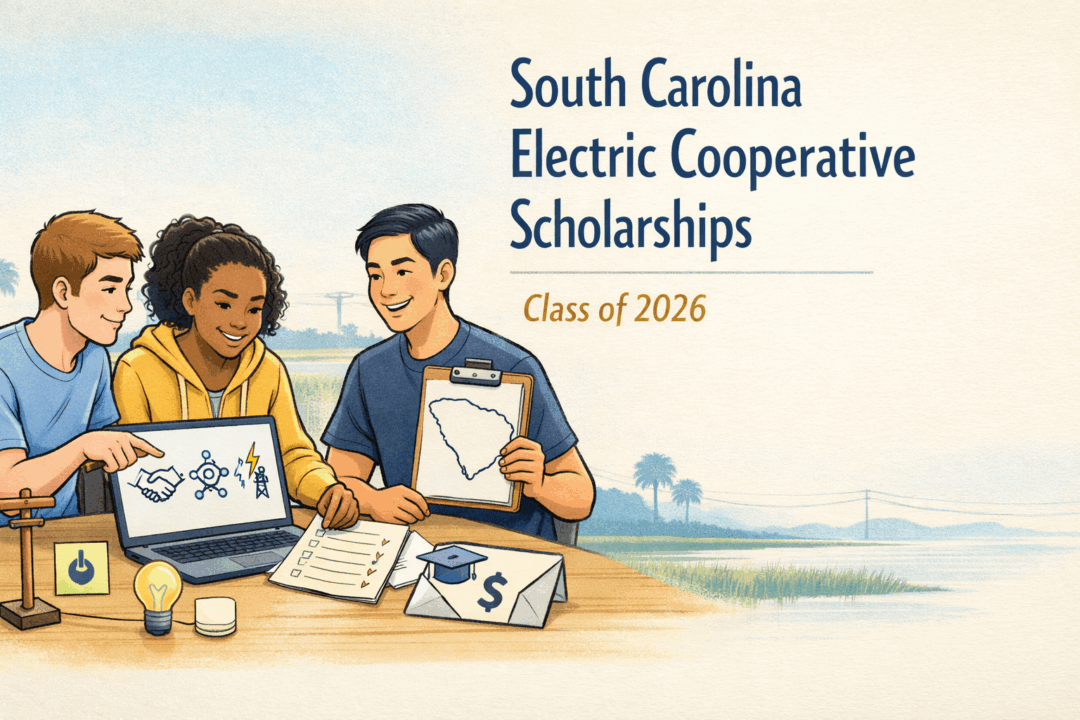
South Carolina Electric Cooperative Scholarships 2026 (Verified Links + Deadlines)
A curated, verified list of 20+ scholarships offered by South Carolina’s electric cooperatives for the Class of 2026—featuring Operation Round Up® awards, WIRE/Jenny Ballard, Touchstone Energy®, technical-trade tracks, deadlines, renewal notes, and direct apply links.
Quick tools for you
• 📍 Area Map: Find your co-op & county coverage (click your co-op name). West River Electric Association
• 🧾 Downloadable Prep Checklist (save/print):
- Verify you/parent are served by an SC electric co-op (account # handy)
- Unofficial transcript + SAT/ACT (if required)
- Short essay prompts (often cooperative/community focused)
- FAFSA confirmation (when asked for need)
- Recommendation(s) (coach/teacher/counselor)
- Residency proof (license/utility bill)
- For renewables: GPA + credit-hour plan for next term
• 🔁 Renewal rules exist for some ORU/foundation awards; examples linked under each applicable co-op.
South Carolina Electric Co-op Scholarships (Class of 2026)
Sorted roughly by earlier-in-the-year windows (Jan → Jun). Always confirm your co-op’s current 2026 dates at the link.
Palmetto Electric Trust – University (4-Year) Scholarship
💥 Why It Slaps: Bigger, renewable ORU-funded award (by county) with clear eligibility and Feb deadline—great for early birds.
💰 Amount: Up to $5,000/yr × 4 years
⏰ Deadline: Typically late Feb (e.g., Feb 28, 2025 for last cycle); 2026 window posts each January
🔗 Apply/info: https://palmetto.coop/scholarships Sources: Palmetto scholarship page (amounts, timing), renewal notes. Palmetto Electric Cooperative
Palmetto Electric Trust – Technical (2-Year) Scholarship
💥 Why It Slaps: Renewable ORU support for technical college pathways.
💰 Amount: Up to $3,000/yr (2-year programs)
⏰ Deadline: Typically late Feb (e.g., Feb 28, 2025)
🔗 Apply/info: https://palmetto.coop/scholarships Source: Palmetto scholarship page. Palmetto Electric Cooperative
York Electric – Touchstone Energy® Scholarships (5 awards)
💥 Why It Slaps: Clear eligibility + concrete deadline; strong essay-forward prompt connects to co-op values.
💰 Amount: $3,000 (five awards)
⏰ Deadline: Typically mid-March (e.g., Mar 15, 2025)
🔗 Apply/info: https://www.yorkelectric.net/my-community/education/touchstone-energy-scholarship-application/ Sources: Program page + 2025 post with deadline. York Electric Cooperative, Inc.+1
York Electric – Technical Advantage Scholarship
💥 Why It Slaps: Dedicated trade/tech award; YEC membership not required.
💰 Amount: $3,000 (one award)
⏰ Deadline: Typically mid-March (e.g., Mar 15, 2025)
🔗 Apply/info: https://www.yorkelectric.net/my-community/education/ Sources: Education overview + 2025 announcement. York Electric Cooperative, Inc.+1
Mid-Carolina Electric – Touchstone Energy® Scholarships
💥 Why It Slaps: Seven 4-year awards—one of the larger multi-year programs among SC co-ops.
💰 Amount: 7 awards × $4,000 (multi-year)
⏰ Deadline: Typically spring; check active cycle
🔗 Apply/info: https://www.mcecoop.com/in-the-community/scholarships/ Sources: MCEC scholarships page; ORU background. mcecoop.com+1
Fairfield Electric – Touchstone Energy® Scholarships
💥 Why It Slaps: Multiple awards (eight) for graduating seniors in FEC territory.
💰 Amount: $1,000 each (8 awards)
⏰ Deadline: Spring; see page for current year dates
🔗 Apply/info: https://fairfield.coop/taxonomy/term/3 Source: FEC scholarship page. fairfield.coop
Berkeley Electric Trust Scholarship (Operation Round Up®)
💥 Why It Slaps: ORU-funded education boost for students in BEC service area.
💰 Amount: Varies by year; trust-funded
⏰ Deadline: Spring; see trust page
🔗 Apply/info: https://www.berkeleyelectric.coop/trust-scholarship Source: BEC Trust Scholarship page. aikenco-op.org
Santee Electric – Scholarship Program
💥 Why It Slaps: SECO’s dedicated scholarship instructions + counselor toolkit.
💰 Amount: Varies; published each cycle
⏰ Deadline: Spring; see instructions
🔗 Apply/info: https://www.santee.org/sec-schools Source: Santee Electric scholarship page. Horry Electric Cooperative, Inc.
MPD Electric (Pee Dee + Marlboro) – 4-Year University Scholarship
💥 Why It Slaps: Larger 4-year track managed by MPD after the Pee Dee/Marlboro consolidation—clear track options.
💰 Amount: Up to $9,500 (4-year track)
⏰ Deadline: Spring; see MPD page
🔗 Apply/info: https://www.mpd.coop/scholarship-application Source: MPD scholarship page (amounts/criteria). mpd.coop
MPD Electric – 2-Year/Technical Scholarship
💥 Why It Slaps: Purpose-built for two-year programs; solid local pathway support.
💰 Amount: $2,500 (2-year track)
⏰ Deadline: Spring; see MPD page
🔗 Apply/info: https://www.mpd.coop/scholarship-application Source: MPD scholarship page. mpd.coop
Coastal Electric (SC) – Foundation Academic Scholarship
💥 Why It Slaps: Foundation-backed awards (county-served students), plus published renewal rules for returning recipients.
💰 Amount: Varies; Academic track
⏰ Deadline: Typically opens early year; see page
🔗 Apply/info: https://coastal.coop/foundation/scholarships/ Sources: Scholarships overview + renewal policy. Broad River Electric Cooperative, Inc.Coastal Electric Cooperative
Coastal Electric (SC) – Foundation Technical Scholarship
💥 Why It Slaps: Dedicated funding for technical/trade programs.
💰 Amount: Varies; Technical track
⏰ Deadline: See page
🔗 Apply/info: https://coastalelectric.coop/community-education/scholarships/technical-college-scholarship/ Sources: Scholarships overview + renewal policy. Broad River Electric Cooperative, Inc.Coastal Electric Cooperative
Broad River Electric – Annual Meeting Scholarships
💥 Why It Slaps: Meeting-linked awards for seniors; easy to plug into if you’re in BREMC’s footprint.
💰 Amount: $1,000 (historical)
⏰ Deadline: Spring (tied to annual meeting)
🔗 Apply/info: https://www.broadriverelectric.com/education/ Source: Education/Annual Meeting scholarships page. Broad River Electric Cooperative, Inc.
Laurens Electric – Annual Meeting Mini-Scholarships
💥 Why It Slaps: LEC pairs youth programs with scholarships; mini-scholarships historically around $1,000–$2,000.
💰 Amount: Varies; examples shown on site
⏰ Deadline: Spring/Annual Meeting timing
🔗 Apply/info: https://laurenselectric.com/category/scholarships/ Sources: LEC scholarships archive + youth page. Laurens Electric Cooperative+1
Aiken Electric – Scholarships (includes Touchstone/Trust tracks)
💥 Why It Slaps: Multiple youth opportunities under one hub; consistent annual cadence.
💰 Amount: Varies by track
⏰ Deadline: Spring; see student programs hub
🔗 Apply/info: https://www.aikenco-op.org/youth-programs Source: AEC Student Programs. aikenco-op.org
Newberry Electric – Scholarships
💥 Why It Slaps: Centralized page for NEC’s scholarship offerings (incl. WIRE and other local awards).
💰 Amount: Varies by program
⏰ Deadline: Listed per item on page
🔗 Apply/info: https://www.fastweb.com/college-scholarships/scholarships/134862-newberry-electric-cooperative-scholarship Source: NEC scholarships hub. santee.org
Horry Electric – WIRE/Jenny Ballard Opportunity Scholarship (adult learners)
💥 Why It Slaps: A second-chance, need-based $2,500 award for members returning to college (great for parents/guardians).
💰 Amount: $2,500 (one-time)
⏰ Deadline: Typically June 1 (e.g., 2025)
🔗 Apply/info: https://horryelectric.com/community-and-news/wire/jenny-ballard-scholarship/ Source: HEC WIRE page. Horry Electric Cooperative, Inc.
Little River Electric – WIRE/Jenny Ballard Scholarship (adult learners)
💥 Why It Slaps: Local WIRE chapter + co-op posts app + instructions annually (clear path for returning students).
💰 Amount: $2,500
⏰ Deadline: Typically June 1
🔗 Apply/info: https://lreci.coop/serving-our-community/wire/ Sources: WIRE page + application download. lreci.coop+1
Lynches River Electric – WIRE/Jenny Ballard Scholarship (adult learners)
💥 Why It Slaps: Frequently promoted by the co-op; straightforward eligibility for members resuming studies.
💰 Amount: $2,500
⏰ Deadline: Typically June 1
🔗 Apply/info: https://www.lynchesriver.com/ (see “Apply now for WIRE Scholarship”) Sources: LREC WIRE posts. lynchesriver.com+1
Blue Ridge Electric (SC) – WIRE/Jenny Ballard Scholarship (adult learners)
💥 Why It Slaps: Easy “Apply Now” portal centralized by the co-op.
💰 Amount: $2,500
⏰ Deadline: Typically June 1
🔗 Apply/info: https://blueridge.coop/apply-now-scholarships Source: BREC scholarship page. Coastal Electric Cooperative
Co-op Statewide: R.D. Bennett Community Service Scholarship (after Youth Tour)
💥 Why It Slaps: $5,000 statewide competition (community-service project) offered through Electric Cooperatives of South Carolina; many co-ops nominate Youth Tour students who then compete.
💰 Amount: $5,000 (one statewide winner annually)
⏰ Deadline: Application typically opens in March; awarded after summer Youth Tour
🔗 Apply/info: https://www.ecsc.org/washington-youth-tour (see R.D. Bennett application/news) Sources: ECSC Bennett scholarship news + Youth Tour page. Electric Cooperatives of South Carolina+1
Operation Round Up® (How it powers scholarships)
Many co-op scholarships are funded through ORU “round-up” giving (trust/foundation boards manage awards). Examples: Mid-Carolina’s ORU program background and Palmetto Electric Trust’s scholarships. If your co-op’s scholarship doesn’t say “ORU,” it may still be funded by its trust/foundation. mcecoop.com, Palmetto Electric Cooperative
Renewal Rules & Deadlines (Quick Notes)
Renewable examples: Palmetto Electric Trust (multi-year), Coastal Electric Foundation (explicit renewal policy). Keep GPA/credit-hour docs handy each spring. Palmetto Electric Cooperative, Coastal Electric Cooperative
One-time examples: Many Touchstone Energy® senior awards (e.g., YEC $3,000; FEC $1,000). York Electric Cooperative, Inc., fairfield.coop
Powering Access: Analysis of South Carolina Electric Cooperative Scholarships and the Cooperative Education Pipeline (2026)
South Carolina’s electric cooperatives occupy a distinctive position in the state’s education-finance ecosystem: they are private, independent, not-for-profit utilities owned by the members they serve, and they operate the state’s largest distribution footprint across a predominantly rural service geography. This paper analyzes how that institutional structure translates into scholarship design—who gets funded, when, for how much, and through what selection and accountability mechanisms. Using publicly available program information from the Electric Cooperatives of South Carolina (ECSC) and multiple South Carolina distribution co-ops, the study constructs a scholarship typology (member-territory merit/need scholarships, adult-learner re-entry awards, service-project scholarships, and experiential “youth leadership trip” pathways) and quantifies observable award pools and value ranges. We find a system characterized by (1) place-based eligibility tied to cooperative service territory, (2) relatively early-cycle deadlines clustered in late winter/early spring for graduating seniors, (3) direct-to-institution payment norms that reduce leakage and improve accountability, and (4) a dual mission of access (need-aware awards) and workforce/community development (service leadership and civic learning). Conservative aggregation of several published programs indicates at least ~$89,500/year in one-time awards from a subset of co-ops alone, before accounting for many additional co-op scholarships statewide and before multi-year trust scholarships that can raise per-student value dramatically. The paper concludes with evidence-based recommendations for students (application strategy and timing) and for cooperatives (measurement, transparency, and equity-forward program architecture) to strengthen educational mobility and local human-capital development.
1. Cooperative infrastructure as education policy (in practice)
Electric cooperatives in South Carolina are not simply “another scholarship sponsor.” They sit inside a statewide utility system where service territory, governance, and community reinvestment are structurally intertwined.
ECSC’s statewide “facts” profile underscores the scale: 1.5 million South Carolinians in all 46 counties receive power delivered by 20 electric distribution cooperatives, which together maintain more than 74,000 miles of power line across ~70% of the state. ECSC also reports that co-ops contribute $1.4 billion per year to South Carolina’s economy and emphasizes their not-for-profit, member-owned model and elected board governance.
At the wholesale layer, Central Electric Power Cooperative describes itself as the power supplier for 19 distribution cooperatives, highlighting a transmission backbone (e.g., ~900 miles of transmission lines) that supports reliability and long-term resource planning.
These structural facts matter for scholarships because co-ops frequently design awards around member identity (you are a “member-consumer”), territory (your home must be served by the co-op), and community reinvestment logic (revenues are returned through programs and benefits rather than distributed to shareholders). In cooperative theory, this aligns with widely recognized cooperative principles—especially Education, Training & Information and Concern for Community.
2. Data and method: what “South Carolina Electric Cooperative Scholarships” actually includes
In practice, “South Carolina Electric Cooperative Scholarships” is not a single scholarship. It is a portfolio that spans:
-
Statewide/trade-association-adjacent awards (e.g., ECSC/WIRE-administered opportunities).
-
Local distribution co-op scholarships (often branded as “Touchstone Energy Scholarships”).
-
Trust and round-up funded scholarships (Operation Round Up® models).
-
Leadership experiences (Washington Youth Tour, Cooperative Youth Summit) that can include scholarship competitions or downstream awards.
This paper uses program pages and official co-op postings to extract: award size, number of awards (when published), eligibility rules, deadlines/windows, and selection steps (e.g., interviews; counselor endorsements; direct payment). Where totals are not published statewide, the analysis intentionally reports conservative, minimum-visible dollar sums from a subset of documented programs.
3. Typology of cooperative scholarships in South Carolina
3.1 Adult-learner re-entry: the Jenny Ballard Opportunity Scholarship (WIRE)
One of the most distinctive features of the South Carolina cooperative scholarship landscape is its explicit investment in adult learners, not only traditional high school seniors.
The Jenny Ballard Opportunity Scholarship (linked to WIRE—Women Involved in Rural Electrification) is described as a $2,500 scholarship with a June 1, 2026 deadline. It is designed for women who may not have attended college immediately after high school and now seek to further their education; published eligibility emphasizes cooperative membership and a “10 years since high school/GED” threshold, plus acceptance into an accredited South Carolina college or university and financial need.
Why this is analytically important: adult-learner scholarships are relatively rare in local scholarship markets, which often over-concentrate on seniors. By targeting re-entry, co-ops create an “education second chance” mechanism that aligns with rural workforce needs and family economic mobility (especially for women re-entering education after caregiving or early labor-market entry).
3.2 Civic learning + service leadership: Youth Tour ecosystem and the R.D. Bennett scholarship
South Carolina electric cooperatives also invest heavily in experiential civic education, most visibly through the Washington Youth Tour and the Cooperative Youth Summit programming hosted/organized via ECSC’s program infrastructure.
A key scholarship signal inside this ecosystem is the R.D. Bennett Community Service Scholarship. ECSC reporting on the 2025 awards indicates a $5,000 scholarship for the winner and a $2,500 scholarship for a runner-up, awarded to students whose community service projects best exemplify the cooperative principle of “concern for community.”
Interpretation: this is a “values-based scholarship architecture.” Instead of purely funding grades/test scores, co-ops encode a governance/mission principle into the award rubric—service as demonstrable cooperative citizenship.
3.3 Traditional senior scholarships: Touchstone Energy programs (member-territory + selection rigor)
A large share of published cooperative scholarships in South Carolina appear under “Touchstone Energy Scholarship” branding at individual co-ops. While specific rules vary, a consistent pattern emerges: eligibility tied to the co-op service area, plus holistic review (academics, community involvement, extracurriculars), and frequently an interview component.
Fairfield Electric Cooperative reports it will award ten $1,000 scholarships in 2026, with applications due Friday, March 6, 2026, and notes required recommendation letter and in-person interviews for finalists.
York Electric Cooperative reports five $3,000 scholarships awarded to York Electric members.
Mid-Carolina Electric Cooperative reports seven $4,000 scholarships each year, targeted to seniors in its service-area schools, with semi-finalist interviews and stated emphasis on community involvement, positive attitude, and financial need.
Aiken Electric Cooperative reports multiple awards including a $2,000 Trustee Scholarship and two $1,000 Touchstone Energy awards (one for a four-year college path and one for a two-year technical school), with eligibility tied to an active Aiken Electric account at the applicant’s primary residence.
3.4 Member-funded trusts and “round-up” philanthropy: Berkeley Electric Trust Scholarships
Another structurally important model is the “small-change aggregation” approach: members voluntarily round their bills to the nearest dollar, and the pooled funds are governed by a local trust board. This governance structure pushes scholarship decision-making closer to local community priorities.
Berkeley Electric Cooperative describes its Trust Scholarship model as funding ten $2,500 scholarships for graduating seniors in the co-op’s service territory, with guidelines that are “grade and income-based,” a minimum GPA standard, and a strong accountability mechanism: scholarship funds are paid directly to the institution, with invoice submission required. It also disqualifies children of the co-op’s board and employees (including the Trust’s board), a governance safeguard against perceived conflicts of interest.
3.5 High-value, multi-year scholarships: Palmetto Electric Trust
Palmetto Electric’s scholarship portfolio illustrates the upper tail of cooperative scholarship value, especially when a trust commits to multi-year funding.
Palmetto Electric Trust scholarships are described as worth up to $5,000 per year for four consecutive years for a four-year college track, and up to $3,000 per year for a technical college track, with scholarships awarded to qualifying students from each county served (southern Beaufort, Jasper, Hampton).
Implication: unlike one-time awards, these commitments can materially shift affordability. A single four-year recipient could receive up to $20,000 over four years if maintained at the maximum annual level.
4. Quantifying the visible scholarship pool (conservative minimum)
A statewide total is not centrally published in one ledger (at least not in the sources analyzed here). However, a minimum-observable annual pool can be computed from publicly posted programs (subset sample):
-
Fairfield Electric: 10 × $1,000 = $10,000
-
York Electric: 5 × $3,000 = $15,000
-
Mid-Carolina: 7 × $4,000 = $28,000
-
Berkeley Electric Trust: 10 × $2,500 = $25,000
-
Aiken Electric: $2,000 + (2 × $1,000) = $4,000
-
R.D. Bennett (winner + runner-up as reported): $5,000 + $2,500 = $7,500
Conservative subtotal (subset only): $89,500/year in published, one-time awards.
This subtotal excludes (a) Palmetto Electric Trust multi-year awards (potentially large), (b) many other distribution cooperative scholarships across the state not enumerated in this subset, and (c) experiential program costs (travel, lodging, program delivery) that function as “in-kind scholarships” for Youth Tour/Summit participation.
5. Design patterns: what co-op scholarships optimize for
5.1 Place-based eligibility and “membership as gatekeeper”
Nearly every co-op scholarship uses residency/service-territory rules: applicants must have a primary residence served by the cooperative or be a member/customer.
This is not incidental—it is the cooperative equivalent of “shareholder dividends”: education funding is treated as a member benefit and a community reinvestment strategy.
5.2 Early-cycle deadline clustering
Several co-op senior scholarships cluster in January–March windows (e.g., Berkeley applications generally accepted January–March; Fairfield due March 6, 2026; Palmetto senior deadlines February 28, 2026).
The WIRE adult-learner deadline (June 1, 2026) is later, which effectively creates a second scholarship season for nontraditional applicants.
5.3 Holistic review with interviews and endorsements
Multiple programs explicitly include interviews (Fairfield; Mid-Carolina) or counselor endorsements (Berkeley Trust).
This approach trades scale for depth—fewer awards, higher confidence that recipients reflect cooperative values and are likely to persist.
5.4 Financial-need integration without abandoning merit
Many programs explicitly mention need (Mid-Carolina; Berkeley income-based; Palmetto Trust; WIRE), while still requiring GPA thresholds, “average or above-average grades,” or holistic achievement.
Functionally, this is a need-aware merit model, typical of community foundations, but rooted in utility governance rather than donor philanthropy alone.
5.5 Accountability via direct-to-institution payments
Berkeley Trust specifies payment directly to the institution; WIRE scholarship reporting indicates funds paid to the recipient’s college of choice; similar patterns appear in other co-op scholarships.
This is a strong mechanism for reducing misuse and improving public trust—especially important when scholarships are funded by member round-ups or community-facing utility programs.
6. Scholarships as human-capital strategy in a rural infrastructure economy
Because co-ops serve a large geographic footprint (70% of the state by ECSC’s account) and deliver power statewide, their scholarship programs can be interpreted as a rural human-capital policy lever embedded in infrastructure governance.
South Carolina’s co-op–linked economic development messaging reinforces the “community investment” orientation: the South Carolina Power Team reports major long-run economic development outcomes (jobs and investment) tied to cooperative territories.
Even when scholarships are not explicitly “workforce scholarships,” they are often aligned with workforce realities through:
-
Technical college pathways (Aiken’s two-year award; Palmetto’s technical scholarship category).
-
Civic/leadership development (Youth Tour, Youth Summit).
-
Adult re-entry (WIRE Jenny Ballard).
7. Practical implications for applicants (student-side strategy, evidence-based)
-
Confirm service-territory eligibility early. Many programs require your primary residence to be served by a specific co-op, not merely that you live in South Carolina.
-
Treat late winter as “co-op scholarship season.” If you wait until April, you will miss multiple senior scholarships. February–March is the critical window in several programs.
-
Prepare for interviews and documentation. Recommendation letters, counselor endorsements, and in-person interviews are not uncommon—plan your timeline accordingly.
-
Use cooperative values language—because rubrics often do. The R.D. Bennett scholarship explicitly ties selection to “concern for community,” and multiple Touchstone programs emphasize community involvement and “spirit of cooperation.”
-
Adult learners should not self-eliminate. The WIRE Jenny Ballard Opportunity Scholarship is specifically designed for women returning to school after a long gap, with a June 1 deadline that may fit re-entry planning cycles.
8. Recommendations for cooperatives: building a measurable scholarship ROI
8.1 Publish a minimal annual “scholarship transparency dashboard”
Even a simple annual disclosure—number of awards, total dollars, applicant counts, and recipient persistence (where trackable)—would allow cooperatives to evaluate impact and improve targeting. The Berkeley Trust model already signals governance rigor (eligibility exclusions; direct-to-school payment; annual variability based on funds). Scaling similar transparency statewide would enhance legitimacy.
8.2 Reduce search costs with a single statewide index (without removing local control)
ECSC already functions as a coordinating infrastructure (programs, statewide information). A central “find scholarships by co-op/service address” index could reduce information friction while preserving local selection autonomy.
8.3 Expand high-impact categories: technical credentials + adult re-entry + service learning
The most equity-forward and labor-market-relevant programs in the sample include technical college categories (Palmetto, Aiken), adult re-entry (WIRE), and service-project awards (R.D. Bennett). These designs could be replicated across more cooperatives or funded through pooled trust mechanisms.
8.4 Integrate K–12 learning grants as “upstream scholarship policy”
While not scholarships, classroom grant programs can influence readiness and postsecondary ambition—effectively functioning as upstream pipeline investment. Palmetto Electric’s Bright Ideas reporting (over $805,000 since 2004; $39,150 awarded to 44 teachers in 2025) illustrates how co-ops can fund learning environments that later feed scholarship competitiveness.
Conclusion
South Carolina electric cooperative scholarships form a decentralized but coherent education-finance ecosystem rooted in member ownership, place-based eligibility, and cooperative principles. The observed portfolio spans one-time senior awards ($1,000–$4,000 common), governance-heavy trust scholarships, multi-year high-value grants (up to $20,000 per student in some cases), adult-learner re-entry funding, and civic leadership experiences linked to service scholarships. The system’s strengths are its accountability mechanisms (direct-to-institution payments, conflict-of-interest rules), its alignment with community development, and its ability to reach rural territories that often face thinner scholarship markets. Its primary weakness is discoverability: without a single statewide index and consistent reporting, students can miss deadlines and policymakers cannot easily quantify total educational investment. Improving transparency and reducing search costs—while preserving local cooperative autonomy—would likely increase applicant equity, program efficiency, and measurable long-term community returns.
Selected References (program sources)
-
Electric Cooperatives of South Carolina (ECSC): state co-op facts; Washington Youth Tour program; scholarship reporting.
-
Palmetto Electric Cooperative: scholarships; Bright Ideas grant reporting.
-
Berkeley Electric Cooperative: Trust Scholarship program.
-
Mid-Carolina Electric Cooperative: scholarship program details.
-
Fairfield Electric Cooperative: 2026 Touchstone scholarships and deadline.
-
York Electric Cooperative: Touchstone scholarship amounts.
-
Aiken Electric Cooperative: scholarship amounts and eligibility.
-
International Cooperative Alliance: cooperative principles framework.