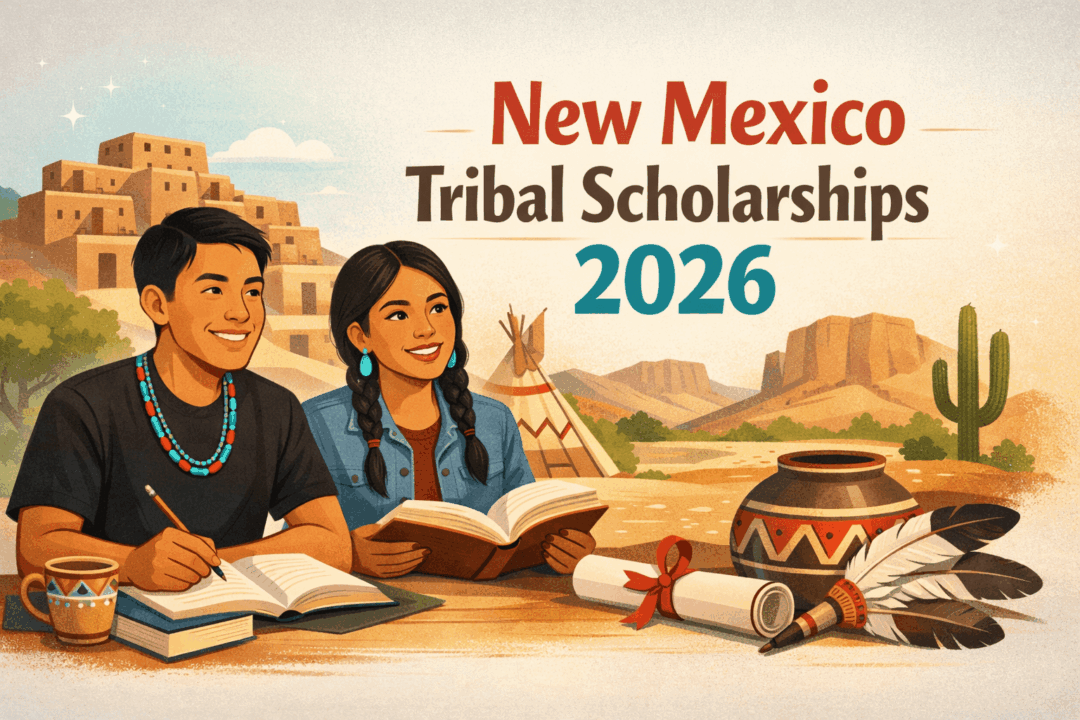
New Mexico Tribal Scholarships for High School Seniors (Class of 2026): Deadlines, Apply Links, Contacts
A hand-checked list of 20+ New Mexico tribal scholarships for the Class of 2026.
Deadline quick calendar (Jan → Dec)
- Apr 28 — San Felipe (Summer priority) sfpueblo.com
- Apr 30 — Zuni (Summer) ashiwi.org
- May 1 — Acoma (Fall app due) puebloofacoma.org
- Jun 15 — Cochiti (Fall application) Pueblo de Cochiti
- Jun 25 — Navajo Nation ONNSFA (AY) onnsfa.org+1
- Jun 30 — Zuni (Fall/Spring AY) ashiwi.org
- Jul 1 — Jemez (Fall) jemezpueblo.org
- Jul 14 — San Felipe (Fall priority) sfpueblo.com
- Jul 30 — ENIPC (Picuris, Pojoaque, Tesuque) for 2026-2027 (by 5 pm) Google Sites
- Aug 1 — Cochiti (Fall supporting docs) Pueblo de Cochiti
- Oct 1 — Acoma (Spring app due) puebloofacoma.org
- Oct 30 — Zuni (Spring) ashiwi.org
- Nov 15 — Cochiti (Spring application) Pueblo de Cochiti
- Nov 25 — Navajo Nation ONNSFA (Winter/Spring) onnsfa.org
- Dec 1 / 8 — Cochiti (Spring supporting docs Jan 8) Pueblo de Cochiti
- Dec 15 — San Felipe (Spring priority) sfpueblo.com
- Jan 31 — Jemez (Spring) jemezpueblo.org
Citizenship documentation checklist (what almost every office asks for)
- Certificate of Indian Blood (CIB) / enrollment verification
- FAFSA submission + Financial Needs Analysis (FNA) from your college FA office
- Official HS transcript (for new grads) or college transcript (continuing)
- College admissions/verification, class schedule, degree plan
- W-9 (many programs), personal statement, letters of recommendation (varies)
(See examples in official checklists: Cochiti, Acoma, San Felipe PDFs.) Pueblo de Cochiti+1sfpueblo.com
Application windows (common patterns in NM)
- Navajo ONNSFA: AY app opens Mar 15 → Jun 25; Winter/Spring Sep 25 → Nov 25. onnsfa.org+1
- Acoma (BIA Higher Ed grant): Fall app due May 1 (docs by Jul 1); Spring app due Oct 1 (docs by Dec 1). puebloofacoma.org
- Zuni ZECDC: Summer Apr 30; AY Jun 30; Spring Oct 30. ashiwi.org+1
- Cochiti: Fall app Jun 15 (docs Aug 1); Spring app Nov 15 (docs Jan 8); Summer app Mar 1 (docs Apr 30). Pueblo de Cochiti
- Jemez: Fall Jul 1; Spring Jan 31. jemezpueblo.org
- ENIPC (Picuris, Pojoaque, Tesuque): AY app opens April; 2026-27 deadline Jul 30, 2026, 5 pm. Google Sites
Scholarships (organized by TRIBE → program)
Navajo Nation → ONNSFA (incl. Chief Manuelito)
💥 Why It Slaps: Flagship Navajo aid; clear timelines; works alongside other aid; Chief Manuelito honors high-achieving grads.
💰 Amount: Varies by program (need/merit categories).
⏰ Deadline: AY Jun 25; Winter/Spring Nov 25.
🔗 Apply/info: https://onnsfa.org/what-you-need-to-apply — source: onnsfa.org+2onnsfa.org+2
Contact: Agency offices listed on site. onnsfa.org
Mescalero Apache Tribe → Tribal Education Scholarship
💥 Why It Slaps: Direct tribal scholarship with FNA; packet contains all forms.
💰 Amount: Need-based; set by unmet need and policy.
⏰ Deadline: See packet (terms indicated).
🔗 Apply/info: PDF packet — https://mescaleroapachetribe.com/wp-content/uploads/Complete-Scholar-Packet-REV.pdf — source: mescaleroapachetribe.com
Contact: Tribal Education Program (packet header). mescaleroapachetribe.com
Pueblo of Acoma → Higher Education Grant (BIA-contract)
💥 Why It Slaps: True BIA Higher Ed grant administered by the Pueblo; published deadlines; downloadable app.
💰 Amount: Supplemental (unmet need).
⏰ Deadline: May 1 (Fall app) / docs Jul 1; Oct 1 (Spring app) / docs Dec 1.
🔗 Apply/info: Program page + “AHE Grant Application” — https://www.puebloofacoma.org/departments/department-of-education/student-support-services/hed/ — source: puebloofacoma.org
Contact: Student Support Services; staff listed on page. puebloofacoma.org
Pueblo of Laguna → Direct Education Scholarship (DES)
💥 Why It Slaps: Dedicated Laguna DES with explicit reqs and online “Apply” page.
💰 Amount: Supplemental; GPA thresholds vary by credits earned.
⏰ Deadline: See DES site (rolling by term).
🔗 Apply/info: https://www.partnersforsuccess.us/des-apply — source: partnersforsuccess.us+1
Docs checklist: Listed on DES “About” page. partnersforsuccess.us
Pueblo of Zuni → ZECDC Tribal Scholarship
💥 Why It Slaps: Clear term deadlines + fillable app; AY and summer cycles.
💰 Amount: Need-based (supplemental).
⏰ Deadline: Jun 30 (Fall/Spring AY); Oct 30 (Spring); Apr 30 (Summer).
🔗 Apply/info: Program page — https://www.ashiwi.org/ZECDC/TribalScholarship.html — source: ashiwi.org+1
Application (fillable): https://www.ashiwi.org/ZECDC/Applications/ZuniTribalScholarship_FillableUpdated031821.pdf — source: ashiwi.org
Pueblo of Isleta → Higher Education Scholarship (DOE)
💥 Why It Slaps: Direct online application (Formstack) + upload portal.
💰 Amount: Supplemental; policies on page.
⏰ Deadline: Listed within DOE materials (per-term).
🔗 Apply/info: https://isletapueblo.formstack.com/forms/poi_scholarship_application — source: Isleta Pueblo
Support docs upload: https://isletapueblo.formstack.com/forms/scholarship_application_supporting_documents — source: Isleta Pueblo
Pueblo of San Felipe → Tribal Scholarship
💥 Why It Slaps: Downloadable app with priority dates and award amounts by enrollment status.
💰 Amount: Up to $3,000/semester full-time; $1,500/semester part-time (contingent on funds).
⏰ Deadline: Priority — Apr 28 (Summer), Jul 14 (Fall), Dec 15 (Spring).
🔗 Apply/info: PDF — https://sfpueblo.com/uploads/documents/Tribal_Scholarship_Application_%28New_applicant%29.pdf — source: sfpueblo.com
Pueblo of Santa Ana → Higher Education Scholarship (portal)
💥 Why It Slaps: Dedicated Scholarship Login portal for applicants.
💰 Amount: Varies; see DOE.
⏰ Deadline: Per DOE/portal.
🔗 Apply/info: https://santaana-nsn.gov/scholarshiplogin/ — source: Santa Ana Pueblo
Kewa (Santo Domingo Pueblo) → Tribal Scholarship
💥 Why It Slaps: Scholarship application listed under Forms & Applications.
💰 Amount: Supplemental; provide to your school’s FA office for third-party billing.
⏰ Deadline: Per DOE postings.
🔗 Apply/info: https://santodomingotribe.org/education/ — source: Santo Domingo Pueblo
Pueblo de Cochiti → Higher Education Program Scholarship
💥 Why It Slaps: Exceptionally clear deadlines + checklists + fillable application.
💰 Amount: Based on unmet need (availability of funds).
⏰ Deadline (examples): Jun 15 (Fall app) / Aug 1 (docs); Nov 15 (Spring app) / Jan 8 (docs); Mar 1 / Apr 30 (Summer).
🔗 Apply/info: Program hub — https://cochiti.org/education/ — source: Pueblo de Cochiti
— New-student checklist (deadline table): https://cochiti.org/wp-content/uploads/2025/02/2.-Higher-Ed-New-Student-Checklist-2.pdf — source: Pueblo de Cochiti
— Fillable app (docx): https://cochiti.org/wp-content/uploads/2025/02/4.-Higher-Ed-Application-Fillable-2.docx — source: Pueblo de Cochiti
Pueblo of Jemez → Scholarship Program (multiple named awards)
💥 Why It Slaps: Choice of need, merit, health, ag, graduate tracks with set deadlines.
💰 Amount: Varies by track.
⏰ Deadline: Jul 1 (Fall); Jan 31 (Spring).
🔗 Apply/info: https://www.jemezpueblo.org/government/education/education-services-center/ — source: jemezpueblo.org
Pueblo of Zia → Education Services (Higher Ed)
💥 Why It Slaps: Official Education Department page for Zia higher ed support.
💰 Amount: Supplemental; see DOE.
⏰ Deadline: Per DOE postings.
🔗 Apply/info: ✅ Link verified Sep 5, 2025 — source: ziapueblo.org
Pueblo of Santa Clara (Khap’ō Owingeh) → Scholarship Program
💥 Why It Slaps: Published program guidelines + online portal used by DOE.
💰 Amount: Varies; see guidelines.
⏰ Deadline: Per DOE postings/guidelines.
🔗 Apply/info: ✅ Link verified Sep 5, 2025 — source: khapokidz.org
(Also see 2023 guidelines PDF for criteria.) khapokidz.org
Pueblo of San Ildefonso → Scholarship & Student Services
💥 Why It Slaps: Official Education program w/ scholarship info; annual bulletins post dates.
💰 Amount: Varies.
⏰ Deadline: Example bulletin shows mid-July timeline for AY.
🔗 Apply/info: ✅ Link verified Sep 5, 2025 — source: sanipueblo.org
(Recent community bulletin with dates.) sanipueblo.org
Pueblo of Sandia → Education Department (Higher Ed)
💥 Why It Slaps: Official Education landing page; higher ed assistance provided.
💰 Amount: Varies.
⏰ Deadline: Per DOE postings.
🔗 Apply/info: ✅ Link verified Sep 5, 2025 — source: sandiapueblo.nsn.us
Pueblo of Pojoaque → Education Department (Higher Ed)
💥 Why It Slaps: Official Education site with downloads and contacts.
💰 Amount: Varies.
⏰ Deadline: Per DOE postings.
🔗 Apply/info: https://pojoaque.org/community/administrative-support/education/ — source: Northern New Mexico College
Pueblo of Nambé → Higher Education / Tuition Waiver references
💥 Why It Slaps: Official Pueblo site referencing Higher Education Scholarship/Tuition Waiver support (contact for app).
💰 Amount: Varies.
⏰ Deadline: Per office.
🔗 Apply/info: https://nambepueblo.org/chr/ (Education support references) — source: Nambé Pueblo
Ohkay Owingeh → Department of Education Scholarship
💥 Why It Slaps: DOE page + application portal (OODoE).
💰 Amount: Varies.
⏰ Deadline: Per DOE postings.
🔗 Apply/info: DOE page — https://ohkay.org/ohkay-owingeh-department-of-education/ and portal — http://oocsorg0000.web803.discountasp.net/Default.aspx — source: Ohkay OwingehNorthern New Mexico College
Taos Pueblo → Education & Training Scholarship
💥 Why It Slaps: Stand-alone scholarship site + current application packets by term.
💰 Amount: Varies by term (see packet).
⏰ Deadline: Posted by term (e.g., Spring shown on packet; fall posts seasonally).
🔗 Apply/info: https://taospuebloeducation.com/ (site) ✅ Link verified Sep 5, 2025 — source: Taos Pueblo Education
Picuris, Pojoaque, Tesuque (Eight Northern Indian Pueblos Council) → Higher Education Scholarship
💥 Why It Slaps: ENIPC administers higher-ed scholarships for these three Pueblos; next AY application opens April with fixed deadline.
💰 Amount: Varies; undergrad full-time.
⏰ Deadline: Jul 30, 2026 (5 pm) for 2026-27 (application posted April 2026).
🔗 Apply/info: https://sites.google.com/enipc.org/education/home — source: Google Sites
Pueblo of Tesuque (direct contact)
💥 Why It Slaps: DOE coordinator contact for scholarship materials (some support delivered via ENIPC).
💰 Amount: Varies.
⏰ Deadline: Per DOE/ENIPC postings.
🔗 Info/contact: See DOE contact; also ENIPC listing above. — source: Northern New Mexico College, Google Sites
Statewide for NM Pueblo/Tribal students (worth applying alongside tribal aid)
PNM Pueblo Education Endowment Scholarships (administered by Native Forward)
💥 Why It Slaps: Pueblo-only (19 NM Pueblos), multiple awards ($2k–$7k typical), STEM + several fields; includes Everett F. Chavez named award.
💰 Amount: Commonly $2,000–$7,000/yr; multiple awards.
⏰ Deadline: Follows Native Forward cycles; see program pages.
🔗 Apply/info: Native Forward Scholarship Finder (PNM programs appear in the finder): https://www.nativeforward.org/scholarship-finder/ and sponsor page: https://www.pnm.com/puebloscholarship — ✅ Links verified Sep 5, 2025 — source: Native Forward Scholars Fundpnmprod
Native Forward (formerly AIGC) – National & Partner Scholarships
💥 Why It Slaps: Largest direct provider to Native students; many Pueblo-eligible programs.
💰 Amount: Varies widely (merit/need).
⏰ Key date: Financial Needs Form by Jul 15 each academic year.
🔗 Apply/info: https://www.nativeforward.org/scholarship-faq/ — source: Native Forward Scholars Fund
Cobell Scholarship (ELI)
💥 Why It Slaps: Prestigious national program with set 2026–27 dates already posted.
💰 Amount: Varies; AY and summer opportunities; fellowships.
⏰ 2026–27 AY opens Dec 15, 2025; closes Mar 31, 2026 (11:59 pm MT).
🔗 Apply/info: https://cobellscholar.org/our-scholarships/ — source: cobellscholar.org+1
American Indian College Fund (Full Circle & others)
💥 Why It Slaps: Opens Feb 1 annually; priority by May 31; stays open until funds run out.
💰 Amount: Varies; multiple cycles (TCUs & non-TCUs).
⏰ Opens Feb 1; priority May 31.
🔗 Apply/info: https://collegefund.org/students/scholarships/ — source: collegefund.org+1
Indian Pueblo Cultural Center – Bob Chavez Scholarship (Arts)
💥 Why It Slaps: Pueblo-only arts scholarship for graduating HS seniors (visual arts & related).
💰 Amount: Typically $2,500 (two awards/yr).
⏰ Deadline: Announced each cycle on IPCC page.
🔗 Apply/info: https://indianpueblo.org/bob-chavez-scholarship-for-the-arts/ — source: Indian Pueblo Cultural Center
New Mexico Tribal Scholarships: Program Analysis of Indigenous Postsecondary Financing Pathways
New Mexico’s Indigenous postsecondary financing landscape is shaped by an unusually dense concentration of sovereign tribal nations, long-standing educational inequities, and a rapidly evolving “tuition-free” state aid environment. This paper maps the scholarship ecosystem serving Native students connected to New Mexico’s tribal nations and pueblos, and it quantifies key pressure points in the pipeline from K–12 through higher education. Using publicly available administrative reports, institutional cost-of-attendance data, and program rules from major tribal, state, nonprofit, and corporate scholarship providers, the analysis highlights a central finding: even where tuition is covered, living costs remain the dominant barrier, and scholarship design features (documentation burden, renewal predictability, and coordination rules) often determine whether funding translates into persistence and completion. Recommendations focus on (1) reducing administrative friction (especially around residency/eligibility and verification), (2) shifting more aid toward “basic needs” gaps, and (3) strengthening government-to-government and institution-to-tribe data coordination to improve take-up and renewal rates—without undermining tribal sovereignty.
Keywords: New Mexico, tribal scholarships, pueblos, Native American financial aid, Opportunity Scholarship, cost of attendance, college persistence, sovereignty
1. Context: Why New Mexico’s Tribal Scholarship System Is Structurally Distinct
New Mexico is commonly described as home to 23 federally recognized tribes, nations, and pueblos—including 19 Pueblos, the Navajo Nation, and Apache nations such as Jicarilla Apache and Mescalero Apache—creating one of the most tribally dense state environments in the United States. This density matters for financing: tribal scholarship systems are not merely “local philanthropy,” but expressions of sovereign policy—often administered through tribal education departments with priorities tied to language revitalization, workforce development, public service, and community return.
The demographic scale is similarly consequential. U.S. Census “QuickFacts” indicates that American Indian and Alaska Native (alone) represents a large share of New Mexico’s population relative to most states. In K–12, New Mexico’s Martinez–Yazzie Action Plan (produced in the wake of the landmark education adequacy lawsuit) reports 37,038 Native American students enrolled in New Mexico public schools for 2024–2025, and it situates Indigenous education within multilingual, culturally grounded contexts (listing multiple Indigenous languages used across communities).
Implication: In New Mexico, “tribal scholarships” should be analyzed as a system interacting with state tuition policy, federal aid, and institution-level supports—not as isolated awards.
2. A Pipeline View: Where Financing Pressure Concentrates
A practical way to evaluate scholarship effectiveness is to ask where the pipeline leaks: entry, persistence, or completion. New Mexico’s official education planning documents emphasize persistent gaps in opportunity and outcomes for Native students, framing postsecondary access as downstream of K–12 adequacy and service delivery issues.
At the postsecondary level, New Mexico’s State Tribal Collaboration Act (STCA) report describes statewide strategies to expand Native enrollment and completion—including investments in Tribal Education Technical Assistance Centers and targeted communications to increase Native participation in public and Tribal colleges. While scholarships are vital, the report implicitly supports a core research insight from higher-ed finance literature: aid has the strongest completion effects when paired with advising, navigation support, and predictable renewal.
2.1 The “tuition is not the whole price” problem
Even strong tuition coverage does not equal affordability. Institutional cost-of-attendance (COA) budgets show that housing/food, transportation, and personal costs often match or exceed tuition/fees—especially for rural students who must relocate or commute long distances.
Example: The University of New Mexico’s published COA for a New Mexico resident undergraduate living on campus lists tuition/fees and a substantial non-tuition component (housing/food, books, transportation, personal). In such a budget structure, a “tuition-first” aid model can still leave a large unmet need—precisely where many tribal scholarships become decisive.
2.2 Federal aid sets an upper bound—but not full coverage
Federal Pell Grants remain the backbone of need-based aid for many Indigenous students. For 2025–2026, the U.S. Department of Education confirms the maximum Pell Grant remains $7,395 (with the minimum at $740). In many COA scenarios, Pell plus tuition coverage still leaves a material living-cost gap—especially for students supporting family, traveling between home and campus, or facing childcare needs.
3. Ecosystem Map: Four “Funding Lanes” That Native Students Stack
New Mexico tribal scholarships operate within a stackable ecosystem. This paper groups funding into four lanes, each with distinct rules and friction points.
Lane A: Tribal government scholarships and education assistance (sovereign programs)
These awards are typically administered through tribal education departments and may include: (1) term-based scholarships, (2) vocational/technical support, (3) emergency aid, and (4) workforce-linked programs. They often require proof of enrollment and tribal affiliation, and they may impose renewal criteria aligned with community goals (e.g., continuous enrollment, GPA, or service intentions).
A major regional exemplar is the Navajo Nation Office of Navajo Nation Scholarships & Financial Assistance (ONNSFA). Its public guidance lists required documents (including proof of Navajo Nation enrollment) and identifies recurring deadlines (commonly June 25 and November 25, depending on term/application cycle).
Why it matters: large tribally administered programs function as “anchor funders” that can stabilize multi-year enrollment—if students can clear documentation hurdles and meet renewal rules.
Lane B: State tuition policy and state aid (especially “tuition-free” frameworks)
New Mexico’s affordability policies materially change how tribal scholarships function. Two elements are especially important:
-
Residency and tuition classification rules. New Mexico’s Higher Education Department explains that certain waivers allow students to receive in-state tuition rates while being classified as non-residents for reporting. For out-of-state members of tribes located wholly or partially in New Mexico, the policy provides access to in-state tuition rates; critically, the same page clarifies that receiving such a waiver does not automatically make a student eligible for state-funded financial aid.
Interpretation: This creates a two-tier affordability reality: tuition pricing can be reduced without automatically unlocking the full state aid stack—making tribal scholarships more pivotal for out-of-state Indigenous students connected to New Mexico. -
Opportunity Scholarship “last-dollar” dynamics. New Mexico’s state budget and higher-ed reporting describe the Opportunity Scholarship as a major tuition-free mechanism with recurring funding (noted as $146 million in House Bill 2) and academic requirements (e.g., GPA maintenance). The STCA report specifically notes that 2,520 Native American students received the Opportunity Scholarship in Fall 2022.
Interpretation: Last-dollar tuition programs can increase enrollment but may also shift the binding constraint to living expenses—where tribal and nonprofit scholarships become the “completion margin.”
Lane C: National Native-serving nonprofits (portable scholarships)
Two high-scale national actors illustrate how portable scholarships supplement tribal/state aid:
-
Native Forward Scholars Fund (formerly the American Indian Graduate Center) reports scholarship awards that can vary widely; its scholarship FAQ states awards can range from $100 to $30,000 per academic year, allocated based on financial aid information from institutions.
-
Cobell Scholarship program descriptions indicate need-based awards typically $5,000–$10,000 for undergraduates and up to $12,000 for graduate students, plus a separate summer research fellowship (as described by a university scholarship advisement office summarizing the program benefits).
-
American Indian College Fund describes a portfolio model in which one application can be considered across multiple scholarships, with awards that average between $2,000 and $3,000, and documentation requirements centered on tribal affiliation and academic records.
Why this lane matters in New Mexico: portable scholarships are especially valuable for students attending off-reservation institutions, specialized programs (arts, engineering, health), or graduate/professional tracks not fully supported by local tribal funds.
Lane D: Corporate and place-based philanthropy (New Mexico-specific examples)
Corporate programs can reduce friction by simplifying eligibility criteria and expanding beyond four-year degrees. A prominent New Mexico example is New Mexico Gas Company’s Native American Scholarship Program, which explicitly includes trade school and technical training alongside undergraduate and master’s pathways, and states that it has awarded $524,000 to 265 Native American students since 2011. It also specifies that twenty $3,000 scholarships will be awarded in 2025 (with future application dates announced later).
Design insight: including vocational/technical routes is consistent with workforce-aligned tribal priorities and can produce faster wage impacts—especially when paired with local employment pipelines.
4. Administrative Friction: The Hidden Variable in Scholarship Impact
Across lanes, scholarship effectiveness is strongly shaped by friction—documentation, deadlines, verification, and renewal complexity. In New Mexico’s tribal scholarship context, four friction points are recurrent:
-
Eligibility verification (tribal affiliation and documentation). Many programs require tribal ID, CIB, or enrollment verification—necessary for integrity but burdensome when families lack records or must coordinate across enrollment offices and campuses. Programs like the College Fund explicitly list tribal documentation needs (member or descendant documentation).
-
Residency and classification complexity. New Mexico’s tuition waiver for out-of-state members of New Mexico-located tribes is helpful—but the state’s own guidance stresses that the waiver confers in-state tuition rates only, not automatic eligibility for state-funded aid. This can confuse students and reduce take-up if advising is weak.
-
“Last-dollar” interactions. When tuition is covered after other aid, additional scholarships may not reduce out-of-pocket costs unless they are permitted to pay for non-tuition COA components (housing, food, transportation). This makes award flexibility (what costs are allowable) as important as award size.
-
Renewal uncertainty. Tribal programs may be subject to annual appropriations, variable revenue, or cohort caps. Students planning multi-year pathways (e.g., engineering, nursing, music performance, or doctoral tracks) experience higher risk when renewal is not predictable.
5. Cost Structure and the Completion Margin: A Quantitative Interpretation
A simple affordability identity is:
Net Cost of Attendance = COA – (Grants/Scholarships) – (Work/Family Support)
Where COA includes tuition/fees and non-tuition essentials. UNM’s COA illustrates that even if tuition/fees are reduced substantially, remaining components can dominate the net cost. Pell’s maximum ($7,395) can cover a meaningful share of need, but it is rarely sufficient alone.
Completion-margin claim: In a tuition-covered environment, the marginal dollar that prevents stop-out is often a living-expense dollar—rent, food, car repair, childcare, laptop replacement, or travel home for family obligations. This is why flexible tribal scholarships and emergency micro-grants frequently yield outsized persistence effects relative to their dollar amount.
6. Strategic Recommendations (Evidence-Aligned and New Mexico-Specific)
6.1 For tribal governments and tribal education departments
-
Shift a larger share of aid to “basic needs allowable” categories (housing/food, transportation, childcare, technology) when legally and administratively feasible—because these costs become binding under tuition-free structures.
-
Increase renewal predictability via multi-year award letters contingent on academic progress, reducing student uncertainty and stop-out risk.
-
Standardize documentation pathways (e.g., shared checklists, enrollment verification templates) to reduce re-submission burdens across semesters. ONNSFA’s clear document lists and deadlines are a model for transparency.
6.2 For the State of New Mexico (HED and partner agencies)
-
Clarify—and operationalize—the boundary between tuition waivers and state-aid eligibility in student-facing materials and advising workflows, because the state’s own guidance highlights that waivers do not automatically confer state-funded aid eligibility.
-
Fund navigation capacity (community-based outreach, FAFSA support, tribal college liaisons). The STCA framework’s emphasis on technical assistance centers aligns with what scholarship take-up research predicts: information and advising are often as important as award supply.
6.3 For colleges and universities serving Native students
-
Build “aid stacking audits” into advising: a proactive review each term to ensure scholarships can actually be applied to the student’s highest-need COA components.
-
Expand emergency aid and short-term bridge grants targeted to predictable stress points (move-in costs, travel, medical copays, technology).
-
Institution–tribe data coordination (with consent and sovereignty-respecting agreements) to reduce verification burden and improve renewal rates.
6.4 For nonprofit and corporate scholarship partners
-
Adopt low-friction eligibility and broad program coverage (including technical training), as exemplified by New Mexico Gas Company’s program design and clear eligibility messaging.
-
Prefer renewable awards (even at smaller annual amounts) over one-time awards when the goal is completion.
7. Conclusion
New Mexico’s tribal scholarship ecosystem is best understood as a multi-lane financing system operating at the intersection of sovereignty, state tuition policy, and federal need-based aid. The data points that matter most for policy are not merely “how many scholarships exist,” but (1) how many Native students are in the pipeline, (2) how much of COA remains after tuition is covered, and (3) how program rules shape take-up and renewal. K–12 enrollment figures (37,038 Native students in 2024–2025) show the scale of future demand. State rules enabling in-state tuition rates for out-of-state tribal members help, but also risk confusion if students assume that tuition classification equals full state aid eligibility. Meanwhile, the persistence problem increasingly concentrates in living expenses—making flexible tribal scholarships, portable national awards (e.g., Native Forward, Cobell), and place-based corporate aid crucial to keeping students enrolled through graduation.
References (selected)
-
New Mexico Public Education Department. Martinez–Yazzie Action Plan (Nov 2025).
-
New Mexico Higher Education Department. Residency Requirements / Waivers (American Indian nations, tribes, and pueblos).
-
Navajo Nation ONNSFA. What You Need to Apply (deadlines and documentation).
-
U.S. Department of Education, Federal Student Aid. (GEN-25-02) 2025–2026 Pell Grant Maximum and Minimum Award Amounts.
-
University of New Mexico. Cost of Attendance (COA) budgets.
-
Native Forward Scholars Fund. Scholarship FAQ (award range).
-
New Mexico Gas Company. Native American Scholarship Program (eligibility and award data).
-
New Mexico Secretary of State. Federally recognized tribes list (New Mexico).
-
American Indian College Fund. Scholarships (average award range; eligibility/documentation).
-
Cobell Scholarship (program benefit summary).