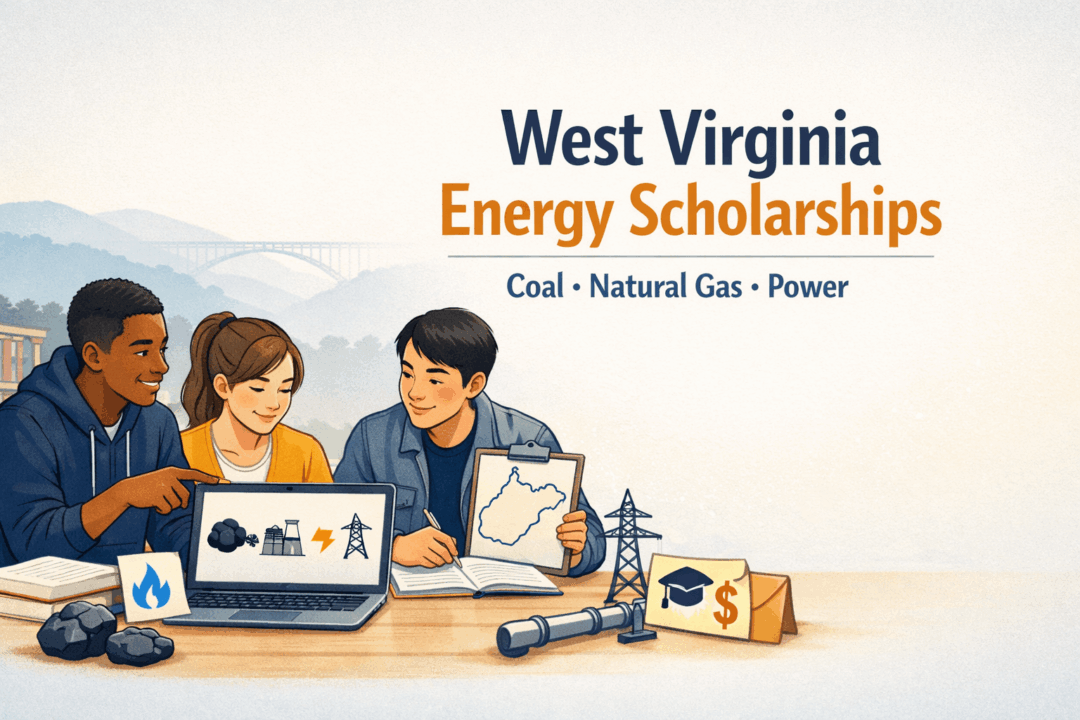
West Virginia Energy Scholarships (Coal • Natural Gas • Power) — Class of 2026
Hand-checked scholarships for West Virginia high school seniors headed into energy careers—mining, natural gas, power/lineman, diesel/welding.
Quick Fast-Facts (by sector)
-
Coal/Mining: frequent local/association funds; many due Jan–Mar. Typical awards $1k–$3k+. Safety + foreman training pathways highlighted. The Greater Kanawha Valley Foundation, media.statler.wvu.edu
-
Natural Gas/Oil: state association + company foundations; many due Feb–Apr. Typical awards $1k–$5k (some larger). Gas & Oil Association of West Virginia, appalachianpipeliners.org
-
Power/Lineman: utility tuition assistance & paid apprenticeships; dates vary by cohort (often spring). Scholarships for plant tech + lineworker; welding/diesel support common.
-
Trades (Diesel/Welding): national + WV-section awards; deadline March 1 for many AWS funds; rolling for welder-training micro-grants. Typical awards $1k–$5k. American Welding Society
Scholarships (sorted by earlier deadline / month, then rolling)
🗓️ January
The Greater Kanawha Valley Foundation (TGKVF) – Energy/Trades Funds (one portal)
💥 Why It Slaps: One application unlocks multiple funds used by coal/mining/trades groups (e.g., Kanawha Valley Mining Institute, Southern Coal Providers Association, Jim Campbell Trade Scholarship).
💰 Amount: Varies (many $1k–$3k+).
⏰ Deadline: Typically mid-January (portal opens fall).
🔗 Apply/info: https://tgkvf.org/scholarship-information/ source: TGKVF overview and list of managed funds. The Greater Kanawha Valley Foundation
🗓️ March
West Virginia Engineering, Science & Technology (WV STEM) Scholarship (energy-aligned majors like mining, petroleum & natural gas, electrical, etc.)
💥 Why It Slaps: State program to keep STEM talent in WV; renewable up to 4 yrs; service commitment to work in-state.
💰 Amount: Up to $3,000/yr.
⏰ Deadline: March 1, 2026 (Class of 2026).
🔗 Apply/info: https://www.cfwv.com/financial-aid/wv-stem-scholarship/ source: CFWV program page + state code (amount) + deadline confirmations. CFWV.com, West Virginia Code,
Promise Scholarship (stack with energy majors at WV colleges)
💥 Why It Slaps: WV’s flagship merit award—pairs well with mining/petroleum/power pathways at WVU, WVU Tech, etc.
💰 Amount: $5,500/yr (tuition/fees cap).
⏰ Deadline: March 1, 2026 (apply + FAFSA).
🔗 Apply/info: https://www.cfwv.com/financial-aid/promise-scholarship/ source: CFWV Promise page. CFWV.com
American Welding Society (AWS) – National, District & WV-Section Scholarships
💥 Why It Slaps: Hundreds of awards for welding/fabrication—great for mining maintenance, pipeline, plant careers.
💰 Amount: $1,000–$5,000+ (varies).
⏰ Deadline: March 1 (most); Welder Training Scholarship runs Dec 1–Nov 30 rolling.
🔗 Apply/info: https://scholarship.aws.org/ source: AWS national/section pages + dates. American Welding Society
Women’s Energy Network – West Virginia Chapter Scholarship
💥 Why It Slaps: Focused support for women in energy (HS seniors eligible).
💰 Amount: Varies.
⏰ Deadline: Typically spring (watch page).
🔗 Apply/info: https://www.womensenergynetwork.org/WestVirginia/scholarship-program source: WEN WV.
Appalachian Pipeliners Association Scholarships
💥 Why It Slaps: Supports pipeline & gas pathways (includes trades). Some awards reserved for students connected to members.
💰 Amount: Varies (multiple awards annually).
⏰ Deadline: Early April in recent cycles (e.g., Apr 5, 2024).
🔗 Apply/info: https://www.appalachianpipeliners.org/scholarships.php source: APA scholarship page + overview PDF (deadline example). appalachianpipeliners.org
🗓️ April
Dominion Energy Educational Equity Scholarship (WV eligible)
💥 Why It Slaps: Big-ticket utility-sponsored awards; WV residents eligible; 2-year and 4-year tracks.
💰 Amount: $5,000 (2-yr) or $10,000 (4-yr).
⏰ Deadline: Mid-April (varies by cycle; e.g., Apr 15, 2025).
🔗 Apply/info: https://scholarshipamerica.org/scholarship/dominionenergy/ sources: Scholarship America + details pages. Scholarship AmericaPeterson’s
EQT Foundation – Scholarships (counties where EQT operates in WV)
💥 Why It Slaps: Marcellus-focused operator funding students in the footprint; strong WV presence.
💰 Amount: Varies (multiple programs).
⏰ Deadline: Opens annually (spring); check the foundation page for the current window.
🔗 Apply/info: https://www.eqtfoundation.org/grants-scholarships/scholarships source: EQT Foundation.
TC Energy – Build Strong Scholarships (U.S.) (WV communities near assets are eligible)
💥 Why It Slaps: Major pipeline operator with up to $5k awards; categories include Trades and STEM.
💰 Amount: Up to $5,000.
⏰ Deadline: Spring–Summer (varies by year).
🔗 Apply/info: https://www.tcenergy.com/ source: TC Energy scholarships page. TC Energy
🗓️ Month varies (watch program pages)
Gas & Oil Association of West Virginia (GO-WV) Scholarships
💥 Why It Slaps: Long-running WV oil & gas association program (includes named scholarships: ConServ, Brian Fox, etc.).
💰 Amount: Varies (multiple awards).
⏰ Deadline: Jan–Mar typical; 2026 details post fall 2025.
🔗 Apply/info: https://gowv.com/education/scholarship/ sources: GO-WV main page + named scholarships + recent recipients pages. Gas & Oil Association of West Virginia+2Gas & Oil Association of West Virginia+2
WV Desk & Derrick Club – High School Scholarship (energy careers)
💥 Why It Slaps: WV chapter serving oil & gas/energy careers; HS senior friendly.
💰 Amount: ~$1,000 (historical).
⏰ Deadline: Spring (varies by cycle).
🔗 Apply/info: Start with WV D&D updates: https://www.facebook.com/wvddc/ source: WV Desk & Derrick Club posts + prior HS scholarship notice. FacebookThrillshare
Desk & Derrick Educational Trust (for later college years)
💥 Why It Slaps: When you’re 2+ years into energy studies (petroleum/energy majors), this national fund kicks in.
💰 Amount: Varies.
⏰ Deadline: Early April (e.g., Apr 10, 2025).
🔗 Apply/info: https://theeducationaltrust.org/ source: Trust site + current application PDF. The Educational Trust
OMEGA WV (WV Oil Marketers & Grocers Association) Scholarship
💥 Why It Slaps: Supports students from families working across WV’s petroleum marketing/energy retail chain.
💰 Amount: Varies.
⏰ Deadline: Annual; see current cycle.
🔗 Apply/info: https://omegawv.com/education/scholarships/ source: OMEGA WV.
FirstEnergy — Fleet Operations Diversity Scholarship (Power Generation)
💥 Why It Slaps: A power-plant operations pathway (with mentoring and internship exposure) through a major WV utility’s parent.
💰 Amount: Varies (tuition support + program experience).
⏰ Deadline: Varies by cohort.
🔗 Apply/info: https://www.firstenergycorp.com/careers/student_opportunities/technical_schools/ppt.html source: FirstEnergy Fleet Ops page.
FirstEnergy — Lineworker Apprenticeship Transition (replacing PSI cohorts)
💥 Why It Slaps: Paid training + benefits while you learn; WV subsidiaries (Mon Power/Potomac Edison) recruit regionally.
💰 Amount: Paid apprenticeship (earn while you learn).
⏰ Deadline: Posted by cohort (recent update Aug 15, 2025).
🔗 Apply/info: https://www.firstenergycorp.com/careers/apprenticeship-program.html source: FirstEnergy apprenticeship update.
New River CTC — Power Line Service Program (Lineman Track)
💥 Why It Slaps: WV-based lineworker training that maps cleanly into utility and contractor jobs statewide.
💰 Amount: Program tuition (use WV grants/scholarships below); check school aid.
⏰ Deadline: Program intakes; see school calendar.
🔗 Apply/info: https://www.newriver.edu/courses/electric-distribution-engineering-technology-assc/ source: New River CTC program page.
BridgeValley CTC — Boyd CAT Diesel Technology Scholarship
💥 Why It Slaps: Diesel tech aid (mining/oilfield fleets, plant maintenance).
💰 Amount: Up to $1,500/yr.
⏰ Deadline: School-posted; typically by term.
🔗 Apply/info: https://www.bridgevalley.edu/academics/workforce-technical/diesel-technology.html source: BVCTC diesel page. bridgevalley.edu
WVNCC — Petroleum Technology (Named Scholarships incl. Southwestern Energy Scholars)
💥 Why It Slaps: Petroleum tech pathway in the WV panhandle; one app for many WVNCC Foundation funds.
💰 Amount: Varies.
⏰ Deadline: School cycle; single app covers multiple funds.
🔗 Apply/info: https://www.wvncc.edu/offices-and-services/scholarships/3700 source: WVNCC scholarships page. West Virginia Northern Community College
Kanawha Valley Mining Institute Scholarship (via TGKVF portal)
💥 Why It Slaps: Local mining scholarship tied to industry group; great for entering mining engineering/trades.
💰 Amount: Varies.
⏰ Deadline: Matches TGKVF cycle (typically Jan).
🔗 Apply/info: https://tgkvf.org/scholarship-information/ source: TGKVF list (shows fund). The Greater Kanawha Valley Foundation
Southern Coal Providers Association (SCPA) Scholarship (via TGKVF portal)
💥 Why It Slaps: Supports students with coal industry ties in southern WV.
💰 Amount: Varies.
⏰ Deadline: Matches TGKVF cycle (typically Jan).
🔗 Apply/info: https://tgkvf.org/scholarship-information/ source: TGKVF page; program description corroborated. The Greater Kanawha Valley FoundationPeterson’s
Jim Campbell Trade/Vocational Scholarship (via TGKVF portal)
💥 Why It Slaps: Trades-first award (electrician, welding, etc.) feeding plant/field roles.
💰 Amount: Varies.
⏰ Deadline: Matches TGKVF cycle (typically Jan).
🔗 Apply/info: https://tgkvf.org/scholarship-information/ source: TGKVF scholarships. The Greater Kanawha Valley Foundation
Remember the Miners — WVU Mining Engineering Scholarship (for students enrolling at WVU)
💥 Why It Slaps: Endowed fund specifically boosting mining engineering at WVU.
💰 Amount: Varies (WVU-awarded).
⏰ Deadline: WVU scholarship timelines.
🔗 Apply/info: https://media.statler.wvu.edu/news/2017/02/02/remember-the-miners-endows-mining-engineering-scholarship source: WVU Statler announcement. media.statler.wvu.edu
WVU Statler College — Mining / Petroleum & Natural Gas Engineering Scholarship Funds (umbrella funds for incoming students)
💥 Why It Slaps: Multiple endowed funds earmarked for mining and petroleum & natural gas majors at WVU.
💰 Amount: Varies.
⏰ Deadline: WVU scholarship cycle.
🔗 Apply/info: https://www.statler.wvu.edu/students/current-student-scholarships/statler-college-scholarship-funds source: WVU Statler scholarship list (includes mining/PNGE). statler.wvu.edu
FirstEnergy / Pierpont & Regional Partners — Utility Pathways (Plant & Line)
💥 Why It Slaps: The Power Systems Institute model has shifted toward apprenticeships; Pierpont & others still receive utility foundation support.
💰 Amount: Tuition assistance/grants vary.
⏰ Deadline: School + utility cohort calendars.
🔗 Info (utility update): ✅ Link verified Sep 4, 2025; sources: Pierpont Community & Technical College
Women in Energy — WV Chapter (repeat entry for awareness)
💥 Why It Slaps: If you missed spring, check again—chapter often cycles updates.
💰 Amount: Varies.
⏰ Deadline: Watch page for reopen.
🔗 Apply/info: https://www.womensenergynetwork.org/WestVirginia —
Bonus: Helpful funding that pairs well with energy tracks (WV residents)
-
WV Invests (Last-Dollar Grant) — can cover community & technical college tuition for approved programs (great for diesel tech / power line / plant ops). Priority deadline Apr 15 (file FAFSA + application). CFWV.com
-
State FAFSA/aid reminders — Promise by Mar 1, Higher Education Grant by Apr 15 (use alongside sector scholarships). WVCTCS
Safety, Diesel Tech & Lineman Highlights
-
Mine safety training & certifications are abundant statewide (WV Office of Miners’ Health, Safety & Training + MSHA resources); pair scholarships above with these credentials to stand out. WV Miners’ Health & Safety, Mine Health and Safety Administration
-
Lineman tracks: New River CTC’s Power Line Service, FirstEnergy apprenticeship cohorts (Mon Power/Potomac Edison).
-
Diesel/Welding: BridgeValley’s Boyd CAT scholarship and AWS awards align directly with mining/oilfield/utility maintenance roles. bridgevalley.edu, American Welding Society
Notes on service areas & eligibility
-
GO-WV prioritizes students with family employment at member companies (oil & gas). Named scholarships (e.g., ConServ, Brian Fox) have specific focuses. Check 2026 criteria when posted this fall. Gas & Oil Association of West Virginia
-
Company foundations (EQT, TC Energy, Dominion Energy) typically restrict eligibility to footprint counties/states—WV is included; confirm your county/school fits each program’s map before applying.
West Virginia Energy Scholarships: Human-Capital Strategy for an Energy-Dominant State
West Virginia sits at a rare intersection: it remains an electricity-exporting, fossil-generation-anchored state while also confronting workforce churn, regulatory change, and a slow but real diversification toward gas, grid modernization, and renewables. In this context, “energy scholarships” are not merely student aid—they function as labor-market instruments that shape who enters the pipeline, what skills they acquire, and whether they stay in-state after graduation. This paper synthesizes publicly available evidence on key West Virginia–relevant energy scholarships (state STEM aid, oil & gas association awards, utility workforce scholarships, coal-region funds, and region-specific renewable scholarships) and evaluates them as a portfolio: (1) how capital is allocated (award sizes, recipient counts, renewal structures), (2) who is eligible (industry-tied vs. universal merit, rural/county targeting, diversity targeting), and (3) how tightly the scholarships are coupled to in-state employment. Using state electricity metrics and scholarship program statistics, the analysis argues that West Virginia’s current scholarship ecosystem is strongest at retaining STEM graduates in legacy energy pathways (power generation operations; extraction-adjacent families) and weaker at systematically scaling “transition skills” (grid tech, environmental compliance, automation/instrumentation, and renewable O&M). Policy and donor recommendations are offered to rebalance this portfolio without undermining the state’s near-term operational needs.
1. Why scholarships matter more in West Virginia’s energy economy
In energy-dominant states, the education pipeline is inseparable from operational continuity. West Virginia’s electricity profile underscores this reality: coal remains the primary energy source, with 15,128 MW of net summer capacity and 50,594,818 MWh of net generation (2024 data). The state also ranks extremely high on power-sector carbon intensity—1,912 lbs CO₂/MWh (rank 1)—a marker that the generation fleet is both emissions-heavy and therefore more exposed to policy, compliance, and capital-investment shocks.
From a workforce perspective, this means West Virginia must staff (a) day-to-day generation, maintenance, and safety roles in existing plants, while (b) building capacity for modernization—controls, instrumentation, reliability engineering, environmental systems, and (in specific regions) wind or other renewable operations. The scholarship ecosystem becomes a lever to steer students into these roles, especially where rural geography, family income volatility (common in extractive regions), and limited local program availability constrain access.
2. Sector baseline: coal-anchored generation with expanding gas and “operations” demand
While this paper focuses on scholarships, scholarship design only makes sense against the labor demand signals they respond to.
Electricity operations footprint (statewide). The EIA’s state electricity profile provides a useful “scale” proxy:
-
Net summer capacity: 15,128 MW
-
Net generation: 50.6 million MWh
-
CO₂ emissions: 43,967 thousand metric tons (rank 10)
-
Average retail price: 11.05 cents/kWh
These figures imply ongoing demand for technicians and technologists (I&C, electrical, mechanical), compliance roles tied to emissions controls, and reliability operations—jobs that often require associate degrees, industry credentials, or targeted training more than traditional four-year pathways.
Oil & gas production relevance. West Virginia’s modern energy labor market is also shaped by the gas basin and midstream/processing ecosystem. Industry reporting from the state’s oil and gas association describes record-level activity (e.g., reporting ~3.21 Tcf of natural gas production and substantial liquids output in 2023), which is directly relevant because scholarship programs often target dependents of industry employees or students working for member companies.
3. The scholarship landscape: five “archetypes” in West Virginia energy aid
West Virginia energy scholarships cluster into recurring program designs. Each design carries distinct consequences for equity, skill alignment, and retention.
Archetype A — State merit + in-state service obligation (STEM retention model)
West Virginia STEM Scholarship (WV STEM) is the flagship example. It offers up to $3,000 per academic year for engineering/science/technology students, with a limited funding pool and a recurring annual cycle (application opens Oct 1; apply by March 1).
Critically, WV STEM is not “no strings attached.” Recipients must work full-time in an approved STEM occupation in West Virginia for one year for each year they received the scholarship (after leaving at least half-time enrollment), with a formal verification and repayment mechanism if the obligation is not met.
The statutory structure reinforces this: awards are up to $3,000/year, not to exceed cost of attendance, and limited to four academic years.
Program scale (hard data). West Virginia’s Higher Education Policy Commission (HEPC) publishes recipient counts and award totals that let us quantify this program as an “energy workforce” feeder, not just student aid:
-
2023–24: 251 recipients; $720,681 total awards; $2,871 average award
-
Most recipients attend public four-year institutions (92.4%); WVU enrolls 63.7% of recipients and Marshall 17.1%
This is unusually actionable data for scholarship planning because it reveals concentration: WV STEM is primarily a WVU/Marshall pipeline.
Implication. WV STEM is an explicit retention instrument: it subsidizes training and then contractually “pulls” graduates into in-state STEM work. That is highly aligned with energy operations and grid modernization roles, but it can also create risk for students whose best job offer is out-of-state (or in a non-approved field), because noncompliance converts aid to repayment obligations.
Archetype B — Industry-family scholarships (legacy sector continuity model)
The Gas & Oil Association of West Virginia (GO-WV) Scholarship exemplifies the “industry family” model. The 2026 program is open to WV high-school seniors who are dependents of GO-WV member company employees/retirees—or students employed by a member company meeting work-hour requirements. Applications are due March 13, 2026. The program reports $261,000 awarded since inception (1997) and also offers vocational/technical scholarships (added starting in 2020).
A notable design feature is the essay prompt requiring students to analyze an oil-and-gas challenge over the next 5–10 years and propose a solution—an implicit attempt to cultivate sector-aware future professionals.
Implication. This model is powerful for continuity in regions where energy employment is intergenerational. But it can be exclusionary: students without an industry parent or job are structurally filtered out, even if they are academically strong and interested in energy careers.
Archetype C — Employer-linked “earn-to-learn” scholarships (utility workforce pipeline)
The FirstEnergy Fleet Operations Diversity Scholarship (connected to Mon Power operations) is a tighter coupling of training to employment than Archetype A. It provides up to $3,500 per year, potentially awarded twice for $7,000 total, to support a two-year associate degree pathway focused on Energy Systems Operations at Pierpont Community & Technical College. It also includes:
-
an internship at a FirstEnergy/Mon Power facility, and
-
if offered full-time employment after graduation, a requirement to accept and complete a two-year employment contract.
The program explicitly targets historically underrepresented groups in skilled craft trades (including Black/African American, American Indian/Alaska Native, Asian, Native Hawaiian/Pacific Islander, multiracial, Hispanic/Latino, and female candidates).
External confirmation of scale appears in a university news release describing that, across Pierpont and Youngstown State University, four scholarships are available each year.
Implication. This is the strongest “workforce instrument” in the portfolio: it reduces financial friction, guarantees work-based learning, and creates a structured hiring channel. It also directly addresses diversity gaps in a sector where “pipeline” narratives often fail without explicit financial and experiential supports.
Archetype D — Place-based renewable scholarships (community benefit / county targeting)
The Eastern WV Wind Scholarship Fund is a classic place-based model: it supports WV residents (including graduating seniors and GED recipients) from a defined set of counties (e.g., Grant, Hardy, Mineral, Pendleton, Preston, Randolph, Tucker) and nearby areas adjacent to wind farm development. The application deadline is March 31 and the fund is administered through the Eastern West Virginia Community Foundation as a donor-advised scholarship mechanism.
Implication. Place-based funds can translate local energy development into educational opportunity (“benefit sharing”), but they often lack published program-wide metrics (recipient counts, average awards), limiting portfolio-level evaluation.
Archetype E — Coal-region and coal-family scholarships (regional stabilization)
Coal-linked scholarships appear in multiple forms—some tied to coal organizations, some tied to coal-producing counties, and some designed as broad educational stabilization in coal communities. One visible example is the Southern Coal Providers Association (SCPA) Scholarship, which is open to eligible coal-industry employees/former employees and family members within a large set of southern WV counties. The listing indicates a February 4, 2026 deadline and renewable status (award amount varies).
Coal-sector scholarships also appear prominently in scholarship aggregation for West Virginia energy programs (including coal and natural gas items) within the target page concept for Scholarships & Grants.
Implication. Coal-region scholarships typically function as economic stabilization: they help families whose income is cyclical or structurally disrupted. But many are not explicitly aligned to “transition skills,” which can limit long-run resilience unless paired with re-skilling pathways.
4. Portfolio analytics: what the combined ecosystem is optimizing for (and what it isn’t)
4.1 Award size and scale: public data shows where the “mass” is
Only some programs publish enough data to compute scale. WV STEM does, and it is large enough to treat as a statewide lever: roughly $0.72 million in annual awards with ~250 recipients, and a stable average award just under the statutory ceiling.
By contrast, GO-WV reports cumulative dollars ($261,000 since 1997) but not annual recipient counts or average awards in the cited material.
FirstEnergy’s program offers a clear per-student maximum ($7,000), but the annual scholarship count is small (four per year across two schools).
Inference (portfolio level): West Virginia’s public energy scholarship “center of gravity” is WV STEM (broad, measurable, retention-linked). The most tightly workforce-linked program (FirstEnergy) is high-impact but small-N. Industry family programs (GO-WV) sit in between but are less transparent on annual throughput.
4.2 Eligibility structures reveal implicit policy goals
-
WV STEM: merit + service obligation → retain STEM graduates in WV.
-
GO-WV: dependent/student-employee eligibility → reward and reproduce industry workforce families.
-
FirstEnergy: diversity targeting + contract pathway → solve skilled-trade hiring constraints and representation gaps.
-
Wind fund: county targeting → local benefit sharing around renewable development.
-
Coal scholarships: county + industry connection → regional stabilization in coal communities.
These are not interchangeable. Each scholarship design “selects” for different students and pushes them toward different labor outcomes.
4.3 Deadlines cluster in a narrow spring window (application congestion risk)
Across major WV energy scholarships, deadlines concentrate between early February and late March:
-
SCPA: Feb 4, 2026
-
WV STEM: March 1
-
GO-WV: March 13, 2026
-
Wind fund: March 31
This clustering matters because it creates “application congestion” for first-gen and rural students who often have weaker counseling bandwidth. A portfolio approach would treat deadline staggering and shared document standards (common app elements, reuse of transcripts/FAFSA outputs) as a measurable equity intervention.
4.4 Alignment to “transition skills” is uneven
West Virginia’s generation mix and emissions intensity indicate that compliance, reliability, and modernization skills will grow in importance even if coal remains dominant in the near term.
Yet most scholarships are either:
-
sector-tethered to legacy systems (coal/oil-gas family pipelines), or
-
broad STEM without explicit emphasis on grid modernization, controls, automation, cybersecurity for OT systems, or environmental engineering.
The exception is the FirstEnergy model, which explicitly trains for operations, maintenance, instrumentation and controls in power generation and wraps training in internship + employment structure.
5. Recommendations: upgrading the scholarship ecosystem into a workforce strategy
5.1 Build a “stackable credential” scholarship track for energy operations
The strongest near-term labor needs in West Virginia energy often sit at the associate/credential level (process technology, electrical, I&C, industrial maintenance). Programs like Pierpont’s Energy Systems Operations pathway illustrate how scholarships can be coupled to real facilities and jobs.
Recommendation: Expand scholarship funding explicitly for stackable credentials (OSHA/safety, PLCs, instrumentation, NERC-adjacent awareness, emissions control operations). Even modest awards ($1,000–$2,000) can unlock completion when paired with paid internships.
5.2 Increase transparency for private/industry scholarships
WV STEM is analytically strong because it publishes recipient counts, award totals, and institutional distribution.
Industry and place-based scholarships frequently do not, which makes it impossible to answer basic portfolio questions like: “How many students are we funding into energy programs each year, and where do they end up working?”
Recommendation: Encourage (or require for partners featured on aggregators) annual reporting of: recipients, average award, program of study distribution, and post-completion placement (in aggregate). This can be done without compromising student privacy.
5.3 Pair service-obligation programs with “placement support”
WV STEM’s service requirement is a powerful retention lever, but it also transfers employment risk to the student: failure to meet the obligation can trigger repayment.
Recommendation: Add structured job-matching for WV STEM recipients in energy-adjacent employers (utilities, contractors, manufacturing, environmental services, state agencies). A scholarship becomes more equitable when the state helps the student satisfy the obligation, not just enforces it.
5.4 Diversify beyond “industry family” eligibility without eliminating it
GO-WV’s dependent/student-employee model supports community continuity and recognizes student labor contribution, but it excludes talented “outsider” students who could refresh the workforce.
Recommendation: Maintain the family pipeline, but add an “open track” for WV students pursuing energy-relevant majors/credentials (with internships at member companies as the selection differentiator).
5.5 Expand “benefit sharing” scholarships in renewable regions
The wind scholarship fund model is a template for translating localized energy development into durable educational capital.
Recommendation: Replicate this structure for grid upgrades, transmission siting, and brownfield redevelopment—especially where community acceptance depends on tangible local benefits.
6. Practical guidance for students (how to navigate the WV energy scholarship map)
For the Scholarships & Grants audience, the key is matching student profile to scholarship archetype:
-
STEM student aiming for engineering/tech in WV → WV STEM (apply by March 1; plan for the WV work requirement).
-
Parent works in WV oil & gas (or student employed by member company) → GO-WV Scholarship (March 13, 2026; essay required).
-
Interested in power plant / generation operations and wants a job-linked pathway → Pierpont Energy Systems Operations + FirstEnergy scholarship (up to $7,000 plus internship; potential employment contract).
-
Lives in eligible eastern WV counties near wind development → Eastern WV Wind Scholarship Fund (deadline March 31).
-
Coal-region family eligibility → programs like SCPA (deadline Feb 4, 2026) and other coal-community scholarships featured in WV energy scholarship collections.
Conclusion
West Virginia’s energy scholarships are already doing real workforce work—especially where programs include retention obligations (WV STEM) or direct employer pathways (FirstEnergy/Pierpont). The data show WV STEM as the largest measurable lever: about $720k annually reaching ~250 recipients, heavily concentrated at WVU and Marshall. Meanwhile, the state’s electricity footprint—coal as primary source, high CO₂ intensity—signals that compliance, reliability, and modernization skills will only grow in importance.
The strategic opportunity is portfolio design: keep continuity scholarships that stabilize legacy energy communities, but deliberately scale scholarships that train for grid modernization and operations technology, publish consistent annual metrics, and reduce student risk by pairing service obligations with placement support. Done well, “West Virginia energy scholarships” become not just a list of awards, but an integrated talent strategy that meets the state’s operational needs while expanding access and future resilience.
References (selected, APA-style)
-
College for WV (CFWV). (n.d.). WV STEM Scholarship and Service Requirement.
-
Gas & Oil Association of West Virginia. (2026). GO-WV Scholarship Program (applications due March 13, 2026).
-
FirstEnergy. (2025). Power Plant Technology—Fleet Operations Diversity Scholarship; scholarship brochure.
-
U.S. Energy Information Administration. (2025). West Virginia Electricity Profile 2024 (release Nov 10, 2025).
-
West Virginia Higher Education Policy Commission. (2024). Financial Aid Comprehensive Report 2024 (WV STEM recipients and awards).
-
West Virginia Legislature. (n.d.). West Virginia Code §18C-6-6 (WV STEM scholarship amount/duration).
-
Eastern West Virginia Community Foundation. (n.d.). Eastern WV Wind Scholarship Fund.
-
Peterson’s. (n.d.). Southern Coal Providers Association (SCPA) Scholarship listing (deadline and county/eligibility framing).