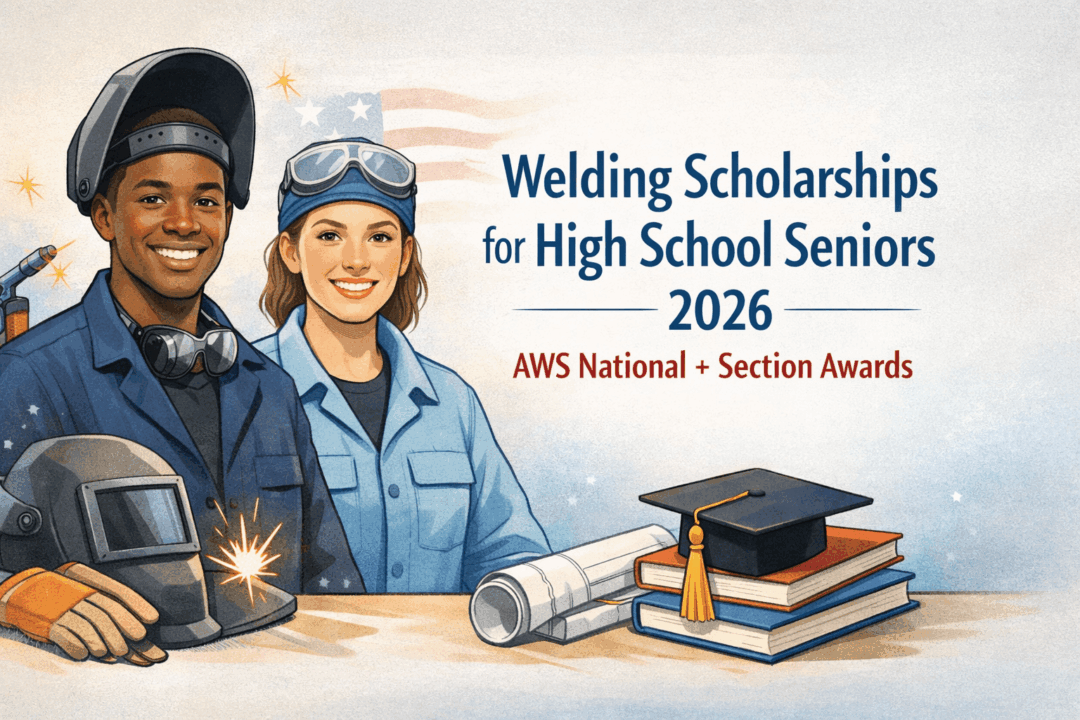
Welding Scholarships for High School Seniors 2026 — AWS National + Section Awards (20+ Verified)
Verified, deadline-ordered list of welding scholarships for the Class of 2026. Emphasis on AWS national/district/section awards, plus NBT manufacturing, GAWDA, Hobart Institute, and more. Includes application windows, eligibility, and portfolio tips (beads, joints, photos).
Before you start: Where the money is (and timing)
-
AWS Foundation = the hub. All National, District, and Section scholarships open Dec 1; deadline Mar 1 (one online application for many awards). Welder Training Scholarship runs Dec 1 → Nov 30 (rolling). American Welding Society+1AWS Scholarships
-
Section awards exist in most regions (Detroit, LA/Inland Empire, North Texas, Houston, etc.) and are applied for through the AWS portal; some sections also post local details. American Welding SocietyAmerican Welding Society Section Hub+3American Welding Society Section Hub+3American Welding Society Section Hub+3
-
Other good stacks: NBT (Nuts, Bolts & Thingamajigs) spring & fall cycles; GAWDA (gas & welding distributors); Hobart Institute named awards; some OEM/college scholarships. FMAMFGRECFGAWDAThe Troy Foundation
The List (ordered by earliest window/deadline: Jan → Jun)
1) AWS Welder Training Scholarship (certificate programs < 2 years)
💥 Why It Slaps: Rolling awards at the district level; ideal for seniors heading to welding certificate programs.
💰 Amount: Typically $1,000 per award (district funds)
⏰ Deadline: Rolling Dec 1, 2025 – Nov 30, 2026 (awarded throughout the year)
🔗 Apply/info: AWS portal (choose “Welder Training Scholarship”) Sources: AWS scholarships hub + Welder Training details. AWS ScholarshipsAmerican Welding Society
2) AWS National Scholarships (donor-funded, high-dollar)
💥 Why It Slaps: 130+ named awards via one application; for AAS/BS welding & related majors.
💰 Amount: ~$2,500–$10,000+
⏰ Deadline: Mar 1, 2026 (applications open Dec 1, 2025)
🔗 Apply/info: AWS National Scholarships; AWS portal Sources: AWS National page; AWS portal. American Welding SocietyAWS Scholarships
3) AWS District Scholarships (22 districts nationwide)
💥 Why It Slaps: Money reserved in your district (at least $15,000 per district).
💰 Amount: Typically $1,000–$2,500+
⏰ Deadline: Mar 1, 2026 (opens Dec 1)
🔗 Apply/info: AWS District Scholarships page; AWS Foundation overview Sources: AWS district page (dates); AWS Foundation page (district funding). American Welding Society+1
4) AWS Section-Named & District-Named Scholarships
💥 Why It Slaps: Local/section funds with narrower applicant pools (Detroit, LA/IE, North Texas, Houston, etc.).
💰 Amount: Commonly $1,000–$3,000+
⏰ Deadline: Mar 1, 2026 (most; some sections run additional rounds)
🔗 Apply/info: AWS “Section & District-Named” hub Sources: AWS section/district-named hub. American Welding Society
5) AWS Detroit Section Scholarships (District 11)
💥 Why It Slaps: Large section; 31 awards / $65,000 awarded recently; Michigan + nearby Ontario eligibility.
💰 Amount: Section-set (often $1,000–$3,000+)
⏰ Deadline: Section cycle begins Dec 2025; most awards align to Mar 1 through AWS portal
🔗 Apply/info: AWS Detroit Section scholarships; residency/eligibility PDF Sources: Detroit Section page; 2024–25 instructions PDF. American Welding Society Section Hub+1
6) AWS Los Angeles / Inland Empire Section
💥 Why It Slaps: Active section; posts local details + directs students to AWS national/district apps.
💰 Amount: Typically $1,250–$5,000+ across section/district/national
⏰ Deadline: Mar 1 main cycle; some local cycles may add a fall round
🔗 Apply/info: LA/IE Section scholarships page Sources: Section site. American Welding Society Section Hub
7) AWS North Texas Section
💥 Why It Slaps: Big metro coverage; frequent student award meetings; section links to AWS portal.
💰 Amount: Section-set; often $1,000–$3,000+
⏰ Deadline: Mar 1 main cycle
🔗 Apply/info: North Texas Section scholarships page Sources: Section site. American Welding Society Section Hub
8) AWS Houston Section
💥 Why It Slaps: Historic welding hub; section routes applicants to AWS Foundation awards and local named funds.
💰 Amount: Section-set; often $1,000–$3,000+
⏰ Deadline: Mar 1 main cycle
🔗 Apply/info: Houston Section scholarships page Sources: Section site. American Welding Society Section Hub
9) NBT (Nuts, Bolts & Thingamajigs) — Manufacturing Scholarships (welding eligible)
💥 Why It Slaps: Two cycles/year; welding is a recommended field (manufacturing focus).
💰 Amount: Typically $1,500–$2,500
⏰ Deadline: Mar 31, 2026 (Fall) and Sep 30, 2026 (Spring) (their naming flips by term)
🔗 Apply/info: NBT official page (FMA Foundation); deadline listing Sources: FMA/NBT page; deadline notice. FMAMFGRECF
10) GAWDA (Gases & Welding Distributors Association) Scholarships
💥 Why It Slaps: Industry-backed; good for students eyeing welding tech + gases/distribution careers.
💰 Amount: Varies by year; multiple awards
⏰ Deadline: March (annually) — 2025 cycle showed Mar 12/Mar 26 close; expect similar 2026 window
🔗 Apply/info: GAWDA scholarship pages Sources: GAWDA 2025 posts (program open; application deadline examples). GAWDA+1
11) Hobart Institute of Welding Technology (HIWT) — Named Scholarships
💥 Why It Slaps: Directly offsets HIWT tuition; includes Howard B. Cary full-tuition for Structural program.
💰 Amount: Ranges up to full tuition (program-dependent)
⏰ Deadline: Early March (e.g., Mar 7, 2025; expect similar 2026)
🔗 Apply/info: Troy Foundation/HIWT scholarship page; HIWT scholarship hub Sources: Troy Foundation (HIWT scholarships); welding.org scholarship info. The Troy Foundationwelding.org
12) AWS — Airgas Donor Scholarships (e.g., Terry Jarvis; Jerry Baker) — via AWS portal
💥 Why It Slaps: Well-known donor line within AWS National; strong industry signal.
💰 Amount: Typically $2,500–$5,000 (varies by donor/year)
⏰ Deadline: Mar 1, 2026 (inside AWS National cycle)
🔗 Apply/info: Use AWS portal (donor scholarships surface in your profile) Sources: AWS National page (donor-funded overview). American Welding Society
13) Miller Electric — Grants & Scholarships (program directory)
💥 Why It Slaps: OEM’s official page aggregating welding scholarship pathways + partner awards.
💰 Amount: Varies (see listed partners/programs)
⏰ Deadline: Program-specific (often Jan–Mar)
🔗 Apply/info: Miller “Grants & Scholarships” page Sources: Miller official. Miller Welds
14) Lincoln Electric — Scholarship Hub
💥 Why It Slaps: OEM’s portal to scholarships (some campus-specific, e.g., Tri-C).
💰 Amount: Typically $500–$1,500+ (varies by school/partner)
⏰ Deadline: Program-specific (several Spring windows)
🔗 Apply/info: Lincoln Electric scholarships page Sources: Lincoln official. Lincoln Electric
15) Bismarck State College (Energy/Welding adjacent) — see Energy list (if attending BSC welding/fab)
💥 Why It Slaps: Many energy donors also fund welding/fab students through BSC’s portal.
💰 Amount: $500–$2,500+
⏰ Deadline: Spring windows by award
🔗 Apply/info: BSC scholarship listing (energy/welding related) Sources: BSC energy scholarships.
16) College-specific Lincoln Electric Scholarships (example: Cuyahoga CC)
💥 Why It Slaps: Quick “extra” if your campus hosts a Lincoln-funded award.
💰 Amount: Often $1,000
⏰ Deadline: Campus-specific (example May 28, 2026)
🔗 Apply/info: Example Tri-C listing Sources: BigFuture listing for Tri-C Lincoln Electric scholarship. BigFuture
17) AFS/SkillsUSA × Miller (WorldSkills/Skills) — competitive welding path
💥 Why It Slaps: If you compete in SkillsUSA welding, the Miller/AWS WorldSkills USA scholarship recognizes top competitors.
💰 Amount: Up to $10,000
⏰ Deadline: Recent window Feb 1–Mar 1 (competition-linked)
🔗 Apply/info: Scholarship listing (recent cycle details) Sources: BigFuture Miller WorldSkills entry. BigFuture
18) AWS San Antonio Section — Welder Training Scholarships (rolling)
💥 Why It Slaps: Confirms rolling district awards and local info; good pointer if you’re in Texas District 18.
💰 Amount: $1,000 (per award; rolling until funds used)
⏰ Deadline: Jan–Nov (rolling)
🔗 Apply/info: AWS San Antonio Section page Sources: Section page (WTS details). American Welding Society Section Hub
19) AWS Inland Empire Section — local named funds (e.g., Jerry Hope Memorial)
💥 Why It Slaps: Extra local dollars on top of national/district awards.
💰 Amount: Section-set (often $1,000–$3,000+)
⏰ Deadline: Usually Mar 1 via AWS portal (some sections add fall rounds)
🔗 Apply/info: Inland Empire Section scholarships page Sources: Section site. American Welding Society Section Hub
20) AWS Section pages near you (choose your section, then apply in AWS portal)
💥 Why It Slaps: Many sections publish local FAQs, timelines, and contacts; all feed into the AWS portal decision flow.
💰 Amount: Commonly $1,000–$3,000+
⏰ Deadline: Mar 1 main cycle
🔗 Apply/info: Example section pages — Detroit • LA/IE • North Texas • Houston Sources: Section sites listed above. American Welding Society Section Hub+3American Welding Society Section Hub+3American Welding Society Section Hub+3
21) GAWDA WGW (Women of Gases & Welding) — Education Grants (HS → postsecondary)
💥 Why It Slaps: Women entering welding or related technical programs; separate cycle from GAWDA main.
💰 Amount: Varies
⏰ Deadline: Example Aug 1 (2025); watch 2026 page for dates
🔗 Apply/info: WGW Education Grant page Sources: GAWDA WGW page. GAWDA
Portfolio & photo tips (to stand out)
-
Show the work: Add 6–10 clear, well-lit photos of your best welds (stringer/ weave beads; fillet & groove joints in PA/2F, PB/2G, 3G, 4G positions; SMAW, GMAW, FCAW, GTAW samples). Include close-ups of bead profile, tie-in, heat-affected zone, root penetration (if coupons are cut/etched).
-
Caption each photo with process, material, thickness, position, parameters (amps/volts/WFS, travel speed).
-
Verification: If your school/mentor did bend tests or etches, include before/after pics; upload WPS or instructor sign-off if allowed.
-
One-pager PDF resume: put certifications (OSHA-10, AWS D1.1 school certs), SkillsUSA medals, attendance, and hours in booth.
Welding Scholarships for High School Seniors: Workforce Demand, Training Economics, and Scholarship Design (2026)
Welding is simultaneously a “foundational” industrial capability and a high-churn occupation with persistent replacement needs. For high school seniors, scholarships targeted to welding training can function as (1) a credit-constraint solution that unlocks short-term credentials, (2) a labor-market matching mechanism that signals readiness to employers, and (3) a pipeline investment that complements federal Career and Technical Education (CTE) funding and Registered Apprenticeship. This paper synthesizes the most recent U.S. labor-market statistics, CTE pipeline evidence, and scholarship program structures relevant to welding-bound seniors. It quantifies the economic case for scholarship support using current wage distributions, opening rates, and training cost benchmarks; maps the modern scholarship ecosystem (national foundations, industry partners, and local “last-mile” awards); and proposes evidence-aligned design principles for scholarships and for scholarship-directory platforms. Findings indicate that while projected employment growth for welders is modest, annual openings remain large; industry-validated demand projections point to a sizable need for new welding professionals through 2029; and relatively low tuition at public two-year institutions can be outweighed by non-tuition barriers (tools, PPE, testing, transportation). Effective welding scholarships therefore require “total cost of entry” coverage, early deadlines aligned to senior-year decision points, and stackable credential pathways that link high school CTE, community college certificates, and apprenticeship.
1. Introduction: Why welding scholarships matter now
Welding sits at the intersection of manufacturing, construction, repair, and infrastructure renewal. The occupation “welders, cutters, solderers, and brazers” accounted for about 457,300 U.S. jobs in 2024, with manufacturing employing ~61% and specialty trade contractors another ~8%. That footprint makes welding a large “middle-skill” labor market—one where high school seniors can enter via multiple pathways (CTE, certificates, employer training, or apprenticeship). Yet welding is also exposed to demographic turnover and physically demanding work conditions, which raises replacement demand. The Bureau of Labor Statistics (BLS) projects ~45,600 openings per year on average through 2034, even as employment growth is only 2% over 2024–2034.
For scholarship policy, the key question is not simply “Is welding growing?” but “How large is the annual throughput the system must produce?” When a labor market has tens of thousands of annual openings, even modest improvements in completion rates, credential attainment, and transition speed can yield meaningful macro effects—especially for regions facing retirements and for industries requiring code-qualified welders.
2. Methods and data sources
This analysis integrates five evidence streams:
-
Labor-market statistics: BLS Occupational Outlook Handbook (OOH) for wages, employment levels, industry distribution, and projected openings.
-
Industry-endorsed demand projections: American Welding Society (AWS) workforce demand dashboard for projected new welding professionals needed through 2029 and annual fill requirements.
-
Training cost benchmarks: College Board published tuition and student budget benchmarks for public two-year institutions; Pell Grant award limits from Federal Student Aid.
-
Secondary-to-postsecondary pipeline evidence: NCES Condition of Education indicators on CTE concentrator participation and outcomes; complementary CTE research evidence.
-
Scholarship program structures: AWS Foundation scholarship details (award pool, deadlines, ranges) and SkillsUSA scholarship timelines and allowable expenses.
Where exact national averages for welding program “all-in costs” vary by provider and region, this paper models costs using public two-year pricing plus documented non-tuition expense categories common to technical training (tools/PPE/testing), explicitly flagging assumptions.
3. Labor-market economics: openings, wages, and the “replacement engine”
3.1 Openings dominate growth
BLS projections show welding’s replacement demand is the central driver: about 45,600 openings per year on average over the coming decade. This matters for seniors because steady openings create repeated entry points for new graduates (including those completing one-year certificates or apprenticeships), not only for four-year degree holders.
Industry projections reinforce the scale: AWS-endorsed workforce data estimates 320,500 new welding professionals will be needed in the U.S. by 2029, with an average of 80,000 welding jobs to be filled annually between 2025 and 2029. The AWS series is broader than the BLS occupational code—often interpreted as capturing a wider “welding ecosystem” including adjacent roles and demand across sectors—yet the directional conclusion is the same: the system requires large annual inflows.
3.2 Wages and distribution: the ROI frame for scholarships
BLS reports a median wage of $51,000 (May 2024) for welders/cutters/solderers/brazers, with the bottom 10% below $38,130 and top 10% above $75,850. Median wages differ by industry: specialty trade contractors show a higher median ($57,310) than manufacturing ($49,740).
Scholarship implication: returns vary widely by specialization, employer type, and credential signaling. That variance strengthens—not weakens—the case for scholarships that fund credential quality (e.g., procedure-specific qualifications, code readiness, safety training) rather than only seat time.
4. Training pathways for high school seniors: stackable, fast, and credentialed
4.1 High school CTE as the “first credential environment”
Nationally, CTE is not marginal: among 2013 public high school graduates, 39% were CTE concentrators (≥2 credits in a single CTE area). Importantly, CTE concentrators still largely proceed to postsecondary: 80% had ever enrolled in postsecondary education by June 2021. This undermines the outdated idea that CTE is simply an alternative to postsecondary; for many students it is a launchpad into certificates, associate degrees, or apprenticeships.
A practical takeaway for welding-bound seniors is that the best pipelines treat high school welding as the beginning of a credential stack: safety + basic processes + blueprint/math → postsecondary certificate or apprenticeship → code qualification → specialization (pipe, structural, stainless, TIG, etc.). BLS explicitly notes technical training may occur through high school technical education, vocational-technical institutes, community colleges, private schools, the armed forces, or apprenticeship.
4.2 Apprenticeship as a paid alternative financing model
Registered Apprenticeship shifts cost from student borrowing to paid work-based learning. The GAO reports Labor findings that apprenticeship completers earned an average annual salary of about $80,000 in fiscal year 2023 (across apprenticeships, not welding-only). For welding specifically, the Urban Institute’s National Occupational Framework for “Combination Welder” recommends 3,000–6,000 hours of on-the-job learning for time/hybrid apprenticeship models.
Scholarship implication: scholarships remain valuable even when apprentices earn wages, because the binding constraints often shift to (a) pre-apprenticeship training costs, (b) transportation and PPE, and (c) the gap between high school graduation and apprenticeship entry. Hybrid “bridge scholarships” can cover this transition period and reduce dropout risk.
5. The true cost of entry: tuition is only part of the barrier
5.1 Tuition benchmarks and total student budgets
At public two-year colleges, average in-district tuition and fees were about $4,150 in 2025–26 (College Board). But total budgets are much larger: the same report notes average full-time public two-year in-district student budgets around $21,320 (including living expenses). For welding-bound seniors, many will commute and work, so the relevant “budget” is highly individual—yet the core point stands: cash-flow constraints are often dominated by non-tuition costs.
5.2 Pell Grants and the short-term credential problem
For low-income seniors, Pell is a cornerstone: the maximum Pell Grant for 2025–26 is $7,395 (minimum $740). However, students in short-term programs can face eligibility and timing frictions depending on program structure and enrollment intensity. (Policy proposals to tighten Pell rules for part-time/low-credit enrollment periodically surface, which matters because many technical students balance work and school.)
5.3 Tools, PPE, and testing: the “hidden tuition” in welding
Welding is capital-intensive at the student level: PPE, boots, helmets, gloves, consumables, and sometimes toolkits are non-negotiable. Scholarship programs increasingly recognize this: SkillsUSA scholarships commonly require documentation of direct educational costs that may include tools and PPE. Certification costs also matter. While fees vary by testing facility and process, published program examples show that an AWS Certified Welder test package can run hundreds of dollars (one program lists a $650 total including tuition/shop/registration fees, plus additional AWS processing fees after passing).
Scholarship implication: A $1,000 scholarship can be transformational if it is structured to cover these “hidden tuition” costs at exactly the moment they block persistence (first-term PPE/tool purchase; certification test fees; travel to testing).
6. The welding scholarship ecosystem: national, competitive, and deadline-driven
6.1 The AWS Foundation as the national anchor
The AWS Foundation is the most visible welding-specific national funder. For the 2026 season, AWS announced $2.7 million available for scholarships, with a March 1, 2026 deadline for National, District, and Section scholarships. The AWS scholarship portfolio includes 130+ donor-funded national scholarships totaling $700,000+, with awards ranging $2,500 to $10,000+ for students pursuing welding or related fields.
For high school seniors, the functional relevance is direct: seniors applying to community college welding programs, associate degrees, or welding-related bachelor pathways can treat AWS as a primary application channel—especially because the March 1 deadline aligns with late-winter decision windows when students finalize postsecondary plans.
6.2 SkillsUSA, competitions, and employer-aligned scholarships
SkillsUSA scholarships illustrate a second model: scholarships tied to CTE participation, leadership, competitions, and documented educational costs. Many awards open January 1, 2026 with an April 17 deadline window, and some explicitly include high school juniors and seniors. In 2025, SkillsUSA and Aerotek launched “Make Your Mark” scholarships providing up to $5,000 for tuition, books, tools, housing, and other direct educational expenses for the spring 2026 semester.
This model matters because it ties scholarship dollars to structured skill development (chapter membership, competitions, instructor references). From a labor economics perspective, this increases “signal-to-noise” for employers: scholarship recipients are more likely to have verified training contexts and performance evidence.
6.3 Local scholarships: the last-mile financing layer
Local civic organizations and community funds often provide smaller awards ($500–$2,000) for vocational and technical pathways—critical for covering tools, transportation, or deposits. These programs are heterogeneous and geographically bounded, which makes them easy to miss—yet they can be the decisive “last mile” funding that keeps a senior enrolled through the first credential.
Directory implication for ScholarshipsAndGrants.us: welding scholarship pages outperform when they treat “local micro-scholarships” as a core category, not an afterthought, because their marginal utility per dollar can be higher than tuition-only awards.
7. Evidence-based scholarship design for welding-bound seniors
Based on the economic constraints and pipeline evidence above, effective welding scholarships share six design features:
-
Total cost coverage: explicitly allow award use for PPE, tools, certification testing, and transportation—costs repeatedly recognized as direct educational expenses in CTE-aligned scholarships.
-
Senior-year timing: deadlines clustered between January and April match the “decision and deposit” period (AWS: March 1; SkillsUSA: April 17).
-
Stackable credential incentives: reward applicants for a plan that connects high school CTE → certificate/apprenticeship entry → certification milestones, consistent with apprenticeship frameworks (3,000–6,000 OJT hours for combination welder pathways).
-
Quality signaling: require verifiable artifacts (instructor references, transcripts, competition participation, project portfolios) because wage outcomes vary widely and scholarships must select for persistence and readiness.
-
Equity-by-design: focus on removing cash-flow barriers rather than purely rewarding prior achievement—especially for students whose schools lack modern welding labs or dual-credit options. Federal CTE funding under Perkins V is intended to expand opportunity broadly; scholarships can complement this by targeting gaps Perkins does not cover (individual tools/testing).
-
Outcome tracking: collect lightweight outcome data (credential earned, program completion, job placement or apprenticeship entry) to improve scholarship ROI and inform future award targeting.
8. Practical roadmap for high school seniors (and how your page can operationalize it)
A welding scholarship page aimed at seniors should not only list awards; it should manage the senior-year workflow:
8.1 The “credential-first” application narrative
Help applicants frame their story around employability milestones:
-
baseline safety training + OSHA awareness (BLS notes OSHA electrical safety training requirements in welding contexts)
-
documented shop hours / lab competencies
-
a plan for certification testing (costs and timing)
-
an industry pathway target (manufacturing vs construction vs repair) tied to wage realities
8.2 A deadline spine (high-value anchors)
-
AWS Foundation scholarships: plan backward from March 1.
-
SkillsUSA scholarships: plan backward from April 17 (many open Jan 1).
-
FAFSA/Pell: ensure seniors understand Pell maximums and eligibility because Pell can stack with scholarships.
8.3 Data features that would make ScholarshipsAndGrants.us “win” this topic
For your welding-scholarships page specifically, the research supports adding:
-
Cost coverage tags: Tuition / Tools / PPE / Certification Fees / Housing / Transportation (because non-tuition is decisive).
-
Pathway tags: Certificate / Associate / Apprenticeship / Pre-apprenticeship / Competition-based.
-
Deadline heatmap Jan–Apr (the densest window for seniors).
-
“ROI context box” using BLS wage distribution + openings so students see the payoff and the reality of variance.
9. Conclusion
Welding scholarships for high school seniors are best understood as targeted investments in a high-opening labor market with meaningful wage dispersion and substantial non-tuition entry costs. The data show a large installed base of welding employment, persistent annual openings, and industry projections indicating significant need for new workers through 2029. Meanwhile, tuition at public two-year institutions is comparatively modest, but total costs (living expenses plus welding-specific equipment and testing) create binding constraints precisely at the moment seniors try to transition into training. The most effective scholarship ecosystems—exemplified by AWS Foundation’s national portfolio and SkillsUSA’s CTE-linked awards—align deadlines to senior-year decisions, permit spending on tools/PPE/testing, and reinforce stackable pathways into credentials and apprenticeships.
For ScholarshipsAndGrants.us, the strategic opportunity is to make welding scholarships legible as a financing plan, not a scavenger hunt: organize awards by cost coverage and pathway, surface the January–April deadline spine, and embed ROI context using authoritative labor-market statistics. If executed well, this approach reduces friction for seniors, improves application completion, and—at scale—helps close the welding pipeline gap.
References (selected, APA-style)
American Welding Society Foundation. (2025). Scholarship season announcement and deadlines.
American Welding Society. (n.d.). AWS Foundation scholarships overview and award ranges.
American Welding Society. (n.d.). Welding workforce data dashboard (U.S. demand projections).
Bureau of Labor Statistics. (2025). Occupational Outlook Handbook: Welders, cutters, solderers, and brazers (wages, employment, openings, projections).
College Board. (2025). Trends in College Pricing and Student Aid: 2025–26 published tuition and student budgets.
National Center for Education Statistics. (2024). Career and technical education indicators and postsecondary outcomes (HSLS:09).
U.S. Government Accountability Office. (2025). Apprenticeship outcomes and post-completion earnings (FY2023).
U.S. Department of Education, Federal Student Aid. (2025). Pell Grant maximum and minimum award amounts for 2025–26.
U.S. Department of Education, OCTAE. (2018–2025). Perkins V overview and annual funding level.
Urban Institute. (2023). Combination welder national occupational framework (apprenticeship hours and competencies).