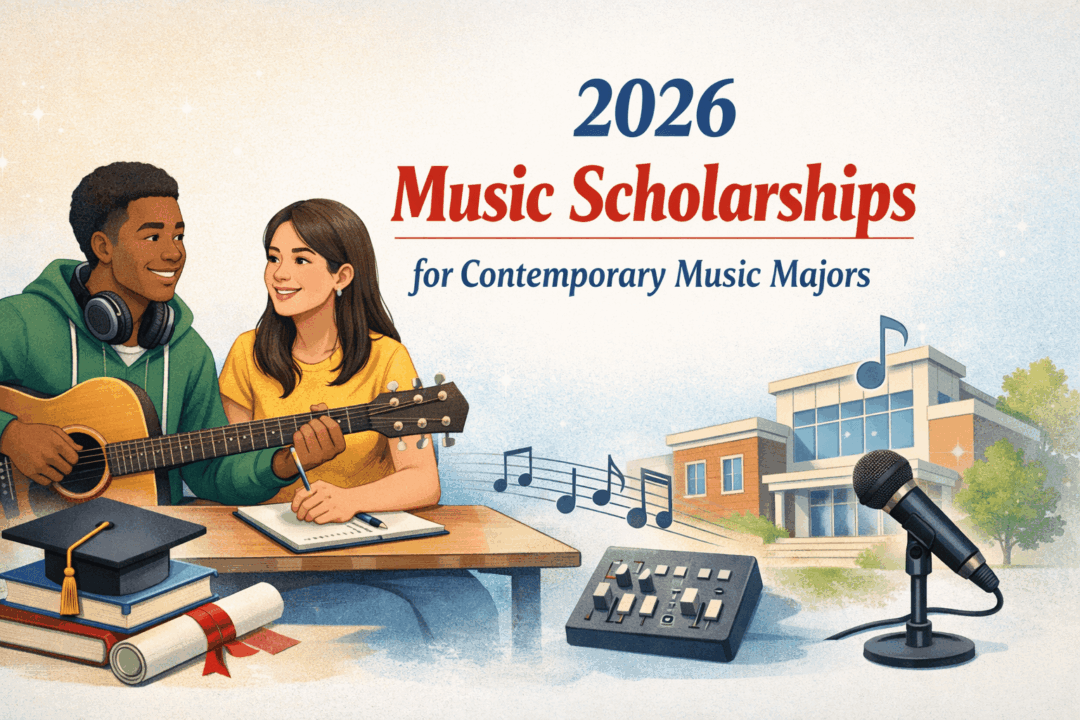
Music Scholarships for Contemporary Music
Discover 20+ verified music scholarships for contemporary music students in 2026. Includes awards for vocalists, instrumentalists, composers, and producers.
1. John Lennon Scholarship (BMI Foundation)
💥 Why It Slaps: Celebrates songwriters of contemporary genres including pop, rock, indie, R&B, and hip hop.
💰 Amount: Up to $20,000 split among winners
⏰ Deadline: February 7, 2026
🔗 Apply/info: https://bmifoundation.org/by-application/johnlennonaward BMI Foundation – John Lennon Scholarship
2. ASCAP Foundation Herb Alpert Young Jazz Composer Awards
💥 Why It Slaps: Perfect for contemporary jazz and improvisational composers pushing the boundaries.
💰 Amount: $1,000–$5,000
⏰ Deadline: December 15, 2025
🔗 Apply/info: https://www.ascapfoundation.org/programs/awards/herb-alpert-composer ASCAP Foundation – Herb Alpert Awards
3. National YoungArts Foundation Music Award
💥 Why It Slaps: Prestigious recognition for contemporary musicians (instrumental, voice, and composition). Winners get mentoring and performance opportunities.
💰 Amount: Up to $10,000 plus career development
⏰ Deadline: October 15, 2025
🔗 Apply/info: YoungArts Music Award
4. Musicians Foundation Grants
💥 Why It Slaps: Supports contemporary musicians in financial need pursuing education and career advancement.
💰 Amount: Varies ($500–$3,000 typical)
⏰ Deadline: Rolling (apply anytime)
🔗 Apply/info: Musicians Foundation
5. D’Addario Foundation Music Grants
💥 Why It Slaps: Focuses on contemporary instrumentalists and ensembles innovating in music education and performance.
💰 Amount: $2,500–$20,000 (program/project support)
⏰ Deadline: January 31, 2026
🔗 Apply/info: D’Addario Foundation Grants
6. Fulbright Distinguished Awards in Music Performance & Study
💥 Why It Slaps: Supports U.S. students studying contemporary music abroad.
💰 Amount: Varies by country (typically covers tuition, travel, stipend)
⏰ Deadline: October 8, 2025
🔗 Apply/info: Fulbright U.S. Student Program
7. Berklee College of Music World Tour Scholarship
💥 Why It Slaps: Highly competitive award for contemporary music majors at Berklee.
💰 Amount: Full-tuition
⏰ Deadline: January 15, 2026 (admissions aligned)
🔗 Apply/info: Berklee Scholarships
8. Jazz Education Network (JEN) Scholarships
💥 Why It Slaps: Awards students excelling in contemporary jazz and improvisational music.
💰 Amount: $1,000–$5,000
⏰ Deadline: March 31, 2026
🔗 Apply/info: JEN Scholarships
9. Jack Kent Cooke Young Artist Award (NPR’s From the Top)
💥 Why It Slaps: Spotlights young musicians excelling in contemporary and classical genres, including broadcast performances.
💰 Amount: Up to $10,000
⏰ Deadline: January 15, 2026
🔗 Apply/info: https://fromthetop.org/apply/jack-kent-cooke-young-artist-award/
10. NAfME (National Association for Music Education) Scholarships
💥 Why It Slaps: For contemporary music education majors advancing innovative approaches.
💰 Amount: $1,000–$5,000
⏰ Deadline: February 28, 2026
🔗 Apply/info: NAfME Scholarships
11. Music Forward Foundation Scholarships (House of Blues)
💥 Why It Slaps: Built for contemporary genres—pop, rock, hip-hop, R&B—and supports diversity in music industry careers.
💰 Amount: $5,000–$10,000
⏰ Deadline: March 31, 2026
🔗 Apply/info: Music Forward Foundation Scholarships
12. BMI Student Composer Awards
💥 Why It Slaps: Encourages emerging voices in contemporary composition across genres.
💰 Amount: $500–$5,000
⏰ Deadline: February 15, 2026
🔗 Apply/info: BMI Student Composer Awards
13. National Federation of Music Clubs (NFMC) Scholarships
💥 Why It Slaps: Includes awards for contemporary performance and composition categories.
💰 Amount: $500–$3,000
⏰ Deadline: Varies by award (most due March 1, 2026)
🔗 Apply/info: NFMC Scholarships
14. Presser Undergraduate Scholar Award
💥 Why It Slaps: Recognizes outstanding contemporary music undergrads with leadership potential.
💰 Amount: $4,000–$6,000
⏰ Deadline: Nominated by music school (March 2026 typical)
🔗 Apply/info: Presser Foundation
15. Pinetop Perkins Foundation Scholarships
💥 Why It Slaps: Supports young contemporary blues and roots musicians with immersive workshops.
💰 Amount: $500–$1,500
⏰ Deadline: April 1, 2026
🔗 Apply/info: Pinetop Perkins Foundation
16. Glenn Miller Birthplace Society Scholarship Competition
💥 Why It Slaps: Awards students performing contemporary jazz and big band styles.
💰 Amount: $1,000–$3,000
⏰ Deadline: April 15, 2026
🔗 Apply/info: Glenn Miller Scholarship
17. International Songwriting Competition (ISC)
💥 Why It Slaps: Massive global competition for contemporary songwriters across pop, rock, EDM, hip hop, R&B, and indie.
💰 Amount: $25,000 Grand Prize + gear packages
⏰ Deadline: September 30, 2026
🔗 Apply/info: International Songwriting Competition
18. Unsigned Only Music Competition
💥 Why It Slaps: Focused on independent contemporary artists seeking recognition.
💰 Amount: $10,000 Grand Prize + music industry exposure
⏰ Deadline: April 30, 2026
🔗 Apply/info: Unsigned Only
19. Peermusic Latin Scholarship
💥 Why It Slaps: Highlights emerging Latin contemporary composers and songwriters.
💰 Amount: $5,000
⏰ Deadline: June 1, 2026
🔗 Apply/info: BMI Peermusic Latin Scholarship
20. National Federation of Music Clubs – Contemporary Music Award
💥 Why It Slaps: Specific category for contemporary composers in NFMC competitions.
💰 Amount: $750–$2,000
⏰ Deadline: July 1, 2026
🔗 Apply/info: NFMC Contemporary Award
Music Scholarships for Contemporary Music: A Data-Driven Research Review of Funding, Access, and Workforce Alignment (U.S. Focus)
Contemporary music programs (popular music performance, songwriting, music production, audio engineering, music business, and hybrid “creator-entrepreneur” tracks) sit at the intersection of higher education, the creative economy, and platform-mediated labor markets. This paper synthesizes recent U.S. evidence on (1) the size and composition of the contemporary-music talent pipeline, (2) the cost structure students face (tuition plus production “tooling”), (3) the scholarship ecosystem that underwrites training, and (4) what the best causal evidence says about how grant aid changes persistence and attainment. Using national completions data, labor market statistics, and scholarship-provider disclosures, we argue that contemporary-music scholarships function not only as price reduction but as time capital: they reduce the need for off-campus labor, enabling sustained practice, portfolio building, and industry immersion—inputs that matter in a field where earnings are highly skewed and employment is often intermittent. We conclude with a framework for designing and evaluating scholarships that better match contemporary-music career realities.
1) Defining “Contemporary Music” as a Training-and-Career System
“Contemporary music” in scholarship taxonomy rarely maps neatly onto a single academic discipline. Instead, it clusters around applied pathways:
- Creation: songwriting, composition for media, beatmaking, arranging
- Production: recording, mixing, mastering, live sound, audio engineering
- Performance: popular music performance (voice/instruments), jazz and commercial styles
- Industry: music business, marketing, management, publishing, A&R, touring/logistics
- Technology: music technology, sound arts, interactive media, creative coding
This “system” view matters because scholarship eligibility often follows inputs (auditions, portfolios, competitions, affiliation with industry organizations) rather than a standardized major name.
2) The Contemporary-Music Pipeline: What Completions Data Suggest
National completions data show a large and diverse arts pipeline—90,241 bachelor’s degrees in “Visual and performing arts” in 2021–22, plus 15,729 master’s and 1,762 doctoral/professional degrees.
Within the same dataset, music-related subfields reveal patterns directly relevant to contemporary music:
- Music, general: 7,037 bachelor’s degrees (near gender parity overall)
- Music performance (general): 3,936 bachelor’s degrees
- Jazz/jazz studies: 314 bachelor’s degrees, heavily male (249 men vs 65 women)
- Music technology: 678 bachelor’s degrees, strongly male (523 men vs 155 women)
- Music management: 1,331 bachelor’s degrees (closer to parity)
Implication: Contemporary music scholarship design can be evidence-informed. For example, the pronounced gender imbalance in music technology suggests that targeted awards (women/nonbinary in audio engineering and production) are not merely symbolic—they address a measurable pipeline skew.
3) Cost Reality: Tuition Is Only the First Layer
3.1 Published cost and net price
College pricing data underscore why scholarships dominate contemporary-music affordability conversations. For 2025–26, average published tuition and fees were about $12,000 (in-state public 4-year) and $44,090 (private nonprofit 4-year). When room/board and other expenses are included, average total budgets rise to $27,940 (public in-state) and $61,990 (private nonprofit).
Net price (after grant aid) still remains substantial: roughly $10,650 at public in-state 4-year and $30,780 at private nonprofit 4-year on average.
3.2 “Tooling costs” unique to contemporary music
Contemporary music adds a second affordability layer that many traditional aid models underweight: production and performance tooling (computer capable of audio workflows, interface/controllers, microphones, headphones/monitors, software subscriptions, storage/backup, and—in performance tracks—instrument maintenance). These costs behave like a “hidden lab fee,” often recurring across semesters and escalating when students reach industry-standard production expectations.
Why this matters for scholarships: awards that can be used for tuition only reduce price but may not fully unlock participation; awards that explicitly allow purchase of production tools can change a student’s functional capacity to create competitive portfolio work.
4) Why Scholarships Matter More in Contemporary Music Than Many Majors
Two features intensify the value of scholarships in contemporary music:
4.1 Labor-market structure: high self-employment and intermittent work
BLS reports about 169,800 jobs for musicians and singers (2024), with 47% self-employed—an unusually high share that signals irregular income and project-based careers. Median hourly pay is $42.45, but earnings dispersion is very wide, and many experience long periods between jobs.
Adjacent contemporary-music roles show varied pay and outlook:
-
Music directors and composers: median $63,670 (May 2024), with “little or no change” projected growth (2024–34).
-
Broadcast/sound/video technicians: median $56,600 (May 2024), and within that category sound engineering technicians have a median $66,430.
This mix implies that contemporary music careers are portfolio careers: many combine performance, teaching, production, gigging, and content work. Scholarships can reduce debt exposure in a field where early earnings are uncertain and uneven.
4.2 Causal evidence: grant aid improves persistence and completion
A systematic review and meta-analysis of causal studies estimates that grant aid increases persistence and degree completion by ~2–3 percentage points, and that an additional $1,000 in grant aid improves year-to-year persistence by ~1.2 percentage points.
For contemporary music, this mechanism likely interacts with discipline-specific time demands: practice hours, rehearsal schedules, production deadlines, performances, and internships. Aid isn’t just affordability; it is time and bandwidth.
A 2025 study of New Jersey’s need-based Tuition Aid Grant (TAG) provides direct evidence on mechanism: additional aid led students to reduce earnings dollar-for-dollar on average, consistent with the idea that aid “buys time” by reducing off-campus work.
Contemporary-music translation: time bought by scholarships can be converted into (a) deliberate practice, (b) portfolio creation, (c) networking/industry immersion, and (d) unpaid or low-paid creative apprenticeships—key inputs in this sector.
5) The Scholarship Ecosystem for Contemporary Music
Contemporary-music scholarships can be modeled as four overlapping funding streams:
5.1 Institutional scholarships (conservatories, music colleges, university programs)
Institutions—especially private nonprofits—are central scholarship providers because tuition is high and discounting is structurally embedded. NACUBO reports a first-year tuition discount rate above 56% for first-time, full-time freshmen at private nonprofit colleges (and above 51% for all undergraduates) in its most recent study cycle, indicating widespread reliance on institutional grants/scholarships to shape enrollment.
Case example (disclosure-based): Berklee College of Music reports awarding over $115 million in scholarships each year.
While Berklee is only one institution, it illustrates the institutional-aid logic common in contemporary music training: high sticker price paired with large scholarship outlays to recruit talent and manage net tuition.
5.2 Industry-anchored scholarships (PROs, academies, museums, foundations)
These awards frequently use portfolio/creation signals (original songs, recordings, career intent) that align with contemporary career pathways.
Examples of scholarship models that reflect contemporary music’s structure:
-
Songwriting-as-credential: ASCAP Foundation’s Leiber & Stoller scholarship provides $10,000 over four years and uses audition/selection mechanisms tied to songwriting talent.
-
Creation grants usable beyond tuition: BMI Foundation’s Dolly Parton Songwriters Award offers $20,000 (up to two recipients) in eligible contemporary genres, supporting creation costs in addition to education.
-
Portfolio competition with contemporary genres: BMI Foundation’s John Lennon Award presents three scholarships totaling $20,000 annually for original songs across contemporary genres.
5.3 Equity- and access-focused scholarships with professional development
Some programs bundle cash + immersion/networking, a particularly strong match for contemporary music where social capital and industry proximity matter.
-
The Recording Academy’s “Your Future Is Now” scholarship program has awarded $10,000 scholarships to five HBCU students and includes a week-long professional development experience; it also provided $10,000 equipment grants to two HBCUs.
5.4 Global-identity and cultural-heritage scholarships (cross-border contemporary scenes)
Contemporary music is inherently transnational (Latin, K-pop, Afrobeats, EDM). Scholarships here often combine cultural mission and industry pathways.
-
The Latin GRAMMY Cultural Foundation describes a four-year scholarship with a maximum value of $120,000 (tuition, housing, meal plan, wraparound services).
5.5 “Network capital” awards tied to convenings
These awards matter because contemporary music careers often hinge on repeated exposure to professional networks, not just classroom instruction.
6) A Framework: Scholarships as Price, Time, and Network Capital
A doctorate-level way to evaluate scholarship value in contemporary music is to treat scholarships as a three-part bundle:
- Price capital: direct tuition/fee reduction (traditional)
- Time capital: reduction in paid work hours (enabling practice/portfolio)
- Network capital: access to mentors, studios, showcases, conferences, internships
The evidence base supports (2) and (1) as drivers of persistence and completion (grant aid → higher persistence; aid can buy time by reducing work).
Contemporary music intensifies the returns to (3) because professional identity is built through collaborations, credits, and proximity to gatekeepers.
7) Design Recommendations for Scholarship Providers
7.1 Align allowable uses with contemporary training needs
Scholarships that allow spending on production tools, lessons, portfolio recording, or travel can convert funding into measurable skill outputs—especially when paired with clear accountability artifacts (finished tracks, mixing reels, live set recordings).
7.2 Bundle “cash + career infrastructure”
Programs that add mentorship, studio access, showcases, or industry convenings can provide network capital that pure tuition scholarships do not. The Recording Academy’s model (cash + immersion + equipment grants) exemplifies this approach.
7.3 Target pipeline gaps using observed data
Given the gender skew in music technology completions, targeted scholarships for underrepresented groups in audio engineering/production can be justified as a pipeline-corrective intervention grounded in national data.
7.4 Evaluate outcomes with music-appropriate metrics
Traditional scholarship evaluation often stops at GPA and graduation. Contemporary music needs additional indicators:
- Portfolio completion (released works, credits, sync placements, live performance logs)
- Internships/industry apprenticeships completed
- Post-graduate earnings stability (variance matters), not just mean earnings
- Network outcomes (mentorship continuity, professional references, collaborative projects)
8) Practical Implications for Applicants (Evidence-Based)
Without turning this into a “how-to,” the research implies high-leverage applicant behaviors:
- Treat the portfolio as the “test score”: many contemporary scholarships are judged by songs, recordings, and proof of craft (e.g., ASCAP/BMI-style original-work submissions).
- Optimize for time: because aid can translate into fewer work hours, applicants should explicitly articulate how scholarships will increase practice/production output (a credible time-to-output story aligns with the “time capital” mechanism).
- Match scholarship type to career track: performance, production, business, and songwriting awards often have different evidentiary expectations (audition vs original song vs leadership vs technical reel).
Conclusion
Contemporary music scholarships operate in a distinct higher-education microeconomy: training is skill-intensive, careers are network-driven, and income is volatile with high self-employment. National completions data show substantial output in music-related fields and pronounced demographic skews in music technology that scholarship design can directly address. Labor-market statistics reinforce the portfolio and intermittent nature of work in music and adjacent production roles. Meanwhile, the causal literature is clear that grant aid increases persistence and completion—and can “buy time” by reducing student work.
The central recommendation is to treat scholarships not only as affordability tools but as capacity builders: funding that converts into time, tools, and networks. Programs that combine cash with professional development and industry access are especially well-aligned to contemporary music’s labor market. As tuition and living costs remain high, and as institutions continue to rely heavily on discounting and grant aid, scholarship ecosystems will increasingly determine who can afford to build the portfolios and relationships that contemporary music careers demand.
References (APA-style)
- Anderson, D. M., & Zaber, M. A. (2025). Buying time: Financial aid allows college students to work less while enrolled (EdWorkingPaper: 24-1108).
- ASCAP Foundation. (n.d.). Leiber & Stoller Scholarship for Songwriters.
- Berklee College of Music. (n.d.). Scholarships.
- BMI Foundation. (n.d.). Dolly Parton Songwriters Award.
- BMI Foundation. (n.d.). John Lennon Award.
- College Board. (2025). Trends in College Pricing and Student Aid (2025–26 highlights / newsroom release).
- National Center for Education Statistics. (2023). Digest of Education Statistics, Table 318.30 (2021–22 completions by field and sex).
- NACUBO. (2025). NACUBO Tuition Discounting Study (press release).
- Recording Academy. (2025). Your Future Is Now scholarship program (Black Music Collective).
- U.S. Bureau of Labor Statistics. (2024). Occupational Outlook Handbook: Musicians and Singers.
- U.S. Bureau of Labor Statistics. (2024). Occupational Outlook Handbook: Broadcast, Sound, and Video Technicians.
- U.S. Bureau of Labor Statistics. (2024). Occupational Outlook Handbook: Music Directors and Composers.
- Latin GRAMMY Cultural Foundation. (n.d.). Scholarships (four-year scholarship description).
- NAMM Foundation. (n.d.). Lamond GenNext Award.
- Nguyen, T. D., Kramer, J. W., & Evans, B. J. (2018). The effects of grant aid on student persistence and degree attainment: A systematic review and meta-analysis of the causal evidence. Stanford CEPA.
❓ FAQs: Music Scholarships for Contemporary Music
1) What counts as “contemporary music” for these scholarships?
Contemporary typically includes pop, rock, indie/alt, R&B, hip-hop, EDM, singer-songwriter, contemporary jazz, Latin/urban, and cross-genre fusions. If you create original work with modern production or performance practices (even hybrid with classical/jazz), you’re in the zone.
2) Do I have to be a music major to apply?
Not always. Many awards are open to any major as long as your submission is music-focused. School-administered awards usually require enrollment in a music program; industry-sponsored competitions often do not.
3) Are producers, composers, and audio engineers eligible—or only performers?
Yes. A large share of contemporary awards welcome producers, topliners, beatmakers, film/game composers, and mix/mastering engineers. Read the brief: if they say “songwriting” or “composition,” producers often qualify with an original track.
4) Can I submit a cover? What about tracks with samples, loops, or AI tools?
- Covers: Many programs require original works; if covers are allowed, you’ll usually need a transformative arrangement and proper rights.
- Samples/loops: Only when you have the legal right to use them (royalty-free with license or fully cleared). Unlicensed samples can disqualify you.
- AI tools: Policies vary. Some bans exist; others allow assistive use if you disclose it. Default safe move: submit fully original human-made work unless rules state otherwise.
5) What submission formats are typical?
- Audio: WAV/AIFF (16–24-bit, 44.1–48 kHz) or MP3 (320 kbps).
- Video auditions: 1080p preferred; single, unedited take if requested.
- Scores/lyrics: PDF lead sheet or full score if composition award; lyric sheet for songs with vocals.
- Links: Private/unlisted links (e.g., portfolio or EPK) often accepted—ensure permissions are open.
6) How are entries judged?
Common criteria: originality, songwriting/compositional craft, arrangement, groove/time feel, vocal/instrumental performance, production quality appropriate to the genre, artistic identity, and coherence of your artist statement.
7) What makes a standout artist statement?
Hook them in 2–3 sentences (who you are + your sound), give a crisp purpose (“what I’m building”), cite 1–2 career moments with numbers (streams, live shows, placements, collabs), and close with how this award meaningfully moves your next step (EP, tour, mixing, mastering, mentorship).
8) Will I keep ownership/royalties if I win?
Usually yes—most scholarships/competitions do not take your copyright. Some contests may request limited promotional rights (e.g., to post your track). Always read the terms; avoid agreements asking for exclusive ownership of your master or publishing unless that is your goal.
9) Are these scholarships renewable? Can they stack with other aid?
- Renewability: Many are one-time; school-based awards may renew with GPA/credit requirements.
- Stacking: Often allowed, but your college’s packaging rules may shift institutional aid when outside awards post. Ask your financial aid office how they treat outside scholarships.
10) Taxes: will I owe anything if I win?
Scholarship funds used for qualified education expenses (like tuition and required fees/books) are often treated favorably; amounts used for room/board or non-qualified costs can be taxable. Keep documentation and consult a tax professional or your financial aid office for your situation.
11) I’m an international/DACA/homeschooled/part-time student—am I eligible?
Eligibility varies. Some programs are U.S.-citizen/permanent-resident only; others are open globally. Many competitions focus on age/education level rather than citizenship. Always check the eligibility line items (citizenship, enrollment status, age, GPA).
12) Do I need letters of recommendation? From whom?
Not always, but when required: pick people who’ve seen you create—private teachers, ensemble directors, producer mentors, studio owners, or venue bookers who can speak to craft and professionalism.
13) Any audition/recording tips to avoid instant rejection?
- Label files clearly:
Lastname_Firstname_Title_YYYY.
- Start strong—hook in first 10–15 seconds.
- Peak around -6 dBFS; avoid clipping; leave basic headroom.
- Minimize room noise; prioritize performance over heavy post-processing.
- For video: steady framing, good light, show hands/face/instrument.
14) What timeline should I follow each cycle?
- Aug–Sep: Identify 10–15 targets; sketch statement; shortlist tracks.
- Oct–Dec: Record final takes; gather rec letters; prep scores/lyrics.
- Jan–Apr: Submit to rolling/spring deadlines; book time for revisions.
- May–Jul: Prep summer fests/residencies; update EPK.
Pro tip: keep a single spreadsheet tracking due dates, links, and what each award wants (file types, piece length, letters).
15) I don’t read notation—can I still apply?
Yes for many programs. Submit stems or high-quality stereo bounces and a clear description of your process/arrangement decisions. Composition-focused awards may require some form of score or lead sheet; collaborate with a notating friend if needed.
16) How many submissions should I send—one perfect track or several?
Follow the rules: if they allow multiple, send 2–3 contrasting pieces (tempo/feel/vibe) that still sound like you. Quality over quantity—no filler.