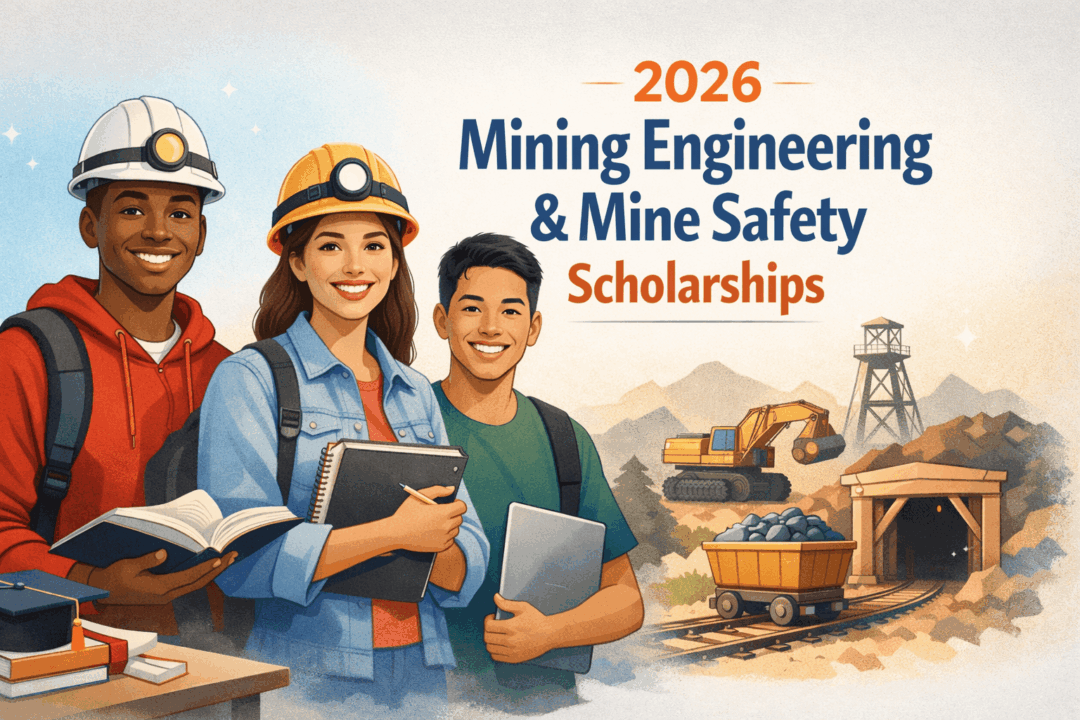
2026 Mining Engineering & Mine Safety Scholarships (Verified Links)
Hand-picked, verified scholarships for Mining Engineering & Mine Safety students.
January
WAAIME (Women’s Auxiliary to AIME) National Scholarships
💥 Why It Slaps: National awards supporting students in mining, metallurgy, geology & related fields; quick Jan window.
💰 Amount: Varies (multiple undergraduate/graduate awards)
⏰ Deadline: Jan 25, 2026 (applications open Jan 1)
🔗 Apply/info: https://www.tms.org/portal/portal/Professional/HonorsAwards/WAAIME_Scholarship.aspx
February
Kanawha Valley Mining Institute (KVMI) Scholarships (WV)
💥 Why It Slaps: Long-running industry-backed awards for mining-related majors; multiple awards via KVMI/TGKVF.
💰 Amount: Varies
⏰ Deadline: Feb 15 (typical cycle via TGKVF; confirm current year on program page)
🔗 Apply/info: https://www.kvmiwv.com/scholarships
Southern Coal Providers Association (SCPA) Scholarship (WV)
💥 Why It Slaps: Need-based aid for families of coal industry employees across 26 WV counties.
💰 Amount: Typically up to $1,000 (varies by year)
⏰ Deadline: Feb 15 (most cycles)
🔗 Apply/info: https://tgkvf.org/scholarships/southern-coal-providers-association-scpa/
March
RMCMI Undergraduate Engineering/Geology Scholarships
💥 Why It Slaps: Regional coal & mining institute supporting students in eligible western states aiming at mining careers.
💰 Amount: Varies
⏰ Deadline: Mar 1 (annual)
🔗 Apply/info: https://rockymtnmining.org/scholarships/apply-for-scholarships/
RMCMI Technical School Scholarship
💥 Why It Slaps: Focused support for 2-year technical programs feeding directly into mine operations.
💰 Amount: Varies
⏰ Deadline: Mar 1 (annual)
🔗 Apply/info: https://rockymtnmining.org/scholarships/apply-for-scholarships/
April
Women in Mining (WIM) Denver Professional Chapter Scholarships
💥 Why It Slaps: Chapter-level awards that often favor active student involvement and industry commitment.
💰 Amount: Varies
⏰ Deadline: Apr 20, 2025 (check page for 2026 dates)
🔗 Apply/info: https://www.womeninmining.us/scholarships/
May
Women in Mining California Scholarships
💥 Why It Slaps: State chapter support for mining & minerals students; clear, simple application.
💰 Amount: Varies
⏰ Deadline: May 1, 2025 (check for 2026 update)
🔗 Apply/info: https://www.wim-ca.org/scholarships
ISEE (Society of Explosives Engineers) – SEE Education Foundation Scholarships
💥 Why It Slaps: Direct fit for blasting/explosives within mining; sizable pool, worldwide eligibility.
💰 Amount: ~$400–$7,500
⏰ Deadline: May 13, 2025 (11:59 pm ET) for 2025–26; watch page for 2026 cycle opening.
🔗 Apply/info: https://isee.org/resources/students/scholarships
Women in Mining Arizona Scholarships
💥 Why It Slaps: Support for AZ-based students in mining tracks; friendly, essay-based application.
💰 Amount: Varies
⏰ Deadline: May 30, 2025 (check for 2026 update)
🔗 Apply/info: https://www.womeninmining.us/scholarships/
Joseph A. Holmes Safety Association (JAHSA) Scholarships
💥 Why It Slaps: Targeted mine safety & health scholarships—perfect for H&S paths (industrial hygiene, safety engineering, etc.).
💰 Amount: Varies
⏰ Deadline: Typically late spring/early summer; confirm current window on JAHSA channels.
🔗 Apply/info: Overview via CareerOneStop (program details & contacts): https://www.holmessafety.org/scholarship/
June
NSSGA – Mining-Related Degree Scholarship (Aggregates)
💥 Why It Slaps: For students in mining-related majors; ties directly to the crushed stone/sand/gravel industry.
💰 Amount: Varies
⏰ Deadline: Jun 20, 2025 (watch for 2026 cycle)
🔗 Apply/info: https://www.nssga.org/get-involved/scholarships
July
NSSGA – Jennifer Curtis Byler Scholarship (Public Policy/GA, for dependents of aggregates employees)
💥 Why It Slaps: Great add-on if you sit at the mining–policy interface (advocacy, regulatory).
💰 Amount: $5,000
⏰ Deadline: Jul 31, 2025 (watch for 2026 cycle)
🔗 Apply/info: https://www.nssga.org/get-involved/scholarships
September
UCA of SME – Cutting Edge Conference Attendance Scholarships (Underground Construction/Tunneling)
💥 Why It Slaps: Covers registration + travel/hotel + stipend to immerse in underground tech—huge networking boost.
💰 Amount: Conference package + stipend (see page)
⏰ Deadline: Sept 25, 2025 (for the 2025 Cutting Edge event)
🔗 Apply/info: https://ucaofsme.org/students/scholarships
October (SME Foundation Unified Portal — most close Oct 15, 2025)
Apply to these through the SME portal. Many are perfect for mining engineering and mine safety specializations.
SME Coal & Energy Division & John Sidney Marshall Memorial Scholarships
💥 Why It Slaps: Coal/energy emphasis + one application considered for both.
💰 Amount: Varies
⏰ Deadline: Oct 15, 2025
🔗 Apply/info: SME portal — https://smescholarships.secure-platform.com/
SME Environmental Division & Veolia Scholarship
💥 Why It Slaps: Mining + environment; Veolia-sponsored award requires a short water-in-mining essay.
💰 Amount: $3,000 (two division awards + one Veolia award)
⏰ Deadline: Oct 15, 2025
🔗 Apply/info: SME portal — https://smescholarships.secure-platform.com/
SME Health & Safety Division Scholarship
💥 Why It Slaps: Direct mine H&S focus—ideal for safety engineering, IH, human factors.
💰 Amount: Varies
⏰ Deadline: Oct 15, 2025
🔗 Apply/info: SME portal — https://smescholarships.secure-platform.com/
Dr. Jessica Elzea Kogel Mining Health & Safety Scholarship (SME)
💥 Why It Slaps: Signature H&S award honoring a leader in mining safety—spotlights your safety impact.
💰 Amount: Varies
⏰ Deadline: Oct 15, 2025
🔗 Apply/info: SME portal — https://smescholarships.secure-platform.com/
MMSA/SME Presidential Scholarship
💥 Why It Slaps: Prestigious joint award (MMSA + SME Foundation) for top juniors/seniors & grads in minerals.
💰 Amount: $4,000 (minimum per current guidelines)
⏰ Deadline: Oct 15, 2025
🔗 Apply/info: Program page & SME portal — https://community.smenet.org/smefoundation/programs/mmsasmepresidentialscholarship
Mineral & Metallurgical Processing Division & Richard Klimpel Memorial Scholarships (SME)
💥 Why It Slaps: Processing-centric—great for those leaning toward plant/processing roles in mining.
💰 Amount: Varies
⏰ Deadline: Oct 15, 2025
🔗 Apply/info: SME portal — https://smescholarships.secure-platform.com/
J.H. Fletcher & Co. Scholarship (SME)
💥 Why It Slaps: Underground mining technology emphasis; aligns with real-world equipment & safety.
💰 Amount: Varies
⏰ Deadline: Oct 15, 2025
🔗 Apply/info: SME portal — https://smescholarships.secure-platform.com/
Stantec/McIntosh Engineering Scholarship (SME)
💥 Why It Slaps: Underground mining focus for juniors; strong industry visibility.
💰 Amount: Varies (multi-recipient program)
⏰ Deadline: Oct 15, 2025
🔗 Apply/info: SME portal — https://smescholarships.secure-platform.com/
George V. Weisdack Memorial Scholarship (SME Pittsburgh Section)
💥 Why It Slaps: Mining/mineral/coal processing—bonus consideration for Pittsburgh-area programs.
💰 Amount: Varies
⏰ Deadline: Oct 15, 2025
🔗 Apply/info: SME portal — https://smescholarships.secure-platform.com/
Ernest K. Lehmann Memorial Scholarship (SME)
💥 Why It Slaps: For undergrads in geology/mining—nice fit for geotech-leaning mining students.
💰 Amount: Varies
⏰ Deadline: Oct 15, 2025
🔗 Apply/info: SME portal — https://smescholarships.secure-platform.com/
Mine Ventilation Scholarship (SME Underground Ventilation Committee)
💥 Why It Slaps: Graduate-level award squarely focused on ventilation—a core mine safety area.
💰 Amount: Varies
⏰ Deadline: Oct 15, 2025
🔗 Apply/info: SME portal — https://smescholarships.secure-platform.com/
Henry DeWitt Smith Graduate Scholarship (SME)
💥 Why It Slaps: Historic graduate scholarship for mining/metallurgical/materials—great résumé signal.
💰 Amount: Varies
⏰ Deadline: Oct 15, 2025
🔗 Apply/info: SME portal — https://smescholarships.secure-platform.com/
Raja V. & Geetha V. Ramani Graduate Scholarship Award (SME)
💥 Why It Slaps: Supports thesis completion/travel for grad students in mining/mineral processing.
💰 Amount: Varies
⏰ Deadline: Oct 15, 2025
🔗 Apply/info: SME portal — https://smescholarships.secure-platform.com/
RETC Executive Committee Academic Scholarship (UCA of SME)
💥 Why It Slaps: ~$5,000 plus full conference experience—tunneling/underground focus ties to mine safety.
💰 Amount: ~$5,000 + conference package
⏰ Deadline: Oct 15, 2025 (via SME portal)
🔗 Apply/info: SME portal — https://smescholarships.secure-platform.com/
RETC/NAT Conference Attendance Scholarships (UCA of SME)
💥 Why It Slaps: Registration, airfare, hotel + stipend to attend RETC/NAT; ideal for underground/mine safety exposure.
💰 Amount: Conference package + stipend (see page)
⏰ Deadline: Oct 15, 2025 (via SME portal)
🔗 Apply/info: SME portal — https://smescholarships.secure-platform.com/
Financing the Critical Minerals & Safety Workforce: Mining Engineering & Mine Safety Scholarships (U.S.)
Mining and geological engineering—including mining safety engineering—sits at the intersection of national security, infrastructure resilience, and worker protection. The U.S. government’s evolving “critical minerals” agenda is expanding the strategic importance of domestic extraction and processing, while mine safety regulation continues to focus on the persistent drivers of fatal incidents (notably powered haulage and machinery). This paper synthesizes current labor-market evidence, federal safety priorities, and the scholarship ecosystem supporting mining engineering and mine safety talent. Using U.S. Bureau of Labor Statistics (BLS) wage/outlook data, Mine Safety and Health Administration (MSHA) training priorities and grant programs, and scholarship disclosures from major professional societies and university programs, we map how scholarships function as workforce infrastructure: (1) lowering financial barriers in a small, specialized field; (2) steering students into high-need safety subdomains (ground control, mobile equipment risk, emergency preparedness); and (3) widening participation through targeted programs (e.g., women-in-mining pipelines). We argue that “scholarship design” is not merely philanthropy but a measurable safety and productivity lever—particularly when paired with structured internships, safety-research placements, and competency-based assessment aligned to MSHA priority hazards.
1. Why mining engineering and mine safety scholarships matter now
Mining engineering is no longer only about tonnage and cost-per-ton. It increasingly resembles a systems discipline: geology + automation + industrial hygiene + geomechanics + regulatory compliance + risk engineering. That expansion is partly demand-driven. In November 2025, the U.S. Department of the Interior (via USGS) published the final 2025 List of Critical Minerals (60 minerals), adding 10 new minerals—including copper, metallurgical coal, phosphate, potash, silver, and uranium—explicitly tying mineral supply disruption to economic and national security risk. This policy environment increases the value of a domestic talent pipeline that can design safe mines, optimize processing, and manage environmental and community impacts.
Simultaneously, mine safety remains a non-negotiable constraint. MSHA and the U.S. Department of Labor have repeatedly emphasized that powered haulage and machinery are leading contributors to serious and fatal mine accidents—precisely the hazard classes that dominate modern operations with large mobile fleets and mixed contractor traffic. This creates a direct logic for scholarships that do more than “fund tuition”: they can shape the competencies and research focus of the next generation of engineers toward the hazards regulators and operators most urgently need to control.
2. Labor-market realities: small occupation, high stakes
From a labor economics perspective, mining and geological engineering is a classic “thin market”: relatively few workers, specialized training, and high consequence of skill gaps.
BLS reports the median annual wage for mining and geological engineers as $101,020 (May 2024), with the lowest 10% earning below $62,500 and the highest 10% above $163,740. Employment is projected to grow 1% from 2024–2034, but importantly, BLS still anticipates ~400 openings per year (largely replacement demand).
Two implications follow:
-
Scholarships can move the needle even at modest dollar totals. In a field where annual openings are in the hundreds, funding a few dozen additional graduates (or retaining students who would otherwise stop out) is structurally meaningful.
-
Safety specialization is an economic differentiator. BLS explicitly includes “mining safety engineers” within this occupational grouping. As mines adopt autonomy, electrification, and advanced monitoring, the highest-value engineers will increasingly be those who can quantify and reduce catastrophic risk while sustaining productivity.
3. Safety burden and the “priority hazard” lens
A key mistake in generic scholarship writing is treating safety as a moral add-on rather than an engineering optimization target. MSHA’s grant and regulatory communications define a usable “priority hazard” taxonomy that can guide scholarship design and applicant positioning.
3.1 MSHA’s training priorities (a proxy for the industry’s competency gaps)
The Brookwood-Sago Mine Safety Grants Program, created under the Mine Improvement and New Emergency Response Act of 2006, funds education/training to prevent unsafe conditions and to produce training materials aligned to MSHA-identified priorities. A 2025 Grants.gov listing (and related MSHA communications) highlights focus areas such as powered haulage/mobile equipment safety, emergency preparedness and mine rescue, electrical safety, contractor and customer truck driver safety, and training for new/inexperienced miners.
This matters for scholarships because it converts “safety interest” into auditable topics that can be reflected in an applicant’s coursework, capstone, research assistantship, internships, or even essay framing.
3.2 Safety data infrastructure students can actually use
NIOSH’s mining program provides Mine and Mine Worker Charts—interactive graphs/tables that allow breakouts by sector, accident class, injury rates, employee hours, and more, based on MSHA Part 50 reporting and standardized methodology. For scholarship applicants (and for scholarship committees), this is an underused advantage: candidates who demonstrate they can interpret sector-specific safety data (rather than recite slogans) signal readiness for modern safety engineering roles.
4. The scholarship ecosystem: who pays, what they’re buying, and how it’s structured
Mining engineering scholarships can be grouped into five functional “funding markets,” each with different incentives and selection logic.
4.1 Professional society mega-pipeline (broad coverage + reputational screening)
The Society for Mining, Metallurgy & Exploration (SME) and the SME Foundation publicly report offering $1.6 million in scholarships annually to SME student members. In thin labor markets, this kind of recurring funding acts like a stabilizer: it reduces volatility in enrollment and helps students persist through the expensive, time-intensive parts of the curriculum (field camps, labs, capstones).
Safety-specific example (geomechanics / ground control): The Syd S. & Felicia F. Peng Ground Control in Mining scholarship sets a minimum award of $5,000 and is explicitly tied to shortages of competent ground control engineers—one of the most safety-critical specialties in underground mining.
Interpretation: Society funding is often “portfolio funding”: it supports many subfields, but the named scholarships reveal the profession’s perceived bottlenecks (ground control, underground tech, minerals economics, etc.). Applicants who align with bottleneck areas can be unusually competitive even without perfect transcripts.
4.2 Federal safety-training grants (institutional capacity building)
Brookwood-Sago is not a student scholarship per se; it is a training and materials grant. But it affects student opportunity by underwriting university programs, safety labs, training content, and paid research roles. The MSHA Brookwood-Sago page lists multi-year recipients and shows a pipeline of universities and workforce organizations involved in safety education.
Why it matters for students: If your department participates in grant-funded safety work, you may gain access to (a) paid assistantships, (b) specialized safety coursework, (c) industry-recognized training modules, and (d) networking with MSHA-aligned safety initiatives. In scholarship strategy terms, this is “stackable funding”: tuition scholarship + paid safety research + safety credential.
4.3 University departmental scholarship pools (retention + “debt-free” recruitment)
Mining programs often compete for talent against larger engineering majors. One way they compete is by building department-level scholarship pools big enough to make mining a low-debt pathway.
A concrete example: the University of Arizona’s mining program reports over $500,000 in scholarships available annually, with additional support that helps many students graduate with little or no debt under certain criteria.
Interpretation: Department pools are frequently designed for retention (keeping students through sophomore/junior “filter” years) and for industry placement (students likely to enter mining immediately). Applicants should emphasize persistence signals: field readiness, teamwork under constraints, safety mindset, and willingness to work in site-based roles.
4.4 Inclusion-focused pipelines (women-in-mining and allied programs)
Workforce diversification is not only equity; it is a resilience strategy in small labor markets.
-
Women in Mining USA (WIM USA) lists national and chapter-based scholarships and updates opportunities as they open.
-
WAAIME supports scholarships for students pursuing earth science degrees including mining and related disciplines, operating under the SME ecosystem.
These programs often value leadership + community impact + persistence alongside GPA. Applicants who can show safety leadership (e.g., leading a lab’s safety audit, writing a haul-truck traffic management plan for a capstone, or participating in mine rescue training) can stand out because those experiences translate directly to operational safety culture.
4.5 Regional industry institutes and corporate “responsible mining” funds (local workforce + social license)
Regional and corporate scholarships are frequently linked to “social license to operate”: companies and associations fund local students to build trust, stabilize the workforce, and improve community benefit narratives.
Examples include:
-
Rocky Mountain Mining Institute (RMMI) engineering/geology scholarships, which include professional exposure (e.g., conference engagement) alongside funding.
-
Corporate endowments such as Royal Gold’s “Future Leaders in Responsible Mining” scholarships described as $30,000 annual scholarships supporting mining-related majors at specific institutions.
Interpretation: These programs often prefer candidates with credible ties to mining states/regions, a clear intention to enter the industry, and a “responsible operations” narrative (safety + environment + community).
5. Quantifying leverage: scholarship dollars as safety and productivity investment
Scholarship funding is sometimes framed as charity. In mining, it can be framed as risk financing.
5.1 A simple “thin market” ratio (illustrative but informative)
If SME/SME Foundation scholarships total $1.6M/year, and BLS projects ~400 openings/year for mining and geological engineers, then society scholarships alone correspond to roughly $4,000 per annual opening (1,600,000 ÷ 400).
This is not a perfect mapping—scholarships also support geologists, mineral processing, etc.—but it highlights the scale: even a single foundation can materially influence a significant share of the pipeline in a small occupation.
5.2 Data tools enable ROI framing
NIOSH explicitly provides mining economic analysis tools (e.g., estimating costs of injuries/fatalities and illustrating how safety investment improves the bottom line). This creates an actionable playbook for scholarship sponsors: require or reward applicants who can articulate how their proposed work reduces high-frequency/high-severity hazards (powered haulage, machinery interaction, ground falls) and how success will be measured.
Design insight: the most “doctorate-level” scholarship applications increasingly resemble mini research proposals: hazard → mechanism → intervention → measurement plan.
6. What “mine safety engineering” skills are actually being subsidized
Scholarships in this domain often implicitly subsidize a specific set of competencies:
-
Geomechanics / ground control (roof, rib, highwall stability; rock mass characterization; monitoring). The Peng scholarship’s focus is a direct signal that this specialty is perceived as scarce and essential.
-
Powered haulage risk engineering (traffic management, proximity detection, human–machine interface design, contractor interfaces). MSHA’s priority framing repeatedly centers powered haulage and mobile equipment safety.
-
Emergency preparedness and mine rescue systems (ventilation, communications, refuge alternatives, training design).
-
Industrial hygiene and exposure control (dust, diesel particulate, noise, heat stress) often embedded in safety grant workstreams and in NIOSH topic areas.
-
Safety management systems (leading indicators, incident learning, contractor governance) increasingly required to operate complex sites safely at scale.
7. Evidence-based applicant strategy (what actually correlates with awards)
Across sponsor types, selection criteria consistently reward four categories of signal:
-
Affiliation signal: membership and engagement (e.g., SME student membership for society scholarships).
-
Competency signal: safety-relevant projects (haulage safety analysis, ground control modeling, ventilation simulations).
-
Commitment signal: internships/co-ops in mining or adjacent heavy industry; participation in mine rescue, safety committees, or field programs.
-
Service/leadership signal: especially in inclusion-focused scholarships (WIM USA, WAAIME), where mentoring and chapter engagement can matter.
A high-performing application usually does one additional thing: it names a real hazard class and shows the applicant can reason quantitatively about it using public datasets (NIOSH charts, MSHA reports).
8. Recommendations for scholarship sponsors (how to maximize safety outcomes per dollar)
If the goal is to grow a safer mining workforce—not merely to distribute aid—then scholarship programs should be evaluated like interventions:
-
Align essays and project requirements to MSHA priority hazards (powered haulage, emergency preparedness, electrical safety, training for inexperienced miners).
-
Require a measurement plan (what metric changes: exposure reduction, near-miss reduction, training completion, hazard recognition accuracy).
-
Bundle funding with structured work placements (co-ops, safety research assistantships, sponsor site visits).
-
Create “retention scholarships” targeted at sophomore/junior transition points—where attrition is high in rigorous engineering majors—mirroring the logic of large departmental pools.
-
Use stackable credentials (first aid, mine rescue intro, OSHA/MSHA-aligned training modules produced via Brookwood-Sago-type initiatives).
Conclusion
Mining engineering and mine safety scholarships should be understood as strategic workforce infrastructure for a thin, high-stakes labor market. BLS data show the occupation offers strong wages but limited overall growth, making each additional competent graduate disproportionately valuable. USGS’s expanding critical minerals framing raises the national importance of domestic mining capability, while MSHA’s hazard priorities clarify exactly where competency shortages create unacceptable risk. The scholarship ecosystem—anchored by professional societies (e.g., SME’s reported $1.6M/year), departmental scholarship pools (e.g., Arizona’s >$500k/year), and inclusion-focused pipelines (WIM USA, WAAIME)—already reflects these pressures.
The next step is to treat scholarship design as an evidence-driven intervention: align awards to priority hazards, reward quantitative safety reasoning, and embed experiential learning that converts scholarship dollars into measurable safety capability. Done well, mining scholarships do not simply fund degrees—they fund safer systems, better operations, and a more resilient critical-minerals future.
Selected Sources (for citations and further reading)
BLS Occupational Outlook Handbook (Mining & Geological Engineers)
USGS Final 2025 List of Critical Minerals (news snippet)
MSHA Brookwood-Sago Mine Safety Grants Program
NIOSH Mining Data & Statistics (Mine and Mine Worker Charts)
SME Scholarships (annual scholarship total)
Peng Ground Control in Mining scholarship guidelines (minimum award)
Women in Mining USA scholarships hub
FAQs — Mining Engineering & Mine Safety Scholarships
1) What counts as a “mining-related” major?
Mining Engineering, Mine Safety/Health, Mineral Engineering, Geological/Geotechnical Engineering, Metallurgical/Materials (mining focus), Mineral Processing, Explosives Engineering, Underground Construction/Tunneling, Environmental Engineering (mine focus), Industrial Hygiene (mine focus).
2) Do I need to be in an ABET-accredited program?
Often required for SME-administered awards; others just want a clear mining focus. If your program isn’t ABET, show strong mining alignment (courses, research, internships, club leadership).
3) I’m a grad student. Which awards fit me best?
Target ventilation, health & safety, processing, and named graduate awards (e.g., ventilation-focused, classic graduate endowments, division-specific funds). Emphasize thesis topic, field data, and safety outcomes.
4) I’m at a 2-year/technical college. Am I eligible?
Yes—several programs explicitly support technical pathways (e.g., surface/UG operations tech, maintenance, blasting tech). Highlight hands-on labs, certifications, and shiftwork experience.
5) Do I have to be a U.S. citizen?
Varies. Many industry foundations prefer U.S. citizens/permanent residents; some awards are open to international students—especially conference travel/attendance awards. Always check the specific eligibility line.
6) Can I double-major (e.g., Mining + Environmental) and still be competitive?
Absolutely. Tie your narrative to safer, cleaner, more efficient mines (e.g., dust/noise controls, water stewardship, tailings risk reduction).
7) How do I prove “mine safety commitment” beyond grades?
Show MSHA training, JSA creation, near-miss analysis projects, ventilation modeling, hearing conservation projects, explosives safety protocols, incident trend dashboards, or stop-work authority stories.
8) What GPA do I need?
Many awards look for ~3.0+, but strong industry engagement can offset a slightly lower GPA. Pair any GPA dips with evidence of growth (co-op, improved upper-division grades, safety leadership).
9) What makes a standout mining scholarship essay?
Use a “Risk → Action → Result” arc:
-
Risk: A concrete mining/safety challenge you observed.
-
Action: The tool/analysis/behavior you used (vent modeling, dust mapping, lock-out/tag-out audit).
-
Result: Measurable impact (reduced exposure %, improved airflow, a new SOP adopted).
End with how the award accelerates your next step (certification, thesis fieldwork, conference presentation).
10) Who should write my recommendations?
One academic (mining, ventilation, geotech, IH) + one industry supervisor or co-op mentor who can speak to safety culture, reliability underground, and teamwork.
11) Can I stack multiple awards?
Usually yes. Some sponsors cap stacking or require school financial-aid coordination. Flag if an award is tuition-only vs. general educational expenses (travel, PPE, conference, software).
12) Are conference “attendance scholarships” worth it?
Yes—these can include registration, airfare, hotel, and a stipend. They’re networking gold, often leading to internships or thesis partners.
13) What’s the ideal application timeline?
- Fall (Sept–Oct): Big industry portals; conference travel apps.
- Winter (Jan): Fast Jan windows (national auxiliaries).
- Late Winter/Spring (Feb–May): Regional institutes, explosives, WIM chapters.
- Summer (Jun–Jul): Aggregates/association awards.
Block 2–3 hours per application; build a reusable packet (résumé, transcript, MSHA card, essay base, portfolio links).
14) What documents should be in my “ready-to-apply” packet?
Unofficial+official transcripts, 1-page engineering résumé, MSHA or safety training proof, project abstracts (ventilation, dust control, explosives), work logs (if relevant), and a 300-word core essay you can adapt.
15) Common mistakes that sink mining apps?
Missing the portal close by hours, wrong division/sponsor name, generic essays with no mine examples, no proof of field exposure, not joining SME/WIM/ISEE student groups, and forgetting to thank donors post-award.
16) My school has no SME/WIM/ISEE chapter—am I disadvantaged?
Not if you’re proactive. Join as an at-large member, attend meetings virtually, find a faculty sponsor, and document activity (webinars, poster sessions, committee work).
17) I’ve only done geology/civil internships—how do I show mining fit?
Translate scope: rock mechanics → ground control; hydrology → pit dewatering; tunnel support → UG ground support; environmental sampling → mine water quality & dust control.
18) How are funds typically disbursed?
Most sponsors pay your university directly; travel scholarships often reimburse with receipts. Keep award letters and talk to financial aid to avoid delays.
19) Any quick résumé tune-ups for mine safety?
Quantify exposure reductions, airflow gains, compliance rates, or inspection findings. Add PPE proficiencies, software (Ventsim, Deswik, Rocscience, ArcGIS), and any shiftwork or UG time.
20) Should I re-apply if I didn’t win?
Yes. Many donors like persistence. Update with new training, conference posters, and any safety improvements you’ve led since the last cycle.