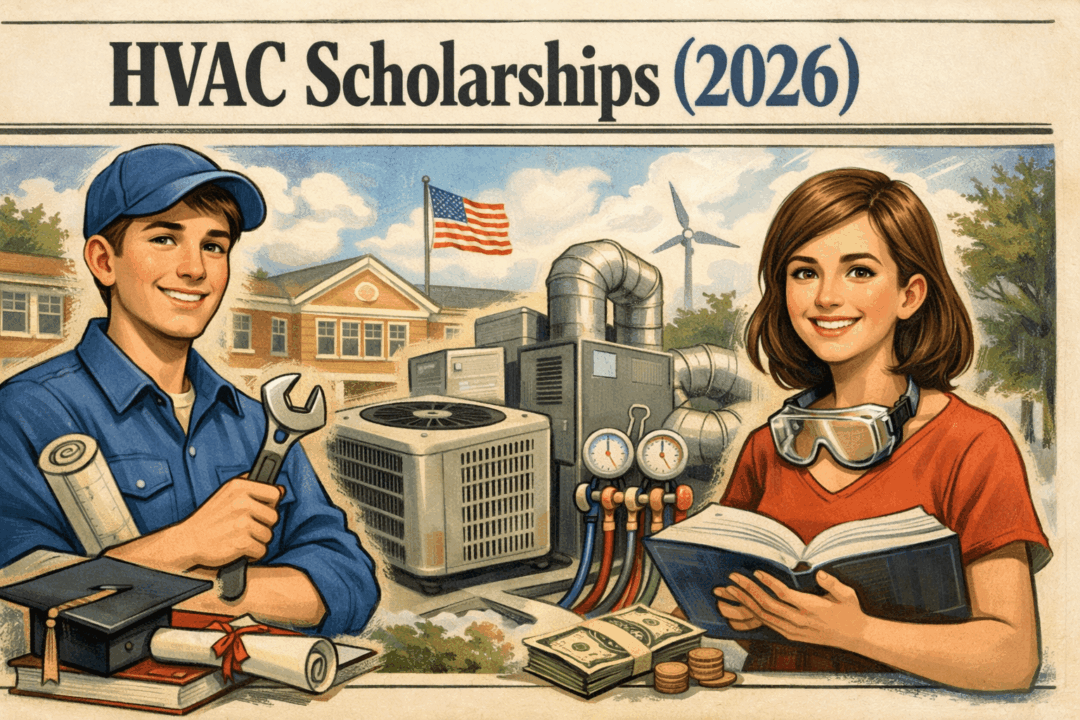
HVAC Scholarships (2026) — Verified Links, Deadlines & Awards
The most accurate, monthly-updated list of HVAC & refrigeration scholarships.
January
IIAR Natural Refrigeration Foundation (NRF) Founders’ Engineering Scholarship
💥 Why It Slaps: Made for industrial refrigeration (ammonia/CO₂) students—perfect if you’re heading toward HVAC/R engineering.
💰 Amount: Typically $5,000 (junior year) and $10,000 (senior year) for selected recipients.
⏰ Deadline: January 31
🔗 Apply/info: https://nrf.iiar.org/apply/
February
SMACNA College of Fellows Scholarships
💥 Why It Slaps: Strong fit for sheet metal/HVAC families—great if a parent/guardian works with a SMACNA contractor.
💰 Amount: Varies (competitive multi-recipient program).
⏰ Deadline: February 28
🔗 Apply/info: https://www.smacna.org/about-smacna/scholarships
March
OESP Dave Nelsen Scholarship (Oil & Energy Service Professionals)
💥 Why It Slaps: Long-running HVAC/heating scholarship with industry recognition; great for service-side careers.
💰 Amount: Historically $5,000 per award.
⏰ Deadline: Early March (Mar 10 in 2025; expect similar window)
🔗 Apply/info: https://thinkoesp.org/index.php/scholarships
Horatio Alger Career & Technical Education (CTE) Scholarship
💥 Why It Slaps: Need-based CTE funding usable at nonprofit community/technical colleges; HVAC programs qualify.
💰 Amount: $2,500 (rolling awards until funds are allocated).
⏰ Opens March 15; priority deadline typically June 15 (continues rolling if funds remain)
🔗 Apply/info: https://horatioalger.org/career-technical-education-scholarships/
Donohue Family SkillPointe Scholarship
💥 Why It Slaps: Simple app for skilled trades; HVAC is explicitly eligible; two cycles per year.
💰 Amount: $2,000
⏰ Deadline: March 31 (Cycle 1) and September 30 (Cycle 2)
🔗 Apply/info: https://www.myscholarship.app/donohue-family-skillpointe-scholarship
Carrier & Bryant Distributors’ Education Foundation Scholarship
💥 Why It Slaps: Great option if your parent/guardian works for a Carrier/Bryant dealer/contractor; supports vocational programs too.
💰 Amount: Recent awards included $1,500 (4-year) and $2,000 (vocational)
⏰ Window typically early December–late March
🔗 Apply/info: https://www.carrier.com/residential/en/us/news/news-article/investing-in-futures–carrier-and-bryant-distributors-award-scholarships-to-students-across-17-states.html
April
Rees Scholarship — SkillsUSA HVACR Scholarship (AHRI Foundation)
💥 Why It Slaps: Dedicated to SkillsUSA HVACR competitors; classic pathway funding into tech programs.
💰 Amount: Varies
⏰ Deadline: April 30
🔗 Apply/info: https://www.ahrinet.org/scholarships-education/rees-scholarship-foundation
May
PHCC Educational Foundation Scholarships (Plumbing-Heating-Cooling Contractors)
💥 Why It Slaps: One of the biggest trades scholarship pools; many awards benefit HVAC/apprentice pathways.
💰 Amount: Varies (multiple scholarships each year)
⏰ Deadline: May 1
🔗 Apply/info: https://www.phccfoundation.org/scholarship-program/
ASHRAE Society Scholarships (HVAC&R Engineering/Technology)
💥 Why It Slaps: Gold-standard awards for future HVAC/R engineers and technologists; multiple named scholarships.
💰 Amount: ~$3,000–$10,000 (varies by scholarship)
⏰ Deadlines: May 1 (some awards) and December 1 (many society-level awards)
🔗 Apply/info: https://www.ashrae.org/communities/student-zone/scholarships-and-grants/engineering-technology-scholarships
Bay Area SMACNA Scholarship Trust (regional)
💥 Why It Slaps: Regional program with meaningful awards; helpful for NorCal sheet metal/HVAC families.
💰 Amount: Up to ~$6,000 (varies)
⏰ Deadline: May 31
🔗 Apply/info: https://www.bayareasmacna.org/education/scholarships
June
Women in HVACR Scholarships
💥 Why It Slaps: Industry-leading program supporting women entering HVACR—with strong mentorship and community.
💰 Amount: $5,000 (multiple awards)
⏰ Deadline: June 1
🔗 Apply/info: https://www.womeninhvacr.org/scholarships
Rees Scholarship Foundation — HVACR & Water Heating Technician Program (AHRI Foundation)
💥 Why It Slaps: Flagship technician scholarship for students in accredited HVACR programs.
💰 Amount: Varies (commonly a few thousand dollars)
⏰ Deadlines: June 1 and October 1 (two review cycles)
🔗 Apply/info: https://www.ahrinet.org/scholarships-education/rees-scholarship-foundation
Horatio Alger Career & Technical Education (CTE) Scholarship — Priority Round
💥 Why It Slaps: If you missed earlier trade-specific awards, this national CTE fund is a strong second chance mid-year.
💰 Amount: $2,500
⏰ Priority Deadline: June 15 (rolling until funds are awarded)
🔗 Apply/info: https://horatioalger.org/career-technical-education-scholarships/
September
Donohue Family SkillPointe Scholarship — Cycle 2
💥 Why It Slaps: Second window in case spring didn’t line up; same simple application.
💰 Amount: $2,000
⏰ Deadline: September 30
🔗 Apply/info: https://www.myscholarship.app/donohue-family-skillpointe-scholarship
EGIA Foundation HVAC HERO Scholarship
💥 Why It Slaps: Pure HVAC fund—well-known, national, and student-friendly for tech schools and community colleges.
💰 Amount: $2,500 (multiple awards)
⏰ Opens each fall; watch for 2026 cycle announcements
🔗 Apply/info: https://egiafoundation.org/what-we-do/scholarships/
October
Rees Scholarship Foundation — Fall Cycle (Technician)
💥 Why It Slaps: Missed June? The October window keeps you in play for the academic year.
💰 Amount: Varies
⏰ Deadline: October 1
🔗 Apply/info: https://www.ahrinet.org/scholarships-education/rees-scholarship-foundation
RETA National Conference Scholarship (Industrial Refrigeration)
💥 Why It Slaps: Covers conference registration to level-up your industrial refrigeration knowledge and networking.
💰 Amount: Registration scholarship (see program page for details)
⏰ Deadline: October 1
🔗 Apply/info: https://reta.com/page/scholarship
Schneider Electric SkillPointe Scholarship (Building Automation & Related Trades)
💥 Why It Slaps: Ideal if you’re blending HVAC with controls/building automation.
💰 Amount: $3,000
⏰ Deadline: October 31
🔗 Apply/info: https://skillpointe.com/financial-resources
ASHRAE YEA Scholarship — HVAC Design Essentials (training grant)
💥 Why It Slaps: Funds ASHRAE’s HVAC Design Essentials training—professional development that boosts job-readiness.
💰 Amount: Covers course fee (see page for specifics)
⏰ Next round opens October 2025
🔗 Apply/info: https://www.ashrae.org/communities/young-engineers-in-ashrae-yea/yea-events-and-programs/yea-scholarship-for-hvac-design-essentials-training
December
ASHRAE Society Scholarships — Major Deadline
💥 Why It Slaps: The big society-level deadline for multiple named HVAC&R awards.
💰 Amount: ~$3,000–$10,000 (varies by scholarship)
⏰ Deadline: December 1
🔗 Apply/info: https://www.ashrae.org/communities/student-zone/scholarships-and-grants/scholarship-program
Trade Academy Skilled Trades Scholarship
💥 Why It Slaps: Clean, quick application—open to HVAC students nationwide.
💰 Amount: $2,500
⏰ Deadline: December 31
🔗 Apply/info: https://tradeacademy.com/trade-school/scholarship
Rolling / Association / Regional (check windows)
Conditioned Air Association of Georgia (CAAG) Annual Scholarship (regional/member-affiliated)
💥 Why It Slaps: HVAC-industry-specific in GA; helpful if you or family are connected to CAAG member companies.
💰 Amount: Varies
⏰ Deadline: Announced annually (apps are typically open during the school year)
🔗 Apply/info: https://www.caag.org/scholarship
SMART (Sheet Metal Workers) Local 100 Scholarship (union-affiliated)
💥 Why It Slaps: For members/dependents in sheet metal trades; aligns well with residential/commercial HVAC sheet metal paths.
💰 Amount: Varies (competitive scholarship competition)
⏰ Deadline: Varies by year (Local 100’s 2025 competition opened Feb 20)
🔗 Apply/info: https://smart100.org/scholarship-application/
Financing the Climate-Resilience Workforce: HVAC Scholarships in the United States (2026)
Heating, ventilation, and air conditioning (HVAC) occupations sit at the intersection of public health, energy affordability, and climate resilience. Yet the U.S. talent pipeline for HVACR technicians and related mechanical trades is constrained by training capacity, certification hurdles, and the last-mile financing problem: students can often access short programs, but struggle to cover tuition, tools, transportation, and exam fees. This paper synthesizes labor-market projections, education-cost benchmarks, and the national HVAC scholarship ecosystem to quantify where scholarships meaningfully de-risk entry—and where gaps persist. Using Bureau of Labor Statistics (BLS) outlook data, national tuition-price indicators, and program-level award disclosures from industry and association scholarship sponsors, we estimate the scale and structure of published HVAC-specific scholarship funding relative to projected annual job openings. We then propose evidence-based design improvements for scholarship programs and for scholarship-information platforms, emphasizing timing, eligibility clarity, and “stackable aid” strategies aligned to apprenticeship and credential pathways.
1. Why HVAC scholarships matter now: labor demand plus policy-driven complexity
The HVACR workforce is not merely “another skilled trade.” HVAC technicians maintain the systems that control temperature, humidity, and indoor air quality across homes, schools, hospitals, laboratories, and industrial facilities. That centrality is increasingly visible in three data-backed trends:
1) Strong occupational demand and replacement needs. BLS reports a median annual wage of $59,810 (May 2024) for heating, air conditioning, and refrigeration mechanics and installers, with employment projected to grow 8% from 2024–2034 and about 40,100 openings each year on average over the decade.
2) A workforce shortage narrative that is specific and persistent. Industry groups highlight shortages in technician headcount and experience depth; Women in HVACR, for example, frames demand at a national scale—citing a need for 86,000 new employees—while simultaneously emphasizing the low share of women in the field and the importance of targeted pipeline interventions.
3) Rising technical and regulatory complexity in the “HVACR” part of HVAC. Refrigerant-handling requirements elevate compliance costs and credential barriers. The U.S. Environmental Protection Agency’s Section 608 program requires technician certification for those who service or dispose of equipment containing regulated refrigerants—a constraint that shapes training curricula and student expenses (prep materials, exam fees, retakes).
Taken together, these trends strengthen the economic rationale for scholarships: they function as targeted subsidies to accelerate entry into a high-demand occupation with public-benefit spillovers (energy efficiency, safety, climate adaptation).
2. Education pathways and the “real” cost of entry
2.1 Pathways are short, but costs are multi-component
HVAC entry commonly runs through: (a) certificate programs at technical schools/community colleges, (b) employer-sponsored training, and/or (c) registered apprenticeship, often paired with credentials such as EPA 608 certification. While instructional time can be comparatively short versus a four-year degree, the cost stack is often underestimated:
- Tuition and fees
- Tools and personal protective equipment
- Transportation (commute to lab-based instruction and job sites)
- Exams and certifications (EPA 608; additional industry certs may be employer-preferred)
- Opportunity cost during training (foregone earnings)
A crucial insight for scholarship design: HVAC students are frequently financing cash-flow volatility more than they are financing “sticker tuition.”
2.2 Benchmarking tuition: why small HVAC awards can have outsized effects
National published tuition-price benchmarks show why trade scholarships can be unusually “high-leverage.” College Board reporting indicates that average public two-year in-district tuition and fees are about $4,150, while public four-year in-state tuition and fees average $11,950 (2025–26 figures, as summarized in College Board’s pricing highlights/newsroom reporting).
That matters because many HVAC programs are housed in the two-year sector or vocational institutes whose tuition levels are closer to the two-year benchmark than the four-year benchmark. A $2,500 HVAC scholarship can cover a substantial share of annual tuition at many community colleges—before considering Pell Grants, state workforce aid, or employer contributions.
3. Apprenticeship scale and what it implies for scholarship strategy
Registered apprenticeship is often discussed as the “debt-light” path into the trades. But scholarships still matter in apprenticeship ecosystems because many apprentices face front-loaded costs (tools, transportation, pre-apprenticeship tuition, exam fees) and because pre-apprenticeship or related technical instruction can be a gate to entry. Federal apprenticeship activity is large: a Federal Register document summarizing apprenticeship conditions references 678,014 active registered apprentices (as of FY 2025 in that context).
Implication: HVAC scholarships should be designed not only for “full-time students,” but also for (1) pre-apprentices, (2) apprentices in related mechanical/sheet metal programs, and (3) employed learners upskilling into refrigerants, heat pumps, controls, commissioning, or building-automation specialties.
4. The HVAC scholarship ecosystem: who funds it, how it’s structured, and what it signals
Unlike traditional academic scholarships—often mediated through universities—HVAC scholarships are frequently sponsored by industry charitable foundations, trade associations, and workforce nonprofits. This structure shapes eligibility, timing, and award delivery mechanics.
4.1 Industry charitable foundations: the AHRI Rees Scholarship Foundation
The Clifford H. “Ted” Rees, Jr. Scholarship Foundation (an AHRI charitable foundation) is one of the most visible national HVACR-focused scholarship entities. AHRI reports that since its founding in 2003, Rees has awarded more than $1.1 million in scholarships to over 700 students.
Operationally, the Rees Foundation accepts applications year-round with two review deadlines: June 1 and October 1 (aligned with spring and fall cycles), and scholarship funds are paid to the school and credited to the student’s account—an important consumer-protection feature that reduces fraud risk and increases accountability.
Interpretation: This model behaves like a targeted workforce-investment instrument: it recruits talent and stabilizes competency development by anchoring aid to accredited institutions.
4.2 Competition-linked and partner scholarships: SkillsUSA + HVACR
Rees-related programming also appears in partner scholarships. AHRI notes a SkillsUSA partnership offering eight one-time $2,500 scholarships to eligible students (HVACR or general construction tracks pursuing postsecondary HVACR training).
Interpretation: Competition-linked scholarships can identify motivated candidates and reward demonstrated commitment—useful when applicant pools are smaller and sponsors want strong signaling.
4.3 Workforce nonprofits: EGIA Foundation HVAC HERO Scholarship
The EGIA Foundation’s HVAC HERO Scholarship is unusually transparent about program outputs. It states that up to 30 students per year receive $2,500 each for HVAC technical education. It also publishes cumulative impact metrics: 165 scholarships awarded and $407,000 of tuition funded, spanning 39 states and 120 schools.
This disclosure enables a rare level of evaluation: sponsors can infer geographic spread, institutional variety, and typical award scale. It also suggests the scholarship is built as a pipeline strategy, not merely philanthropy.
4.4 Equity-targeted scholarships: Women in HVACR
Women in HVACR positions scholarships as a direct intervention against both labor shortages and representation gaps. The organization states it offers six $5,000 scholarships (as shown on its scholarship page) with a deadline of June 1.
Interpretation: Equity-targeted scholarships in HVAC are economically rational even before equity arguments: they expand the applicant pool in a high-opening occupation and can be evaluated by retention and completion outcomes over time.
4.5 Mechanical contracting pipeline: MCAA / John R. Gentille Foundation (JRGF)
HVAC careers overlap heavily with mechanical contracting, construction management, and mechanical systems engineering. The MCAA/JRGF scholarship ecosystem illustrates a broader “HVAC-adjacent” funding lane. MCAA communications report scholarship totals on the order of $100,000 in a given awards cycle (e.g., a note that scholarship totals reached $100,000 at MCAA25), and a 2026-related release references $105,000 in student scholarships with an application deadline of November 5 (in that announcement).
Interpretation: Students targeting HVAC design/engineering, estimating, project management, or commissioning can stack HVAC-adjacent scholarships to finance higher-cost degree pathways—expanding the HVAC talent pipeline above the technician layer.
4.6 Employer demand stimulus: consumer incentives and downstream workforce pressure
Consumer incentives can indirectly tighten labor markets by increasing installation volume and service demand. The IRS notes that qualified home energy improvements can be claimed through December 31, 2025, and that heat pumps can qualify for a credit of up to $2,000 per year (subject to program rules).
Interpretation: When policy incentives encourage adoption of high-efficiency systems (often requiring knowledgeable installation and commissioning), labor demand can rise faster than training capacity—strengthening the case for scholarships tied to modern equipment competencies (heat pumps, controls, refrigerant safety).
5. Quantifying the “published scholarship pool” vs. projected openings
Because HVAC scholarship funding is fragmented (national + state + local + employer-specific), no single dataset captures total annual HVAC scholarship dollars. However, we can quantify a published national minimum using publicly stated award structures from major programs:
- EGIA HVAC HERO: up to 30 × $2,500 = $75,000/year
- Women in HVACR: 6 × $5,000 = $30,000/year
- Rees/SkillsUSA (as described): 8 × $2,500 = $20,000 (cycle-based)
- MCAA/JRGF: $105,000 in student scholarships (as announced for a cycle)
A conservative aggregation of these disclosed pools is roughly $230,000 (excluding the broader Rees Foundation scholarship totals, PHCC totals not enumerated in the cited excerpts, and the many state/local programs). Compare this to ~40,100 annual openings for HVAC mechanics/installers projected by BLS: the published minimum pool equates to only about $5–$6 per projected annual opening if spread evenly.
This is not an argument that scholarships are ineffective; it’s an argument about scale and targeting. Scholarships in HVAC appear to function best as:
- High-leverage last-mile funding (tools, tuition gaps, exam fees), and
- Recruitment signals that pull candidates into programs with strong completion and placement outcomes.
6. Where scholarships create the most value: a program-design lens
A doctorate-level view treats scholarships as policy instruments that can be optimized. Four design features recur among the strongest HVAC scholarships:
6.1 Timing aligned to training calendars
Rees uses two review deadlines (June 1; October 1), matching semester starts and enabling rapid award deployment.
Women in HVACR uses a June 1 deadline, aligning with summer/fall entry.
MCAA/JRGF publicizes cycle deadlines (e.g., November 5) well before spring conferences/award events.
Design principle: Deadlines should match the moments when students commit to a cohort, buy tools, or register for exams—when small cash infusions prevent dropout.
6.2 Payment routed to institutions (anti-fraud + accountability)
Rees explicitly routes funds to school accounting departments, credited to the student, reducing misuse and reinforcing trust.
6.3 Eligibility clarity focused on HVAC pathways
EGIA clearly states qualifying institutions (community college, technical/vocational, approved technical institutes) and award amount and scale.
6.4 Public reporting of outcomes
EGIA’s impact reporting (scholarships awarded, tuition funded, states and schools represented) is an uncommon best practice in trade scholarships.
Design principle: Publishing outcome metrics enables iterative program improvement and builds sponsor confidence—key for scaling annual award pools.
7. Recommendations for students, educators, sponsors, and scholarship platforms
7.1 For students (and families): “stack” HVAC funding in a sequence
A practical evidence-based strategy is to stack aid across stages:
- Tuition baseline: community college/technical tuition benchmarks show why even $2,500 awards matter.
- Credential costs: prioritize EPA 608 certification readiness early (budget for exams/materials).
- Scholarship sequencing: apply to year-round or multi-cycle scholarships first (e.g., Rees), then identity/mission scholarships (Women in HVACR), then workforce non-profits (EGIA) and HVAC-adjacent mechanical contracting pathways (MCAA/JRGF) depending on your track.
7.2 For educators and training providers: reduce “information friction”
Many HVAC scholarships are missed because application requirements are scattered across sponsor sites. Training programs can improve capture rates by:
- Embedding scholarship deadlines into program onboarding (first week of class)
- Maintaining a “scholarship checklist” with required artifacts (transcripts, instructor recommendation, resume)
- Assigning a staff member or faculty lead as the scholarship coordinator for HVAC cohorts
7.3 For sponsors: fund last-mile barriers and publish outcomes
If the goal is workforce throughput, scholarships should explicitly cover high-friction expenses (tools, PPE, transportation vouchers, exam fees). Sponsors should also publish outcomes (completions, placements, credential pass rates) to justify scaling. EGIA’s public reporting is a template.
7.4 For scholarship-information platforms (like ScholarshipsAndGrants.us): optimize for conversion
Given the fragmented market, the highest-impact platform features are those that reduce cognitive and administrative load:
- A sortable table by deadline month, award amount, who can apply (student/apprentice/degree track)
- “Stacking suggestions” (e.g., technician track vs. mechanical engineering/management track)
- A mini “cost-of-entry” explainer: tuition benchmark + typical tool/certification costs, paired with scholarship examples
- Strong anti-scam cues: “funds paid to institution,” sponsor legitimacy, and application-fee warnings—especially important in trade scholarship spaces
Conclusion
HVAC scholarships operate in a labor market with clear demand signals: strong annual openings, a solid median wage, and rising technical complexity driven by energy efficiency and refrigerant compliance. Yet the disclosed national HVAC scholarship pool—while impactful for individual recipients—appears modest relative to annual job openings, implying that scholarships are best conceptualized as precision tools: they remove last-mile barriers, signal occupational prestige, and expand access to high-quality training pathways. Programs that align deadlines to training calendars, route funds through institutions, and report outcomes (as EGIA does) represent an emerging best-practice standard. For platforms curating HVAC scholarships, the opportunity is to transform scattered sponsor announcements into an actionable, stackable roadmap—so that the next cohort of technicians, installers, and mechanical professionals can enter the field faster, with less financial turbulence, and with credentials that match the evolving demands of U.S. buildings.
Key Sources Consulted (selected)
- U.S. Bureau of Labor Statistics, Occupational Outlook Handbook: HVAC mechanics/installers pay, outlook, openings.
- College Board, Trends in College Pricing reporting: published tuition/fee benchmarks.
- AHRI / Rees Scholarship Foundation program description and application details.
- EGIA Foundation HVAC HERO Scholarship program page and impact metrics.
- Women in HVACR scholarship details and workforce framing.
- MCAA/JRGF scholarship announcements.
- IRS heat-pump-related residential credit guidance (contextual demand driver).
- EPA Section 608 technician certification requirement (credential barrier context).
FAQs — HVAC Scholarships
1) Who’s eligible for HVAC scholarships—high school seniors, adult learners, or apprentices?
Most sponsors allow any of the following: high school seniors entering HVAC/R programs, current trade-school or community-college students, and working apprentices. Union- or employer-affiliated awards may also include dependents of members/employees. Always check the sponsor’s exact wording on enrollment status and affiliation.
2) Do I need prior experience, certifications, or EPA 608 to qualify?
Usually no. Most scholarships target future HVAC techs and students. Having OSHA-10/30, EPA 608, or dual-enrollment credits can strengthen your application, but they’re rarely required unless a specific award says so.
3) Will online or hybrid HVAC programs count?
If the program is offered by an accredited institution (recognized by the U.S. Department of Education) and clearly leads to HVAC/R training or a related credential, many sponsors accept it. Program-level accreditations (e.g., HVAC Excellence, PAHRA) are a bonus but not universally required.
4) What GPA do I need?
Ranges widely. Some trade-focused awards have no GPA minimum; others ask for ~2.5–3.0+. If your GPA is below the posted minimum, look for need-based or essay/portfolio-driven awards.
5) Can I stack these scholarships with Pell Grants, state aid, or GI Bill® benefits?
Often yes. Many private scholarships can stack with federal/state aid and VA education benefits, but schools may adjust your package to avoid over-awards. Tell the financial aid office about every scholarship you receive.
6) I’m undocumented/DACA. Do any of these work for me?
Some private scholarships don’t require U.S. citizenship or permanent residency. Read the eligibility section carefully; if it isn’t clear, email the sponsor. Consider local community-foundation funds and industry associations, which sometimes have flexible eligibility.
7) Do union apprenticeships have separate funding?
Yes. JATCs and local unions sometimes reimburse tuition, books, or tools and may offer member/dependent scholarships (e.g., SMART locals). Check your local hall, training center, and any labor-management trust funds.
8) What expenses can scholarships cover—tools, boots, certifications?
Depends on the sponsor. Many pay tuition/fees first; some allow books, required tools, PPE, or certification exam fees (like EPA 608). If “educational expenses” is allowed, ask whether tools qualify before you buy.
9) Are there good HVAC scholarships specifically for women?
Yes—Women in HVACR is a standout. Also look at general women-in-trades awards and local industry groups. Pair them with national HVAC options for best results.
10) I want industrial refrigeration or building automation—do these lists still apply?
Absolutely. Industrial refrigeration (ammonia/CO₂) aligns with IIAR/NRF and RETA opportunities. For building automation/controls, look for awards that mention “controls,” “energy management,” or “MEP/ASHRAE” pathways.
11) What do winning applications usually include?
Clear HVAC career goals, proof of enrollment/acceptance, a concise résumé, transcripts (if required), 1–2 short essays, and 1–2 recommendations (instructor/supervisor). Show hands-on projects, service work, SkillsUSA/CTSO achievements, or related jobs.
12) How early should I start?
Back-plan 6–8 weeks before each deadline for essays and recommendations. Many HVAC awards open between December–March, with additional waves in June and October.
13) I missed a deadline—what now?
Target rolling and multi-cycle awards (e.g., some CTE funds, Rees June/October cycles, SkillPointe cycles) and set reminders for the next window. Also check local contractor associations and community foundations year-round.
14) How do I avoid scammy aggregator links?
Use the official sponsor domain (e.g., .org/.edu/.com for the actual foundation or association), look for a current-year application PDF/form, and confirm contact info. If a page only redirects or demands payment to “apply,” skip it.
15) Will awards be paid to me or to the school?
Varies. Many sponsors send funds directly to your school’s bursar; some mail checks to students. If paid to you, ask how to document education expenses for tax purposes.
16) Are scholarships taxable?
Generally, amounts used for qualified education expenses (tuition, mandatory fees, required books/supplies) are not taxable; amounts used for room/board or non-required items may be taxable. Keep receipts and consult a tax professional.
17) How many applications should I submit?
As many as fit your profile and timeline—10–20 targeted applications across national and local awards is common for trades students. Local awards often have better odds.
18) Any quick wins for HVAC applicants?
- Join/engage with your local ASHRAE/PHCC/SMACNA/RETA/IIAR chapter.
- Ask instructors/employers for recommendations early.
- Keep a master application packet (résumé, transcripts, acceptance letter, certs).
- Showcase hands-on projects (before/after photos, brief write-ups).
- Reuse essays smartly—tailor the intro/conclusion to each sponsor’s mission.
19) How do I use this page efficiently?
Start with your month (deadlines), star 6–8 best-fit awards, and calendar the due dates. Then move to regional/association options and multi-cycle awards so you always have a next application in the queue.
20) My school has its own HVAC scholarships—should I still apply here?
Yes. Campus awards plus external industry awards can stack and reduce out-of-pocket costs. Ask financial aid how external funds interact with institutional scholarships.