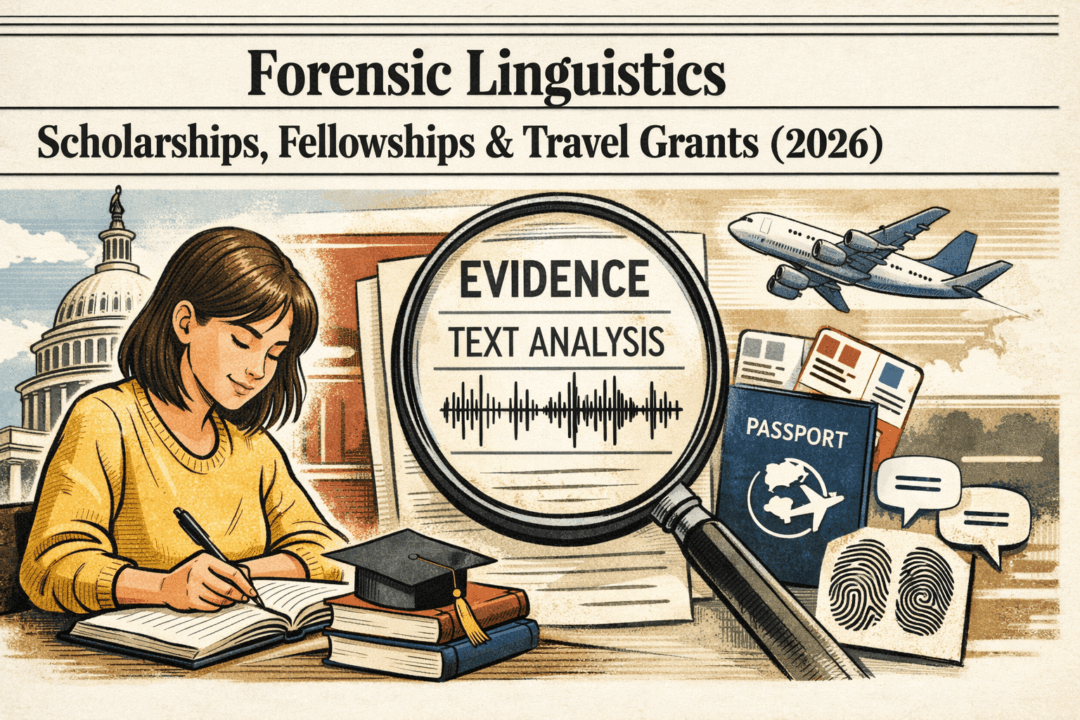
Forensic Linguistics Scholarships, Fellowships & Travel Grants (2026)
Verified, US-focused list of 20+ scholarships and grants for forensic linguistics, forensic phonetics, NLP/authorship analysis, and language-&-law research.
January
(No major, field-relevant national deadlines typically hit in January. Check “Rolling/Varies” at the bottom for year-round options.)
February
Acoustical Society of America — Technical Committee Student Travel Grant (Oceanography track)
💥 Why It Slaps: If your forensic phonetics/acoustics overlaps with ASA topics (speech, signals, audio analysis), this is a legit way to offset travel to present.
💰 Amount: Varies by meeting (typ. one grant/meeting)
⏰ Deadline: February 3, 2025 (New Orleans meeting example; future meetings post new dates)
🔗 Apply/info: acousticalsociety.org/new-orleans-2025
March
Duolingo Dissertation Grants (Language Learning)
💥 Why It Slaps: Clean, quick support for dissertation work in second-language acquisition and applied linguistics, with obvious relevance to forensic language analysis and measurement.
💰 Amount: $5,000 (five language awards, plus music/math tracks)
⏰ Deadline: May 31, 2025 (most recent cycle; expect similar spring window)
🔗 Apply/info: duolingo-papers…/2025_Duolingo_dissertation_grants_faq.pdf
(Listed here for planning—work up your proposal in March for the late-May deadline.)
April
NIJ Graduate Research Fellowship (GRF)
💥 Why It Slaps: NIJ funds justice-impact projects; dissertation-stage work in forensic linguistics (e.g., threat, authorship, deception, investigative interviewing, language access) is eligible.
💰 Amount: Up to $41,000/year salary + $16,000 COE + $3,000 research (up to 3 years within 5)
⏰ Deadline: April 15, 2025 (FY25 cycle example; check new NIJ posting annually)
🔗 Apply/info: nij.ojp.gov/funding/fellowships/graduate-research-fellowship-program
Acoustical Society of America — Student Transportation Subsidies
💥 Why It Slaps: Handy back-up for travel to present speech/phonetics-adjacent work (group travel prioritized).
💰 Amount: Varies by request volume
⏰ Deadline: About 5 weeks before each ASA meeting (e.g., Apr 21, 2025 for one meeting)
🔗 Apply/info: acousticalsociety.org/grants-sudsidies
May
CIPL (Permanent International Committee of Linguists) — Travel Grants (Spring Round)
💥 Why It Slaps: Classic linguistics travel money to present abroad—great for forensic linguistics talks at intl. venues.
💰 Amount: €500 (about US$525)
⏰ Deadline: May 15 (Spring window runs Mar 1–May 15)
🔗 Apply/info: ciplnet.com/travel-grant-procedure
TIRF Doctoral Dissertation Grants (ELT/applied linguistics)
💥 Why It Slaps: Funds data collection/analysis in language assessment/ELT research that often overlaps with forensic corpora, rater behavior, and measurement.
💰 Amount: Up to $5,000
⏰ Deadline: May 14, 2025 (2025 cycle; watch for 2026 announcement)
🔗 Apply/info: tirfonline.org/doctoral-dissertation-grants
June
Forensic Sciences Foundation — Field & Lucas Research Grants (AAFS)
💥 Why It Slaps: Supports research across forensic disciplines; language-&-law, speaker ID, and evidence communication projects can fit.
💰 Amount: Varies (competitive small-grant program)
⏰ Deadline: June 15 (annual)
🔗 Apply/info: aafs.org/forensic-sciences-foundation
July
AAFS — Jan Bashinski Criminalistics Graduate Thesis Assistance Grant (FSF)
💥 Why It Slaps: Graduate-level thesis support with extra travel money if you present at AAFS—useful for forensic linguistic casework methods.
💰 Amount: $1,850 + up to $1,400 travel
⏰ Deadline: July 31 (annual)
🔗 Apply/info: aafs.org/…/Jan-Bashinski-Criminalistics-Graduate-Thesis-Assistance-Grant
LSA — CEDL Travel Awards (Diversity in Linguistics)
💥 Why It Slaps: Up to $1,000 to attend/present at the LSA Annual Meeting; forensic topics welcomed within linguistics.
💰 Amount: Up to $1,000
⏰ Deadline: July 15, 2025 (for the next Annual Meeting)
🔗 Apply/info: lsadc.org/cedl-travel-awards
August
AAFS — Student Affiliate Scholarships (FSF)
💥 Why It Slaps: Presentation-linked scholarships (oral/poster) for students—perfect if your project bridges linguistics with forensic practice.
💰 Amount: Varies (scholarship awards tied to Annual Meeting submissions)
⏰ Deadline: August 1 (abstract deadline; scholarship application follows)
🔗 Apply/info: aafs.org/forensic-sciences-foundation/Student-Affiliate-Scholarship
September
NWAV (New Ways of Analyzing Variation) — Student Travel Awards
💥 Why It Slaps: Sociolinguistics meets justice—recent themes include conflict/justice; awards help grad students attend.
💰 Amount: $800 (recent host example; amounts vary by host/year)
⏰ Deadline: Varies by host (typically early Fall tied to reg./acceptance)
🔗 Apply/info: sites.lsa.umich.edu/nwav53
October
ETS — TOEFL® Grant for Doctoral Research in Language Assessment
💥 Why It Slaps: Funds dissertation-stage measurement work (assessments, rater behavior, validity)—methods often port straight into forensic authorship/scoring pipelines.
💰 Amount: Up to $6,000 (up to 10 awards)
⏰ Deadline: October 15 (most recent cycle)
🔗 Apply/info: ets.org/toefl/grants/doctoral-research-grant-language-assessment.html
AAFS — Student Travel Grants (FSF)
💥 Why It Slaps: Travel help (up to four figures) to present at AAFS—great for phonetics/acoustics, authorship, or legal-language panels.
💰 Amount: Up to $1,500 (per student; varies by year)
⏰ Deadline: October 15 (annual)
🔗 Apply/info: aafs.org/article/scholarship-and-grant-opportunities-abstracts-now-being-accepted
CIPL — Travel Grants (Autumn Round)
💥 Why It Slaps: Another shot at €500 to reach an international linguistics venue and showcase forensic work.
💰 Amount: €500
⏰ Deadline: Nov 15 (Autumn window runs Oct 1–Nov 15)
🔗 Apply/info: ciplnet.com
November
NSF Graduate Research Fellowship Program (GRFP) — Linguistics
💥 Why It Slaps: The big one—if you’re early-grad/entering a research MA/PhD with a forensic linguistics plan, this can fund you for years.
💰 Amount: $37,000 stipend/year (3 years) + $16,000 COE (5-year fellowship)
⏰ Deadline: Nov 12, 2025 for Social/Behavioral/Economic Sciences (check your field date)
🔗 Apply/info: new.nsf.gov/funding/…/grfp
Rolling / Varies (apply anytime or tied to event dates)
International Association of Forensic & Legal Linguists (IAFLL) — Student Travel Awards
💥 Why It Slaps: Conference fee waiver + up to $1,000 travel to present forensic linguistics work at IAFLL conferences.
💰 Amount: Up to $1,000 + registration waiver
⏰ Deadline: Varies by conference call (posted on IAFLL site)
🔗 Apply/info: iafll.org
IAFLL — PhD Student Bursaries
💥 Why It Slaps: Extra pot for doctoral candidates doing forensic linguistics; recent bursaries at affiliated events.
💰 Amount: £500 (recent example)
⏰ Deadline: Varies by event (see IAFLL announcements)
🔗 Apply/info: iafll.org
IAFPA — Student Travel Grant (Forensic Phonetics & Acoustics)
💥 Why It Slaps: Direct hit for speaker comparison/forensic acoustics papers; helps you get to IAFPA’s annual meeting.
💰 Amount: £500
⏰ Deadline: Linked to annual conference; see current call
🔗 Apply/info: https://www.iafpa.net/conferences/
IAFPA — Research Grants
💥 Why It Slaps: Seed money for pilot studies in forensic phonetics/acoustics (corpora, experiments, tooling).
💰 Amount: Up to £1,500
⏰ Deadline: Rolling (per committee cycle)
🔗 Apply/info: iafpa.net/research-grants
LSA — Student Abstract Award (Annual Meeting)
💥 Why It Slaps: $500 award for outstanding student abstracts—good visibility if your submission is forensic-focused.
💰 Amount: $500
⏰ Deadline: With Annual Meeting abstract cycle (varies yearly)
🔗 Apply/info: lsadc.org/student-awards
Association for Computational Linguistics — D&I/Hardship Travel Support
💥 Why It Slaps: If your forensic NLP/authorship analysis is at ACL/NAACL/EMNLP, this can subsidize travel/fees.
💰 Amount: Varies (D&I subsidies; hardship funds)
⏰ Deadline: Varies by conference; rolling until funds used
🔗 Apply/info: aclweb.org/portal/content/acl-policies-diversity-and-inclusion-initiatives
AAAL — Graduate Student Awards (Travel/Registration)
💥 Why It Slaps: Applied linguistics hub (assessment, discourse, forensic-adjacent work welcome); sponsor-backed grad awards.
💰 Amount: Varies by sponsor (registration + travel support)
⏰ Deadline: Tied to the annual conference acceptance window
🔗 Apply/info: aaal.org/awards-for-students
International Speech Communication Association (ISCA) — Grants for Students & Young Scientists
💥 Why It Slaps: Funds attendance at speech tech conferences (Interspeech, workshops)—useful for forensic speaker recognition work.
💰 Amount: Varies
⏰ Deadline: Before each event; see ISCA page
🔗 Apply/info: https://www.interspeech2025.org/travel-grants
NSF — Linguistics DDRI (Doctoral Dissertation Research Improvement Grants)
💥 Why It Slaps: Classic dissertation micro-grant—fieldwork, experiments, corpora for forensic-relevant studies.
💰 Amount: Up to $12,000 (direct costs)
⏰ Deadline: Accepted any time (review windows posted in solicitation)
🔗 Apply/info: nsf.gov/funding/opportunities/ling-ddri
NSF — Dynamic Language Infrastructure (DLI-DDRI)
💥 Why It Slaps: Funds documentation/tech infrastructures—useful if your forensic corpora involve endangered or under-resourced languages.
💰 Amount: Up to $15,000 (direct costs)
⏰ Deadline: Cycles set in solicitation (check current due dates)
🔗 Apply/info: nsf.gov/funding/opportunities/dli-ddri
Hofstra University — MA in Forensic Linguistics Graduate Linguistics Fellowships
💥 Why It Slaps: Program-specific tuition support ($10,000 typical award) in a dedicated US MA in Forensic Linguistics.
💰 Amount: About $10,000 (tuition award)
⏰ Deadline: Follows program application timelines (check cohort’s priority date)
🔗 Apply/info: hofstra.edu/pdf/academics/forensic-linguistics-graduate-handbook.pdf
Forensic Linguistics Scholarships, Fellowships, and Travel Grants: A Funding-Ecology Analysis for an Interdisciplinary Evidence Science
Forensic linguistics (FL) sits at the operational boundary between language science and legal decision-making: it includes the analysis of authorship, deception and threat communication, forensic transcription and translation, police and courtroom discourse, and the interpretation of language as evidence. Yet FL’s interdisciplinarity creates a structural funding problem: students rarely find “forensic linguistics” named explicitly in scholarship databases, and instead must assemble support across linguistics, forensic science, criminal justice, and sociolegal studies. This paper maps the current U.S.-anchored (but globally relevant) funding ecology for FL using a data-driven typology of awards—(i) conference travel grants, (ii) skills-building institute scholarships, (iii) dissertation-stage fellowships, and (iv) applied-research internships—then translates that ecology into a practical “funding stack” strategy that students can execute. Using publicly documented award ceilings, we show that travel awards commonly cluster around a median maximum of $1,000 (with typical ceilings from $500 to $1,500), while dissertation-stage fellowships can exceed $60,000 per year in stipend-plus-education allowances. The implication is straightforward: the FL pipeline is less constrained by “existence of money” than by matchmaking—aligning a linguistics-shaped research identity with justice-system funders’ evaluation criteria and compliance requirements.
1. Why funding FL is uniquely hard (and why it is increasingly necessary)
Two facts define FL’s scholarship landscape. First, FL is not a single discipline in the way “chemistry” or “nursing” is; it is a methodological toolkit deployed across contexts where language becomes probative evidence (e.g., disputed authorship, investigative interviews, asylum narratives, and trademark disputes). Second, the institutional homes of FL vary: a student may be enrolled in linguistics, applied linguistics, communication, computer science (NLP/authorship attribution), anthropology, or criminal justice—each with different fellowship norms and different “signal words” that funders recognize.
This mismatch matters because the most financially consequential awards typically belong to large bureaucratic funding systems (federal agencies, universities, and major professional associations) that classify applicants into pre-existing program areas. In practice, FL students win funding when they translate their work into the language of funders’ priorities: reliability of evidence, fairness in legal processes, human subjects protections, and measurable public impact.
Labor-market signals also incentivize the field. While FL is not a Bureau of Labor Statistics (BLS) occupation category, adjacent categories capture the “employment surface area” of FL training. Forensic science technicians—one common professional ecosystem FL collaborates with—are projected to grow 13% from 2024 to 2034, with a median pay of $67,440 (May 2024). Language-access and translation functions—central to many legal settings—also show strong wage floors: interpreters and translators report median pay of $59,440 (May 2024). These adjacent-market indicators suggest that FL’s applied skill set (analysis, documentation, expert-facing communication, and evidentiary reasoning) remains economically legible even when job titles vary.
2. Method: building a funding typology from observable award mechanics
Instead of attempting an exhaustive list of “forensic linguistics scholarships” (a category that is inherently sparse), we inventory representative award mechanisms that FL students can realistically use. The logic is ecological: FL funding is best modeled as a network of overlapping habitats rather than a single pipeline.
We anchor the typology in programs that publish (a) eligibility rules, (b) award ceilings, and (c) selection and documentation requirements. The resulting “funding stack” includes:
- Forensic science conference travel grants (high-fit for FL students presenting in forensic venues)
- Forensic-and-legal linguistics society travel awards (direct-fit FL funding)
- Linguistics equity and access travel awards (indirect-fit but high-availability)
- Summer institute fellowships (skills acquisition; high ROI for FL methods)
- Dissertation-stage justice fellowships (high dollar; high compliance)
- Federal research internships in justice contexts (training + applied placement)
3. Results: what the award data say about FL funding “shape”
3.1 Travel awards dominate the visible FL-specific layer
The most consistently discoverable FL-relevant funding is travel support, because conferences are where interdisciplinary legitimacy is negotiated and where students acquire professional sponsorship. Consider three directly relevant examples:
- AAFS/Forensic Sciences Foundation (FSF) Student Travel Grant: FSF allocates $12,000 total for student travel support, “not to exceed $1,500 per student,” and includes complimentary conference registration for the AAFS Annual Scientific Conference. Eligibility requires (among other items) AAFS membership/application status, an abstract submitted by the relevant deadline, a recommendation letter, a 400–600 word essay, and a CV.
- IAFLL Student Travel Awards: for a biennial conference cycle, IAFLL travel awards provide a registration waiver and reimbursement of “reasonable travel costs” up to US $1,000, with preference for applicants for whom costs would be prohibitive and who show potential contributions to the discipline.
- IAFLL PhD travel bursaries (example cycle): the association has offered travel bursaries of up to £500, plus a conference fee waiver (example early-bird concession member fee cited), reimbursed after receipts; eligibility requires active IAFLL membership and an accepted oral presentation.
These examples share a common selection logic: funders are not simply paying travel; they are buying field reproduction—the formation of new professionals who will publish, present, and eventually stabilize standards.
3.2 Linguistics equity and access awards expand the pool
FL students often present at linguistics venues (or hybrid venues) and can legitimately compete for linguistics travel awards—especially those designed to broaden participation. Two highly actionable programs illustrate the structure:
- CEDL Travel Awards (LSA ecosystem): each grant has a maximum of $1,000 to support travel to the LSA Annual Meeting; applicants do not need to be U.S. citizens. Required materials include a personal statement (with explicit prompts on contribution and need), transcript, and advisor letter; graduate applicants also provide a CV.
- FGAE Travel Grant: the First Gen Access & Equity Committee offers $500 for travel assistance for a first-generation linguistics student to attend the 2026 LSA Annual Meeting (New Orleans), explicitly to increase participation.
These awards matter for FL because they reduce the “identity tax” of interdisciplinarity: students can maintain a linguistics identity while pursuing justice-facing research questions.
3.3 Institute fellowships fund skill acquisition (the underrated bottleneck)
For FL, “methods capital” is often the binding constraint: audio analysis, sociophonetics, corpus methods, computational stylometry, research ethics, and legal literacy. Summer institutes provide concentrated upskilling, but tuition and living costs are real barriers.
The Linguistic Society of America (LSA) institute ecosystem illustrates a tuition-support model: the General Institute Fellowship offers 12 awards of $2,500 for tuition support (example year 2025). The host institute’s published tuition estimates (example cycle) indicate ~$1,600 (2.5 weeks) or ~$2,500 (5 weeks), excluding housing and meals—meaning a $2,500 fellowship can plausibly cover most or all tuition for the longer term.
For FL specifically, this category of funding is strategically powerful because it converts a student from “interested in forensic linguistics” into “trained in evidentiary-grade language analysis.”
3.4 Dissertation-stage fellowships are the high-dollar core—if you can fit the template
When students reach dissertation stage, the funding system changes: agencies will fund research production rather than participation.
A key example is the National Institute of Justice (NIJ) Graduate Research Fellowship (FY24). The solicitation specifies that each year of support includes:
- $41,000 salary and fringe benefits
- Up to $16,000 cost of education allowance
- Up to $3,000 research expenses (including items such as data collection travel and even conference travel, with justification)
Funding may extend up to three years, contingent on progress and enrollment.
This award structure is not “forensic linguistics” branded, but it is FL-compatible when a dissertation frames language evidence as a justice-system problem: e.g., threat assessment discourse, interviewing practices, language access inequities, or error rates in transcription/interpretation workflows.
3.5 Federal internships signal an “applied bridge” pathway
A separate high-impact mechanism is internship supplementation for students already funded on NSF projects. NSF’s NSF-NIJ INTERN supplemental funding opportunity invites requests to support graduate students for internships in forensic science or criminal justice contexts. Importantly, the DCL notes that the total requested amount “should not exceed $55,000 per student” for a six-month internship period.
For FL, this pathway is ideal for students whose research includes computational methods, human factors, or workflow design—areas NSF funding often touches—while the internship anchors their work in operational justice settings.
4. A quantitative snapshot: award ceilings and what they imply
If we treat the maximum award as a proxy for “funding power,” the travel-grant layer clusters tightly:
Representative travel-award maxima (USD):
- $500 (FGAE)
- $700 (example: Cornell conference grant model; illustrates common campus ceilings)
- $1,000 (CEDL; IAFLL student travel award)
- $1,500 (FSF/AAFS student travel grant + registration)
Sorted, the median maximum is $1,000, and the typical range is $500–$1,500. That range is large enough to make conferences feasible, but too small to solve tuition or living costs.
By contrast, dissertation-stage mechanisms are an order of magnitude larger. NIJ’s fellowship structure totals up to $60,000 per year in combined allowances ($41,000 + $16,000 + $3,000) and can run up to three years. This gap produces a predictable strategy: students should use travel/institute awards to generate the publications, presentations, and institutional fit that make them competitive for high-dollar dissertation fellowships.
5. The “Funding Stack” strategy for FL students
Because FL funding is distributed across categories, students should pursue a layered portfolio—stacking awards that solve different constraints at different times.
Stack A: Visibility → Legitimacy (Year 1–2 graduate / advanced undergrad)
- Join the relevant association(s) early (membership is often a gatekeeper).
- Target travel awards with explicit equity/participation missions (CEDL/FGAE) if eligible.
- Present early-stage work (even pilot studies) at venues where reviewers understand linguistic evidence.
Stack B: Methods → Credibility (pre-dissertation)
- Use institute fellowships to acquire demonstrable method competence (e.g., phonetics, corpus methods, computational stylometry).
- Translate methods into artifacts funders recognize: pre-registered protocols, reproducible pipelines, annotated corpora, inter-rater reliability, etc.
Stack C: Production → Impact (dissertation stage)
- Frame dissertation questions in NIJ-relevant terms (system error, evidentiary reliability, fairness, operational workflows).
- Budget “research expenses” strategically—NIJ explicitly allows relevant travel and professional costs with justification.
Stack D: Applied bridge (NSF-funded students)
- If supported on NSF projects, pursue NSF-NIJ INTERN supplements for internships that place your linguistic methods inside justice institutions.
6. What selection criteria reveal about “how FL is judged”
Across the travel-grant layer (AAFS/FSF, IAFLL, linguistics equity awards), selection criteria consistently reward:
- Proof of participation (accepted abstracts, membership status, advisor letters).
- Narrative of professional formation (essays/personal statements that explain career impact and public value).
- Evidence of contribution (research promise, service, or the ability to strengthen underrepresented research agendas).
At the dissertation fellowship layer, an additional evaluation regime appears: compliance, feasibility, and deliverables. NIJ’s fellowship expectations (annual reporting, defined budget categories, justification for travel) highlight that agencies fund governable research, not just interesting research.
This has a practical implication for FL applicants: you must articulate not only what language evidence means, but how your method reduces uncertainty, error, or inequity in legal processes.
7. Equity considerations: who gets locked out, and how these awards counteract it
FL has an “access paradox.” Many of the communities most affected by language in legal systems—immigrants, multilingual speakers, dialect-minoritized communities, Deaf communities—are also the communities most likely to be economically excluded from conference travel and unpaid training time. Programs like CEDL explicitly target underrepresented groups (including first-generation scholars) and ask applicants to explain both financial need and anticipated contribution. The FGAE travel grant similarly operationalizes first-generation inclusion with a direct $500 award.
For ScholarshipsAndGrants.us, this implies that FL funding content should not only list awards but also clearly label: (a) eligibility axes (first-gen, URG, non-U.S. citizen eligible), (b) membership prerequisites, (c) whether an accepted abstract is required, and (d) reimbursed vs. upfront funding—because these features determine who can realistically apply.
8. Implications for the ScholarshipsAndGrants.us Forensic Linguistics major page
A high-performing FL funding page should reflect the ecology rather than pretending there is a single scholarship funnel. Concretely:
Recommended filters/tags (user-facing):
- Type: Scholarship / Fellowship / Travel Grant / Institute Funding / Internship Supplement
- Home discipline: Linguistics / Forensic Science / Criminal Justice / Sociolegal Studies / Computational (NLP)
- Gatekeepers: Membership required; Accepted abstract required; Advisor letter required
- Typical award size: ≤$500; $501–$1,000; $1,001–$2,500; $2,500+; $25,000+
- Citizenship: U.S.-only vs. open to international applicants (CEDL notes no U.S. citizenship requirement).
Anchor programs to feature (because they are clearly documented and FL-compatible):
- FSF/AAFS Student Travel Grant (up to $1,500 + registration; structured requirements).
- IAFLL Student Travel Awards (up to $1,000 + registration waiver).
- IAFLL PhD bursaries (up to £500 + fee waiver; membership + accepted talk).
- CEDL Travel Awards (max $1,000; strong equity framing).
- NIJ Graduate Research Fellowship (high-dollar dissertation-stage).
- NSF-NIJ INTERN supplement (applied internship up to $55,000 per student, for eligible NSF-funded contexts).
- LSA Institute Fellowships (skills-building tuition support up to $2,500; aligns with method bottlenecks).
Conclusion
Forensic linguistics does not suffer from a total absence of funding; it suffers from a discoverability and classification problem created by interdisciplinarity. The data show a two-tier funding structure: (1) a broad, relatively accessible layer of travel and training awards (typically capped around $1,000; often membership- and abstract-gated), and (2) a narrower, compliance-heavy layer of dissertation and internship funding that can exceed $50,000–$60,000 per year (or per internship period) when students align their work with justice-system research priorities.
For students, the dominant strategy is therefore stacking: use travel and institute funding to build publication/presentation credibility and method competence, then compete for dissertation-stage fellowships that underwrite real research production. For scholarship curators, the dominant strategy is ecological indexing: build pages that surface adjacent-field awards, flag gatekeeping requirements, and help applicants map their FL identity onto the categories funders already use. Done well, a Forensic Linguistics funding hub becomes more than a list—it becomes an infrastructure for producing the next generation of language-and-law experts.
References (selected, public documentation)
Bureau of Labor Statistics. Occupational Outlook Handbook: Forensic Science Technicians.
Bureau of Labor Statistics. Occupational Outlook Handbook: Interpreters and Translators.
Forensic Sciences Foundation / American Academy of Forensic Sciences. Student Travel Grant (program page) and related announcements/recipient notice.
International Association for Forensic and Legal Linguistics (IAFLL). Student Travel Awards; PhD Travel Bursaries (example cycle).
LSA/DC ecosystem. CEDL Travel Awards; FGAE Travel Grant; Linguistic Institute Fellowships and tuition estimates (example cycle).
National Institute of Justice. FY24 Graduate Research Fellowship solicitation (award structure and allowable expenses).
National Science Foundation. NSF-NIJ INTERN supplemental funding opportunity (award ceiling guidance).
FAQs — Forensic Linguistics Scholarships & Grants
Q1) What exactly “counts” as forensic linguistics for funding?
Anything that applies linguistic science to justice or legal contexts: authorship attribution, threat/harassment analysis, forensic phonetics/speaker comparison, interviewing and interpreter-mediated discourse, language access in courts, investigative linguistics, deception/credibility language metrics, corpus building for legal text, and NLP pipelines used in casework.
Q2) I’m in a general Linguistics/CS/Criminology program—not a “Forensic Linguistics” program. Am I eligible?
Usually yes. Most funders care about your project scope and supervision, not the exact program title. Make the justice impact explicit and name mentors with relevant methods (phonetics, discourse, NLP, measurement).
Q3) Which fellowships prefer early-stage vs dissertation-stage projects?
- Early-stage (pre-dissertation): NSF GRFP, many conference travel awards, diversity & inclusion travel funds.
- Dissertation-stage: NIJ GRF, NSF DDRI/DLI-DDRI, ETS/TOEFL Doctoral Grants, TIRF DDG, Duolingo Dissertation Grants.
- Any stage tied to acceptance: AAFS/IAFPA/IAFLL/LSA/AAAL/ASA/ISCA travel awards.
Q4) Can international students apply to these US-based opportunities?
Some yes (conference travel from professional societies typically is), others no (certain federal funds, e.g., NSF GRFP). Always check citizenship/visa sections. If ineligible, target society travel awards, foundation micro-grants, and university funds.
Q5) How do I show “justice impact” without real case data?
Use vetted proxy corpora (e.g., public legal text, synthetic or redacted datasets), preregistered experiments, and external practitioner feedback. Show how your methods generalize to case contexts and discuss ethical safeguards you’d use in real deployments.
Q6) What should my budget include for small grants/travel awards?
Registration, airfare/lodging/per diem, poster/printing, local transit, and methods-critical costs (ASR/forced aligner credits, cloud compute, audio recorders, head-mounted mics, calibration tools, transcription). Tie every line to a method deliverable.
Q7) Can I buy software or compute time with these grants?
Often yes, if essential to methods (e.g., Praat-compatible plugins, diarization/ASR usage, phonetic analysis packages, GPU time). Provide vendor quotes or rate cards and justify why open-source alternatives are insufficient.
Q8) How do I handle IRB/ethics when proposals use sensitive language data?
Explain de-identification, secure storage, minimization (only data you need), and access controls. If using scraped or historical case texts, justify legality, licenses, and ethics; outline human-subjects determination or IRB review plan.
Q9) What writing samples strengthen my application?
A short, methods-dense paper (pilot or class paper) with clear evaluation and error analysis. Include a one-page measurement appendix (features, models, evaluation metrics, baselines) to signal rigor, even for qualitative projects.
Q10) Any common mistakes that sink otherwise good proposals?
- Vague “detect deception” claims without validity testing or error bounds.
- Ignoring linguistic variability (dialect, L2, code-switching) in evaluation.
- No plan for domain shift (social media vs. legal complaints).
- Budgets not aligned to milestones.
- Missing letters from method mentors (only practice-side letters).
Q11) Can I stack multiple awards for one trip or project?
Sometimes. Many society travel awards don’t stack with another society’s award for the same trip, but they may stack with a university travel grant. Disclose all funding and ask in advance.
Q12) Do poster presentations get less funding than talks?
Not usually. Many travel programs fund both equally if your abstract is accepted. Prioritize conferences where your methods community attends (AAFS, IAFPA, LSA, AAAL, ASA, ISCA, ACL venues, NWAV).
Q13) What if the new cycle dates aren’t posted yet?
Apply last year’s timeline as a planning guide and prepare a “just-in-time” packet: abstract draft, budget, advisor letter, IRB status, and a one-page project diagram. You’ll be ready to submit within days once the call drops.
Q14) Should letters come from law enforcement/legal partners or professors?
For methods grants: at least one letter from a methods expert (phonetics/NLP/measurement). If you have a practitioner letter, include it as a second letter to show impact, not as a replacement.
Q15) How do I frame qualitative discourse work competitively against NLP/phonetics?
Lean into methodological clarity: sampling frame, coding protocol, inter-rater reliability, analytic lenses, triangulation, and transfer to training guidelines for investigators/interpreters. Include a simple logic model (input → analysis → training/policy output).
Q16) Any tips for first-time applicants with limited publications?
Show trajectory: completed methods coursework, pilot analyses, open prereg, code or stimuli in a public repo (where allowed), and concrete deliverables by month. A good Gantt chart can win tight panels.
Q17) What evaluation details do reviewers want for authorship/speaker work?
Balanced datasets; justified features; baselines; error analysis by subgroup (dialect/L2/genre); calibration curves; confidence/likelihood ratios where appropriate; reproducibility notes (seed, versioning, hardware).
Q18) Where do I find “hidden” funds if I miss a deadline?
Departmental travel pools, graduate school micro-grants, campus research offices, small endowed funds in Linguistics/Criminology/CS, and conference hardship funds released shortly before the event.
Q19) How do I keep applications consistent across multiple calls?
Maintain a living grant kit: 2-page project summary, 1-page budget with notes, 250-word abstract, biosketch, facilities paragraph, IRB status, and a modular methods appendix you can trim/expand.
Q20) Any accessibility considerations that improve applications?
Yes—budget for CART/ASR captioning, interpreters, accessible formats for posters, and quiet recording spaces. Framing accessibility as method-quality (better transcripts, cleaner audio) resonates with reviewers.