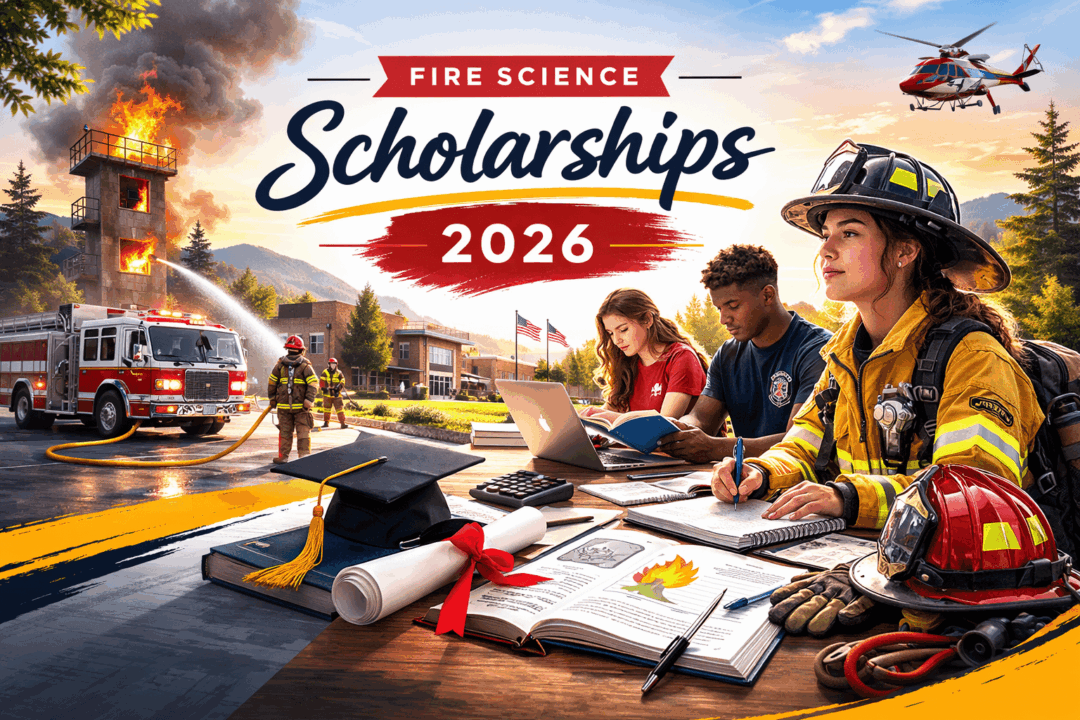
Fire Science Scholarships — 20+ Verified Awards for 2026
The most accurate, link-verified list of Fire Science & Fire Protection scholarships for 2026. Sorted by deadline (Jan–Dec). Includes national, state, and association awards for future firefighters, wildland fire, FPE, and volunteer firefighters. “Apply/info” links verified.
W. H. “Howie” McClennan Scholarship (IAFF)
💥 Why It Slaps: Long-running IAFF award for children of firefighters killed in the line of duty.
💰 Amount: $2,500 per year
⏰ Deadline: February 1, annually
🔗 Apply/info: https://www.iaff.org/scholarships/
National Fallen Firefighters Foundation (NFFF) — Sarbanes & Partner Scholarships
💥 Why It Slaps: Tuition support for spouses/partners and children of fallen firefighters honored at the National Memorial.
💰 Amount: Varies by scholarship program
⏰ Deadline: March 1, 2025 (2025–26 cycle)
🔗 Apply/info: https://nff-foundation.smapply.io/
FASNY — Gerard J. Buckenmeyer Memorial Volunteer Scholarship (NY)
💥 Why It Slaps: 25 merit awards for NY volunteer firefighters who are HS seniors heading to college.
💰 Amount: $1,500 (25 awards)
⏰ Deadline: March 15, annually
🔗 Apply/info: https://fasny.com/awards/scholarship/
North Carolina State Firefighters’ Association (NCSFA) Scholarships
💥 Why It Slaps: Multiple awards for NC volunteers and dependents (includes Saunders $1,500 and R. Wayne Bailey $500).
💰 Amount: $500–$1,500 (by scholarship)
⏰ Deadline: Closes March 15 (application window Jan 1–Mar 15)
🔗 Apply/info: https://scholarship.ncsfa.com/
International Association of Arson Investigators (IAAI) Foundation — Academic Scholarships
💥 Why It Slaps: Supports students in fire investigation/forensic science—perfect for Fire/Arson Investigation tracks.
💰 Amount: Varies
⏰ Deadline: Varies by cycle (check current year page)
🔗 Apply/info: https://www.iaaifoundation.org/scholarships
Pennsylvania Firemen’s Association (PFA) — Scholarship Program
💥 Why It Slaps: Long-standing support for PA volunteers and families; multiple categories.
💰 Amount: Varies
⏰ Deadline: June 15, annually
🔗 Apply/info: https://pafirefighters.org/scholarships/
International Association of Wildland Fire (IAWF) — Graduate Scholarships
💥 Why It Slaps: Two competitive $3,000 awards for grad students studying wildland fire.
💰 Amount: $3,000 (two awards annually)
⏰ Deadline: Closed for 2025; next cycle Spring 2026
🔗 Apply/info: https://www.iawfonline.org/scholarships/
First Responders Children’s Foundation (FRCF) — General Scholarships
💥 Why It Slaps: Annual awards for children of first responders (fire included); renewable and needs/merit-based.
💰 Amount: Varies (many awards)
⏰ Deadline: Typically July 1 (confirm each year)
🔗 Apply/info: https://1strcf.org/scholarship/
Charles W. Riley Firefighter & EMS Scholarship (Maryland)
💥 Why It Slaps: State program covering tuition/mandatory fees (up to in-state public rate) for MD firefighters/EMS & volunteers.
💰 Amount: Tuition & fees (see program)
⏰ Deadline: Varies by term/program (see state site)
🔗 Apply/info: https://mhec.maryland.gov/preparing/Pages/FinancialAid/ProgramDescriptions/prog_RileyFirefighter.aspx
National Smokejumper Association — Annual Scholarships
💥 Why It Slaps: Up to seven awards for smokejumpers, pilots, and their spouses/children/grandchildren—great for wildland families.
💰 Amount: Up to $3,000 (up to 7 awards)
⏰ Deadline: Varies (see current year PDF/application)
🔗 Apply/info: https://smokejumpers.com/scholarships/
Public Safety Officers’ Educational Assistance (PSOEA) — U.S. DOJ/BJA
💥 Why It Slaps: Federal education benefit for spouses/children of public safety officers (incl. firefighters) killed or totally disabled in the line of duty.
💰 Amount: Set monthly rate (FY2025 full-time: $1,536/month)
⏰ Deadline: No fixed filing deadline (education benefits paid retroactively once eligible)
🔗 Apply/info: https://bja.ojp.gov/program/psob
California Fire Foundation — Daniel A. Terry Scholarship (Children of Fallen CA Firefighters)
💥 Why It Slaps: Targeted support for CA families of fallen firefighters.
💰 Amount: Varies
⏰ Deadline: September 1, 2025 (2025 cycle)
🔗 Apply/info: https://www.cafirefoundation.org/what-we-do/for-firefighters-and-families/dat-scholarship
SFPE New England — A.L. Brown Scholarship (Fire Protection Engineering)
💥 Why It Slaps: Classic FPE chapter award; friendly to undergrad/grad FPE students in New England.
💰 Amount: Varies
⏰ Deadline: September 12, 2025 (postmark)
🔗 Apply/info: https://www.sfpe-newengland.org/application
IABPFF — Chief Joseph L. Jones (with Columbia Southern University)
💥 Why It Slaps: Major tuition scholarship for members of the International Association of Black Professional Firefighters; up to 60 credit hours at CSU.
💰 Amount: Up to full CSU tuition for 60 credits (IABPFF notes 2025 value update)
⏰ Deadline: TBA (historically late spring) — 2025 page indicates update in progress
🔗 Apply/info: https://iabpf.org/?page_id=2757
American Fire Sprinkler Association (AFSA) — Second Chance College Scholarship
💥 Why It Slaps: No-essay quick entry for college/trade students; perfect add-on for Fire Science majors.
💰 Amount: $1,000 (multiple awards)
⏰ Deadline: August 31, 2025
🔗 Apply/info: https://www.afsascholarship.org/
AFSA — High School Senior Scholarship Contest
💥 Why It Slaps: Easy entry for HS seniors headed to college/trade programs (great for future firefighters).
💰 Amount: $1,000 (5 awards)
⏰ Deadline: December 31, 2025
🔗 Apply/info: https://www.afsascholarship.org/high-school-scholarships/
AFSA — Bill Phair Design School Scholarship (Fire Sprinkler Design)
💥 Why It Slaps: Pays tuition for AFSA’s Beginning Fire Sprinkler System Planning School (career-ready skill).
💰 Amount: Design school tuition (paid to employer per AFSA rules)
⏰ Deadline: October 31, annually
🔗 Apply/info: https://firesprinkler.org/designscholarship/
SFPE Chicago Chapter — Student Scholarships (FPE)
💥 Why It Slaps: Two cycles (Fall/Spring) for Fire Protection Engineering students; Chicago-area friendly.
💰 Amount: Varies
⏰ Deadline: June 30 (Fall) and November 30 (Spring)
🔗 Apply/info: https://chicagosfpe.org/Scholarships
NVFC & Columbia Southern University — NVFC Member Scholarship
💥 Why It Slaps: Covers up to 60 credit hours toward an online CSU degree for two NVFC members (volunteer firefighters/EMS).
💰 Amount: Up to 60 credit hours of CSU tuition
⏰ Deadline: Varies (program announcement in 2025; watch page)
🔗 Apply/info: https://www.nvfc.org/advance-your-education-apply-for-the-2025-nvfc-scholarship-to-columbia-southern-university/
IAFC Foundation — Fire Service Educational Scholarships
💥 Why It Slaps: Flagship national foundation supporting fire/EMS academic degrees and professional development.
💰 Amount: Varies (multiple named awards)
⏰ Deadline: Opens annually; 2025 cycle closed (check for 2026 window)
🔗 Apply/info: https://www.iafcfoundation.org/scholarships
Maryland State Firemen’s Association (MSFA) — Scholarships
💥 Why It Slaps: Extensive list of MSFA/partner awards for MD volunteers and dependents.
💰 Amount: Varies (multiple programs)
⏰ Deadline: Varies by scholarship
🔗 Apply/info: https://www.msfa.org/resources/msfa-scholarships/
Cumberland Valley Volunteer Firemen’s Association (CVVFA) — Scholarships
💥 Why It Slaps: Regional volunteer-focused support; several categories (incl. dependents).
💰 Amount: Varies
⏰ Deadline: Varies by scholarship
🔗 Apply/info: https://cvvfa.org/awards-copy/
New Mexico Higher Education Dept. — Fire Fighters & Peace Officers Survivors Scholarship (NM)
💥 Why It Slaps: Robust state benefit for survivors—tuition, room & board up to average COA at a NM public research university.
💰 Amount: Up to tuition + R&B (see program)
⏰ Deadline: September 1, annually
🔗 Apply/info: https://hed.nm.gov/financial-aid/scholarships/fire-fighters-and-peace-officers-survivors
Bonus (Related to Fire Protection / Codes)
FAMA — Phillip L. Turner Scholarship (Fire Protection Engineering)
💥 Why It Slaps: Industry-backed FPE scholarship from the Fire Apparatus Manufacturers’ Association.
💰 Amount: Varies
⏰ Deadline: Varies
🔗 Apply/info: https://www.fama.org/scholarships/
Fire Science Scholarships in the United States: Workforce, Equity, and Risk-Reduction Analysis (2026)
Fire Science (including fire suppression, fire prevention, fire administration, and closely related emergency services pathways) sits at the intersection of public safety, municipal finance, and critical infrastructure resilience. Yet its education pipeline is unusually “stacked”: many entrants pursue short postsecondary certificates or associate degrees while simultaneously meeting academy requirements, EMS credentials, and department onboarding expectations. This structure creates a distinctive scholarship market that blends traditional tuition aid with credential micro-grants, department and union professional-development awards, and survivor education benefits. Using national labor-market data, degree-completion and tuition benchmarks, line-of-duty fatality statistics, and major fire-service scholarship and benefit programs, this paper quantifies the demand for Fire Science talent, maps the education and funding ecosystem, and proposes evidence-based scholarship design principles. Key findings include: (1) Fire Science & Fire-Fighting produced ~8,414 completions in 2023, concentrated in public 2-year institutions, with median in-state public tuition around $3,465; (2) the fire service remains heavily volunteer-dependent (NFPA estimates ~65% volunteer firefighters), implying recruitment and retention constraints are fundamentally tied to education and training affordability; (3) official survivor-benefit education aid is substantial and inflation-indexed (PSOB educational assistance $1,574 per month of full-time attendance for benefits on/after Oct 1, 2025), yet administrative frictions can delay access; and (4) occupational exposure as a firefighter is classified as carcinogenic to humans (IARC Group 1), strengthening the economic case for scholarships that explicitly fund prevention, decontamination, and safety-engineering coursework.
1. Introduction: Why Fire Science scholarships behave differently than “typical” college scholarships
Fire Science education is not merely a private investment in earnings; it produces public goods: reduced fire losses, improved emergency medical response, stronger code enforcement, and safer built environments. The U.S. fire problem remains economically large: NFPA’s national estimates for 2024 include approximately 1.38 million fires, 3,920 civilian fire deaths, 13,250 civilian injuries, and $19.0 billion in property damage.
At the same time, fire departments increasingly function as all-hazards response agencies. The Bureau of Labor Statistics (BLS) notes that most firefighter calls are medical rather than fire-related. This shifts Fire Science training demand toward EMS integration, incident command, hazardous materials awareness, community risk reduction, and data-driven prevention.
Scholarships therefore matter in Fire Science for three reasons:
- Capacity (recruiting and retaining responders, especially volunteers and rural departments),
- Capability (upskilling for modern hazards and evidence-based prevention), and
- Continuity (supporting families after line-of-duty deaths through education benefits and scholarships).
2. Data and methods
This paper synthesizes:
- Labor market benchmarks from BLS Occupational Outlook Handbook (firefighters; fire inspectors and investigators).
- Education pipeline and price signals from Data USA (IPEDS-derived completions, sector mix, and tuition medians for Fire Science & Fire-Fighting).
- Fire service workforce structure from NFPA’s national fire department profile (career/volunteer mix) and related fire-service statistics.
- Line-of-duty death (LODD) counts and categories from U.S. Fire Administration reporting for 2024.
- Scholarship/benefit program parameters from major providers (e.g., Glatfelter Scholarship Foundation, NVFC partnership scholarships, IAFF, SFPE, PSOB, and NFFF).
- Occupational health evidence signals from IARC and CDC/NIOSH firefighter cancer research and registry resources.
The analytic focus is descriptive and economic: measuring the scale of demand (incident burden and workforce), the supply pipeline (completions and tuition), and the scholarship market’s ability to close affordability gaps.
3. Workforce demand: jobs, wages, and the all-hazards pivot
BLS reports a national median pay for firefighters of $59,530 per year (May 2024) and about 344,900 firefighter jobs, with projected growth around 3% over 2023–2033. Fire inspectors and investigators—often a pathway for Fire Science graduates who specialize in prevention, codes, and investigations—show higher wage benchmarks (BLS reports median pay $75,480 in May 2024).
Two structural forces amplify scholarship relevance even when headline job growth is modest:
- Replacement demand: firefighting is physically demanding with well-known injury and cardiovascular risks. USFA reports 72 on-duty firefighter deaths in 2024, including 42 attributed to cardiovascular events and 12 related to training activities.
- Service expansion: departments increasingly staff EMS response and community risk reduction programs; educational programs must therefore cover clinical coordination, public health interfaces, and data literacy, not only suppression tactics.
This mix creates a labor-market reality where scholarships can be less about “creating new jobs” and more about reducing the cost of entry and accelerating credential completion so departments can fill rosters, meet staffing standards, and deploy specialized capability (inspections, investigations, wildland interface, hazardous materials, and leadership).
4. The education pipeline: completions, tuition, and where Fire Science is taught
Fire Science & Fire-Fighting awarded 8,414 total degrees/completions in 2023 (across certificates and degrees). The pipeline is heavily concentrated in the public 2-year sector, which Data USA identifies as the most common sector by degrees awarded (e.g., 3,924 completions in 2023 in public 2-year institutions).
Price signals are also distinctive. Data USA reports median in-state public tuition around $3,465, compared with median out-of-state private tuition around $25,714 for this field. This spread supports a “cost-minimization” student strategy: many aspiring firefighters pursue community college pathways, departmental academies, online programs, or hybrid credential stacks.
Implication for scholarship design: because baseline tuition at public 2-year colleges can be relatively low compared with many bachelor’s programs, the binding constraints often become non-tuition costs (academy fees, gear, testing, commute, unpaid time in training, EMT clinical hours, and lost work shifts). Scholarships that treat Fire Science like a standard four-year tuition problem can miss the actual affordability bottleneck.
5. Equity and representation: who earns Fire Science credentials
Scholarships also function as labor-market equity tools. Data USA’s field-level demographics show a strong sex imbalance: among the most common institutions, male graduates dominate (e.g., ~87.7% male in the displayed “sex imbalance” indicator). The same source shows degrees awarded by race/ethnicity, with White students receiving the largest share (e.g., 5,593 degrees noted in the race/ethnicity breakdown).
NFPA’s national fire department profile provides additional workforce context, reporting that in 2020 about 4.4% of career firefighters were female and providing race/ethnicity shares for career firefighters.
These patterns matter because scholarship dollars can be targeted toward:
- Increasing representation in departments and leadership pipelines,
- Supporting childcare and schedule-flexibility barriers common among adult learners and volunteers, and
- Funding bridge programs (EMT → paramedic → fire officer; prevention/investigation tracks; fire protection engineering pathways).
6. Risk, health, and the case for “prevention-linked” scholarships
A key scholarship argument in Fire Science is risk reduction. In 2022, IARC classified occupational exposure as a firefighter as carcinogenic to humans (Group 1). CDC/NIOSH resources emphasize ongoing firefighter cancer research and the National Firefighter Registry (NFR) for Cancer as a major national effort to understand and reduce risk.
From an economic standpoint, scholarships that fund education in:
- contaminants and decontamination protocols,
- PPE science and respiratory protection,
- incident safety officer training,
- fire dynamics and modern materials, and
- data-driven prevention and inspection practice,
can be framed as health investments with long-horizon returns (lower occupational disease burden, fewer disability claims, reduced turnover, and preserved institutional expertise).
This is one reason “Fire Science scholarships” often extend beyond degree tuition to certifications (NFPA certificates, CPSE credentials, and officer training), aligning education with measurable safety outcomes.
7. The scholarship ecosystem: four dominant funding archetypes
7.1 Credential micro-grants for working responders (upskilling model)
A leading example is the Arthur J. Glatfelter Fire & Emergency Services Scholarship Foundation, which explicitly funds coursework and professional credentials and sets per-class maximums by degree level (e.g., $500 per class for associate-level classes up to a lifetime cap, $1,000 for bachelor’s classes, $1,200 for master’s classes, and $1,500 per class for PhD-level coursework, plus credential/certification caps). The program design embeds accountability (evidence of cost and proof of completion) and supports “stackable” advancement—exactly the structure many fire-service careers follow.
7.2 Partnership scholarships tied to specific institutions (pipeline + branding model)
Many national organizations operate scholarships through university partnerships that lower friction (simplified eligibility, clear enrollment channel). These models can rapidly increase enrollments in fire-adjacent programs (fire administration, emergency management) and often serve active volunteers or career firefighters.
7.3 State and local service-obligation tuition programs (retention model)
Maryland’s Charles W. Riley firefighter/EMS scholarship policy infrastructure illustrates how states can pair education funding with service requirements and dedicated revenue sources. Maryland legislative fiscal notes describe award maximums tied to tuition/fees benchmarks and document program funding levels (including appropriations history and the relationship between award caps and tuition indices). This category is especially important for volunteer-heavy systems: the scholarship is not merely access—it’s a retention tool that keeps trained responders serving in-state.
7.4 Survivor education benefits and scholarships (continuity + moral obligation model)
The federal Public Safety Officers’ Benefits (PSOB) program sets inflation-indexed benefit amounts. For deaths/disabilities occurring on or after October 1, 2025, PSOB reports a $461,656 death/disability benefit and $1,574 per month of full-time educational assistance.
Complementing PSOB, the National Fallen Firefighters Foundation (NFFF) provides scholarship assistance (Sarbanes Scholarship Program) for spouses, partners, children, and stepchildren of honored fallen firefighters and allows use across undergraduate, graduate, vocational, and certification training.
This archetype is economically meaningful: it stabilizes a family’s long-term human-capital trajectory after a line-of-duty death, converting a catastrophic labor shock into an education pathway.
8. Fire protection engineering as the “adjacent” scholarship universe
Although “Fire Science” programs are often housed in public safety or applied technology divisions, a closely linked academic pipeline is Fire Protection Engineering (FPE). FPE scholarships tend to be structured like engineering scholarships (merit, research interest, and diversity goals). For example, the University of Maryland’s FPE department lists multiple scholarships, including awards explicitly tied to diversity and inclusion and an award with a stated maximum of $5,000 for tuition and fees (Frank J. Fee Jr. Award).
At the professional-society layer, the Society of Fire Protection Engineers (SFPE) compiles scholarship opportunities by chapters and institutions and notes that SFPE Foundation student research grants may consider requests up to $25,000.
For Fire Science scholarship strategy, this adjacency matters: departments increasingly need personnel who can interpret fire modeling, building codes, and performance-based design—skills that benefit from scholarship-driven articulation pathways (associate → bachelor’s in FPE or related engineering/technology).
9. The volunteer backbone: why affordability is a national readiness issue
NFPA’s fire department profile estimates that in 2020 there were about 1,041,200 firefighters total, with approximately 676,900 volunteers (about 65%) and 364,300 career firefighters (about 35%). This is not a marginal detail; it means Fire Science scholarships have macro-level readiness implications, because the largest share of the workforce is not salaried in the same way and may face higher opportunity costs for training.
Policy-facing organizations argue that volunteer time provides substantial economic value and that call volume has grown over decades—creating pressure on volunteers whose training requirements rise while household time availability falls. In this context, scholarships function as a compensation surrogate: they “pay” volunteers through education and credential support, which can improve retention and leadership development.
10. Where scholarships succeed—and where they fail: a performance framework
10.1 The common failure mode: “tuition-only” design
Because many Fire Science students are in low-tuition public 2-year programs, tuition-only awards can be underpowered relative to binding costs. A $500 tuition scholarship may not address the costs that delay completion: EMT exam fees, background checks, immunizations for clinicals, PPE, travel to academy sites, or unpaid time in training rotations.
10.2 High-performing designs share four traits
- Stackability: supports micro-credentials and degree laddering (e.g., one class per year caps, credential funding, documented completion).
- Service alignment: encourages continued response through explicit service requirements or department verification (common in state tuition models).
- Safety externality targeting: funds prevention, decon, and health-protective learning aligned with the carcinogenicity evidence base and modern hazards.
- Administrative reliability: minimizes delays and “paper friction,” a critical issue for survivor benefits and time-sensitive education transitions.
11. 2025–2026 headwinds: administrative capacity and research infrastructure risk
Two current vulnerabilities intersect with scholarships. First, survivor-benefit systems can face delays; investigative reporting has highlighted PSOB backlogs and extended adjudication timelines in some cases, which can postpone family access to intended financial and educational support. Second, worker-safety research capacity is a live policy issue: news reporting in 2025 described significant staffing cuts at NIOSH that could threaten programs including the firefighter cancer registry and other occupational health infrastructure.
For scholarship ecosystems, these issues matter because they shift more burden to nonprofit, state, and institutional scholarship providers to maintain continuity and prevention-oriented training.
12. Recommendations for ScholarshipsAndGrants.us Fire Science coverage: data-driven “what to emphasize”
For a Fire Science scholarships hub (like your Fire Science scholarships page), the evidence supports organizing funding opportunities by what cost they actually solve:
- Entry + certification (EMT/paramedic, academy fees, testing, gear microgrants)
- Degree ladder (certificate → associate → bachelor’s in fire administration/emergency management) using tuition medians as context
- Prevention & investigations (fire inspector/investigator pathway, higher wage benchmark)
- Officer & leadership credentials (NFPA/CPSE credential funding models)
- Survivor resources (PSOB + NFFF) with clear benefit amounts and eligibility pointers
A practical editorial improvement is to add a short “ROI + readiness” panel on the page that:
- cites the field’s completions and tuition medians (to contextualize award sizes),
- explains the volunteer share of the workforce (to justify microgrant emphasis),
- and highlights the occupational health evidence (to elevate prevention-linked scholarships).
Conclusion
Fire Science scholarships are best understood as workforce infrastructure: they reduce entry friction, sustain volunteer-dependent readiness, and accelerate upskilling in a profession that increasingly blends EMS, hazard mitigation, inspections, and community risk reduction. National data show a sizable education pipeline (~8,414 completions in 2023) concentrated in public 2-year institutions with relatively low median in-state tuition, implying that the decisive barriers are frequently non-tuition costs and opportunity costs. Meanwhile, workforce risks remain salient: USFA reports 72 on-duty firefighter deaths in 2024, with cardiovascular events a major contributor, and IARC classifies occupational exposure as a firefighter as carcinogenic to humans—evidence that reinforces the value of scholarships tied to prevention, safety engineering, and health-protective credentials.
For scholarship designers, the highest leverage comes from stackable, completion-accountable models (funding classes and credentials with documentation), service-aligned state programs, and robust survivor education benefits. For scholarship curators and student applicants, the winning strategy is to match scholarships to the true cost structure of Fire Science—credential fees, gear, clinical hours, and time—rather than focusing exclusively on tuition.
FAQs
What can I study to qualify as “Fire Science”?
Fire Science typically includes fire technology, fire administration, fire protection engineering, fire/arson investigation, wildland fire, and related EMS coursework. Many awards also cover closely related majors (e.g., public safety, emergency management). Always check each program’s eligibility.
I’m a volunteer firefighter. Which scholarships prioritize volunteers?
Start with NCSFA (NC), PFA (PA), VSFEMSA (VA), MSFA (MD), CVVFA, and FASNY (NY). Nationally, NVFC & CSU is tailor-made for volunteers. National Volunteer Fire Council
Are there benefits for families of fallen or disabled firefighters beyond scholarships?
Yes — the PSOEA program (U.S. DOJ/BJA) provides monthly education benefits (FY2025: $1,536/month full-time) to eligible spouses/children. States like Maryland and New Mexico also have strong survivor programs. hed.nm.gov
I’m pursuing Fire Protection Engineering (FPE). Where should I look?
Check SFPE chapters (Chicago, New England) and industry partners (FAMA). University FPE departments (e.g., UMD) also manage internal scholarships—watch their department pages and campus portals for May 1-style deadlines. Fire Protection Engineering
Wildland-focused options?
Look at IAWF Graduate Scholarships and the National Smokejumper Association awards; California families of fallen firefighters may qualify for the Daniel A. Terry Scholarship. iawfonline.org
Do I have to be an active firefighter to qualify?
Not always. Some awards are for current firefighters/EMS or volunteers; others are for dependents (spouse/children) or for anyone majoring in Fire Science, Fire Protection Engineering (FPE), arson investigation, wildland fire, emergency management, or public safety. Read the eligibility line carefully.
What counts as a “related major”?
Commonly accepted: Fire Science/Technology/Administration, FPE, Fire/Arson Investigation, Wildland Fire, Forestry with fire emphasis, Emergency Management, Public Safety/HS, and sometimes EMS/Paramedic. If the prompt says “related field,” you’re usually fine if your coursework clearly maps to fire service or life-safety outcomes.
Are online degrees eligible?
Usually yes—if your college is accredited and the program aligns with the scholarship’s field. Some state/association awards also require state residency or membership regardless of online vs. on-campus.
Volunteer vs. career—does it matter?
Many association awards explicitly favor or require volunteer service. Keep an up-to-date service log (dates, duties, incident types) and a signed verification letter from your chief or training officer on department letterhead.
I’m a high-school senior planning a Fire Science AAS—am I eligible yet?
Yes for many awards. You’ll typically need proof of enrollment (or intent to enroll) for the coming term. If a scholarship requires current fire/EMS affiliation, ask whether junior/cadet programs or explorer posts count.
Can I stack these with federal/state aid?
Often yes. Scholarships can reduce your “unmet need,” but some colleges may “repackage” institutional aid. Share outside award letters with financial aid early and (if needed) request an appeal to minimize displacement.
Typical GPA and testing?
Varies widely. Many association awards target ~2.5–3.0+ GPAs; some are merit-selective with higher bars. If GPA is borderline, strengthen your application with service hours, leadership, ICS training, certifications, and a sharp essay.
What certifications help my application pop?
IFSAC/Pro Board Firefighter I/II, NREMT (EMR/EMT/Paramedic as applicable), ICS-100/200/700/800, wildland “Red Card” with NWCG S-130/190, HazMat Ops/Awareness, Rescue Tech (rope/confined space), and documented live-fire or prevention projects.
I’m pursuing FPE. Any evidence to include?
Showcase technical chops: code familiarity (NFPA/ICC), hydraulics/calculations, egress modeling, fire dynamics, or a design project (e.g., water supply calc, detection/alarm layout, sprinkler concept). A short portfolio (3–6 pages) beats a long one.
What makes a standout essay for fire-service awards?
Anchor on service and risk reduction. Good themes: community risk reduction wins, lessons from incidents (with discretion), integrity/safety culture, team leadership, after-action learning, resilience, and how your degree elevates your department/community.
Letters of recommendation—who and how?
Chief, training officer, fire science faculty, or shift supervisor. Ask 3–4 weeks ahead, share your résumé + bullet points (certs, incidents, hours, GPA, goals), and request letterhead + contact info. Always waive your right to view if the portal asks.
Residency & membership traps to watch
State associations often require state residency and/or affiliation with a member department. Some chapter awards require you (or your parent) to be a dues-paid member by a specific date. Check those fine-print boxes before you apply.
Are dependents of fallen or disabled firefighters treated differently?
Yes. Those programs typically ask for official documentation (line-of-duty determination or disability verification). Start early; those records can take time to obtain.
Do undocumented or DACA students qualify?
Some private awards do allow DACA/undocumented applicants, but many state/association funds require U.S. citizenship or permanent residency. Read eligibility closely and, when in doubt, email the program administrator.
Trade/academy programs vs. 2- or 4-year degrees
Plenty of awards cover accredited certificates, academies, AAS, and bachelor’s/grad programs. If your target program is non-degree (academy/cert), check whether the scholarship permits non-degree enrollment.
Renewable vs. one-time—how do I know?
Applications or award letters will say “renewable” and list conditions (GPA, Satisfactory Academic Progress, continued affiliation). If it’s not stated, assume one-time and re-apply each year if allowed.
Month-by-month game plan (quick)
-
Jan–Mar: Heavy season (many state/association deadlines). Lock FAFSA + transcripts + LORs.
-
Apr–Jun: Rolling chapter/state awards; watch department/union newsletters.
-
Jul–Sep: National foundations + late-summer contests; prep for fall chapter cycles.
-
Oct–Dec: Chapter/industry awards and no-essay rounds; set reminders for next Jan–Mar reopen.
How do I verify a scholarship is legit?
Look for: (1) an official org/association domain with a contact and physical address, (2) clear eligibility and past winners, (3) application hosted on the same domain or a reputable third-party platform, and (4) no fees to apply. Avoid aggregator forms that collect data without naming the actual awarding body.
Any quick checklist before I hit submit?
✓ Eligibility boxes matched
✓ Name/ID uniform across docs
✓ Transcript(s) + cert proofs attached
✓ Service hours log + LOR(s) on letterhead
✓ Essay tailored to mission/safety outcomes
✓ Deadline and timezone double-checked
✓ Screenshot/print to keep a record
What if my department can’t spare me for school?
Ask about tuition assistance, shift trades, or partial course loads. Some programs support part-time enrollment; others require full-time. If work hours are heavy (e.g., wildland season), consider spring/fall scheduling or online sections.
Do interviews happen?
Occasionally—for larger awards or chapter finalists. Prep a 60-second story (who you are, your department, your goal, how the award translates to safer communities).
FAQs
What can I study to qualify as “Fire Science”?
Fire Science typically includes fire technology, fire administration, fire protection engineering, fire/arson investigation, wildland fire, and related EMS coursework. Many awards also cover closely related majors (e.g., public safety, emergency management). Always check each program’s eligibility.
I’m a volunteer firefighter. Which scholarships prioritize volunteers?
Start with NCSFA (NC), PFA (PA), VSFEMSA (VA), MSFA (MD), CVVFA, and FASNY (NY). Nationally, NVFC & CSU is tailor-made for volunteers. National Volunteer Fire Council
Are there benefits for families of fallen or disabled firefighters beyond scholarships?
Yes — the PSOEA program (U.S. DOJ/BJA) provides monthly education benefits (FY2025: $1,536/month full-time) to eligible spouses/children. States like Maryland and New Mexico also have strong survivor programs. hed.nm.gov
I’m pursuing Fire Protection Engineering (FPE). Where should I look?
Check SFPE chapters (Chicago, New England) and industry partners (FAMA). University FPE departments (e.g., UMD) also manage internal scholarships—watch their department pages and campus portals for May 1-style deadlines. Fire Protection Engineering
Wildland-focused options?
Look at IAWF Graduate Scholarships and the National Smokejumper Association awards; California families of fallen firefighters may qualify for the Daniel A. Terry Scholarship. iawfonline.org
Do I have to be an active firefighter to qualify?
Not always. Some awards are for current firefighters/EMS or volunteers; others are for dependents (spouse/children) or for anyone majoring in Fire Science, Fire Protection Engineering (FPE), arson investigation, wildland fire, emergency management, or public safety. Read the eligibility line carefully.
What counts as a “related major”?
Commonly accepted: Fire Science/Technology/Administration, FPE, Fire/Arson Investigation, Wildland Fire, Forestry with fire emphasis, Emergency Management, Public Safety/HS, and sometimes EMS/Paramedic. If the prompt says “related field,” you’re usually fine if your coursework clearly maps to fire service or life-safety outcomes.
Are online degrees eligible?
Usually yes—if your college is accredited and the program aligns with the scholarship’s field. Some state/association awards also require state residency or membership regardless of online vs. on-campus.
Volunteer vs. career—does it matter?
Many association awards explicitly favor or require volunteer service. Keep an up-to-date service log (dates, duties, incident types) and a signed verification letter from your chief or training officer on department letterhead.
I’m a high-school senior planning a Fire Science AAS—am I eligible yet?
Yes for many awards. You’ll typically need proof of enrollment (or intent to enroll) for the coming term. If a scholarship requires current fire/EMS affiliation, ask whether junior/cadet programs or explorer posts count.
Can I stack these with federal/state aid?
Often yes. Scholarships can reduce your “unmet need,” but some colleges may “repackage” institutional aid. Share outside award letters with financial aid early and (if needed) request an appeal to minimize displacement.
Typical GPA and testing?
Varies widely. Many association awards target ~2.5–3.0+ GPAs; some are merit-selective with higher bars. If GPA is borderline, strengthen your application with service hours, leadership, ICS training, certifications, and a sharp essay.
What certifications help my application pop?
IFSAC/Pro Board Firefighter I/II, NREMT (EMR/EMT/Paramedic as applicable), ICS-100/200/700/800, wildland “Red Card” with NWCG S-130/190, HazMat Ops/Awareness, Rescue Tech (rope/confined space), and documented live-fire or prevention projects.
I’m pursuing FPE. Any evidence to include?
Showcase technical chops: code familiarity (NFPA/ICC), hydraulics/calculations, egress modeling, fire dynamics, or a design project (e.g., water supply calc, detection/alarm layout, sprinkler concept). A short portfolio (3–6 pages) beats a long one.
What makes a standout essay for fire-service awards?
Anchor on service and risk reduction. Good themes: community risk reduction wins, lessons from incidents (with discretion), integrity/safety culture, team leadership, after-action learning, resilience, and how your degree elevates your department/community.
Letters of recommendation—who and how?
Chief, training officer, fire science faculty, or shift supervisor. Ask 3–4 weeks ahead, share your résumé + bullet points (certs, incidents, hours, GPA, goals), and request letterhead + contact info. Always waive your right to view if the portal asks.
Residency & membership traps to watch
State associations often require state residency and/or affiliation with a member department. Some chapter awards require you (or your parent) to be a dues-paid member by a specific date. Check those fine-print boxes before you apply.
Are dependents of fallen or disabled firefighters treated differently?
Yes. Those programs typically ask for official documentation (line-of-duty determination or disability verification). Start early; those records can take time to obtain.
Do undocumented or DACA students qualify?
Some private awards do allow DACA/undocumented applicants, but many state/association funds require U.S. citizenship or permanent residency. Read eligibility closely and, when in doubt, email the program administrator.
Trade/academy programs vs. 2- or 4-year degrees
Plenty of awards cover accredited certificates, academies, AAS, and bachelor’s/grad programs. If your target program is non-degree (academy/cert), check whether the scholarship permits non-degree enrollment.
Renewable vs. one-time—how do I know?
Applications or award letters will say “renewable” and list conditions (GPA, Satisfactory Academic Progress, continued affiliation). If it’s not stated, assume one-time and re-apply each year if allowed.
Month-by-month game plan (quick)
-
Jan–Mar: Heavy season (many state/association deadlines). Lock FAFSA + transcripts + LORs.
-
Apr–Jun: Rolling chapter/state awards; watch department/union newsletters.
-
Jul–Sep: National foundations + late-summer contests; prep for fall chapter cycles.
-
Oct–Dec: Chapter/industry awards and no-essay rounds; set reminders for next Jan–Mar reopen.
How do I verify a scholarship is legit?
Look for: (1) an official org/association domain with a contact and physical address, (2) clear eligibility and past winners, (3) application hosted on the same domain or a reputable third-party platform, and (4) no fees to apply. Avoid aggregator forms that collect data without naming the actual awarding body.
Any quick checklist before I hit submit?
✓ Eligibility boxes matched
✓ Name/ID uniform across docs
✓ Transcript(s) + cert proofs attached
✓ Service hours log + LOR(s) on letterhead
✓ Essay tailored to mission/safety outcomes
✓ Deadline and timezone double-checked
✓ Screenshot/print to keep a record
What if my department can’t spare me for school?
Ask about tuition assistance, shift trades, or partial course loads. Some programs support part-time enrollment; others require full-time. If work hours are heavy (e.g., wildland season), consider spring/fall scheduling or online sections.
Do interviews happen?
Occasionally—for larger awards or chapter finalists. Prep a 60-second story (who you are, your department, your goal, how the award translates to safer communities).