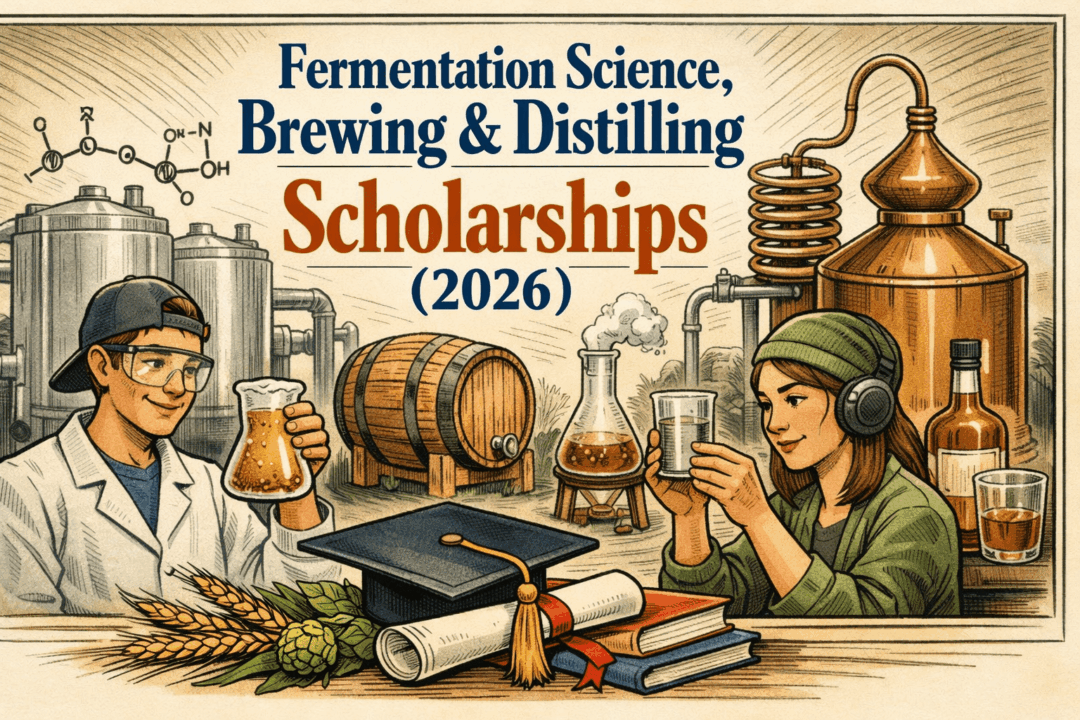
Fermentation Science, Brewing & Distilling Scholarships (2026) — 20+ Verified Awards with Deadlines
A hand-picked, link-verified list of scholarships and grants for fermentation science, brewing, and distilling students & pros. Sorted by deadline (Jan→Dec). Includes MBAA, ASBC, MJF, UC Davis, WOTVS, guild & university awards.
Master Brewers Association of the Americas (MBAA) — National Scholarships
💥 Why It Slaps: Multiple application windows; tuition support for recognized brewing courses.
💰 Amount: Tuition coverage (course-dependent).
⏰ Deadline: Jan 31, May 1, Aug 1 (annual cycles)
🔗 Apply/info: https://www.mbaa.com/scholarships
ASEV Presidents’ Award in Enology & Viticulture (Fermentation-relevant)
💥 Why It Slaps: Prestigious wine/fermentation science award—fits many fermentation tracks.
💰 Amount: Varies.
⏰ Deadline: Mar 1, 2025
🔗 Apply/info: https://www.asev.org/awards-lectures/scholarship-programs/
American Wine Society Educational Foundation (AWSEF) Scholarships (Enology/Viticulture)
💥 Why It Slaps: Multiple awards; strong fit for fermentation science students focusing on wine.
💰 Amount: $3,500–$5,000 typical.
⏰ Deadline: Mar 31, 2025
🔗 Apply/info: https://www.awsef.org/Scholarships
ASBC (American Society of Brewing Chemists) Foundation — Graduate Scholarship
💥 Why It Slaps: For research-oriented brewing chemists; great CV signal.
💰 Amount: Varies.
⏰ Deadline: Apr 1 (annual)
🔗 Apply/info: https://www.asbcnet.org/lab/foundation/Pages/GraduateScholarships.aspx
Hop Quality Group — Dan Martinez Jr. Memorial Scholarship
💥 Why It Slaps: Supports hop/brewing-focused students; easy, clear application.
💰 Amount: $1,000
⏰ Deadline: May 2, 2025
🔗 Apply/info: https://www.hopqualitygroup.com/scholarship
Michael James Jackson Foundation (MJF) — Brewing & Distilling Scholarships
💥 Why It Slaps: Full-ride technical education awards for BIPOC brewers/distillers; Siebel/IBD/UCD & more.
💰 Amount: Tuition + fees (program-dependent; often full-ride).
⏰ Deadline: May 30, 2025 (spring cohort) (multiple cohorts per year)
🔗 Apply/info: https://www.themjf.org/
WSWA Educational Foundation — General Scholarship (Bev-Alc Industry)
💥 Why It Slaps: Industry foundation support; flexible major if you’re in the bev-alc space.
💰 Amount: $4,000
⏰ Deadline: May 31, 2025
🔗 Apply/info: https://www.wswa.org/scholarships
New York State Brewers Association — College Scholarship
💥 Why It Slaps: Brewery-guild support for students (Hospitality/Tourism fits many fermentation careers).
💰 Amount: $1,000
⏰ Deadline: June 1 (annual)
🔗 Apply/info: https://nybeer.org/scholarship/
Women of the Vine & Spirits (WOTVS) Foundation — Scholarship Suite (incl. WSET Beer/Spirits)
💥 Why It Slaps: Multiple tracks (continuing ed + WSET incl. Beer & Spirits); strong for women & non-binary pros.
💰 Amount: $300–$8,500 (program-dependent; multiple awards).
⏰ Deadline: July 31, 2025
🔗 Apply/info: https://www.wotvsfoundation.org/scholarship-opportunities
MBAA — John Mallett Scholarship (travel + tuition)
💥 Why It Slaps: Named after a brewing legend; helps cover tuition plus travel to coursework.
💰 Amount: $1,200 travel stipend + tuition (course-dependent)
⏰ Deadline: Aug 1 (annual)
🔗 Apply/info: https://www.mbaa.com/scholarships/Pages/JohnMallett.aspx
Yakima Valley College — Vineyard & Winery Technology Program Scholarships
💥 Why It Slaps: Multiple campus awards tied to fermentation & production skills.
💰 Amount: $250–$2,000 (varies by term)
⏰ Deadlines: Aug 12, 2025 (Fall); Nov 24, 2025 (Winter)
🔗 Apply/info: https://yvcc.edu/news/academic-year/2025-2026/wine-scholarship-2025-2026.php
MBAA District Northwest — Brewing Scholarships
💥 Why It Slaps: District-level help for PNW brewers; practical education focus.
💰 Amount: Varies by course (tuition support).
⏰ Application Window: May 1 – Sep 5 (annual)
🔗 Apply/info: https://www.mbaa.com/districts/Northwest/Pages/District-Scholarships.aspx
MBAA District Michigan — Scholarships
💥 Why It Slaps: Local support; often tied to brewing short courses & certifications.
💰 Amount: Varies.
⏰ Application Window: Apr – Sep 30 (annual)
🔗 Apply/info: https://mbaa.com/districts/Michigan/Pages/scholarships.aspx
Pink Boots Society — Fort Collins Chapter (PBS Conference Scholarships)
💥 Why It Slaps: Covers registration + up to $1,500 travel for PBS Conference—killer networking & education.
💰 Amount: $275 + up to $1,500 travel
⏰ Deadline: Oct 31, 2025
🔗 Apply/info: https://www.pinkbootssociety.org/chapter-scholarships
Pink Boots Society — Kansas City Chapter (PBS Conference Scholarships)
💥 Why It Slaps: Same great package for KC members; conference elevates careers.
💰 Amount: $275 + up to $1,500 travel
⏰ Deadline: Nov 1, 2025
🔗 Apply/info: https://www.pinkbootssociety.org/chapter-scholarships
Glen Hay Falconer Foundation — American Brewers Guild (ABG) Scholarship
💥 Why It Slaps: Full tuition to ABG’s Intensive Brewing Science & Engineering program.
💰 Amount: Full tuition
⏰ Deadline: Nov 7, 2025
🔗 Apply/info: https://www.abgbrew.com/index.php/admissions/scholarships/falconer
Point Park University — Brewing Science Academy (Pittsburgh) Scholarships
💥 Why It Slaps: Six full-tuition scholarships to an industry-taught academy; great for career changers.
💰 Amount: Full tuition (6 awards)
⏰ Deadline: Rolling for 2025 cohort (apply ASAP)
🔗 Apply/info: https://www.pointpark.edu/academics/schools/continuingandprofessionalstudies/brewingscience/scholarship-application
UC Davis — Tapping Potential Fund (Master Brewers Certificate, full-ride)
💥 Why It Slaps: Diversity-focused full-ride to UC Davis’ Master Brewers Certificate (online + in-person bootcamp).
💰 Amount: Full ride (fees/materials + bootcamp)
⏰ Deadline: Typically opens fall; 2025 cycle TBA
🔗 Apply/info: https://cpe.ucdavis.edu/student-services/scholarships/brewing/tapping-potential
UC Davis — Mark E. Ruedrich North Coast Brewing Diversity Scholarship
💥 Why It Slaps: Endowed fund expanding access to UC Davis Master Brewers Certificate.
💰 Amount: Scholarship support (varies)
⏰ Deadline: Varies (announced by UC Davis CPE)
🔗 Apply/info: https://cpe.ucdavis.edu/student-services/scholarships/brewing/northcoast
UC Davis — Bay Area Brewers Guild Diversity Scholarship (brewing courses & certificate)
💥 Why It Slaps: Guild-funded access to UC Davis brewing courses/certificates.
💰 Amount: Scholarship support (varies)
⏰ Deadline: Varies (announced by UC Davis CPE)
🔗 Apply/info: https://cpe.ucdavis.edu/student-services/scholarships/brewing/babg
Colorado State University (CSU) — Molson Coors Brewing Change Scholarship (FST major)
💥 Why It Slaps: Targets fermentation & food science majors; DEI focus.
💰 Amount: Varies
⏰ Deadline: Via CSU AcademicWorks (annual cycle; typically spring)
🔗 Apply/info: https://colostate.academicworks.com/opportunities/59732
Glen Hay Falconer Foundation — Siebel/WBA Brewing Scholarships
💥 Why It Slaps: Two full-tuition Siebel/World Brewing Academy scholarships + travel/lodging stipend.
💰 Amount: Full tuition + travel/lodging stipend
⏰ Deadline: TBA (2025 cycle offered; follow page for 2026 dates)
🔗 Apply/info: https://www.siebelinstitute.com/about-us/studying-at-siebel/scholarships/glen-hay-falconer-foundation-brewing-scholarship
University of Louisville (Online Distilled Spirits Business Certificate) — KDA Scholar Program + BGCF Diversity in KY Distilling
💥 Why It Slaps: Distilling-specific scholarships through KDA & Blue Grass Community Foundation.
💰 Amount: Varies; includes full-tuition awards in some years
⏰ Deadline: Varies by fund; BGCF general 2026 cycle opens Dec 15, 2025; due Mar 6, 2026
🔗 Apply/info: https://business.louisville.edu/learnmore/onlinespirits/
Illinois Craft Brewers Guild — Diversity in Brewing Scholarship (Siebel/WBA courses)
💥 Why It Slaps: Guild-backed, course-specific scholarships for aspiring/working brewers in IL.
💰 Amount: Full course tuition (varies by course)
⏰ Deadline: Opens annually in fall (check current cycle)
🔗 Apply/info: https://www.illinoisbeer.org/diversity.html
Chartered Institute of Brewers & Distillers (CIBD/IBD) — Distilling Bursaries & Scholarships (incl. Worshipful Company of Distillers)
💥 Why It Slaps: Financial support for General Certificate/Diploma/Master in Distilling.
💰 Amount: Varies; multiple bursaries + annual scholarship
⏰ Deadline: Jan 31, 2026 (for 2026 exam cycle)
🔗 Apply/info: https://www.cibd.org.uk/support/financial-support/the-worshipful-company-of-distillers-scholarship-and-bursaries/
Fermentation Science, Brewing & Distilling Scholarships: Talent Pipeline, Credential Economics, and Equity Design (2026)
Fermentation science sits at a rare intersection of biology, chemistry, process engineering, sensory science, and regulated consumer manufacturing. In the U.S., the craft beer sector alone counted 9,736 small and independent breweries in 2024 and was associated with ~460,000 jobs and $77.1B in economic impact, even amid slower growth. Craft spirits, meanwhile, recorded 12.7 million 9L cases and $7.58B in sales in 2024, while reporting 28,628 full-time domestic employees and a more challenging environment. Against this backdrop, scholarships in brewing/distilling do not behave like typical STEM scholarships (which often underwrite multi-year tuition). Instead, the ecosystem strongly favors micro-credentials, short courses, and conference/certification funding, with a smaller set of high-impact awards underwriting degree pathways and leadership development.
This research paper constructs a “credential economics” lens for fermentation education, compiles a cross-section of publicly documented scholarship values, and evaluates how scholarship design can improve (1) workforce readiness, (2) retention in a high-burnout production environment, and (3) equity in an industry historically shaped by demographic exclusion. The paper closes with implementable recommendations for students and scholarship funders to maximize learning ROI and reduce pipeline leakage.
1. Introduction: Why fermentation scholarships are structurally different
Unlike many majors where professionalization is anchored to licensure (nursing), board exams (accounting), or a single degree norm (engineering), fermentation careers are modular: people assemble competence through stacked credentials—quality lab skills, sensory calibration, safety/regulatory compliance, packaging operations, yeast management, and increasingly, product innovation for non-alcohol/low-alcohol beverages.
This modularity is not merely cultural; it is economic. Brewing and distilling operate inside capital-intensive facilities where errors are expensive (contamination, off-flavors, yield loss, safety incidents). The fastest way to upgrade performance is often targeted training rather than a full degree. Scholarship markets follow that logic: many awards fund course seats, exam fees, conference registration, or travel stipends rather than semester tuition.
At the same time, fermentation science is also a legitimate research discipline—industrial microbiology, biochemical engineering, analytical chemistry, and sensory psychophysics—creating a two-track education pipeline:
-
Production & operations (applied trade-STEM)
-
R&D / QA / product science (laboratory & engineering-leaning STEM)
Scholarships are one of the few instruments that can bridge these tracks, enabling a cellar worker to gain lab credentials, or a food science student to access industry-recognized brewing/distilling training that employers actually reward.
2. Data and method: building a “scholarship value” snapshot
Because brewing/distilling scholarships are dispersed across associations, corporate funds, and nonprofits, there is no single authoritative registry. This paper uses a documented-value sampling approach: publicly listed scholarship awards and ranges from leading industry nonprofits and corporate initiatives, combined with sector labor/economic indicators from government and trade sources.
2.1 Scholarship value sample (documented awards)
Examples of documented scholarship values include:
-
Pink Boots Society scholarships for training/certifications with published values such as $199, $295, $329, $679, and $1,099, alongside opportunities that include a $1,000 travel stipend (e.g., education trips).
-
Women of the Vine & Spirits Foundation scholarship opportunities with awards such as up to $2,000 and WSET-related scholarships ranging $300–$8,500.
-
Yuengling + Pink Boots Society scholarship communications describing awards up to $10,000 (program windows vary by year).
-
Tenth & Blake (Molson Coors) brewing education scholarship model describing $10,000 scholarships tied to underrepresented students and paired with paid internships.
-
Regional nonprofit models (e.g., Fermenta) that explicitly fund continuing education across beer, spirits, mead, wine, kombucha, and cider categories (values vary by opportunity).
Using the scholarship values visible above (where explicit dollar values are published), a small illustrative sample (n=13) shows a distribution shaped by micro-credentials: the median award in this sample is $679, while the micro-credential subset (Pink Boots values shown) has a median of ~$357 (calculations from published values).
Interpretation: most scholarship dollars are engineered to remove friction for short, high-signal credentials, while a smaller number of awards tackle tuition-scale costs.
2.2 Labor and economic context sources
To link scholarship design to workforce outcomes, this paper uses:
-
BLS earnings benchmarks for food science careers (food scientists/technologists median $85,310, May 2024).
-
BLS earnings and employment benchmarks for production roles that overlap brewing/distilling operations (food batchmakers mean wage $40,890; employment 169,190, May 2024).
-
Craft beer macro indicators (breweries count, jobs, economic impact).
-
Craft spirits performance and employment indicators (sales, jobs) and craft distiller counts (method-defined “active craft distillers”).
-
Broader spirits-industry scale indicators (distilleries count, jobs supported, economic contribution).
3. Industry demand: the pipeline problem is not “interest,” it’s volatility and skills mismatch
3.1 Craft beer: a mature market still requiring innovation
Craft beer is no longer in its expansionary “open a taproom and win” era. Yet the sector’s footprint remains large: 9,736 small and independent breweries in operation (2024), with 335 openings and 399 closings tracked that year, plus ~460,000 jobs and $77.1B in economic impact. A key strategic signal is product diversification: non-alcohol beer scan dollars were reported up 30%+ year-over-year (Jan–Oct).
Implication for scholarships: funding that upgrades technical control (fermentation management, sensory QA, packaging DO control, micro testing) becomes more valuable in a “fight for repeat purchase” market.
3.2 Craft spirits: contraction pressure and the need for market-ready talent
Craft spirits data reported 12.7M cases and $7.58B in 2024 sales, alongside a decline in employment to 28,628 full-time domestic employees. The count of active craft distillers was reported as 2,282 as of Aug 2025 (noting methodology changes and a challenging environment).
At the broader scale, the distilled spirits industry is described as supporting ~1.7M U.S. jobs, contributing $200B to the U.S. economy, and including 3,100+ distilleries nationwide.
Implication for scholarships: distilling scholarships need to emphasize “market access” competencies (compliance, quality consistency, cost control, RTD formulation stability), not just craft romanticism.
4. Credential economics: what scholarships are really purchasing
A useful way to understand fermentation scholarships is to treat them as purchases of risk reduction for both students and employers.
4.1 Micro-credential scholarships buy “capability spikes”
Many prominent programs publish values in the $199–$1,099 range for online courses/certifications (e.g., Cicerone- and WSET-aligned training) and may add travel support for immersive training.
These awards are small compared to university tuition, but they can be high leverage because they:
-
Provide recognized signals (certifications) in hiring and promotion decisions
-
Improve sensory vocabulary and calibration, reducing QA disputes
-
Increase retention by giving frontline staff a visible growth pathway
4.2 Tuition-scale scholarships buy “mobility” (who gets to enter the field)
Equity-oriented funds have begun underwriting degree pathways:
-
Corporate scholarship models describe $10,000 awards and structured internships for underrepresented students in fermentation/brewing education.
-
Brewery-affiliated scholarships have been communicated at up to $10,000 for women in brewing education/leadership development (varies by year/window).
-
Women of the Vine & Spirits opportunities include WSET scholarships $300–$8,500 and additional awards up to $2,000.
These larger awards shift the talent pipeline because they enable:
-
Enrollment in tuition-bearing programs
-
Reduced reliance on unpaid labor or “work two jobs while studying” pathways
-
Greater access to networks (internships, mentorship, conference attendance) that often function as the real gatekeepers
5. Equity design: scholarships as corrective infrastructure
Fermentation industries have well-documented inclusion gaps. Scholarship design can act as “corrective infrastructure” when it does three things simultaneously:
-
Pays for skills (human capital)
-
Pays for networks (social capital)
-
Pays for legitimacy signals (credential capital)
The strongest models explicitly couple funding with structured opportunity—for example, scholarship + paid internship. This matters because brewing/distilling is highly networked: a recommendation from a respected brewer/distiller, lab manager, or guild often substitutes for formal hiring pipelines.
Nonprofit designs also matter. Regional and identity-based nonprofits frequently fund continuing education across beverage categories (beer/spirits/mead/cider/wine/kombucha), reflecting the reality that career mobility often occurs by moving across segments.
6. Strategy model for applicants: how to “stack” brewing/distilling scholarships like a scientist
6.1 The three-layer stack
Layer A: Skill credential (fast)
Target scholarships in the $200–$1,100 range for courses that close immediate gaps (sensory, off-flavors, beer/spirit fundamentals, WSET/Cicerone ladders).
Layer B: Proof of practice (portfolio)
Pair credentials with measurable outputs:
-
fermentation logs (gravity/pH/temp curves)
-
contamination troubleshooting case studies
-
SOP rewrites (CIP, sensory panel forms)
-
small R&D trials (yeast strain comparisons)
Layer C: Mobility funding (slower, high impact)
Apply for tuition-scale awards ($2,000–$10,000+) and those tied to internships, which convert education into employability.
6.2 Timing: scholarship calendars behave like industry seasons
Some scholarship cycles explicitly cluster by quarter; for example, Pink Boots notes Q1 scholarships opening the week of January 5 and lists application windows such as Jan 2–Feb 20 for a 2026 program.
Practical implication: build a “Q4 prep → Q1 submit” workflow (resume refresh, employer letter templates, project summaries, budget justification).
7. Policy and workforce implications: aligning scholarships with modern fermentation realities
7.1 The “quality systems” gap
As markets mature, differentiation shifts from novelty to consistency. Scholarships should increasingly prioritize:
-
microbiology and QC (plating, PCR basics, ATP hygiene monitoring)
-
sensory panel leadership
-
packaging oxygen control and shelf-stability
-
HACCP / preventive controls literacy
This is also where wage mobility lives. A worker moving from production to QA/QC moves closer to the earnings profile seen in food science roles (median $85,310 for food scientists/technologists).
7.2 The “operations reality” gap
Many entrants romanticize brewing/distilling but underestimate shift work, physical demands, and cleaning labor. Linking scholarships to:
-
safety training
-
management/leadership credentials
-
retention supports (mentorship, cohort models)
is not soft—it is economically rational. Production-adjacent roles in the broader food processing cluster show materially lower pay (food batchmakers mean wage $40,890). Scholarships can function as a lever to move candidates toward higher-skill, higher-stability roles.
8. Recommendations for scholarship funders and educators
8.1 Build “laddered scholarships,” not one-offs
Offer a sequence: beginner course → intermediate credential → capstone (conference + presentation). This mirrors how competency is built in fermentation.
8.2 Fund outcomes, not attendance
Require deliverables: SOP improvement, sensory panel plan, QA dashboard, or a small R&D report. This increases the ROI narrative funders can defend.
8.3 Pair money with placement
The internship-linked model is unusually powerful because it purchases both skill and network access.
8.4 Treat diversity funding as a competitiveness strategy
In slow-growth markets, the edge comes from operational excellence and product innovation. Scholarship-driven inclusion expands the idea pool and improves talent match.
Conclusion
Fermentation science scholarships are best understood as an engineering solution to a pipeline problem: they reduce risk, accelerate competence, and widen access in industries facing mature-market pressures and skills-intensive production demands. The data show two dominant scholarship “shapes”: (1) micro-credential funding that removes friction for high-signal training (often a few hundred dollars), and (2) tuition-scale/internship-linked awards ($2,000–$10,000+) that change who gets to enter and advance.
With craft beer still supporting large employment and economic impact and craft spirits navigating contraction pressures , the next generation of scholarships should increasingly reward quality systems, sensory/analytical rigor, leadership capacity, and real deliverables. For students, the winning strategy is a stack: credential → portfolio → mobility funding, executed on the scholarship calendar with the discipline of a lab notebook.
FAQs — Fermentation Science / Brewing & Distilling
1) Who’s eligible for these scholarships?
Most target students in fermentation science, brewing, distilling, enology/viticulture, or closely related majors (food science, microbiology, chemical engineering). Many also support early-career pros seeking certificates (e.g., IBD, Siebel/WBA) or short courses.
2) I don’t have a “fermentation science” major at my school—am I still competitive?
Yes. Apply under allied majors (Food Science, Microbiology, ChemE, Biochem, Ag Science) and use your essay to show a tight fit: coursework, lab work, capstones, and internships tied to fermentation, QA/QC, or process engineering.
3) Are international students eligible?
Varies by funder. University-tied awards often follow campus rules; professional bodies (brewing/distilling institutes, guilds) may accept global applicants. Always check residency/citizenship requirements and whether funds can be used at your institution.
4) Do I need to be 21+?
Scholarships rarely require it; programs involving alcoholic beverages might restrict certain hands-on or sensory activities to 21+. If under 21, lean on QA/QC, microbiology, fermentation kinetics, and non-alcohol ferments (dairy, bread, kombucha) to demonstrate skill.
5) Can part-time or online students apply?
Often yes, especially for certificate/continuing-ed awards. Some degree-seeking scholarships require full-time status—read the fine print and your school’s Cost of Attendance (COA) policy.
6) What application materials should I prepare?
A focused resume (lab/production hours, CIP/HACCP/GMP familiarity), unofficial transcripts, 1–2 recommendations (professor, head brewer/distiller, QA manager), and a statement of purpose mapped to the funder’s mission.
7) How do I make my personal statement pop for brewing/distilling?
Show measurable impact and process thinking: yield losses you reduced, sensory triangles you ran, dissolved oxygen or diacetyl data you improved, water/energy savings, safety wins, or a pilot recipe taken from grain-to-glass with QC checkpoints.
8) What counts as “experience” if I haven’t worked in a brewery/distillery yet?
Campus labs, capstones, co-ops, home/pilot-scale projects (within legal limits), fermentation club leadership, sensory panels, yeast propagation experiments, or internships at maltsters/hop or barrel suppliers all count.
9) Are awards stackable with financial aid?
Usually, yes—up to your school’s COA. Scholarships may reduce need-based aid first; coordinate with your financial-aid office to avoid surprises.
10) Are scholarships taxable?
Generally, amounts used for qualified tuition/fees/books for degree candidates are often not taxed; funds for travel/room/board typically are. Keep award letters/receipts and consult a tax professional—rules vary.
11) Can funds cover travel, lodging, or conferences?
Some awards are tuition-only; others explicitly include travel/lodging or a stipend. If not stated, ask the funder before applying.
12) Do I need specific certifications (e.g., IBD exams, WSET Spirits, Cicerone)?
Not required by most scholarships, but they’re strong signal boosters—especially if your goal is production, QA/QC, or sensory.
13) How competitive are guild/district scholarships (MBAA, state guilds, Pink Boots, etc.)?
They’re reachable with a targeted application: engage locally (meetings, brew-days, sensory panels), document contributions, and secure a recommendation from an active member when possible.
14) I’m focusing on distilling—are wine or beer scholarships still relevant?
Many fermentation-adjacent funds welcome distilling students if your proposal highlights transferable science (yeast management, fermentation kinetics, QC, safety, compliance).
15) What if my program is outside the U.S.?
Professional-body scholarships may be portable; university-specific awards may not. Confirm portability, currency/tuition handling, and bank/fee issues ahead of time.
16) Do high school seniors have options?
A few do (especially university-tied funds). Most awards prefer enrolled or admitted students—use your essay to show concrete plans (courses, labs, clubs, internships) starting in your first term.
17) Can industry professionals without a degree apply?
Yes—many certificate and continuing-education scholarships are built for working pros. Document your on-the-floor learning (cellar, packaging, QA, maintenance) and show how the course elevates your role.
18) How far in advance should I apply?
Aim 6–8 weeks before posted deadlines. Some programs batch review; others fund on a rolling basis until seats fill.
19) What’s a quick application checklist?
- Resume with fermentation/QA bullets (metrics!)
- Unofficial transcript (or proof of admission/enrollment)
- 1–2 recommendations (industry + faculty ideal)
- Statement showing mission fit + measurable impact
- Budget/use-of-funds plan if travel/lodging allowed
20) Any essay angles that resonate?
Safety culture (CO₂/pressure/chemical handling), sustainability (water, heat, packaging waste), accessibility/DEI, local agriculture supply chains, and data-driven QC stories. Tie your goals to the funder’s community or workforce pipeline.