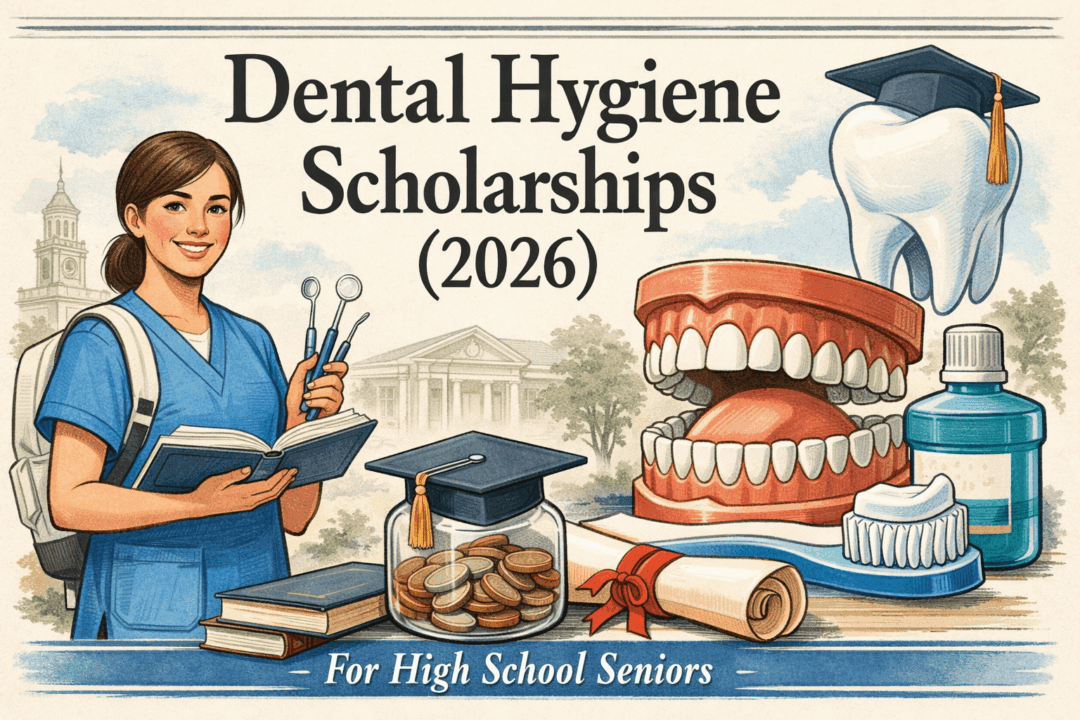
25+ Best Dental Hygiene Scholarships (2026) — Deadlines, Amounts, Verified Links
The most accurate, up-to-date list of scholarships and grants for dental hygiene students (AS, BS, BSDH, MSDH). Sorted by deadline with verified apply links.
January
ADHA IOH — Dr. Esther Wilkins Scholarship
💥 Why It Slaps: Flagship ADHA award for standout undergrads in dental hygiene.
💰 Amount: Minimum $2,000
⏰ Deadline: Jan 31 (most recent cycle closed Jan 31, 2025; next cycle opens Dec 1, 2025)
🔗 Apply/info: https://www.adha.org/foundation/scholarships/bachelors-level-scholarships/ — ✅ Link verified Sep 24, 2025.
ADHA IOH — Crest Oral-B Laboratories Dental Hygiene Scholarship
💥 Why It Slaps: Backed by a major oral-care brand; recognizes excellence in DH education pathways.
💰 Amount: Minimum $1,000
⏰ Deadline: Jan 31 (next cycle opens Dec 1, 2025)
🔗 Apply/info: https://www.adha.org/foundation/scholarships/bachelors-level-scholarships/ — ✅ Link verified Sep 24, 2025.
ADHA IOH — Karla Girts Memorial Community Outreach Scholarship
💥 Why It Slaps: Rewards real community impact with seniors/geriatric care.
💰 Amount: Minimum $2,000
⏰ Deadline: Jan 31 (next cycle opens Dec 1, 2025)
🔗 Apply/info: https://www.adha.org/foundation/scholarships/bachelors-level-scholarships/ — ✅ Link verified Sep 24, 2025.
ADHA IOH — Wilma E. Motley Undergraduate Scholarship
💥 Why It Slaps: Classic merit award for top DH undergrads.
💰 Amount: Minimum $1,000
⏰ Deadline: Jan 31 (next cycle opens Dec 1, 2025)
🔗 Apply/info: https://www.adha.org/foundation/scholarships/bachelors-level-scholarships/ — ✅ Link verified Sep 24, 2025.
ADHA IOH — HuFriedy Group / Esther Wilkins Instrument Scholarships
💥 Why It Slaps: Covers ~$1,000 in essential instruments—big savings on kits.
💰 Amount: $1,000 (instrument value)
⏰ Deadline: Jan 31 (next cycle opens Dec 1, 2025)
🔗 Apply/info: https://www.adha.org/foundation/scholarships/bachelors-level-scholarships/ — ✅ Link verified Sep 24, 2025.
ADHA IOH — Sigma Phi Alpha (SPA) Graduate Scholarship
💥 Why It Slaps: National honor-society recognition for grad-level DH scholars.
💰 Amount: Typically $2,000
⏰ Deadline: Jan 31 (next cycle opens Dec 1, 2025)
🔗 Apply/info: https://www.adha.org/foundation/scholarships/graduate-level-scholarships/ — ✅ Link verified Sep 24, 2025.
ADHA IOH — Dentsply Sirona Research Award (Graduate)
💥 Why It Slaps: Funds research-minded hygienists pushing the science forward.
💰 Amount: Typically $2,000
⏰ Deadline: Jan 31 (next cycle opens Dec 1, 2025)
🔗 Apply/info: https://www.adha.org/foundation/scholarships/graduate-level-scholarships/ — ✅ Link verified Sep 24, 2025.
ADHA IOH — Colgate Bright Smiles, Bright Futures Scholarship (Graduate)
💥 Why It Slaps: Newer award supporting community-focused DH leaders.
💰 Amount: Up to $3,000
⏰ Deadline: Jan 31 (next cycle opens Dec 1, 2025)
🔗 Apply/info: https://www.adha.org/foundation/scholarships/graduate-level-scholarships/ — ✅ Link verified Sep 24, 2025.
ADHA IOH — Alice Hinchcliffe Williams Scholarship (Virginia)
💥 Why It Slaps: Long-running fund honoring service and leadership, open via ADHA IOH.
💰 Amount: Varies (commonly ~$2,000)
⏰ Deadline: Jan 31 (next cycle opens Dec 1, 2025)
🔗 Apply/info: https://www.adha.org/foundation/scholarships/graduate-level-scholarships/ — ✅ Link verified Sep 24, 2025.
WDHA — Lona Hulbush Jacobs Memorial Scholarship (WA)
💥 Why It Slaps: $1,000 for first-year DH students; clear, student-friendly process.
💰 Amount: $1,000
⏰ Deadline: Last Friday in January (annual; via WDHA)
🔗 Apply/info: https://wsdha.com/index.php?category=Main&ref=grants&src=gendocs — ✅ Link verified Sep 24, 2025.
April
WDHA & Dental Connections Dental Hygiene Scholarship (WA)
💥 Why It Slaps: Solid state-association award targeted to students finishing year one.
💰 Amount: $1,000
⏰ Deadline: First Friday in April (annual)
🔗 Apply/info: https://wsdha.com/index.php?category=Main&ref=grants&src=gendocs — ✅ Link verified Sep 24, 2025.
CDHA Foundation — Cora Ueland Scholarships (CA)
💥 Why It Slaps: 4 awards—two for 1st-years and two for 2nd-years; second-year winners get CDHA new-pro membership.
💰 Amount: $1,500 (four awards)
⏰ Deadline: April 13, 2025
🔗 Apply/info: https://cdha.org/About/CDHA-Foundation/Cora-Ueland-Scholarship — ✅ Link verified Sep 24, 2025.
Delta Dental Foundation — Dental Hygiene Scholarships (MI/OH/IN)
💥 Why It Slaps: Regional foundation support for accredited DH programs in MI/OH/IN.
💰 Amount: Varies (multiple awards)
⏰ Deadline: April 30, 2025 (2025 window ran Feb 11–Apr 30)
🔗 Apply/info: https://www.deltadental.foundation/dental-scholarships-awards — ✅ Link verified Sep 24, 2025.
May
Native Hawaiian Health Scholarship Program (NHHSP)
💥 Why It Slaps: Tuition + stipend in exchange for service in Native Hawaiian communities; DH is eligible.
💰 Amount: Tuition & stipend (varies by program)
⏰ Deadline: May 12, 2025 (2025 cycle) Facebook
🔗 Apply/info: https://www.papaolalokahi.org/program/nhhsp— ✅ Link verified Sep 24, 2025.
National Dental Hygienists’ Association (NDHA) Scholarships
💥 Why It Slaps: Supports underrepresented DH students; national recognition.
💰 Amount: Varies
⏰ Deadline: May 31 (apps accepted Mar 1–May 31, annually)
🔗 Apply/info: https://www.ndhaonline.org/scholarships — ✅ Link verified Sep 24, 2025.
September
ADEA/Haleon Dental Hygiene Scholarship
💥 Why It Slaps: Brand-new ADEA award championing inclusivity & community health.
💰 Amount: $2,500 (one award)
⏰ Deadline: Sept 15, 2025 (ADEA noted extension to Sept 22 for 2025)
🔗 Apply/info: https://www.adea.org/home/education/ADEA-Scholarships-Awards-and-Fellowships/for-students/adea-haleon-dental-hygiene-scholarship — ✅ Link verified Sep 24, 2025.
ADEA/Crest Oral-B Scholarships for DH Students Pursuing Academic Careers
💥 Why It Slaps: Premier national award for future DH faculty.
💰 Amount: $3,000 (two awards)
⏰ Deadline: Sept 15, 2025 (ADEA listed an extension window for 2025)
🔗 Apply/info: https://www.adea.org/home/education/ADEA-Scholarships-Awards-and-Fellowships/for-students/adea-crest-oral-b-scholarships-for-dental-hygiene-students-pursuing-academic-careers — ✅ Link verified Sep 24, 2025.
ADEA/MouthWatch Patti DiGangi Scholarship for Dental Hygiene Innovation
💥 Why It Slaps: Celebrates leadership & innovation (AS, BS, MS all eligible).
💰 Amount: $1,000
⏰ Deadline: Sept 15, 2025 (ADEA listed an extension window for 2025)
🔗 Apply/info: https://www.adea.org/home/education/ADEA-Scholarships-Awards-and-Fellowships/for-students/mouthwatch-patti-digangi-scholarship-for-dental-hygiene-innovation — ✅ Link verified Sep 24, 2025.
Illinois DHA — Mary Denowh Scholarship (IL)
💥 Why It Slaps: State-association support; straightforward app.
💰 Amount: Varies
⏰ Deadline: Sept 21, 2025 (2025 cycle)
🔗 Apply/info: https://idha.wildapricot.org/students — ✅ Link verified Sep 24, 2025.
October
ODHA — Ohio Dental Hygienists’ Association Student Scholarships (OH)
💥 Why It Slaps: State-level funding tied to ODHA Annual Session.
💰 Amount: Varies
⏰ Deadline: Oct 1, 2025 (per ODHA announcement) Facebook
🔗 Apply/info: https://odha.net/ (see Students → Resources → Scholarships and Awards) — ✅ Link verified Sep 24, 2025.
CDHA Foundation — Diana Corley Scholarship (CA)
💥 Why It Slaps: $2,000 merit award for BSDH/degree-completion students.
💰 Amount: $2,000 (one award)
⏰ Deadline: Oct 20, 2025
🔗 Apply/info: https://cdha.org/About/CDHA-Foundation/Diana-Corley-Scholarship — ✅ Link verified Sep 24, 2025.
December
Georgia DHA — Student Scholarships (GA)
💥 Why It Slaps: Multiple student-focused awards; easy to navigate.
💰 Amount: Varies
⏰ Deadline: Dec 1, 2025
🔗 Apply/info: https://www.gafutures.org/hope-state-aid-programs/scholarships-grants/ — ✅ Link verified Sep 24, 2025.
Greater Fredericksburg DHS — Student Scholarship (VA)
💥 Why It Slaps: Local-component support with a clear December deadline.
💰 Amount: Varies
⏰ Deadline: Dec 1 (annual)
🔗 Apply/info: https://www.fredericksburgchamber.org/now-accepting-scholarship-applications-over-180000-in-scholarship-funding-available-through-the-community-foundation-of-the-rappahannock-river-region/ — ✅ Link verified Sep 24, 2025.
Rolling / Extra Opportunities (check dates each year)
ADHA IOH — Graduate-level Named Scholarships (multiple)
💥 Why It Slaps: One portal, several funds (e.g., Sigma Phi Alpha, Dentsply Sirona, state-named funds).
💰 Amount: Typically $2,000 each
⏰ Deadline: Historically Jan 31; next cycle opens Dec 1, 2025
🔗 Apply/info: https://www.adha.org/foundation/scholarships/graduate-level-scholarships/ — ✅ Link verified Sep 24, 2025.
Washington DHA — Future Leaders Award (WA)
💥 Why It Slaps: Recognizes student ADHA leaders; presented at WDHA spring symposium.
💰 Amount: Varies (leadership award)
⏰ Deadline: March 15 (annual)
🔗 Apply/info: https://wsdha.com/index.php?category=Main&ref=Scholarships&src=gendocs — ✅ Link verified Sep 24, 2025.
Financing the Preventive Oral-Health Workforce: Dental Hygiene Scholarships in the United States (2026)
Dental hygienists sit at the center of U.S. prevention-oriented oral health care, yet the pipeline into the profession is constrained by program capacity, unequal geographic access, and the high “front-loaded” costs of clinical training (equipment kits, licensure, and uncompensated clinical hours). This paper synthesizes current federal workforce data, oral-health disparity indicators, and the national scholarship ecosystem to evaluate how dental hygiene scholarships function as workforce policy instruments. Key findings include: (1) labor-market demand remains strong (median pay $94,260; ~15,300 annual openings projected), (2) access-to-care needs remain structurally high (7,443 dental HPSA designations affecting ~63.7 million people; rural areas comprise the majority of dental HPSAs), and (3) the scholarship market is fragmented, with many awards optimizing for merit/leadership signals rather than binding service in shortage areas. We propose a “capital stack” framework for funding dental hygiene education (tuition + equipment + living support + service incentives) and recommend program-design principles that better align scholarships with equity goals and shortage-area outcomes.
1. Introduction: Why Dental Hygiene Scholarships Matter as Workforce Policy
Oral health is a population-health issue as much as it is a clinical one: untreated dental disease is patterned by income, education, and geography. CDC indicators show that low-income adults experience substantially higher levels of untreated cavities; one CDC summary reports 40% of low-income adults aged 20–64 had untreated cavities, and among adults reporting unmet dental needs, 80% cite affordability as the barrier. These disparities map onto access constraints, especially in shortage areas and rural communities.
In this context, dental hygiene scholarships are not merely “student aid.” They are a lever that can:
-
expand entry into accredited programs,
-
reduce attrition from financial stress during clinical training, and
-
steer graduates toward high-need settings via service-linked incentives (loan repayment programs).
The central question is whether the current scholarship landscape is structured to meet the magnitude and geography of oral-health need—and if not, how it can be improved.
2. Methods and Data Sources
This analysis uses a desk-research synthesis of authoritative, publicly available sources and a structured scan of major scholarship providers serving dental hygiene students (professional associations, affinity organizations, corporate/foundation sponsors, and federal loan repayment). Core datasets and indicators include:
-
Labor-market outcomes from the U.S. Bureau of Labor Statistics (BLS) Occupational Outlook Handbook for dental hygienists (wages, projections, openings, work patterns).
-
Shortage-area burden from HRSA’s Designated HPSA Quarterly Summary (counts of dental HPSAs, population affected, practitioners needed; rural/non-rural breakdown).
-
Forward-looking workforce gaps from HRSA’s National Center for Health Workforce Analysis projections (2038 shortages for dental hygienists).
-
Education pipeline context from ADEA (program counts; gender composition).
-
Training-cost benchmarks from ADHA (“tuition and fees” estimates by degree level; plus examples of equipment/kit funding needs).
-
Scholarship ecosystem anchors from ADHA Foundation scholarship programming and timeline.
Rather than attempting an exhaustive national inventory of every local award, the scholarship scan focuses on “market makers”—programs that (a) recur annually, (b) operate at national or multi-state scale, and (c) signal how funding criteria shape workforce outcomes.
3. Labor-Market Demand and the Economic Case for Entry
3.1 Earnings, openings, and work structure
BLS reports a median annual wage of $94,260 (May 2024) for dental hygienists, with the bottom decile earning under $66,470 and the top decile above $120,060. BLS also notes that many dental hygienists work part time, often because dentists hire hygienists for limited days per week and some hygienists work for multiple practices.
Employment growth is projected at 7% from 2024–2034, “much faster than average,” with about 15,300 openings per year (including replacement needs). This matters for scholarship design: the “return on training investment” is strong, but the labor market is also segmented (full-time vs part-time, metropolitan vs rural, dentist-office vs public/clinical settings). Scholarships that ignore this segmentation risk funding students without addressing the areas of greatest unmet need.
3.2 Demand drivers relevant to scholarships
BLS explicitly ties demand growth to two drivers: (1) expanded access to preventive services and (2) state laws allowing hygienists to work “at the top of their training.” Even without adjudicating state-by-state scope changes, the policy direction is consistent: hygienists are increasingly positioned as prevention specialists whose productivity is central to both private practice throughput and community-based prevention strategies.
4. The Unmet-Need Backdrop: Shortage Areas and Disparities
4.1 The scale of dental shortage designations
HRSA’s quarterly summary (data as of 01/01/2026) reports 7,443 Dental HPSA designations, encompassing 63,700,964 people. The same report estimates 10,744 practitioners are needed to remove those dental shortage designations, and shows overall “percent of need met” of 32.93%.
Crucially, dental shortages are not evenly distributed. HRSA’s rural/non-rural classification indicates rural areas account for 4,885 dental HPSA designations (65.63%), with ~19.3 million people in rural dental HPSAs. This distribution is a direct critique of “place-neutral” scholarship models: if most shortage designations are rural, then scholarships designed without a geographic or service component will—by default—reinforce existing clustering in metro labor markets.
4.2 Disparities: affordability and untreated disease
CDC indicators help explain why workforce distribution matters. One CDC infographic reports that 40% of low-income adults had untreated cavities, and that 80% of adults reporting unmet dental need could not afford care. This is a financing problem (coverage, reimbursement, out-of-pocket costs) intertwined with a workforce-access problem (availability of dental teams and prevention services in high-need communities). Dental hygiene scholarships sit at the intersection: they can reduce the cost barrier for trainees and, when coupled to service incentives, partially mitigate access gaps.
5. Education Pipeline and Capacity Constraints
ADEA reports 327 entry-level dental hygiene programs, ~51 bachelor’s degree completion programs, and 17 master’s programs. It also reports that current enrollment is 94.7% women and 5.3% men.
This pipeline profile implies two scholarship-relevant realities:
-
Capacity is finite: entry-level programs are not ubiquitous, and clinical placements constrain growth. This makes scholarships more impactful when paired with supports that reduce attrition and enable completion (equipment, transportation, childcare, emergency microgrants).
-
Targeted recruitment can diversify the workforce: scholarships aimed at underrepresented groups (including men, and racial/ethnic groups historically underrepresented in oral-health professions) can alter who enters and where graduates practice—especially when tied to community-based service missions.
6. The Cost Structure of Dental Hygiene Training: Why “Tuition-Only” Aid Is Incomplete
ADHA (citing ADEA) provides benchmark “tuition and fees” expectations: $22,692 (associate), $36,382 (bachelor’s), and $30,421 (master’s). Even if these figures vary by state and institution, they establish the economic logic: relative to median earnings, tuition is often “payback feasible.” Yet many students experience hardship because the binding constraint is not only tuition—it is the timing and composition of costs.
6.1 The hidden “clinical capital” problem
Dental hygiene education is unusually equipment-intensive. Programs often require instrument kits and clinical supplies at the beginning of training. For example, one community-college program page lists an approximate $3,300 dental kit requirement. Another published cost sheet estimates a first-year instrument kit around $3,695 (plus additional second-year costs).
These costs are scholarship-relevant because they are:
-
Up-front (due before students can fully participate in clinic),
-
Non-deferrable (cannot be postponed without delaying progress), and
-
Not always fully covered by conventional tuition scholarships.
Thus, scholarships that explicitly cover equipment—and do so early—may have disproportionate impact on persistence.
7. Mapping the Dental Hygiene Scholarship Ecosystem
The scholarship market for dental hygiene can be conceptualized as four interacting segments:
7.1 Profession-led scholarships (the “anchor platform”)
The ADHA Foundation is a major national platform: it reports 17 different scholarships across degree levels and provides a defined annual cycle. For 2025–2026, ADHA lists applications open December 1, 2025 through February 28, 2026, with recipient selection in late spring.
This platform model matters because it standardizes application processes, bundles multiple awards, and can integrate industry sponsorship. ADHA’s scholarship listings and recipient categories (e.g., scholarships branded by corporate sponsors such as Crest + Oral-B) illustrate how profession-led infrastructure can serve as a marketplace for donors while reducing friction for students.
Design implication: profession-led platforms can improve efficiency, but unless award criteria explicitly incorporate shortage-area or equity metrics, they may primarily reward already-advantaged students (those with time for leadership activities, high GPAs, and strong mentorship networks).
7.2 Identity- and mission-based scholarships (equity pipeline tools)
Affinity organizations often structure scholarships around representation and community service.
-
The National Dental Hygienists’ Association (NDHA) advertises scholarship awards up to $4,000.
-
The Hispanic Dental Association Foundation notes scholarships up to $2,500 for dental hygiene students (with parallel awards for dental students).
These programs function as pipeline interventions: they address social capital gaps (mentorship, professional networks) in addition to funding. If scaled, they can influence both workforce diversity and community alignment—important given the persistent oral-health disparities by income and other social determinants.
7.3 Payer/corporate foundation scholarships (regional workforce investments)
Payers and regional foundations can treat scholarships as “workforce development” aligned with their service regions. A clear example is the Delta Dental Foundation (Michigan/Ohio/Indiana) program for hygienists, which includes scholarships and equipment funding. ADHA’s “Paying for School” page notes scholarships from $1,000 to $10,000 per year for students accepted to dental hygiene programs in those states, and up to $5,000 for instrument kits and other necessary equipment for students about to enter a program.
Design implication: regional payer/foundation models are unusually well-positioned to tie awards to local workforce needs (including rural gaps) because they operate within a defined geography and can partner with community colleges and safety-net clinics.
7.4 Service-linked loan repayment (the “back-end scholarship”)
For many hygienists, the largest “scholarship-like” benefit is not front-end tuition aid but post-graduation loan repayment conditioned on service in high-need sites.
-
HRSA’s NHSC Loan Repayment Program explicitly includes Dental Hygienists among eligible dental care disciplines.
-
For the 2025 NHSC loan repayment cycle, HRSA describes non-primary care awards (including dentists and dental hygienists) up to $55,000 full-time and $30,000 half-time, and includes a one-time Spanish-language proficiency enhancement to address language access barriers.
-
HRSA’s State Loan Repayment Program eligibility list includes RDH (Registered Dental Hygienist) as a discipline states may support.
Service-linked repayment has two advantages over conventional scholarships: it is explicitly shortage-area oriented (NHSC-approved sites in HPSAs) and it can be large enough to materially change where a hygienist chooses to practice.
8. A “Capital Stack” Framework for Funding Dental Hygiene Education
Because dental hygiene training has multiple binding constraints, a single scholarship rarely solves access. A more realistic approach is a capital stack, akin to project finance:
-
Tuition & fees (baseline aid)
-
Clinical capital (instruments, loupes, uniforms, immunizations, exam fees)
-
Living support (transportation, childcare, reduced work hours during clinic)
-
Completion incentives (microgrants for remediation, emergency expenses)
-
Service-linked repayment (NHSC/State LRP as a post-graduation “principal reduction” mechanism)
The strongest evidence for why the stack matters is the mismatch between tuition benchmarks and equipment realities: tuition may be manageable on paper (e.g., associate-level tuition/fees estimates) , but kit costs in the several-thousand-dollar range are immediate and can block entry or force high-interest borrowing.
9. Aligning Scholarships to Shortage-Area Outcomes: What’s Missing
Two macro indicators suggest misalignment risk:
-
The shortage-area burden is massive (63.7 million people in dental HPSAs; 10,744 practitioners needed to remove designations).
-
HRSA projects a 2038 shortage of 33,220 dental hygienists (FTE).
Yet many scholarships remain non-binding (no service requirement) and place-neutral (no shortage-area targeting). From an economic standpoint, this is a classic externality: scholarships generate private returns for recipients (higher earnings, mobility) but do not necessarily generate public returns where need is greatest (rural HPSAs, safety-net clinics). This does not mean all scholarships should require service; rather, it argues for portfolio design: a mix of merit awards and explicitly shortage-linked awards, with transparent reporting on outcomes.
10. Recommendations
10.1 For scholarship providers (foundations, associations, corporate sponsors)
-
Fund the clinical bottleneck early: create “equipment-first” awards disbursed before the first clinical term, indexed to typical kit costs documented by programs.
-
Add a shortage-area track: dedicate a portion of awards to recipients who commit to work in HPSA-linked settings, with mentorship and placement support (modeled on the logic of NHSC).
-
Measure outcomes: publish annual metrics (retention, graduation, first job setting, rural practice share). Without these, scholarships cannot be evaluated as workforce tools.
10.2 For students (how to strategically finance a dental hygiene degree)
-
Treat funding as a stack: combine association scholarships (e.g., ADHA Foundation’s annual cycle) with regional payer/foundation awards and equipment funds where eligible.
-
Plan for the “hidden” line items: instruments and fees can be decisive; build a budget that includes them explicitly.
-
Evaluate service-based repayment early: if you expect to borrow, NHSC and State LRP pathways can be financially transformative and align with public service.
10.3 For policymakers and workforce planners
-
Expand service-linked funding: given rural dominance among dental HPSAs, scaling NHSC/SLRP-like incentives for hygienists is a direct response to documented need.
-
Support program capacity: scholarships increase demand for seats; without investments in faculty and clinical sites, funding alone cannot expand supply at the scale projected.
Conclusion
Dental hygiene scholarships should be analyzed as a component of U.S. oral-health workforce policy. The data show a strong labor-market return (median pay near $94k; robust openings) , a persistent access crisis (7,443 dental HPSA designations affecting 63.7 million people, with rural areas comprising the majority) , and projections of substantial future hygienist shortages.
The core insight is structural: the binding constraints for dental hygiene students are often “clinical capital” and time, not only tuition. Scholarships that fund equipment up front, provide living supports during clinical intensives, and connect recipients to shortage-area service incentives are more likely to produce measurable public-health returns. A capital-stack approach—integrating profession-led scholarships, mission-based awards, regional foundation programs, and federal/state loan repayment—offers the most credible pathway to aligning student success with national oral-health needs.
FAQs — Dental Hygiene Scholarships (read this before you apply)
1) Who’s usually eligible for dental hygiene scholarships?
Most awards require you to be accepted to or enrolled in a CODA-accredited dental hygiene program (AS/AAS, BS/BSDH, degree-completion, or MS). Some are state-restricted (residency or school location). Always confirm program level and enrollment status requirements.
2) Do pre-DH or pre-req students qualify?
Sometimes. A few awards allow applicants who’ve been formally accepted into a DH cohort but haven’t started clinic yet. If you’re only taking general ed pre-reqs with no program acceptance, options are limited—prioritize school/college-wide scholarships.
3) Is ADHA or state association membership required?
Many ADHA IOH and state association funds favor (or require) student membership and engagement (local component, volunteering, leadership). If your budget is tight, ask your program if they cover student dues.
4) What GPA do I need?
Common floors are 3.0–3.3 for merit awards; need-based awards may be lower but still expect satisfactory academic progress. If your GPA dipped due to life circumstances, write a short context note and show an upward trend.
5) Are part-time or returning/career-change students eligible?
Plenty are. Read for language like “non-traditional,” “re-entry,” or “degree completion.” If the application says “full-time required,” don’t assume exceptions—email the listed contact to confirm.
6) I’m in an online or out-of-state program—does that matter?
State association and regional foundation awards often tie eligibility to residency or school location. Online programs can still qualify if your home address meets the residency rule.
7) Can DACA/undocumented or international students apply?
Some private foundations do allow it; others require U.S. citizenship or permanent residency. Filter for “no citizenship requirement” in the criteria, and look closely at payment logistics (some fund directly to your school account).
8) What counts as “community service” for DH awards?
Screensings at school-based clinics, sealant or fluoride varnish events, mobile/van clinics, elder-care outreach, care for rural/underserved communities, special-needs clinics, tobacco cessation education, and oral-health curriculum you developed.
9) What makes a winning essay for DH scholarships?
Tell one strong story using ADPIED (Assessment, Diagnosis, Planning, Implementation, Evaluation, Documentation): what need you assessed, what you did, what changed, and your measurable impact (e.g., “screened 86 kids; 41 received sealants; 72% improved OHI scores at 3-mo follow-up”). Tie it to your future practice goals.
10) What documents should I prepare in advance?
A “scholarship pack”: unofficial transcript, proof of enrollment/acceptance, ADHA ID (if applicable), resume/CV, brag sheet (bullets your achievements and hours), one polished 500–750-word essay you can tailor, and 2 recommenders with emails ready.
11) How early should I ask for recommendation letters?
3–4 weeks ahead. Share your brag sheet + the prompt + hard deadline + a gentle reminder plan (1 week out, then 48 hours out). Offer talking points about your chairside skills, infection control, teamwork, and community impact.
12) Can I stack multiple scholarships?
Usually yes. Watch for “may not be combined with” language, enrollment minimums, and whether funds pay to your student account (may reduce need-based aid) vs directly to you.
13) Are scholarships taxable?
Generally not taxable if used for qualified expenses (tuition, required fees, books, supplies) and not compensation for services. Stipends or service-obligation payments can be different. This is not tax advice—check your school’s financial office or a tax pro.
14) What’s a service-obligation award and should I do it?
Programs that pay tuition/stipend in exchange for post-graduation service in designated communities. If you leave early or don’t complete the service, funds can convert to a repayable obligation. Accept only if you’re confident about the commitment.
15) Do I need the FAFSA for DH scholarships?
For need-based awards—often yes (or school’s equivalent). Even if you think you won’t qualify, filing the FAFSA can unlock institutional funds and emergency grants.
16) My program costs include expensive instruments. Are there tool-kit scholarships?
Yes—look for instrument scholarships or awards that explicitly allow required supplies. Keep itemized receipts so you can document purchases if the donor asks.
17) Any quick wins to boost my application in 2 weeks?
- Gather verifiable numbers from your outreach logs.
- Add one new micro-project (e.g., 1-page bilingual brushing chart, or a 30-min tobacco cessation in-service).
- Ask faculty to peer-edit your essay and tighten the impact metrics.
- Replace generic openers with a specific patient story (de-identified).
18) What if I had a leave of absence or childcare/health challenges?
Name it briefly, focus on resilience and what systems you built (calendar blocks, childcare plan, study group). Show recent grade recovery and supervisor validation of your performance.
19) Do honors societies matter (e.g., Sigma Phi Alpha)?
Yes—nomination or membership can strengthen merit cases and unlock SPA-specific awards. Don’t self-nominate; ask your program how selections work and what evidence they need.
20) How do I prove leadership beyond “I was treasurer”?
List outputs: budgets you managed, events you ran (attendee numbers), volunteer hours coordinated, interprofessional collabs (e.g., nursing or public health), and any policies or checklists you authored that others now use.
21) What’s a realistic yearly application plan?
- Aug–Oct: ADEA + state fall awards
- Nov–Jan: ADHA IOH cycle historically opens/ends here
- Feb–May: State/foundation spring cycles (Delta Dental, CDHA, etc.)
- June–July: Prep season (essay refresh, letters, new outreach)
Mark everything in a shared calendar and batch submit on weekends.
22) How can I stand out if my GPA is average?
Lean on community metrics, quality improvement wins (e.g., reducing broken appointments), patient education materials you authored, and innovations (teledentistry triage, QR code after-care sheets).
23) I’m an employer-sponsored student—do I still qualify?
Often yes, but disclose employer sponsorship. Some awards exclude recipients with other tuition benefits; others don’t. Clarify whether your employer requires work back time (and for how long).
24) What are the biggest reasons applications get rejected?
Missed deadlines, wrong eligibility (state/school), vague essays with no metrics, missing documents, or letters that arrived late. Also, ignoring a prompt (e.g., “innovation” but you wrote your life story).
25) Final pre-submit checklist
- You meet every eligibility line.
- Essay uses ADPIED and has at least one number.
- Two proofreads (faculty + peer).
- Recommenders confirmed, deadlines on their calendars.
- Files named clearly:
LastName_ScholarshipName_YYYY.pdf. - You can be reached at a non-school email after graduation.