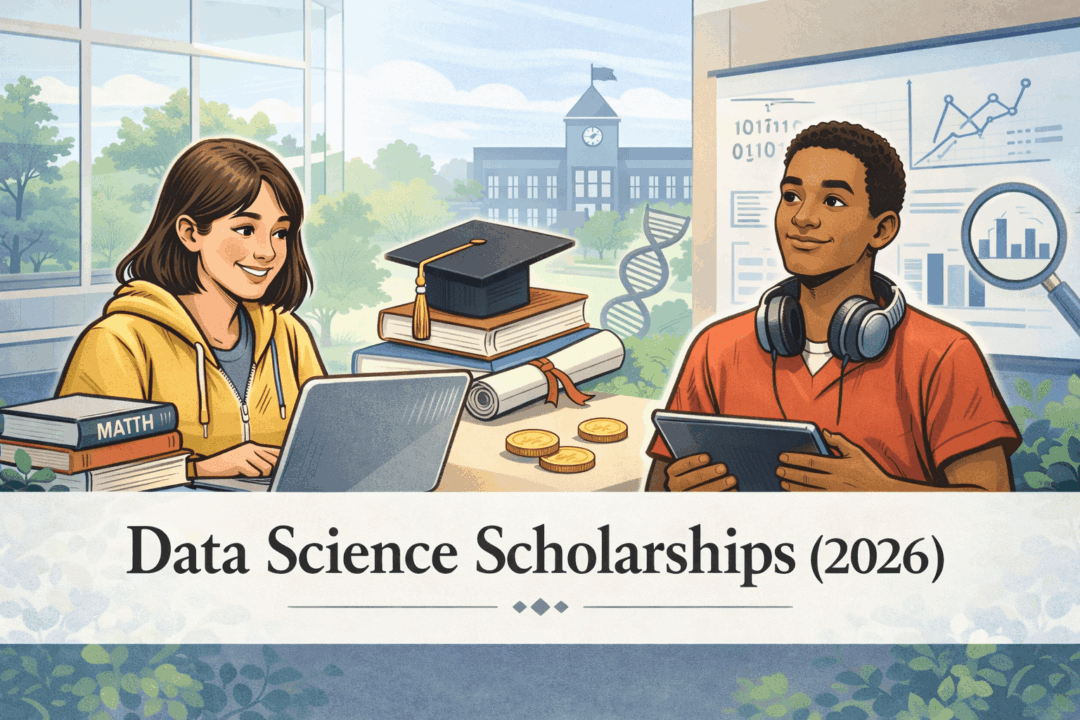
Data Science Scholarships (2026 Cycle) — Verified Awards for Undergrad, Master’s & PhD
Curated, verified Data Science scholarships and fellowships for undergrads, master’s, and PhD students. Sorted by month (Jan→Dec), with amounts, deadlines, and direct apply links.
January
DOE Computational Science Graduate Fellowship (DOE CSGF) — PhD
💥 Why It Slaps: Premier HPC + data science PhD funding with $45k stipend, full tuition, national-lab practicum, and a strong alumni network.
💰 Amount: $45,000 annual stipend + full tuition & fees (renewable up to 4 years)
⏰ Deadline: TBA for 2026 cycle (last cycle: Jan 16, 2025)
🔗 Apply/info: https://www.krellinst.org/csgf/
February
SWE Scholarships (Society of Women Engineers) — Undergrad/Grad (Data Science eligible under “Tech”)
💥 Why It Slaps: Hundreds of awards; upperclass/grad window typically closes mid-Feb; freshmen window opens later in spring.
💰 Amount: Varies by award (multiple awards)
⏰ Deadline: TBA (Upperclass/Grad window typically Dec → mid-Feb; check page)
🔗 Apply/info: https://swe.org/scholarships/
March
Milliman Opportunity Scholarship — Undergrad/Grad (includes statistics/data)
💥 Why It Slaps: Targeted access for underrepresented students pursuing math, stats, actuarial, and analytics paths.
💰 Amount: Varies (multiple awards)
⏰ Deadline: TBA (applications typically open in March; check current cycle)
🔗 Apply/info: https://learnmore.scholarsapply.org/milliman-opportunity/
April
ACM SIGHPC Computational & Data Science Fellowships — MS/PhD
💥 Why It Slaps: Flagship data/comp-science fellowship from ACM’s HPC community; prestigious signal for grad researchers.
💰 Amount: Varies by cycle
⏰ Deadline: Apr 30 (typical — confirm current cycle)
🔗 Apply/info: https://www.sighpc.org/
Row Zero Data Analytics Scholarship — Undergrad (Data Analytics/Data Science)
💥 Why It Slaps: Directly aimed at analytics students; clear, student-friendly app and nationwide eligibility.
💰 Amount: $1,000 (one award)
⏰ Deadline: May 31, 2026 (current posted cycle)
🔗 Apply/info: https://rowzero.io/blog/scholarship
May
AFCEA STEM Majors Scholarships — Undergrad (Data Science eligible)
💥 Why It Slaps: National STEM awards (including CS/data) through a respected tech nonprofit; multiple categories.
💰 Amount: Typically $2,500–$5,000 (varies by award category)
⏰ Deadline: TBA (recent cycles closed around May 1; confirm current year)
🔗 Apply/info: https://www.afcea.org/stem-majors-scholarships
AFCEA DC STEM Scholarship — HS Seniors/Transfers (DC region; data/CS eligible)
💥 Why It Slaps: Local chapter with substantial awards for DC-area students heading into STEM majors (incl. CS/data).
💰 Amount: Varies
⏰ Deadline: Apr 1, 2026 (chapter listing)
🔗 Apply/info: https://dc.afceachapters.org/content/stem-scholarships
July
Blacks at Microsoft (BAM) Scholarship — HS Seniors (tech majors including CS/Data)
💥 Why It Slaps: Big-name tech backing for Black/African American students entering tech; combines need + merit.
💰 Amount: Up to $20,000 (mix of multi-year and one-time awards; varies by year)
⏰ Deadline: TBA (last cycle window: Jan 22–Mar 13, 2025)
🔗 Apply/info: https://www.microsoft.com/en-us/diversity/programs/bam-scholarship
August
Generation Google Scholarship (North America) — Undergrad (CS/related incl. Data)
💥 Why It Slaps: Major brand, mentoring/community, and 10-month support period during the academic year.
💰 Amount: Varies by region/year (flat stipend)
⏰ Deadline: TBA (last cycle milestone: recommendation letters due Aug 18; program ran Oct–Jul)
🔗 Apply/info: https://www.google.com/about/careers/applications/buildyourfuture/scholarships/generation-google-scholarship
September
NVIDIA Graduate Fellowship — MS/PhD (AI/ML/Data)
💥 Why It Slaps: Highly selective industry fellowship for cutting-edge GPU/AI/data research; strong industry ties.
💰 Amount: High-value stipend (varies by cycle)
⏰ Deadline: Sep 2025 cycle closed on Sept 11 (watch for 2026 dates)
🔗 Apply/info: https://www.nvidia.com/en-us/research/graduate-fellowships/
Two Sigma PhD Fellowship — PhD (ML/Stats/Data)
💥 Why It Slaps: Quant/ML-heavy fellowship with mentorship from a top data-driven firm.
💰 Amount: Fellowship stipend (varies by cycle)
⏰ Deadline: Sept 26, 2025 (watch for 2026 cycle page)
🔗 Apply/info: https://www.twosigma.com/graduate-students/phd-fellowships/
AAUW Selected Professions Fellowship — Master’s (Data Science/Data Analytics included under “Technology”)
💥 Why It Slaps: $20k fellowship for women in low-representation STEM master’s fields (explicitly lists Data Science/Analytics).
💰 Amount: $20,000 stipend
⏰ Deadline: Sept 30, 2025 (2026–27 cohort; confirm next cycle)
🔗 Apply/info: https://www.aauw.org/resources/programs/selected-professions-fellowship-program/
October
NSF Graduate Research Fellowship Program (GRFP) — MS/PhD (CISE fields incl. Data/ML)
💥 Why It Slaps: The flagship U.S. grad fellowship; stipend + cost-of-education; portable across universities.
💰 Amount: Stipend + cost-of-education allowance (see program for current figures)
⏰ Deadline: Oct 28, 2025 for CISE (field-specific dates; confirm for your field/year)
🔗 Apply/info: https://www.nsfgrfp.org
Hertz Fellowship — PhD (applied sciences/math/CS/data)
💥 Why It Slaps: Elite, long-tenure PhD funding and community; extremely competitive.
💰 Amount: Full fellowship support (see program for current package)
⏰ Deadline: Oct 31, 2025 (application window Aug 12–Oct 31, 2025)
🔗 Apply/info: https://www.hertzfoundation.org/apply/
November
NDSEG Fellowship — PhD (DoD; ML/AI/Data eligible fields)
💥 Why It Slaps: Full-ride grad fellowship (stipend + tuition) without service requirement; defense-relevant research.
💰 Amount: Stipend + tuition/fees (see program for current figures)
⏰ Deadline: Nov 15, 2025 (typical; confirm on portal)
🔗 Apply/info: https://ndseg.sysplus.com/
GEM Fellowship — MS/PhD (industry-backed; data/CS eligible)
💥 Why It Slaps: Tuition support + paid summer internship at a GEM employer; strong DEI mission and hiring pipeline.
💰 Amount: Tuition assistance + stipend (varies by MS/PhD track)
⏰ Deadline: Priority deadlines typically in November (confirm current year); university portion may extend into January
🔗 Apply/info: https://www.gemfellowship.org/apply/
December
SMART Scholarship-for-Service (DoD) — Undergrad/Grad (Data/CS eligible)
💥 Why It Slaps: Full tuition + stipend + guaranteed DoD civilian job after graduation; STEM list includes data/CS.
💰 Amount: Full tuition + stipend + bonuses (see program for current figures)
⏰ Deadline: Second Friday in December by 5:00 PM ET (Dec 12, 2025 for this cycle)
🔗 Apply/info: https://www.smartscholarship.org/smart
Rolling / Regional / Identity-Focused (great for Data Science majors)
Amazon Future Engineer Scholarship — HS Seniors (CS/related incl. Data)
💥 Why It Slaps: $40K + laptop + paid Amazon internship; massive career lift for first-year CS/data students.
💰 Amount: $40,000 over 4 years + laptop + internship
⏰ Deadline: TBA (opens in fall annually; confirm current window)
🔗 Apply/info: https://www.amazonfutureengineer.com/scholarships
Latinos in Technology Scholarship (Silicon Valley Community Foundation) — Undergrad (STEM)
💥 Why It Slaps: Up to $18,000 over three years plus mentorship and internship pipeline—excellent for data majors.
💰 Amount: Up to $6,000 per year (renewable up to $18,000)
⏰ Deadline: TBA (reopens annually; check page)
🔗 Apply/info: https://www.svcf.org/scholarships/latinos-in-technology-scholarship
BDPA (Black Data Processing Associates) Scholarships & Competitions — HS → College (IT/CS/Data)
💥 Why It Slaps: National tech org with multiple student programs, app competitions, and scholarship pathways.
💰 Amount: Varies (chapter/national awards)
⏰ Deadline: Varies by program/chapter
🔗 Apply/info: https://bdpa.org/scholarships-2/
Women at Microsoft (WAM) Scholarship — HS Seniors (women & non-binary in tech)
💥 Why It Slaps: 26 one-time $5K awards for aspiring technologists; data/CS welcome.
💰 Amount: $5,000 (one-time; 26 awards)
⏰ Deadline: TBA (watch the page for new cycle)
🔗 Apply/info: https://www.microsoft.com/en-us/diversity/programs/women-at-microsoft-scholarship
AISES Intel “Growing the Legacy” Scholarship — Undergrad/Grad (Indigenous students in STEM incl. Data)
💥 Why It Slaps: Substantial recurring awards for Indigenous students, plus visibility and community support.
💰 Amount: Typically $5,000 (UG) to $10,000 (Grad) per year (varies)
⏰ Deadline: TBA (recent cycles closed around late April)
🔗 Apply/info: https://aises.org/scholarships/
Acxiom Diversity Scholarship — Undergrad (CS/Data/Math/IS)
💥 Why It Slaps: Data-marketing company funding diverse students in CS/data/IS majors; ~10 national awards.
💰 Amount: Typically $5,000 (varies by year)
⏰ Deadline: TBA (announced annually)
🔗 Apply/info: https://www.acxiom.com/diversity-equity-inclusion/
Editor’s Picks — Grad/PhD (Data-Heavy)
Google PhD Fellowship — PhD (ML/AI/Data)
💥 Why It Slaps: Direct support from Google for frontier ML/AI/data research; strong brand + cohort benefits.
💰 Amount: Fellowship support (varies by region and year)
⏰ Deadline: TBA (North America window typically spring)
🔗 Apply/info: https://research.google/programs-and-events/phd-fellowship/
Data Science Scholarships in the United States: Analysis of Workforce Demand, Educational Supply, and Equity-Oriented Funding Design
Data science has shifted from a niche specialization to a core labor-market competency across the U.S. economy, intensifying demand for graduates with skills in statistics, computing, and domain-informed inference. The U.S. Bureau of Labor Statistics (BLS) reports a median annual wage of $112,590 (May 2024) for data scientists and projects 34% employment growth from 2024–2034, with ~23,400 openings per year on average—making data science among the fastest-growing occupations. Yet the educational pipeline is still maturing: “Data Science” is a relatively new Classification of Instructional Programs (CIP) family (e.g., CIP 30.7001 Data Science, General) and early completions data show rapid growth from a small base.
This paper analyzes the economics and design logic of data science scholarships as workforce investments and access interventions. Using national labor-market indicators, postsecondary pricing/debt benchmarks, and evidence from rigorous financial-aid research, it argues that scholarships are most effective when they (1) reduce price barriers and (2) fund wraparound academic/career supports that improve persistence, particularly for low-income and underrepresented students. The paper concludes with actionable design recommendations for funders, institutions, and applicants—positioning data science scholarships as both a human-capital strategy and an equity lever in a rapidly evolving AI-driven economy.
1. Introduction: Why Data Science Scholarships Matter Now
Data science sits at the intersection of applied statistics, computer science, data engineering, and decision science—an interdisciplinary profile explicitly reflected in CIP definitions that emphasize algorithms, programming, data management, modeling, and visual analytics. As organizations adopt machine learning and “data-first” operations, the labor market is rewarding analytical talent with strong wage premiums and sustained hiring projections. BLS reports both high median pay and rapid projected growth for data scientists, suggesting durable demand even amid cyclical shifts in the broader tech sector.
Yet the pathway into data science is not evenly accessible. Students face rising all-in costs (tuition plus living) and heterogeneous access to prerequisites (calculus, programming, research opportunities, internships). The resulting “talent bottleneck” is not merely a question of how many students enroll—it is also about who persists, who gets mentored into high-return subfields (ML engineering, causal inference, security analytics), and who can afford to complete industry-valued experiential learning (internships, research assistantships, capstone projects). Therefore, data science scholarships should be understood as a strategic policy instrument: they can expand the skilled workforce while reducing inequities in who benefits from data-driven economic growth.
Key claim: The best data science scholarships do more than pay bills. They are bundled interventions that reduce financial stress and increase persistence through structured academic and career supports—an approach aligned with both research evidence and major federal scholarship models.
2. Data and Approach
This analysis synthesizes five evidence streams:
- Workforce demand and earnings: BLS Occupational Outlook Handbook (OOH) and related tables for wages and projected openings.
- Education pipeline signals: CIP definitions for data science and published indicators of growth in data science degrees; broader computing enrollment/demographic trends from credible sector surveys.
- Price and financing context: College Board pricing/budget benchmarks and NCES indicators on borrowing patterns.
- Program design exemplars: NSF S-STEM and DoD SMART Scholarship program structures to illustrate how scholarships operationalize workforce and equity goals.
- Causal evidence on financial aid impacts: Research syntheses and evaluations (NBER, MDRC, and S-STEM evaluation reporting) on how grants/scholarships affect persistence and academic progress.
The goal is not to rank individual scholarships (your site’s list does that), but to provide a doctoral-level framework for interpreting scholarship design, likely impacts, and applicant strategy.
3. Labor-Market Economics: High Demand, High Stakes
BLS reports a median annual wage of $112,590 (May 2024) for data scientists, with substantial dispersion (reflecting industry, seniority, and specialization). Employment is projected to grow 34% from 2024–2034, with ~23,400 openings per year—a combination of expansion and replacement demand.
From a human-capital perspective, these numbers suggest that data science training has strong expected private returns (earnings gains to individuals) and potential public returns (productivity growth, improved decision-making in healthcare, logistics, energy, government). The implication for scholarships is straightforward: where labor markets show both strong wages and rapid projected growth, scholarships can be justified not only as individual aid but also as workforce development investments.
However, high demand does not automatically translate into equitable opportunity. Employers increasingly screen for portfolios, internships, cloud tooling, and demonstrated applied work. That shifts the effective cost of entering the field beyond tuition—toward unpaid/low-paid experiential learning, computing equipment, and time-intensive project-building. Well-designed scholarships can “buy back time” for students by reducing the need for excessive paid work hours and funding structured pathways into internships and research.
4. The Education Pipeline: Rapid Growth from a New Degree Category
Data science is a relatively new formal degree category in federal education taxonomies. The NCES CIP system defines CIP 30.7001 (Data Science, General) as an interdisciplinary program spanning applied statistics, computer science, data management, modeling, and analytics. This matters because “newness” creates measurement lags: early growth may be undercounted (programs housed under statistics, computer science, information systems) while new CIP adoption expands.
Even so, available indicators show steep growth. The American Statistical Association reported that the number of bachelor’s degrees in data science jumped to 897 in 2022, up from 165 (2021) and 84 (2020)—a classic diffusion curve from a small base. Simultaneously, broader computing enrollments have continued to rise in recent Taulbee Survey reporting, signaling strong student demand for adjacent pathways that often feed into data science careers.
Pipeline constraint: “Seats” + prerequisites + mentoring
Data science programs face constraints that are not purely financial:
- Prerequisite intensity (math/stat + programming) can produce early attrition without tutoring and cohort supports.
- Faculty and course capacity in high-demand modules (ML, databases, cloud computing) can bottleneck progression.
- Internship access is uneven, often mediated by networks, career services quality, and geographic proximity to employers.
Scholarships that include academic coaching, research placements, and structured internship pipelines can therefore raise completion and job placement rates more than “tuition-only” aid.
5. Cost, Debt, and the “True Price” of Becoming a Data Scientist
The cost problem has two layers: published price and total student budget. College Board reporting shows that average student budgets (tuition/fees plus housing, food, transportation, etc.) can be substantial—for example, the average budget for in-state students at public four-year institutions is about $29,910, while private nonprofit four-year budgets are higher (e.g., $62,990 in reported averages). These figures contextualize why even “mid-sized” scholarships ($2,000–$10,000) can meaningfully reduce work hours and persistence risk.
Borrowing remains common. NCES reports that in 2020–21, 38% of first-time, full-time undergraduates received loan aid, and the average annual loan amount (constant dollars) was about $7,700. The debt burden interacts with data science in a specific way: while expected earnings are high, risk is front-loaded. Students must finance the educational period before returns arrive, and attrition risk is highest early when prerequisites hit hardest. Scholarships can be modeled as risk-reduction instruments: they reduce the probability of stop-out or major switching that prevents students from reaching the high-return segment of the earnings distribution.
6. Scholarship “Types” in Data Science: A Funding Ecology
Data science scholarships in the U.S. typically cluster into five functional categories. Understanding these categories helps both applicants (strategy) and funders (design).
6.1 Need-based persistence scholarships (access first)
These programs aim to reduce net price and improve retention for low-income students, often tied to academic supports. A leading model is NSF S-STEM, whose goal is enabling academically talented, low-income students to complete STEM degrees; importantly, NSF emphasizes that financial aid alone is insufficient and funds institutions to implement evidence-based co-curricular supports alongside scholarship dollars. The latest solicitation notes large allowable award sizes (up to $2,000,000 for multi-year projects), illustrating the scale at which scholarship-plus-support is conceived as a system intervention.
Relevance to data science: Because early-course barriers (calculus/programming) drive attrition, S-STEM-like wraparound structures (tutoring, cohort models, mentoring, early research exposure) are especially aligned with data science persistence risk.
6.2 Service-linked “talent-to-agency” scholarships (workforce first)
The DoD SMART Scholarship is a canonical example: it provides full tuition, stipends (often listed as $30,000–$46,000 depending on degree level), internships, mentorship, and post-graduation employment with the Department of Defense.
Trade-off logic: These scholarships can be among the most financially generous, but they exchange flexibility for certainty (service commitment and employer match). For students interested in government, security, operations research, or applied ML in defense contexts, this can be an efficient path.
6.3 Merit/competition scholarships (signal first)
Common in corporate and foundation ecosystems, these awards use academic performance, projects, hackathons, essays, and leadership as selection mechanisms. Their economic function is signaling: they identify “high potential” candidates and sometimes create early recruiting pipelines. In data science, where portfolios matter, these scholarships often reward demonstrable applied work.
6.4 Identity- and mission-linked scholarships (equity and representation)
These scholarships target groups underrepresented in computing and quantitative fields, addressing both access and representation gaps. For context, the CRA’s Taulbee reporting indicates that among bachelor’s graduates in computing with gender reported, ~23.7% were female (recent cycle reporting), underscoring persistent gender imbalance in adjacent pipelines that feed data science. Organizations like NCWIT curate participation statistics and trend resources used widely in computing equity work.
6.5 Graduate fellowships and research training funds (innovation first)
At the graduate level, the scholarship ecosystem becomes more fellowship-like: the goal is research production (new methods, new applications) and advanced workforce readiness. For data science, fellowships often support specialization in causal inference, privacy, ML theory, or domain science (biostatistics, computational social science).
7. Do Scholarships “Work”? What the Best Evidence Suggests
The strongest research base on financial aid shows that lowering costs can improve access and completion, though effects vary by program design and context. A major NBER review (“Financial Aid Policy: Lessons from Research”) summarizes evidence that grant aid can influence enrollment and attainment outcomes, while cautioning that not all designs yield large persistence effects.
Two design insights are particularly relevant for data science scholarships:
7.1 Aid interacts with student behavior and institutional packaging
Randomized evidence shows that grant aid can change the composition of student financing—sometimes reducing borrowing and work intensity. For example, Angrist et al. (NBER) report that grant aid increased total grant aid and reduced reliance on loans/work-study in measurable ways in an experimental context. For data science students, this “time reallocation” channel is plausibly important: project-building and skill acquisition are time-intensive and strongly rewarded in hiring.
7.2 Scholarship + structure tends to outperform scholarship alone
MDRC evaluations of performance-based scholarship demonstrations show modest but positive effects on academic progress markers (e.g., credits earned), especially when scholarships are paired with clear benchmarks and supports. NSF’s S-STEM explicitly reflects this logic by funding both scholarships and evidence-based co-curricular strategies and requiring participation in evaluation infrastructure (e.g., national synthesis via resource/evaluation centers).
Implication: For data science—where “gateway” courses can derail students—scholarships are most likely to improve graduation and workforce entry when they are integrated with tutoring, cohort supports, mentoring, and early experiential learning.
8. Equity Implications: Who Gets to Become a Data Scientist?
Data science scholarships are not only about increasing headcount; they shape the composition of the future analytic workforce. Persistent gender and race/ethnicity disparities in computing pipelines suggest that without targeted support, data science growth can reproduce unequal access to high-wage careers.
Equity-oriented scholarship design in data science should address three bottlenecks:
- Academic readiness gaps (especially in math and programming), which are remediable with funded tutoring and bridge programs.
- Network and opportunity gaps (internships, research roles, referrals), which can be reduced through paid placements and employer partnerships.
- Financial volatility (housing, food, emergency costs), which can be mitigated via flexible micro-grants and predictable multi-year awards—particularly important given total student budgets reported in national pricing benchmarks.
From a policy standpoint, these are not “nice-to-have” features; they are causal mechanisms that convert scholarship dollars into persistence and degree completion.
9. Recommendations for Scholarship Designers (Foundations, Companies, Universities)
A data science scholarship that aims for measurable impact should be evaluated like an applied social investment. The following design principles are strongly supported by the research and program exemplars:
- Bundle money with supports. Follow the S-STEM logic: scholarships plus structured, evidence-based recruitment/retention strategies.
- Target “gateway risk” periods. Concentrate supports in the first 3–4 semesters (calculus sequence, programming, data structures, intro ML/stats).
- Pay for experiential learning. Fund paid internships/research assistantships so low-income students can build portfolios without sacrificing income.
- Use clear, fair selection signals. In data science, projects can be more predictive than GPA alone; evaluate portfolios with transparent rubrics.
- Measure outcomes that matter. Track persistence, credits in gateway courses, internship placement, graduation, and early-career placement; participate in shared evaluation when possible (mirroring national evaluation practices in large STEM scholarship ecosystems).
- Consider service pathways where mission-aligned. Programs like DoD SMART demonstrate a scalable model where scholarship generosity is matched with workforce commitments.
10. Recommendations for Applicants (How to Win Data Science Scholarships)
Data science scholarship selection often rewards proof of ability more than declarations of interest. High-leverage actions include:
- Build a “minimum viable portfolio.” One cleaned dataset, one modeling notebook, one interpretation write-up, one visualization dashboard.
- Translate projects into impact language. Scholarship committees respond to problems solved: “reduced churn,” “improved forecasting,” “identified inequities,” “optimized resource allocation.”
- Align with sponsor mission. Service scholarships (e.g., defense/public sector) value reliability and mission fit; research-focused awards value curiosity and methodological rigor.
- Show persistence signals. Progress through prerequisites matters; if grades are imperfect, demonstrate trajectory plus tutoring/mentoring engagement.
- Stack scholarships strategically. Combine institutional awards with external scholarships and need-based aid to reduce work hours during high-intensity semesters (a mechanism consistent with aid research on changing financing mixes).
11. Conclusion
Data science scholarships operate at the intersection of labor-market economics and educational equity. The occupation’s high projected growth and median wage levels suggest strong returns to training and justify scholarship investments as workforce development. Yet pipeline constraints—new degree taxonomy, prerequisite intensity, and uneven access to internships and mentoring—mean that tuition relief alone is often insufficient. The best evidence and the most credible federal models point toward a “scholarship-plus-support” paradigm: pairing financial aid with structured, evidence-based academic and career pathways improves the probability that students, especially those from low-income backgrounds, complete the degree and enter high-wage analytic work.
For ScholarshipsAndGrants.us readers, the practical takeaway is simple: treat scholarships not just as money, but as a pathway. The most valuable awards are those that pay, mentor, place, and propel.
References (Selected)
- U.S. Bureau of Labor Statistics. Occupational Outlook Handbook: Data Scientists (wages, projections, openings).
- U.S. Bureau of Labor Statistics. Fastest Growing Occupations (data scientists listed).
- NCES (IPEDS CIP). CIP 30.7001 Data Science, General (program definition).
- American Statistical Association. Degrees in Data Science increase sharply (degree counts).
- NSF. S-STEM program overview and solicitation NSF 25-514 (design, scale, evaluation).
- S-STEM Resource & Evaluation Center (AAAS). Outcomes/impact reporting (program goals, mixed-methods synthesis).
- DoD SMART Scholarship. Program benefits and requirements (tuition, stipends, internships, employment).
- College Board. Trends in College Pricing and Student Aid (student budgets).
- NCES. Condition of Education: Loans and debt indicators (loan participation and annual amounts).
- Dynarski, S. & Scott-Clayton, J. (NBER). Financial Aid Policy: Lessons from Research (evidence synthesis).
- MDRC. Performance-Based Scholarships: Emerging Findings (impacts on academic progress).
- CRA. Taulbee Survey updates (gender share among computing graduates; enrollment trends).
Notes for readers
- Always confirm current-year deadlines and amounts on the official pages (cycles shift year to year).
- Where we list “TBA (last cycle …)”, that’s intentional for accuracy until the new window is posted.
(Editor verification log — sources backing key details)
- DOE CSGF benefits/stipend; program overview. krellinst.org
- NSF GRFP field-specific deadlines (CISE Oct 28, 2025).
- Hertz Fellowship application window (Aug 12–Oct 31, 2025).
- NDSEG fellowship portal (deadline published on portal each cycle).
- SMART Scholarship deadline rule (second Friday in December).
- NVIDIA Graduate Fellowship 2025 call (Sept 11 deadline).
- Two Sigma University Programs page (PhD Fellowship; Sept 26 date listed for 2025).
- AAUW Selected Professions Fellowship — includes Data Analytics/Data Science; $20,000; Aug 1–Sept 30, 2025 timeline. AAUW : Empowering Women Since 1881
- AFCEA STEM Majors Scholarships official page (national; categories & eligibility). AFCEA International
- AFCEA DC chapter scholarship hub; (GoingMerry listing shows Apr 1, 2026). dc.afceachapters.org
- Amazon Future Engineer Scholarship official page (amount & internship).
- Generation Google (IIE program page; letters due Aug 18, 2025; 10-month support).
- Row Zero Data Analytics Scholarship (amount & May 31, 2026 deadline).
- Milliman Opportunity Scholarship (program overview).
- SVCF Latinos in Technology Scholarship (up to $18,000 over three years; eligibility). Silicon Valley Community Foundation
- BDPA scholarships portal. bdpa.org
- Blacks at Microsoft (program page + last cycle window via BigFuture). Microsoft
- ACM SIGHPC fellowship (program pages & university deadline call-outs).
Data Science Scholarships — FAQs (2026 Cycle)
Q1) What majors count for “Data Science” scholarships?
A: Programs usually accept Data Science, Data Analytics, Statistics, Applied Math, Computer Science (data/AI track), Information Science, and Business Analytics. If your program name is different, show how your coursework and projects map to DS skills (stats, ML, data engineering, visualization). 📊
Q2) I’m a Statistics/Applied Math/CS major. Am I eligible?
A: Almost always, yes—as long as you highlight DS-aligned classes (probability, regression/ML, databases, Python/R) and evidence (GitHub, Kaggle, capstones, research). 🎯
Q3) What GPA do I need to be competitive?
A: Many national awards look for 3.5+; numerous orgs accept 3.0–3.4; some focus more on research, leadership, and need. If a program lists no minimum, aim to pair a solid GPA with strong evidence of impact (projects, internships). 📈
Q4) When should I apply?
A: For grad fellowships (NSF GRFP, Hertz, NDSEG), the main window is fall (Oct–Nov). Undergrad and identity-based awards pop up year-round, with clusters in spring and early summer. Start 3–4 months before typical deadlines and keep a rolling calendar. 📅
Q5) Are “no-essay” scholarships worth it for DS students?
A: They’re fast, but odds are low because everyone enters. Use them sparingly. Your best ROI is essay-required, portfolio-friendly awards where you can showcase projects, research, or community impact. 🤖✍️
Q6) What makes a standout DS scholarship essay?
A: Tie a real problem to data impact. Briefly show your method (data gathering, modeling, evaluation, ethics) and result. Mention reproducibility, bias, privacy, and fairness. Avoid hype; show measured outcomes (e.g., “reduced model error by 12%”). 🧠
Q7) Should I include a portfolio? What goes in it?
A: Yes—link a concise README that points to:
-
1–2 polished repos (clean notebooks, tests, data cards)
-
A short demo/video or hosted app
-
Clear results (metrics, charts) and limits/ethics notes
-
Optional: Kaggle profile, research poster, or blog. 🔎
Q8) Who should write my letters of recommendation?
A: Pick faculty or mentors who observed your DS work in depth (research advisors, project leads, internship managers). Provide a 1-page brief: your goals, top projects, impact bullets, and the scholarship criteria. ✉️
Q9) I’m a high school senior—how do I show DS readiness?
A: Emphasize AP/IB math, any CS courses, personal projects (small ETL + viz + inference), clubs/competitions (stats, coding, robotics), and community impact (e.g., dashboard for a local nonprofit). 📚
Q10) Can international students apply?
A: Many university and private awards are open to international students; some government-funded fellowships limit to U.S. citizens/permanent residents. Always check citizenship/visa rules on the official page. 🌍
Q11) Are DS scholarships stackable with other aid?
A: Often yes, but some fellowships (especially funded by agencies or with service terms) may restrict stacking or replace institutional grants. Read the stacking and renewal clauses carefully. 🧩
Q12) What does “renewable” really mean?
A: You typically must maintain Satisfactory Academic Progress, a minimum GPA, and full-time enrollment (sometimes specific credit loads). Miss any condition, and renewal can be paused or canceled. 🔁
Q13) Do bootcamps or online programs have scholarships?
A: Many bootcamps offer internal scholarships or discounts (women, veterans, low-income). Scrutinize placement stats, refund policies, and partner employers. For long-term DS careers, degree + portfolio still carries strong signaling value. 🧰
Q14) What are common eligibility red flags?
A: Major mismatch, missing citizenship/region criteria, part-time status when full-time is required, or graduation date outside the stated window. Double-check all fine print before applying. 🚩
Q15) How do I avoid scholarship scams?
A: Never pay to apply, beware of “guaranteed winner” claims, and avoid sharing SSN/bank info outside secure financial-aid workflows. Stick to official org/university pages. 🛡️
Q16) Are scholarships taxable?
A: In general, amounts used for tuition and required fees may be tax-free, while portions for room/board or stipends can be taxable. Rules vary—keep records and consult a qualified tax advisor. 💵
Q17) I’m pivoting from another field (economics, biology, physics). Do I qualify?
A: Yes—bridge with a DS-aligned course plan, highlight quant/programming skills, and show a coherent story (e.g., bio → bioinformatics). A focused capstone can make your pivot tangible. 🔄
Q18) How do I prove impact beyond grades?
A: Include before/after metrics, links to dashboards/demos, user testimonials (professors or nonprofit partners), and ablation or error analysis to show rigor—not just shiny visuals. 📊
Q19) Any strategy for finding university-specific DS awards?
A: Search your department site (+scholarships/fellowships), college of engineering/science, grad school funding pages, and the campus foundation. Many program-level prizes are under-publicized and have great odds. 🏫
Q20) I can’t find the new cycle dates. What should I do?
A: Put the program on your watchlist, note last year’s open/close dates, and set calendar alerts 30/14/7 days before those expected windows. Check again weekly during that month. ⏰