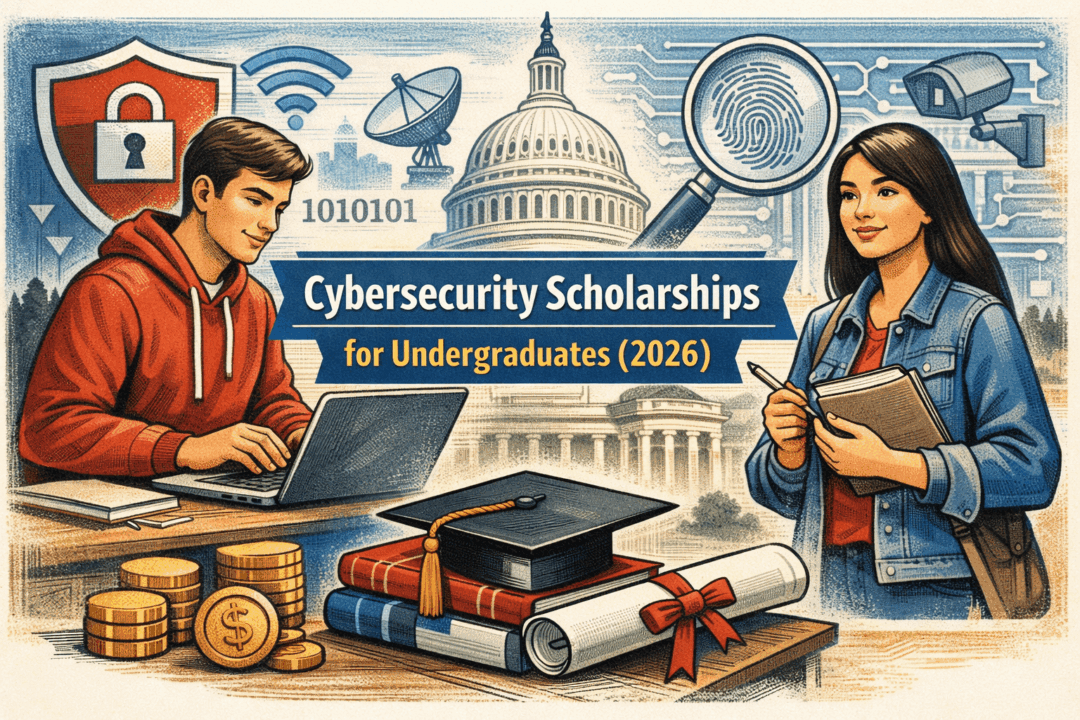
Cybersecurity Scholarships for Undergraduates (2026) — 20+ Verified Awards by Deadline
The most accurate, monthly-updated list of undergraduate cybersecurity scholarships. Verified links, amounts, and deadlines (sorted Jan→Dec). Includes DoD SMART, DoD CySP/CSA, NSA Stokes, SFS, (ISC)², ISACA, FS-ISAC, ISSAEF, AFCEA, and more.
New opportunities from ISACA (Cycle 2), FS-ISAC, and the Center for Cyber Safety & Education (Nightwing + Amentum).
January
(No major national undergrad-tuition cyber awards traditionally close in January. Keep an eye on campus-level SFS windows opening late winter.)
February
DoD Cyber Scholarship Program (CySP)
💥 Why It Slaps: Full ride + stipend to study cyber at an NSA CAE-C school, with paid DoD internship(s) and post-grad civilian service.
💰 Amount: Full tuition/fees + stipend (varies by component)
⏰ Deadline: Typically around Feb 1 via your NCAE-C institution (school deadlines may precede federal cut-off).
🔗 Apply/info: https://dodcio.defense.gov/Portals/0/Documents/Cyber/ScholarshipProgramFastFacts.pdf
DoD Cyber Service Academy (CSA)
💥 Why It Slaps: Another DoD pathway (distinct from CySP) that funds cyber degrees at select NCAE-C schools with internships and service.
💰 Amount: Full tuition/fees + stipend (institution-administered)
⏰ Deadline: Often Feb 1 via participating schools (confirm locally).
🔗 Apply/info: https://dodcio.defense.gov/Cyber-Workforce/Cyber-Service-Academy/
March
Nightwing Cybersecurity Scholarships (via Center for Cyber Safety & Education)
💥 Why It Slaps: Two $10,000 tuition/fee awards for students from historically underrepresented groups in cyber/STEM.
💰 Amount: $10,000 (2 awards)
⏰ Deadline: Mar 3, 2025 (last cycle; monitor page for 2026 window).
🔗 Apply/info: https://www.iamcybersafe.org/s/Nightwing-Cybersecurity
(ISC)² Undergraduate Cybersecurity Scholarship (Center for Cyber Safety & Education)
💥 Why It Slaps: Well-known academic award for undergrads in cybersecurity/information assurance; typical Spring close.
💰 Amount: $1,000–$5,000
⏰ Deadline: Spring (last cycles closed in March; watch the portal).
🔗 Apply/info: https://www.iamcybersafe.org/s/scholarships
(ISC)² Women’s Cybersecurity Scholarship
💥 Why It Slaps: Supports women pursuing undergrad degrees in cyber; multiple awards each year.
💰 Amount: $1,000–$5,000 (typical)
⏰ Deadline: Spring (historically March/April; check the current application window).
🔗 Apply/info: https://www.iamcybersafe.org/s/scholarships
FS-ISAC Women in Cyber Scholarship
💥 Why It Slaps: $10,000 plus mentorship, event access, and industry networking in the financial sector.
💰 Amount: $10,000 + mentorship & FS-ISAC Summit travel
⏰ Deadline: Typically Winter/Spring; follow current cycle dates on program page.
🔗 Apply/info: https://www.fsisac.com/scholarships
April
ESET Women in Cybersecurity Scholarship (North America)
💥 Why It Slaps: Ten-year program; multiple $10,000 awards in the U.S., including a San Diego seat honoring the program’s origin.
💰 Amount: Up to $10,000 (U.S. awards; total pool expanded in 2025)
⏰ Deadline: Apr 8, 2025 (last cycle; monitor for 2026 reopen).
🔗 Apply/info: https://www.eset.com/us/women-in-cybersecurity-scholarship
AFCEA Cybersecurity Scholarship (AFCEA Educational Foundation)
💥 Why It Slaps: National STEM nonprofit with named cyber awards; strong defense/Intel community ties.
💰 Amount: Varies by scholarship (often in the $2,500–$5,000 range)
⏰ Deadline: Spring; specific windows posted on AFCEA’s scholarship pages each cycle.
🔗 Apply/info: https://www.afcea.org/afcea-educational-foundation
May
ISACA Digital Trust Scholarship (Global)
💥 Why It Slaps: Open to IT audit/risk/security/cybersecurity students worldwide; ISACA also bundles mentorship/career perks.
💰 Amount: Varies (multiple awards)
⏰ Deadline: May 20, 2025 for Cycle 1 (last cycle); cycle dates update annually.
🔗 Apply/info: https://isaca.secure-platform.com/a/page/ISACAfoundation/aboutscholarships
June
ISSA Education Foundation (ISSAEF) Undergraduate Scholarships
💥 Why It Slaps: Dedicated security-association foundation; several undergrad awards (e.g., Howard A. Schmidt Memorial).
💰 Amount: Varies by award (e.g., $3,500+ named scholarships)
⏰ Deadline: June 15 (2025 window Feb 1–Jun 15).
🔗 Apply/info: https://issaef.org/scholarships/apply/
August
Amentum Career Development Scholarships (via Center for Cyber Safety & Education)
💥 Why It Slaps: Funds ISC2 certification training/exam + first AMF for >100 recipients; great add-on to your degree path.
💰 Amount: Training + exam voucher + first AMF (non-tuition)
⏰ Deadline: Aug 19, 2025 (last cycle).
🔗 Apply/info: https://www.isc2.org/Insights/2025/07/Center-for-Cyber-Safety-and-Education-and-Amentum-Scholarships
October
NSA Stokes Educational Scholarship Program (STEM Track)
💥 Why It Slaps: Up to $30,000/yr tuition + a paid NSA role while in school and a civilian job after graduation.
💰 Amount: Up to ~$30,000/year tuition + salary/benefits while in school
⏰ Deadline: Opens Sep 1; closes Oct 1 (per current NSA posting; STEM track).
🔗 Apply/info: https://www.nsa.gov/Careers/Student-Programs/
ISACA Cybersecurity Month Scholarship
💥 Why It Slaps: Fall cycle scholarship specifically for cybersecurity students; part of ISACA’s national program.
💰 Amount: Varies (multiple awards)
⏰ Deadline: Oct 14, 2025 (Cycle 2 close).
🔗 Apply/info: https://isaca.secure-platform.com/a/page/ISACAfoundation/aboutscholarships
ISACA National Cyber League (NCL) Games Scholarship
💥 Why It Slaps: Rewards NCL competitors pursuing cyber/information assurance degrees.
💰 Amount: Varies
⏰ Deadline: Oct 14, 2025 (Cycle 2 close).
🔗 Apply/info: https://isaca.secure-platform.com/a/page/ISACAfoundation/aboutscholarships
December
DoD SMART Scholarship-for-Service
💥 Why It Slaps: Full tuition + $30k–$46k annual stipend, DoD summer internships, and guaranteed post-grad civilian DoD job.
💰 Amount: Full tuition + stipend + internships + employment
⏰ Deadline: First Friday in December (Dec 5, 2025 at 5 pm ET per current cycle).
🔗 Apply/info: https://www.smartscholarship.org/smart/en
Rolling / Varies by Institution or Cycle
NSF CyberCorps®: Scholarship for Service (SFS)
💥 Why It Slaps: Full tuition + stipend (e.g., $25,000/yr undergrad), pro allowance, federal internship + cyber service commitment. Program runs campus-by-campus.
💰 Amount: Tuition/fees + ~$25,000/yr (undergrad) + allowance (varies by campus)
⏰ Deadline: Varies by participating university; some paused 2025 intake due to federal budget. Check your campus SFS page.
🔗 Apply/info: https://sfs.opm.gov/
ISACA Sacramento Cybersecurity Scholarship (U.S. Chapter example)
💥 Why It Slaps: Chapter-level award for students at Sacramento-area schools; administered on ISACA’s national platform.
💰 Amount: Varies
⏰ Deadline: Aligns with ISACA cycles (e.g., Cycle 2 closed Oct 14, 2025).
🔗 Apply/info: https://isaca.secure-platform.com/a/page/ISACAfoundation/aboutscholarships
INSA Foundation (INSF) Scholarships
💥 Why It Slaps: Awards for students pursuing careers in intelligence/national security (including cybersecurity tracks).
💰 Amount: Varies (recently $60,000 total across 8 awards) D
⏰ Deadline: Spring window (e.g., opened Mar 21, 2025; monitor for 2026).
🔗 Apply/info: https://www.insaonline.org/foundation/scholarships
FS-ISAC Cybersecurity Scholarship (program hub)
💥 Why It Slaps: Competitive $10,000 award plus mentorship/networking with financial-sector security leaders.
💰 Amount: $10,000 + mentorship/event access
⏰ Deadline: See current cycle on program page (varies by region/year).
🔗 Apply/info: https://www.fsisac.com/scholarships
InfraGard Oklahoma Student Scholarships (Security/Intel/Cyber)
💥 Why It Slaps: Regional awards that include students in cybersecurity fields; good add if you’re in OK or nearby.
💰 Amount: Varies
⏰ Deadline: Posted annually (see chapter page).
🔗 Apply/info: https://infragardok.org/scholarships
Maryland Cybersecurity Public Service Scholarship (MHEC)
💥 Why It Slaps: State program tying cyber study to Maryland public-service work—strong funding for MD residents.
💰 Amount: Varies (see MHEC program details)
⏰ Deadline: Posted annually by MHEC; monitor program page.
🔗 Apply/info: https://mhec.maryland.gov/preparing/pages/financialaid/cybersecurity-scholarship-program.aspx
WiCyS Security Training Scholarship (career-prep)
💥 Why It Slaps: Multi-tier training pathway for WiCyS members (students & career changers) targeting cyber roles within ~18 months.
💰 Amount: Training access (non-tuition)
⏰ Deadline: Cohorts announced periodically; check current cycle.
🔗 Apply/info: https://www.wicys.org/benefits/security-training-scholarship/
Center “Pathway to Certification” Scholarships (ISC2 CC) (career-prep)
💥 Why It Slaps: At least 20 scholarships covering ISC2 training, CC exam voucher, and first AMF—perfect complement to your degree.
💰 Amount: Training + exam voucher + first AMF
⏰ Deadline: See current 2025/2026 cycle in the application portal.
🔗 Apply/info: (application portal) https://www.iamcybersafe.org/s/scholarships
ISACA Scholarship Hub (many U.S. chapter awards — e.g., North Texas, West Florida, Chicago, New England)
💥 Why It Slaps: One place to find local cyber awards; chapters often target students in their region/partner schools.
💰 Amount: Varies
⏰ Deadline: Chapter awards follow ISACA cycles (e.g., Cycle 2: closes Oct 14 each year).
🔗 Apply/info: https://isaca.secure-platform.com/a/page/ISACAfoundation/aboutscholarships
Pro Tips for Cyber Scholarship Hunters
- Stack “service-commitment” scholarships (SMART, CySP/CSA, SFS) with professional scholarships (FS-ISAC, ISACA, (ISC)²) to offset what service awards don’t cover—just check compatibility and financial-aid rules at your school. smartscholarship.org
- Use your CAE-C campus scholarship office; many have extra internal deadlines ahead of federal cut-offs.
- Document everything early (transcripts, letters, resume, FAFSA, proof of residency for state awards).
Financing the Cyber Workforce: A Data-Driven Map of Cybersecurity Scholarships in the United States
U.S. cybersecurity education sits at the intersection of three measurable forces: (1) labor-market growth and strong wages for core security roles, (2) persistent unmet employer demand for cybersecurity skills, and (3) rising economic consequences of security failures that elevate cybersecurity from “IT cost center” to organizational survival function. This paper synthesizes federal labor-market projections, national job-posting analytics, and global workforce-gap estimates to explain why cybersecurity scholarships have expanded in number, variety, and strategic design. It then categorizes the U.S. cybersecurity scholarship ecosystem into mission-linked public-service programs, professional-association awards, industry/vendor scholarships, and conference/community-based funding—each with distinct incentives, eligibility patterns, and selection criteria. Finally, it offers an evidence-based “application strategy framework” that aligns student narratives and portfolios to the competencies employers and governments signal they most need, using the NICE Workforce Framework as a unifying taxonomy. The result is a practical research-informed blueprint for students and families seeking to reduce the cost of cybersecurity education while increasing employability and long-run career mobility.
1. Introduction: Why Cybersecurity Scholarships Have Become a Strategic National Asset
Cybersecurity scholarship growth is not simply a feel-good response to tuition inflation; it is a market signal that human capital in security has become scarce relative to the speed and scale of digital risk. The Bureau of Labor Statistics (BLS) reports a May 2024 median annual wage of $124,910 for information security analysts and projects 29% employment growth from 2024 to 2034, with about 16,000 openings per year on average. (These estimates are for one of the clearest “core” cybersecurity occupations, but they also act as a proxy for broader security demand.)
Demand is visible not only in wages and projections, but also in real-time job-posting volumes. CyberSeek’s June 2025 release reports 514,359 job listings over the prior 12 months (May 2024–April 2025) for dedicated cybersecurity jobs and adjacent roles requiring heavy cybersecurity skills, and it computes a 74% supply-demand ratio—a structural shortfall where employer demand outpaces available talent.
At the same time, the costs of cyber failures have risen. IBM’s Cost of a Data Breach Report 2024 put the global average breach cost at $4.88 million (a sharp increase from the prior year), quantifying why organizations increasingly treat security capability as a board-level priority rather than a back-office function. Cyber incidents also remain operationally common: Verizon’s 2025 DBIR executive summary reports ransomware present in 44% of breaches reviewed (up from 32% in the prior report), alongside notable shifts in attacker focus and victim response.
Scholarships emerge in this environment as targeted interventions to (a) expand the talent pipeline, (b) reduce entry barriers for underrepresented groups, and (c) shape workforce behavior via incentives such as service obligations, mentorship, internships, and certification funding. The critical question for students is no longer “Do cybersecurity scholarships exist?” but “Which scholarship designs best match my goals, constraints, and risk tolerance?”
2. Data and Method
This paper integrates five kinds of evidence:
- Labor market structure: BLS wages, occupational employment base, and 10-year projections for information security analysts.
- Demand signals and workforce ratios: CyberSeek job-posting counts, NICE-category mapping of postings, and supply-demand ratio estimates.
- Workforce gap and pathway evidence: ISC2’s 2024 Cybersecurity Workforce Study estimates of workforce size and gap, plus survey measures of staffing shortages and credential pathways.
- Risk-cost context: IBM breach-cost benchmarks and Verizon breach composition/ransomware prevalence.
- Program-design documentation: Official or primary program pages for major scholarship mechanisms (e.g., CyberCorps® SFS) and reputable program sources for widely used scholarship pathways (e.g., CAE Community map).
The methodological goal is explanatory: connect macro-level demand and risk data to micro-level scholarship eligibility patterns and selection incentives, and translate that into a decision framework students can use.
3. The Cybersecurity Labor Market: High Returns, Persistent Shortages
3.1. Strong wages and sustained growth
BLS data shows information security analysts at $124,910 median pay (May 2024) and 29% projected growth (2024–2034), far above average occupational growth. Importantly, BLS also notes that while a bachelor’s degree is typical, some workers enter with a high school diploma plus relevant training and certifications, implying that “cybersecurity education” is broader than four-year degree pathways. This matters because many scholarships explicitly fund certifications, bootcamps, and professional development rather than (or in addition to) tuition.
3.2. Job postings, NICE categories, and the shape of demand
CyberSeek’s June 2025 release provides two unusually useful details for scholarship applicants: (1) a large posting volume over 12 months (514,359 listings) and (2) a taxonomy of demand mapped to the NICE Workforce Framework categories. Those category counts are not mutually exclusive, but they demonstrate that demand clusters in governance, implementation/operations, design/development, and protection/defense roles.
This is where scholarships become strategic: many applicants write essays about “loving cybersecurity,” but higher-value applications translate motivation into role clarity—e.g., “I’m preparing for Protection and Defense (PD) roles via incident response labs and blue-team competitions” or “I’m building toward Oversight and Governance (OG) through risk management coursework and policy internships.”
3.3. The global workforce gap and credential pathways
ISC2 estimates a global cybersecurity workforce of 5,468,173 and a workforce gap of 4,763,963 in its 2024 study, underscoring that talent scarcity is not localized. The same study reports 67% of respondents indicating a staffing shortage, and it highlights a shift where budget and resource constraints increasingly drive skills gaps.
For applicants, two ISC2 findings are especially “scholarship-relevant”:
- Education remains a common pathway, with 62% entering the cybersecurity workforce directly from higher learning institutions (in the ISC2 survey).
- Certifications are widely valued, with 86% valuing their cybersecurity certifications and many seeing certifications as a way to demonstrate competencies.
Scholarships that fund certification exams, training, or conference participation therefore align tightly with how the field signals competence.
4. Why Scholarship Design in Cybersecurity Looks Different Than Other Majors
Cybersecurity scholarships often bundle money with structure: internships, mentoring, service commitments, and professional development funding. That design reflects a basic economics problem—education financing alone doesn’t guarantee pipeline conversion into staffed roles, especially for public-sector cybersecurity.
Two sectors dominate “structured funding”:
- Government and national security (service obligations, clearance eligibility, agency placement)
- Professional associations and industry (credentialing pipelines, community belonging, and conference-based recruiting)
The scholarship landscape should therefore be read less like a pile of coupons and more like a set of talent pipelines—each with its own contract terms.
5. A Taxonomy of Cybersecurity Scholarships
Category A: Public-service “pipeline” scholarships (high support, high obligation)
CyberCorps®: Scholarship for Service (SFS) is the flagship example. It offers up to three years of support, including tuition and education-related fees, stipends ($27,000/year undergraduate; $37,000/year graduate), and a professional allowance of $6,000 for travel, certifications, and related costs, paired with a post-graduation government service requirement matching the length of scholarship support.
This model effectively converts scholarship dollars into workforce staffing—an explicit attempt to close public-sector gaps. For students, SFS is often among the highest total-value opportunities, but it requires real alignment with government work and (sometimes) clearance eligibility.
A related ecosystem exists around NSA’s National Centers of Academic Excellence in Cybersecurity (NCAE-C) community infrastructure, which helps students identify designated institutions and programs. The CAE Community map is actively maintained (e.g., showing “Map Last Updated 01/16/2026”) and includes filters for institutions linked to SFS and other programs.
DoD SMART Scholarship sits in a parallel “service-for-support” tradition, providing full tuition and annual stipends (reported ranges of $30,000–$46,000, depending on degree level) and post-graduation employment with the Department of Defense.
Decision rule for applicants: These programs are optimal when you want maximum financial coverage and you are comfortable trading some early-career autonomy for guaranteed placement and accelerated professional entry.
Category B: Professional association and nonprofit scholarships (moderate awards, strong signaling)
These scholarships typically optimize for pipeline broadening and competency demonstration.
The Center for Cyber Safety and Education (associated with ISC2) offers multiple scholarships; for example, its undergraduate scholarships award $1,000–$5,000 (with funds typically sent to the school) and often emphasize academic strength plus commitment to the field.
The ISACA Foundation ecosystem includes recurring awards such as the Cybersecurity Month Scholarship, which (in one program instance) awards $2,500 and often bundles career resources.
Decision rule: Association scholarships are especially valuable early because they function as third-party validation—signals that matter in internship selection and first-job screening.
Category C: Industry and vendor scholarships (often DEI-oriented, recruiting-adjacent)
Industry scholarships frequently aim to diversify the field or build brand-aligned talent pipelines.
One visible example is the ESET Women in Cybersecurity Scholarship, listed with an $10,000 award and an explicit goal to close gender gaps in cybersecurity. Vendor and employer scholarships often come with less rigid obligations than government programs, but they may offer mentoring, event access, or recruiting pathways that are “soft pipelines” into internships.
Decision rule: Treat these as both funding and networking assets; the award is cash, but the real leverage can be access to employer communities.
Category D: Conference and community scholarships (access funding + career acceleration)
Cybersecurity is unusually community-driven: conferences, capture-the-flag (CTF) events, and local chapters drive hiring and skill formation. Organizations like WiCyS (Women in CyberSecurity) offer scholarships tied to conference attendance and training pathways, including programs such as the WiCyS FS-ISAC Women in Cyber Scholarship and Mentor Program with $10,000 awards and mentorship components.
Decision rule: If your resume lacks “experience,” conference/community scholarships can function as experience multipliers—turning attendance into mentorship, referrals, and internship leads.
6. Eligibility Patterns: What Cybersecurity Scholarships Reward (Beyond GPA)
Across categories, several recurring “selection logics” show up:
- Role clarity and mission fit: Service scholarships prioritize alignment with government/defense cybersecurity needs and willingness to serve.
- Competency evidence: Portfolios (projects, labs, writeups), certifications, and competitions align with ISC2’s finding that certifications and demonstrable skills are heavily valued.
- Pipeline broadening: Many scholarships explicitly support women and other underrepresented groups, reflecting a workforce-gap strategy that expands entry points rather than competing for the same talent.
- Professionalization signals: Conference attendance, chapter leadership, and mentoring participation mirror how hiring often happens in cyber—through trust networks and demonstrated curiosity.
A key implication is that “cybersecurity scholarship readiness” can be built intentionally. Students who treat scholarship applications as a capstone for their learning journey—rather than as an afterthought—can create an upward spiral where each funded experience yields more evidence for subsequent funding.
7. An Evidence-Based Application Strategy Framework
This section translates the demand signals (BLS + CyberSeek) and credential signals (ISC2) into a replicable application approach.
Step 1: Pick a NICE-aligned target role family
Use the NICE Workforce Framework categories as your organizing spine—Oversight & Governance, Design & Development, Implementation & Operation, Protection & Defense, Investigation. Then write your personal statement as a trajectory into that category, not a generic “love technology” narrative.
Step 2: Build a “proof-of-skill” portfolio that matches scholarship incentives
Because cyber is skills-forward, your proof can be lightweight but concrete:
- A home lab writeup (e.g., logging + detection experiment)
- A small security tool or script with documentation
- A CTF participation summary with lessons learned
- A risk assessment memo for a mock organization (especially for governance pathways)
ISC2’s data that certifications are widely valued supports pairing this with entry-level certification goals when feasible.
Step 3: Convert risk context into narrative urgency
Scholarship committees respond to stakes. Use credible external benchmarks: breach costs, ransomware prevalence, and employer demand. IBM’s $4.88M global average breach cost and Verizon’s ransomware prevalence provide concise, authoritative context. The goal is not fearmongering; it’s showing you understand why the work matters.
Step 4: Apply as a portfolio, not a lottery ticket
Structure your year like a pipeline:
- High-value, high-obligation (SFS/SMART)
- Mid-value, high-signal (association scholarships like ISC2/ISACA)
- Access multipliers (WiCyS/community conferences, training scholarships)
This portfolio approach increases expected value: even if a large award fails, smaller awards can still fund certification exams, conference attendance, or tools that raise employability.
Step 5: Treat service obligations as early-career leverage (if aligned)
Programs like SFS trade funding for service. For many students, that is not a “restriction” but a reduction in labor-market uncertainty: it can convert education into placement, mentoring, and accelerated domain exposure.
8. Policy and Institutional Implications: Measuring Scholarship ROI in Cybersecurity
Cybersecurity scholarships are implicitly evaluated by whether they convert into staffed roles and reduced organizational risk. The evidence suggests three design features are especially “ROI-positive”:
- Paid practical experience (internships, apprenticeships)
- Competency verification (certifications, portfolio deliverables)
- Community integration (mentorship and conference-based recruiting)
CyberSeek’s data indicates that cybersecurity demand is large and diverse across NICE categories, reinforcing that scholarship programs should not only fund “cyber degrees,” but also fund transitions into specific work roles that employers can absorb quickly. Meanwhile, ISC2’s workforce gap estimate and staffing shortage rates imply that scaling such programs remains justified even during budget-tight cycles, because the risk cost of underinvestment is measurable at the breach level.
Conclusion: The Practical Thesis for Students
Cybersecurity scholarships exist because cyber risk is expensive, cyber talent is scarce, and competence is difficult to signal without structured pathways. The most successful applicants treat scholarships as an integrated career-financing strategy: they align to a role family (NICE), produce proof-of-skill artifacts, use credible risk/demand evidence to frame purpose, and apply across a diversified portfolio of funding mechanisms—from public-service pipelines (SFS/SMART) to professional-association awards (ISC2/ISACA) to community accelerators (WiCyS).
In short: in cybersecurity, scholarships are not merely financial aid—they are talent-market infrastructure. Students who understand that infrastructure can fund school, reduce debt, and enter the workforce with stronger signals than a transcript alone.
Selected References (Primary / Authoritative)
- U.S. Bureau of Labor Statistics, Occupational Outlook Handbook: Information Security Analysts (May 2024 wage data; 2024–2034 projections).
- CyberSeek, June 2025 data release (job postings; supply-demand ratio; NICE category mapping).
- ISC2, 2024 Cybersecurity Workforce Study (workforce size; gap; staffing shortage metrics; credential pathway insights).
- IBM, Cost of a Data Breach Report 2024 (global average breach cost).
- Verizon, 2025 Data Breach Investigations Report: Executive Summary (ransomware prevalence and related indicators).
- U.S. Office of Personnel Management, CyberCorps®: Scholarship for Service (Student Information).
- CAE Community, CAE Institution Map (current designation and program filters; last-updated date shown).
- CISA NICCS, NICE Framework overview (categories).
- Center for Cyber Safety and Education (ISC2 Foundation), Undergraduate scholarships overview.
- WiCyS, FS-ISAC Women in Cyber Scholarship and Mentor Program (award + mentorship components).
- ESET / Scholarships.com listing, ESET Women in Cybersecurity Scholarship ($10,000).
FAQs — Cybersecurity Scholarships for Undergraduates
1) What’s the difference between SMART, SFS, CySP/CSA, and NSA Stokes?
These are federal, service-commitment scholarships. In exchange for funding (often tuition + stipend), you agree to work for a federal agency (or DoD component) after graduation. Key distinctions:
- SMART places you with a specific DoD sponsor through paid internships → full-time role.
- SFS (CyberCorps®) funds you through a participating university; you intern with a federal agency and then serve there post-grad.
- DoD CySP/CSA runs through NCAE-C schools, with DoD internships and civilian service.
- NSA Stokes funds school + paid work at NSA while studying, then you convert to a full-time role.
Rule of thumb: pick the program that matches your target employer and school eligibility.
2) Do these awards require U.S. citizenship?
Almost always yes for the big federal programs (SMART, SFS, CySP/CSA, NSA Stokes). Private association and foundation awards may accept permanent residents or international students—check each program’s fine print.
3) What does “service commitment” mean?
You’ll owe federal employment after you graduate, typically about the same number of years as you were funded. If you leave early, you may owe a repayment. Read the agreement before you sign.
4) Do I need a security clearance first?
No. Clearances (if required) are sponsored by the agency after selection. You must be clearable (e.g., background check ready, truthful paperwork).
5) My school isn’t an NSA CAE-C. Can I still get funded?
Yes—SMART and many private awards aren’t restricted to CAE-C campuses. But CySP/CSA requires an NCAE-C institution, and SFS requires a participating campus. If your dream program needs a partner school, consider transferring or a recognized online CAE-C.
6) Can community-college or transfer students apply?
Often yes. Many programs allow rising juniors or transfer students to apply, especially if you’ll be full-time in a 4-year cyber/CS/IT-security program next term.
7) I’m a freshman—should I wait?
Don’t wait to build a profile: join the cyber club, compete in CTFs/NCL, volunteer on blue-team projects, and line up faculty who can write strong letters. Apply to smaller/private awards now; target the big service-commitment programs as a sophomore/junior.
8) What GPA and major do I need?
Most programs prefer a STEM/cyber-aligned major (cybersecurity, information assurance, CS with a security focus, IT/security, digital forensics) and a solid GPA (often ≥3.0). A minor can work if your coursework, projects, and internships are clearly security-focused.
9) Are online or hybrid degrees eligible?
Many private awards accept any accredited program. Federal awards generally require full-time status; some accept accredited online formats—confirm program rules and any location requirements for internships.
10) Can I stack multiple scholarships?
Sometimes. Your school’s cost of attendance and program rules determine stacking. Service-commitment programs may limit stacking or reduce institutional aid. Always clear it with your financial aid office before accepting overlapping awards.
11) How competitive are these?
Very. Expect strong applicants with hands-on work (CTFs, labs, SOC internships), clear public-service motivation, and polished essays. Apply broadly, including regional ISACA/ISSA/WiCyS chapter awards and niche foundations.
12) What makes a standout application?
- Impact: concrete stories of building or defending something (lab, home lab, club project, SOC/IT role).
- Service fit: explain why government/DoD work motivates you.
- Proof of growth: CTF write-ups, GitHub repos, research posters, NCL stats, or competition rankings.
- Recommenders who can speak to your integrity and teamwork (important for clearance-bearing roles).
13) Do I need FAFSA?
Not all programs are need-based, but filing FAFSA helps your school package aid and avoid “over-award” issues. Some private/state awards may require it.
14) Will stipends be taxed?
In the U.S., qualified tuition is generally not taxable; stipends often are. Keep records and speak with a tax professional (we can’t give tax advice).
15) I’m an international student. Any options?
Yes—many private/association scholarships are open internationally or to permanent residents. Focus on (ISC)²/Center, ISACA, ISSAEF, corporate scholarships, and campus-level funds. Federal service-commitment programs typically require U.S. citizenship.
16) Are certification scholarships worth it if I’m in a degree program?
Yes—funding for training/exam vouchers (e.g., ISC2 CC, Security+, CySA+) pairs well with your degree and can accelerate internships and entry-level roles.
17) What’s the best application timeline?
Work 6–9 months ahead:
- Month 1–2: shortlist programs + gather transcripts/resume.
- Month 3–4: draft essays; request letters early.
- Month 5–6: polish; submit; prep for interviews/clearance paperwork.
Use our month-sorted list above to plot an ICS reminder calendar.
18) What if I have past mistakes (e.g., minor legal/disciplinary issues)?
Be honest and thorough on forms. Minor issues are not automatic disqualifiers; omissions can be. If concerned, seek guidance from your campus security officer or a knowledgeable advisor.
19) Can I defer or pause the scholarship if plans change?
Deferments are uncommon and strictly case-by-case. Changing majors away from cyber can void eligibility. If something changes, talk to the program and your aid office immediately.
20) How do I find smaller/local cyber awards?
Check ISACA/ISSA/WiCyS local chapters, InfraGard and state tech councils, regional financial-sector (FS-ISAC-adjacent) funds, and your college of engineering/IT pages. Small awards stack and are often less competitive.
21) Any common mistakes to avoid?
- Linking to aggregator pages instead of the official scholarship page.
- Submitting generic essays with no service mission.
- Skipping proofreading or missing transcript/test score uploads.
- Ignoring stacking rules and creating an over-award problem late.
22) How should I choose recommenders?
Prefer people who’ve seen your security work (networking/OS/prog profs, lab supervisors, SOC leads). Give them your resume + essay draft + bullet points at least 3 weeks ahead.