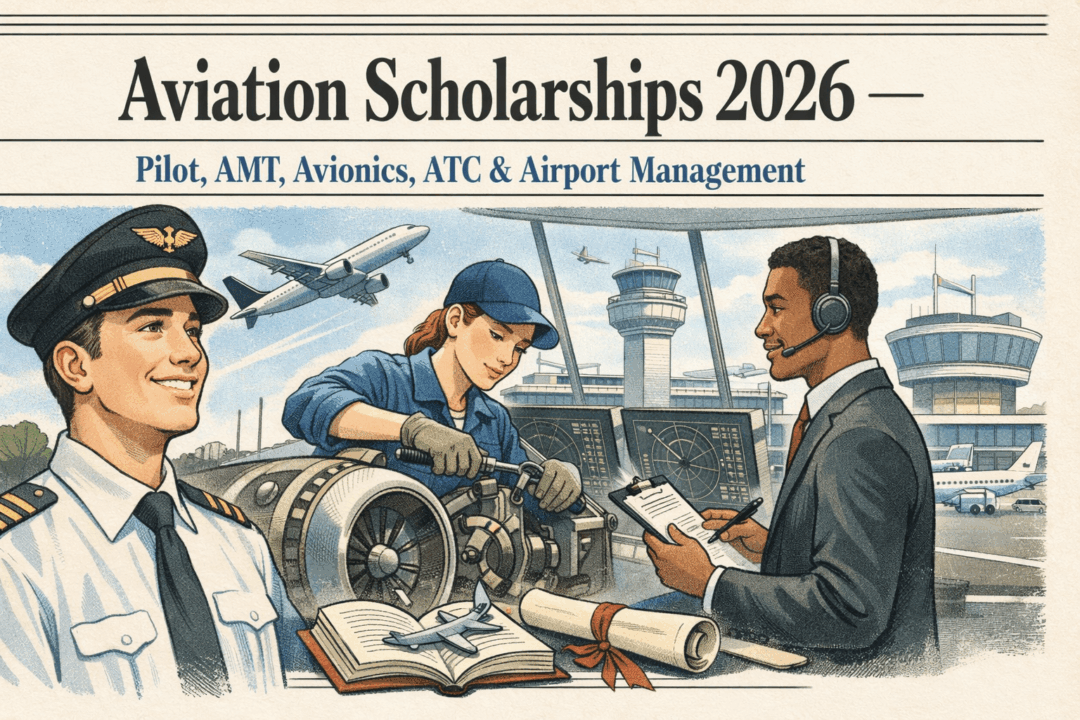
Aviation Scholarships 2026 — Pilot, AMT, Avionics, ATC & Airport Management
A verified, up-to-date list of 30 legit aviation scholarships for 2026—covering pilots, helicopter, AMT/A&P, avionics, ATC, airport management, business aviation & more. Each entry has award info, real deadline, and a direct apply link.
Aviation Scholarships 2026 (Top 30 — Verified)
January
The Ninety-Nines Amelia Earhart Memorial Scholarships (AEMSF)
💥 Why It Slaps: The gold standard for women pilots advancing ratings and certificates (PPL through ATP, type ratings, technical training, and more). Long-running, respected, and laser-focused on real cockpit and classroom costs—great ROI for serious aviators building time and credentials.
💰 Amount: Varies by category (often several thousand dollars; some cover full training components).
⏰ Deadline: January 1, 2026.
🔗 Apply/info: https://www.ninety-nines.org/scholarships.htm
AIAA Undergraduate Scholarships & Graduate Awards
💥 Why It Slaps: If you’re headed for aerospace/aviation engineering or research, AIAA is the professional home. One application window with many awards—perfect for students targeting design, structures, propulsion, UAS, and flight systems.
💰 Amount: Varies; multiple awards annually.
⏰ Deadline: January 31, 2026 (apps open Oct 15; rec letters due Feb 14).
🔗 Apply/info: https://aiaa.org/get-involved/university-students/undergraduate-scholarships-graduate-awards/
LeRoy W. Homer Jr. Foundation Flight Training Scholarship
💥 Why It Slaps: Honors a United Airlines captain from Flight 93 by funding PPL training for committed college students. Strong mission and a track record of launching real pilot careers.
💰 Amount: Covers significant PPL training costs (award varies).
⏰ Deadline: Expected January 31, 2026 (last cycle closed Jan 31, 2025).
🔗 Apply/info: https://leroywhomerjr.org/scholarships/
AIAA Roger W. Kahn Scholarship (HS Seniors → Aero)
💥 Why It Slaps: $10k for high-achieving high-school seniors stepping into aerospace or related STEM majors—clean criteria, national prestige, and direct relevance for future pilots/engineers.
💰 Amount: Up to $10,000 (multiple awards).
⏰ Deadline: January 7, 2026.
🔗 Apply/info: https://aiaa.org/get-involved/k-12-students/scholarships/
February
Vertical Flight Foundation (VFS) Scholarships (rotorcraft/VTOL)
💥 Why It Slaps: For helicopter/VTOL students (BS–PhD). Highly respected academically and industry-connected—great for those eyeing rotary-wing engineering or rotorcraft ops.
💰 Amount: Varies; multiple awards annually.
⏰ Deadline: February 1, 2026.
🔗 Apply/info: https://vtol.org/education/vertical-flight-foundation-scholarships
AOPA Flight Training Scholarships — Spring Cycle (multiple categories)
💥 Why It Slaps: One portal, many awards—high school students, teachers, and adult members (incl. advanced ratings/A&P). Clear rules, large cohort, and funding that actually moves the needle on flight time.
💰 Amount: Many awards; flagship student/teacher awards are $12,000 each (90+ HS awards; ≈20 teacher awards).
⏰ Deadline: February 11, 2026 (Spring cycle window).
🔗 Apply/info: https://www.aopa.org/training-and-safety/students/aopa-flight-training-scholarships
AIAA + Club for the Future “Resilient Student” Scholarship
💥 Why It Slaps: A single $10,000 award with mentorship—ideal for students who’ve overcome obstacles and want a launchpad into aerospace, avionics, or flight systems.
💰 Amount: $10,000 (1 award + mentorship).
⏰ Deadline: February 16, 2026.
🔗 Apply/info: https://aiaa.org/get-involved/k-12-students/scholarships/club-for-the-future-scholarship/
March
AAAE Foundation Scholarships (Airport Management & Aviation)
💥 Why It Slaps: Airport ops/management track? AAAE is the hub. Multiple scholarships from the industry’s main professional org—excellent for future A.A.E.s, ops supervisors, planners, and terminal pros.
💰 Amount: Varies; multiple awards annually.
⏰ Deadline: Expected March 2026 (last cycle closed March 14, 2025; watch the portal for 2026 dates).
🔗 Apply/info: https://aaae.org/foundation
NATF Richard L. Taylor Flight Training Scholarship (NATA)
💥 Why It Slaps: Straight-to-cockpit dollars specifically for flight training—clean criteria and an aviation-centric sponsor (NATA/NATF).
💰 Amount: Typically $1,500.
⏰ Deadline: March 27, 2026 (typical).
🔗 Apply/info: https://nata.aero/national-air-transportation-foundation/scholarships/richard-l-taylor-flight-training-scholarship/
April
ISTAT Foundation Scholarships (air transport/aviation business)
💥 Why It Slaps: The aircraft trading/finance world funds students directly—perfect for those headed to airline management, leasing, MRO leadership, or aviation finance.
💰 Amount: Varies; multiple awards worldwide.
⏰ Deadline: April 1, 2026 (U.S. cycle typically due April 1).
🔗 Apply/info: https://foundation.istat.org/programs/scholarships
Aircraft Electronics Association (AEA) Educational Foundation (Avionics/AMT)
💥 Why It Slaps: Avionics techs and A&P students get many small-to-mid awards with high odds from an industry-insider foundation—great for tools, test fees, or key ratings.
💰 Amount: Varies; many awards (commonly $1,000+).
⏰ Deadline: April 1, 2026. The Lyons Aviation Foundation
🔗 Apply/info: https://aea.net/educationalfoundation/scholarships/
Captain Jason Dahl Scholarship (College Aviators—Pilot Track)
💥 Why It Slaps: Mission-driven fund honoring Capt. Jason Dahl (UA93) that has launched hundreds of student pilots—strong community, meaningful recognition, and direct PPL support.
💰 Amount: Varies (scholarships awarded annually).
⏰ Deadline: April 15, 2026 (application window typically Jan 15–Apr 15).
🔗 Apply/info: https://www.dahlfund.org/
Lyons Aviation Foundation (Private Pilot)
💥 Why It Slaps: Focused PPL scholarships for rising pilots—clean, grassroots foundation support that helps you cross the solo-to-checkride gap.
💰 Amount: Varies (multiple awards).
⏰ Deadline: April 30, 2026 (apps open Jan 15).
🔗 Apply/info: https://lyonsaviation.org/
Regional Airline Association (RAA) Scholarship
💥 Why It Slaps: Airline-focused funding for students headed to cockpit, maintenance, or airline operations—direct pipeline visibility with regional carriers.
💰 Amount: $4,000 each (three awards annually).
⏰ Deadline: April 30, 2026 (based on recent cycles).
🔗 Apply/info: https://raa.org/scholarship/
May
OBAP (Organization of Black Aerospace Professionals) Scholarships
💥 Why It Slaps: Dozens of cockpit, maintenance, dispatcher, and corporate aviation awards from one trusted hub—plus mentoring and career programs like ACE Academy.
💰 Amount: Varies (many awards each year).
⏰ Deadline: Expected May 2026 (last cycle closed May 21, 2025).
🔗 Apply/info: https://obap.org/outreach-programs/scholarships/
ATCA Scholarship Fund (Air Traffic Control Association)
💥 Why It Slaps: Flagship ATC/aviation awards (Gabriel A. Hartl, Fortier, Buckingham, ATCA/Leidos). Big-ticket scholarships with strong ATC industry ties and alumni network.
💰 Amount: Generally $5,000–$15,000 per award.
⏰ Deadline: Expected late May 2026 (2025 window closed May 30, 2025).
🔗 Apply/info: https://www.atca.org/atca-scholarships
June
AMAC Foundation (Airport Minority Advisory Council) Scholarships
💥 Why It Slaps: Airport/aviation business pathway for underrepresented students—scholarships plus internships, networking, and visibility with airport authorities & contractors.
💰 Amount: Varies; multiple awards each year.
⏰ Deadline: Expected June 30, 2026 (last cycle June 30, 2025).
🔗 Apply/info: https://www.amac-org.com/foundation/scholarships/
July
NBAA Flight Attendants/Flight Technicians Scholarships
💥 Why It Slaps: Business aviation cabin pros can land both monetary and training awards; winners often leverage these into type-specific training and pro advancement.
💰 Amount: Monetary + training awards (varies).
⏰ Deadline: Expected July 2026 (last cycle July 27, 2025).
🔗 Apply/info: https://nbaa.org/professional-development/scholarships/flight-attendantsflight-technicians-scholarship/
August
Women in Corporate Aviation (WCA) — Fall Scholarships
💥 Why It Slaps: Multiple tracks (pilot, MX training, flight attendants, professional development) in one cycle—ideal for bizav careers with real training dollars.
💰 Amount: Varies; multiple awards.
⏰ Deadline: Historically late August (last cycle Aug 22, 2025).
🔗 Apply/info: https://wcascholarships.scholarshipsplatform.com/
GlobalAir.com Calvin L. Carrithers Aviation Scholarship
💥 Why It Slaps: A unique “learn-and-share” scholarship for aviation students who chronicle their journey—great visibility + cash for school.
💰 Amount: Typically $1,000 (multiple awards).
⏰ Deadline: 2026 TBA (traditionally mid-August; watch the page).
🔗 Apply/info: https://www.globalair.com/scholarships/
September
NGPA (National Gay Pilots Association) Scholarships
💥 Why It Slaps: One of the largest single-portal programs for pilots/AMTs/dispatchers—partners include airlines, OEMs, and flight schools—with inclusive community support.
💰 Amount: Varies (many awards, often $2,000–$10,000+).
⏰ Window: September 1–30, 2026 (typical annual window).
🔗 Apply/info: https://www.ngpa.org/scholarships
October
Whirly-Girls International Helicopter Scholarships
💥 Why It Slaps: Helicopter-specific awards for women—transition, advanced ratings, and type-specific training. Strong industry partners and career lift for rotorcraft paths.
💰 Amount: Varies; many training awards.
⏰ Deadline: October 5, 2025 (2026 cycle to be announced; check FAQ page—new deadline noted for 2025).
🔗 Apply/info: https://whirlygirls.org/scholarships/
Women in Aviation International (WAI) Scholarships (hundreds of awards)
💥 Why It Slaps: Massive, diverse portfolio—fixed-wing, rotor, maintenance, dispatch, engineering, bizav, airlines—with many partners. One of the best odds to match your niche.
💰 Amount: Varies widely (numerous awards; some include type ratings & big cash).
⏰ Deadline: October 15, 2025 (for 2026 awards).
🔗 Apply/info: https://www.wai.org/scholarships
November
AOPA Flight Training Scholarships — Fall Cycle
💥 Why It Slaps: Second annual shot at the same high-impact funding—perfect to sync with training milestones before winter/spring.
💰 Amount: Many awards; student/teacher scholarships $12,000 each.
⏰ Deadline: November 1, 2025 (Fall 2025 cycle; watch for 2026 dates).
🔗 Apply/info: https://www.aopa.org/training-and-safety/students/aopa-flight-training-scholarships
NBAA Schedulers & Dispatchers Monetary Scholarship
💥 Why It Slaps: Up to $10,000 for continuing ed/certifications—ideal for dispatchers climbing the ladder in bizav flight departments.
💰 Amount: Up to $10,000.
⏰ Deadline: November 3, 2025 (apps typically open Sept; 2026 cycle expected similar).
🔗 Apply/info: https://nbaa.org/professional-development/scholarships/schedulers-dispatchers-monetary-scholarship/
NBAA Schedulers & Dispatchers Training Scholarship
💥 Why It Slaps: Training packages from top providers—convertible into certs that employers recognize.
💰 Amount: Training awards (value varies).
⏰ Deadline: November 3, 2025.
🔗 Apply/info: https://nbaa.org/professional-development/scholarships/schedulers-dispatchers-training-scholarship/
Vertical Aviation International (VAI) Scholarships (rotorcraft)
💥 Why It Slaps: The helicopter association’s (formerly HAI) consolidated scholarship hub—mechanic & pilot pathways with strong industry brand recognition.
💰 Amount: Varies; multiple awards.
⏰ Deadline: November 14, 2025 (2026 awards).
🔗 Apply/info: https://verticalavi.org/vertical-aviation-career-pathways/vai-scholarships/ (see VAI Foundation/Scholarships)
December
NBAA AMT Maintenance Scholarships
💥 Why It Slaps: Real-world maintenance courses from premier providers—great for adding inspection authorization prep or advanced systems training to your toolkit.
💰 Amount: Training/course awards (value varies).
⏰ Deadline: December 1, 2025.
🔗 Apply/info: https://nbaa.org/professional-development/scholarships/amt-maintenance-scholarships/
EAA Flight Training & Post-Secondary Scholarships
💥 Why It Slaps: EAA funds both initial flight training and aviation/AMT college programs—broad eligibility and a straightforward portal that many students overlook.
💰 Amount: Varies; multiple awards.
⏰ Deadline: December 19, 2025 (apps open Oct 1 each year).
🔗 Apply/info: https://www.eaa.org/eaa/learn-to-fly/scholarships
NATF Pioneers of Flight Scholarship (NATA)
💥 Why It Slaps: A classic general-aviation award for sophomores/juniors in full-time aviation programs—clean requirements and a simple, focused mission.
💰 Amount: $1,000 (multiple awards).
⏰ Deadline: Last Friday in December (e.g., Dec 26, 2025 last cycle).
🔗 Apply/info: https://nata.aero/national-air-transportation-foundation/scholarships/pioneers-of-flight-scholarship/
Financing the Aviation Talent Pipeline: Analysis of U.S. Aviation Scholarships, Credential Economics, and Equity
Abstract
Aviation scholarships are not merely “free money” for flight hours; they are targeted instruments that shape the talent pipeline across piloting, maintenance, dispatch, air traffic, and rapidly expanding drone operations. This paper synthesizes the most current public data on U.S. airmen credentials and workforce signals, and maps scholarship dollars to the cost structure and bottlenecks of aviation training. FAA-linked airmen statistics show a large, diverse credential ecosystem (including hundreds of thousands of certificated pilots and a separate, very large population of remote pilots), but persistent underrepresentation of women in key technical roles and ongoing financing frictions in the early-to-mid training phases. Workforce demand signals remain strong: federal labor statistics and industry forecasts project sustained hiring needs, while government oversight work highlights constraints such as training cost, flight-hour requirements, and flight-school capacity.
A central finding is that scholarships are most impactful when designed as “constraint-busters” rather than symbolic awards: large last-dollar awards for ratings, structured hour-building support, and wraparound services (mentorship, medical/knowledge-test prep, and placement) outperform small, one-off checks in moving recipients across the most failure-prone transitions. The paper proposes an evaluation framework (completion velocity, credential stacking, safety culture proxies, and placement outcomes) and offers evidence-based design and applicant strategies. It also discusses a notable policy development: federal law changes to 529 plans that broaden qualified expenses to certain postsecondary credentialing costs, potentially creating a new complementary financing channel for aviation credentials when program criteria are met.
Keywords: aviation scholarships, pilot pipeline, flight training finance, workforce development, equity, 529 credentialing expenses, remote pilot, A&P
1. Introduction: Scholarships as Workforce Infrastructure
The public narrative around aviation scholarships often centers on a “pilot shortage” and the high sticker price of flight training. But the more precise economic problem is pipeline fragility under credit constraints. Training is front-loaded with cash costs (aircraft rental, instructor time, exams, medical certification, and checkrides), while earnings arrive later—sometimes much later—after multiple credentials and accumulated hours. Government analyses of commercial aviation repeatedly surface the same barriers to expanding pilot supply: the cost of pilot education, the 1,500-hour requirement for airline first officers (with limited structured pathways), and capacity constraints at flight schools, among others.
Scholarships function as micro-infrastructure inside this system. They can (a) reduce the private cost of human-capital formation, (b) reallocate who gets to enter and persist, and (c) change the timing of entry into the labor market. When well-targeted, they also indirectly support regional air service stability and broader aviation connectivity—areas where government stakeholders explicitly cite workforce supply as a limiting factor.
2. Data and Approach
This is a synthesis and policy-analysis paper using:
- FAA-linked airmen credential statistics (via FAA data references and aviation training analyses that summarize the FAA annual credential counts), including pilot and non-pilot certificates and separate remote pilot credentials.
- BLS Occupational Outlook for wage and employment outlook signals in pilot occupations.
- GAO reports on commercial aviation and air service to small communities, including stakeholder-identified barriers to pilot supply.
- Industry outlooks (e.g., Boeing and CAE) for long-horizon demand for pilots and technicians.
- Scholarship ecosystem evidence from major aviation associations and nonprofits (e.g., WAI, OBAP, NGPA, EAA/AOPA-related initiatives as available in public descriptions), used to characterize funding models and scale.
Because comprehensive, centralized scholarship-award microdata (recipient demographics, amounts, completion outcomes) is not publicly standardized, the paper emphasizes measurable proxies and proposes an evaluation framework that scholarship providers and aggregators can adopt.
3. The Credential Landscape: More Than “Pilots”
Aviation is credentialed work. The U.S. system spans:
- Pilots: student → private → instrument → commercial → instructor (CFI/CFII/MEI) → ATP (and often type ratings).
- Non-pilot technical roles: mechanics/repairmen, dispatchers, ground instructors, and others.
- Remote pilots (UAS): a large, separate credential population with distinct training economics and faster entry-to-earnings timelines.
FAA-referenced summaries of the annual credential counts illustrate the scale: hundreds of thousands of certificated pilots (excluding students), a large CFI population, and hundreds of thousands of remote pilot certificates. The central implication for scholarships is that “aviation scholarship” should be treated as a portfolio category across multiple occupations—each with different cost curves, dropout risks, and labor-market payoffs.
Table 1. Pipeline choke points and scholarship leverage (conceptual mapping)
| Stage / Transition | Typical failure risk (why people drop) | High-leverage scholarship design |
|---|---|---|
| Discovery → Student pilot | information + mentorship gaps; upfront costs; medical uncertainty | paid discovery flights; medical consult stipends; structured mentorship |
| Student → Private | inconsistent flying (cash flow); instructor availability; checkride costs | milestone-based flight-hour funding + checkride “completion bonus” |
| Private → Instrument | high complexity + time; simulator/CFII cost | IFR bundle awards (ground + sim + checkride) |
| Commercial → CFI | financing gap; opportunity cost; need for professionalization | tuition + teaching practicum + placement support |
| CFI → ATP mins / airline entry | time-building cost; low early wages; location constraints | hour-building support tied to service commitments or structured time-building programs |
| Maintenance / A&P pathway | tool costs; exam fees; underexposure | tools + exam + apprenticeship stipends; employer-linked scholarships |
This table reflects a key thesis: awards are most effective when they “pay for the exact thing that blocks completion,” not when they spread thinly across generic expenses.
4. Demand Signals: Pay, Hiring, and Long-Horizon Forecasts
4.1 Labor-market economics
BLS outlook for pilot occupations indicates high earning potential at the top end of the pathway, supporting the view that aviation training is a classic human-capital investment—but one with steep entry costs and risk. This combination (high eventual wages, high upfront costs) is exactly where scholarships and financing tools can meaningfully change who participates.
4.2 Industry forecasts
Long-horizon forecasts consistently emphasize continued global demand for new pilots and maintenance technicians over multi-decade horizons (Boeing) and large aggregate needs for aviation professionals (CAE). While forecasts are not guarantees, they shape airline, OEM, and training-provider behavior—and they help explain why corporate and association scholarship programs have expanded in both number and specialization.
4.3 Regional connectivity as a policy externality
GAO’s analysis of small community air service documents stakeholder concerns that pilot and maintenance workforce supply challenges contribute to service pressures, alongside cost increases and shifting traveler behavior. This matters for scholarships because it reframes them as public-interest tools: scholarships that accelerate pilot progression (especially in regional pipelines) can have downstream impacts on service reliability and local economic connectivity.
5. The Financing Problem: Credit Constraints and “Training Debt Mismatch”
Aviation training differs from typical college finance in three ways:
-
Nonlinear credential stacking: students must pass multiple gates, and each gate has “lumpy” costs (checkrides, written exams, medicals).
-
Time-building economics: accumulating hours can be expensive unless a structured paid pathway exists.
-
Institutional mismatch: many flight training routes do not align neatly with traditional degree-based aid systems.
Industry policy discussions have repeatedly highlighted that conventional student loan limits may not align with aviation training cost structures—especially for professional pilot pathways outside four-year degree programs.
5.1 A new complementary channel: 529 credentialing-expense expansion
Recent federal statutory language expanded what can count as qualified education expenses for 529 accounts by creating “qualified postsecondary credentialing expenses”—including tuition, fees, required supplies/equipment, and required testing/continuing education for recognized credential programs. The definition of recognized credentials includes occupational or professional licenses issued or recognized by a State or the Federal Government.
Implication (carefully stated): FAA certificates and ratings are federal credentials; in practice, whether 529 distributions qualify can depend on how a training program meets the statute’s “recognized program” criteria and on state-level conformity and plan rules. The scholarship ecosystem can adapt by (a) educating families about compliant pathways and (b) designing scholarships to “top off” what 529 and other financing tools can’t cover.
6. Scholarship Ecosystem: Who Funds Aviation, and Why
The U.S. aviation scholarship market is best understood as five overlapping funder classes:
-
Professional associations & affinity organizations (pipeline + representation goals)
-
Example scale signals: WAI reports awarding over $15 million in scholarships historically and advertises substantial annual program offerings (e.g., 50+ scholarships totaling $200k+ in a cycle).
-
OBAP reports multi-million-dollar cumulative scholarship impact, indicating long-running support structures for underrepresented groups in aerospace careers.
-
NGPA and other associations similarly frame scholarships as workforce and inclusion strategies.
-
-
Industry-sponsored programs (airlines, OEMs, corporate aviation)
These often tie awards to specific pipelines (maintenance academies, university pathways, cadet programs), reflecting employers’ desire to reduce onboarding risk. -
Philanthropic foundations (mission-driven, often milestone-based)
Some programs focus on measurable outcomes (first solo, checkride completion), which aligns well with impact evaluation. -
Universities and community colleges (bundled with degrees and institutional aid)
These can reduce financing friction through integrated advising and access to broader student support systems. -
Local/community foundations and airport-area funds (place-based workforce development)
These awards often have higher acceptance odds and can be aligned with regional labor needs.
Key structural point: Many aviation scholarships are not simply cash—they are in-kind training awards, test-fee coverage, memberships, mentorship, conference access, or job placement support. These non-cash elements can be disproportionately valuable because they reduce both cost and information risk.
7. Equity and Representation: The Pipeline Is Not Demographically Neutral
FAA-referenced summaries indicate that women hold roughly ~11% of airmen certificates overall and a higher share among student pilots (mid-teens), but substantially lower shares in certain advanced pilot categories and especially in technical trades such as mechanics. This pattern matters because it suggests two different problems:
-
Entry gap (who starts) is narrowing somewhat in the student stage.
-
Persistence and advancement gaps (who completes higher-cost credentials) remain substantial, especially where costs spike and mentorship networks matter most.
Scholarships can intervene at three leverage points:
-
Early confidence-building (discovery flights, ground school sponsorship, medical consult support).
-
High-cost gates (instrument and commercial checkrides, multi-engine time, A&P tooling/exams).
-
Network access (mentors, internships, and employer visibility), which is often as decisive as cash in converting training into employment.
8. Measuring Impact: From “Dollars Awarded” to “Credentials Produced”
Most programs report dollars awarded, which is a necessary but weak outcome metric. A doctorate-level evaluation stance asks: what did those dollars buy in human-capital terms? The following framework is practical for scholarship providers and scholarship aggregators.
8.1 Core outcome metrics (trackable)
- Completion rate by credential (PPL, IR, CPL, CFI, A&P, dispatcher).
- Time-to-milestone (months from award to checkride pass).
- Stacking efficiency (number of new credentials within 12/24 months).
- Placement outcomes (first aviation job within 6/12 months, retention at 24 months).
- Equity outcomes (demographic parity in persistence, not just awards).
8.2 Design features linked to better outcomes
- Milestone-based disbursement (reduces dropout and ensures funds match progress).
- Checkride protection (funding retakes or remedial training, where allowed).
- Mentor + money pairing (reduces information asymmetry and “hidden curriculum” failures).
- Structured hour-building pathways (the largest “gap” between training and airline eligibility highlighted in policy discussions).
9. Practical Strategy for Applicants (Evidence-Aligned)
Aviation scholarships are competitive because they are high leverage. Applicants can improve odds by matching how scholarship committees actually evaluate risk and return:
- Apply “stage-appropriately.” Scholarships often map to a specific milestone (instrument rating, A&P tools, CFI). Submitting a generic essay without a milestone plan is a common failure mode.
- Quantify your training plan. Include current hours, target hours, monthly flight cadence, and a specific budget gap (e.g., “IR checkride + 10 hours CFII”).
- Signal safety culture. Committees implicitly fund safe pilots/technicians. Structured training habits, documented studying, and instructor endorsements help.
- Exploit local advantages. Airport associations, state aviation groups, and community foundations often have fewer applicants than national awards.
- Stack scholarships with complementary funding. Where allowable, combine scholarships with institutional aid, employer tuition support, GI Bill pathways, and (in some cases) credential-aligned 529 spending—while verifying eligibility rules carefully.
10. Recommendations for Scholarship Designers and Policymakers
10.1 Scholarship design
-
Shift from small general awards to bottleneck awards. Target checkrides, instructor time blocks, and time-building structures—points where GAO-documented constraints emerge.
-
Bundle wraparound services. Mentorship, tutoring, and job placement can be as valuable as cash in converting training into employment.
-
Report outcomes, not only dollars. Publish credential completion and time-to-completion (even anonymized cohorts). This improves trust and attracts sponsor funding.
10.2 Public policy alignment
-
Leverage aviation workforce grants. FAA’s aviation workforce development efforts are explicitly intended to expand and diversify the pipeline; scholarship programs can align with these initiatives by building local partnerships and dual-enrollment pathways.
-
Integrate with credential financing channels. The expansion of 529 qualified expenses to certain credentialing costs creates an opportunity for scholarship administrators to coordinate: scholarships can cover non-qualified costs (or serve as last-dollar) and reduce compliance risk for families.
-
Treat maintenance and dispatch as first-class scholarship targets. Air service reliability depends on more than pilots; workforce constraints are multi-occupational.
Conclusion
Aviation scholarships sit at the intersection of workforce development, human-capital finance, and equity. Current data show a large U.S. credential ecosystem and robust demand signals, but persistent constraints—training cost, hour-building economics, and institutional capacity—limit how quickly supply can respond. Scholarships are most effective when they are engineered to push recipients across the highest-friction transitions (instrument/commercial/CFI, checkrides, and structured hour-building), and when they bundle mentorship and placement supports that convert credentials into careers. Newer financing flexibility—such as expanded 529 credentialing expense eligibility under federal law—may complement scholarships and reshape how families assemble funding packages, provided programs meet statutory criteria and plan rules.
For scholarship aggregators and content platforms, the opportunity is to present aviation scholarships not as a flat list, but as a pipeline map: awards categorized by credential stage, occupation (pilot vs maintenance vs UAS), and bottleneck covered. That structure helps applicants choose strategically, helps donors fund measurable outcomes, and ultimately strengthens aviation’s talent infrastructure.
References (selected)
- Bureau of Labor Statistics. Occupational Outlook Handbook: airline pilots, copilots, and flight engineers.
- Government Accountability Office. Commercial Aviation: Trends in Air Service to Small Communities (GAO-24-106681).
- FAA. U.S. Civil Airmen Statistics (program description and data access).
- Aviation Supplies & Academics (ASA). FAA-based summary of 2024 airmen counts and demographics.
- Boeing. Pilot and Technician Outlook (long-horizon demand forecast).
- CAE. Aviation Talent Forecast (aggregate workforce needs).
- Public Law text (Congress.gov). Expansion of 529 qualified expenses to certain postsecondary credentialing expenses.
- Women in Aviation International scholarship program reporting (cycle-level totals and historical scholarship scale).
FAQs — Aviation Scholarships (2026)
1) Who qualifies as an “aviation” student for these scholarships?
Generally: pilots (fixed-wing & rotor), AMT/A&P students, avionics techs, dispatchers, flight attendants/technicians, ATC, airport management, aviation business/finance, UAS/remote pilots, and aero/aviation engineering. Each program defines eligibility—always scan the fine print.
2) Can I apply if I’m training at a Part 61 flight school (not a college)?
Yes—many private-foundation awards fund Part 61 training and pay the school directly or reimburse with receipts. University-only awards will say so explicitly.
3) Do I need flight time already to be competitive?
Not always. Some scholarships target zero-to-PPL students; others prefer proof of commitment (e.g., discovery flight, written test pass, or a training log with a few hours). Show concrete progress and a plan.
4) Do these funds cover everything (headset, medical, written, DPE)?
Often yes, but it varies. Typical eligible expenses include aircraft rental, instructor time, sim time, books, charts/EFB, knowledge test fees, medical, TSA/fingerprints (if applicable), and DPE checkride fees. Tool allowances are common for AMT/avionics awards.
5) How are awards disbursed—direct to me or to the school?
Expect one of three models: (1) payment to your school/training provider, (2) reimbursement after you upload itemized receipts, or (3) stipend to you with proof-of-enrollment/ongoing progress. Read the disbursement section carefully and keep immaculate records.
6) Can I stack these with Pell Grants, GI Bill®, or employer tuition assistance?
Usually yes—most private scholarships are stackable. If you’re degree-seeking, ask your financial-aid office about a Cost of Attendance (COA) adjustment to avoid displacing grants when flight lab fees or tools raise your real costs.
7) I’m international or on a student visa—am I eligible?
Some programs are U.S.-citizen/permanent-resident only; others allow international students who are studying at U.S./Canadian institutions or training providers. Check the citizenship/visa line on each application.
8) What makes a strong aviation scholarship essay?
Specificity. Tie your hours, ratings, checkride timeline, and training budget to the award amount. Show safety mindset, human-factors maturity, and how you’ll give back (mentoring, outreach, chapter leadership). Quantify progress and milestones.
9) Do I need membership (WAI, AOPA, NGPA, OBAP, NBAA, VAI, AEA) to apply?
Sometimes. Several programs require low-cost membership and recommend a local/chapter reference. Membership also unlocks mentoring, job boards, and conference discounts—often worth it regardless.
10) I’m a helicopter student. Which awards should I prioritize?
Focus on rotor-specific programs first (e.g., vertical-flight/heli associations and women-in-helicopter groups), then apply to general pilot funds that don’t restrict aircraft category. Highlight distinct rotorcraft goals (mountain, external-load, EMS pathway).
11) I’m pursuing airport ops/management or ATC, not flying. Do I fit here?
Yes. Airport-foundation, airport-minority-advisory, ATC, and airline/airport-management scholarships are part of this roundup. Emphasize ops, safety, planning, environmental/compliance, or NAS systems knowledge in your materials.
12) How should I document progress for “renewable/continued funding” awards?
Keep a digital binder: training log excerpts, endorsements, stage checks, written test results, invoices, sign-offs, and short monthly notes (what you practiced, what’s next). Upload on schedule; small updates build trust.
13) My school’s flight lab fees are huge. Any strategy tips?
Ask the financial-aid office about professional judgment for COA increases tied to required flight labs. Pair that with outside scholarships timed to your most expensive semesters. Use an expense tracker and align applications with upcoming stage checks.
14) Are there scholarships for AMT/avionics tools and certifications?
Yes—industry foundations and avionics associations frequently fund tool sets, test fees, and specialized training (e.g., human factors, FMS, ADS-B, composites). Include an itemized tool list with prices and the certs you’ll complete.
15) What are common reasons applicants get rejected?
Missed deadlines, incomplete uploads, generic essays, fuzzy budgets, and no evidence of progress or safety mindset. Another big one: asking for amounts that don’t match your documented needs.
16) How can I avoid scams or dead links?
Stick to official orgs, associations, and foundations. Avoid sites that gatekeep the application behind “create profile to see more.” Each entry on our list links straight to the official page and is re-verified monthly.
17) What’s the best month-by-month application rhythm?
- Aug–Oct: Big national cycles (bizav, WAI, heli, fall AOPA).
- Nov–Dec: Maintenance/AMT, EAA, some airline/dispatcher programs.
- Jan–Apr: Engineering, PPL/advanced rating funds, airport management, industry foundations.
- May–Jul: ATC, OBAP, internships, cabin crew/tech, scattered corporate cycles.
Set alerts 2–4 weeks early for each target month.
18) I don’t meet the GPA or hour minimums yet—apply anyway?
If you’ll meet them by the award date and the rules allow it, apply. Otherwise, use the current cycle to assemble references, budget docs, and training proof so you can hit submit on day one next cycle.
19) Can I use scholarship money for a type rating or advanced turbine training?
Some programs do fund advanced ratings and type-specific courses. These are competitive—show why the type aligns with your immediate job path and how you’ll cover any gap costs.
20) Any quick checklist before I click submit?
- Tight, quantified budget matched to award amount
- Proof of enrollment/training plan + hours/progress
- Two references who can speak to safety, judgement, and work ethic
- Resume with certificates/rankings/aircraft, tools/certs for AMT/avionics
- A calendar reminder for reporting and thank-you requirements