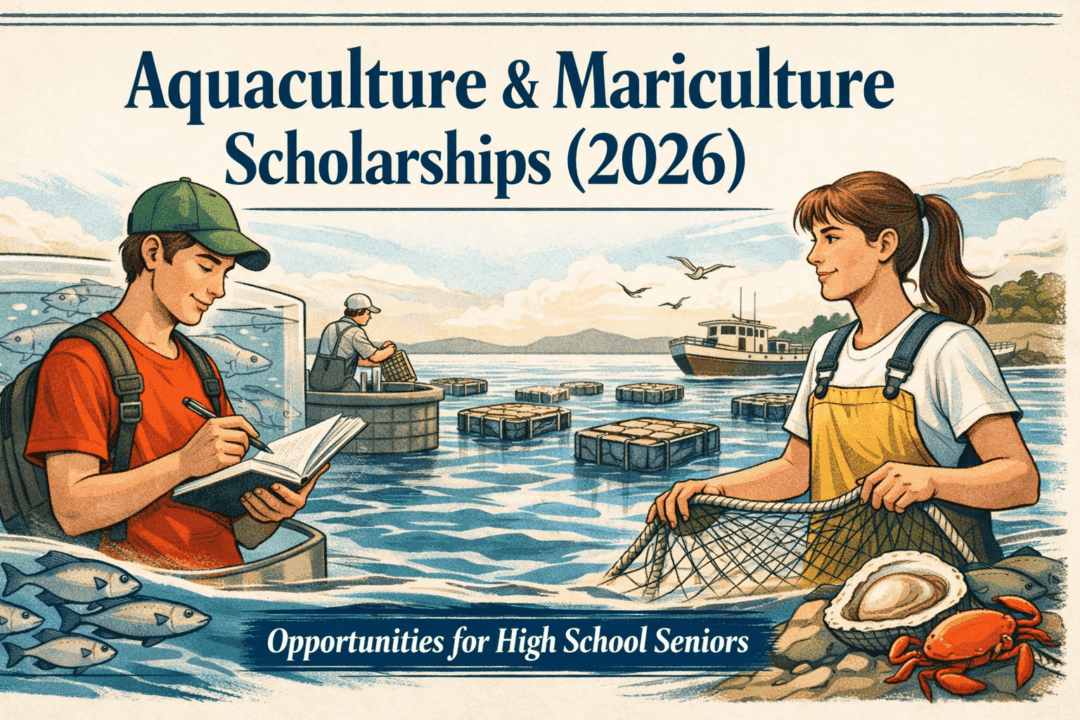
Aquaculture & Mariculture Scholarships (2026) — Verified Deadlines & Links
The most accurate, monthly-updated list of aquaculture & mariculture scholarships, fellowships, and paid internships. 20+ opportunities, sorted by deadline with verified links (today), covering shellfish, finfish, hatchery, seaweed/kelp, fisheries & marine resource programs.
Scholarships, Fellowships & Paid Internships
Garden Club of America — Award in Coastal Wetlands Studies (Grad)
💥 Why It Slaps: $5K for field-based coastal wetlands research—perfect for shellfish habitat, marsh restoration, and coastal aquaculture interfaces.
💰 Amount: $5,000
⏰ Deadline: January 10 (annual)
🔗 Apply/info: https://www.gcamerica.org/scholarships/details/coastal-wetland-award
NOAA Ernest F. Hollings Undergraduate Scholarship (UG)
💥 Why It Slaps: Two years of tuition support plus a paid 10-week NOAA internship—fantastic springboard into marine/aquaculture careers.
💰 Amount: ~$19,500 over 2 years + paid summer internship
⏰ Deadline: Opens annually in winter; dates vary
🔗 Apply/info: https://www.noaa.gov/office-education/hollings-scholarship
Friends of Chatham Waterways – Lewis E. Kimball Jr. Scholarship (Upper-UG/Grad)
💥 Why It Slaps: Flexible support for marine/environmental studies; New England shellfish & coastal research welcome.
💰 Amount: Up to $3,000
⏰ Deadline: March 31 (annual)
🔗 Apply/info: https://chathamwaterways.org/wp/scholarships/
Catfish Farmers of Arkansas Scholarship (UAPB / AR focus)
💥 Why It Slaps: Direct line to the US catfish industry; undergrads aiming at aquaculture careers get industry-backed support.
💰 Amount: Two awards of $1,000 per year
⏰ Deadline: March 1 (annual)
🔗 Apply/info: https://uapb.edu/academics/safhs/department-of-aquaculture-fisheries/scholarships/
UAPB Department of Aquaculture & Fisheries — Trinity Scholarships (UG)
💥 Why It Slaps: Department-exclusive funds for fisheries/aquaculture majors—stackable with other aid.
💰 Amount: $1,000 (five awards/year)
⏰ Deadline: Varies by cycle
🔗 Apply/info: https://uapb.edu/academics/safhs/department-of-aquaculture-fisheries/scholarships/
National Shellfisheries Association — Student Research Grants (Grad/UG)
💥 Why It Slaps: Mini-grants to fuel shellfish aquaculture research (oysters, clams, mussels, etc.).
💰 Amount: $1,250 each
⏰ Deadline: November 1 (annual)
🔗 Apply/info: https://www.shellfish.org/student-research-grants
NSA — George R. Abbe Student Research Grant (Grad)
💥 Why It Slaps: Non-travel research support squarely in crustaceans/fisheries management—great for hatchery & stock work.
💰 Amount: $1,250
⏰ Deadline: November 1 (annual)
🔗 Apply/info: https://www.shellfish.org/the-george-r–abbe-student-research-grant
Pacific Coast Section of NSA — Student Awards/Travel (UG/Grad)
💥 Why It Slaps: Travel support + presentation awards at the annual PCSGA–NSA Pacific meeting—network with growers & scientists.
💰 Amount: Varies
⏰ Deadline: Aligns with conference abstract windows
🔗 Apply/info: https://www.shellfish.org/pcs-student-awards
Florida Aquaculture Association — Dan F. Leonard Scholarship (UG/Grad)
💥 Why It Slaps: Twice-yearly scholarships specifically for Florida aquaculture students.
💰 Amount: Varies
⏰ Deadline: July 1 & October 1
🔗 Apply/info: https://www.flaa.org/education-news
Texas Aquaculture Association — Undergraduate Scholarship
💥 Why It Slaps: State industry network backing—great for Texas hatchery/pond/recirculating systems students.
💰 Amount: Varies
⏰ Deadline: Posted per semester cycle
🔗 Apply/info: https://texasaquaculture.org/scholarships/
Kurt Grinnell Aquaculture Scholarship Foundation (Indigenous students)
💥 Why It Slaps: Dedicated support for Native/Indigenous students in aquaculture & related fields.
💰 Amount: Varies
⏰ Deadline: Annual cycle
🔗 Apply/info: https://kurtgrinnellscholarship.org
Oregon Sea Grant — Robert E. Malouf Marine Studies Scholarship (Grad)
💥 Why It Slaps: Up to $12K for Oregon-based coastal/marine research (shellfish aquaculture, kelp, hatcheries welcome).
💰 Amount: Up to $12,000
⏰ Deadline: Spring
🔗 Apply/info: https://seagrant.oregonstate.edu/fellowships/malouf-marine-studies-scholarship
Oregon Sea Grant — Summer Scholars (UG; Paid Internship)
💥 Why It Slaps: 10-week, full-time, paid placement—hands-on coastal/aquaculture experience in Oregon.
💰 Amount: Paid internship
⏰ Deadline: January–February
🔗 Apply/info: https://seagrant.oregonstate.edu/summer-scholars
Maine Sea Grant — Undergraduate Scholarship in Marine Sciences (UG)
💥 Why It Slaps: Matched scholarship with participating Maine institutions—excellent for shellfish/seaweed mariculture tracks.
💰 Amount: $1,000 total ($500 + $500 match)
⏰ Deadline: Institution-managed
🔗 Apply/info: https://seagrant.umaine.edu/funding-opportunity/undergraduate-scholarship/
Maine Maritime Academy — Mariculture Certificate Scholarship (UG Cert.)
💥 Why It Slaps: Stackable scholarship while earning an aquaculture/mariculture credential.
💰 Amount: Up to $1,000/semester
⏰ Deadline: Rolling
🔗 Apply/info: https://mainemaritime.edu/cpmd/mariculture/
NMFS–Sea Grant Joint Graduate Fellowship
💥 Why It Slaps: Flagship NOAA–Sea Grant research support—frequently used for aquaculture-related modeling & economics.
💰 Amount: ~ $66,700/year package
⏰ Deadline: Winter (Nov–Jan)
🔗 Apply/info: https://seagrant.noaa.gov/opportunities
Sea Grant — Knauss Marine Policy Fellowship (Post-Grad)
💥 Why It Slaps: One-year, DC-based policy fellowship influencing national ocean/coastal decisions; aquaculture policy fits well.
💰 Amount: ~$73,100 stipend + benefits
⏰ Deadline: February (annual)
🔗 Apply/info: https://seagrant.noaa.gov/communities/students/graduate-fellows/knauss-fellowship-program/
NOAA Coastal Management & Digital Coast Fellowships (Post-Grad)
💥 Why It Slaps: Two-year placement with competitive salary + benefits; strong fit for aquaculture-coastal planning interfaces.
💰 Amount: Salary + $8,400 for PD/travel
⏰ Deadline: January (annual)
🔗 Apply/info: https://coast.noaa.gov/fellowship/coastalmanagement.html
Florida Sea Grant — Guy Harvey Fellowship (Grad)
💥 Why It Slaps: $5K for research supporting sustainable marine fisheries—great for aquaculture-fisheries intersections.
💰 Amount: $5,000
⏰ Deadline: Summer
🔗 Apply/info: https://www.flseagrant.org/student-opportunities/
Florida Sea Grant — H.A.R.V.E.S.T. Aquaculture Internships (UG; Paid)
💥 Why It Slaps: Paid industry placements with Florida aquaculture businesses—real farm skills, real pay.
💰 Amount: Paid
⏰ Deadline: Pending next cohort
🔗 Apply/info: https://www.flseagrant.org/student-opportunities/
University of Rhode Island — Alexander D. Daunis Memorial (UG)
💥 Why It Slaps: URI-specific aid for aquaculture/fisheries majors.
💰 Amount: Varies
⏰ Deadline: June 30
🔗 Apply/info: https://uri.academicworks.com/opportunities/16042
URI — Lloyd Robert Crandall Memorial (UG)
💥 Why It Slaps: Endowment explicitly for Aquaculture & Fishery Tech students.
💰 Amount: Varies
⏰ Deadline: Posted annually
🔗 Apply/info: https://web.uri.edu/favs/scholarships/
UW — School of Aquatic & Fishery Sciences Scholarships (UG)
💥 Why It Slaps: $1K–$6K typical awards; includes travel and double-major options.
💰 Amount: $1,000–$6,000
⏰ Deadline: April 10
🔗 Apply/info: https://fish.uw.edu/students/undergraduate-program/scholarships-funding/
OSU — Hatfield Marine Science Center Scholarships (UG/Grad)
💥 Why It Slaps: Nearly $100K awarded annually; supports projects including shellfish aquaculture at HMSC.
💰 Amount: Varies
⏰ Deadline: Posted annually
🔗 Apply/info: https://hmsc.oregonstate.edu/students/scholarships
OSU — COMES Founders Scholarship (UG Juniors/Seniors)
💥 Why It Slaps: $4K scholarships supporting Hatfield/Seafood Lab internships—great for applied aquaculture.
💰 Amount: $4,000 (two awards/year)
⏰ Deadline: Posted annually
🔗 Apply/info: https://marineresearch.oregonstate.edu/comes/who-we-are/comes-founders-scholarship
Florida Sea Grant — Aylesworth Foundation Scholarship (UG/Grad)
💥 Why It Slaps: Career award that can continue semester-to-semester; strong tie-ins to Florida fisheries/aquaculture.
💰 Amount: ~$2,500/semester
⏰ Deadline: June (annual)
🔗 Apply/info: https://www.flseagrant.org/opportunities/aylesworth-foundation-scholarship/
Rhode Island Saltwater Anglers Foundation — Fisheries & Marine Sciences Scholarship (HS→UG)
💥 Why It Slaps: Entry-level boost for RI students stepping into fisheries/marine tracks.
💰 Amount: $500
⏰ Deadline: Posted annually
🔗 Apply/info: https://risaa.org/scholarships/fisheries-and-marine-sciences-scholarship/
CIGLR — Great Lakes Summer Fellows (UG/Recent Grad; Paid)
💥 Why It Slaps: $10K stipend for Great Lakes research; aquaculture topics sometimes included.
💰 Amount: $10,000 stipend + travel
⏰ Deadline: Winter/early spring
🔗 Apply/info: https://ciglr.seas.umich.edu
Florida Sea Grant — Chuck Skoch Scholarship (HS seniors in FL)
💥 Why It Slaps: On-ramp award that can lead to aquaculture/fisheries pathways.
💰 Amount: $1,000
⏰ Deadline: April
🔗 Apply/info: https://www.flseagrant.org/student-opportunities/
Southern Shrimp Alliance — Scholarship
💥 Why It Slaps: Supports coastal fishing families; relevant for students entering shrimp aquaculture/seafood sectors.
💰 Amount: $1,000
⏰ Deadline: Announced annually
🔗 Apply/info: https://shrimpalliance.com/category/industry-enhancement/scholarship/
Financing “Blue Food” Talent: A Data-Driven Analysis of Aquaculture & Mariculture Scholarships (U.S. Focus)
Aquaculture (freshwater and marine) and mariculture (ocean/coastal farming of finfish, shellfish, and seaweeds) have moved from “niche seafood” to a core pillar of global food security and coastal economic development. Globally, fisheries and aquaculture production reached 223.2 million tonnes in 2022; aquaculture produced 130.9 million tonnes total and, for the first time, surpassed capture fisheries in aquatic animal production, generating 94.4 million tonnes of farmed aquatic animals (about 51% of total aquatic animal production). In the United States, the 2023 Census of Aquaculture reported $1.9B in aquaculture sales, 3,453 farms, and rapid growth in key categories (e.g., mollusks $575.5M, crustaceans $175.7M). Meanwhile, import dependence remains high: USDA summarizes NOAA statistics showing the U.S. imported >79% of seafood consumed in 2020, and the seafood trade deficit reached $20.3B in 2023—headwinds that shape domestic producer margins and workforce planning.
Scholarships are a central (and under-analyzed) policy lever that translate “blue economy” ambitions into skilled labor supply—technicians, hatchery managers, shellfish farmers, aquatic veterinarians, feed specialists, water-quality analysts, and aquaculture engineers—especially as offshore and nearshore mariculture sit at the intersection of permitting, community engagement, and environmental performance. Using recent sector and education cost data, this paper maps the current scholarship ecosystem, explains why aquaculture has an unusually strong “cost-to-competency” gap, and proposes evidence-based scholarship designs and evaluation metrics that maximize workforce outcomes, equity, and industry ROI.
1) Why aquaculture scholarships matter now: the scale shift in blue foods
The last decade’s “blue food” story is not just more seafood—it’s a structural shift in how seafood is produced. FAO’s SOFIA 2024 reporting highlights that aquaculture’s output is now large enough to set global supply dynamics, and that future expansion must prioritize sustainability and equitable benefits. In parallel, U.S. policy conversation has increasingly treated domestic aquaculture and mariculture as (1) a food-security hedge, (2) a working-waterfront jobs strategy, and (3) a research-and-innovation domain (RAS systems, genetics, vaccines, feeds, disease management, and remote monitoring).
But production capacity is only one constraint. The other is human capital: aquaculture is hands-on, regulated, and technically complex. It requires a blend of biological science (nutrition, pathology, physiology), engineering (water treatment, sensors, pumps, oxygenation), business (costing, logistics, compliance), and place-based skills (gear, tides, farm operations, and community permitting processes). When the talent pipeline breaks, farms fail not because demand disappears, but because operations cannot stabilize mortality risk, water quality, biosecurity, and financing under tight margins.
Scholarships therefore function as workforce infrastructure: they reduce entry barriers, fund experiential learning, and create predictable pathways into an industry that often competes with better-known STEM tracks (biotech, software, engineering) for the same students.
2) The U.S. aquaculture economy: what the data say about “return on talent”
Two recent datasets help quantify why scholarships can have outsized impact in aquaculture:
2.1 Industry scale and composition
The USDA National Agricultural Statistics Service (NASS) reports $1.9B in total aquaculture sales (2023), with 3,453 farms; five states—Mississippi, Washington, Louisiana, Florida, Alabama—accounted for 55% of sales and 49% of farms. The same release identifies strong sales concentration in food fish ($819.6M) and mollusks ($575.5M), with catfish ($480.0M) and oysters ($327.0M) leading their categories.
This composition matters for scholarships because the “skills stack” differs by subsector:
-
Catfish/foodfish: feed conversion, health management, pond/RAS operations, processing linkages.
-
Shellfish mariculture: hatchery genetics, larval rearing, site selection, water quality, food safety, and coastal permitting.
-
Seaweed/macroalgae (emerging): farming systems, harvesting logistics, product development, and ecosystem co-benefits.
2.2 Economic contribution and jobs multiplier
A NOAA-Sea Grant–funded national analysis estimates U.S. aquaculture farms contribute ~$4B annually and support >22,000 jobs per year at the farm level (including indirect and induced effects), with ~$1B labor income and ~$3B value-added contribution. The authors emphasize that downstream impacts (processing, distribution, food service, retail) likely make total economic impact 3–4x larger than farm-level impacts alone.
Implication for scholarship ROI: if workforce bottlenecks prevent farms from scaling, the economic loss is not just farm payroll—it includes supplier spending and community demand effects (especially in rural/coastal regions). In that sense, scholarships that unlock stable operations can have multiplicative regional effects.
3) Import dependence and the “competitiveness premium” on skills
U.S. aquaculture competes in a market shaped by imports. USDA’s Amber Waves analysis (drawing on NOAA statistics) notes the U.S. imported >79% of seafood consumed in 2020, and that the seafood trade deficit expanded to $20.3B in 2023. High import share can compress domestic prices and reduce cash available for training—meaning scholarship-funded training is often the difference between “a farm can hire and upskill” versus “a farm stays short-staffed.”
NOAA also frames U.S. imports as 70–85% of seafood and notes that more than half of imported seafood is estimated to be aquaculture-produced abroad. Regardless of the exact year-to-year figure, the strategic point is consistent: domestic aquaculture growth is partly a substitution story, and substitution requires operational excellence (biosecurity, product quality, cost control). Human capital is a core input to that excellence.
4) Education costs: why aquaculture has a bigger “last-mile” funding gap than many majors
Scholarships matter in every field, but aquaculture has a distinctive financing problem: competency is experience-heavy. Students must do labs, field seasons, internships on working farms, hatchery rotations, conference networking, and often relocate to coastal/rural sites.
Meanwhile, baseline college costs remain high. College Board reports average published tuition and fees in 2025–26 of $11,950 (public four-year in-state), $31,880 (public four-year out-of-state), and $45,000 (private nonprofit). Even when net prices are lower due to aid, aquaculture students frequently face additional costs that general aid does not cover well: boots and gear, sampling equipment, certification fees (boating safety, HACCP/food safety), travel to farms, and time costs of seasonal work.
Scholarship design takeaway: aquaculture scholarships are most effective when they pay for the last-mile competency build—internships, travel, research mini-grants, and professional placement—rather than only reducing tuition.
5) The scholarship ecosystem in aquaculture & mariculture: a functional typology
Aquaculture scholarships in the U.S. cluster into five functional categories. The best systems combine multiple categories into a coherent pathway.
5.1 Mission-driven federal scholarships and fellowships (high leverage, competitive)
These are not always “aquaculture-only,” but they are aquaculture-relevant because they fund marine/coastal science, policy, and applied research:
-
NOAA Hollings Undergraduate Scholarship: provides academic assistance of up to $9,500 per year (plus a paid NOAA internship and other supports).
-
NOAA Sea Grant Knauss Marine Policy Fellowship: provides substantial one-year support; for example, Virginia Sea Grant describes $95,600 federal funding including a $73,100 stipend plus travel and expense allowances.
-
NMFS–Sea Grant Joint Fellowship (PhD-focused, quantitative fisheries/ecosystems and marine resource economics): supports up to three years (stipend/tuition/fees/travel described in program materials).
-
USDA NIFA education and scholarship programs (agriculture/natural resources pipeline support): these programs can indirectly support aquaculture students, especially those in food/ag systems tracks.
What these programs do well: they link dollars to professional identity formation (internships, policy placement, research training). For aquaculture, that linkage is critical: students must see a credible career ladder to stay in the field.
5.2 Sea Grant and extension workforce pathways (training + placement logic)
Sea Grant’s model treats workforce development as applied education. Examples include paid internships, shellfish farming courses, and youth apprenticeships. These may not always be branded as “scholarships,” but functionally they reduce the cost of entry and accelerate employability—often more directly than tuition discounts.
5.3 Professional-society micro-grants and research awards (small dollars, high signal)
These are disproportionately important in aquaculture because small sums can unlock fieldwork, assays, travel to present results, or participation in industry conferences where hiring happens.
-
National Shellfisheries Association (NSA): offers student research grants (e.g., $1,250 grants) and related student supports.
-
World Aquaculture Society: conference-linked awards and travel support; recent reporting describes student travel awards (e.g., $400), presentation prizes, and women-in-aquaculture travel awards in a conference awards program.
-
U.S. Aquaculture Society (USAS): supports student awards across multiple categories (travel/presentation awards).
Why micro-grants work: they fund observable outputs (poster, talk, data, prototype), which improves hiring prospects and graduate admissions—creating compounding returns.
5.4 Place-based industry/community scholarships (coastal clusters)
In many states, shellfish and mariculture are organized around working waterfronts and regional producer associations. These scholarships typically target: (a) local retention, (b) farm succession, and (c) region-specific permitting/operations skills. Even when dollar amounts are modest, the placement network can be the main value.
5.5 Hybrid “earn-and-learn” models (the future-leaning design)
Apprenticeships, micro-credentials (RAS training, shellfish farming courses), and employer-sponsored tuition assistance can be paired with scholarships so that students (1) learn, (2) earn, and (3) convert into full-time roles. Training programs and targeted courses—like RAS short courses—illustrate the industry’s movement toward modular credentials.
6) Mariculture is a permitting-and-community discipline: scholarships must fund “regulatory literacy”
A unique feature of mariculture (vs many land-based aquaculture forms) is that scaling is limited by public process: marine spatial planning, NEPA reviews, navigation conflicts, habitat considerations, and community acceptance. NOAA’s Aquaculture Opportunity Areas (AOAs) program frames AOAs as defined geographic areas evaluated for suitability via scientific analysis and public engagement—explicitly incorporating environmental, social, and economic appropriateness.
Scholarship implication: the “best” mariculture graduates are not only good biologists; they can translate between growers, regulators, and communities. Scholarships that fund policy fellowships, stakeholder engagement training, and applied regulatory projects (capstones) directly increase mariculture’s probability of successful expansion.
7) Equity and workforce development: what we know, and what we still don’t
Aquaculture workforce data are fragmented. A 2024 synthesis on U.S. aquaculture workforce development describes persistent data gaps—including limited demographic data—and notes that employers prioritize recruiting people with the right mix of technical and business skills and an understanding of aquaculture’s physical demands and risks.
From a scholarship design perspective, this yields two evidence-based priorities:
-
Reduce “hidden costs” that exclude students without family wealth. In aquaculture, hidden costs (transport to farms, unpaid summer periods, gear, relocation) are often the real barrier—more than tuition.
-
Build structured pathways into paid roles. Scholarships should be paired with paid placements, not just merit recognition.
There is also policy volatility risk. For example, Reuters reported that USDA’s 1890 Scholars Program (supporting students at HBCU land-grant institutions) was shown as “suspended pending further review” in early 2025. While not aquaculture-specific, it underscores why diversified scholarship portfolios matter: overreliance on any single program can destabilize pipelines for underrepresented students.
8) A scholarship ROI framework tailored to aquaculture and mariculture
A doctorate-level approach to scholarships asks not only “how many students funded?” but “what outcomes, relative to costs, and compared to counterfactuals?”
8.1 Outcomes that matter (and are measurable)
Student outcomes
-
Completion (credential attainment)
-
Competency milestones (internship completion, certifications)
-
Placement (job/grad school) and 12–36 month retention
-
Earnings trajectory (by role, region, subsector)
Industry outcomes
-
Reduced vacancy duration for critical roles (hatchery techs, health managers)
-
Lower mortality events / improved survival (proxy for operational competency)
-
Productivity improvements (e.g., feed efficiency, cycle time, quality compliance)
Public outcomes
-
Growth in domestic production capacity in strategic subsectors (shellfish/seaweed)
-
Community benefits (working waterfront jobs; rural employment)
-
Environmental compliance and monitoring quality
8.2 What “high-leverage” funding looks like in aquaculture
Given average tuition levels and the sector’s job/economic multipliers , aquaculture scholarships typically deliver the greatest marginal returns when they:
-
Pay for experiential learning (paid internships, farm placements, hatchery rotations)
-
Fund research mini-grants with industry-facing deliverables (e.g., disease diagnostics, gear trials)
-
Support conference travel (network-to-hire is unusually strong in this field)
-
Bundle mentorship + placement (reducing dropout and mismatch)
8.3 Evaluation designs that scholarship providers can actually implement
-
Matched comparison groups (scholar recipients vs similar applicants not funded)
-
Difference-in-differences (before/after scholarship introduction at a program)
-
Employer-validated competency rubrics (standardized skill checklists)
-
Longitudinal tracking with lightweight surveys + LinkedIn/industry verification
These approaches are feasible even for small foundations if they standardize intake forms and follow-up intervals.
9) Practical recommendations: building a “pipeline” instead of one-off awards
For scholarship providers (foundations, industry, Sea Grant, associations)
-
Shift from “tuition-only” to “competency-first” budgets. Prioritize internships, travel, equipment, and research supplies.
-
Create stackable awards: micro-grant (freshman/sophomore) → internship stipend (junior) → capstone/research grant (senior) → placement fellowship (postgrad).
-
Require (and fund) mentorship. Pair each recipient with a producer or hatchery manager, not only a faculty mentor.
-
Tie awards to place-based labor demand. Use state aquaculture census patterns (sales concentration, subsector mix) to target training.
-
Measure retention, not just placement. A 12-month job is good; a 36-month career is the real win.
For students (and families) pursuing aquaculture/mariculture
-
Apply to “adjacent” marine/STEM scholarships too (NOAA/Sea Grant pathways often welcome aquaculture-relevant majors).
-
Treat micro-grants as accelerators. Even $400–$1,250 travel/research awards can put you in hiring rooms and build your CV fast.
-
Build a portfolio (data + demonstration): water-quality logs, hatchery SOPs, small experiments, poster presentations.
For policymakers and institutions
-
Fund apprenticeship models (paid, local, repeatable).
-
Support regulatory literacy as a core competency in mariculture programs (AOAs, NEPA, stakeholder engagement).
-
Invest in data systems tracking aquaculture workforce demographics and outcomes (critical to equitable growth).
Conclusion
Aquaculture and mariculture scholarships are not merely “financial aid”—they are strategic workforce instruments in a sector with measurable economic multipliers, high experiential-learning requirements, and a clear national competitiveness context. The latest data show rapid global scaling of aquaculture , growing (though still modest) U.S. farm sales and subsector concentration , and meaningful economic contributions tied to job support and value-added activity. Yet education costs remain high, and aquaculture’s hidden “last-mile” competency expenses can exclude talented students.
The scholarship designs most likely to move the needle are those that (1) fund hands-on training, (2) connect students to employers and mentors, (3) support policy/regulatory fluency for mariculture, and (4) measure outcomes beyond award counts—completion, placement, and multi-year retention. If the U.S. wants sustainable domestic aquaculture growth, scholarships should be treated as part of the sector’s production infrastructure: the human systems that make farms viable, resilient, and scalable.
Selected References (for attribution and further reading)
-
FAO. The State of World Fisheries and Aquaculture 2024 (SOFIA 2024) and FAO newsroom statistical highlights.
-
USDA NASS. USDA Releases the 2023 Census of Aquaculture Results (Dec 16, 2024).
-
Kumar et al. (2024). Economic Contribution of U.S. Aquaculture Farms (NOAA-Sea Grant funded).
-
USDA ERS (Amber Waves). U.S. Seafood Imports Expand as Domestic Aquaculture Industry Repositions Itself (May 22, 2024).
-
College Board. Trends in College Pricing 2025: Highlights (2025–26 published prices).
-
NOAA Fisheries. Aquaculture Opportunity Areas (AOA) overview and FAQ.
-
National Shellfisheries Association. Student Research Grants (e.g., $1,250 awards).
-
World Aquaculture Society conference awards reporting (travel/presentation awards).
-
Meridian Institute. Collaborative Solutions to Meet Workforce Development Needs in U.S. Aquaculture (2024).
If you want, I can add a FAQ section (schema-ready) tailored to “Aquaculture & Mariculture Scholarships” for that page (eligibility, internships, NOAA/Sea Grant pathways, what counts as mariculture, typical award sizes, and how to build a standout application).
FAQs — Aquaculture & Mariculture Scholarships
Q1) What majors count as “aquaculture/mariculture” for these awards?
Programs in aquaculture, mariculture, fisheries/aquatic sciences, marine biology with aquaculture emphasis, shellfish science, seaweed/kelp farming, hatchery technology, and related marine resource economics/policy typically qualify. Always match your degree/track to the sponsor’s wording.
Q2) I’m focused on seaweed/kelp or microalgae—do I still qualify?
Yes. Most aquaculture-friendly sponsors include macroalgae/seaweed and microalgae production, especially if you frame outcomes around sustainable cultivation, processing, or ecosystem services.
Q3) Are Sea Grant and NOAA fellowships relevant if they aren’t “aquaculture-only”?
Absolutely. Many Sea Grant/NOAA programs fund coastal, fisheries, or policy work that directly supports aquaculture (e.g., permitting, siting, carrying capacity, disease, economics). Your proposal should make the aquaculture linkage explicit.
Q4) Do these opportunities allow international students?
Varies. Some federal programs (e.g., certain NOAA scholarships) require U.S. citizenship. University, foundation, or association awards may be open to international students enrolled at U.S. institutions. Check eligibility lines carefully.
Q5) I attend a community college or technical program—am I eligible?
Often yes. Several department/association awards and state/Sea Grant programs support 2-year pathways, certificates, and hatchery tech programs. If a sponsor lists “undergraduate” without limiting to 4-year schools, you’re likely eligible.
Q6) What if my school is inland?
That’s fine if your work clearly supports aquaculture (e.g., RAS systems, genetics, feed trials, water quality). For field elements, propose collaborations or short residencies with coastal labs or hatcheries.
Q7) What strengthens an aquaculture application most?
Clear problem statement tied to industry needs, a tractable methods plan, letters from faculty/industry mentors, realistic budget/timeline, and evidence of hands-on experience (hatchery hours, AAUS/scuba where relevant, small-boat/field safety, HACCP or biosecurity training).
Q8) Can I budget for scuba, boat time, or lab fees?
Sometimes. Many mini-grants allow reasonable research costs (consumables, small equipment, analytical fees, limited travel). Certifications, major equipment, or salaries are often restricted. Mirror the sponsor’s allowable-costs list.
Q9) How far in advance should I ask for recommendation letters?
3–4 weeks minimum. Send your recommenders a polished draft statement, resume/CV, transcript, and the sponsor’s prompts so they can write to the criteria.
Q10) How do I prove “hands-on” aquaculture experience?
Log hours and tasks (spawning, larval rearing, feeding regimes, system maintenance, disease monitoring, plankton culture). Include supervisor names, dates, species, and systems (flow-through, RAS, IMTA, longline, upweller, etc.).
Q11) Are paid internships listed here treated like scholarships?
We include high-value paid internships/fellowships that function like scholarships (stipend, tuition impact, or career pipeline). They’re marked as “Paid Internship” or “Fellowship” and sorted by typical application windows.
Q12) What does “Deadline varies/posted by cycle” mean?
Sponsors update dates annually or per semester. Set reminders to check the official page 6–8 weeks before the prior year’s close and again 2–3 weeks before it.
Q13) Can I re-apply or renew awards?
Many association/university awards are renewable or allow repeat applications if you show progress. Mention deliverables (poster, talk, farm placement, data) and how another term of funding accelerates impact.
Q14) How many applications should I target per cycle?
Aim for 6–10 well-matched applications. Build a mix: 2–3 mini-grants, 2–3 department/university awards, 1–2 state/Sea Grant, and 1–2 national fellowships/internships.
Q15) Any common mistakes that sink applications?
Missing eligibility (citizenship/residency), vague methods, budgets that don’t match tasks, ignoring page limits, and generic letters. Also: linking to aggregator pages rather than the sponsor’s official page when asked for “program URL.”
Q16) How should I frame broader impacts for aquaculture?
Connect outcomes to farmer adoption, animal welfare, disease mitigation, efficiency (FCR), workforce training, permitting clarity, or climate resilience (e.g., ocean warming/tolerance, selective breeding, IMTA).
Q17) What GPA or transcript rules should I expect?
Typical thresholds range around 3.0, but many programs emphasize fit and mentorship over a single metric. Always include unofficial transcripts unless the sponsor demands official ones.
Q18) Can high-school seniors apply?
Some state Sea Grant and local foundation awards support HS→UG transitions into marine/aquaculture majors. Read for “entering freshmen” or “matriculating in marine/aquatic sciences.”
Q19) How do I handle human/animal care or permits?
If your project uses vertebrates or requires collecting/biosecurity permits, note the status (approved/pending), the overseeing office, and your compliance plan. This signals readiness and reduces sponsor risk.
Q20) What’s a solid mini-grant budget for hatchery/lab work?
Line items might include broodstock/seed, feeds, culture media, small gear (nets, tubing), water quality kits, sample processing, limited travel to a partner hatchery, and conference presentation costs if allowed.