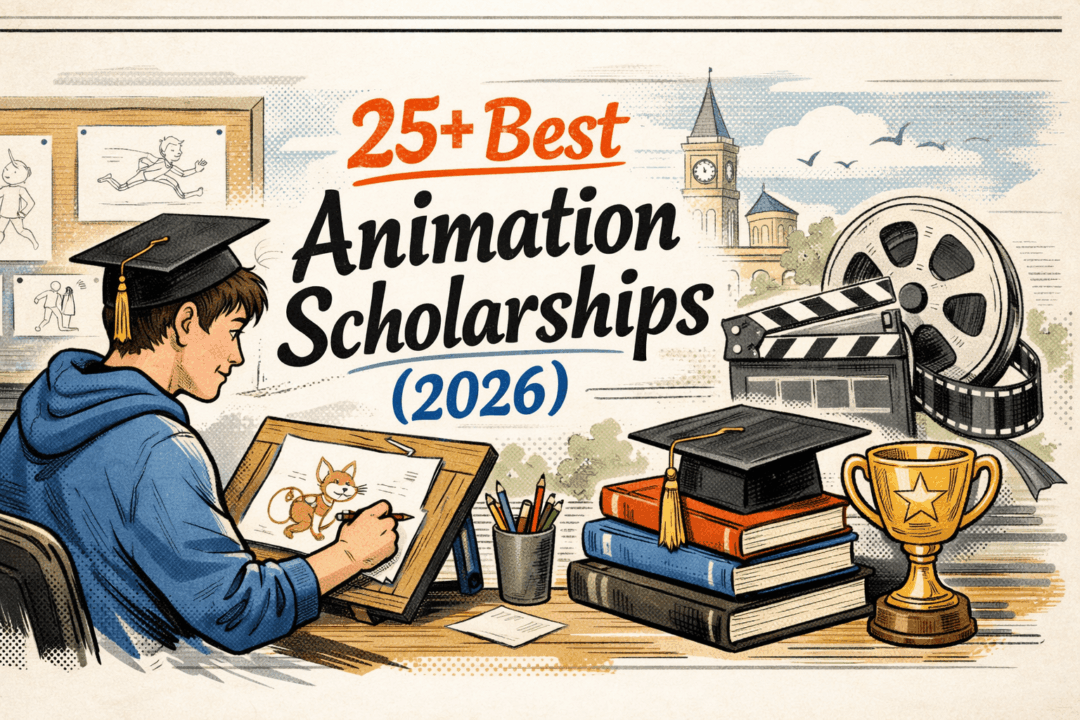
Animation Scholarships — Verified & Sorted by Deadline Month
January
Mister Rogers Memorial Scholarship (Television Academy Foundation)
💥 Why It Slaps: For students focused on children’s media—animation applicants with kid-centric work fit well.
💰 Amount: Varies
⏰ Deadline: TBA (historically winter/spring; monitor page)
🔗 Apply/info: https://www.televisionacademy.com/foundation/programs/mister-rogers/apply
Scholastic Art & Writing Awards — Film & Animation (Grades 7–12)
💥 Why It Slaps: Top U.S. high-school competition; “Film & Animation” category plus portfolio awards.
💰 Amount: Up to $12,500 for Gold Medal Portfolio; other awards vary
⏰ Deadline: Dec–Jan (varies by region; portal opens each September)
🔗 Apply/info: https://artandwriting.org/
February
Society of Illustrators — Student Scholarship Competition
💥 Why It Slaps: Prestigious juried competition (accepts animation entries via student work) with cash awards.
💰 Amount: Varies (multiple cash prizes)
⏰ Deadline: Feb 14, 2025 (new cycle typically posted late fall)
🔗 Apply/info: https://societyillustrators.org/student-scholarship/
Princess Grace Awards — Film (incl. Animation)
💥 Why It Slaps: National honor funding emerging film artists; animation/animated film students may qualify under Film.
💰 Amount: Varies (tuition/project support)
⏰ Deadline: Spring window (announced annually)
🔗 Apply/info: https://pgfusa.org/2025award/
April
ESA Foundation — Computer & Video Game Arts & Sciences Scholarship (animation and game-art eligible)
💥 Why It Slaps: Focus on women and under-represented students creating game art/animation—great for 2D/3D, rigging, VFX for games.
💰 Amount: Varies (scholar numbers and awards announced each cycle)
⏰ Deadline: April 30 (2025 cycle closed; 2026 opens Feb 2026)
🔗 Apply/info: https://www.theesa.com/foundation/scholarships/
May
AIAS Foundation Scholarships — Randy Pausch Memorial (Game Arts/Animation) & WomenIn
💥 Why It Slaps: Tuition aid + D.I.C.E. Summit experience + mentorship—ideal for character/tech animators pivoting to interactive.
💰 Amount: Typically $2,500 tuition + travel/mentorship benefits (see current call)
⏰ Deadline: May 31 (2025 cycle)
🔗 Apply/info: https://www.aiasfoundation.org/news/submissions_now_open_for_2025_aias_foundation_scholarships_.asp
Against The Grain Artistic Scholarship (AAPI students in visual/performing arts)
💥 Why It Slaps: Portfolio-based award—animation majors count under visual arts.
💰 Amount: $1,000
⏰ Deadline: May 31 (annual)
🔗 Apply/info: https://againstthegrainproductions.com/atg-artistic-scholarship/
June
AMIA (Association of Moving Image Archivists) Scholarships
💥 Why It Slaps: For students in moving-image fields; strong pick for animation students interested in preservation/tech.
💰 Amount: Varies (multiple named awards)
⏰ Deadline: June 7, 2025 (opens each March)
🔗 Apply/info: https://amianet.org/about/scholarships/
BAFTA North America (US) Scholarships
💥 Why It Slaps: Prestigious support for film/TV/game students; animation applicants welcome within film/TV tracks.
💰 Amount: Varies (often several thousand USD)
⏰ Deadline: Spring–Summer (varies by year)
🔗 Apply/info: https://www.bafta.org/programmes/us-scholarships/
August
ASIFA-Hollywood — Animation Educators Forum (AEF) Student Scholarship
💥 Why It Slaps: Animation-only, merit-based; funds tuition, gear/software, senior/grad projects + ASIFA membership.
💰 Amount: Up to $5,000
⏰ Deadline: Aug 1, 2025 (new cycle announced annually)
🔗 Apply/info: https://scholarships.animationeducatorsforum.org/
September
CTN Foundation — Andreas Deja Character Animation Scholarship
💥 Why It Slaps: Celebrates classical character animation craft through CTN’s industry network.
💰 Amount: Varies
⏰ Deadline: TBA (last cycle posted late summer/early fall)
🔗 Apply/info: https://ctnfoundation.org/andreas-deja-award
CTN Foundation — Aaron Blaise Scholarship (Digital/Creature/Environment)
💥 Why It Slaps: For animators crossing into creature/FX and digital workflows.
💰 Amount: Varies
⏰ Deadline: TBA
🔗 Apply/info: https://ctnfoundation.org/andreas-deja-award
CTN Foundation — Torsten Schrank Animation Design Scholarship
💥 Why It Slaps: Targets strong design/story sensibilities for animated worlds.
💰 Amount: Varies
⏰ Deadline: TBA
🔗 Apply/info: https://ctnfoundation.org/scholarships/
CTN Foundation — Sam Koji Hale Puppet Film Scholarship (Stop-Motion)
💥 Why It Slaps: Perfect fit for stop-motion and puppet-animation filmmakers.
💰 Amount: Varies
⏰ Deadline: TBA
🔗 Apply/info: https://ctnfoundation.org/scholarships/
CTN Foundation — Michal Makarewicz Animation Scholarship
💥 Why It Slaps: Performance-driven character animation focus.
💰 Amount: Varies
⏰ Deadline: TBA
🔗 Apply/info: https://ctnfoundation.org/scholarships/
CTN Foundation — Glenn Vilppu Scholarship (Drawing/Foundations)
💥 Why It Slaps: Life-drawing fundamentals for stronger animation posing and acting.
💰 Amount: Varies
⏰ Deadline: TBA
🔗 Apply/info: https://ctnfoundation.org/scholarships/
October
YoungArts — Film (Animation) (Grades 10–12, ages 15–18)
💥 Why It Slaps: Nationally recognized teen arts award; alumni network + cash awards; great for portfolio and press.
💰 Amount: Up to $10,000 (National level)
⏰ Deadline: Typically October (annual)
🔗 Apply/info: https://youngarts.org/discipline/film/
NCS Foundation — Jay Kennedy Memorial Scholarship (Cartooning)
💥 Why It Slaps: Cartooning award (single-panel/strips/graphic narrative) — many animation students are strong contenders.
💰 Amount: $5,000 (single winner)
⏰ Deadline: Oct 1 – Dec 31 (annual window)
🔗 Apply/info: https://cartoonistfoundation.org/scholarship/
Walt Disney Company x UNCF — Disney Future Storytellers / Corporate Scholars
💥 Why It Slaps: Scholarship + mentorship + potential paid Disney internship—great pathway into studio pipelines (animation adjacent).
💰 Amount: Varies (often multi-year up to ~$5,000 total; details vary by pathway)
⏰ Deadline: Typically fall (varies by track)
🔗 Apply/info: https://uncf.org/programs/the-walt-disney-company-uncf-scholars-program
November
Women in Animation (WIA) Scholarship Program
💥 Why It Slaps: Cash awards + in-kind packages (software/mentorship) from industry partners; global recognition.
💰 Amount: Varies (cash + in-kind)
⏰ Deadline: Runs annually in U.S. fall (application window announced each year)
🔗 Apply/info: https://wearewia.org/scholarship/
Rolling / Various
SMPTE — Louis F. Wolf Jr. Memorial Scholarship & Student Scholarships
💥 Why It Slaps: For students in motion-imaging (animation/VFX/tech adjacent); reputable engineering-meets-media org.
💰 Amount: Varies
⏰ Deadline: Posted annually (spring/summer)
🔗 Apply/info: https://www.smpte.org/membership/student/louis-f.-wolf-jr.-memorial-scholarship
Bonus: Game/Film Pathways That Welcome Animation Students
Television Academy Foundation — College Television Awards (Animation category)
💥 Why It Slaps: National recognition for student animated series/shorts; strong résumé credit.
💰 Amount: Awards/recognition (not a tuition scholarship)
⏰ Deadline: Annual (categories posted each cycle)
🔗 Info: https://www.televisionacademy.com/foundation/programs/cta/categories
Animayo Talent Scholarships (Global; partner schools)
💥 Why It Slaps: Large pool (€600k+) of partner-school scholarships (tuition awards) across animation/VFX schools; international.
💰 Amount: Varies by partner (tuition awards)
⏰ Deadline: Rolling across partners (often through summer)
🔗 Info: https://www.animayo.com/
Animation Scholarships in the U.S.: Analysis of Labor-Market Alignment, Cost Barriers, and Equity-Oriented Funding Design (2026)
Animation education sits at a high-cost intersection of art training, computing infrastructure, and portfolio-driven credentialing. Yet the U.S. labor market for “special effects artists and animators” is projected to grow slowly (2% from 2024–2034) even as it produces about 5,000 openings per year, mostly from replacement rather than expansion. This creates a financing paradox: students face large upfront costs (tuition, living expenses, hardware/software, and unpaid portfolio time) while expected job growth is modest, making scholarships an especially consequential form of risk-sharing. Using public data and program-level scholarship documentation, this paper examines (1) the scale of the animation talent pipeline, (2) the cost structure of animation training relative to typical scholarship sizes, (3) how major sector scholarships operationalize merit, need, and portfolio evaluation, and (4) design features that best convert scholarship dollars into measurable educational and career outcomes. Key findings include: (a) animation-related degree production is concentrated and relatively small compared with the broader creative-tech ecosystem; (b) “micro-awards” can still be high-impact when they target hardware/software access and mentorship; and (c) the most outcome-aligned scholarship models combine cash with in-kind tools, structured reporting, portfolio milestones, and industry network access.
1. Introduction: Why Animation Scholarships Function Like “Creative Infrastructure”
Unlike many majors where costs are dominated by tuition and textbooks, animation students often face a “stacked” budget: tuition and living costs plus the hardware/software environment required to produce portfolio-grade work. Scholarships in animation therefore act less like symbolic prizes and more like infrastructure funding—subsidizing the conditions needed to create employable work samples (reels, storyboards, rigs, short films, research outputs).
The stakes are heightened by the labor-market profile of the occupation. The U.S. Bureau of Labor Statistics reports a 2024 median pay of $99,800 for special effects artists and animators, with 57,100 jobs in 2024 and 2% projected growth from 2024–2034. While median pay is strong, slow growth implies a highly competitive market where employability depends on portfolio quality, specialization (e.g., 3D character animation, storyboarding, VFX simulation, technical direction), and network access. Scholarships can directly influence those determinants by funding tools, time, and mentorship.
2. Data and Method
This analysis synthesizes five data streams:
- Labor-market data from BLS Occupational Outlook Handbook (OOH) for pay, employment size, and projected openings.
- Education pipeline indicators using NCES Digest tabulations of degrees conferred in “Animation/interactive technology/video graphics/special effects,” including distribution by award level.
- Cost-of-attendance benchmarks from College Board’s Trends in College Pricing 2025 (published prices and full student budgets across sectors).
- Scholarship program microdata from publicly documented animation scholarship programs and reports, including ASIFA-Hollywood’s Animation Educators Forum (AEF) and Women in Animation (WIA).
- Financial risk context from reporting on U.S. student loan balances and delinquency signals.
Limitations: Scholarship ecosystems are fragmented and not centrally reported; most public documentation emphasizes eligibility and award ceilings rather than applicant pools, selection ratios, or long-run outcomes. As a result, the paper focuses on measurable program features and cost-to-award alignment, and proposes outcome metrics scholarship providers can adopt.
3. The Labor Market: Strong Earnings, Slow Growth, and Replacement-Driven Openings
BLS data show a favorable wage signal (median $99,800 in 2024) but limited projected expansion (2% growth, +900 jobs from 2024–2034). Importantly, BLS also notes ~5,000 openings per year on average—primarily replacement openings rather than net new job creation.
This combination matters for scholarship strategy. In a replacement-driven market, job access often depends on (a) portfolio readiness at graduation, (b) geographical and network mobility, and (c) specialization that maps to ongoing demand (episodic animation pipelines, game animation, real-time rendering workflows, or simulation/VFX). Scholarships that fund “portfolio completion” or internship/travel costs can therefore have higher marginal impact than those that simply offset tuition.
4. The Education Pipeline: Degree Output in Animation-Adjacent Fields
NCES reporting on degrees conferred indicates that “Animation/interactive technology/video graphics/special effects” produces thousands—not tens of thousands—of credentials at the bachelor’s level each year. In 2021–22, the field recorded 2,992 bachelor’s degrees and 411 master’s degrees (with additional sub-baccalaureate awards also reported in the same table).
Two implications follow:
- Pipeline concentration: The number of specialized animation degrees is modest relative to the broader creative and computing education system. Many entrants likely come from adjacent majors (computer science, graphic design, film, illustration), meaning animation scholarships often compete with general STEM/arts scholarships for the same talent.
- Credential–portfolio decoupling: Employers frequently treat degrees as a signal of training environment and network access, but rely heavily on portfolio evidence. Scholarship models that require deliverables (reel updates, project milestones) align more directly with hiring mechanisms than GPA-only awards.
5. The Cost Problem: Animation Students Face “Full Budget” Pressures
College Board estimates that in 2025–26, the average published tuition and fees are $11,950 for in-state students at public four-year institutions and $45,000 at private nonprofit four-year institutions. But tuition is only part of the economic reality: College Board also reports average total student budgets (tuition + living + other costs) ranging up to $30,990 for public four-year in-state students and $65,470 for private nonprofit four-year students.
From a financing lens, these full budgets are the correct denominator because portfolio production requires time and living support—not just paid tuition.
Scholarship size vs. budget: a quick calibration
Using the $30,990 public in-state budget benchmark:
- A $2,000 scholarship covers ~6.5% of a typical annual budget.
- A $5,000 scholarship covers ~16.1% of that budget.
Using the $65,470 private nonprofit budget benchmark:
- A $5,000 scholarship covers ~7.6% of an annual budget.
This is why animation scholarships frequently bundle in-kind software/hardware support and mentorship: small cash awards can still be decisive if they remove “production bottlenecks” (render-capable devices, licensed tools, conference travel, or time bought back from excessive paid work hours).
6. The Animation Scholarship Ecosystem: A Typology
Animation scholarships tend to cluster into five functional types:
- Portfolio-judged merit scholarships (reel/stills required, evaluated by industry panels).
- Need-informed access scholarships (explicit focus on under-resourced students; often include membership/mentorship).
- Tool-and-platform scholarships (in-kind software licenses, hardware stipends, cloud credits).
- Project-completion grants (fund a senior film, thesis, research trip, or capstone).
- Network-gated scholarships (union, professional association, or conference travel grants tied to membership participation).
Two U.S.-relevant case studies illustrate how these models operate in practice.
7. Case Study A: ASIFA-Hollywood’s Animation Educators Forum (AEF)
AEF’s scholarship program is explicitly designed to fund education-linked production needs. Awards are up to $5,000 and may be applied to tuition, books/supplies, research (including travel), animation equipment (hardware/software), and senior or graduate projects. This matches the actual cost structure of portfolio-based learning better than tuition-only scholarships.
AEF also demonstrates an outcome-oriented application design:
- Minimum GPA 2.5; applicants must be in animation programs accredited by recognized agencies.
- Application requires a proposal, a budget narrative, and work samples (stills/reel) or an academic abstract depending on track.
- The program includes structured follow-up, such as reporting and evidence of how funds were spent (itemized budgets/receipts).
Scale and selectivity signals
For academic year 2025–26, six students were selected and total scholarships awarded were $26,800 (average ≈ $4,467 per recipient). While applicant counts are not publicly stated in the same notice, the small number of recipients relative to the national animation-student population strongly suggests a competitive, high-signal award—functioning as both funding and résumé credential.
Design insight: AEF’s requirement for a budget and deliverables effectively turns scholarships into micro-grants with accountability, a structure associated (in grantmaking literature) with higher likelihood of funds translating into concrete outputs (in this case: portfolio artifacts and research products).
8. Case Study B: Women in Animation (WIA) Scholarships and the “In-Kind” Model
WIA’s 2024–2025 Annual Impact Report provides unusually specific scholarship accounting. In that year, WIA reports awarding over $100,000 in scholarships and grants, comprising $92,000 in-kind and $18,500 in cash, to 55 recipients. Averaged across recipients, this is roughly $1,818 in total value per person—most of it delivered through tools, services, or sponsored resources rather than cash.
This structure is economically rational for animation training:
- In-kind awards can be tightly matched to production needs (software access, mentorship programs, training subscriptions), limiting “leakage” into unrelated expenses.
- Sponsors can often provide in-kind support at lower internal cost than the market price, increasing the real value delivered per scholarship dollar.
WIA’s publicly described scholarship offerings also illustrate how programs blend cash and targeted support. For example, WIA’s scholarship page shows sponsor-backed awards (including cash and other forms of support) and notes a scholarship cycle reconfiguration with applications planned to reopen in 2026.
Design insight: WIA’s approach treats scholarships as part of a broader workforce-equity pipeline: scholarships + mentorship + community. The report also indicates substantial organizational scale (over 17,000 members, including 3,000 new members in the reported year), which increases the network value of any scholarship tied to WIA programming.
9. Scholarships as Risk Management: The Student Debt Backdrop
Scholarships operate within a broader financing environment where student debt remains a macroeconomic constraint. Reporting on U.S. household finance has noted large outstanding student loan balances and elevated delinquency dynamics following repayment policy changes and the resumption of repayment obligations.
For animation students, debt risk can be amplified by:
- Early-career income volatility (contract work, freelance cycles, geographic clustering of opportunities).
- Portfolio time demands, which reduce hours available for paid work during school.
- Technology depreciation, requiring periodic upgrades that may be financed on credit.
Thus, the most welfare-enhancing scholarship dollars are those that reduce debt reliance and improve the probability of employment-aligned portfolio outcomes.
10. What “Works”: Evidence-Informed Scholarship Design Principles for Animation
Drawing from the documented design features of AEF and WIA (and consistent with broader scholarship effectiveness research), several principles emerge:
10.1 Target binding constraints, not just tuition
Animation training has clear bottlenecks: hardware/software access, production time, and mentorship. AEF explicitly allows awards to fund these bottlenecks (equipment, software, research travel). WIA heavily emphasizes in-kind support, consistent with removing tool barriers at scale.
10.2 Require a budget and a deliverable
AEF’s proposal + budget requirement turns an award into a plan: applicants must articulate what they will build and what it will cost. This is particularly suited to animation, where project scope creep and unclear pipelines can erode outcomes.
10.3 Combine awards with network access
AEF offers recipients a 1-year student membership to ASIFA-Hollywood. WIA’s scale (17,000+ members) suggests that scholarship recipients can also benefit from community effects, mentorship, and visibility. These network multipliers matter in a labor market with slow growth but steady replacement openings.
10.4 Use portfolio-based evaluation to improve signaling
In a field where portfolios dominate hiring, portfolio review can increase alignment between scholarship criteria and job criteria. AEF explicitly considers reels/still art and proposals in selection.
10.5 Measure outcomes that matter
Most animation scholarships could dramatically improve accountability by tracking a short list of outcomes:
- Portfolio completion milestones (reel length, project deliverables).
- Internship/placement rates within 6–12 months.
- Tool access stability (software continuity, device adequacy).
- Career persistence (staying in the field after 1–3 years).
AEF’s required reporting creates an administrative pathway toward these metrics.
11. Implications for Scholarship Applicants (Practical, Data-Linked Strategy)
Given the cost landscape and award structures above, applicants can adopt a strategy that treats scholarships as portfolio accelerators:
- Prioritize scholarships that pay for production bottlenecks (hardware/software, capstones, research travel), because these have direct portfolio ROI. AEF explicitly funds these categories.
- Translate “need” into a credible budget narrative. Programs that request budgets reward specificity: line items, timelines, and deliverables outperform generic essays.
- Apply to awards that bundle community access. In a market with modest growth but consistent openings, networks can increase access to replacement-driven opportunities.
- Treat scholarship applications as portfolio artifacts. Proposals, animatics, breakdowns, and research abstracts can be repurposed for internships, grants, and graduate applications.
12. Conclusion
Animation scholarships in the U.S. are best understood not merely as tuition offsets, but as targeted investments in creative infrastructure—tools, time, mentorship, and networks that convert training into employable portfolios. With BLS projecting slow occupational growth but steady annual openings, scholarships that raise portfolio readiness and professional connectivity are likely to yield the highest returns. Cost benchmarks show that even $5,000 awards cover a limited fraction of total annual student budgets, reinforcing the value of in-kind and bottleneck-targeted funding. Case studies from AEF and WIA demonstrate two effective models: (1) structured project/budget scholarships with accountability and (2) scalable in-kind scholarship ecosystems linked to mentorship and community.
For scholarship providers, the central design recommendation is clear: fund the constraints that determine portfolio quality and job access, then measure outcomes at the portfolio-to-placement level. For applicants, the optimal strategy is equally clear: pursue scholarships that buy back production time, secure tool access, and expand professional networks—because those are the mechanisms most tightly coupled to outcomes in animation careers.
References (Selected)
- U.S. Bureau of Labor Statistics. Occupational Outlook Handbook: Special Effects Artists and Animators.
- National Center for Education Statistics. Digest of Education Statistics, Table 318.30 (degrees conferred by field and award level; includes animation/interactive technology/video graphics/special effects).
- College Board. Trends in College Pricing 2025 (published prices and student budgets).
- ASIFA-Hollywood Animation Educators Forum. Student Scholarship program details (award uses, eligibility, application requirements).
- Animation Scoop. AEF scholarship recipients and total funding for 2025–26 ($26,800; six recipients).
- WIA (Women in Animation). Scholarship page and 2024–2025 Annual Impact Report (scholarship totals; in-kind vs cash; recipients; membership scale).
- Reuters reporting on student loan balances and delinquency dynamics (context for scholarship risk reduction).
FAQs — Animation Scholarships (2025–2026)
Q1) Who’s eligible for “animation” scholarships—does 2D/3D/stop-motion all count?
Yes. Most animation-specific awards accept 2D, 3D, stop-motion, motion design, and sometimes related areas like storyboarding, previs, character/tech animation, rigging, layout, lookdev, lighting, compositing, and game animation. Always check each program’s definition of “eligible disciplines.”
Q2) I’m in high school. Which programs should I target?
Start with teen competitions/awards (e.g., national fine-arts competitions that include “Film & Animation”) and foundation programs aimed at grades 9–12. Build a strong portfolio/reel and a short artist statement; many college-level scholarships require current enrollment, so note which allow “incoming freshmen” or “admitted but not yet enrolled.”
Q3) I’m attending community college or a certificate/online program. Am I eligible?
Many scholarships require degree-seeking status at an accredited institution (AA/AS, BA/BFA/BS, MA/MFA). Some do accept community college, certificate, or online students—others don’t. Read the “Eligibility” section carefully for institution type, accreditation, and enrollment load (full-time vs part-time).
Q4) Do international, DACA, or undocumented students qualify?
It varies. Some U.S. programs are restricted to U.S. citizens/permanent residents; others are open internationally, and some specifically support DACA/undocumented students. Always verify the citizenship/residency requirement and any age/location limits.
Q5) What GPA do I need?
Ranges widely. Common minimums are 2.5–3.0, but portfolio merit can be the primary factor for art programs. If your GPA is borderline, focus on a stellar reel, clear project write-ups, and strong references, and apply where merit weighs heavily.
Q6) What should my animation reel include—and how long should it be?
Prioritize your strongest 60–90 seconds. Lead with your best work, cut anything weak, label shots with your role (e.g., “Character Animation,” “Rigging,” “Compositing”), and credit collaborators. If you’re a specialist (e.g., rigging/tech anim), show breakdowns and shot notes. Keep audio simple.
Q7) Portfolio format: Vimeo, YouTube, or file upload?
Most programs accept Vimeo/YouTube (unlisted) or a single .mp4 link; some require direct uploads. Use clean filenames (Lastname_Firstname_Reel_2025.mp4), a share link that doesn’t require login, and avoid expiring links.
Q8) Can I submit AI-assisted or generator content?
Assume original, self-created work is required unless guidelines explicitly allow AI. If any AI tools were used (e.g., for concept ideation), disclose that and be sure your submission meets originality rules.
Q9) Do letters of recommendation matter? From whom?
Yes—quality over quantity. Aim for 1–2 letters from people who have seen you work (animation faculty, supervising artists, internship managers). Provide your reel, statement, and resume early so they can write specific examples of your process and growth.
Q10) How do deadlines work if a page says “TBA”?
Many programs run on the same seasonal window every year. Track last year’s open/close dates, set alerts 6–8 weeks earlier, and draft your materials now (reel, statement, resume, transcript, LOR requests) so you can submit immediately when the portal opens.
Q11) Can I “stack” multiple scholarships?
Often yes, but your college’s financial-aid office may adjust need-based aid (“scholarship displacement”). Ask them how outside scholarships interact with grants/loans and whether funds can be applied to equipment, software, or approved project costs.
Q12) Are awards renewable?
Some are one-time; others renew annually if you maintain eligibility (GPA, major, full-time status, Satisfactory Academic Progress). Note renewal criteria and any re-application steps.
Q13) Will winning affect my taxes?
Scholarships used for qualified education expenses are often treated differently than funds used for non-qualified costs (e.g., room/board). Keep receipts and consult a tax professional or your financial-aid office for your specific situation.
Q14) What if my best work is collaborative?
Include it—just label your contribution clearly on-screen or in captions (e.g., “Animation only; model/rig by Jane D.”). Many committees value teamwork as long as roles are transparent.
Q15) I’m pivoting from illustration/VFX/game art—am I eligible?
Usually yes, if your work sits within moving-image storytelling, game/real-time animation, or pipeline roles. Tailor your reel to the scholarship’s focus: story/character acting for animation; tools/rigs/breakdowns for technical tracks; cinematic polish for game/film hybrids.
Q16) Do I need to be a WIA/ASIFA/industry member to apply?
Some programs are open to all; others prioritize or require student membership (often low-cost and worth it for opportunities, mentorship, and events). If membership helps, join early so you can reference involvement in your application.
Q17) What common mistakes cost applicants awards?
• Weak opening shots; too long a reel
• Uncredited collaborators / unclear roles
• Broken or private links
• Generic personal statements without specific goals
• Missing transcripts or file-name chaos
• Submitting late (servers jam in final hours)
Q18) What’s a strong artist statement for animation?
1–3 short paragraphs: your story/theme focus, the specific animation craft you’re pursuing (e.g., character performance, creature FX, stop-motion fabrication, rigging), tools you use, a brief project highlight with what you learned, and how this scholarship accelerates a concrete next step (capstone film, festival submissions, internship readiness).
Q19) How should I plan my year around deadlines?
- Aug–Oct: Update reel, pick recommenders, outline statement.
- Nov–Jan: Submit teen competitions and early-cycle college awards.
- Feb–Jun: Peak season for college animation/game/film scholarships.
- Jul–Aug: Last-minute summer awards + prep new-cycle materials.
Keep everything in a tracker with columns for status, link, due date, and requirements.
Q20) Can I apply during a gap term, part-time, or while on co-op/internship?
Maybe. Many programs require current or upcoming full-time enrollment; some accept part-time or co-op if you remain degree-seeking. Verify the enrollment definition and allowed breaks/deferrals.
Q21) May I share my submitted film publicly?
Some scholarships double as festivals/competitions with premiere rules; others don’t mind. If in doubt, keep your film public but unlisted during judging and check any exclusivity requirements.
Q22) What if my school teaches Blender/Toon Boom but the industry uses Maya/Houdini?
Scholarships rarely mandate software—skill fundamentals (timing, spacing, posing, acting, appeal, problem-solving) matter most. If a program requires specific deliverables, they’ll say so; otherwise show your strongest work in the tools you know.